
Quick Answer
The average drain field lasts 15–25 years for most homeowners with a properly maintained conventional system. Some chamber-based systems stretch to 30 years under ideal soil conditions. Others fail in 10. The difference almost always comes down to maintenance habits, soil quality, and how much water you're sending through the system every day.
📊 Key Takeaways:
- Most conventional drain fields last 15–25 years with routine care; chamber systems can reach 20–30 years
- The EPA recommends pumping your septic tank every 3–5 years to protect the drain field from solids overflow
- Exceeding your system's design flow can shorten drain field lifespan by 30–50%
- Early warning signs include slow drains, wet spots over the leach field, and sewage odors in the yard
- Replacement costs typically run $5,000–$20,000+ depending on system type, soil conditions, and local permitting
What Is a Drain Field, and What Causes It to Wear Out?
Your drain field - also called a leach field - is the underground network of perforated pipes and gravel (or chamber units) that receives treated wastewater from your septic tank and slowly releases it into the surrounding soil. If you're new to how the whole system works, our guide on what a drain field is and how it functions covers the full picture.
The primary killer of drain fields is biomat buildup. Biomat is a dense, dark layer of anaerobic bacteria and organic material that forms at the soil-pipe interface. It develops within 2–5 years in any active system - that's normal. Problems start when the biomat layer thickens to the point where it restricts effluent flow below the system's design rate. At that point, wastewater backs up into the pipes, saturates the soil, and the field fails.
⚠️ Warning: Two things accelerate biomat buildup faster than anything else: sending solids into the drain field (from an under-pumped tank) and flooding the field with more water than it was designed to handle.
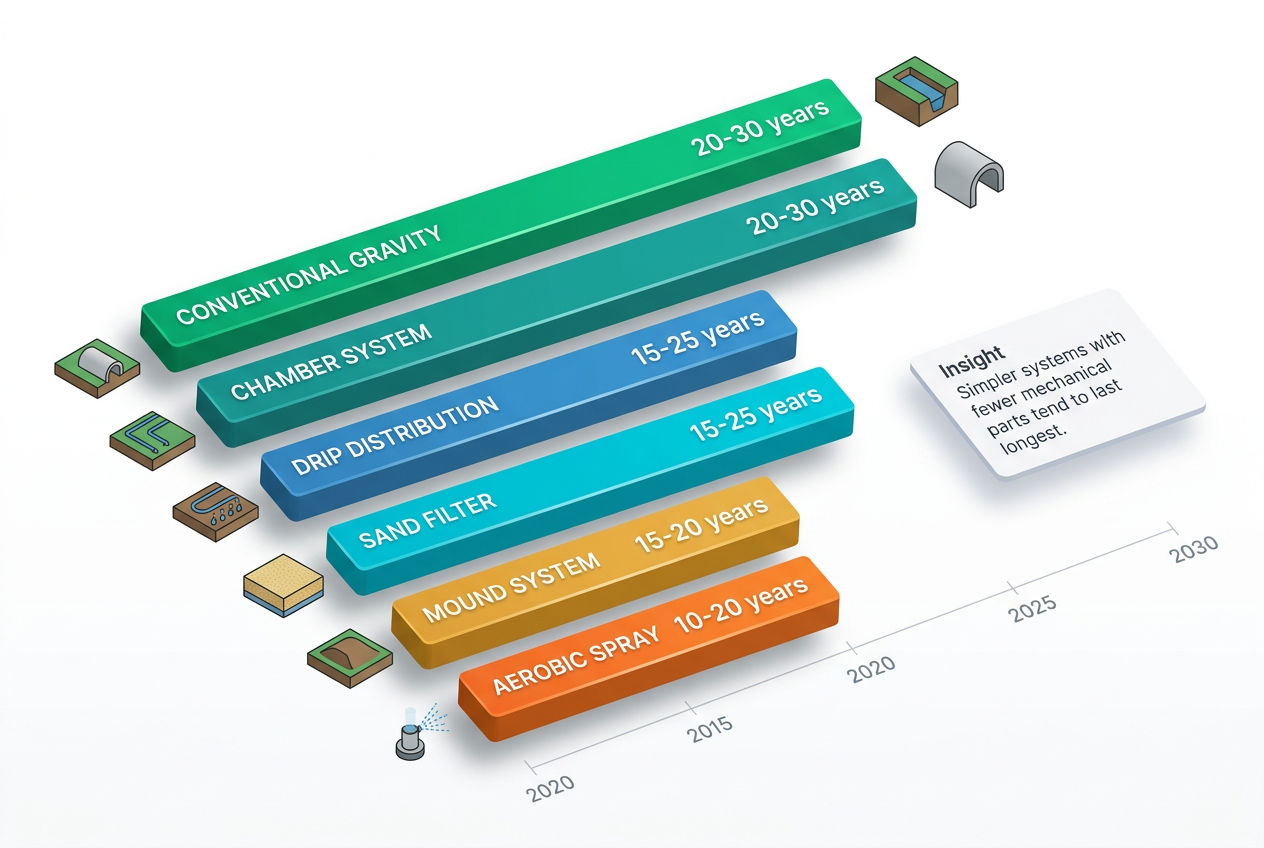
How Long Does a Drain Field Last by System Type?
Drain field lifespan isn't one-size-fits-all. The type of system you have matters significantly.
| System Type | Typical Lifespan | Key Variable |
|---|---|---|
| Conventional gravel trench | 15–25 years | Soil percolation rate |
| Chamber system (Infiltrator) | 20–30 years | Load rate & pumping habits |
| Mound system | 15–25 years | Mound media condition |
| Drip distribution | 15–20 years | Filter & emitter maintenance |
| Sand filter system | 15–25 years | Media replacement schedule |
Source: Manufacturer data (Infiltrator Water Technologies), university extension programs, and state health department design standards.
Chamber systems - like those built with Infiltrator Water Technologies units - often outperform traditional gravel trenches because they offer more storage volume and don't rely on gravel, which can compact over time. A well-maintained Infiltrator chamber field serving a 3-bedroom home has a realistic shot at 25–30 years. A gravel trench system that's been overloaded and under-pumped? You might be shopping for a replacement at year 12.
For a deeper look at system types and how they're sized, see our drain field size guide.
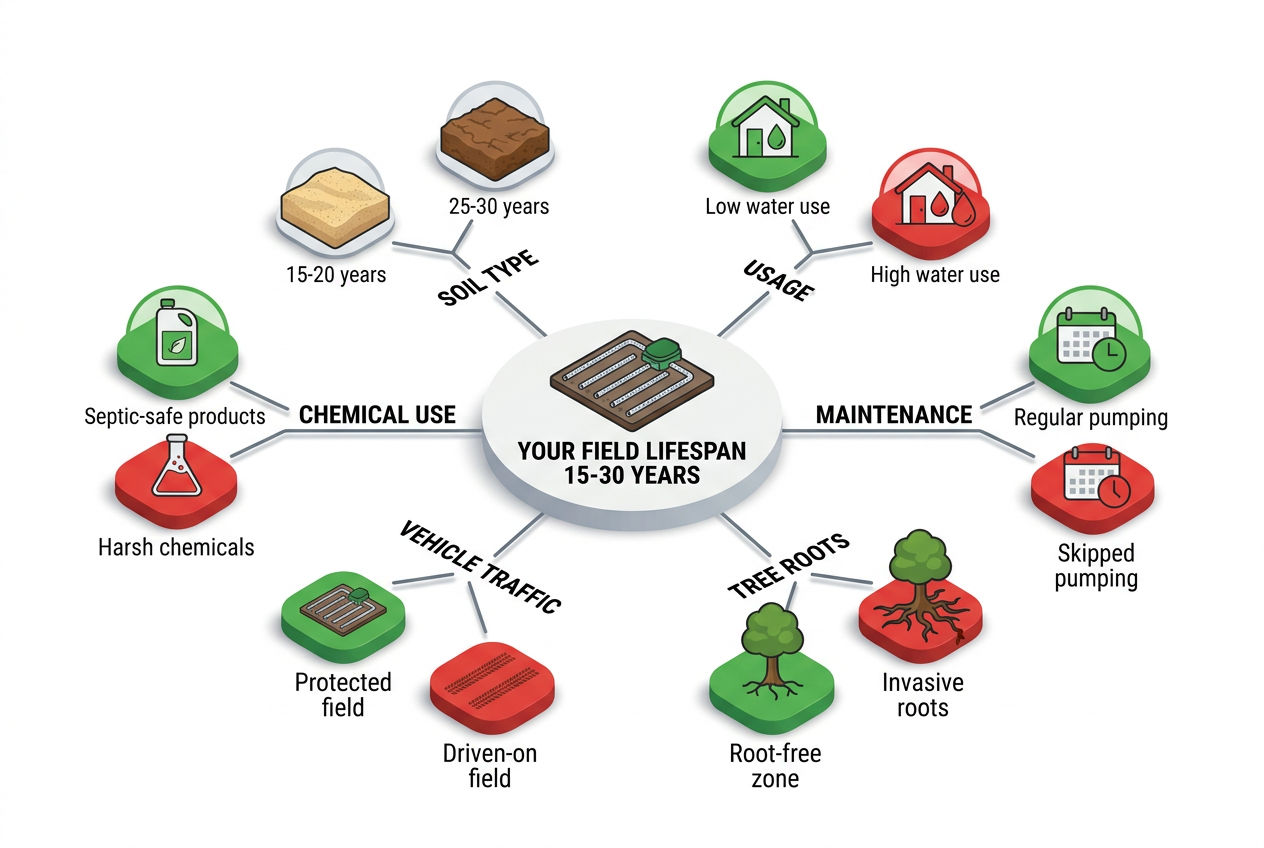
What Factors Affect Drain Field Lifespan?
Soil Percolation Rate
Soil is the engine of your drain field. It has to absorb effluent fast enough to prevent ponding, but not so fast that untreated water races through before the soil can filter it. The sweet spot for standard drain fields is a percolation rate of 1–60 minutes per inch (measured via a perc test during design).
- Sandy soils drain fast - sometimes too fast for adequate treatment
- Dense clay soils drain too slowly and saturate easily, building biomat faster
- Loam soils provide the ideal balance for long-term performance
📊 Regional Reality Check:
- Southeast (FL, GA, SC): High water tables and sandy soils → 10–20 year lifespans without careful design
- Midwest: Well-drained loam soils → 20–25 year field life is common
- Pacific Northwest: Restrictive soils often require mound or drip systems from the start
Pumping Frequency
This one is simple: if your tank isn't pumped often enough, solids escape into the drain field. Once solids reach the leach laterals, they accelerate biomat formation and plug the soil. Damage is often irreversible.
The EPA's SepticSmart program recommends pumping every 3–5 years for most households. That's a guideline, not a guarantee:
- 1,000-gallon tank serving four people → pump every 3–4 years
- Same tank with garbage disposal → pump every 2–3 years
- 1,500-gallon tank with two retired adults → may stretch to 5 years safely
✅ Pro Tip: A licensed pumper can measure your sludge and scum layers with a sludge judge to tell you exactly where you stand. Our septic tank pumping guide goes deeper on how to calculate your actual pumping interval.
Household Water Usage
The average U.S. household sends roughly 300 gallons of water per day through the septic system. Your drain field was designed for a specific daily flow - typically based on bedroom count and local per-bedroom assumptions (often 75–150 gallons per bedroom per day, depending on the state).
Consistently exceed that design flow and you compress the soil's recovery time. University extension research and EPA data both indicate that chronic overloading can reduce drain field lifespan by 30–50%. That's the difference between a 20-year field and a 10-year field.
Common overload culprits:
- Guests staying for extended periods
- New high-efficiency washer replacing an older one
- Teenagers taking 30-minute showers
- Running multiple loads of laundry in one day
Effluent Quality and Tank Maintenance
An effluent filter - like a Polylok PL-122 or Zabel A1800 installed in your tank's outlet baffle - catches suspended solids before they reach the drain field. These filters need cleaning every 1–3 years. It's a 15-minute job that can add years to your field's life. Many homeowners don't know they even have one.
Factors that degrade effluent quality:
- Using your garbage disposal heavily
- Flushing non-biodegradable wipes
- Dumping grease down the drain
- Skipping effluent filter maintenance
Free download
Free: the Septic Fridge Card — what to flush, what never to.
The Do / Don’t card the whole family can see, plus the Survival Kit: emergency flowchart, warning-sign decoder and pump-schedule card. One printable PDF.
What Are the Signs Your Drain Field Is Failing?
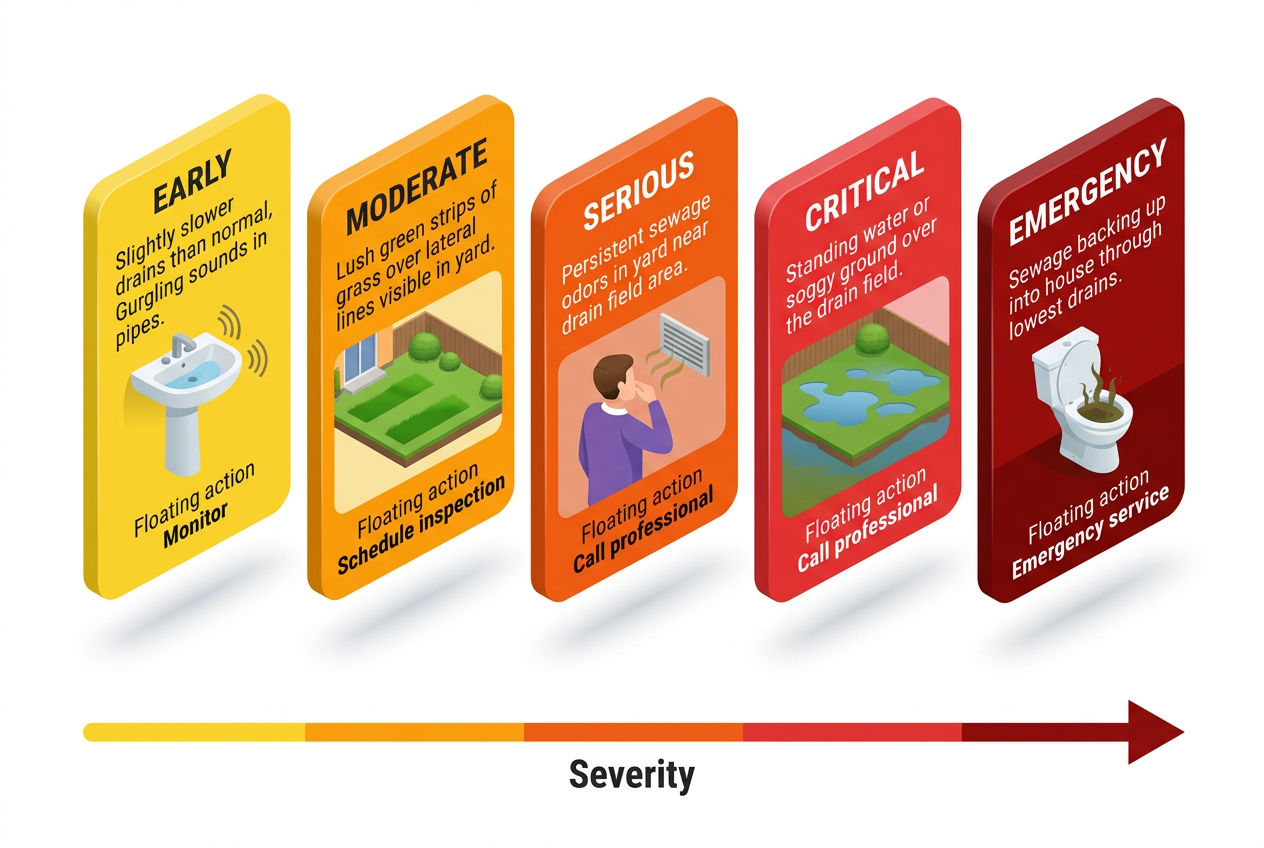
Don't wait until sewage surfaces in your yard. These warning signs usually appear months - sometimes years - before complete failure.
1. Wet, spongy, or unusually green grass over the field. Effluent rising to the surface acts like fertilizer. If one strip of your lawn is greener than the rest and the ground feels soft underfoot, your field is saturated.
2. Slow drains throughout the house. One slow drain is usually a clog. All your drains running slowly at once - sinks, showers, toilets - points to a backup in the septic system itself.
3. Sewage odors indoors or outdoors. A healthy drain field is odorless. If you're smelling rotten eggs or sewage near the leach field area, effluent isn't moving through the soil properly.
4. Sewage backing up into the lowest fixtures. Toilets and floor drains are the first to back up when the tank is full or the field is saturated.
5. Gurgling sounds from drains. Air trapped in the lines by a partial backup often produces gurgling in toilets and sink drains.
If you're seeing any of these, our article on signs your drain field is failing will help you understand what you're dealing with before you call anyone.
Can a Drain Field Be Repaired Instead of Replaced?
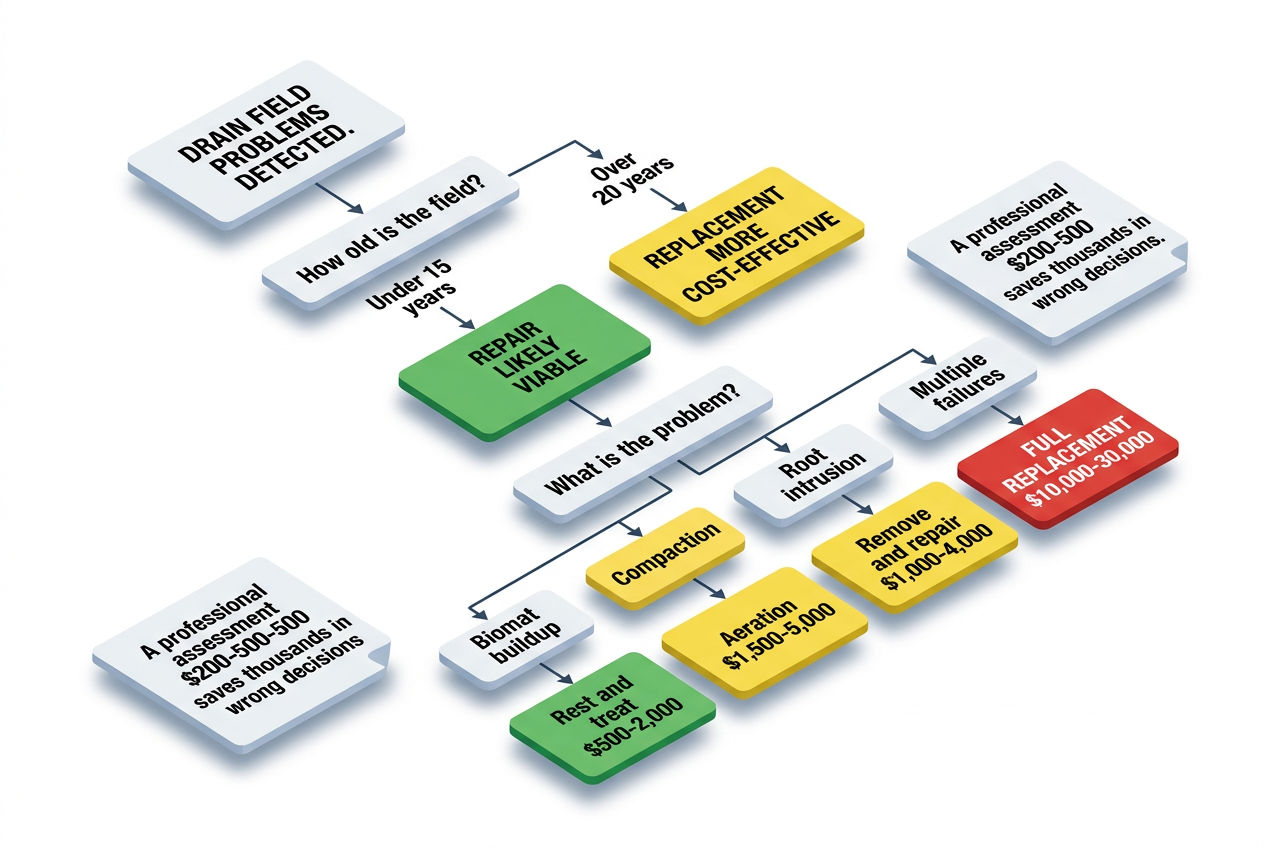
Sometimes, yes. Full replacement isn't always the only option.
Repair Options Worth Considering
Resting the field - diverting flow to a secondary field or reducing water usage significantly - allows biomat to oxidize naturally. Some systems recover partially after 6–12 months of rest. This only works if the biomat hasn't fully sealed the soil and you have an alternative field available.
Drain field restoration treatments using oxygen-based products or terravore bacterial injections show mixed results in peer-reviewed literature. They may help a marginally failing system, but they won't reverse a field that's been flooded with solids for years. No product eliminates the root cause if that root cause is a neglected septic tank.
Hydro-jetting the laterals can clear accumulated solids from the pipes themselves. If the soil is still accepting effluent but the pipes are partially blocked, jetting can restore flow. For saturated field options, see our guide on how to fix a saturated drain field.
⚠️ Hard Truth: When the soil is truly sealed - when a perc test shows it's no longer accepting effluent at any meaningful rate - replacement is your only path forward. Talk to a licensed septic inspector before committing to either direction.
How Much Does It Cost to Replace a Drain Field?
Drain field replacement runs $5,000–$20,000+ nationally, with most homeowners paying $8,000–$12,000 for a standard conventional system on a site with reasonable soil and access.
What Drives the Price Up
| Cost Factor | Impact on Total Cost |
|---|---|
| System type | Conventional gravel ($5,000–$8,000) vs. mound system ($12,000–$20,000) |
| Permit & inspection fees | $500–$1,300 total ($200–$500 inspection + $300–$800 permit) |
| Site conditions | Rocky ground, steep slopes, limited equipment access add 20–40% labor |
| Regional labor rates | Rural Tennessee vs. suburban New Jersey = dramatically different contractor costs |
For a full breakdown, see our drain field replacement cost guide.
💡 Insurance Reality: Does homeowner's insurance cover it? Usually not. Standard policies treat drain field failure as a maintenance issue, not a sudden loss. A few insurers offer septic endorsements - check your policy before you need to make that call.
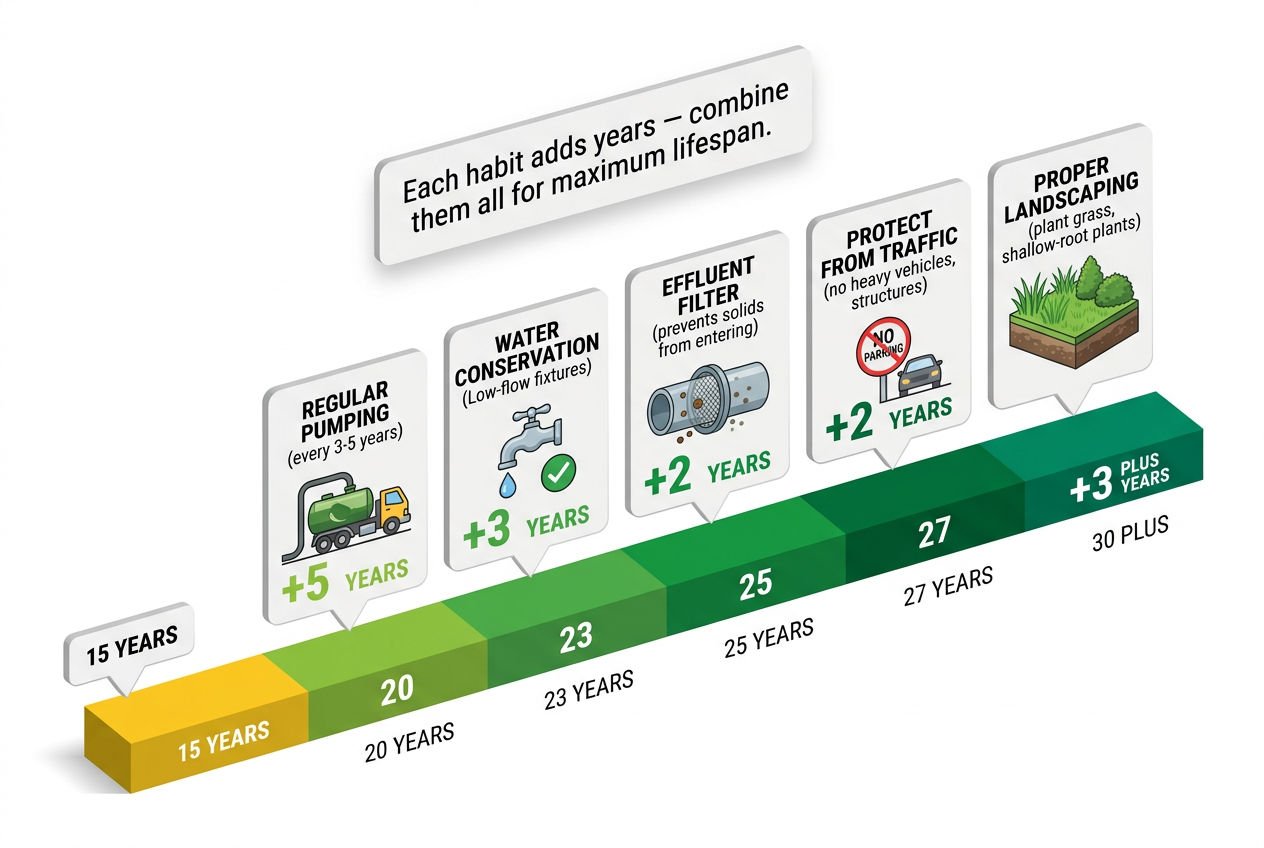
How to Extend Your Drain Field's Lifespan
You can't control your soil type, but you can control almost everything else.
Six Actions That Add Years to Your Field
Pump on schedule. Every 3–5 years for most households. Set a reminder. A $300–$500 pump-out every few years is far cheaper than a $10,000 replacement. Find a qualified pumper through our septic pumping service directory.
Spread laundry loads out. Doing eight loads of laundry on Saturday floods the drain field in one day. Space loads through the week to match the field's absorption rate.
Protect the field from compaction. Never drive vehicles over the drain field. Soil compaction destroys the pore structure that makes absorption possible. Our guide on whether you can drive over a drain field explains exactly what that kind of pressure does underground.
Don't plant trees near the field. Tree roots seek moisture. They will find your perforated laterals, and they will grow into them.
Fix leaky fixtures. A running toilet can add 200 gallons a day to your system load without you noticing. That's 73,000 extra gallons a year - enough to meaningfully accelerate saturation in an already-loaded field.
Get a septic inspection every 3–5 years. A licensed inspector with a sludge judge and a camera can catch problems early - before the field is permanently compromised. See what to expect in our septic inspection cost guide.
Seasonal and Regional Factors Worth Knowing
Spring is when drain field problems announce themselves loudest. Snowmelt and heavy rain raise the water table, and a field that was limping along through a dry fall suddenly can't drain at all. If your yard smells like sewage every April, your field isn't "sick in the spring" - it was already struggling and the water table is just exposing it.
Regional Considerations
Northern states (Minnesota, Wisconsin, Maine): Frost depth is a real variable. Shallow laterals in poorly insulated systems can freeze during hard winters, causing temporary backup that mimics field failure. A $200–$400 inspection in the fall can tell you whether your problem is seasonal frost or structural failure.
Coastal Southeast (Florida, Georgia): High water tables mean many drain fields were engineered with mound designs or elevated laterals from the start. If you're buying a home in these areas, ask specifically what type of field the property has and whether it was designed to current Florida Department of Health standards.
Regulatory Variations
Regulations also vary dramatically:
- Florida: Requires all septic contractors to hold a Registered Septic Tank Contractor (RSTC) license through the Department of Health
- Texas: Delegates oversight to county-level Designated Representatives
- What's legal in one county may not be in the next
✅ Pro Tip: Always verify local requirements - and use a contractor who knows your specific jurisdiction.
Learn more about our drain field services services.
Related reading: septic system installation process.
Sources & Methodology
- U.S. Environmental Protection Agency - SepticSmart Program: Pumping frequency recommendations, household flow estimates, and national septic system statistics including the estimate that approximately 21% of U.S. homes rely on on-site septic systems.
- Infiltrator Water Technologies: Chamber system lifespan and design load specifications referenced from manufacturer product documentation.
- Polylok / Zabel: Effluent filter product specifications for PL-122 and A1800 models.
- University Extension Programs: Biomat accumulation timelines and soil percolation research referenced from extension publications by University of Minnesota Extension and Penn State Extension.
- HomeAdvisor / Angi National Cost Data: Drain field replacement cost ranges ($5,000–$20,000+) based on aggregated contractor pricing data; figures represent national averages as of 2024–2025.
Need a licensed septic professional in your area? Find a septic professional near you through SepticTankHub's vetted directory.
Need help with your septic system? Browse local septic companies in Arizona or Washington.
Was this article helpful?
Frequently Asked Questions
Recommended Resources
📖 Related Articles
💰 Cost Guides
Find Septic Professionals Near You
Compare licensed, verified septic companies by area — top county markets and cities below, or browse all 50 states.
County markets
Popular cities
