
Quick Answer
Drain field pipes are typically buried 18 to 36 inches below ground surface for most residential septic systems. The exact depth depends on your soil type, local frost line, seasonal high water table, and county code requirements. Shallow sandy soils may allow pipes at 18–24 inches, while loam soils typically call for 24–36 inches. No installer should pick a depth before a soil evaluation and percolation test.
💡 Key Takeaways
- Standard drain field pipe depth is 18–36 inches below ground surface for most residential systems
- Most states require at least 2 feet of vertical separation between the trench bottom and the seasonal high water table
- Soil type directly controls depth - sandy soil allows shallower placement; clay may require a mound system entirely
- In northern states, frost lines reach 48–72+ inches, but drain field pipes are not always buried that deep - insulation and pressure dosing are used instead
- A permit and site-specific soil evaluation are required by nearly every U.S. jurisdiction before installation
What Actually Determines Drain Field Depth?
Four variables drive septic drain field installation depth. Get any one of them wrong and you're looking at a failing system, a failed inspection, or both.
Soil Type and Percolation Rate
The drain field works by releasing effluent into soil, where aerobic bacteria in the top 12–24 inches of native soil beneath the trench do the actual treatment. If pipes are buried too deep, that aerobic zone is too far below the trench bottom to do its job. If they're too shallow, effluent can surface before it's treated. Percolation rates between 1 and 60 minutes per inch (MPI) are considered acceptable for conventional systems. A percolation test is the only way to know where your soil falls on that range.
Seasonal High Water Table
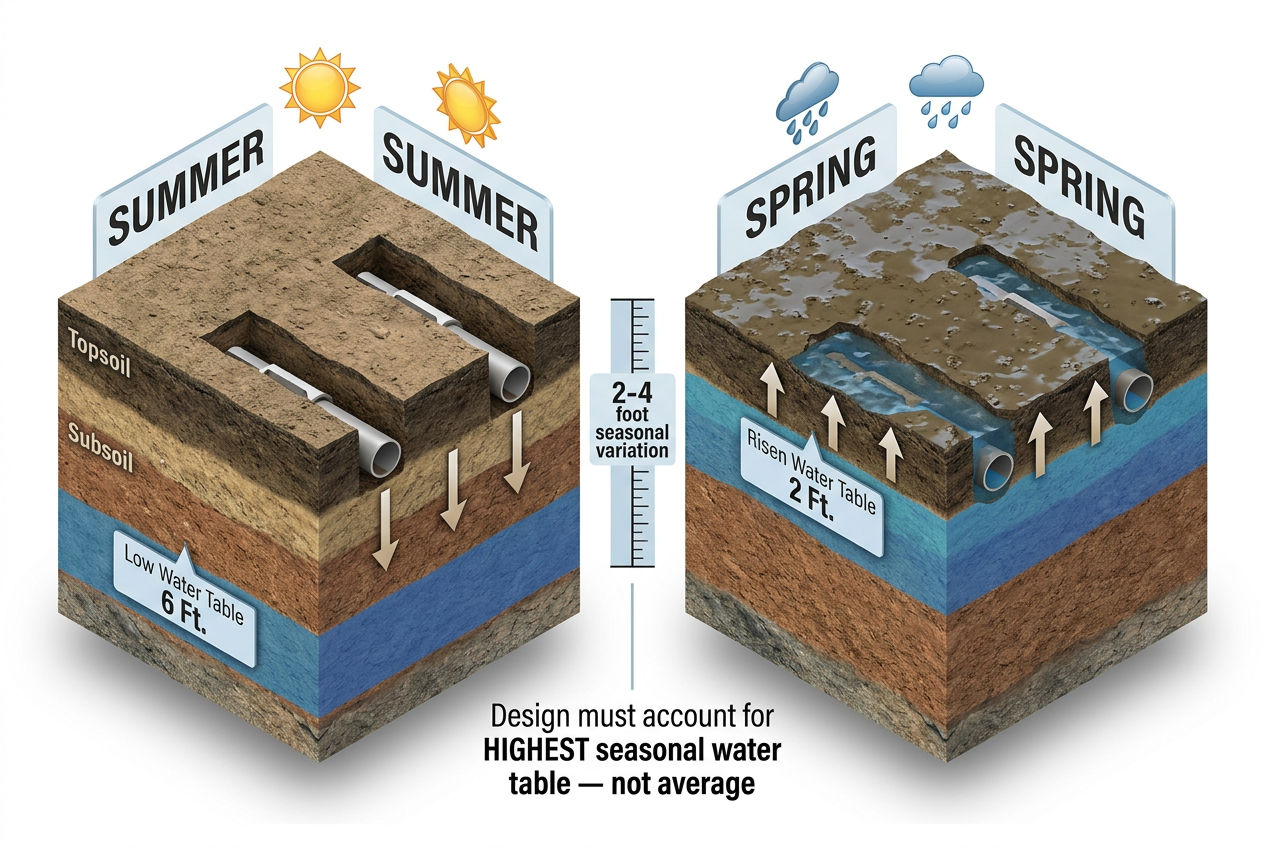
Most state codes require a minimum of 2 feet of vertical separation between the bottom of the trench and the seasonal high water table. Some states - including Minnesota and Wisconsin - require 3 to 4 feet.
⚠️ Warning: A soil evaluation done in August can miss a water table that creeps up to 18 inches below surface every March. Always measure during the wettest part of the year, typically late winter or early spring.
Frost Line Depth
Drain field pipes don't have to be buried below the frost line the way water supply lines do. Effluent carries enough heat to prevent freezing in most cases - as long as the system is used regularly. What gets homeowners in trouble is a cabin used only on weekends in January, or an overloaded system that backs up and stagnates. In northern states, designers often use shallow pressure-dosed systems with insulation board rather than trying to bury pipes 60 inches deep.
Local Code and Bedrock
Minimum vertical separation from bedrock typically runs 2 to 4 feet below the trench bottom, depending on your jurisdiction. The EPA's Onsite Wastewater Treatment Systems Manual (EPA/625/R-00/008) establishes the framework; state and county health departments layer on additional requirements from there.
For a broader look at how drain fields work before digging into depth specifics, the drain field overview guide covers system fundamentals in plain terms.
How Deep Are Drain Field Pipes Usually Buried?
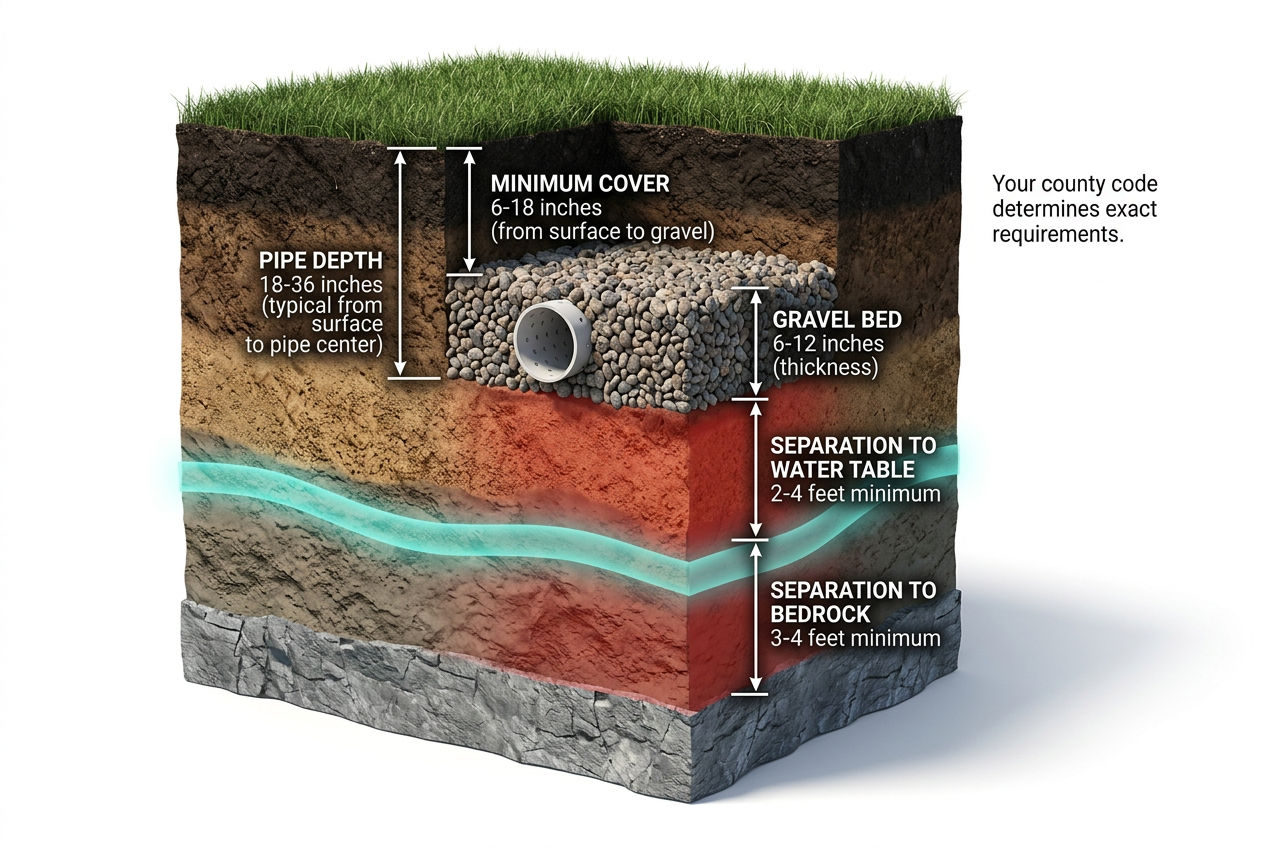
Standard leach field pipe depth runs 18 to 36 inches below grade for conventional gravity-fed systems. That range covers the vast majority of residential installations across the U.S.
Here's how that breaks down in practice:
- 18–24 inches: Common in sandy or loamy soils with fast percolation, warm climates, and areas with low water tables
- 24–36 inches: Typical for loam soils in moderate climates - the most common installation scenario nationwide
- 36–48 inches: Occasionally used in deeper soils with specific site conditions, but aerobic bacterial treatment becomes less effective beyond 36 inches
Typical Trench Construction Layers
The 4-inch perforated PVC or HDPE distribution pipe sits on a bed of 6 to 12 inches of washed drain rock. Another 2 to 4 inches of gravel covers the pipe above. Geotextile fabric goes over that to keep soil from migrating down into the gravel bed, and then native soil backfill brings you back to grade. Total trench depth typically runs 18 to 36 inches; trench width ranges from 12 to 36 inches depending on system design.
Drain Field Depth by Soil Type and Region
| Soil / Region | Typical Perc Rate | Recommended Pipe Depth | Notes |
|---|---|---|---|
| Sandy soil | 1–10 MPI | 18–24 inches | Fast drainage; ensure adequate treatment zone |
| Loam soil | 10–30 MPI | 24–36 inches | Ideal conditions; standard installation |
| Clay-heavy soil | 60+ MPI | Mound or alternative | Too slow for conventional trench systems |
| Northern U.S. (MN, WI, ME) | Varies | 24–48 inches + insulation | Deep frost; pressure dosing often required |
| Southeast U.S. (FL, GA, SC) | Varies | 18–24 inches | High water tables; raised systems common |
| Arid Southwest (AZ, NM, NV) | Rapid | 24–36 inches | Caliche layers can restrict depth options |
Source: EPA Onsite Wastewater Treatment Systems Manual; USDA Natural Resources Conservation Service soil classification data

DIY Septic Blueprint
Thinking about building it yourself?
The complete, plain-English plan to size, permit and install your own septic system — designed for homeowners, not contractors. Skip the $15,000–$25,000 quotes and do it right the first time.
Get the DIY Blueprint — $67 →Instant download · 8 modules + 3 bonus guides · 60-day money-back guaranteeDoes Soil Type Affect How Deep a Drain Field Should Be?
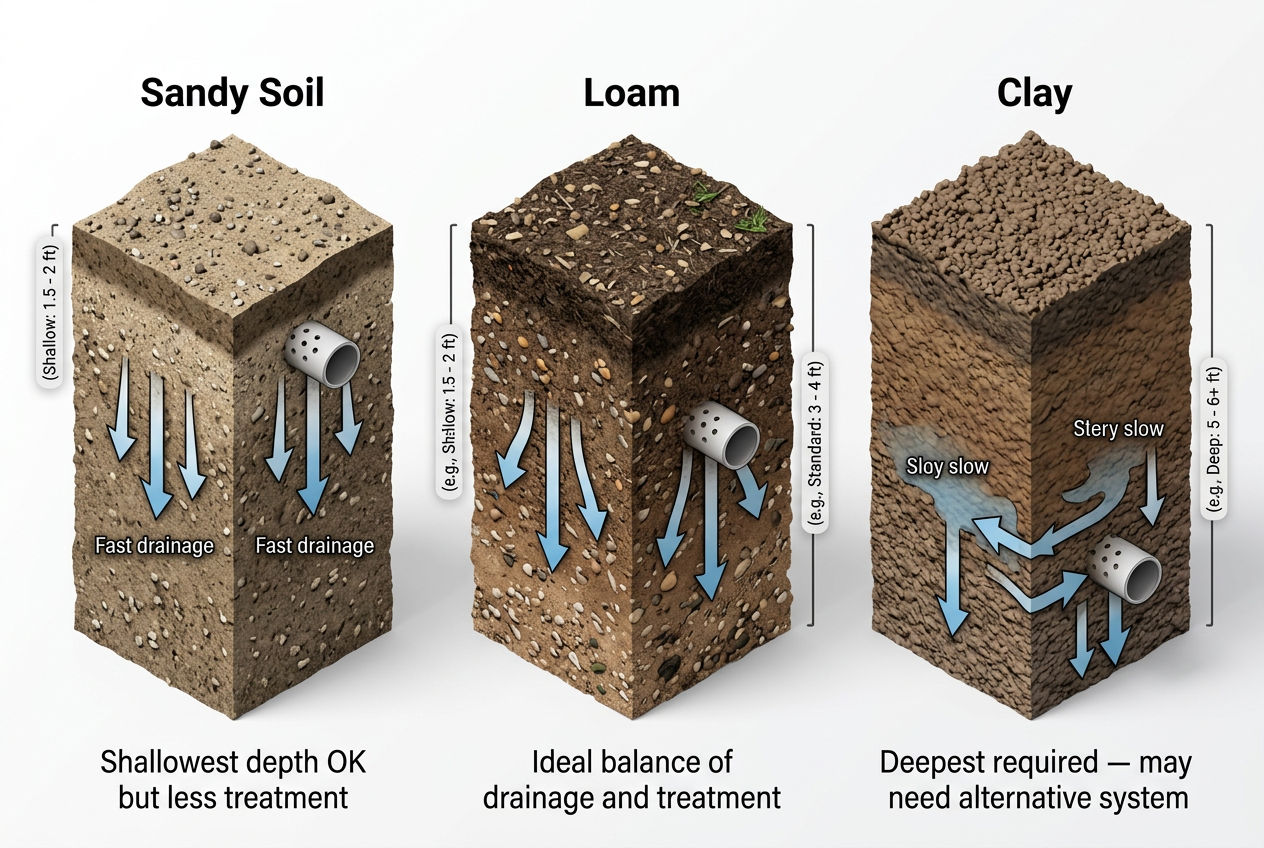
Yes - soil type may be the single most important factor in drain field depth decisions. It determines percolation rate, drainage capacity, and how much vertical separation you need between pipe and water table.
Sandy Soil
Sandy soil drains quickly, sometimes too quickly. Pipes at 18–24 inches give the effluent adequate contact time with the aerobic treatment zone. But in very coarse sand, a designer might actually add depth - or specify a timed-dose pump - to slow the flow and ensure treatment happens before effluent reaches groundwater.
Loam Soil
Loam is the sweet spot. Percolation rates of 10–30 MPI allow conventional gravity systems at 24–36 inches with predictable, reliable performance. Most county health departments consider loam the baseline condition their permitting tables are built around.
Clay Soil
⚠️ Warning: If your perc test comes back slower than 60 MPI, most jurisdictions won't approve a conventional gravity trench system at any depth. Burying pipes deeper in clay doesn't fix slow percolation - it just puts your failing drain field farther underground.
You're looking at a mound system, a chamber system, or an engineered alternative. Learn more about mound and alternative system options in the drain field size guide.
How Deep Should a Leach Field Be Below the Frost Line?
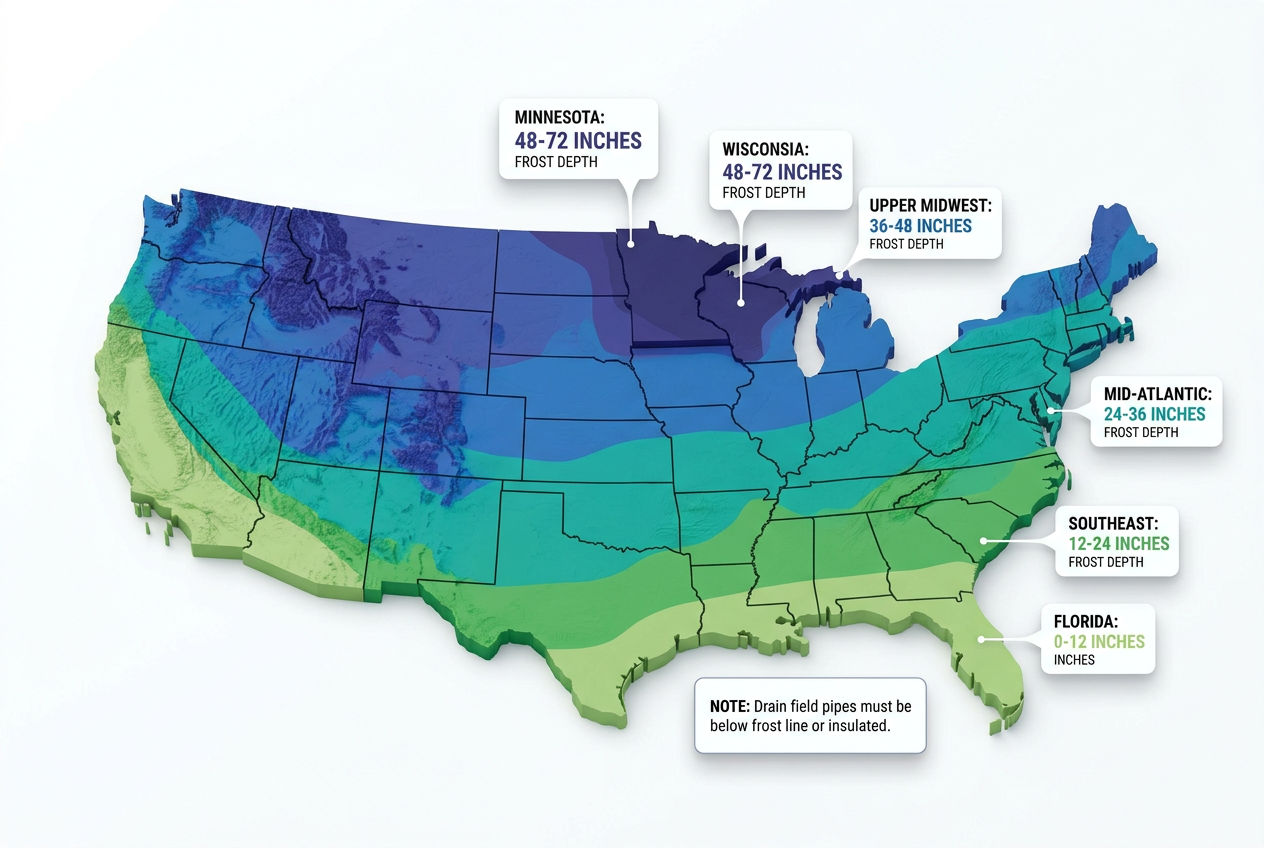
This question trips up a lot of homeowners in northern climates. The short answer: drain field pipes don't need to be buried below the frost line. Wastewater carries enough thermal energy to keep pipes from freezing during normal daily use.
The longer answer has some important caveats.
Northern Climate Solutions
In Minnesota, frost lines range from 42 to 72 inches depending on location. Burying drain field pipes that deep would push them well below the aerobic treatment zone where biological treatment actually happens. Instead, engineers use pressure-dosed systems - where effluent is pumped in timed doses to shallow pipes - combined with 2–4 inches of rigid insulation board over the trench. The University of Minnesota Extension Service has documented this approach extensively for cold-climate systems.
✅ Pro Tip: What does cause freezing problems in northern states isn't the drain field itself - it's the pipes running from the house to the septic tank, particularly the first 10 to 15 feet leaving the foundation. Those lines, often buried at only 12–18 inches, are vulnerable. Insulating them with rigid foam board is cheap insurance against a $1,500–2,500 freeze-up service call.
Warm Climate Considerations
In the Southeast - Florida, Louisiana, coastal South Carolina - frost depth is essentially zero. Depth decisions there are driven almost entirely by the water table, not temperature. Many coastal Florida properties require mound or raised drain fields because the seasonal high water table sits within 12–18 inches of grade.
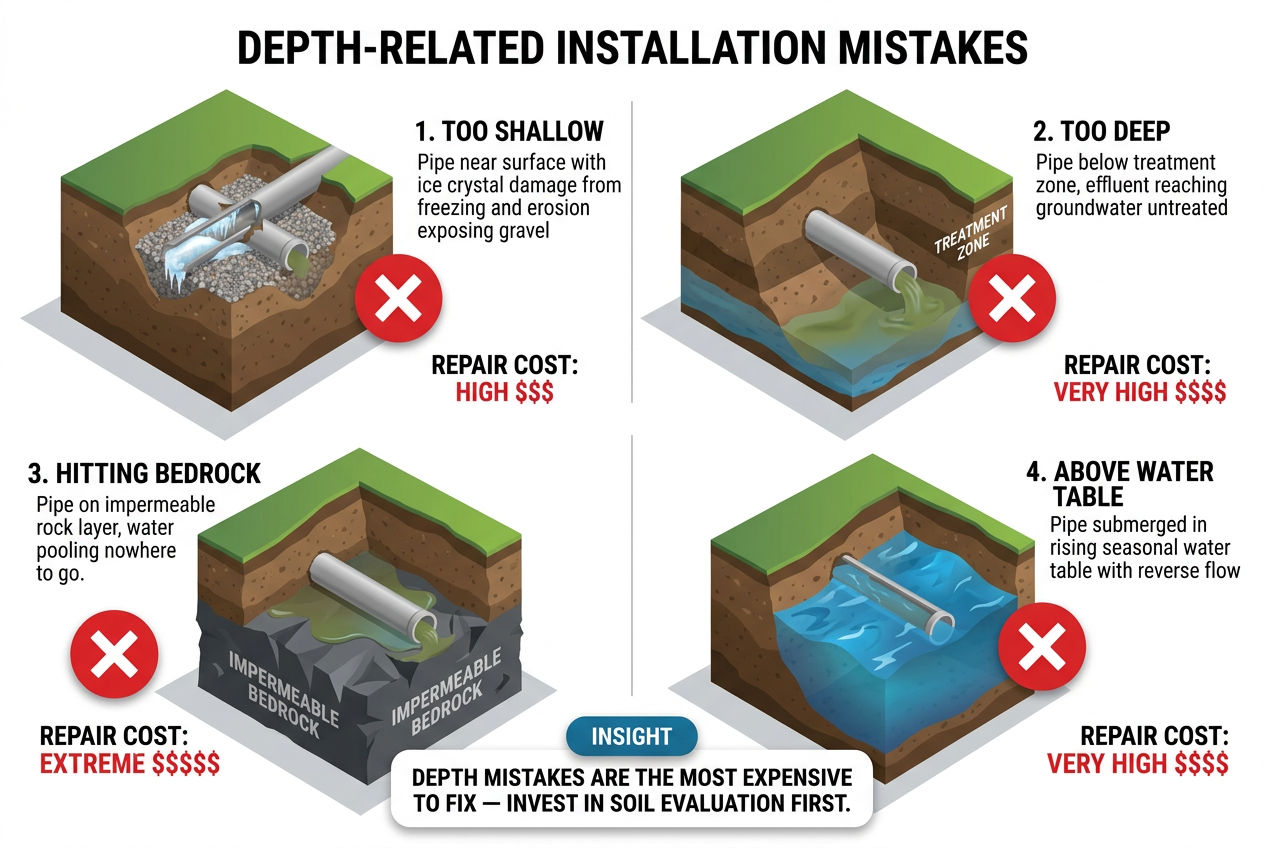
Can a Drain Field Be Too Deep?
Yes, and this is a mistake that's harder to fix than you'd think.
The Aerobic Treatment Zone Problem
The aerobic bacteria responsible for treating wastewater effluent live in the top 12–24 inches of native soil beneath the trench bottom. Bury your pipes at 48 inches and that treatment zone may be too far from the trench bottom to function effectively. Effluent passes through insufficiently treated and reaches groundwater - which is exactly what the system is designed to prevent.
Practical Installation Issues
There's also a practical issue with depth and slope. Drain field laterals need to maintain a slope of 1/16 to 1/8 inch per foot (roughly 1% grade) for gravity systems to flow properly. The deeper the drain field, the more elevation the tank outlet needs to be above the field - which sometimes requires costly tank placement adjustments or a pump system.
📊 Quick Fact: If your property has shallow bedrock, a high water table, or poor soil conditions that seem to demand a very deep field, the right answer usually isn't to dig deeper. It's to consider alternative drain field systems - mound systems, drip irrigation systems, or chamber systems designed for your site conditions.
What Is the Minimum Depth for a Septic Drain Field?
Most jurisdictions set minimum soil cover over distribution pipes at 6 to 12 inches. Below that, there isn't enough soil mass to prevent surface breakout of effluent, support vehicle traffic, or handle freeze-thaw cycles even in mild climates.
Critical Separation Distance Requirements
The more important minimums are the separation distances:
- 2 to 4 feet between trench bottom and seasonal high water table (varies by state - Wisconsin requires 3 feet; Florida requires 2 feet in most counties)
- 2 to 4 feet between trench bottom and bedrock
- 2 to 3 feet between trench bottom and any restrictive soil layer (hardpan, caliche, dense clay)
⚠️ Warning: These aren't suggestions. Fail to meet separation requirements and your county health department will deny the permit. Try to install without a permit and you'll face fines, mandatory removal, and a much harder time selling your property down the road.
How Far Below the Septic Tank Should the Drain Field Be?
The drain field needs to be lower than the septic tank outlet - gravity is what moves effluent from tank to field in conventional systems. Typical tank outlet elevation sits roughly 12–24 inches below grade. The distribution box (D-box) and field laterals need to be slightly lower still.
Calculating Elevation Drop
The exact elevation difference depends on the distance between tank and field. With a 1% slope on the effluent line:
- A drain field 100 feet from the tank should sit about 1 foot lower than the tank outlet
- Push that to 200 feet and you need 2 feet of drop
💡 Key Takeaway: This relationship matters when homeowners ask about expanding or relocating a drain field. If the new location is uphill from the tank - even slightly - you need a pump chamber and effluent pump, which adds $1,500–3,500 to installation costs.
Signs Your Drain Field Depth Might Be the Problem
Drain fields fail for a lot of reasons, but improper installation depth is one that shows up years after the initial install. Watch for:
- Soggy or spongy ground over the drain field area, especially after rain
- Sewage odors in the yard - effluent surfacing before adequate treatment
- Slow drains throughout the house that don't improve after the tank is pumped
- Unusually lush grass in a stripe pattern directly over the lateral lines
📊 Quick Fact: These symptoms can also signal a saturated drain field from other causes - system overload, biomat buildup, or tree root intrusion. But if your system is newer and already showing these signs, a depth issue from original installation is worth investigating.
A licensed inspector can evaluate the system and flag depth compliance issues. See what a septic inspection costs in your area before assuming the worst.
Getting the Depth Right Before You Install
If you're planning a new drain field installation, the process starts with a licensed soil evaluator conducting a percolation test and soil profile assessment. That test determines:
- Whether conventional depth is possible on your site
- What separation distances you have available
- Whether you need a mound, chamber, or alternative system
Nearly every U.S. county requires this evaluation before issuing a permit. The EPA and state health departments treat it as non-negotiable - and for good reason. A drain field installed at the wrong depth can contaminate groundwater, create public health hazards, and run you $8,000–25,000 in drain field replacement costs when the system fails prematurely.
⚠️ Warning: Picture this: you're selling your home and the buyer's inspector discovers your drain field was installed at 12 inches of depth in a county that requires 24 inches minimum. The sale falls through. You're now looking at a full system replacement before you can close. Scenarios like this do happen at point-of-sale inspections. Getting the depth right from day one is far cheaper than fixing it later.
Need help finding a licensed installer who knows your local code requirements? Find a septic professional near you through the SepticTankHub directory.
Need drain field help? Find a qualified contractor near you on SepticTankHub.
Learn more about our drain field services services.
Related reading: septic system installation process.
Sources & Methodology
-
U.S. Environmental Protection Agency - Onsite Wastewater Treatment Systems Manual (EPA/625/R-00/008). Primary reference for separation distances, soil suitability criteria, and system design standards.
-
University of Minnesota Extension Service: Research and field guidance on cold-climate septic system design, frost line considerations, and pressure-dosed systems for northern installations.
-
National Onsite Wastewater Recycling Association (NOWRA): Industry standards for drain field installation depth, trench specifications, and soil evaluation protocols.
-
State Health Department Standards: Minnesota Pollution Control Agency (MPCA), Florida Department of Health, and Wisconsin Department of Natural Resources separation distance requirements reviewed for regional accuracy.
-
USDA Natural Resources Conservation Service: Soil classification data and percolation rate ranges by soil texture type referenced for the depth-by-soil-type table.
Depth ranges and separation distances cited in this article reflect common standards across U.S. jurisdictions. Always verify requirements with your county health department before installation - local code governs.
For more on how drain fields work, how long they last, and whether you can drive over one, see the related guides on drain field lifespan and driving over a drain field.
Need help with your septic system? Browse local septic companies in California or Ohio.
Free download
Not ready for the Blueprint? Start free.
Grab the free DIY Septic Planning Kit — the permit-first checklist, perc-test cheat sheet, and sizing tables that keep your build from getting red-tagged.
Was this article helpful?
Frequently Asked Questions
Recommended Resources
📖 Related Articles
💰 Cost Guides
🔧 Services
Find Septic Professionals Near You
Compare licensed, verified septic companies by area — top county markets and cities below, or browse all 50 states.
County markets
Popular cities
