
Quick Answer
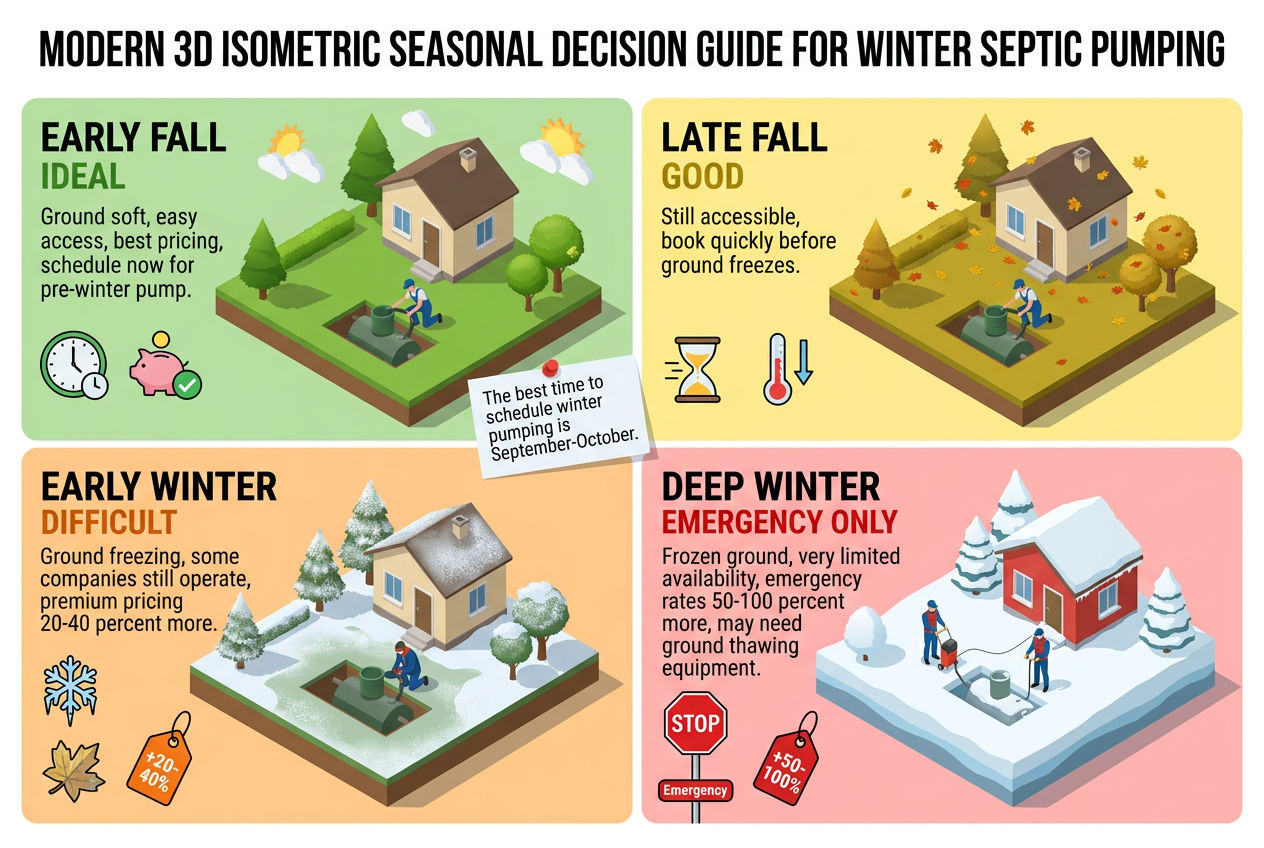
Pumping your septic tank before winter is strongly recommended if you live in a cold-climate region. Scheduling service in early-to-mid fall - ideally September through early November - reduces sludge levels, lowers the risk of frozen pipes and system backups, and gives you time to fix any problems before the ground freezes. For most households, a standard pump-out costs $400–$600 and takes under an hour.
💡 Key Takeaways
- Fall is the best window to pump your septic tank - aim for September or October, before the first hard freeze.
- High sludge levels in winter slow bacterial activity and increase backup risk. Cold temperatures suppress anaerobic bacteria below 50°F (10°C).
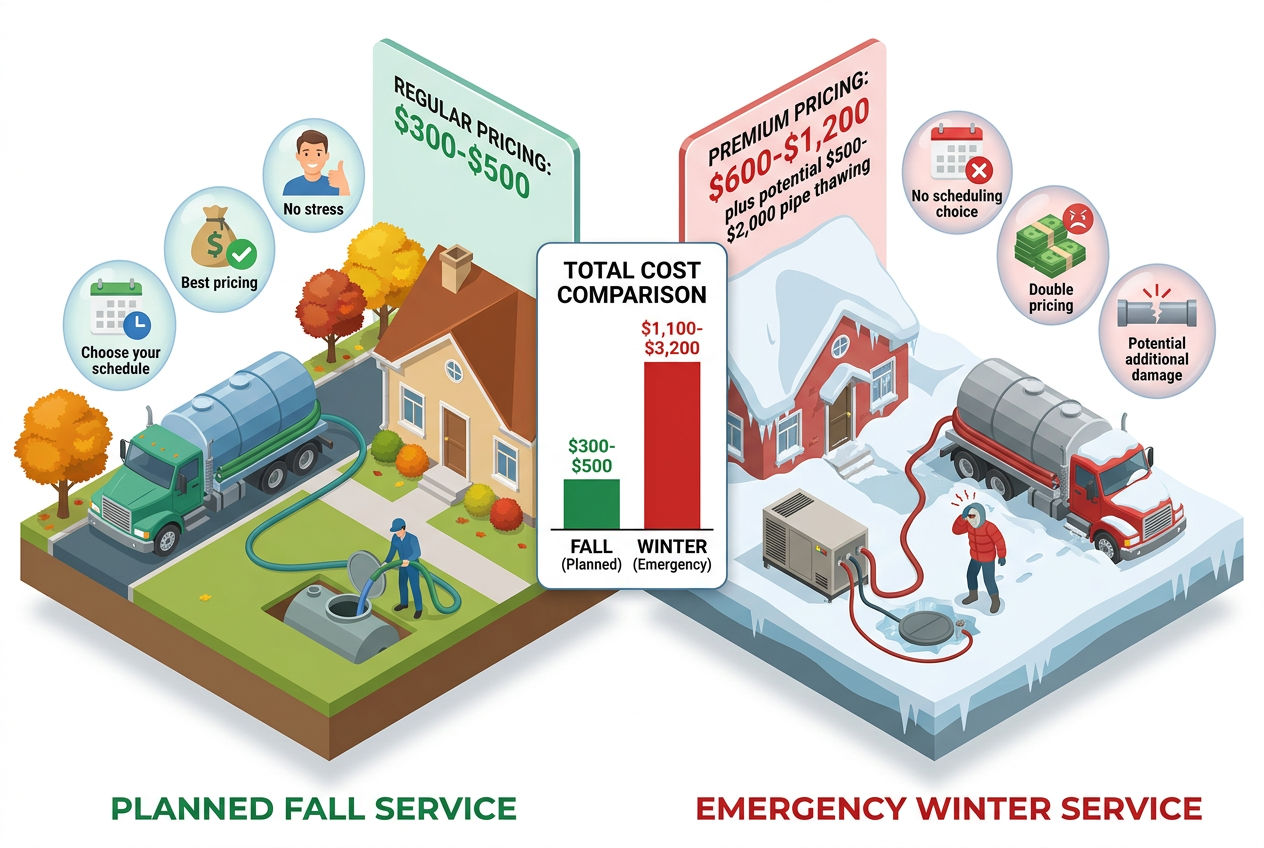
- A standard pump-out costs $400–$600. Emergency winter pumping runs $800–$1,200 or more.
- Frozen septic line repairs average $1,000–$5,000+, depending on depth and pipe length.
- Homeowners in the Deep South face minimal freeze risk, but routine fall maintenance still makes sense.
Why Fall Is the Best Time to Pump Your Septic Tank
The EPA recommends pumping most residential septic tanks every 3–5 years. A 1,000-gallon tank serving a four-person household typically hits that interval right on schedule. Add a garbage disposal to that home, and you're looking at every 2–3 years.
But frequency isn't the only factor. Timing matters too, especially if you're heading into a cold winter.
How Cold Temperatures Affect Bacterial Activity
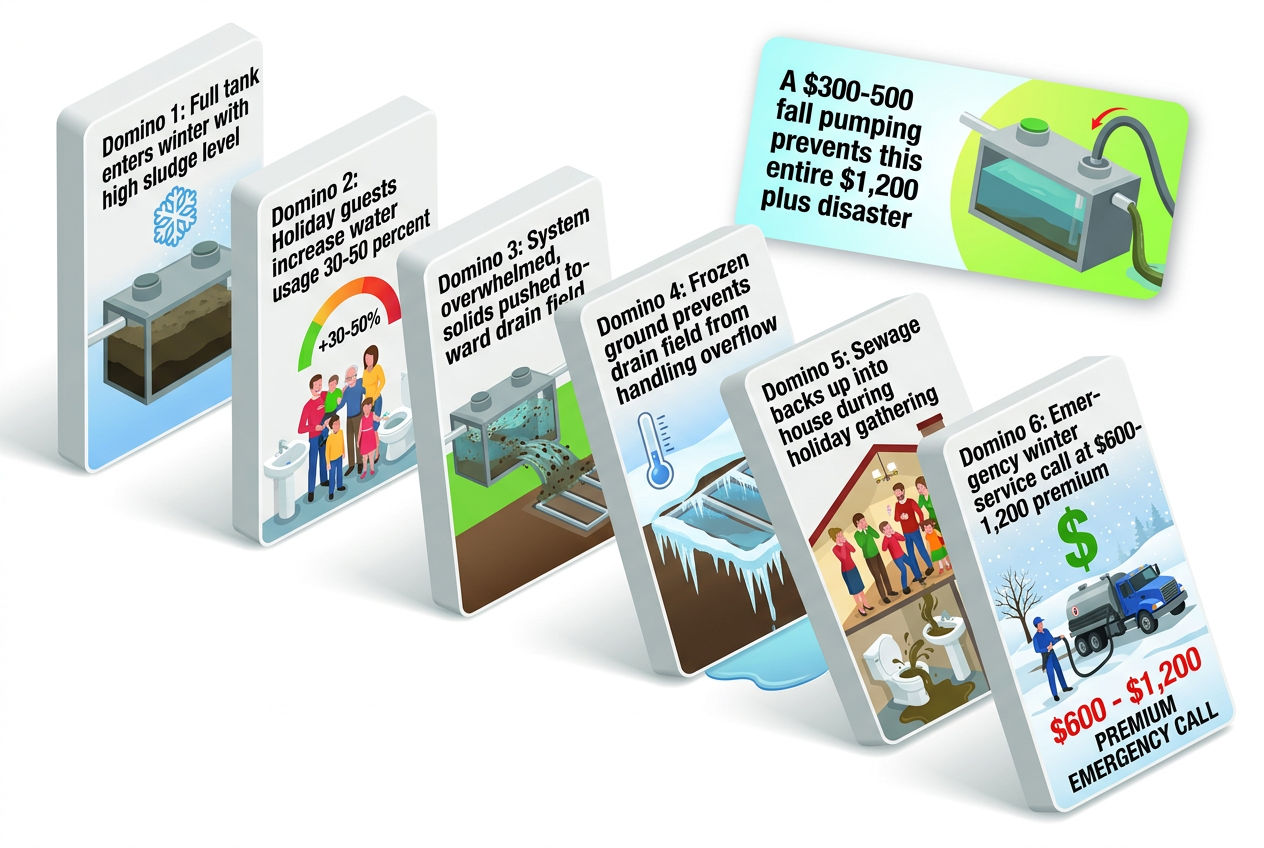
Your septic tank relies on anaerobic bacteria to break down solids. Those bacteria slow down significantly once water temperatures drop below 50°F (10°C), and they're nearly dormant below 40°F. That means a tank that's already carrying heavy sludge going into winter will accumulate waste faster than it can process it. By spring, you may have a full tank - or worse, a backup into the house.
📊 Quick Fact: Bacterial digestion rates in septic tanks can drop by 50% or more when internal temperatures fall below 50°F, leaving solids to accumulate at twice the normal rate throughout winter months.
Why September–October Is the Sweet Spot
Pumping in fall clears that sludge before bacterial activity slows. It also gives the pumper a chance to:
- Inspect your baffles for cracks or deterioration
- Check the effluent filter (such as a Polylok PL-122 filter at the outlet baffle)
- Flag any cracks or structural issues while the ground is still accessible
- Identify potential drain field problems before winter compounds them
Finding a cracked baffle in October costs a fraction of finding a failed drain field in January.
If you're not sure whether your tank is overdue, check out our guide on how often you should pump your septic tank - it covers household size, tank capacity, and usage factors in detail.
Can a Septic Tank Freeze in the Winter?
A properly buried concrete or fiberglass septic tank rarely freezes solid - but that's not the part you should be worried about.
⚠️ Warning: The real vulnerability is your inlet pipe - the line running from your house to the tank. These pipes sit at a shallower depth than the tank itself, and if they freeze, sewage backs up into your home.
Frost Line Depths by Region
The frost line varies dramatically by region:
| State/Region | Typical Frost Line Depth |
|---|---|
| Tennessee | 12 inches |
| Pennsylvania | 36 inches |
| Minnesota | 42–60 inches |
| North Dakota | 60+ inches |
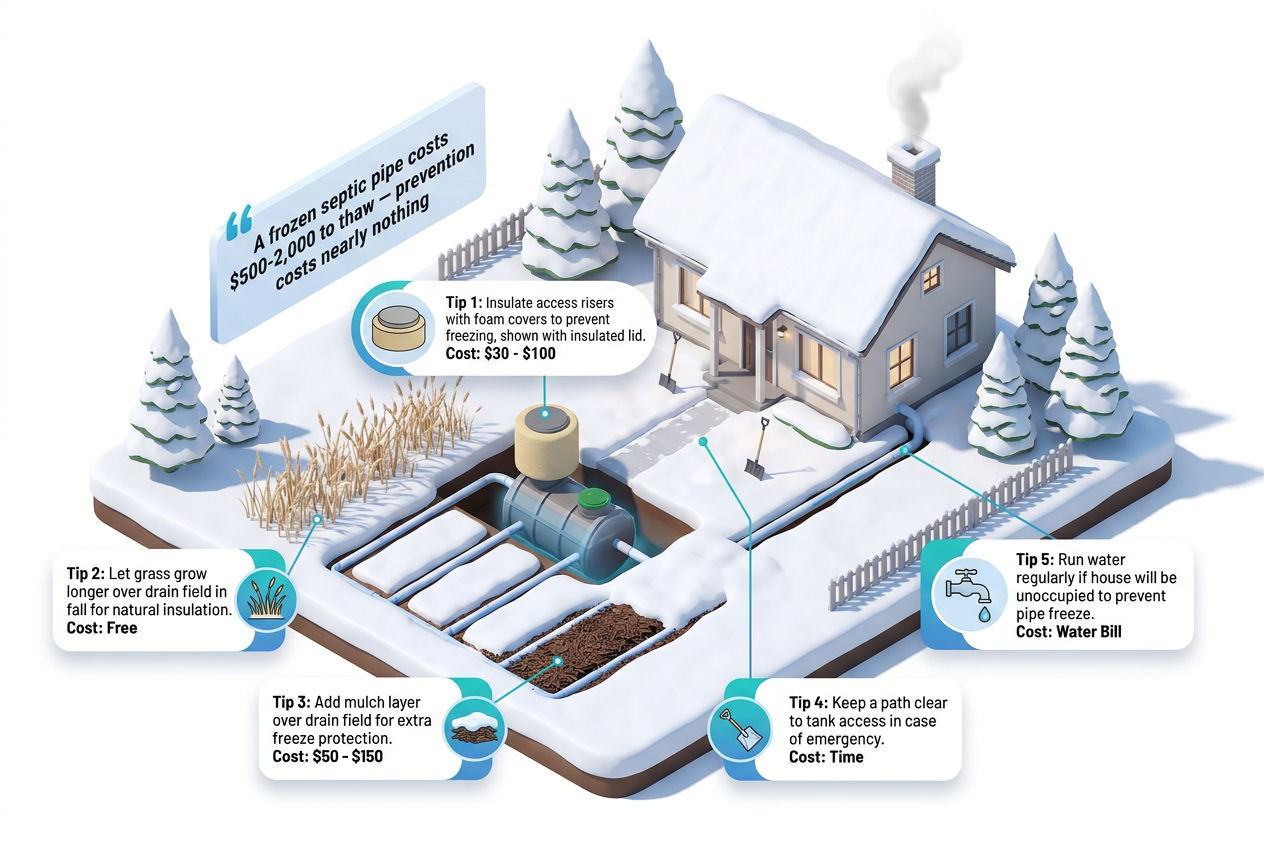
In Minnesota, the MPCA (Minnesota Pollution Control Agency) notes that most septic tank failures in winter involve the lateral pipes, not the tank body. Insulating the first 8–10 feet of your inlet pipe with rigid foam board is a cheap, effective preventative measure - often the difference between a $40 materials cost and a $1,500–$2,500 emergency thaw-out service call.
Snow Cover as Natural Insulation
Snow cover actually helps. According to University of Minnesota Extension, 8–12 inches of undisturbed snow over the drain field acts as effective insulation, keeping soil temperatures above the freezing point even when air temps plunge.
✅ Pro Tip: Never compact snow over your drain field with snowmobiles, ATVs, or foot traffic - you're eliminating the insulating layer that protects your system from freeze damage.
Is It Bad to Pump a Septic Tank When the Ground Is Frozen?
Yes - pumping in frozen or near-frozen conditions is possible, but it comes with real drawbacks.
Why Frozen-Ground Pumping Costs More
First challenge: A frozen or snow-covered lid means the pumper has to locate and excavate the access port, which adds time and cost.
Second challenge: Frozen ground makes it harder to visually inspect the area around the tank and drain field for soft spots, depressions, or signs of failure.
Third challenge: In extreme cold, the contents of the tank can partially solidify, making it harder to fully extract the sludge through the vacuum hose.
💡 Key Takeaway: Emergency septic pumping in winter runs $800–$1,200 or more in most cold-climate markets - roughly double what you'd pay in September.
Rocky soils in northern New England compound the problem, since excavation near frozen ledge can be difficult or impossible without specialized equipment.
If your tank gets to February without a pump-out and you're noticing slow drains or gurgling sounds, don't wait. Call a licensed pumper immediately. A slow drain is far easier to deal with than a full backup. Learn more about what to watch for in our article on signs your septic tank needs pumping.
Free download
Free: the Septic Fridge Card — what to flush, what never to.
The Do / Don’t card the whole family can see, plus the Survival Kit: emergency flowchart, warning-sign decoder and pump-schedule card. One printable PDF.
How Do I Know If My Septic Tank Needs to Be Pumped Before Winter?
The most reliable method is a sludge judge measurement - a clear plastic tube a pumper or inspector lowers into the tank to measure the combined sludge and scum layers. When those layers together occupy about one-third of the tank's capacity, it's time to pump, regardless of the calendar.
Pumping Thresholds by Tank Size
- 1,000-gallon tank: Pump when solids reach ~330 gallons
- 1,500-gallon tank: Pump when solids reach ~500 gallons
Warning Signs You Should Call a Pumper Before Winter
- Slow drains throughout the house (not just one fixture - that's usually a clog)
- Gurgling sounds in toilets or drains after flushing
- Wet, soggy ground over the drain field even without rain
- Sewage odors inside the house or near the tank lid
- It's been more than 3–4 years since your last pump-out
⚠️ Warning: If your last pump-out was during the Obama administration, schedule service now. Don't gamble on another winter.
What Does Pre-Winter Septic Pumping Cost?
Here's a regional breakdown so you know what to budget:
| Region | Tank Size | Avg. Fall Pump-Out Cost | Emergency Winter Cost |
|---|---|---|---|
| Upper Midwest (MN, WI) | 1,000 gal | $400–$550 | $900–$1,200 |
| Northeast (NY, PA, ME) | 1,000 gal | $375–$500 | $800–$1,100 |
| Pacific NW Mountains | 1,000 gal | $350–$475 | $750–$1,050 |
| Midwest (OH, IN, IL) | 1,000 gal | $325–$450 | $700–$950 |
| Upper South (TN, VA) | 1,000 gal | $300–$425 | $600–$850 |
Source: SepticTankHub service provider data, EPA Septic Systems guidelines, regional contractor surveys. Emergency pricing reflects after-hours and frozen-ground access surcharges.
Cost Factors to Consider
Tank size matters: A 1,500-gallon tank typically runs 20–30% higher than a 1,000-gallon tank in the same market.
Additional components add cost: If you have a pump chamber or aerobic treatment unit (ATU) with a Hiblow HP-80 aerator compressor, expect additional service fees for that component.
For a full breakdown of what affects your cost, see our septic tank pumping cost guide.
How Do You Protect a Septic System From Freezing Beyond Pumping?
Pumping is the most important step - but it's not the only one. A complete fall septic maintenance checklist looks like this:
Your 6-Step Pre-Winter Septic Protection Plan
1. Schedule your pump-out in September or October. This is the sweet spot - ground is accessible, weather is cooperative, and contractors have more availability than the November rush.
2. Inspect the inlet and outlet baffles. The inlet baffle keeps solids from flowing straight to the drain field. The outlet baffle (or effluent filter) catches particles before they reach the leach laterals. A cracked or missing baffle is a common cause of premature drain field failure.
3. Check the distribution box (D-box). If you have a conventional gravity-fed system, the D-box distributes effluent equally across your leach laterals. Uneven distribution in fall often means one lateral is getting oversaturated heading into winter.
4. Insulate exposed or shallow pipes. Use 2-inch rigid foam board on any inlet pipe sections running through unheated crawl spaces or at shallow depths in northern climates. Our freeze prevention guide covers pipe insulation and heat tape in detail.
5. Don't compact the soil over the drain field. Leave snow undisturbed. Avoid parking vehicles over the drain field. The soil structure needs to breathe and drain.
6. Reduce water use during cold snaps. Sending large volumes of cold water into the tank rapidly during a hard freeze can overwhelm the system. Spread out laundry loads. Fix leaking faucets and running toilets before winter - a trickling toilet can send 200+ gallons of cold water through your system daily.
✅ Pro Tip: A complete fall inspection and pump-out typically takes 45–60 minutes and can prevent thousands of dollars in winter emergency repairs.
For a broader look at year-round system care, our septic tank maintenance guide covers everything from additives to drain field protection.
Does Pre-Winter Pumping Apply to Every Region?
Not equally. Your location changes the calculus significantly.
Pumping Recommendations by Climate Zone
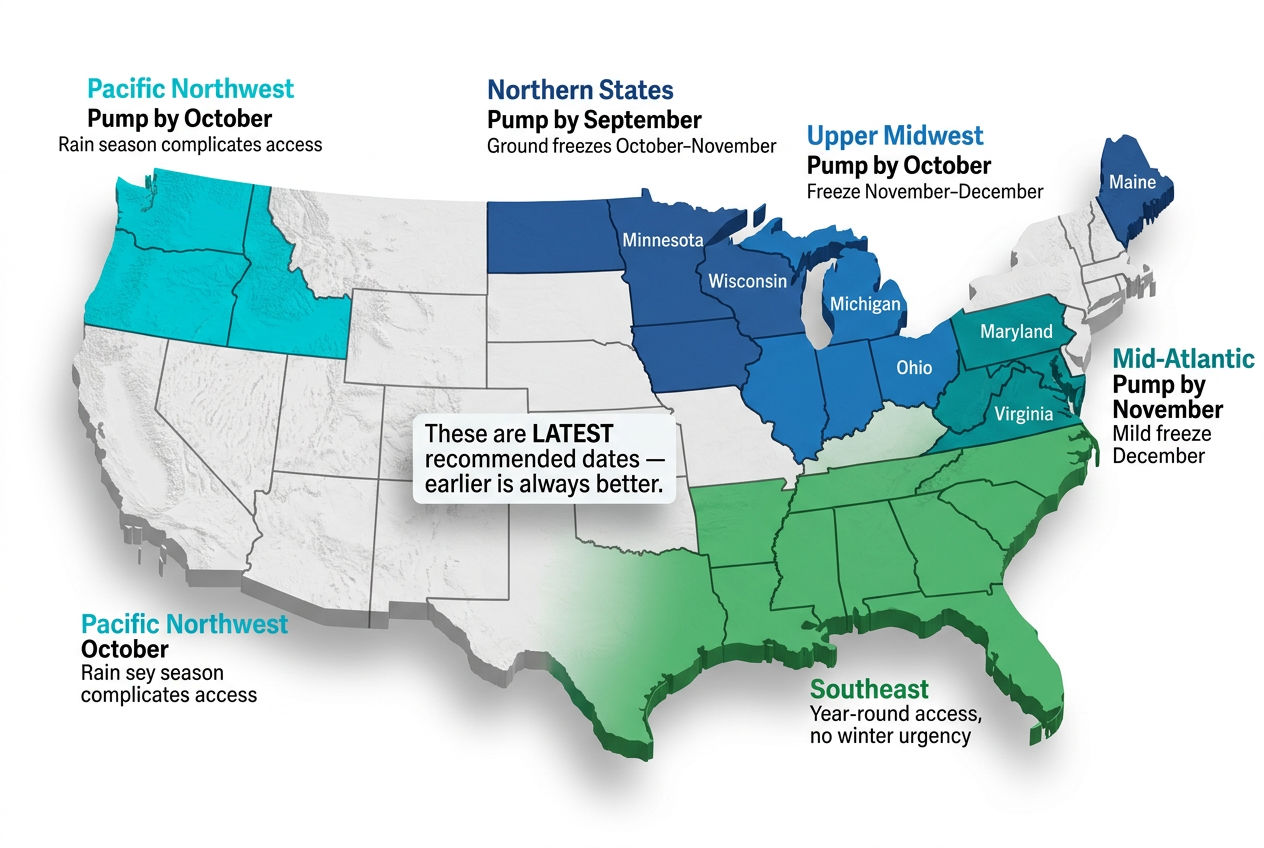
Cold climates (USDA Hardiness Zones 3–6): Yes, strongly recommended. This covers most of the Midwest, Great Plains, Northeast, and mountain West. Frost depths here range from 24 to 60+ inches, and the risk of frozen pipes, sluggish bacterial activity, and winter backups is real.
Transition zone (Zones 6b–7b - Kentucky, Tennessee, Virginia, the Carolinas): Occasional hard freezes can still cause problems, especially in elevated or rural areas. Pre-winter pumping is worthwhile if you're overdue, even if freeze risk alone doesn't demand it.
Warm climates (Zones 8+: Florida, coastal Texas, Arizona lowlands): Freeze prevention isn't your concern. That said, fall is still a reasonable time to schedule routine maintenance - contractor availability is good, and you're avoiding the summer heat that makes outdoor service less pleasant. The EPA's routine maintenance guidelines apply regardless of climate.
⚠️ Warning: If you're in Minnesota, Wisconsin, or Michigan and you've never thought about your frost line depth, this is the year to start. Find a licensed pumper in your area before the October scheduling crunch hits.
Curious about the process? Read how septic tanks are pumped.
Not sure who to call? Learn about who pumps septic tanks.
Winter odors can indicate problems - read about septic system smells and what causes them.
Frozen pipes? Our emergency septic services can help.
Find a licensed septic pumper near you before winter hits.
Learn more about our septic pumping services.
Sources & Methodology
The recommendations and cost data in this article draw from the following sources:
-
U.S. Environmental Protection Agency - Septic Systems: EPA guidelines on pumping frequency, maintenance schedules, and groundwater protection standards for onsite wastewater systems.
-
University of Minnesota Extension - Septic System Owner's Guide: Cold-climate-specific guidance on frost line depths, insulation, and winter system management. Referenced for snow insulation data and bacterial activity temperature ranges.
-
Minnesota Pollution Control Agency (MPCA): State-level guidance on licensed pumper requirements, disposal manifests, and winter system failures in northern climates.
-
National Onsite Wastewater Recycling Association (NOWRA): Industry standards for system inspection, pumping protocols, and effluent filter maintenance.
-
SepticTankHub Provider Network Data: Regional cost ranges compiled from licensed septic service professionals across cold-climate U.S. markets, cross-referenced with contractor surveys and homeowner-reported pricing.
Find a licensed septic pumping professional near you before the first freeze - search the SepticTankHub directory by state or zip code.
Need help with your septic system? Browse local septic companies in Colorado or Minnesota.
Was this article helpful?
Frequently Asked Questions
Recommended Resources
Find Septic Professionals Near You
Compare licensed, verified septic companies by area — top county markets and cities below, or browse all 50 states.
County markets
Popular cities
