
Quick Answer
You know something's off. Maybe the toilet is draining slower than usual, or there's a smell outside that wasn't there last spring. Your gut says "septic issue." But how do you actually know?
Roughly 1 in 5 American homes - about 21 million households - run on a private septic system, according to the EPA. Most of those homeowners don't think about their tank until something goes wrong. That's the problem.
Recognizing the warning signs early keeps a $400–$600 pump-out from turning into a $10,000–$30,000 drain field replacement. This article walks you through the eight most reliable signs that your septic tank needs pumping, plus the numbers and benchmarks you need to act with confidence.
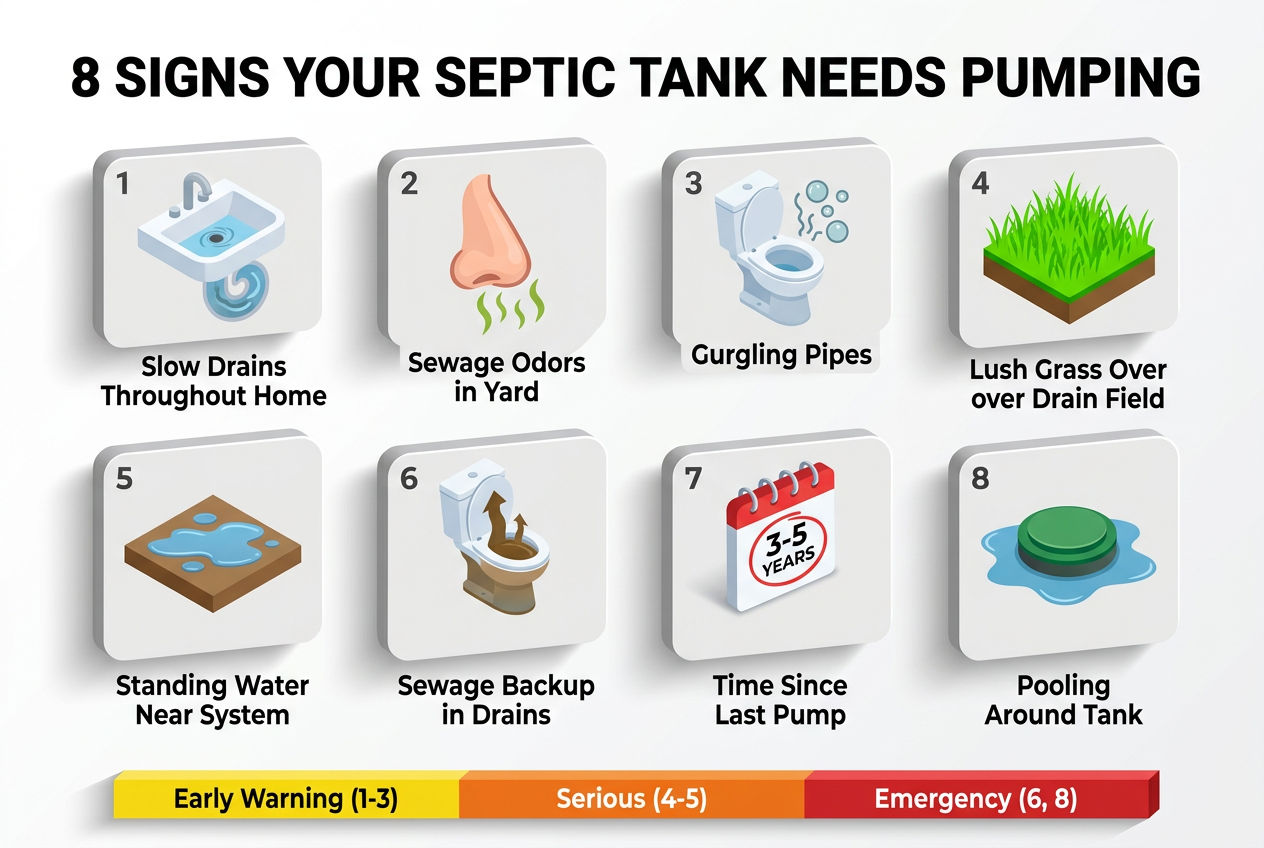
Here's a quick summary of all eight signs:
- Slow drains throughout the house
- Gurgling sounds in pipes or toilets
- Sewage odors in the yard or near drains
- Standing water or soggy ground over the drain field
- Unusually lush, green grass above the tank or drain field
- Sewage backup inside the house
- High nitrate levels in your well water
- It's been more than 3–5 years since your last pump-out
💡 Key Takeaways
- The EPA recommends pumping every 3–5 years. A 1,000-gallon tank serving a 4-person household often needs it every 2.5–3 years.
- Slow drains affecting multiple fixtures - not just one - are one of the earliest and most overlooked septic warning signs.
- Sewage backup indoors is a plumbing emergency. Call a pumper immediately.
- A routine pump-out costs $400–$600 nationally. Ignoring the signs can lead to drain field failure costing $10,000–$30,000.
- Some counties in Florida, North Carolina, and other states mandate pumping on a set schedule - check your local health department rules.
Sign 1: Slow Drains Throughout the House
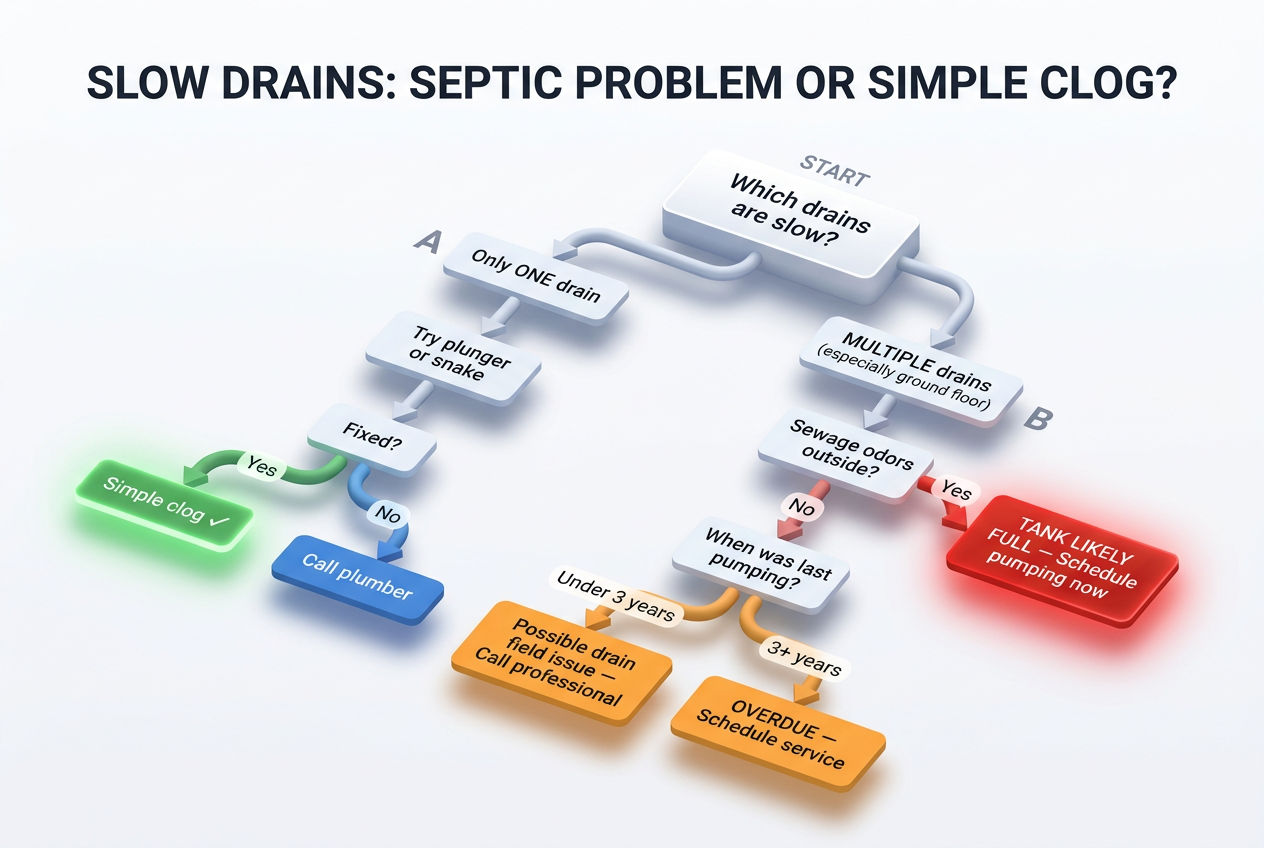
When your septic tank is nearing capacity, waste has nowhere to go - and your drains are the first place that shows up. A single slow drain is usually a clog. Slow drains in multiple fixtures at the same time? That points to the septic system.
Pay attention to whether your bathtub, kitchen sink, and laundry drain all seem sluggish within the same week. If water takes more than 30 seconds to fully clear from a fixture after use and you've already ruled out a local clog, your tank's sludge layer may be restricting normal flow.
What's Happening Inside Your Tank
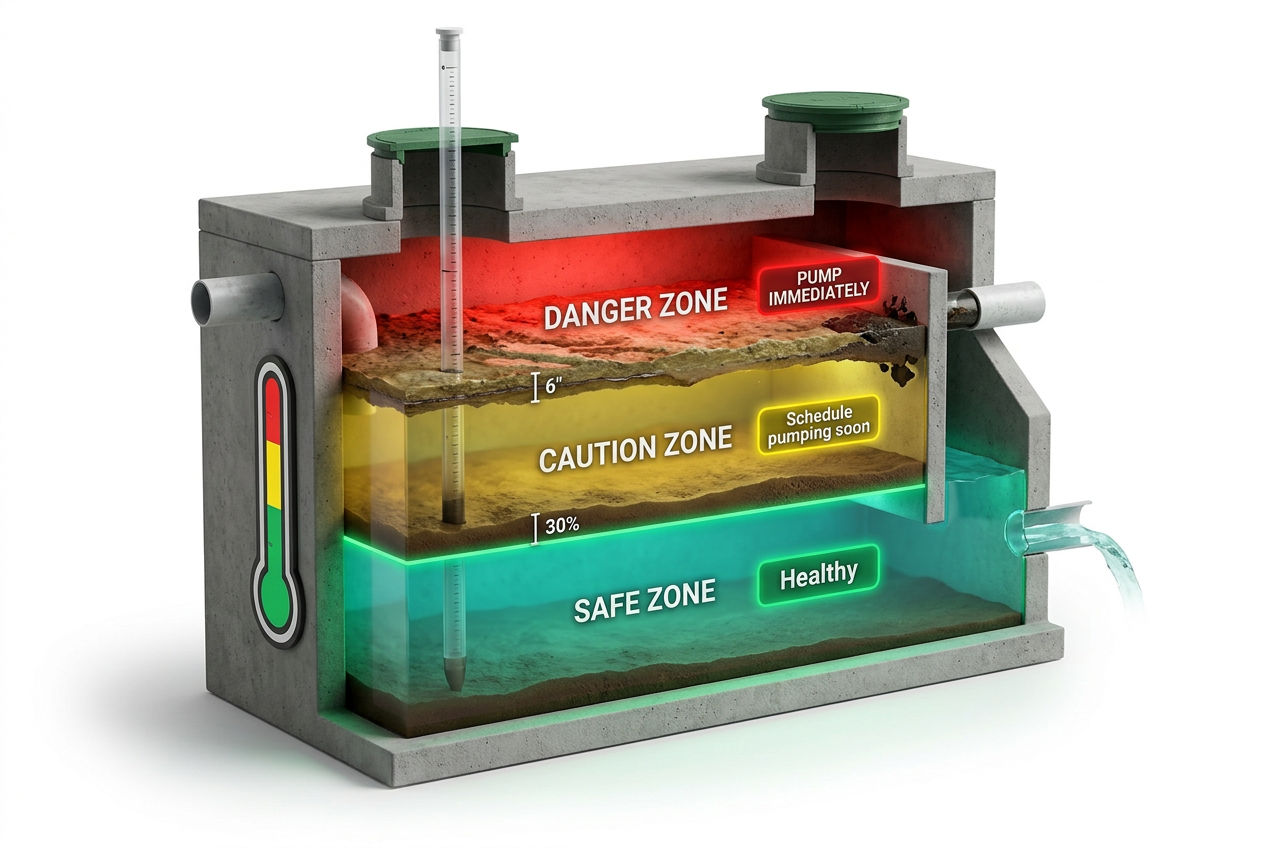
Inside every septic tank, two distinct layers build up over time:
- Bottom sludge layer - solid waste and inorganic material
- Top scum layer - fats, oils, and floating solids
- Middle liquid effluent zone - flows out to the drain field through an outlet baffle
When the sludge and scum layers together take up more than about one-third of the tank's total volume, that middle zone shrinks - and so does drainage performance.
📊 Quick Fact: Not sure what normal looks like? Our guide to how septic tanks are pumped explains the full process, including what a technician actually measures when they open your tank.
Sign 2: Gurgling Pipes and Toilets
A gurgling sound after flushing the toilet or running the dishwasher is your plumbing trying to tell you something. Our guide to gurgling sounds covers every cause and fix in detail. When the drain field or tank can't accept effluent fast enough, air gets displaced back through the pipes. That's the gurgle.
How to Diagnose the Source
- Isolated gurgling (one toilet only) → usually means a vented stack issue or minor blockage
- Gurgling that follows you from bathroom to bathroom → likely a septic system warning sign
- Gurgling when running the washing machine → hydraulic overload signal
✅ Pro Tip: This symptom often shows up 4–8 weeks before a full backup - which means you still have time to schedule a pump-out before things get messy.
Sign 3: Sewage Smell in Your Yard or Near Indoor Drains
A properly functioning septic system is odorless. Seriously - if you walked past your tank lid or clean-out pipe on a normal day, you shouldn't smell anything alarming.
So when you catch a sewage smell near your tank access lid, along the drain field lines, or coming up from your floor drains inside the house, that's a red flag. Odors typically emerge when sludge levels rise within about 6 inches of the outlet baffle, preventing gases from venting properly through the system.
What That Smell Actually Is
The smell itself is hydrogen sulfide - that classic rotten-egg odor - mixed with methane. It's unpleasant and, in confined spaces like basements, potentially dangerous. Heat amplifies it. That's why summer is peak season for odor complaints, even in systems that have been slowly filling for years.
⚠️ Warning: If you're smelling sewage inside the house - near floor drains, washing machine hookups, or in the basement - don't wait. That's Sign 6 territory (see below).
Sign 4: Standing Water or Soggy Ground Over the Drain Field
Picture this: it hasn't rained in a week, but there's a patch of squishy, wet ground right over your drain field. That's not a good sign. It means the field is saturated - either because the tank is sending more effluent than the soil can absorb, or because the drain field itself is starting to fail.
Healthy drain fields absorb liquid effluent 12–36 inches below grade. When the system is overloaded, that effluent moves upward. You end up with standing water near the drain field that can carry pathogens to the surface. If you're noticing wet spots in yard areas near your system, our dedicated guide explains what to check first.
Regional Factors That Make This Worse
- Northeast and Pacific Northwest - high water tables from snowmelt and heavy rain stress absorption capacity
- Clay-heavy areas (Alabama, Mississippi, North Carolina piedmont) - slow percolation makes saturation likely even in drier seasons
- Spring season - worst time for this symptom across most regions
📊 Quick Fact: Standing water over a drain field could mean it's time for a pump-out, or it could signal drain field failure. A licensed septic inspector can tell you which. Check out our septic inspection cost guide to understand what that process involves.
Sign 5: Unusually Lush, Green Grass Over the Tank or Drain Field
This one surprises homeowners every time. You'd think healthy green grass is a good thing - but when it's growing in a suspiciously perfect stripe above your drain field, it means the soil is receiving extra nutrients from partially treated effluent seeping to the surface.
Why Your Grass Loves a Failing System
Effluent is rich in nitrogen and phosphorus. Grass loves both. If the patch of lawn over your septic tank or drain field lines is noticeably greener and thicker than the surrounding yard - especially after a dry stretch when the rest of the lawn looks stressed - your system is likely releasing effluent higher in the soil profile than it should be.
💡 Key Takeaway: This is one of the more subtle signs your septic tank is full, and it's easy to misread as good luck. It's not.
Is your system showing more than one of these signs? Don't wait for it to get worse. Find a licensed septic pumping company near you through the SepticTankHub directory.
Sign 6: Sewage Backup Inside the House
This is the one nobody wants - raw sewage coming up through the lowest drains in your home. Basement floor drains. Bathtubs on the ground floor. First-floor toilets that won't flush.
Sewage backup is the most urgent of all septic tank overflow symptoms. It means the tank is full, the outlet is blocked, or both. At this point, wastewater has nowhere to go except back into your living space.
Emergency Response Steps
- Stop using all water immediately - no flushing, no laundry, no running sinks
- Call an emergency septic pumping company - not sure who pumps septic tanks? Our guide walks you through the types of professionals who handle this work
- Expect premium pricing - many charge $600–$1,000+ for emergency service, but there's no safe alternative
⚠️ Warning: Sewage contains fecal coliform bacteria, E. coli, hepatitis A pathogens, and nitrates. The EPA classifies a failed system discharging raw sewage as an active public health hazard.
After the backup is resolved, get a full septic inspection to determine whether the backup was caused by a full tank alone or whether the drain field has been compromised.
Sign 7: High Nitrates in Your Well Water
This one requires a water test to detect, but it's worth knowing - especially if you rely on a private well. When a septic system is failing or overflowing, inadequately treated effluent can migrate through the soil and into groundwater. Nitrates are one of the primary contaminants.
The Numbers That Matter
- EPA's maximum contaminant level (MCL) for nitrates in drinking water: 10 mg/L (milligrams per liter)
- Levels above that pose a direct health risk, particularly for infants and pregnant women
- If your annual well water test shows elevated nitrates and you haven't identified another source (fertilizer runoff, livestock), your septic system is a likely culprit
✅ Pro Tip: If you're on a well and a septic system - which is common in rural areas across the Midwest, Southeast, and Appalachian regions - annual water testing is simply good practice. The University of Minnesota Extension recommends testing private wells annually for nitrates, coliform bacteria, and pH.
Sign 8: It's Been More Than 3–5 Years Since Your Last Pump-Out
Sometimes the most important sign has nothing to do with symptoms. It's just the calendar.
The EPA recommends pumping most residential septic tanks every 3–5 years. But that range assumes average household usage. The real number depends on tank size and household size:
| Tank Size | Household Size | Estimated Pumping Frequency |
|---|---|---|
| 750-gallon | 2 people | Every 4–5 years |
| 1,000-gallon | 2–3 people | Every 3–5 years |
| 1,000-gallon | 4–5 people | Every 2.5–3 years |
| 1,500-gallon | 4–6 people | Every 3.5–5 years |
| 1,500-gallon | 6+ people or garbage disposal | Every 2–3 years |
Source: EPA SepticSmart Program; University of Minnesota Extension
Factors That Shorten Pumping Intervals
- Garbage disposal use - sends significantly more organic solids into the tank; some estimations cut effective pump-out intervals nearly in half
- Heavy laundry loads - more than 8–10 loads per week stresses hydraulic capacity
- Household size increases - more people = faster accumulation
📊 Quick Fact: If you genuinely don't know when your tank was last pumped, call a licensed pumper and have them use a sludge judge - a clear acrylic measurement tube that they lower into the tank to measure both layers. If the sludge and scum layers together exceed roughly one-third of the tank's capacity, it's time.
For a deeper look at maintenance schedules and what affects them, our guide on how often to pump a septic tank covers every variable worth knowing.
What Happens If You Don't Pump Your Septic Tank?
Skipping pump-outs isn't just an inconvenience - it's a slow-motion system failure. Here's the progression:
The Failure Timeline
- Stage 1: Slow accumulation - sludge and scum accumulate past the one-third threshold; drainage slows; you get the symptoms described above
- Stage 2: Outlet compromise - sludge begins reaching the outlet baffle and entering the distribution box that feeds the drain field laterals
- Stage 3: Field clogging - once solid waste clogs the distribution box or the leach laterals themselves, the drain field is compromised
- Stage 4: Biomat formation - a dense, nearly impermeable layer of organic material forms along the soil interface, shutting down absorption
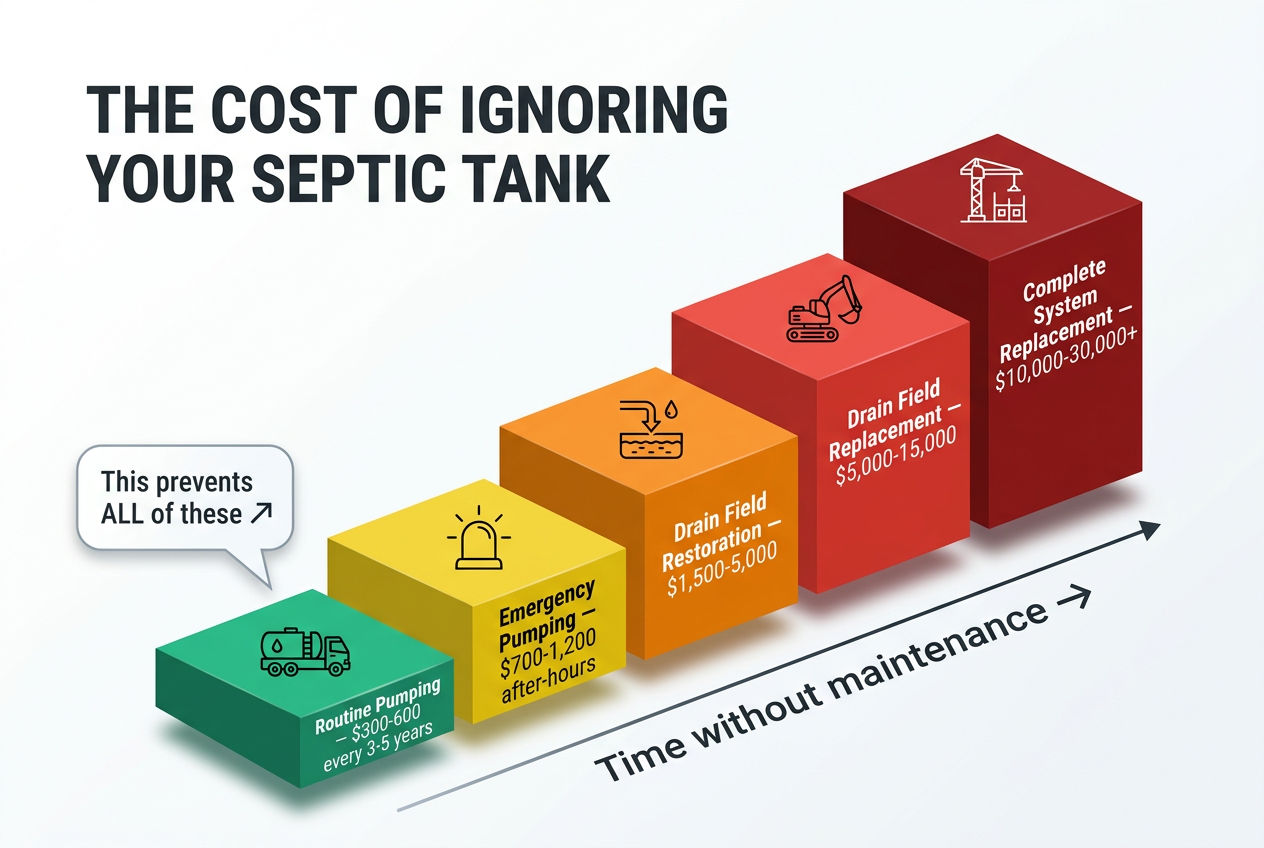
⚠️ Warning: Replacing a failed drain field runs $10,000–$30,000 depending on system type, soil conditions, and local regulations. A mound system replacement in the upper Midwest often exceeds $20,000. Compare that to a routine pump-out at $400–$600, and the math is straightforward.
For a full breakdown of what those repairs actually cost, see our drain field replacement cost guide. To see what neglect really costs over 30 years, our cost infographic lays out the complete financial picture side by side.
Can You Check Your Septic Tank Level Yourself?
You can - to a degree. If your tank has a risered access lid at grade (a plastic or concrete collar bringing the lid up to ground level), you can remove it carefully and visually inspect the tank with a flashlight.
What You're Looking For
- Scum layer thickness - has it grown thick enough to approach the outlet baffle?
- Liquid level - does it look abnormally high?
The Professional Tool
A proper measurement requires a sludge judge - a 6-foot clear acrylic tube that you lower to the bottom of the tank and then pull up, which traps a column of material showing you the exact sludge layer thickness.
- Professionals carry these as standard equipment
- You can buy one for around $30–$60 online if you want to monitor your system between professional visits
What You Cannot Do Yourself
- Assess baffle condition
- Check the effluent filter (if your system has a Polylok PL-122 or similar)
- Evaluate drain field saturation accurately
✅ Pro Tip: If you're curious about what the professional process actually looks like from start to finish, our article on what to expect during septic tank pumping walks through the whole visit.
How Much Does It Cost to Pump a Septic Tank?
A standard residential pump-out for a 1,000-gallon tank runs $400–$600 nationally in 2025, based on current contractor pricing data. The range is wide because geography matters enormously.
Regional Cost Examples
- Central Florida - $275–$375 for a 1,000-gallon tank
- Rural Minnesota - $350–$500 for the same tank (reflecting longer drive times and shorter seasonal access windows)
Cost-Increasing Factors
- Large tanks (1,500+ gallons)
- Systems with pump chambers
- Tanks requiring excavation to locate buried lids
- Emergency service calls (9 p.m. sewage backup) - routinely run $700–$1,000+
See our full septic pumping cost guide for regional breakdowns and a list of factors that affect your final bill.
A Note on Seasonal Timing
Spring is the best time to schedule a pump-out if you're in a proactive mode. Snowmelt raises water tables, which stresses drain fields - having your tank empty heading into a wet spring reduces pressure on the entire system.
Regional Timing Strategies
| Region | Best Pumping Window | Why |
|---|---|---|
| Northeast & Pacific Northwest | March–May | High water tables from snowmelt; latent winter problems become visible |
| Southeast (FL, GA, Carolinas) | Year-round concern | Sandy soils drain fast, but high water tables after heavy rain saturate drain fields quickly |
| Northern climates | October–early November | Pump before ground freezes; avoid emergency service in February |
📊 Quick Fact: Our guide to septic tank pumping in winter covers what to do if you're already past the fall window.
Prevention: What to Do After Your Tank Is Pumped
Getting pumped is the fix. Not getting pumped again in six months is the goal. A few habits make a real difference:
Essential Maintenance Habits
- Track your last service date - write it on the tank lid with a paint marker or keep the service receipt
- Use water efficiently - high-efficiency toilets (1.28 gallons per flush) and front-load washers significantly reduce hydraulic load
- Avoid flushing anything other than toilet paper - wipes (even "flushable" ones) don't break down in the tank
- Keep heavy vehicles off the tank and drain field area - compacted soil crushes drain field laterals
- Skip the additives - products like Rid-X add beneficial bacteria, but peer-reviewed research from the University of Arkansas shows they don't replace pumping; if your tank is already struggling, no additive reverses biomat clogging in the drain field
For a complete checklist, our septic tank maintenance guide covers both do's and don'ts in detail.
Learn more about our septic pumping services.
Related reading: septic system smell.
Sources & Methodology
- U.S. Environmental Protection Agency - SepticSmart Program: Source for the 3–5 year pumping frequency recommendation, household prevalence data (21 million+ homes), and health classifications for sewage discharge.
- University of Minnesota Extension - Septic System Owner's Guide: Source for regional pumping frequency benchmarks, water table impacts, and well water testing recommendations for private well owners.
- University of Arkansas Cooperative Extension Service: Referenced for peer-reviewed findings on bacterial additive (Rid-X) efficacy in residential septic systems.
- National Onsite Wastewater Recycling Association (NOWRA): Industry benchmarks for sludge and scum layer thresholds, equipment terminology, and drain field assessment standards.
- SepticTankHub.com Contractor Pricing Data (2025): Regional cost ranges derived from licensed contractor listings and service quotes across the SepticTankHub.com directory network.
Reviewed for technical accuracy by a licensed septic contractor. SepticTankHub.com connects homeowners with vetted septic professionals nationwide. Find a pumping company in your area.
Free download
Not ready for the Handbook? Start with the free Fridge Card.
The Do / Don’t card the whole family can see, plus the Survival Kit: emergency flowchart, warning-sign decoder and pump-schedule card. One printable PDF.
Was this article helpful?
Frequently Asked Questions
Recommended Resources
📖 Related Articles
- How Are Septic Tanks Pumped? The Complete Process
- What Is a Septic System? How It Works (Visual Guide)
- What Is a Drain Field? (And How Does It Work?)
- The Complete Septic Tank Maintenance Guide
- What to Expect When Getting Your Septic Tank Pumped
- How Often Should You Pump Your Septic Tank?
- Should You Pump Your Septic Tank Before Winter?
- Septic Tank Gurgling Sounds: Causes and Fixes
- Wet Spot in Yard Over Septic: What It Means & How to Fix It
💰 Cost Guides
Find Septic Professionals Near You
Compare licensed, verified septic companies by area — top county markets and cities below, or browse all 50 states.
County markets
Popular cities
