
Quick Answer
Septic tank pumping is the process of removing accumulated sludge and scum from your septic tank using a vacuum truck. A licensed technician locates your tank lid, inserts a hose, and pumps the contents into a sealed tanker. The process takes 30–60 minutes and costs $300–600 for most residential tanks.
Key Takeaways
- A standard pump-out for a 1,000-gallon residential tank takes 30–60 minutes and costs $300–600 nationally.
- The EPA recommends pumping every 3–5 years for most households; larger families may need service every 2 years.
- Technicians do more than just pump - they also inspect baffles, check the effluent filter, and look for signs of drain field stress.
- You don't need to dig up your yard; a single access lid is all most pumpers need.
- Skipping pumping is expensive. A full septic system replacement runs $15,000–$30,000+.
If you've never had your septic tank pumped before, the whole thing can feel a little mysterious. A truck backs up to your yard. A guy runs a hose into the ground. Things happen. And somehow you're supposed to hand over $350 for it.
Here's what's actually going on - from the moment the truck pulls in to what you should do in the days after the service.
Find a licensed septic pumping company near you on SepticTankHub.com.
What Is Septic Tank Pumping, Exactly?
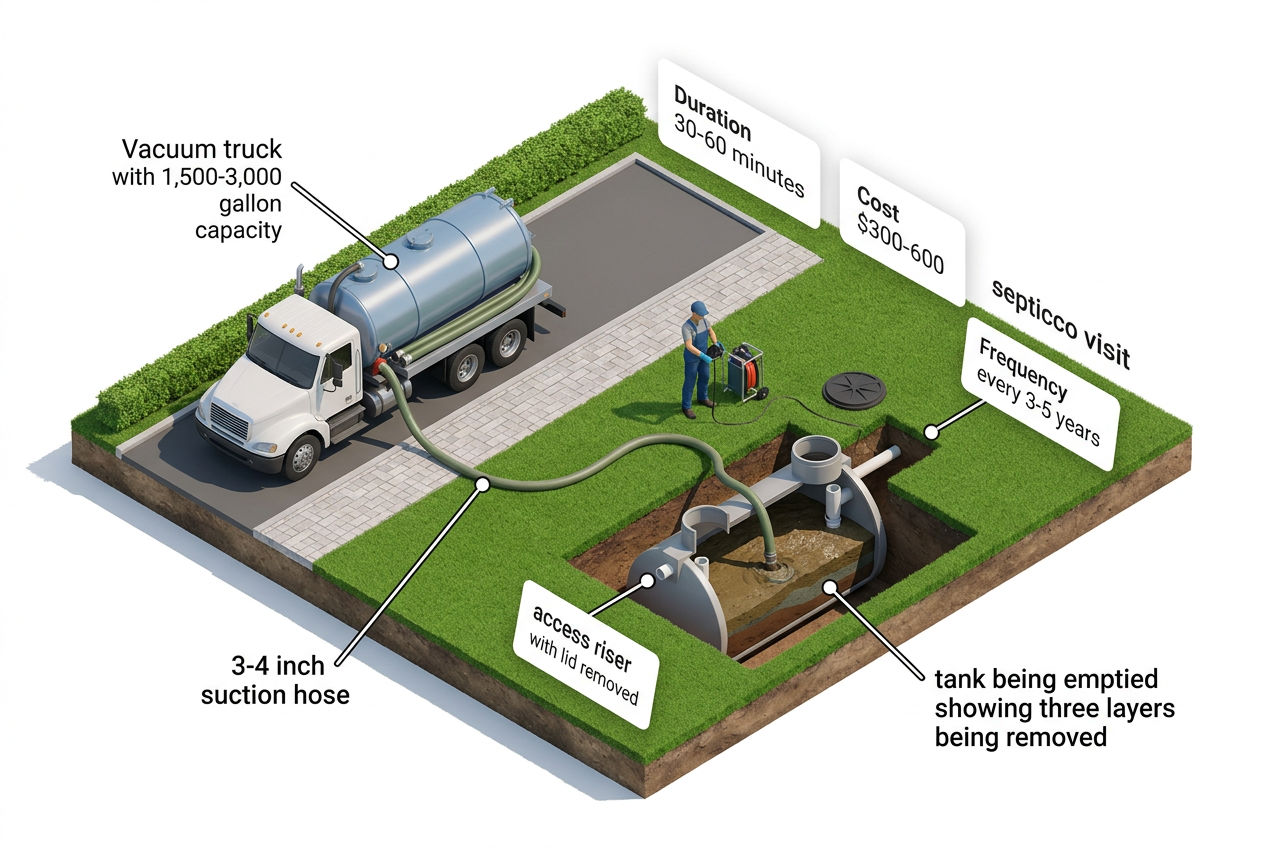
Septic tank pumping is the routine removal of the solids and semi-solids that build up inside your septic tank over time. Your tank is a buried, watertight chamber - typically made of concrete, fiberglass, or polyethylene - that receives all the wastewater leaving your home.
How Waste Separates Inside Your Tank
Inside the tank, waste separates into three layers:
- Scum layer - Fats and oils float to the top
- Effluent - Liquid wastewater sits in the middle and flows out to your drain field
- Sludge layer - Solid waste sinks to the bottom and breaks down slowly
Anaerobic bacteria handle most of the biological breakdown in the tank, but they can't eliminate everything. Sludge and scum accumulate year after year. When those two layers together occupy roughly one-third or more of the tank's capacity, it's time to pump.
⚠️ Warning: Leave it too long, and solids start washing out to the drain field - the beginning of a very expensive problem.
Pumping vs. Cleaning: What's the Difference?
This is different from septic tank cleaning, though the terms are often used interchangeably. A true cleaning involves rinsing the tank walls and agitating remaining material before it's vacuumed out. Most standard pump-outs accomplish this as part of the same visit.
Want a deeper look at how the whole system works? Start with our guide on what a septic system is.
What Happens During Septic Tank Pumping: Step by Step
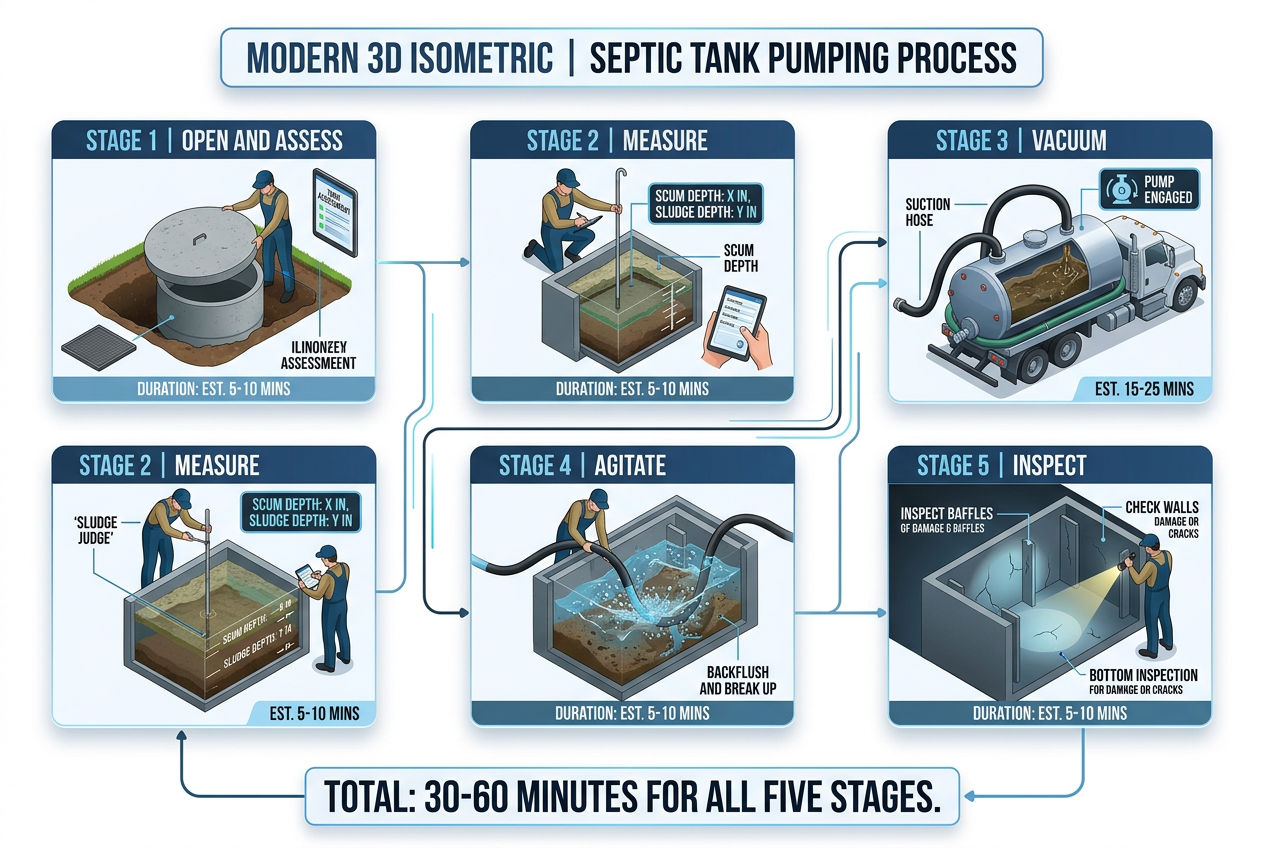
Here's the actual sequence of a typical residential pump-out.
1. Locate and Expose the Access Lid
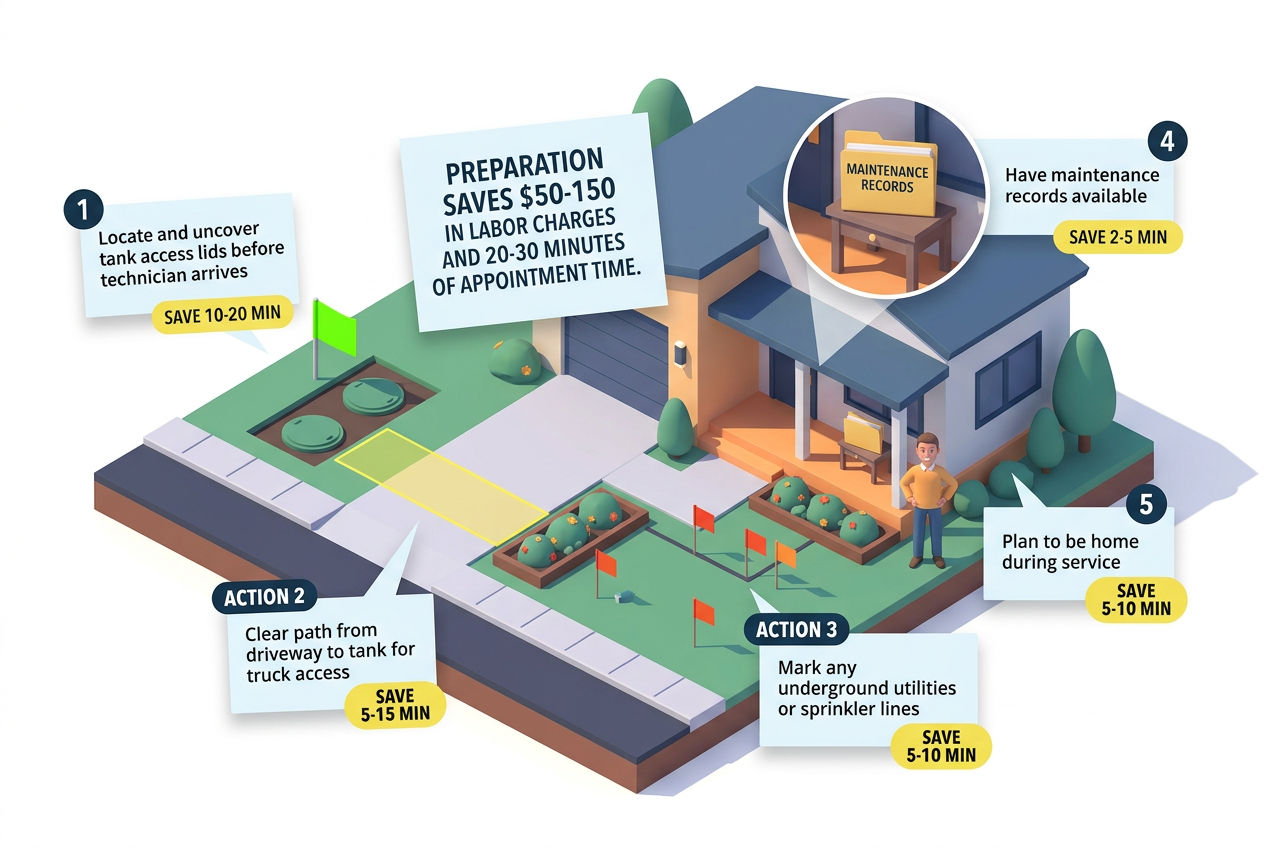
The technician starts by finding your tank's access port. If you have a riser (a PVC or concrete extension that brings the lid up to ground level), this takes about 30 seconds. Without a riser, the pumper may need to probe or dig to find the buried lid - which adds time and sometimes a fee.
2. Set Up the Vacuum Truck
The truck - typically a 2,000–5,500 gallon capacity tanker with a powerful vacuum pump - is positioned near the access point. A large-diameter hose (usually 4 inches) is run from the truck to the tank opening.
3. Pump Out the Contents
The vacuum pulls sludge, scum, and liquid effluent out of the tank simultaneously. For a standard 1,000-gallon tank, this phase takes 20–30 minutes. The technician will typically agitate the sludge layer with water from the truck to break up compacted solids before the final vacuum pass.
4. Inspect the Tank Interior
Once empty, a good technician looks inside. They're checking:
- Inlet and outlet baffles (or tees) to make sure they're intact
- Tank wall integrity - looking for cracks
- Signs of groundwater infiltration
📊 Quick Fact: A damaged outlet baffle is one of the most common causes of drain field failure.
5. Clean or Inspect the Effluent Filter
If your tank has an effluent filter - a cartridge installed in the outlet baffle to catch fine solids - the technician removes it, rinses it off, and reinstalls it. Common filters include the Polylok PL-122 and the Zabel A1800 series. This step is often skipped by budget pumpers, so it's worth asking about explicitly.
6. Assess the Drain Field
The technician may check for wet spots, odors, or standing water near your drain field, which can indicate hydraulic overload or a failing leach field. This isn't a full inspection, but an experienced pumper will flag obvious red flags.
7. Report Findings and Close Up
Before they leave, the pumper should tell you what they found:
- Sludge depth at last pump-out (if recorded)
- Baffle condition
- Filter condition
- Any concerns
Ask for a written report. Some states, including Minnesota, require licensed pumpers to file a disposal manifest with the county after every service.
For a more thorough breakdown, see our detailed article on how septic tanks are pumped.
Free download
Free: the Septic Fridge Card — what to flush, what never to.
The Do / Don’t card the whole family can see, plus the Survival Kit: emergency flowchart, warning-sign decoder and pump-schedule card. One printable PDF.
How Long Does Septic Tank Pumping Take?
Most residential pump-outs take 30–60 minutes from the time the truck arrives to the time it leaves. A straightforward job on a 1,000-gallon tank with an accessible riser lid sits at the lower end. Add complications - a buried lid that needs locating, a heavily compacted sludge layer, or a 1,500-gallon tank that hasn't been pumped in eight years - and you're looking at 90 minutes or more.
Our complete breakdown of timing factors lives in this guide: how long does septic tank pumping take?
How Much Does Septic Tank Pumping Cost in 2026?
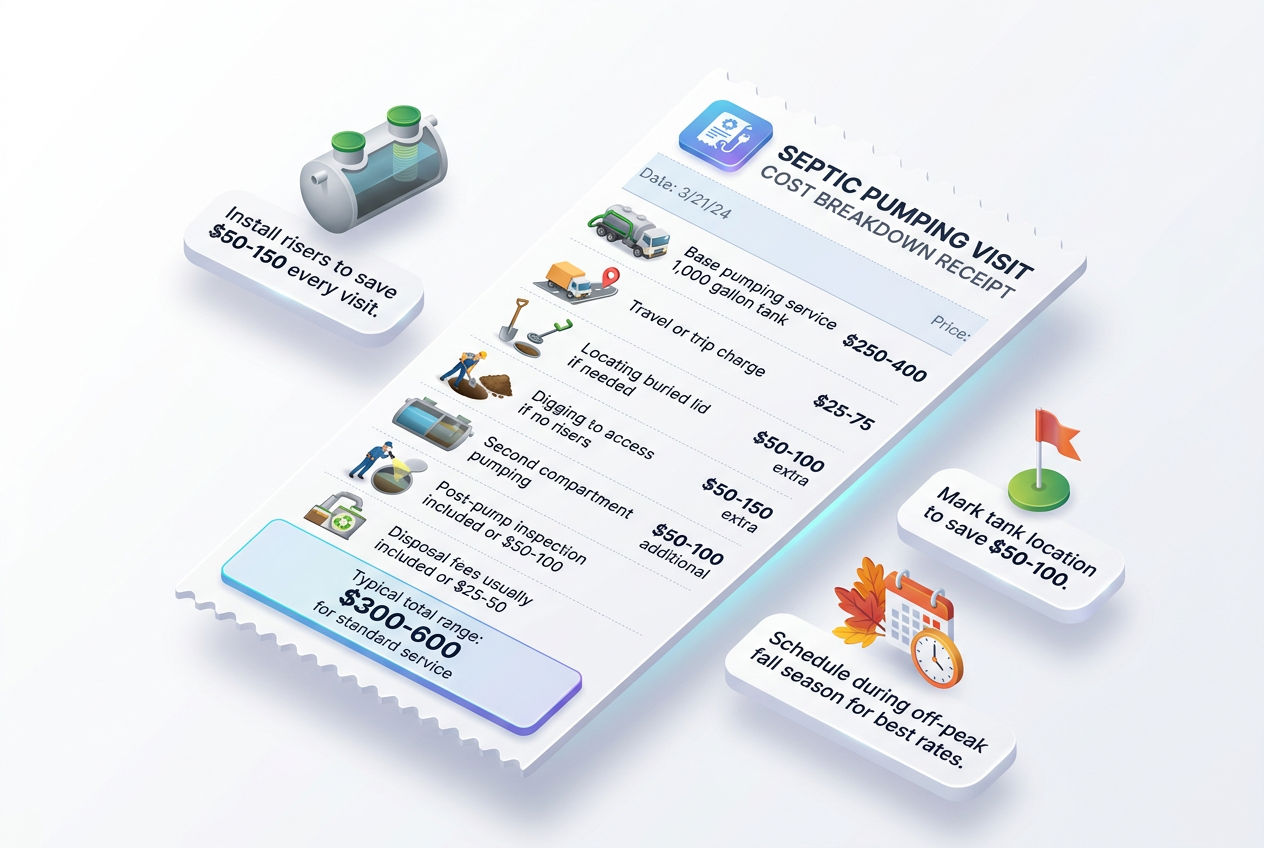
A standard pump-out for a 1,000-gallon residential tank runs $300–600 nationally, with most homeowners paying around $350–450. That said, the number moves significantly based on where you live and what your tank requires.
Regional Cost Variations
| Region | 1,000-Gallon Tank | Notes |
|---|---|---|
| Central Florida | $275–$375 | Plentiful pumpers, soft ground |
| Rural Montana/Minnesota | $400–$550 | Longer drive times, seasonal access challenges |
| 1,500+ gallon tanks | $700–$800+ | Larger capacity, more time required |
| Buried lid requiring excavation | $700–$800+ | Extra labor to locate and access |
The septic inspection that often accompanies a pump-out adds $100–300 depending on depth of assessment.
💡 Key Takeaway: Compare that to the alternative. A full septic system replacement costs $15,000–30,000+. Drain field replacement alone runs $5,000–20,000 depending on system type and local soil conditions. Routine pumping is genuinely cheap insurance.
Get the full regional breakdown in our septic pumping cost guide.
Pumping Frequency by Household Size
How often you need service depends on tank size and how many people live in your home. The EPA recommends pumping every 3–5 years for most households. That guidance assumes typical water use. Add a garbage disposal and the EPA estimates you'll cut that interval roughly in half.
Use this table as a starting point, based on a standard 1,000-gallon tank:
| Household Size | Tank Size | Recommended Interval |
|---|---|---|
| 1–2 people | 1,000 gal | Every 5 years |
| 3–4 people | 1,000 gal | Every 3–4 years |
| 5+ people | 1,000 gal | Every 2 years |
| 3–4 people | 1,500 gal | Every 4–5 years |
| 5+ people | 1,500 gal | Every 3 years |
Source: EPA SepticSmart program; intervals reflect average water use without garbage disposal.
✅ Pro Tip: The rule of thumb in the field: pump when the combined sludge and scum layers reach one-third of tank capacity. A technician can measure sludge depth with a sludge judge - a clear tube that shows exactly how much has accumulated.
Our dedicated frequency guide goes much deeper: how often should you pump your septic tank?
What Are the Signs Your Septic Tank Needs Pumping?
Some tanks quietly tell you they're overdue. Others stay quiet until something goes wrong. Common warning signs include:
- Slow drains throughout the house (not just one fixture)
- Gurgling sounds from toilets or drains
- Sewage odors inside the home or near the drain field
- Wet, spongy ground or unusually green grass over the drain field
- Sewage backup into tubs or floor drains - the most urgent warning sign
⚠️ Warning: If you're seeing any of these, don't wait for your scheduled pump-out date.
Learn more about what these signs mean and how serious each one is.
Do You Need to Be Home During the Pump-Out?
Technically, no - if the technician knows where the tank is and can access the lid. But being home for your first pump-out is worth the hour. You'll learn where your tank lid is (something every homeowner should know), you can ask the technician about baffle condition and filter status, and you'll get a verbal summary of findings while everything is fresh.
If you can't be home, make sure you've:
- Marked the access point clearly
- Left a contact number
- Arranged for the technician to leave a written report
Does Septic Pumping Require Digging Up the Yard?
Not usually. A single access lid is all most pumpers need. If your tank has a riser installed - a PVC or concrete collar that extends from the tank lid up to ground level - the technician opens it in seconds without touching the lawn.
Without a riser, the pumper may need to probe or carefully excavate a small area to find the buried lid. That's a minor nuisance, and many homeowners use the opportunity to have a riser installed so they never deal with the digging again.
💡 Key Takeaway: Risers typically cost $100–300 installed and pay for themselves in reduced labor costs over time.
Seasonal and Regional Factors That Affect Your Pump-Out
Timing your service is worth thinking about. Spring and early summer are peak booking seasons for septic pumpers nationwide. Wait until May and you might be looking at a 2–3 week lead time in busy markets. Schedule in late winter or early fall and you'll usually get quicker service.
Climate-Specific Considerations
Northeast and Upper Midwest: If you're in the Northeast or upper Midwest, winter pump-outs are possible but complicated. Frost lines in Minnesota reach 42–60 inches, and lids buried under a foot of snow take extra time (and sometimes extra money) to locate. Having a riser solves most of that.
Southeast (Florida, Georgia, South Carolina): In Florida, Georgia, and South Carolina, high water tables and sandy soils mean effluent moves through the ground quickly - which sounds good until it means your drain field is more vulnerable to overload during wet seasons. Local pumpers in those markets often recommend shorter intervals than the national average.
State-Specific Requirements
States including Maryland, Washington, and Minnesota have mandated inspection or pumping record requirements:
- Minnesota: MPCA requires licensed pumpers to file disposal records after every service
- Massachusetts: Homeowners selling a property may face a Title 5 inspection requirement that includes tank pumping
- Always check with your county health department for local rules
Not sure which rules apply to you? Find a local septic professional on SepticTankHub.com who knows your county's requirements.
What Should You Avoid Right After Getting Your Septic Tank Pumped?
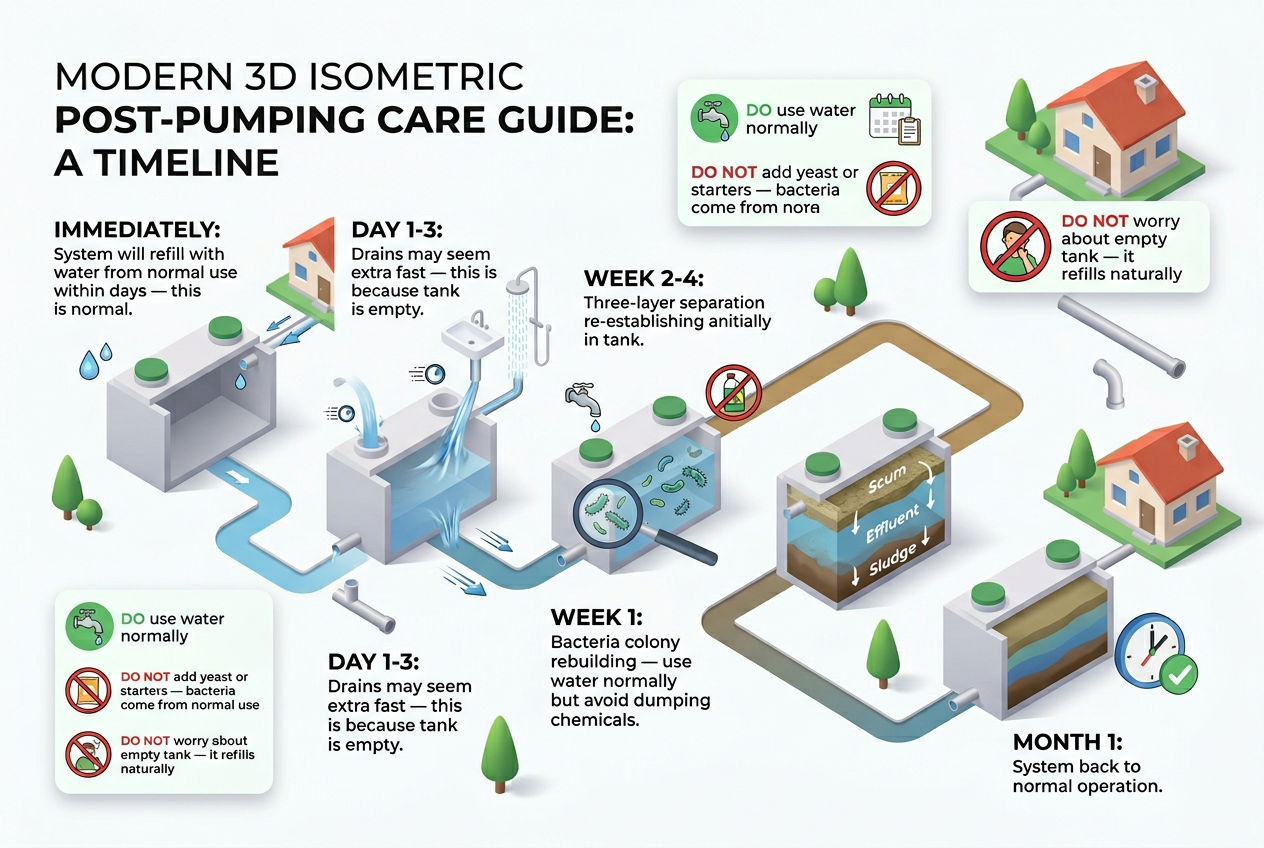
The 24–48 hours after a pump-out matter. Your tank is empty, and the bacterial colony that handles waste breakdown has been significantly reduced. Give the system time to re-establish before you stress it.
Post-Pumping Don'ts
- Avoid running multiple large water loads at once. Don't do five loads of laundry the day the truck leaves.
- Don't use harsh chemical drain cleaners. Bleach, antibacterial soaps in large quantities, and chemical drain openers can kill the anaerobic bacteria your system needs.
- Skip the septic additives. Products like Rid-X add bacterial cultures to the tank, but peer-reviewed research, including a study referenced by the National Environmental Services Center, shows they don't eliminate the need for pumping or accelerate sludge breakdown enough to matter. Save the money.
Post-Pumping Do's
- Do start a maintenance log. Record the date, tank volume pumped, sludge depth noted, and any technician findings. This history is valuable when you sell the home and when you're trying to optimize your pumping schedule.
For ongoing care between pump-outs, our septic tank maintenance guide covers everything from water use habits to what should never go down a septic-system drain.
Finding a Septic Pumper You Can Trust
About 1 in 5 U.S. households - roughly 60 million people - relies on an onsite septic system, according to the EPA. That's a big market, and quality varies widely.
What to Look For
Look for pumpers who:
- Are licensed in your state
- Carry liability insurance
- Provide written reports
- Will give you a sludge depth reading before and after service
- Hold membership in NAWT (National Association of Wastewater Technicians) or NOWRA (National Onsite Wastewater Recycling Association) - a good signal of professional standards
Our guide on who pumps septic tanks explains the different types of companies that offer this service and what credentials to look for.
SepticTankHub.com's directory lists licensed, reviewed septic professionals in your area. Search by zip code to find pumpers who know your local soil conditions, county regulations, and system types.
Learn more about our septic pumping services.
Related reading: septic system smell.
Sources & Methodology
EPA SepticSmart Program: Primary source for recommended pumping intervals (3–5 years), household size guidance, and general septic system function. Referenced for statistical data on septic system prevalence (approximately 21% of U.S. households).
Minnesota Pollution Control Agency (MPCA) - Referenced for Minnesota's licensed pumper disposal manifest requirements and frost depth data (42–60 inches) affecting winter service access.
National Association of Wastewater Technicians (NAWT): Referenced for inspection standards and technician certification criteria.
National Environmental Services Center (NESC) - Referenced for research data on bacterial additive effectiveness and peer-reviewed findings on product performance claims.
Polylok, Zabel/Sim/Tech - Referenced for effluent filter model specifications (Polylok PL-122, Zabel A1800 series) used in residential septic installations.
Cost ranges reflect national averages compiled from service provider listings on SepticTankHub.com and publicly available contractor pricing data as of 2026. Regional figures reflect market conditions in cited areas.
Published by the SepticTankHub.com Editorial Team. Content reviewed for accuracy against current EPA guidance and state regulatory standards.
Need help with your septic system? Browse local septic companies in Arizona or Washington.
Was this article helpful?
Frequently Asked Questions
Recommended Resources
📖 Related Articles
- What Is a Drain Field? (And How Does It Work?)
- What Is a Septic System? How It Works (Visual Guide)
- How Are Septic Tanks Pumped? The Complete Process
- How Long Does It Take to Pump a Septic Tank?
- How Often Should You Pump Your Septic Tank?
- 8 Signs Your Septic Tank Needs to Be Pumped
- The Complete Septic Tank Maintenance Guide
💰 Cost Guides
Find Septic Professionals Near You
Compare licensed, verified septic companies by area — top county markets and cities below, or browse all 50 states.
County markets
Popular cities
