
Quick Answer
Septic tanks are pumped by licensed septic service companies - specialists who operate vacuum trucks designed to remove accumulated sludge and scum from your tank. These aren't general plumbers or utility workers. They're a distinct category of environmental service contractor, and knowing the difference saves you time, money, and a very unpleasant surprise.
Key Takeaways
- Septic pumping is performed by licensed septic contractors, not general plumbers
- Most residential pump-outs cost $250–$600 depending on tank size and region
- The EPA recommends pumping every 3–5 years for most households
- Licensing requirements vary by state - always verify credentials before hiring
- SepticTankHub.com's directory connects you with vetted local septic service providers
Who Actually Pumps Septic Tanks?
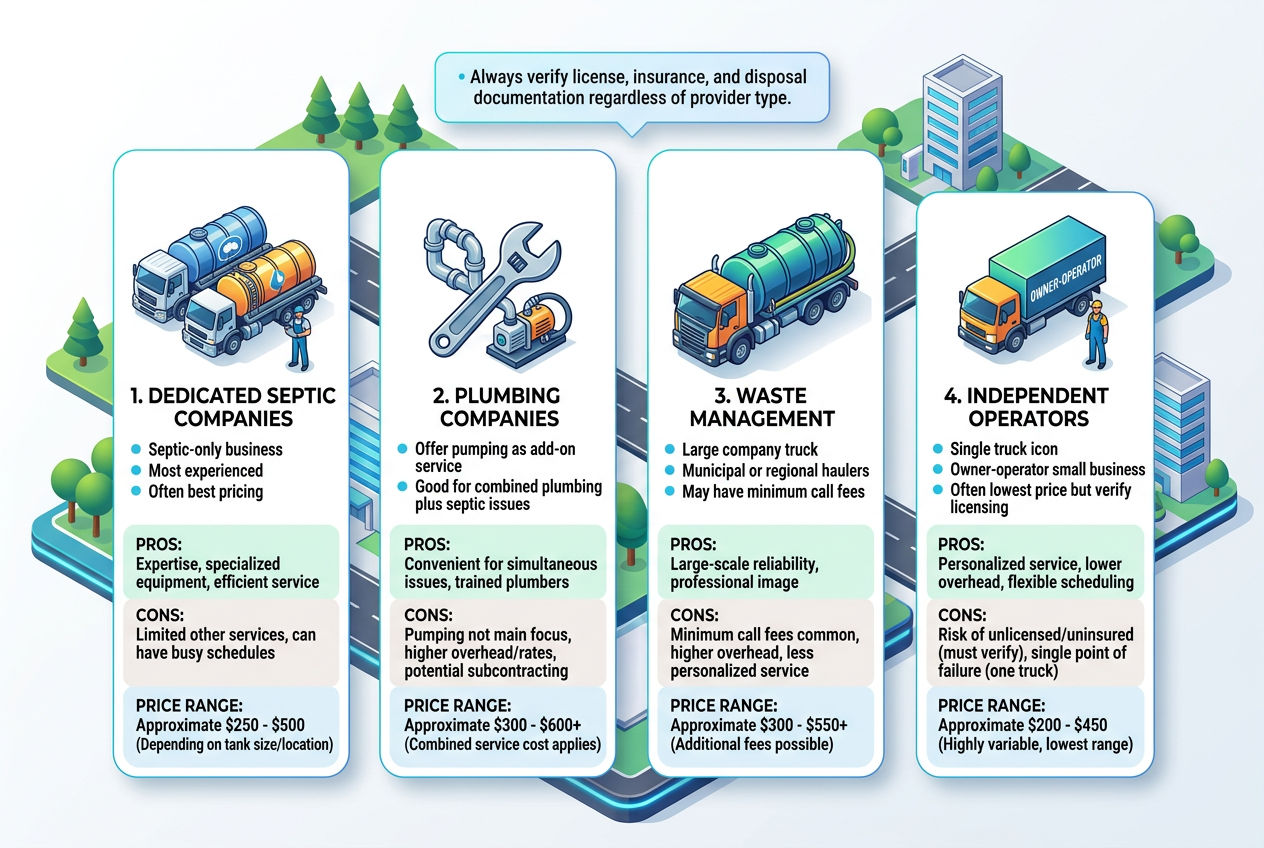
Licensed septic service companies - also called septic pumpers or septic contractors - are the professionals who handle septic tank pumping. They're trained specifically in onsite wastewater systems, operate specialized vacuum trucks, and in most states must hold a state-issued license or environmental permit to legally service your system.
💡 Key Takeaway: A general plumber is not the right call for a pump-out. Plumbers handle pipes, fixtures, and drain lines. Septic pumpers handle the tank itself - a sealed underground vessel that collects and separates household wastewater. The tools, training, and disposal requirements are completely different.
Some companies do both. A larger septic service provider might employ licensed plumbers alongside certified pumpers, offering everything from routine maintenance to septic system repairs. But when you specifically need the tank pumped, you want a company whose primary business is septic work. (Curious about that business from the other side? We break down how to start a septic tank business and whether a septic pumping business is profitable.)
In the Northeast - particularly New York, New Jersey, Connecticut, and Massachusetts - you'll also hear the term "cesspool pumping." Cesspools are older systems without a drain field, but the same type of licensed contractor handles them.
What Does a Septic Pumping Company Actually Do?
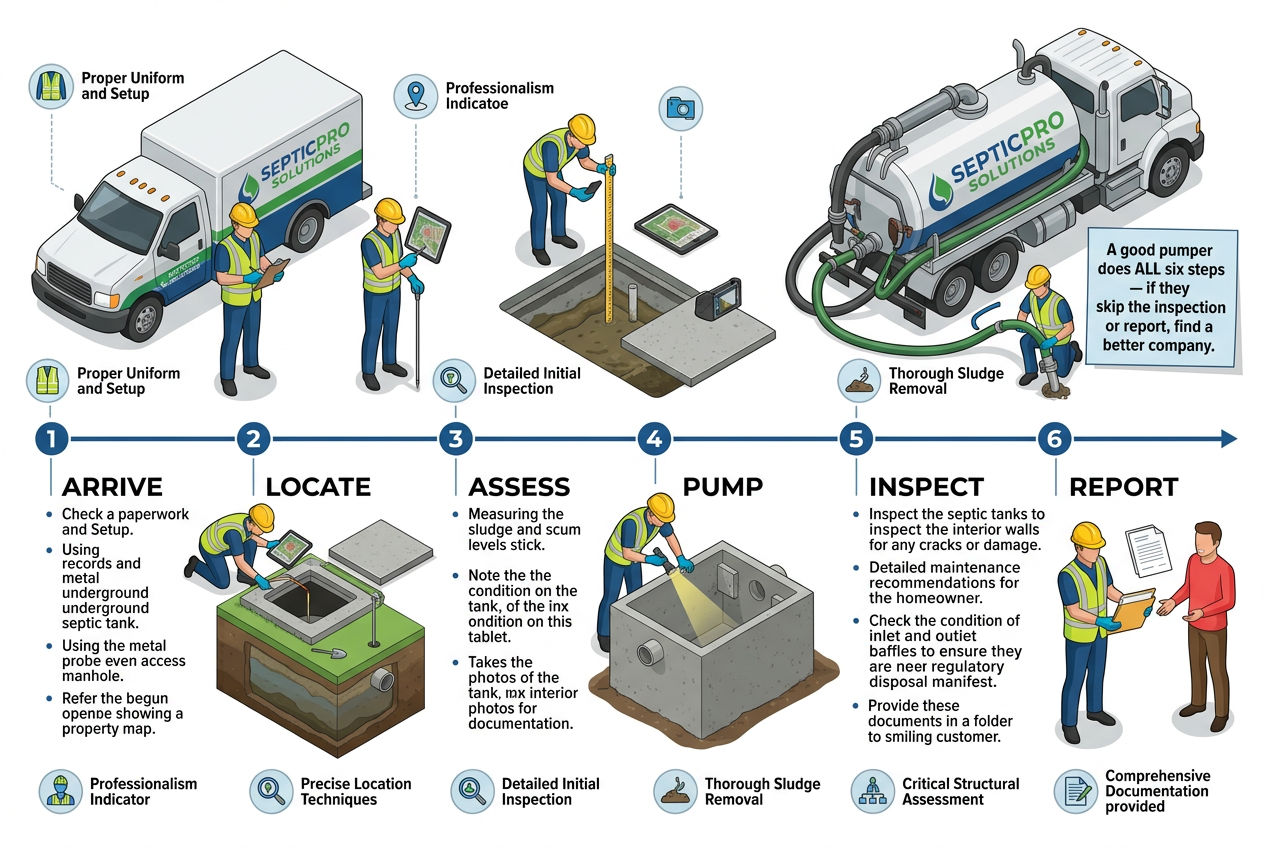
A licensed septic pumping company arrives with a vacuum truck - a specialized vehicle carrying a 2,000–5,000 gallon tank and high-powered suction equipment. Here's what happens during a standard service call:
The Pumping Process
- Access: The technician locates and uncovers your access port (or riser lid if your tank has one installed)
- Extraction: They lower a suction hose into the tank and remove the liquid, sludge layer at the bottom, and floating scum layer at the top
- Inspection: A trained technician will inspect the baffles - the inlet and outlet walls inside the tank that prevent solids from flowing into your drain field - and check the effluent filter if your system has one (common models include the Polylok PL-122)
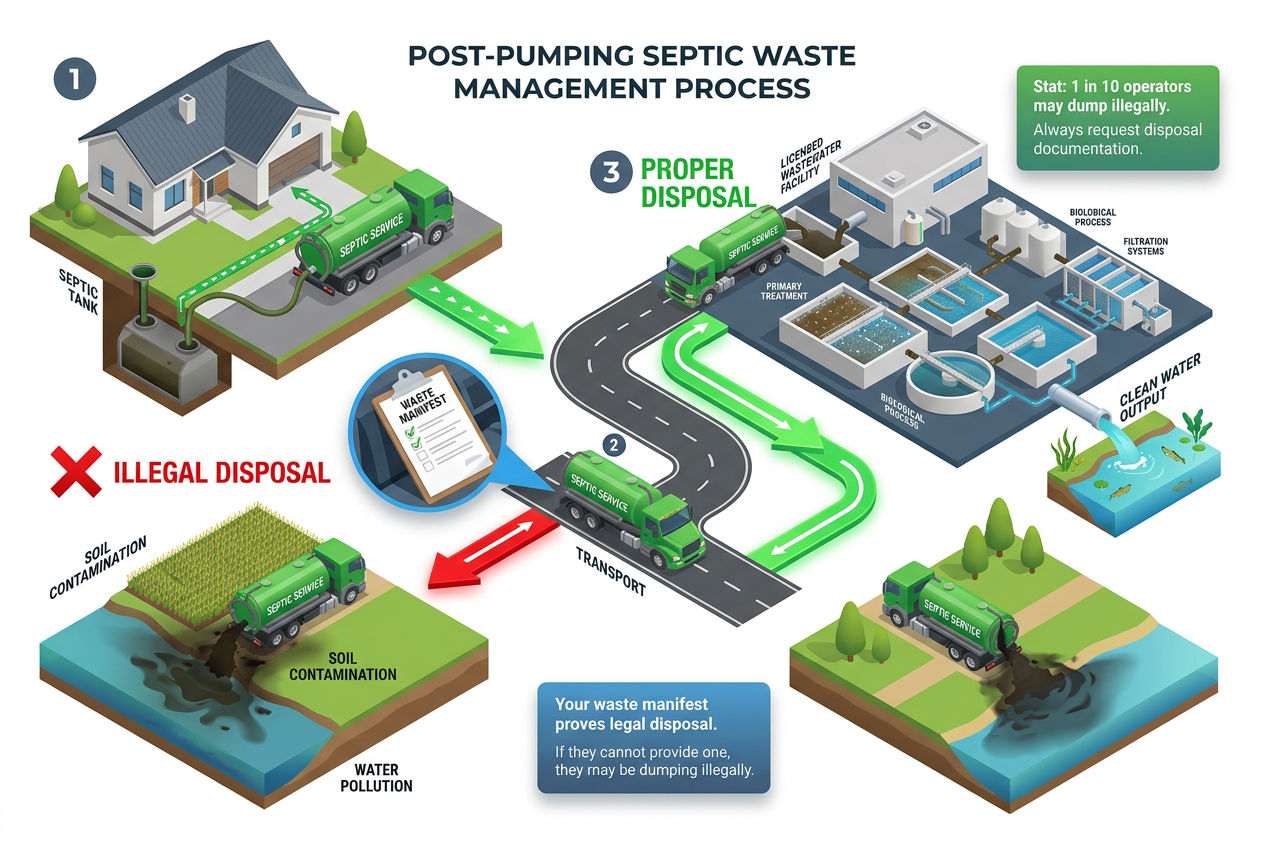
- Disposal: They haul the waste to a licensed disposal facility, typically a municipal wastewater treatment plant
The whole process takes 30–60 minutes for a standard residential tank. A 1,500-gallon concrete tank on a complex property with a buried lid might take longer.
Pumping vs. Cleaning: Understanding the Difference
📊 Quick Fact: Pumping removes the liquid and most solids. Cleaning - also called jetting or backwashing - goes further, using high-pressure water to break up hardened sludge caked on the tank walls and fully rinse the interior.
Most homeowners only need pumping on a regular schedule. Cleaning is typically recommended if the tank hasn't been serviced in many years or shows heavy buildup. Learn more about what to expect during a septic service visit.
A reputable company will also note whether your system needs a septic inspection - checking the distribution box, drain field laterals, and overall system health. Some companies bundle a basic inspection with every pump-out. Ask upfront.
How to Find a Septic Tank Pumping Company Near You
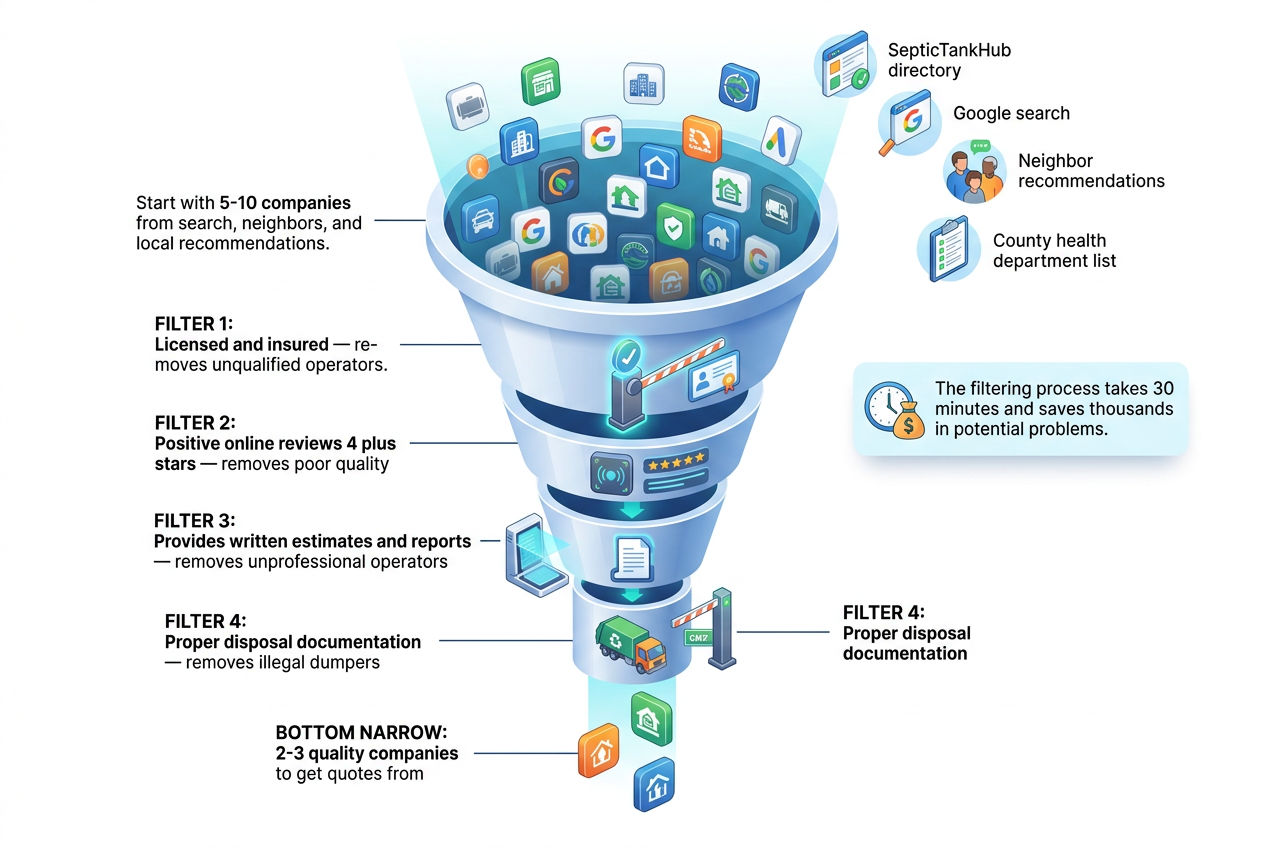
The fastest way to find a qualified septic pumping company near me is to search the SepticTankHub.com directory. It lists licensed, reviewed septic service providers across the country, organized by state and city. You can search your specific area to find local providers with verified credentials.
Three Additional Reliable Methods
Your county health department. Most counties regulate onsite wastewater systems and keep lists of licensed contractors who have pulled permits in their jurisdiction. Call your county's environmental health office and ask for a referral list. This is especially useful in states like Texas, where the county-level Designated Representative oversees septic regulation.
State licensing boards. In states with strong licensing requirements - Florida requires a Registered Septic Tank Contractor (RSTC) license through the Department of Health; Massachusetts operates under strict Title 5 regulations - you can search the state's online contractor lookup tool to verify a company's license is current before you call.
Neighbors and local Facebook groups. Septic service is hyperlocal. The company your neighbor has used for 15 years knows the soil conditions in your area, understands local regulations, and has proven equipment. Word-of-mouth referrals in rural areas are especially valuable, where fewer providers serve larger geographic zones - and where a longer service drive adds to your cost.
What Should You Look for When Hiring a Septic Pumper?
Choosing the wrong company is worse than hiring no one. Here's how to evaluate a septic service provider before you book.
Critical Qualifications to Verify
Licensing and insurance. More than 40 states require some form of license or environmental permit for septic work. Ask for the contractor's license number and verify it through your state's licensing portal. Also confirm they carry general liability insurance and, if they employ a crew, workers' compensation. An uninsured contractor working on your property is your liability problem if something goes wrong.
Experience with your system type. A conventional gravity-fed system is very different from an aerobic treatment unit (ATU) with an aerator compressor like a Hiblow HP-80, or a mound system built on fill soil. Make sure the company has worked on your specific system type.
Transparent pricing. A trustworthy company gives you a clear quote before arriving - not a low "starting at" number that doubles once they're on-site. Get the quote in writing. Ask specifically whether the price includes disposal fees, which are sometimes listed separately.
Equipment condition. A vacuum truck in poor condition is a problem waiting to happen. You don't need to inspect the engine, but a company that shows up with clean, well-maintained equipment and professional signage is telling you something about how they run their business.
Red Flags to Watch For
⚠️ Warning: Avoid contractors who display these warning signs:
- No physical business address (PO box only)
- Refuses to provide a license number
- Demands cash only
- Can't tell you where they're hauling the waste
- Quotes a suspiciously low price with vague scope
NOWRA (the National Onsite Wastewater Recycling Association) and NAWT (the National Association of Wastewater Technicians) both maintain member directories of certified professionals. Membership isn't a legal requirement, but it signals a company takes professional training seriously.
For a full checklist, see our guide on what questions to ask before hiring a septic company.

How Much Does Septic Tank Pumping Cost in 2026?
A standard residential pump-out costs $250–$600 nationally, with most homeowners landing between $300 and $450. Tank size and your location are the two biggest variables.
Real-World Cost Examples
Here's a worked example: A 1,000-gallon tank in Central Florida runs roughly $275–$375 with most licensed providers. The same 1,000-gallon tank in rural Minnesota costs $350–$500, because the service technician may be driving 45 minutes each way, seasonal ground access is limited, and disposal facilities are farther apart.
💡 Pro Tip: Emergency or after-hours pumping - say, your system backs up on Thanksgiving weekend - typically runs 1.5x–2x the standard rate. That $350 pump-out becomes $525–$700. It's one of the better arguments for scheduling regular maintenance instead of waiting for a crisis.
For a full regional breakdown, see our septic tank pumping cost guide.
Septic Tank Pumping Cost by Tank Size
| Tank Size | Typical Cost Range | Avg. Pump-Out Time | Common In |
|---|---|---|---|
| 750 gallons | $200–$350 | 20–35 min | Older homes, small lots |
| 1,000 gallons | $275–$450 | 30–45 min | 2–3 bedroom homes |
| 1,250 gallons | $325–$500 | 35–50 min | 3–4 bedroom homes |
| 1,500 gallons | $400–$600 | 45–60 min | 4–5 bedroom homes |
| 2,000 gallons | $500–$750 | 50–70 min | Large homes, commercial |
Sources: EPA Septic Systems Overview; NAWT industry cost surveys; contractor pricing data compiled by SepticTankHub.com
How Often Should You Pump Your Septic Tank?
The EPA recommends pumping every 3–5 years for most households. That's a starting point, not a fixed rule - the actual interval depends on your tank size and how many people use it daily.
Calculating Your Pumping Schedule
A 1,000-gallon tank serving a 4-person household needs pumping approximately every 2.5–3 years under normal use. Add a garbage disposal and that drops to every 1.5–2 years, because ground food waste accelerates sludge accumulation significantly. A retired couple using the same 1,000-gallon tank might go 5–6 years between pump-outs.
📊 Quick Fact: You don't know exactly when your tank needs pumping unless you measure it. A technician uses a tool called a sludge judge - a clear plastic tube lowered through the access port - to measure the sludge layer depth at the bottom and the scum layer at the top. When combined sludge and scum fill more than one-third of the tank volume, it's time to pump.
Don't Wait for Warning Signs
Don't wait for symptoms. Slow drains, gurgling pipes, and soggy ground over the drain field are signs your system is already in trouble. Learn to recognize the signs your septic tank needs pumping before you reach that point.
About 21 million U.S. households rely on septic systems, according to the EPA. Most of them are under-maintained. Regular septic tank maintenance isn't just good practice - it protects a system that costs $10,000–$30,000 to replace.
For a detailed schedule based on your household size and tank capacity, read our full guide on how often to pump your septic tank.
Do Plumbers Pump Septic Tanks?
General plumbers typically do not pump septic tanks. Plumbers are licensed to work on the pipe and fixture side of your plumbing system - from your fixtures down to the point where wastewater leaves your house. Once it enters the septic tank, that's the jurisdiction of a licensed septic contractor.
When Plumbers Do Septic Work
There are exceptions. Some larger plumbing companies have expanded into full-service septic work and employ both licensed plumbers and certified septic pumpers. If a plumbing company advertises septic pumping, ask to see their specific septic contractor license - not just their plumber's license. These are separate credentials in most states.
✅ Pro Tip: If your issue is a backed-up drain line between your house and the tank, a plumber with a snake or hydro-jetter is the right call. If the problem is inside the tank itself - or the drain field - you need a septic specialist.
Should You Be Home When the Septic Tank Is Pumped?
You don't have to be present, but it's a good idea - especially for your first pump-out with a new company. Here's why: a technician who finds a cracked baffle, a damaged effluent filter, or early signs of drain field stress should be able to show you directly and explain what it means. Seeing a problem in person is more useful than reading about it in a service report later.
If you can't be there, make sure the technician can access the tank lid (mark its location clearly), has your contact number for questions, and will provide a written service report including sludge depth readings and any issues noted.
Find a Licensed Septic Pumping Company Near You
Now you know who pumps septic tanks, what they do, and what separates a reliable contractor from a risky one. The next step is finding a qualified provider in your area.
Search the SepticTankHub.com directory to find licensed, reviewed septic pumping companies near you. Filter by state, read customer reviews, and contact providers directly - no middlemen, no runaround.
Your septic system is working quietly underground every day. The professionals who keep it running deserve to be chosen carefully.
Learn more about our septic pumping services.
Related reading: septic system smell.
Sources & Methodology
This article draws on the following primary sources:
- U.S. Environmental Protection Agency - Septic Systems Overview: Used for pumping frequency guidelines, national household statistics, and general system maintenance recommendations.
- National Association of Wastewater Technicians (NAWT): Referenced for industry cost benchmarks and technician certification standards.
- National Onsite Wastewater Recycling Association (NOWRA): Referenced for contractor membership and professional training standards.
- Florida Department of Health - Registered Septic Tank Contractor licensing requirements: Referenced for state-specific licensing credential verification.
- SepticTankHub.com contractor pricing data: Cost ranges compiled from contractor listings and regional service quotes across the SepticTankHub.com directory network.
About SepticTankHub.com: SepticTankHub.com is a national directory connecting homeowners with licensed septic service professionals. Our editorial content is reviewed for accuracy against EPA guidelines, state licensing databases, and industry standards.
Need help with your septic system? Browse local septic companies in Tennessee or Virginia.
Was this article helpful?
Frequently Asked Questions
Recommended Resources
📖 Related Articles
💰 Cost Guides
📍 Find Local Pros
Find Septic Professionals Near You
Compare licensed, verified septic companies by area — top county markets and cities below, or browse all 50 states.
County markets
Popular cities
