
Quick Answer
A septic inspection is worth the cost for most homeowners and buyers. A standard full inspection runs $300–$600 nationally, while a basic visual check costs $100–$250. Compared to the average drain field repair at $5,000–$20,000 — or a full system replacement at $15,000–$30,000+ — paying for an inspection upfront is one of the better bets in home ownership.
💡 Key Takeaways
- A basic visual septic inspection costs $100–$250; a full inspection runs $300–$600
- Your standard home inspection almost never covers the septic system — you need a separate one
- FHA and VA loans may require a septic inspection before closing
- Catching a failing drain field early can save $10,000 or more in repair costs
- The EPA recommends inspecting your septic system at least every 3 years
How Much Does a Septic Inspection Cost?
Most homeowners pay between $100 and $600 for a septic inspection, depending on what type they order, where they live, and whether pumping is included. That's a wide range — so the number that matters is the one tied to your specific situation.
Here's a breakdown of what drives that price.
Visual Inspection vs. Full Inspection
A visual inspection is the basic option. A technician looks at exposed components — tank lids, cleanout access points, yard conditions near the drain field — and checks for obvious problems. No digging, no pumping. Cost: $100–$250. It's fast, usually under an hour, but it won't catch a baffle wall that's rotted out inside a 1,500-gallon concrete tank or a partially clogged distribution box buried 18 inches underground.
A full inspection goes further. The technician locates and uncovers the tank, checks inlet and outlet baffles, measures sludge and scum layers with a sludge judge, evaluates the distribution box, and walks the drain field area. Some inspectors run water through the system to stress-test it. Cost: $300–$600. This is what most real estate transactions and mortgage lenders require.
What Does a Septic Dye Test Cost?
A dye test is often added onto a visual or full inspection. The technician flushes fluorescent dye into the system, then checks for it surfacing in the yard, in nearby waterways, or in neighboring properties. It helps confirm whether the drain field is actually dispersing effluent or backing up.
Dye test cost: $75–$200 as a standalone add-on. Some companies bundle it into full inspections at no extra charge — ask before you book.
⚠️ Warning: Dye tests can produce false negatives. If the ground is frozen, saturated from recent rain, or the drain field is simply slow, the dye may not surface even when problems exist. In the Pacific Northwest, where seasonal rainfall is heavy, some inspectors won't rely on dye tests alone between November and April.
What Does a Septic Camera Inspection Cost?
A camera inspection — sometimes called a septic scope — sends a waterproof camera through the inlet or outlet pipes to look for cracks, root intrusion, collapsed sections, or baffle damage. This is the only way to see pipe condition without excavation.
Camera inspection cost: $250–$900, depending on pipe length and system complexity. It's not always necessary, but if you're buying an older home with a system installed before 1990, it's worth the add-on. Cast iron or Orangeburg pipe from that era can fail without warning.
Septic Inspection Cost by Region
Where you live has a significant impact on what you'll pay. Labor rates, regulatory requirements, and system complexity all vary.
| Region / State | Typical Full Inspection Cost | Notes |
|---|---|---|
| Massachusetts (Title 5) | $500–$1,500 | Legally required at sale; highly regulated |
| Northeast (general) | $400–$700 | Highest labor rates; strict state regs |
| Florida | $350–$650 | High water table; mound systems common |
| Texas (aerobic ATU systems) | $400–$800 | Mechanical components add inspection scope |
| Pacific Northwest (WA/OR) | $300–$600 | Wet conditions affect dye test reliability |
| Rural Midwest | $150–$350 | Simpler systems, lower labor rates |
| Appalachian States (WV/KY) | $200–$500 | Older/unpermitted systems may complicate scope |
Sources: State health department guidance, NAWT member cost surveys, regional contractor averages
📊 Quick Fact: Massachusetts deserves a specific mention. The Title 5 inspection is mandated by the Massachusetts Department of Environmental Protection before any property sale. It evaluates the full system against the state Sanitary Code, takes 2–4 hours, and includes hydraulic loading tests. If the system fails Title 5, the seller must repair or replace it before closing — or negotiate a price reduction to cover it.
New Jersey is similar, with many municipalities requiring a septic certification at transfer, though requirements vary by township.
What's Included in a Septic Inspection?
A full septic inspection covers more than most homeowners expect. Here's what a qualified inspector should evaluate:
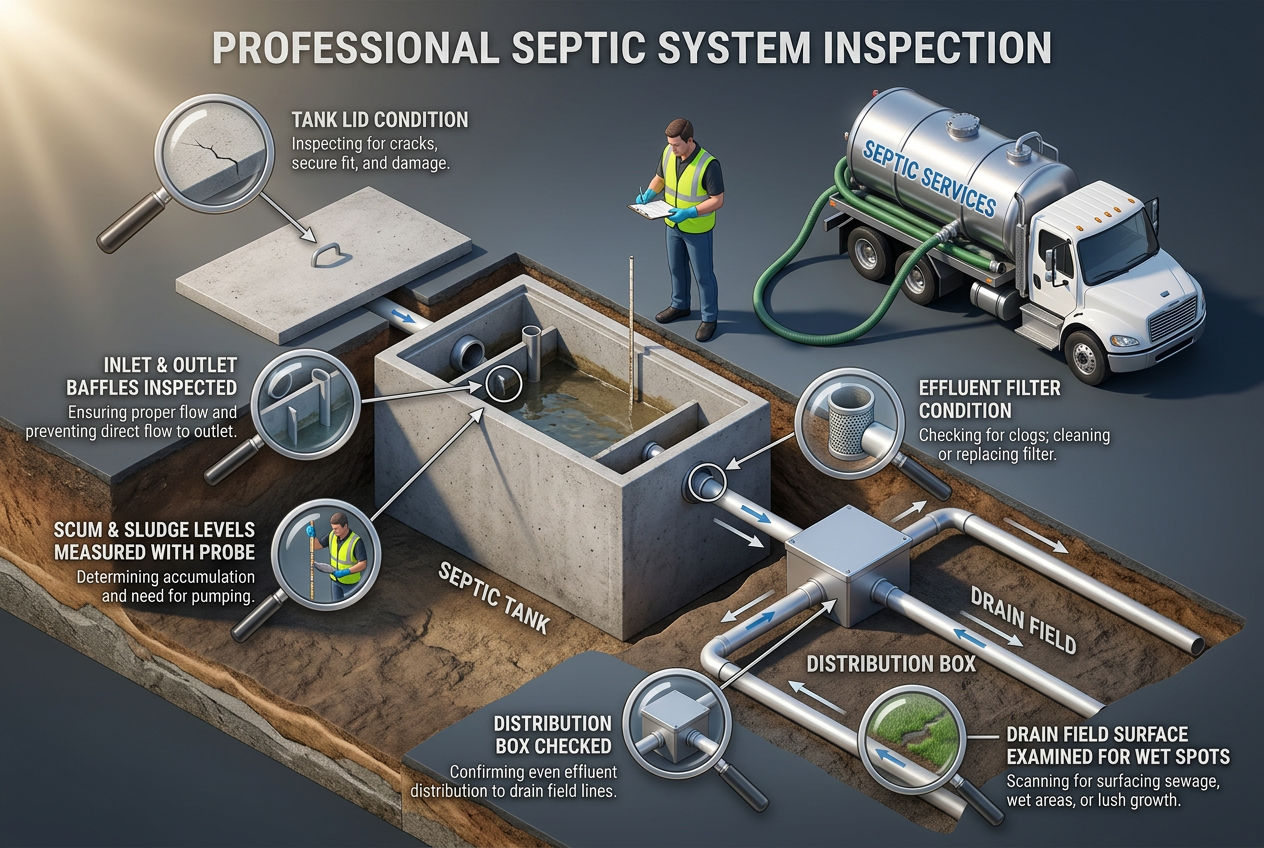
- Tank location and access — finding and uncovering the tank lid(s)
- Inlet and outlet baffles — checking for corrosion, collapse, or missing baffles; deteriorated baffles allow solids to flow into the drain field
- Sludge and scum layer measurement — using a sludge judge to determine if pumping is needed (sludge should not exceed 1/3 of tank volume)
- Tank structural condition — cracks, root intrusion, or signs of leakage in the concrete or fiberglass shell
- Distribution box (D-box) condition — even distribution to leach laterals is critical; a tilted or cracked D-box starves part of the drain field
- Drain field / leach field evaluation — visual inspection for surfacing effluent, wet spots, odors, or dead/unusually green vegetation
- Pump chamber and float switches (if present) — on systems with dosing pumps, technician checks Hiblow HP-80 or similar aerator compressors and float switch function
- Effluent filter inspection — filters like the Polylok PL-122 or Zabel A1800 should be cleaned or replaced every 1–3 years; a clogged filter can trigger sewage backup
After the inspection, you'll receive a septic inspection report — a written summary of findings, component conditions, and recommended repairs. In real estate transactions, this report goes to the buyer, seller, and often the lender.
✅ Pro Tip: For a deeper look at what a full inspection involves step by step, see our guide on the septic inspection process.
Is a Home Inspection the Same as a Septic Inspection?
No — and this is the gap that surprises homebuyers most. A standard home inspection, conducted by a licensed home inspector, covers the structure, roof, HVAC, plumbing, and electrical systems. It typically does not include the septic system.
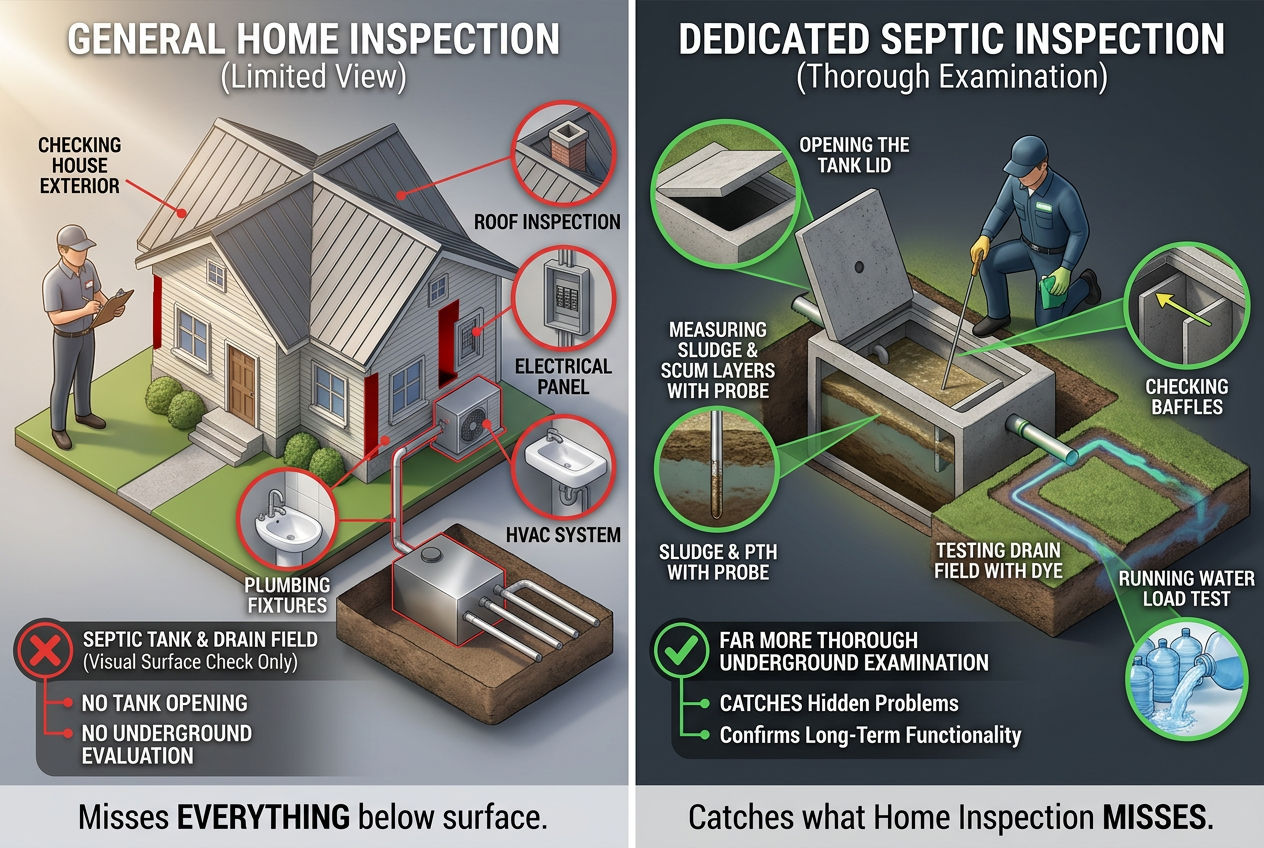
Home inspectors may note obvious red flags — like a sewage smell in the yard or wet spots near the tank area — but they are not qualified to evaluate tank condition, measure sludge levels, or assess drain field function. That requires a septic inspection by a certified septic professional, often a licensed installer or pumper with NAWT (National Association of Wastewater Technicians) certification.
⚠️ Warning: So yes — you do need a separate septic inspection. Budget for it as a standalone cost on top of your home inspection fee.
Free download
Free: the Septic Fridge Card — what to flush, what never to.
The Do / Don’t card the whole family can see, plus the Survival Kit: emergency flowchart, warning-sign decoder and pump-schedule card. One printable PDF.
Septic Inspection Before Buying a House: What You Need to Know
Buying a home with a septic system is fundamentally different from buying one connected to municipal sewer. The system is entirely your responsibility — and unlike a city sewer connection, there's no utility bill that tips you off to a problem. A failing drain field doesn't announce itself until sewage backs up into the house or surfaces in the yard.
Picture this: you're under contract on a 4-bedroom farmhouse. The asking price is $380,000. The seller discloses the system was "recently serviced" but can't produce records. You skip the septic inspection to save $400 and move faster. Three months after closing, sewage appears in the backyard. A contractor tells you the drain field has failed and the soil is saturated. Replacement cost: $18,000 — not covered by your homeowners insurance policy. That's a real scenario. Homeowners insurance rarely covers septic system failure unless you have a specific rider.
FHA and VA Loan Septic Requirements
If you're financing with an FHA or VA loan, a septic inspection may not be optional. Both loan programs require that the septic system be in good working order at the time of appraisal.
FHA requirements include minimum distance rules:
- The septic tank and drain field must be at least 50 feet from any well (100 feet in some cases)
- The system must show no evidence of failure
- If the appraiser flags a concern — odors, wet spots, proximity issues — the lender will require a full septic inspection before funding the loan
VA loans follow similar guidelines under VA Pamphlet 26-7.
Who Pays for the Septic Inspection — Buyer or Seller?
This is negotiable, but conventions vary by region and market conditions.
In most transactions, the buyer pays for the septic inspection as part of their due diligence, just like they pay for the home inspection. In competitive markets, some buyers absorb this cost to keep their offer clean.
In states with mandatory pre-sale septic certifications — Massachusetts, parts of New Jersey — the seller typically pays for the inspection and any required repairs before listing.
✅ Pro Tip: If an inspection reveals significant problems, the buyer can negotiate repair credits, a price reduction, or ask the seller to remediate before closing. A failed drain field, for example, often results in $10,000–$30,000 in negotiated credits. For more on navigating this process, see our guide on selling a house with a septic system.
Is a Septic Inspection Worth It? The Real Math
Here's the honest cost-benefit comparison:
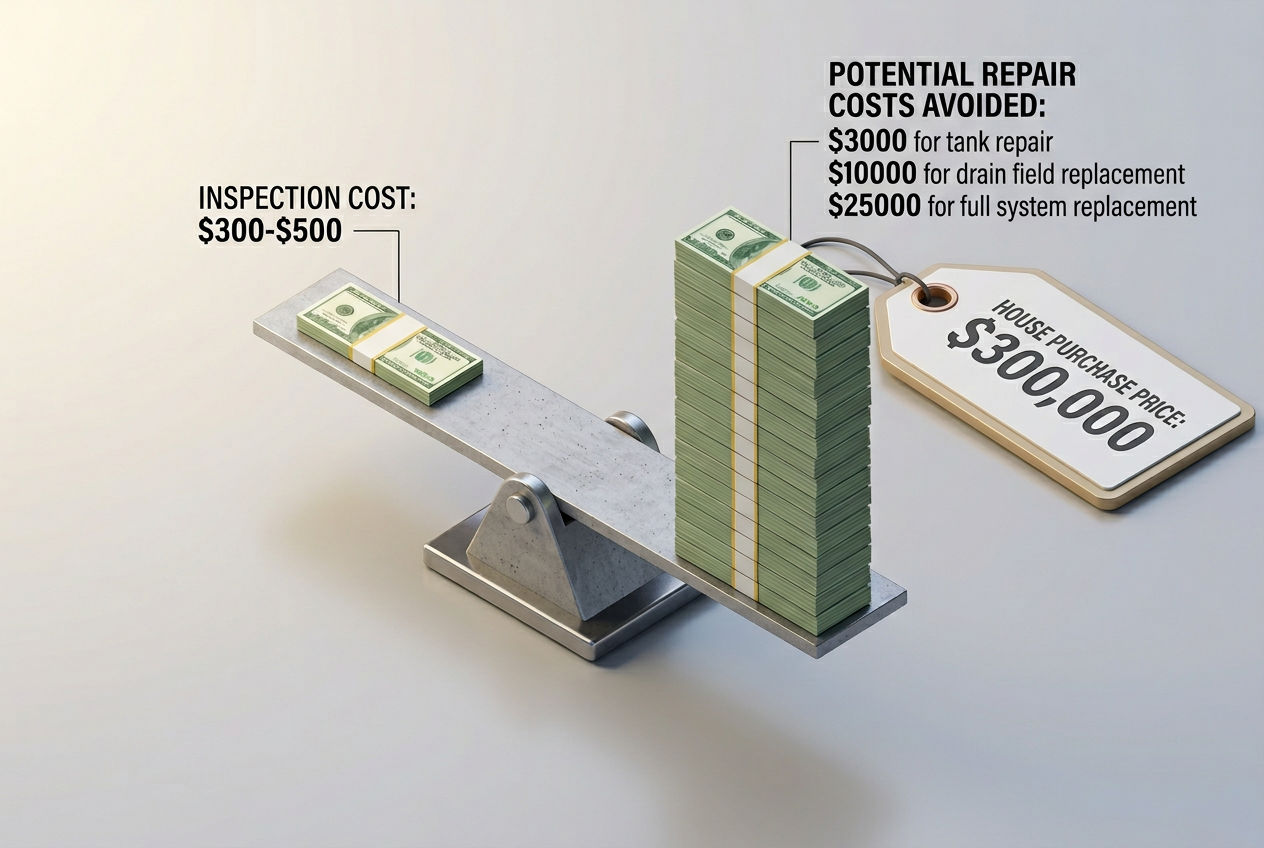
A full septic inspection costs $300–$600. A septic dye test add-on might bring that to $500–$800 total.
Now compare that to what the inspection might catch:
- Drain field repair: $5,000–$20,000
- Full septic system replacement: $15,000–$30,000+
- Emergency sewage remediation (interior backup): $3,000–$15,000
- Home sale price reduction from a failed system: $10,000–$30,000+
📊 Quick Fact: Late-1990s EPA literature estimated that 10–20% of septic systems are malfunctioning at any given time. That's not a small number. And according to EPA data, failing systems release over 1 billion gallons of wastewater into the environment annually — systems that had no idea they were failing.
A $400 inspection that prevents a $20,000 drain field replacement is a 50:1 return on prevention. Even if the inspection comes back clean, you've bought certainty — and in a real estate transaction, certainty is worth money.
For a detailed breakdown of what system failure actually costs, see our septic system repair cost guide.
When You Might Skip It
There are situations where a full inspection is lower priority:
- You're already the owner, you have maintenance records, and the system was pumped and inspected 18 months ago
- The home is on municipal sewer (obvious, but worth confirming on the listing sheet)
- You're buying a brand-new home where the system was installed and permitted within the last year
✅ Pro Tip: Even in these cases, a visual inspection every 3 years — as the EPA recommends — is cheap insurance.
How Often Should You Get a Septic Inspection?
The EPA recommends inspecting a conventional septic system at least every 3 years. For systems with mechanical components — aerobic treatment units (ATUs), pump chambers, or aerator compressors — annual inspections are standard because there are moving parts that fail.
In practice, most homeowners tie the inspection to pumping. A 1,000-gallon tank serving a 4-person household typically needs pumping every 3–4 years. Add a garbage disposal and that drops to every 2–3 years. Scheduling an inspection at the same time as a pump-out is efficient and often cheaper as a bundled service.
For more on pumping schedules, see how often to pump a septic tank.
📊 Quick Fact: If you're maintaining an aerobic septic system — common in Texas and parts of the Southeast — your system likely already requires inspections under a state-mandated maintenance contract. Texas requires ATU owners to hold a maintenance agreement with a licensed provider who inspects the system every 4 months. See our aerobic vs. anaerobic septic guide for specifics on those differences.
How to Find a Qualified Septic Inspector
Not everyone who calls themselves a septic inspector is qualified to do a full evaluation. Here's what to look for:
Certification: Look for inspectors certified through the National Association of Wastewater Technicians (NAWT) or your state's licensing board. In Florida, inspectors must hold a Registered Septic Tank Contractor (RSTC) license through the Florida Department of Health. In Massachusetts, Title 5 inspectors must be approved by the state DEP.
Experience with your system type: A conventional gravity-fed system is different from a mound system, a drip irrigation OWTS, or an aerobic ATU. Make sure the inspector has worked on your type before.
Written report: A qualified inspector always provides a written septic inspection report. If they won't commit to one, move on.
Pumping capability: Many inspectors are also licensed pumpers. Having them pump the tank as part of the inspection gives them a much clearer view of tank internals — and usually saves you money versus scheduling two separate services.
✅ Pro Tip: Use our septic inspection service directory to find licensed inspectors in your area.
What to Ask Before Booking a Septic Inspection
Not all inspection companies offer the same scope or quality. Here are the questions to ask before booking:
"Is pumping included in the inspection price?" — Many inspectors are also licensed pumpers. Bundling saves $100–$200 versus scheduling separately, and pumping gives the inspector far better visibility into tank condition.
"What type of report will I receive?" — A qualified inspector provides a written report with component conditions, measurements, photos, and repair recommendations. If they won't commit to a written report, find someone else.
"Are you certified by NAWT or your state licensing board?" — NAWT certification and state licenses ensure the inspector knows current standards. In Florida, inspectors need an RSTC license. In Massachusetts, they need DEP approval for Title 5 inspections.
"Have you inspected my system type before?" — Conventional gravity systems, mound systems, ATUs, and drip irrigation systems each require different expertise. An inspector experienced with your system type will catch issues others miss.
"Can you do a camera inspection if needed?" — Not all companies have camera equipment. If you're buying an older home, knowing the inspector can scope the pipes saves you from scheduling a second company.
Sources & Methodology
- U.S. Environmental Protection Agency (EPA) — Septic system statistics (21 million households), recommended inspection frequency (every 3 years), and estimate that 10–20% of systems malfunction at any time. epa.gov/septic
- National Association of Wastewater Technicians (NAWT) — Inspector certification standards, industry cost data, and best practices for system evaluation. nawt.org
- Massachusetts Department of Environmental Protection — Title 5 inspection requirements (310 CMR 15.000), mandatory pre-sale certification standards, and well setback distances.
- Florida Department of Health — RSTC licensing requirements and county-level septic inspection regulations.
- Texas Commission on Environmental Quality (TCEQ) — ATU maintenance contract requirements and OSSF inspection standards.
Need help with your septic system? Find trusted septic professionals near you to get free quotes. Browse local septic companies in Georgia or North Carolina.
Was this article helpful?
Frequently Asked Questions
Recommended Resources
📖 Related Articles
💰 Cost Guides
🔧 Services
Find Septic Professionals Near You
Compare licensed, verified septic companies by area — top county markets and cities below, or browse all 50 states.
County markets
Popular cities
