
Quick Answer
Here's a situation I hear about constantly: a homeowner buys a beautiful lot near a lake or in a low-lying neighborhood, gets a septic permit pulled in late summer, and then watches the system back up every single spring. The culprit isn't poor installation — it's a water table that climbed back to where it always was. A high water table septic system problem is one of the most common — and most misunderstood — challenges in residential wastewater treatment.
When groundwater sits too close to the surface, a standard drain field can't treat effluent before it reaches the water supply. The right alternative system can solve it — but it costs more and requires a specialist who knows your local conditions.
📊 Key Takeaways
- Most states require at least 24 inches of separation between the bottom of your drain field and the seasonal high water table
- A conventional septic system will fail if installed in saturated soil — effluent surfaces, sewage backs up, and groundwater gets contaminated
- Mound systems, aerobic treatment units (ATUs), and sand filter systems are the three most proven solutions for high-water-table sites
- Alternative system costs typically run $10,000–$30,000+, compared to $3,000–$10,000 for a conventional install on a site with adequate natural soil separation
- Seasonal fluctuation matters — your system must be designed for peak water table height, not average conditions
What Is a High Water Table, and Why Does It Matter for Septic?
A high water table means the saturated zone — where all the soil pores fill with groundwater — sits close to the surface of your land. On some Florida properties, that zone sits just 12–18 inches below grade. In coastal Carolina wetlands, it may sit even higher after a rainstorm.
Why does this matter for your septic system? The entire premise of a conventional drain field depends on unsaturated soil. Effluent flows out of perforated pipes into the ground, and the soil does the actual treatment: filtering pathogens, breaking down nitrogen, and dispersing water before it reaches the water table.
Aerobic biological treatment requires oxygen. Saturated soil has no oxygen-rich pore space available for that process. When groundwater is already at or near your drain field, there's nowhere for the effluent to go — it pools, it surfaces, and it backs up into your house. Beyond the obvious plumbing failure, untreated sewage reaching the groundwater directly is a public health problem that regulators take seriously, and for good reason.
📊 Quick Fact: The EPA estimates that more than 4 billion gallons of wastewater are dispersed below the soil surface daily via septic systems in the U.S. That works fine when soil conditions are right. When they aren't, that volume becomes a contamination problem fast.
How Do You Know If Your Water Table Is Too High for Septic?
The definitive answer comes from two things: a soil evaluation and a percolation test (perc test). A licensed soil scientist or septic engineer digs test pits — typically to 6–8 feet below grade — and evaluates what they find. They're looking for soil mottling, also called redoximorphic features: rust-colored or gray streaks in the soil profile that indicate where groundwater historically sits, even if it's dry the day they're digging.
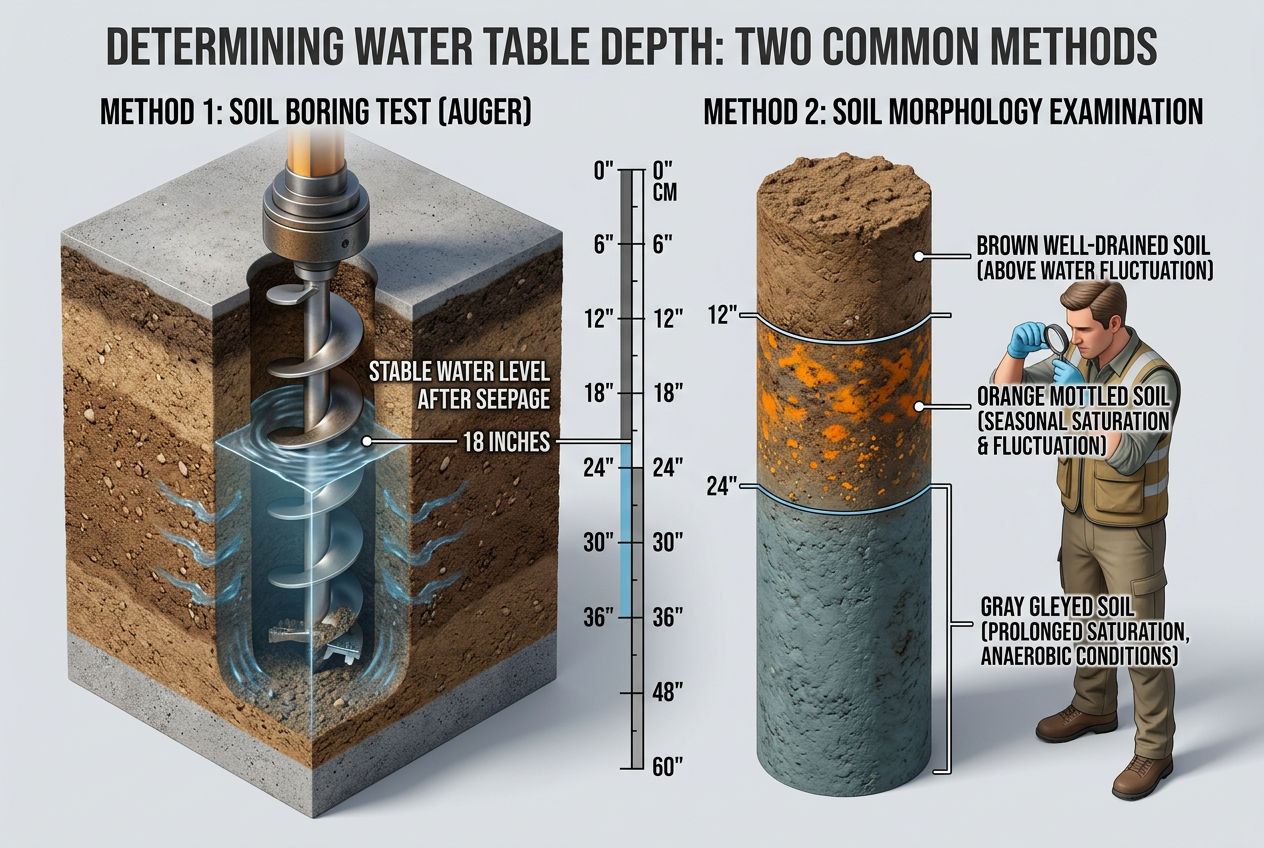
💡 Key Takeaway: Mottling is the permanent record of your seasonal high water table. Even in August, when the water table drops 2–3 feet in many regions, those soil stains tell the evaluator exactly where water reached during the spring thaw or a wet fall.
The perc test measures how quickly water absorbs into the soil. Acceptable rates for most jurisdictions fall between 1 and 60 minutes per inch. Soil that's saturated or has a restrictive layer due to a shallow water table often fails this test entirely.
Warning Signs of a High Water Table
Here are practical red flags that indicate you should call a professional before assuming you have a workable site:
- Yard stays soggy long after rain while neighboring properties dry out
- Mushy or spongy soil over your existing drain field
- Slow drains indoors during wet seasons
- Sewage odor near the drain field in spring
- A property inspection report flagging "seasonal high water table" or soil mottling
Your county health department issues the septic permit and ultimately decides whether a site passes. In states like Massachusetts, the Department of Environmental Protection's Title 5 regulations require soil evaluations to be conducted by a licensed soil evaluator — not just any contractor. Florida's Department of Health (FDOH) requires separation distances to be verified by an authorized agent before any permit is issued.
How Deep Does a Water Table Need to Be for a Septic System?
The most widely adopted minimum is 24 inches (2 feet) of vertical separation between the bottom of the drain field and the seasonal high water table.
State-Specific Requirements
Many states go further than the 24-inch baseline:
| State | Minimum Separation | Notes |
|---|---|---|
| Florida | 24 inches | FDOH requires site-specific evaluation |
| Massachusetts (Title 5) | 4 feet | Required in many soil classifications |
| Minnesota | 3 feet | MPCA standard for conventional systems |
| North Carolina | 12–24 inches | 12 inches for some alternative systems; 24 inches for conventional |
⚠️ Warning: These numbers apply to the seasonal high water table — the highest it reaches all year, not where it sits in late summer. That distinction trips up a lot of homeowners.
A contractor who perc tests your property in July and calls it fine isn't necessarily wrong about that day. Your system, though, has to survive March. This is exactly why soil mottling matters — it captures the peak level, regardless of when the evaluator shows up.

DIY Septic Blueprint
Thinking about building it yourself?
The complete, plain-English plan to size, permit and install your own septic system — designed for homeowners, not contractors. Skip the $15,000–$25,000 quotes and do it right the first time.
Get the DIY Blueprint — $67 →Instant download · 8 modules + 3 bonus guides · 60-day money-back guaranteeWhat Are the Best Septic Systems for High Water Table Areas?
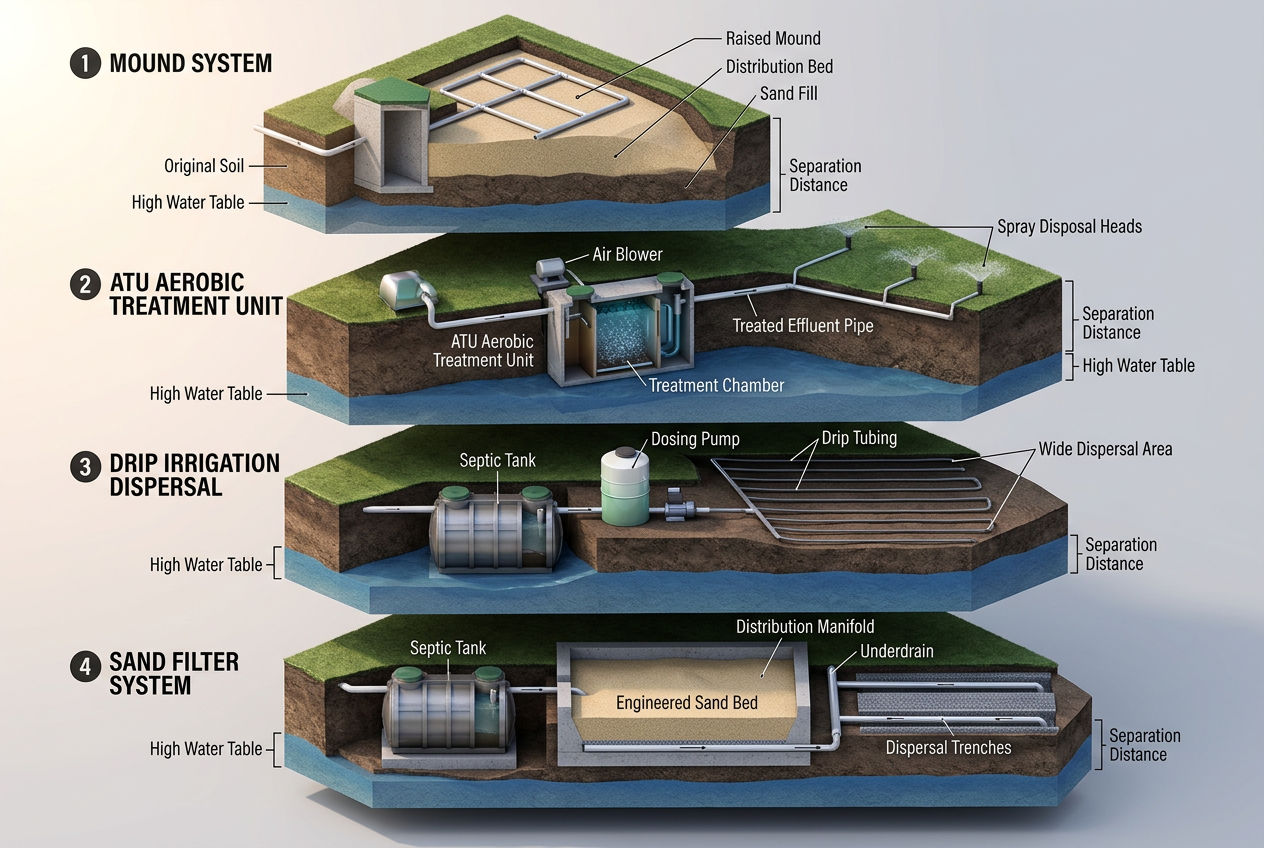
When a conventional system won't work, you have four primary options. Each solves the separation problem differently.
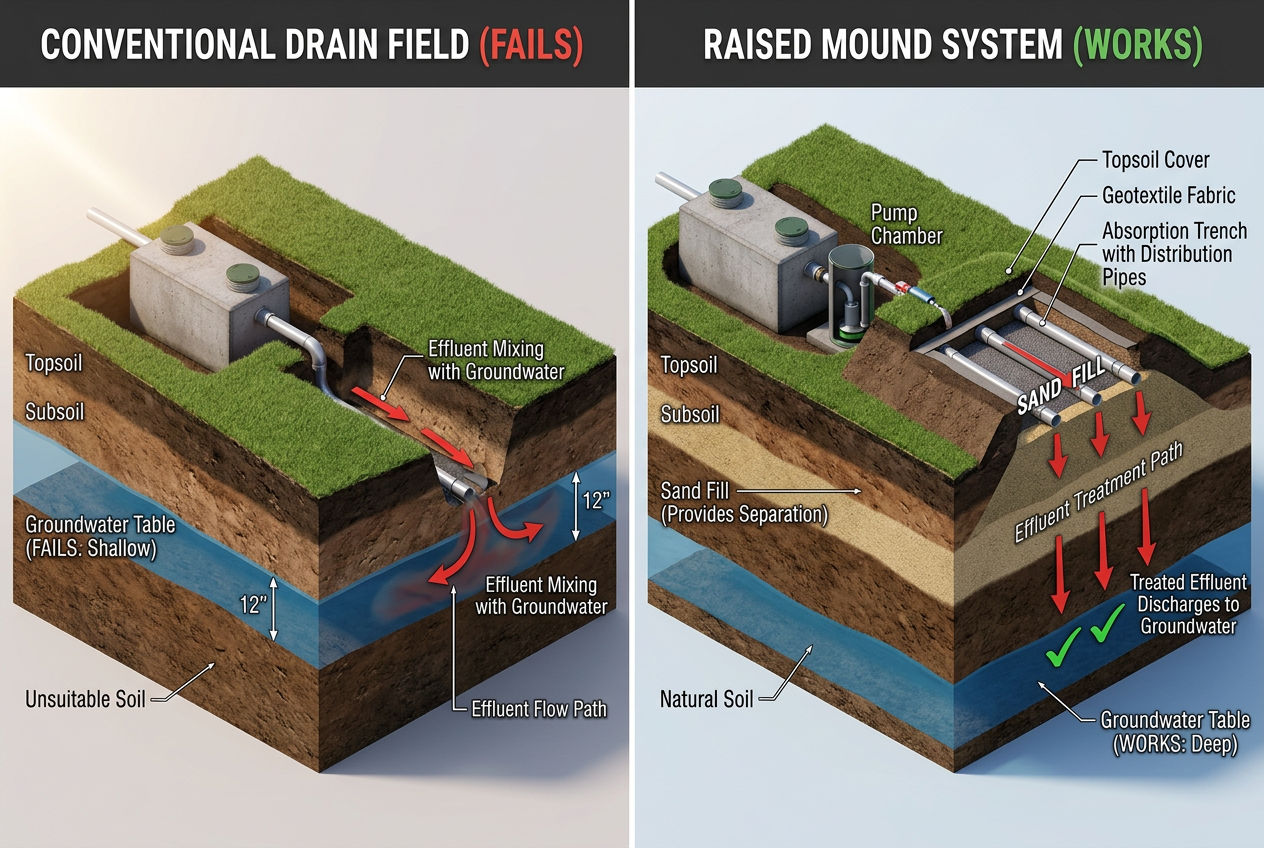
Mound Septic Systems
A mound system is the most common solution for a shallow water table septic challenge. Instead of burying the drain field below grade, installers build it above grade using 2–5 feet of engineered sand fill. The raised bed creates the vertical separation that the natural soil can't provide.
Effluent is pumped from the septic tank to a pump chamber, then pressure-dosed through small-diameter laterals across the sand bed. Gravity does the rest — treating effluent as it moves down through the sand and into native soil.
Key considerations for mound systems:
- Require enough open land to build the raised area
- Minimum setbacks from property lines, wells, and surface water add to footprint
- Expect to pay $10,000–$30,000+ depending on mound height, system size, and region
- Minnesota and Florida contractors build more mound systems than almost anyone in the country
Aerobic Treatment Units (ATUs)
An aerobic treatment unit uses an electric aerator — typically a compressor like the Hiblow HP-80 or similar blower — to inject air into the treatment tank. That oxygen supports aerobic bacteria, which digest waste far more efficiently than the anaerobic process in a conventional tank.
The effluent leaving an ATU meets a substantially higher treatment standard than conventional tank output, which is why most states allow ATU effluent to be dispersed in areas where untreated septic effluent cannot go. ATUs are popular in Texas, the Gulf Coast, and other regions with shallow water tables and restrictive soils.
✅ Pro Tip: Installed cost runs $10,000–$20,000, but factor in the $200–$500/year maintenance contract that most states require — aerobic systems need quarterly inspections and periodic component replacement.
Sand Filter Systems
A sand filter septic system passes effluent through a lined bed of coarse sand before it reaches the drain field or a surface dispersal area. The biological mat that develops in the sand does the treatment work.
Sand filters can be built at or above grade, which helps when groundwater is near the surface. Installation typically costs $7,000–$18,000. They're more common in the Carolinas and Pacific Northwest, where state programs have approved them as a cost-effective alternative to full mound systems on sites with moderate water table challenges.
At-Grade and Raised Bed Systems
Similar in concept to mound systems but less visually dramatic, at-grade systems place the drain field at natural grade and add minimal fill to achieve the required separation. These work on sites where the water table is borderline — say, 12–18 inches below grade — rather than severely shallow.
Cost typically falls in the $8,000–$15,000 range.
For a detailed look at how these types of septic systems compare to conventional installations, see our full comparison guide. If you're planning a new install or replacement, our septic system installation services page covers what the process looks like from site evaluation through permit approval.
System Comparison: High Water Table Septic Options
| System Type | Typical Cost | Water Table Clearance Achieved | Annual Maintenance | Best For |
|---|---|---|---|---|
| Conventional | $3,000–$10,000 | None (requires adequate natural clearance) | Low | Sites with 2–4+ ft natural separation |
| Mound System | $10,000–$30,000+ | 2–5 ft of engineered fill | Pump inspection annually | Most high-water-table sites |
| Aerobic Treatment Unit | $10,000–$20,000 | Requires dispersal area; effluent quality compensates | $200–$500/yr (contract) | Lots with limited footprint |
| Sand Filter System | $7,000–$18,000 | Above-grade filtering | Moderate | Moderate water table challenges |
| At-Grade / Raised Bed | $8,000–$15,000 | 1–2 ft of added fill | Low-moderate | Borderline water table sites |
Sources: NOWRA cost survey data; contractor quotes compiled by SepticTankHub.com
For a full breakdown of what drives these numbers up or down, our septic system installation cost guide walks through regional pricing, permit fees, and what to watch for in contractor bids.
Can You Lower a High Water Table to Fix a Septic Problem?
Sometimes — but it's rarely cheap, and it's almost never a permanent standalone solution.
The most common approach is French drain installation or a curtain drain system: perforated pipe buried upslope of the septic area that intercepts and redirects groundwater before it reaches the drain field zone. In the right conditions — where groundwater is flowing laterally through your lot rather than rising from a regional aquifer — this can meaningfully lower the effective water table at the drain field location.
⚠️ Warning: The honest answer is that drainage improvements work best as a supplement to an engineered alternative system, not a replacement for one. A mound system paired with upslope interception drainage is a more defensible design than drainage alone.
Your local health department won't permit a conventional system just because you added a French drain — the soil evaluation still governs. Subsurface drainage contractors in the upper Midwest and Pacific Northwest have the most experience with this combination approach. Get a soil scientist involved before you spend money on drainage work, so you know whether the groundwater you're dealing with is interceptable or comes from a regional source that no amount of pipe will address.
Will a High Water Table Damage My Septic Tank?
Yes — in ways most homeowners don't anticipate.
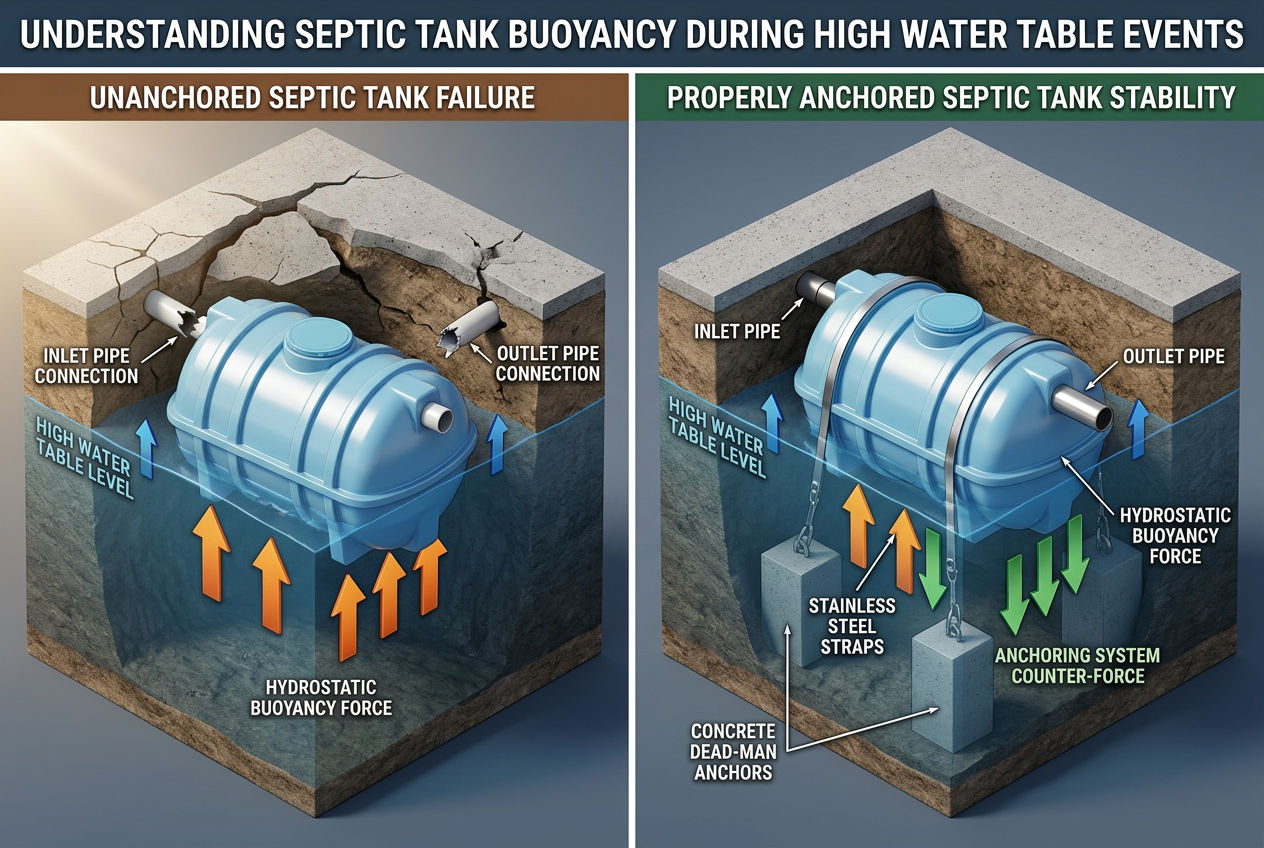
Tank Flotation Risk
The primary mechanical risk is tank flotation. A septic tank is essentially a buried vessel. When it's empty or partially empty — during a pump-out, for example — and the surrounding soil becomes saturated, the buoyant force of the groundwater can literally push the tank upward. A floated tank breaks its inlet and outlet connections, cracks the riser seals, and can tilt enough to compromise the baffle system permanently.
✅ Pro Tip: An experienced pumper working in a high-water-table area will sometimes leave a few inches of liquid in the tank deliberately to counteract buoyancy after a pump-out.
Some installers in coastal areas anchor tanks with concrete deadmen or straps before backfilling. If your tank was installed without these precautions and you're in a high-water-table zone, it's worth asking your inspector to look for signs of flotation damage during the next service visit.
Groundwater Infiltration
The second issue is infiltration. Groundwater seeping into the tank through cracked lids, compromised riser seals, or failed inlet pipe boots dilutes the tank contents and dramatically increases the hydraulic load on your drain field. A tank receiving twice its designed flow because of groundwater infiltration will push the drain field to failure faster than heavy household water use ever would.
Watch for signs your drain field is failing — slow indoor drains in wet months that recover in summer, wet spots over the field in spring, or gurgling sounds when water drains — and don't write those symptoms off as normal seasonal behavior. They're telling you something about groundwater interaction that's worth investigating.
What Happens When a Septic System Fails Due to High Water Table?
Failure isn't a single event — it's a progression, and catching it early matters.
The Four Stages of High Water Table Septic Failure
Stage 1: Hydraulic overload.
The drain field becomes saturated. Effluent can't disperse at the designed rate. Water backs up in the distribution system.
Stage 2: Surfacing effluent.
Sewage begins appearing at ground level, typically over the drain field or in low spots downslope. This is a permit violation in every state and a direct public health risk.
Stage 3: Groundwater contamination.
Untreated effluent reaches the water table. Nearby wells — yours and your neighbors' — may show elevated coliform counts, nitrate levels, or both. Remediation at this stage is expensive and slow.
Stage 4: Regulatory action.
Most counties require a failing system to be repaired or replaced within a defined window — often 30 to 90 days after the violation is documented. Operating a system in active failure can result in fines and, in some jurisdictions, an order to cease using the property until repairs are complete.
⚠️ Warning: Understanding how a flooded septic system behaves during heavy rain events gives you a clearer picture of how quickly a borderline situation can escalate — particularly if you're in a region where a single storm can raise the water table 12–18 inches in 48 hours.
The distribution box is often the first component to show stress when hydraulic load exceeds design capacity. A cracked or tilted d-box causes uneven flow to individual lateral lines, accelerating failure in one trench while others remain functional — which is why field saturation often appears in patches rather than uniformly.
When you've reached stage 2 or beyond, heavy rain and septic system stress is worth reviewing to understand whether your failure is weather-triggered or structural.
What Does a High Water Table Septic Inspection Look For?
A standard septic inspection doesn't automatically assess water table conditions — you typically need to request a site evaluation specifically or hire a licensed soil scientist separately from a basic tank inspection.
What a Thorough Inspection Should Cover on a High-Water-Table Site:
Tank condition:
Lid and riser seal integrity, inlet and outlet baffle condition, any evidence of flotation (misaligned risers, tilted tank orientation)
Groundwater infiltration:
Evidence of clean water entering the tank between pump-outs (diluted effluent, abnormally high liquid levels)
Drain field saturation:
Visual inspection of the field area for wet spots, surfacing effluent, stress vegetation, or odor
Distribution box condition:
Level verification, outlet flow balance, structural integrity
Soil mottling documentation:
If test pits are dug, photographic documentation of redoximorphic features and depth to water table
Seasonal timing:
Ideally conducted during or shortly after the wet season when water table is at or near seasonal high
✅ Pro Tip: If you're buying property and the inspection happens in late summer, request that the inspector note whether a wet-season follow-up evaluation is recommended before finalizing the sale.
Sources & Methodology
-
U.S. Environmental Protection Agency — Onsite wastewater treatment system design guidance, including separation distance requirements between drain field trenches and seasonal high water table.
-
University of Minnesota Extension — Research on mound system design and performance in areas with high water tables and poorly draining soils.
-
Pennsylvania Department of Environmental Protection — State regulations for septic system design in high water table areas, including alternative system requirements and soil morphology standards.
-
National Environmental Services Center (NESC) — Technical guidance on system selection for challenging site conditions, including high groundwater, tight soils, and shallow bedrock.
-
USDA Natural Resources Conservation Service — Soil survey data and seasonal high water table mapping used in septic system site evaluations.
Cost data reflects 2025–2026 national averages compiled from contractor pricing surveys across SepticTankHub.com's directory network.
Need help with your septic system? Find trusted septic professionals near you to get free quotes. Browse local septic companies in Michigan or Pennsylvania.
Free download
Not ready for the Blueprint? Start free.
Grab the free DIY Septic Planning Kit — the permit-first checklist, perc-test cheat sheet, and sizing tables that keep your build from getting red-tagged.
Was this article helpful?
Frequently Asked Questions
Recommended Resources
📖 Related Articles
- What Is a Drain Field? (And How Does It Work?)
- Mound Septic System: $10K–$25K Cost & How It Works (2026)
- Aerobic vs Anaerobic Septic Systems: How They Compare
- Types of Septic Systems: Complete Comparison Guide
- Signs Your Drain Field Is Failing (And What to Do)
- Septic System Flooded? Emergency Steps to Take
- What Is a Distribution Box in a Septic System?
- Heavy Rain and Septic Systems: What Happens and What to Do
🔧 Services
Find Septic Professionals Near You
Compare licensed, verified septic companies by area — top county markets and cities below, or browse all 50 states.
County markets
Popular cities
