
Quick Answer
A flooded septic system occurs when rising groundwater or surface flooding saturates the drain field and surrounding soil, preventing effluent from absorbing properly. Stop using water immediately, avoid pumping the tank during active flooding, and wait 48–72 hours after floodwater recedes before resuming normal use.
Key Takeaways
- Never pump your septic tank while floodwater is still present — an empty 1,000-gallon concrete tank weighs only 1,500–2,000 lbs and can physically float out of the ground.
- Reduce household water use by 50% or more while the system recovers.
- Saturated drain fields need 1–4 weeks to return to full function, depending on soil type and flood severity.
- Floodwater that contacts your septic system can introduce E. coli and other pathogens into your yard and potentially your well.
- A post-flood septic inspection is essential before resuming normal use — regardless of how the system looks.
Can Flood Water Get Into Your Septic Tank?
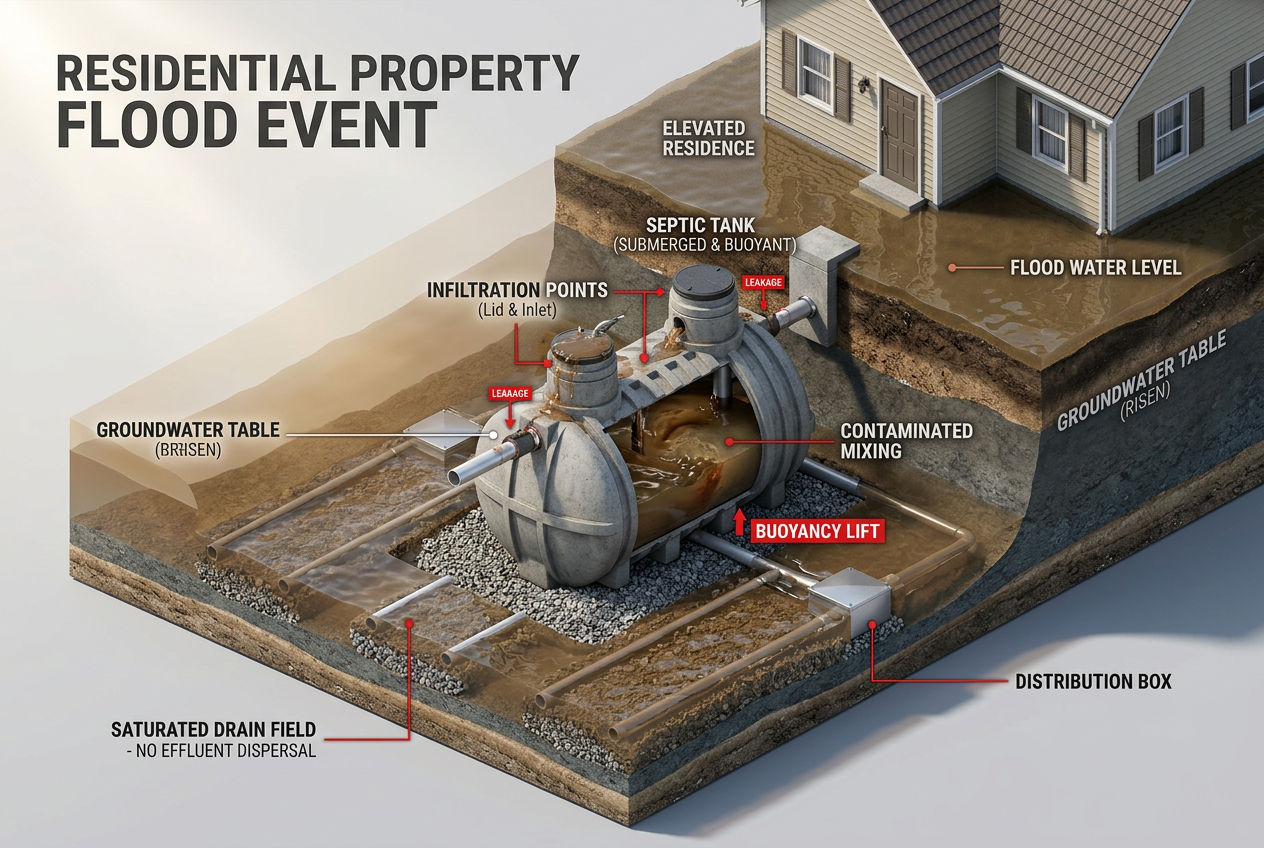
Yes — floodwater absolutely gets into septic tanks, and it does so in multiple ways. Water infiltrates through the tank's inlet and outlet pipes, around loose or damaged risers, through aging concrete that has developed hairline cracks, and via direct inundation when the groundwater table rises above the tank itself.
Think of it this way: your septic tank sits in soil that acts like a sponge. When that sponge gets fully saturated, it can't hold any more liquid. The tank is now surrounded by water under pressure — called hydrostatic pressure — and that water finds every gap it can.
What Happens to Your Drain Field During Flooding
The same thing happens to your drain field. Your leach field pipes rely on unsaturated soil to absorb and filter effluent. When the soil around those laterals is already holding as much water as it can — what engineers call field-capacity saturation — there is literally nowhere for the effluent to go. It backs up. And when it backs up far enough, it comes back into your house.
📊 Quick Fact: Roughly 21% of U.S. households rely on septic systems, according to the U.S. Census Bureau. The EPA identifies flooding as one of the primary causes of septic system failure nationwide, and FEMA considers flooding the most common natural disaster in the country.
If your system is in a low-lying area, near a creek, or on heavy clay soil — you are at elevated risk every single spring and every hurricane season.
What to Do Right Now: Emergency Steps When Your Septic System Floods
Step 1: Stop Using Water Immediately
This is the most important thing you can do in the first hour. Every flush, every shower, every load of laundry is sending water into a system that has no place to send it. That water will follow the path of least resistance — and often that path leads back into your home through your lowest drain.
Actions to take now:
- Turn off the washing machine
- Don't run the dishwasher
- Keep toilet flushes to an absolute minimum
- Brief everyone in your household about water restrictions
Step 2: Do NOT Pump the Tank
⚠️ Warning: This is the mistake that turns a manageable problem into a $10,000 repair.
An empty 1,000-gallon concrete septic tank weighs roughly 1,500–2,000 lbs. That same tank, when full of liquid, weighs approximately 8,345 lbs. The weight of the contents is what holds the tank in the ground when hydrostatic pressure from surrounding groundwater is pushing up from below.
Pump that tank during a flood, and you remove the ballast. Tanks — especially fiberglass and plastic models — can literally pop out of the saturated ground. Even concrete tanks have shifted. Repositioning or replacing a displaced tank starts at $3,000 and can climb well past $10,000 once you factor in excavation, new backfill, and reconnecting the inlet and outlet pipes.
✅ Pro Tip: Wait until the water table drops below the base of the tank before calling for a pump-out.
Step 3: Stay Out of Flooded Areas Near the System
Floodwater that has contacted a septic system is contaminated water. Period. It contains coliform bacteria, E. coli, and a range of pathogens from raw sewage. The CDC warns against any direct contact with floodwater near septic systems and recommends treating any surface water in those areas as a biohazard until testing confirms otherwise.
If you must access the area:
- Wear rubber boots and waterproof gloves
- Wash your hands thoroughly afterward
- Keep children and pets out of the yard entirely until standing water has receded and the ground has dried
Step 4: Protect Your Well If You Have One
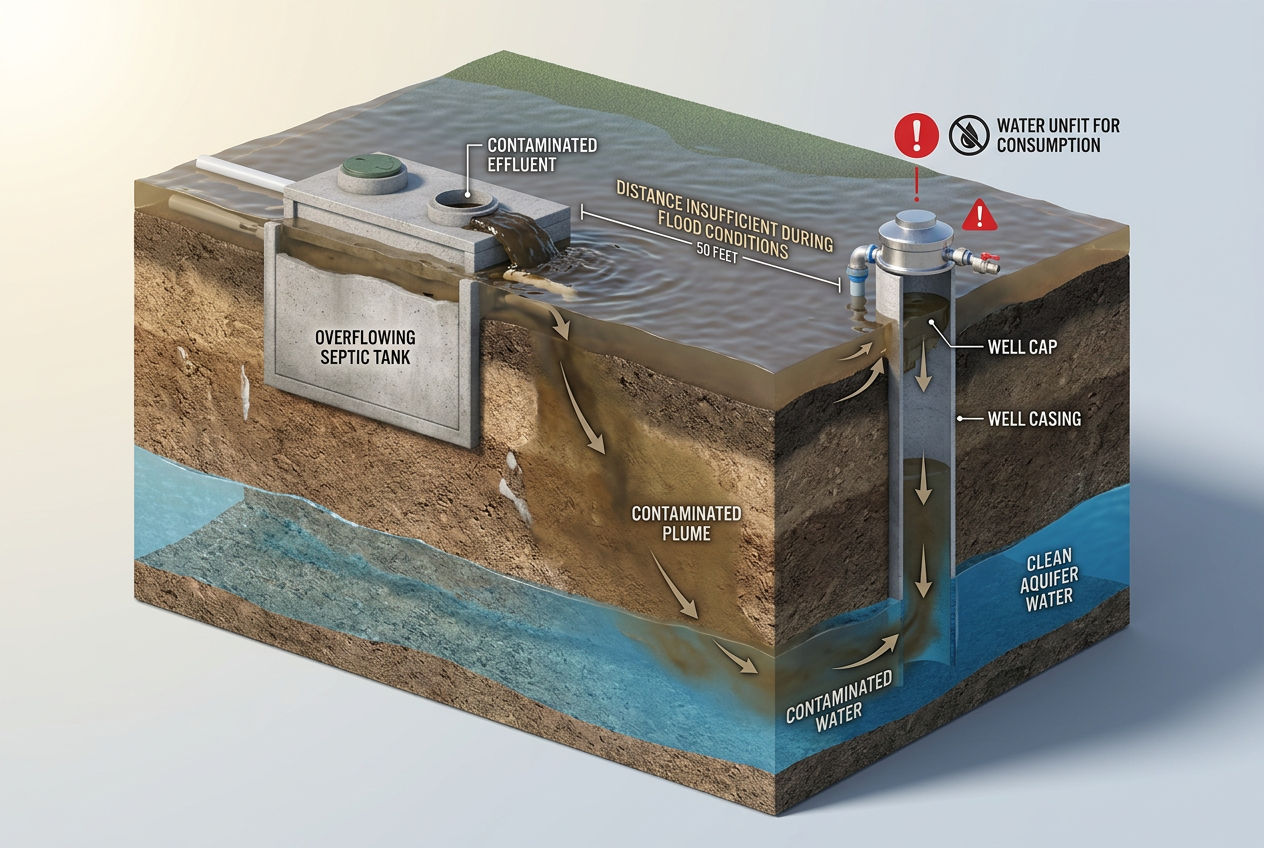
Most states require a minimum setback of 50–100 feet between a septic system and a private well, but setback distance doesn't eliminate contamination risk during major flood events. Floodwater can carry bacteria across much larger distances through the soil and surface water.
If your well is within 100 feet of your septic system, or if you've had any sewage backup during the flood, do not drink the water without testing it first. Contact your county health department for guidance on emergency water testing. Many counties offer free or reduced-cost testing after declared flood emergencies.
Related: septic systems during power outages — worth reading if this applies to your situation.
Step 5: Document Everything for Insurance
Take photos and video of standing water over the septic tank, any visible sewage surfacing in the yard, and any backup inside the house. Note the date and time. This documentation matters for homeowners insurance claims and for any FEMA disaster assistance applications.
For more on what your policy may or may not cover, see our guide to homeowners insurance and septic systems.
Should You Pump a Flooded Septic Tank?
No — not while floodwater is still present or the water table remains elevated. The risk of tank flotation is real and the damage is expensive. Wait until floodwater has fully receded, the soil is no longer waterlogged, and the groundwater table has dropped below the tank's burial depth.
When Pumping Does Make Sense
Once those conditions are met, a pump-out can help. Pumping removes any diluted effluent and allows a technician to inspect the tank's interior for flood-related damage — cracked baffles, displaced inlet pipes, infiltrated soil inside the tank. A standard pump-out for a 1,000-gallon tank runs $250–$500 in most markets. See current septic pumping costs in your area before calling.
Free download
Free: the Septic Fridge Card — what to flush, what never to.
The Do / Don’t card the whole family can see, plus the Survival Kit: emergency flowchart, warning-sign decoder and pump-schedule card. One printable PDF.
How Do You Know If Your Drain Field Is Damaged After a Flood?
The drain field is almost always the part of your system most impacted by flooding, and damage isn't always obvious from the surface.
Visible Warning Signs
- Spongy or mushy ground over the leach field laterals even days after floodwater recedes
- Sewage odor in the yard above or downslope from the drain field
- Slow drains throughout the house (not just one fixture)
- Toilets that gurgle when you run other fixtures
- Bright green, unusually lush grass over the leach lines — that's effluent fertilizing from below
- Standing water over the distribution box or leach laterals
Recovery Timeline by Soil Type
A saturated leach field can take 1–4 weeks to recover functional soil percolation capacity, depending on soil type and flood severity:
| Soil Type | Typical Recovery Time | Geographic Examples |
|---|---|---|
| Sandy soils | 1–2 weeks | Coastal regions, Florida, parts of Texas |
| Loamy soils | 2–3 weeks | Mid-Atlantic, Pacific Northwest |
| Clay soils | 3–4+ weeks | Midwest (Missouri, Iowa, Indiana, Ohio) |
💡 Key Takeaway: Heavy clay soils in the Midwest can take the full four weeks or longer because water simply doesn't move through clay quickly.
If symptoms persist beyond two weeks after floodwater recedes, the biomat layer in your leach field laterals may have been disrupted, or you may have physical damage to the distribution box or lateral pipes. A drain field inspection by a licensed professional is the only way to know for certain.
For a deep look at what can go wrong underground, read our article on how to fix a saturated drain field.
How Long After a Flood Can You Use Your Septic System Again?
The EPA and most state health departments recommend waiting a minimum of 48–72 hours after floodwater recedes before resuming any normal water use. Some state health departments — including Florida's Department of Health and North Carolina's DHHS — recommend waiting until the soil is no longer visibly saturated, which can extend the timeline to a week or more.
Gradual Recovery Schedule
Even after that waiting period, ease back into normal use:
Days 1–3 post-flood:
- Minimize water use aggressively
- One or two toilet flushes per person per day
- No laundry
- No dishwasher
Days 4–7:
- Gradually increase water use
- Monitor for slow drains, gurgling, or odors
- Space out high-water activities
Week 2 onward:
- Resume normal use only if no symptoms persist
- Continue monitoring for unusual signs
✅ Pro Tip: Target reducing household water use by 50% or more during the recovery window. For a 4-person household, that means getting daily water use from a typical 240–300 gallons down to under 150 gallons.
Spacing out showers, running only full dishwasher loads, and doing laundry in small batches over several days all help. Our article on how heavy rain affects your septic system covers this gradual recovery approach in more detail.
Can a Flooded Septic Tank Contaminate Your Well Water?
Yes, and this is one of the most serious risks of septic system flood damage. When raw sewage or septic effluent is displaced by floodwater, pathogens including E. coli, coliform bacteria, and other microorganisms can move through saturated soil toward your water supply.
Highest Contamination Risk Factors
The contamination risk is highest when:
- Your well is less than 100 feet from the septic system
- The well casing is cracked or poorly sealed
- Your well head was submerged during flooding
- Surface water flowed across the area between your septic system and well
Required Testing and Treatment
The CDC recommends testing well water after any flood event that may have compromised a nearby septic system. A basic coliform/E. coli test costs $25–$75 through most county health departments or certified private labs.
⚠️ Warning: Do not rely on the water looking or tasting normal — bacterial contamination is invisible.
If your well was submerged, shock chlorination is required before the water is considered safe. Your county health department can walk you through that process, or contact a licensed well contractor.
Flood Damage Repair Costs: What Are You Looking At?
| Repair Type | Typical Cost Range | Notes |
|---|---|---|
| Emergency pump-out | $250–$750 | Higher after flood events |
| Post-flood inspection | $150–$500 | See full cost breakdown |
| Distribution box repair | $500–$1,500 | Common flood casualty |
| Drain field restoration | $1,500–$5,000 | Aeration, fracturing, additives |
| Drain field replacement | $5,000–$20,000+ | Full replacement if laterals fail |
| Septic tank replacement | $3,000–$10,000 | Required if tank is displaced |
| Full system replacement | $15,000–$30,000+ | New tank + new drain field |
Source: National averages based on contractor surveys; costs vary significantly by region, soil conditions, and permit requirements.
Real-World Cost Example
A homeowner in Baton Rouge with a 1,000-gallon concrete tank and a conventional leach field after a spring flood event might pay:
- $350 for an emergency pump-out
- $275 for a post-flood inspection
- $1,800 for distribution box replacement and partial lateral repair
Total: $2,425 if the drain field itself is still functional. If those laterals need full replacement, add $8,000–$14,000 on top of that. Get a detailed breakdown of what repairs typically run at our septic repair cost guide.
Insurance Coverage Considerations
Will homeowners insurance cover any of this? Standard homeowners policies typically exclude flood damage. A separate flood insurance policy through FEMA's National Flood Insurance Program (NFIP) may cover structural components. But "sudden and accidental" damage from a sewage backup — like a backup caused by a flooded system — may be covered under a sewage backup rider.
✅ Pro Tip: Read your policy carefully and document everything before calling your insurer.
After the Water Recedes: Post-Flood Recovery Checklist
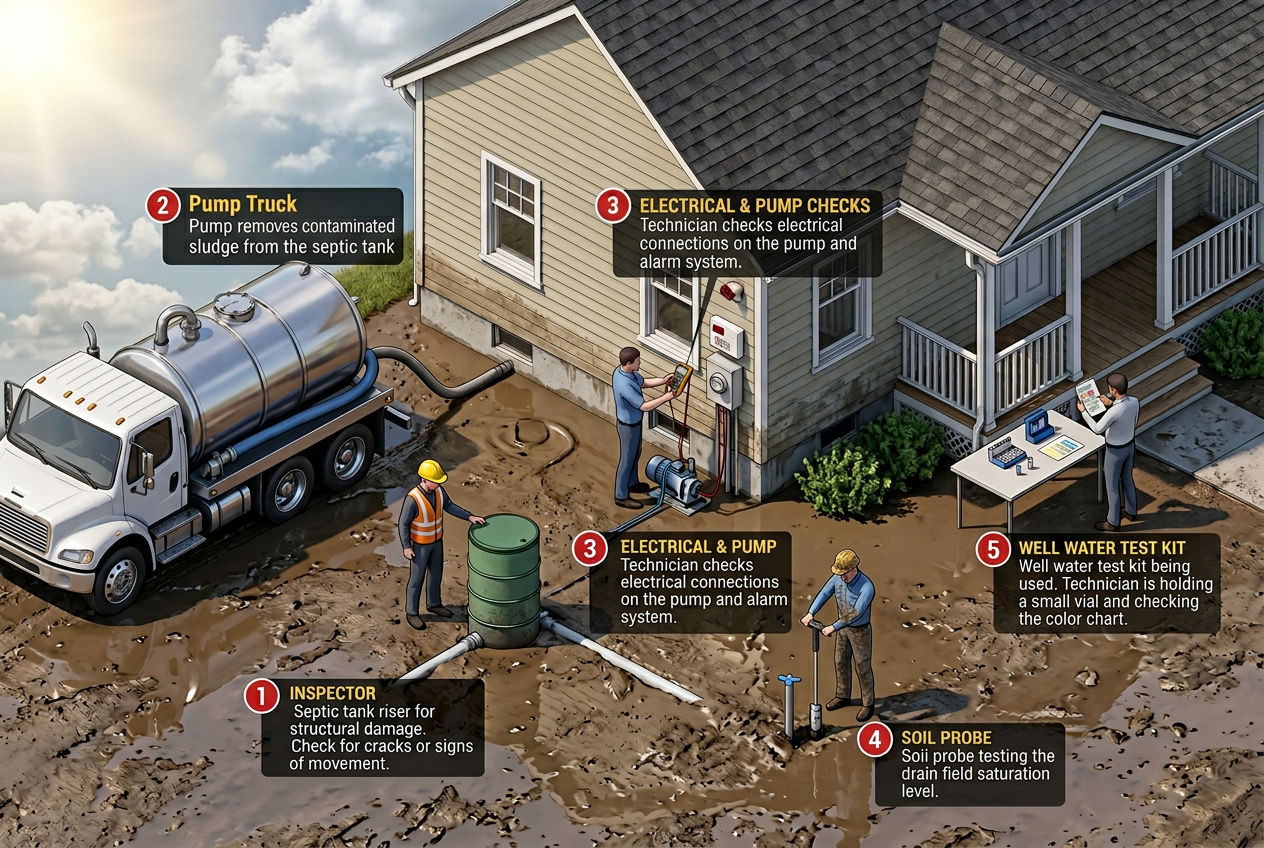
Once conditions are safe to walk the property, work through this sequence:
1. Visual Inspection of the Tank Area
Look for exposed tank tops, shifted lids, cracked risers, or any visible displacement.
⚠️ Warning: If the tank lid appears to have moved, don't open it — call a professional. A displaced lid means the tank may have shifted and there could be structural damage.
2. Check the Distribution Box
The distribution box — the concrete or plastic box that routes effluent from the tank to the individual leach laterals — is frequently damaged in floods. Silt and debris wash into the box, clogging the outlets. A clogged distribution box directs all flow to one lateral, which accelerates failure. A technician can camera-inspect the d-box and laterals in a couple of hours.
3. Schedule a Professional Inspection
This is not optional after a significant flood. A licensed inspector will check:
- The tank's structural integrity
- The inlet and outlet baffles
- The effluent filter (if your system has a Polylok PL-122 or similar)
- The distribution box
- The lateral condition
Many states — including Louisiana, North Carolina, and Texas — require a post-flood inspection before a system can be declared operational again. See what a septic inspection involves and what it costs.
4. Pump Out Once It's Safe
After confirming the tank hasn't shifted and groundwater has dropped, schedule your pump-out. Even if you pumped recently, floodwater infiltration means the tank may be full of diluted effluent mixed with groundwater. A pumper will also be able to observe the inside of the tank for cracks and damage.
5. Monitor the Drain Field for Two Weeks
Mark your calendar. Walk the drain field area every two to three days. You're looking for persistent wet spots, odor, or unusually lush vegetation. If symptoms persist past two weeks, you likely need professional assessment of the drain field.
How to Reduce Your Risk Before the Next Flood
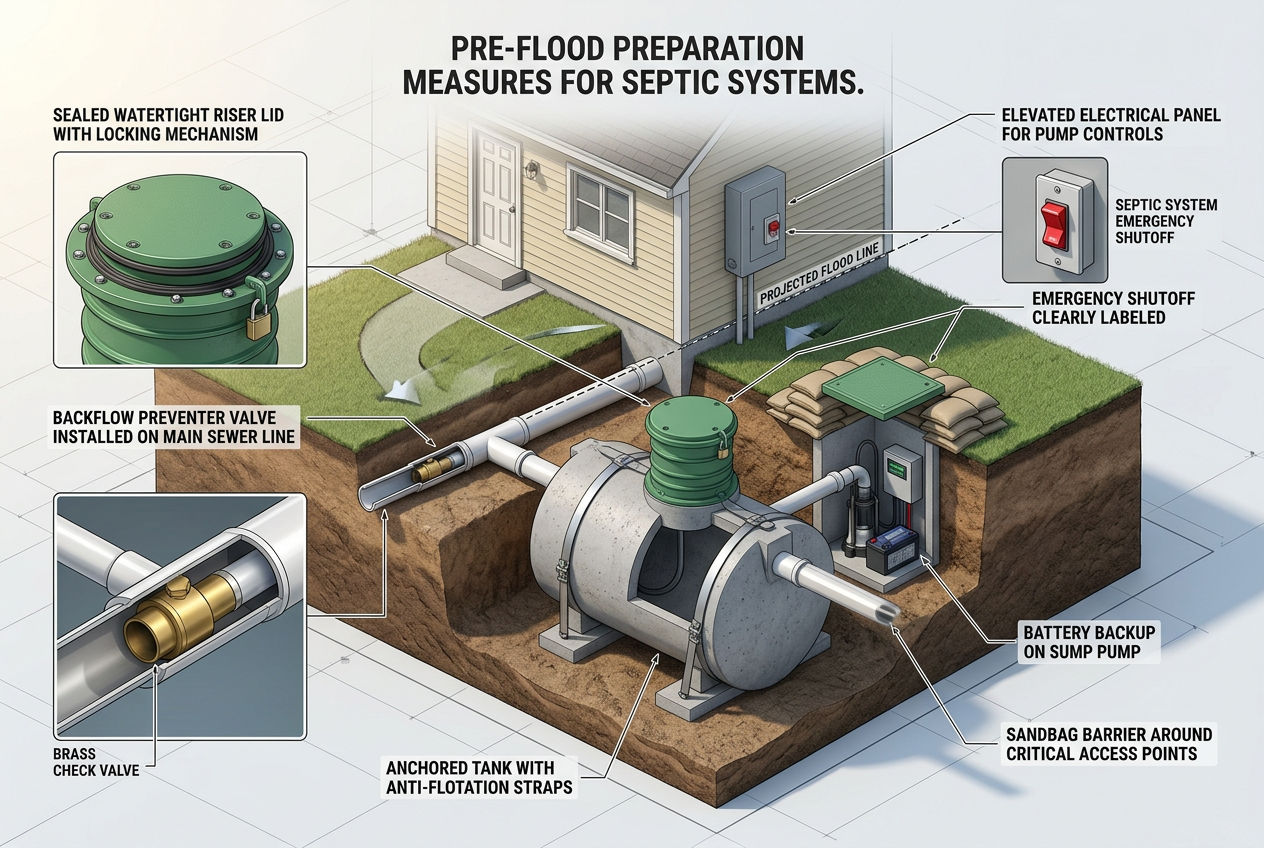
You can't control the weather, but you can make your system less vulnerable.
Inspect and Seal Risers and Lids
Cracked or loose riser lids are the most common infiltration point for surface floodwater. Replacing a damaged riser lid costs $50–$200. Replacing a flooded system costs far more.
Install a Backflow Preventer
A check valve or backflow preventer on your building sewer line — the pipe
Sources & Methodology
-
U.S. Environmental Protection Agency — What to Do After a Flood guidance for septic system owners, including safety precautions and post-flood inspection recommendations.
-
FEMA (Federal Emergency Management Agency) — Disaster recovery guidance for homeowners with damaged septic systems, including federal assistance eligibility for system repair and replacement.
-
National Environmental Services Center (NESC) — Technical publications on the effects of flooding on conventional and alternative septic systems, including soil saturation and structural damage assessment.
-
University of Georgia Cooperative Extension — Research on septic system recovery after flood events, including drain field drying timelines and post-flood maintenance protocols.
-
Centers for Disease Control and Prevention (CDC) — Public health guidance on contamination risks from flooded septic systems and safety precautions for homeowners.
Cost data reflects 2025–2026 national averages compiled from contractor pricing surveys across SepticTankHub.com's directory network.
Need help with your septic system? Find trusted septic professionals near you to get free quotes. Browse local septic companies in California or Ohio.
Was this article helpful?
Frequently Asked Questions
Recommended Resources
📖 Related Articles
💰 Cost Guides
🔧 Services
Find Septic Professionals Near You
Compare licensed, verified septic companies by area — top county markets and cities below, or browse all 50 states.
County markets
Popular cities
