
Quick Answer
A mound septic system is an elevated, above-ground drain field built from engineered sand and gravel fill. It treats wastewater in properties where high water tables, shallow bedrock, or poor soil make conventional below-ground systems impossible. Effluent is pumped from a dosing chamber up into the mound, where sand filters it before it reaches the native soil.
💡 Key Takeaways
- Mound systems cost $10,000–$25,000 to install - roughly 3–5x more than a conventional system
- They're required when your soil fails a percolation test or has less than 2–4 feet of separation to bedrock or the water table
- A dosing pump delivers effluent in controlled cycles (typically 3–6 times per day) for even distribution
- Expect a lifespan of 20–30 years with proper maintenance; pump components last 10–15 years
- Pumping every 2–3 years is essential - skipping it shortens the mound's life significantly
What Is a Mound Septic System, Exactly?
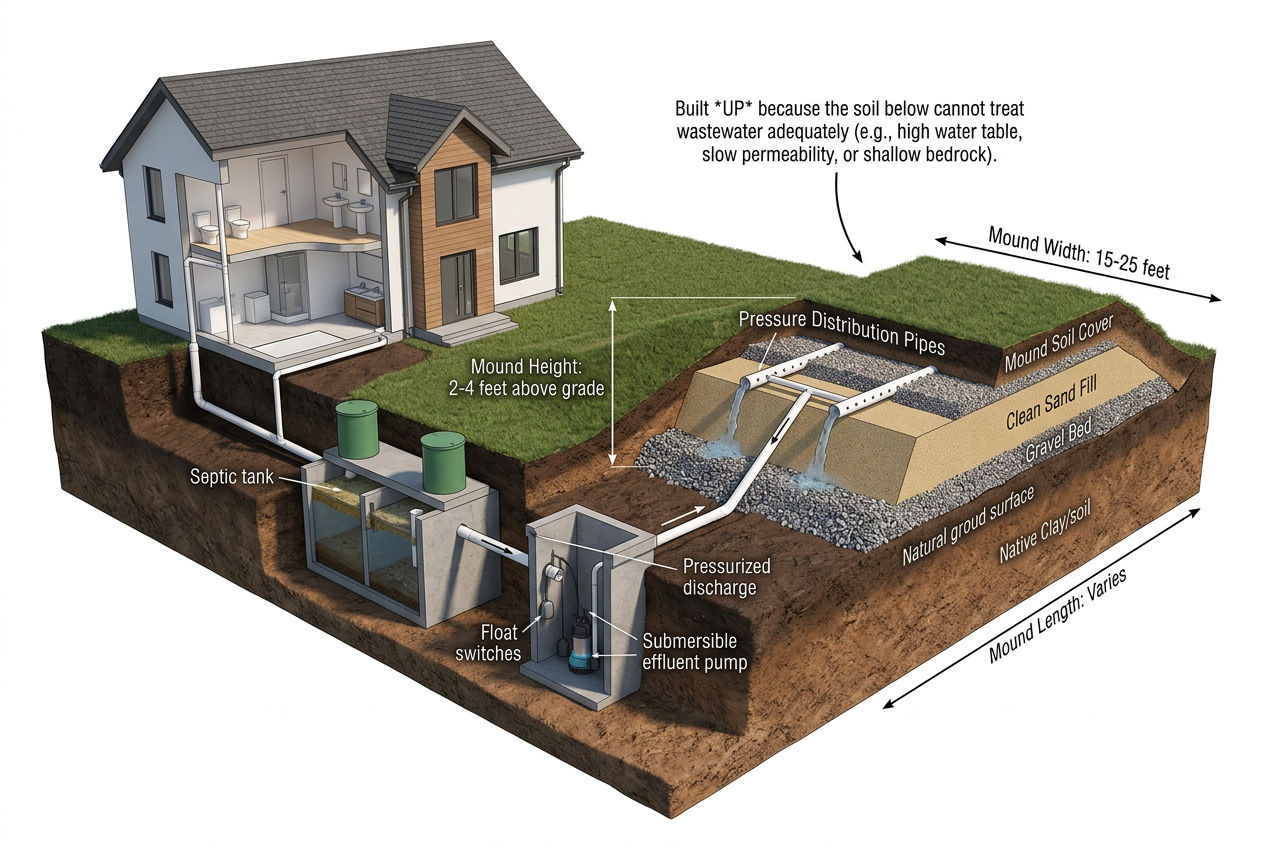
A mound septic system is a type of engineered septic system that raises the drain field above the natural ground surface using a constructed bed of sand and gravel. Instead of digging down to install leach laterals, installers build up - sometimes 3 to 5 feet above grade - to create the soil depth and drainage the system needs.
Common Names for the Same System
You'll also hear it called:
- A sand mound septic system
- An elevated septic system
- A raised drain field
These all refer to the same concept.
The mound itself is that low, grass-covered hill in your yard - the one that looks out of place until you understand what it's doing. Inside is a carefully engineered stack of layers working together to treat your wastewater.
The Engineered Layer Stack
From bottom to top, here's what's inside:
- Native soil at the bottom
- Gravel bed for drainage
- Perforated distribution pipes
- Coarse sand (the treatment layer)
- Protective soil layer
- Topsoil and grass cover
Effluent flows up from your house, gets distributed evenly across the mound through a pressure distribution network, filters down through the sand, and finally enters the native soil below - treated and safe.
📊 Quick Fact: This is fundamentally different from a conventional septic system, which relies on gravity to move effluent into an in-ground drain field. In a mound system, a pump does the heavy lifting.
Why Would You Need a Mound System?
Your property's soil calls the shots. Not every lot can handle a conventional buried drain field, and when a site fails, you need an alternative.
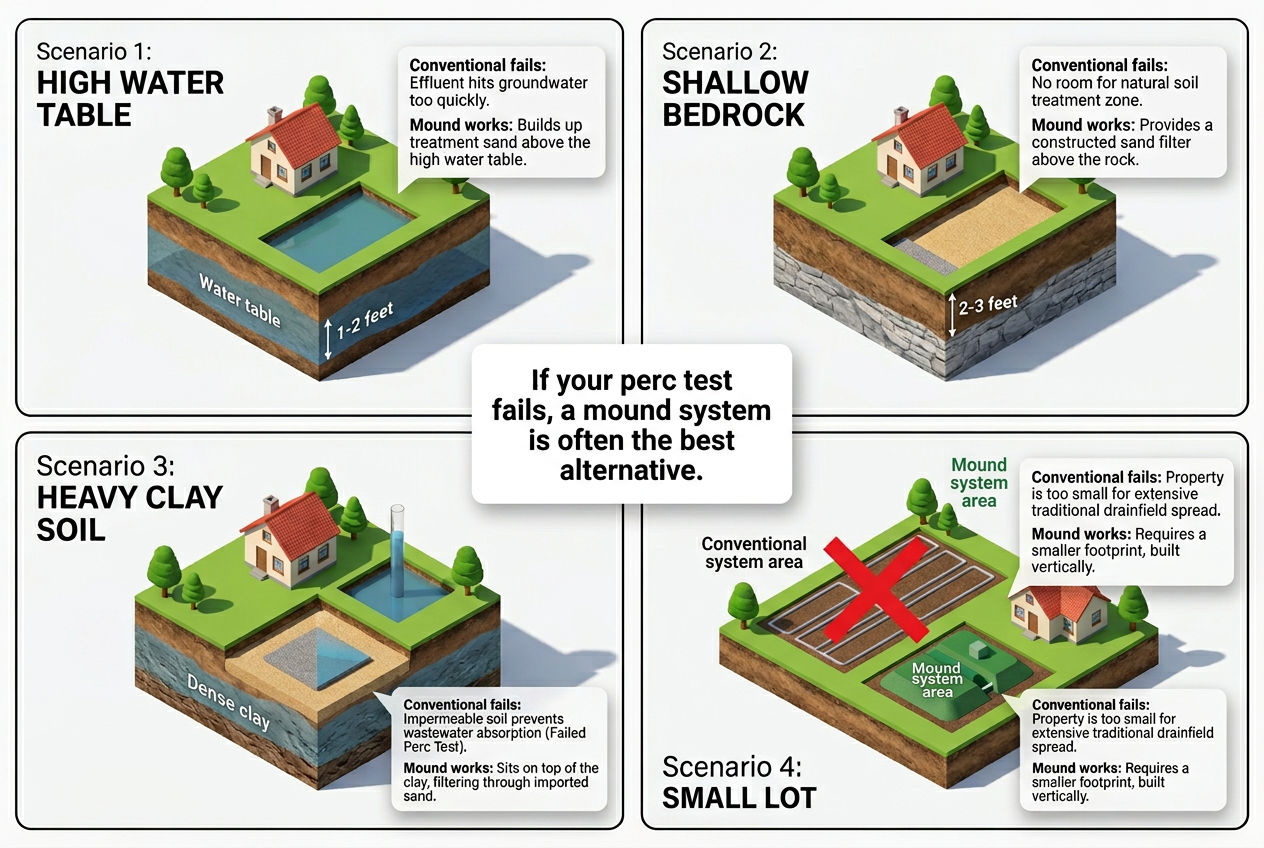
The Three Most Common Triggers
1. High water table
If the seasonal high water table sits within 2 feet of the surface, a buried drain field can't treat effluent fast enough - it just saturates and backs up.
📊 Quick Fact: Mound systems are especially common in Minnesota, Wisconsin, Michigan, Florida, coastal North and South Carolina, and Louisiana for exactly this reason.
2. Shallow bedrock or hardpan
In states like Pennsylvania, Vermont, and Maine, you can hit bedrock 18 inches down. There's nowhere to put a conventional drain field. Pennsylvania's Department of Environmental Protection has detailed sand mound design standards precisely because shallow rock is so common there.
3. Poor soil percolation
Heavy clay soils don't drain well. A percolation test - which costs $250–$1,000 depending on your county - measures how fast water moves through your soil. Fail that test, and your local health department will point you toward a mound system or another alternative.
✅ Pro Tip: The EPA's Onsite Wastewater Treatment Systems Manual identifies all three of these site conditions as primary indicators for elevated or mound-type systems. You can review the EPA's septic guidance at epa.gov/septic.
How Does a Mound Septic System Work? (Step by Step)
Understanding the flow of wastewater through the system makes maintenance and troubleshooting much easier. Here's exactly what happens from flush to final treatment.
Step 1: Wastewater Leaves the House
Everything that goes down your drains flows by gravity into a standard septic tank - usually a 1,000- to 1,500-gallon concrete or polyethylene tank. Inside the tank:
- Solids settle to the bottom as sludge
- Grease and lighter material float to the top as a scum layer
- The middle layer of clarified liquid (effluent) moves forward
Step 2: Effluent Enters the Dosing Chamber
Unlike a conventional system, where effluent flows directly to the drain field, a mound system routes it to a separate pump chamber (also called a dosing chamber). This is usually a 500- to 1,000-gallon tank equipped with:
- A submersible pump
- Float switches that trigger on specific liquid levels
- An alarm float that alerts you if the pump fails
Step 3: The Pump Doses the Mound
The dosing pump activates 3–6 times per day, pushing effluent through a pressurized supply line up into the mound. Most systems use 1.5-inch or 2-inch Schedule 40 PVC force mains. The pump cycles are timed to allow the mound to rest and drain between doses - this resting period is critical for treatment quality.
Step 4: Pressure Distribution Spreads the Load
Inside the mound, a network of small-diameter perforated laterals (typically ¾-inch to 1¼-inch) distributes effluent evenly across the entire mound bed. This is called pressure distribution. It prevents the short-circuiting that plagues older gravity-fed systems, where all the effluent hits the same spot until that spot fails.
Step 5: Sand Filtration Treats the Effluent
As effluent percolates down through 2–3 feet of engineered sand fill, biological treatment occurs. Aerobic bacteria in the sand break down pathogens and nutrients. By the time liquid reaches the native soil interface at the base of the mound, it's significantly cleaner than what entered the system.
Step 6: Final Treatment in Native Soil
The treated effluent disperses into the native soil below and eventually rejoins the groundwater - completing the cycle.

DIY Septic Blueprint
Thinking about building it yourself?
The complete, plain-English plan to size, permit and install your own septic system — designed for homeowners, not contractors. Skip the $15,000–$25,000 quotes and do it right the first time.
Get the DIY Blueprint — $67 →Instant download · 8 modules + 3 bonus guides · 60-day money-back guaranteeMound Septic System Components at a Glance
| Component | Function | Typical Cost to Replace |
|---|---|---|
| Septic Tank (1,000–1,500 gal) | Primary solids separation | $1,500–$4,000 |
| Dosing/Pump Chamber | Stores effluent; houses pump | $1,200–$3,000 |
| Submersible Dosing Pump | Pressurizes effluent to mound | $500–$1,500 |
| Float Switches & Alarm | Control pump cycles; alert on failure | $150–$400 |
| Sand Fill & Gravel Bed | Filtration and distribution media | $3,000–$8,000 (install) |
| Perforated Distribution Laterals | Even effluent distribution | $800–$2,500 |
Cost ranges reflect national averages for component replacement. Installation of full mound systems varies significantly by region and site conditions.
How Much Does a Mound Septic System Cost?
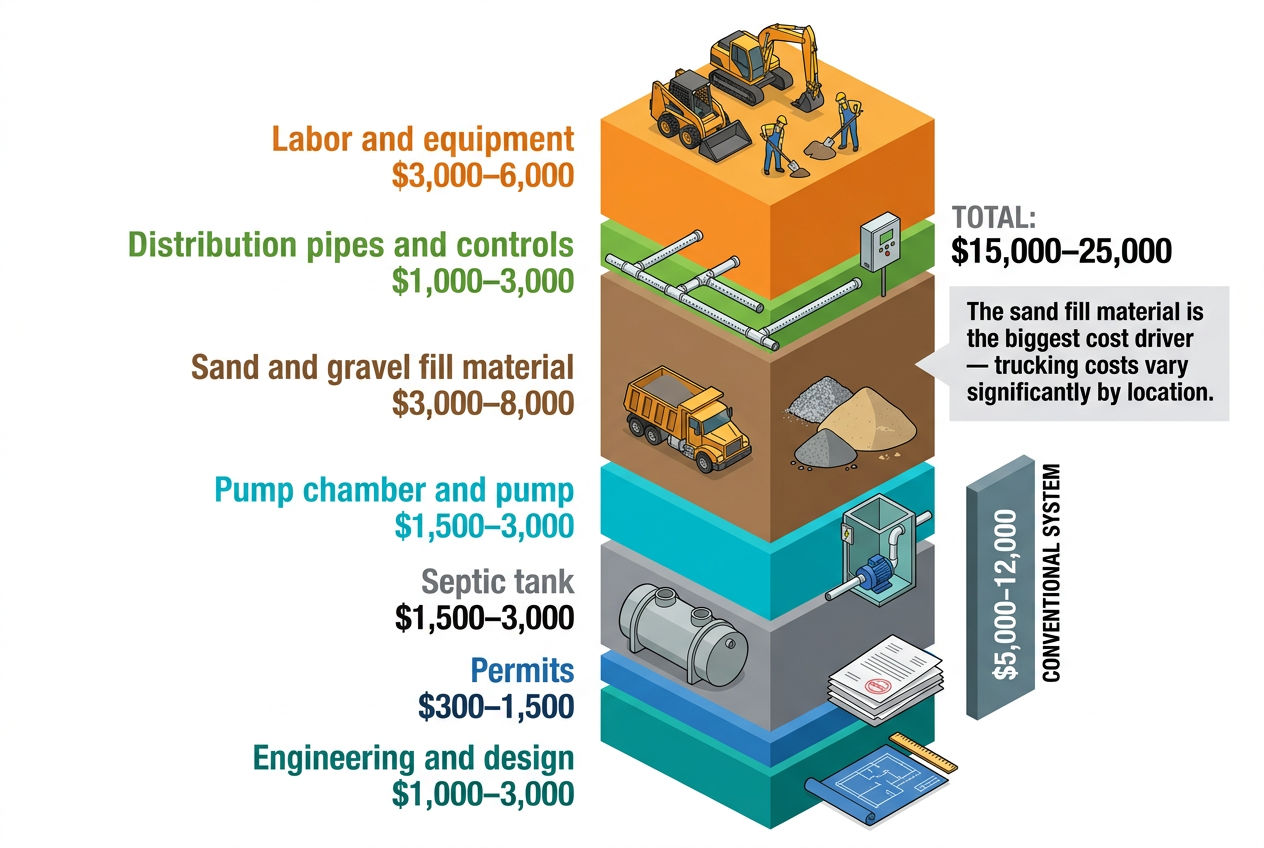
A mound system installation runs $10,000–$25,000 for most residential properties, with complex installs on difficult sites reaching $30,000 or more. Compare that to a conventional system at $3,000–$8,000 and you understand why homeowners feel sticker shock.
Where Your Money Goes
Site evaluation and permits: Before anyone breaks ground, you'll pay:
- $250–$1,000 for a perc test
- $500–$2,000 for engineering design and permit fees
- $1,500–$3,000 additional if your county requires a licensed professional engineer to stamp the design
Excavation and fill material: The biggest cost driver is the sand and gravel fill. Hauling in 50–150 tons of engineered sand can cost $3,000–$8,000 depending on how far the trucks travel. A mound serving a 3-bedroom home (roughly 300–450 gallons per day capacity) typically measures 30 feet wide by 60 feet long and stands 3–4 feet above grade.
Pump and electrical: The dosing pump, float switches, control panel, and electrical connection run $1,500–$3,500 installed.
Labor: Mound systems take 2–5 days to install. Labor alone can run $4,000–$8,000.
Real-World Example
💡 A 3-bedroom home in rural Wisconsin with a high seasonal water table recently paid $19,400 for a complete mound system installation:
- $1,200 for perc test and engineering
- $6,800 for fill material and excavation
- $2,800 for pump system
- $8,600 in labor
That's a realistic breakdown for the Upper Midwest, where mound systems are essentially the standard in many counties.
For a full breakdown of what drives septic installation costs, our cost guide covers all system types side by side.
What Are the Pros and Cons of a Mound Septic System?
Advantages
✅ Works where nothing else will
If your perc test failed and your lot has 18 inches of soil over bedrock, a mound system may be your only legal option short of hauling waste.
✅ Long lifespan with maintenance
A properly maintained mound system lasts 20–30 years. The sand bed itself rarely fails when the pump system is maintained.
✅ Better treatment quality
Pressure distribution and engineered sand filtration produce cleaner effluent than many conventional drain fields.
Disadvantages
❌ High upfront cost
There's no way around it. You're paying 3–5x more than a conventional system.
❌ Mechanical dependency
The dosing pump will fail eventually. Expect to replace it every 10–15 years at $500–$1,500 per replacement. When the pump fails, effluent backs up - fast.
❌ Visible in your yard
A 3- to 5-foot elevated mound covering 1,800–2,000 square feet isn't subtle. It affects landscaping, aesthetics, and how you use that portion of your yard.
❌ Strict setback requirements
Most counties require mound systems to sit 50–100 feet from wells, property lines, and surface water. On a small lot, that math can be impossible.
❌ Cold climate vulnerability
The top of the mound is exposed to frost in ways a buried drain field isn't.
⚠️ Warning: In Minnesota, where frost can penetrate 42–60 inches, properly designed mound systems include 6–12 inches of topsoil cover and sometimes rigid foam insulation beneath the topsoil to protect the distribution laterals. A Minnesota Pollution Control Agency-compliant mound design accounts for this - but cut-rate installs sometimes skip the insulation step, leading to frozen laterals and a $2,000–$4,000 repair call.
How Do You Maintain a Mound Septic System?
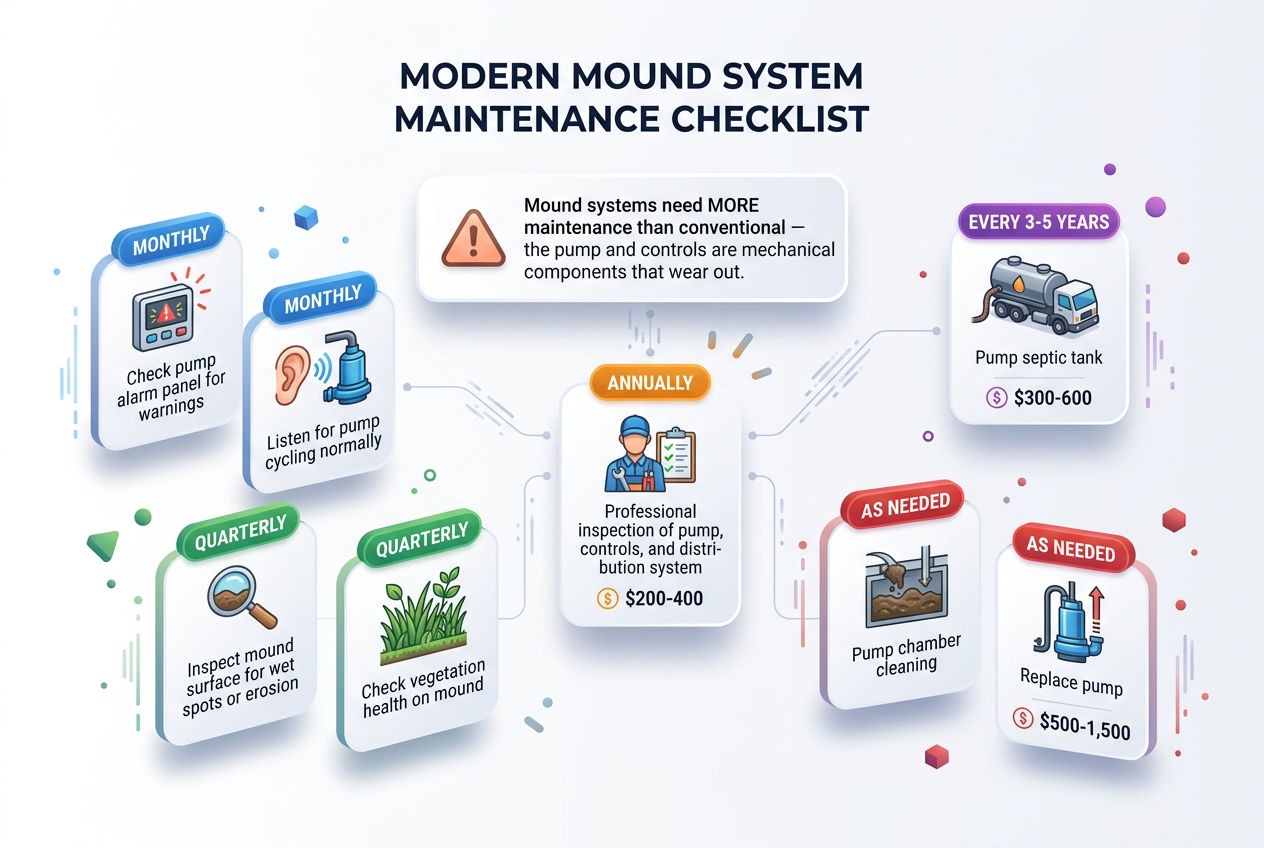
Mound systems need more attention than conventional systems. The mechanical pump adds complexity, and the sand bed is harder to rehabilitate once it clogs than a standard leach field.
Critical Maintenance Tasks
Pump the septic tank every 2–3 years
This is non-negotiable. Sludge buildup in the primary tank forces partially treated solids into the dosing chamber and eventually into the mound's sand bed.
⚠️ Warning: Once biomat (a dense layer of biological material) clogs the sand, the mound fails - and replacing the sand fill costs $8,000–$15,000.
Most licensed pumpers will inspect both the septic tank and the dosing chamber during a single service call. Check septic pumping costs in your area before you book.
Inspect the pump and floats annually
Float switches are inexpensive - usually $50–$150 each - but when they stick or fail, your pump either:
- Runs constantly (burning out the motor), or
- Never runs (backing up the system)
Ask your service tech to pull the pump, check the intake screen, and test float function once a year.
Watch for alarm triggers
Every properly installed mound system should have a visual and audible alarm (usually a light panel inside the house or garage).
✅ Pro Tip: If your alarm triggers, call your septic service provider within 24–48 hours. Don't ignore it.
Never plant trees or deep-rooted shrubs on the mound
Grass is your best friend. Roots from trees will find and destroy the perforated laterals inside the mound. Keep anything with roots off the mound itself - and off the 10-foot buffer zone around it.
Can You Build Over a Mound System?
No. Absolutely not. Here's what's prohibited:
- No structures
- No patios
- No vehicle parking
Heavy weight compacts the sand bed and disrupts treatment. Most states also prohibit any permanent structures within the mound's required setback area. Check your state's health department regulations - Pennsylvania DEP and Minnesota PCA both publish specific setback tables online.
For a complete seasonal maintenance checklist, our septic tank maintenance guide covers everything month by month.
How Long Does a Mound Septic System Last?
With consistent maintenance, a mound septic system lasts 20–30 years. The sand bed and distribution infrastructure are the long-lived components.
Component Lifespans
The mechanical parts have shorter windows:
| Component | Expected Lifespan |
|---|---|
| Submersible dosing pumps | 10–15 years |
| Float switches | 7–12 years |
| Control panels | 15–20 years |
| Sand bed & laterals | 20–30+ years |
The Biggest Threat Isn't Mechanical Failure - It's Neglect
📊 Quick Fact: Systems that go 5–7 years without pumping routinely fail within 15 years. Systems that are pumped on schedule and have their pump inspected annually often hit the 30-year mark with nothing more than a pump swap along the way.
If you're buying a property with an existing mound system, budget for a septic inspection before closing. A licensed inspector can:
- Assess pump function
- Check the alarm system
- Evaluate the mound's surface condition
Signs of ponding or lush green patches over the mound suggest the system is struggling.
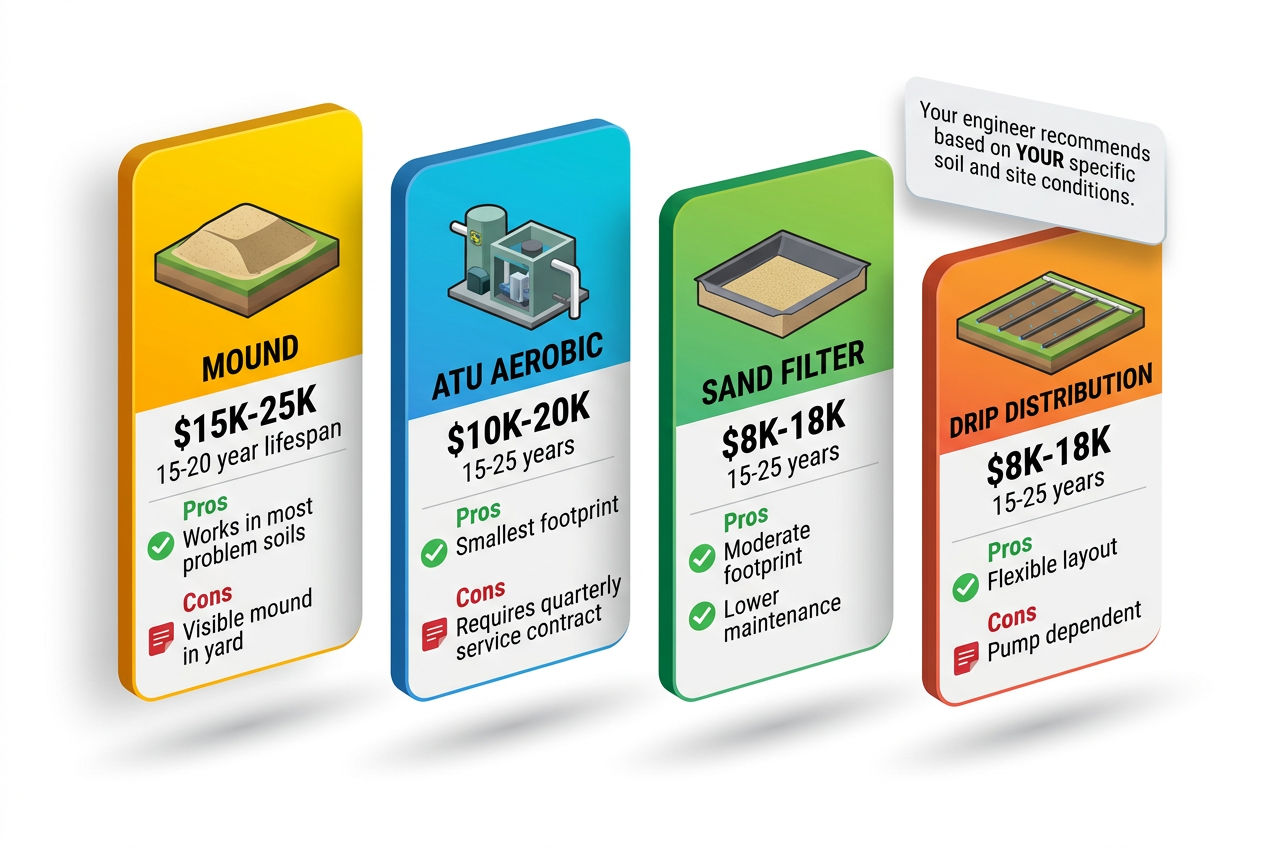
Mound vs. Conventional vs. Aerobic: Which System Do You Need?
If your lot passes a perc test with flying colors and has adequate soil depth, a conventional system is simpler and cheaper.
If you're in an area with poor soils but your county allows it, an aerobic treatment unit (ATU) - like those made by Orenco Systems - can treat effluent to a higher standard in a smaller footprint, though operating costs run higher due to electrical and maintenance requirements.
The mound system sits in the middle: more complex than conventional, less mechanically demanding than a full aerobic septic system, and specifically suited to sites where soil conditions simply don't support in-ground dispersal.
Explore the full comparison in our types of septic systems guide.
Ready to Get a Quote?
Mound system costs vary more by site and region than almost any other septic type. The only way to get a real number is to have a licensed installer evaluate your lot, review your soil data, and pull the local design requirements.
Find a licensed septic installer near you through our directory - every contractor is verified and rated by homeowners in your area.
Learn more about our septic installation services.
Related reading: septic system installation process.
Sources & Methodology
- U.S. Environmental Protection Agency - Septic Systems Overview (): Used for site condition thresholds triggering alternative system requirements and general treatment standards.
- Minnesota Pollution Control Agency (MPCA) - Individual Sewage Treatment Systems Rules: Referenced for frost depth design requirements, mound system design standards, and pumper licensing regulations.
- Pennsylvania Department of Environmental Protection - Sand Mound Design Standards: Referenced for Northeast regional mound system regulations and percolation requirements.
- National Onsite Wastewater Recycling Association (NOWRA) (): Industry standards for pressure distribution system design and component specifications.
- National Association of Wastewater Technicians (NAWT) (): Referenced for pump inspection intervals and maintenance best practices.
Cost data reflects aggregated contractor estimates and regional pricing data from 2024–2025. Individual costs vary based on site conditions, local labor rates, permit fees, and material availability.
Need help with a mound septic system? Browse licensed installers in Minnesota, Wisconsin, Pennsylvania, Vermont, or Maine — or find a pro in any state on our homepage.
Free download
Not ready for the Blueprint? Start free.
Grab the free DIY Septic Planning Kit — the permit-first checklist, perc-test cheat sheet, and sizing tables that keep your build from getting red-tagged.
Was this article helpful?
Frequently Asked Questions
Recommended Resources
📖 Related Articles
- What Is a Drain Field? (And How Does It Work?)
- Engineered Septic System Cost: $12K–$30K+ (2026)
- What Is a Septic System? How It Works (Visual Guide)
- The Complete Septic Tank Maintenance Guide
- Aerobic vs Anaerobic Septic Systems: How They Compare
- Types of Septic Systems: Complete Comparison Guide
- High Water Table and Septic Systems: What You Need to Know
💰 Cost Guides
🔧 Services
Find Septic Professionals Near You
Compare licensed, verified septic companies by area — top county markets and cities below, or browse all 50 states.
County markets
Popular cities
