
Quick Answer
An engineered septic system is a custom-designed onsite wastewater treatment system built for properties where a conventional septic system cannot perform safely. Also called an alternative septic system or advanced treatment system, it's designed by a licensed professional engineer or soil scientist specifically for your lot's soil conditions, slope, water table depth, and setback requirements. No two engineered designs are identical.
Key Takeaways
- Engineered septic systems are required when soil, terrain, or lot size rules out a conventional system
- Common types include mound systems, aerobic treatment units (ATUs), drip irrigation systems, and sand filter systems
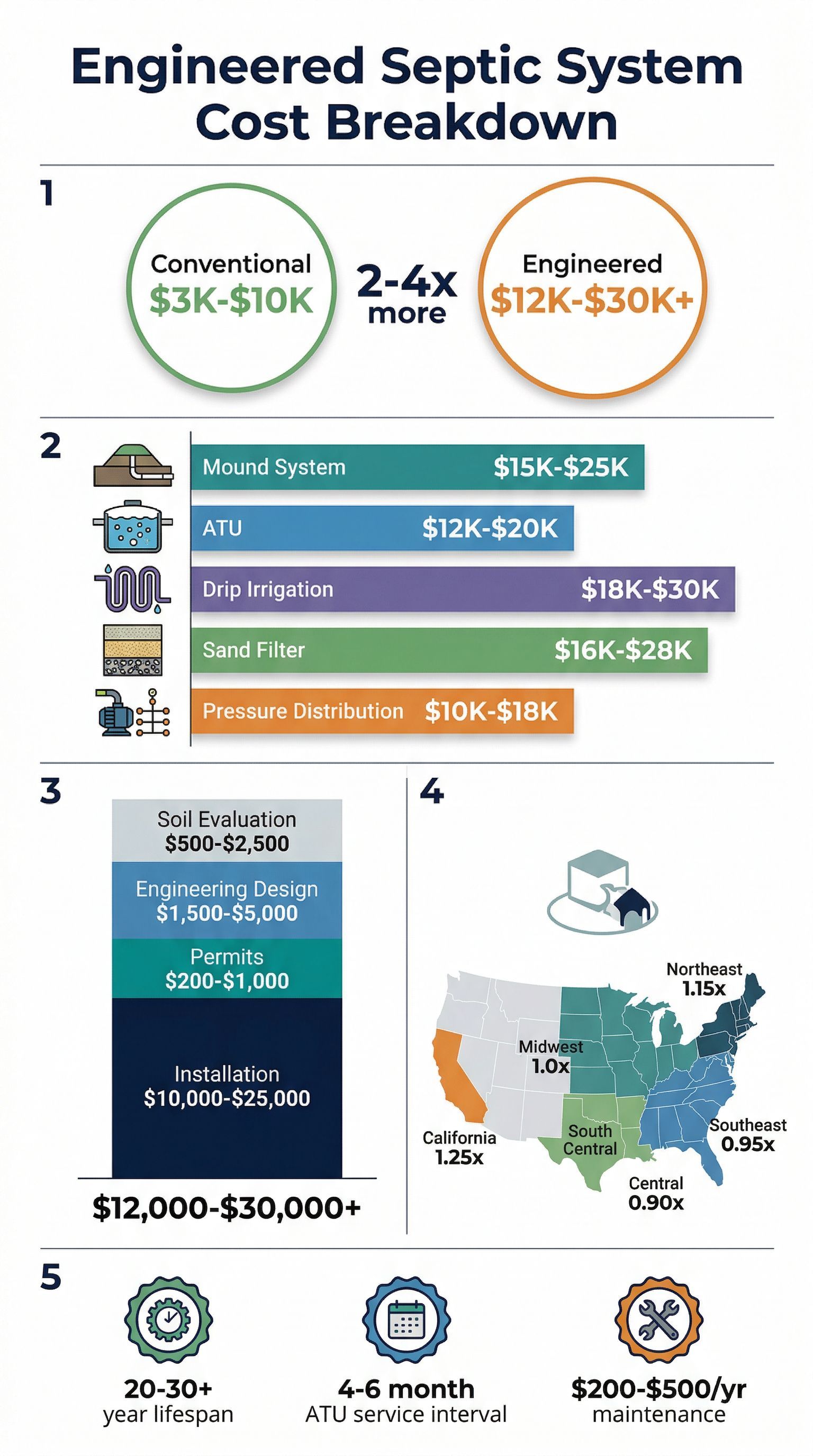
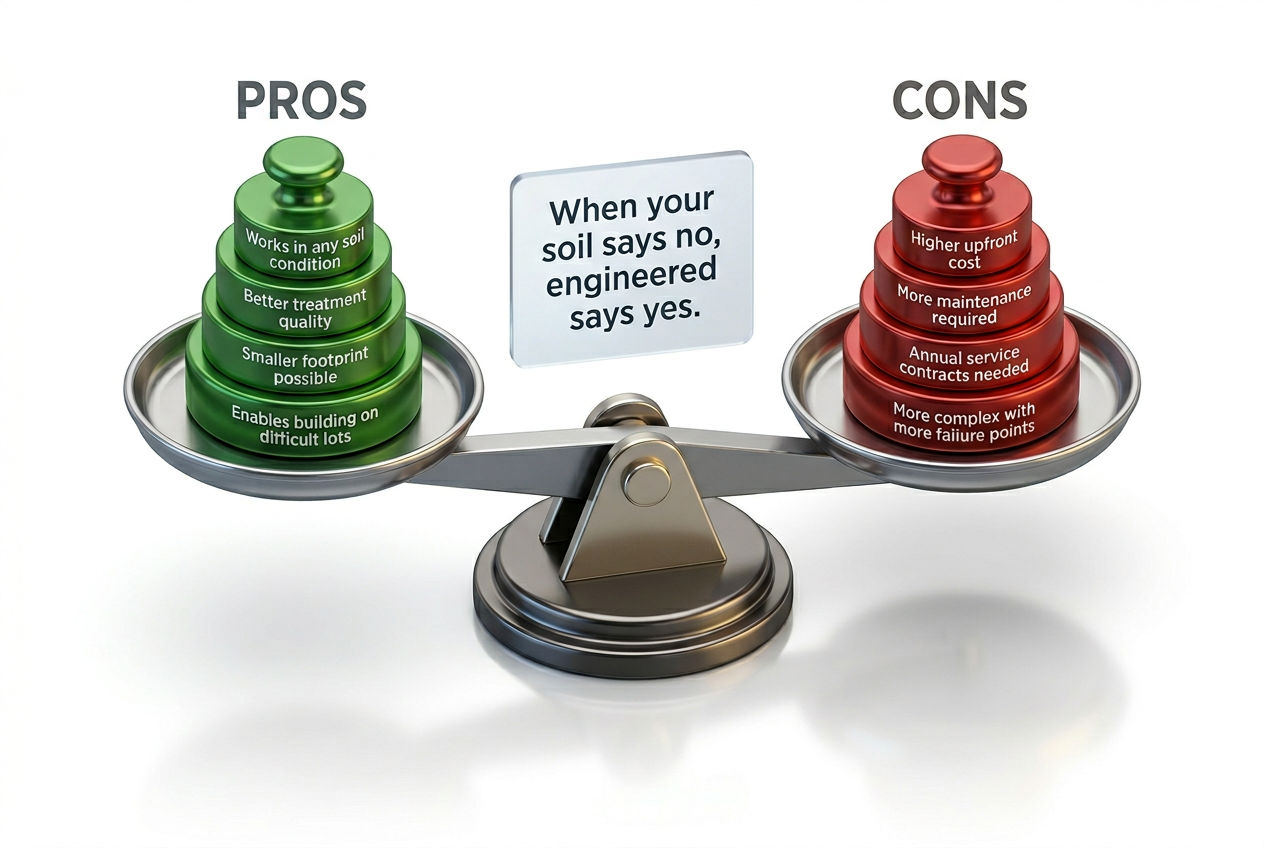
- Expect to pay $12,000–$30,000+ installed, versus $3,000–$10,000 for a conventional system
- A licensed engineer or certified soil scientist must design the system before permits are issued
- These systems last 20–30+ years with proper maintenance - they're not a liability, they're an engineered solution
How Much Does an Engineered Septic System Cost?
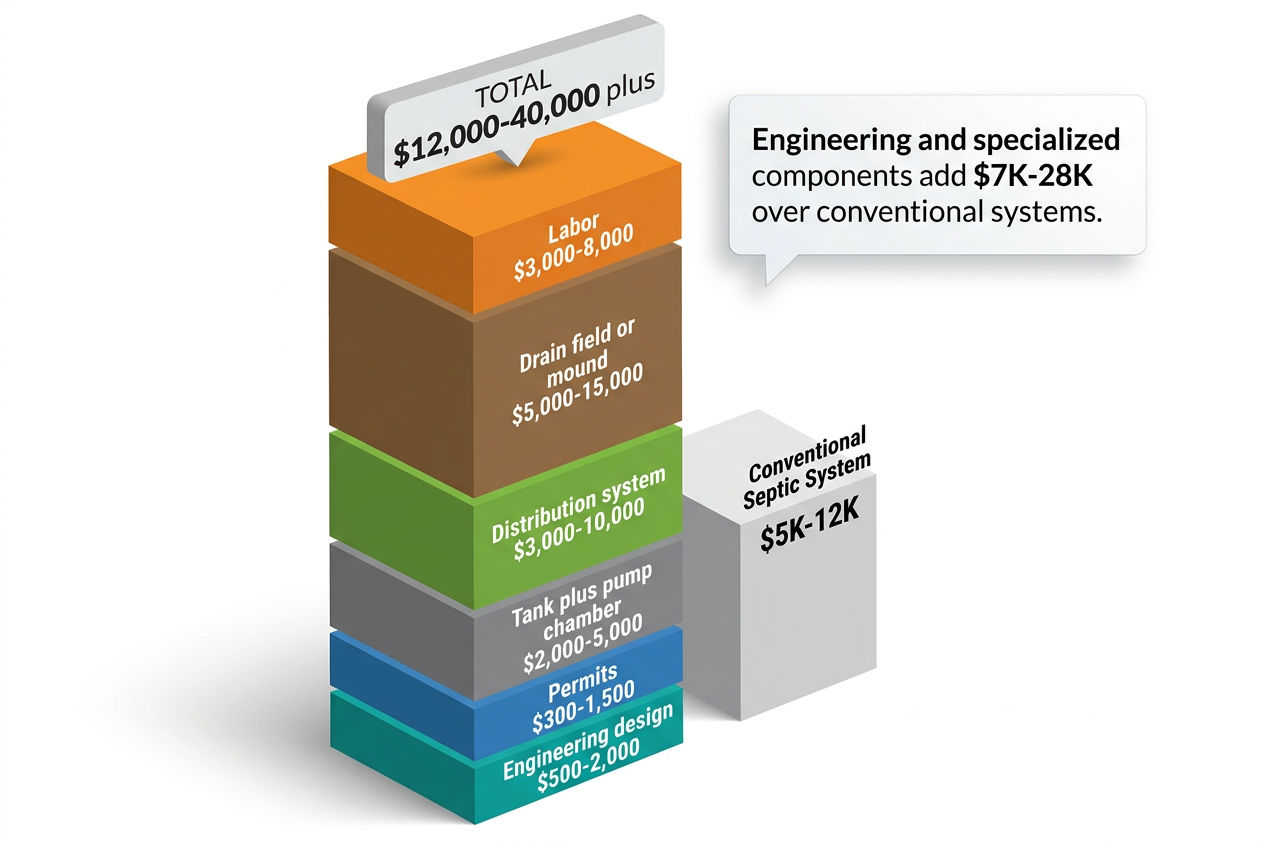
An engineered septic system costs $12,000 to $30,000 or more for a standard 3-bedroom home. That total includes soil evaluation ($500–$2,500), engineering design fees ($1,500–$5,000), permits ($200–$1,000), and system installation ($10,000–$25,000+). The most affordable option is a pressure distribution system starting around $10,000, while drip irrigation systems on difficult sites can exceed $30,000.
Cost Components Breakdown
Total costs depend on system type, site complexity, your region, and current material prices. Here's a realistic breakdown for a typical 3-bedroom home:
- Soil evaluation and site work: $500–$2,500
- Engineering design fees: $1,500–$5,000
- Permitting: $200–$1,000
- System installation (mound, ATU, or drip): $10,000–$25,000+
- Total project range: $12,000–$30,000+
💡 Key Takeaway: For comparison, a conventional system on an easy lot runs $3,000–$10,000 all-in. See our full septic system installation cost guide for a deeper regional breakdown.
| System Type | Install Cost | Annual Maintenance | Best For |
|---|---|---|---|
| Mound System | $15,000–$25,000 | $200–$400 | High water table, slow-perc soils |
| Aerobic Treatment Unit (ATU) | $12,000–$20,000 | $200–$500 (service contract) | Thin soil over bedrock, small lots |
| Drip Irrigation | $18,000–$30,000 | $250–$500 | Steep slopes, tight spaces |
| Sand Filter | $16,000–$28,000 | $150–$400 | Coastal areas, sensitive watersheds |
| Pressure Distribution | $10,000–$18,000 | $100–$300 | Marginal soils, uneven terrain |
Cost ranges based on national installer surveys and EPA data as of 2026. Actual costs vary by region, soil conditions, and local labor rates.
Advanced Treatment Septic System Cost (How It Differs From Conventional)
Advanced treatment septic system cost runs $12,000–$30,000 installed, versus $3,000–$10,000 for conventional. "Advanced treatment" is the regulatory term most state health departments use for any engineered system that adds a treatment step beyond a conventional tank + gravity drain field — including ATUs, mound systems, drip distribution, sand filters, and pressure distribution.
The premium pays for three things you don't get with conventional: (1) active mechanical treatment that produces cleaner effluent (NSF/ANSI 40-certified discharge), (2) engineered dispersal that works on sites where gravity drainage can't, and (3) enhanced regulatory acceptance for environmentally sensitive watersheds, small lots, and high water tables. If you're specifically researching aerobic systems, our aerobic septic system cost guide goes deeper on ATU-specific pricing including brand-by-brand equipment costs.

DIY Septic Blueprint
Thinking about building it yourself?
The complete, plain-English plan to size, permit and install your own septic system — designed for homeowners, not contractors. Skip the $15,000–$25,000 quotes and do it right the first time.
Get the DIY Blueprint — $67 →Instant download · 8 modules + 3 bonus guides · 60-day money-back guarantee✅ Pro Tip: A homeowner in coastal Maine with 18 inches of soil over bedrock needs a mound system. Soil evaluation: $1,800. Engineering: $3,200. Permitting: $450. Installation (mound with pressure distribution, 1,500-gallon concrete tank, pump chamber): $21,500. Total: ~$27,000. That's real money - but the alternative is no permit, no house.
For ongoing costs, check our septic repair cost guide - ATU pump replacements and service contracts add up over time. Routine tank pumping for an engineered system follows the same schedule as conventional, at $400–$750 every 3–5 years.
Why Would You Need an Engineered Septic System?
You need an engineered septic system when your property fails to meet the minimum requirements for a conventional drainfield. The most common trigger is a failed perc test - or more accurately, a complete soil evaluation showing your land can't absorb wastewater fast enough, or at all, without contaminating groundwater.
Common Site Conditions That Require Engineered Solutions
- High water table - If the seasonal high water table sits within 24 inches of the soil surface, a standard drainfield will flood. Treated effluent has nowhere to go except sideways - toward your neighbor's property or a nearby water body.
- Shallow bedrock or ledge - Common in New England and the Rocky Mountain states. If bedrock sits 18 inches below grade, you can't bury a conventional drainfield. Period.
- Slowly permeable clay soils - Clay-heavy soils in the Southeast - Virginia, North Carolina, Georgia - absorb water so slowly that a conventional system backs up within years, sometimes months.
- Steep slopes - Grades over 25–30% make conventional trenching impossible and create serious erosion and runoff risks.
- Small or irregular lot size - When there's not enough land to meet setback requirements from wells, property lines, and surface water, a conventional layout won't fit.
📊 Quick Fact: About one-third of new septic installations in many states now require some form of engineered or alternative design, according to data from the National Onsite Wastewater Recycling Association (NOWRA). The EPA estimates roughly 25% of U.S. homes rely on onsite wastewater systems - and that number keeps climbing as rural and suburban development pushes into less-than-ideal soils.
How Is an Engineered Septic System Different From a Conventional One?
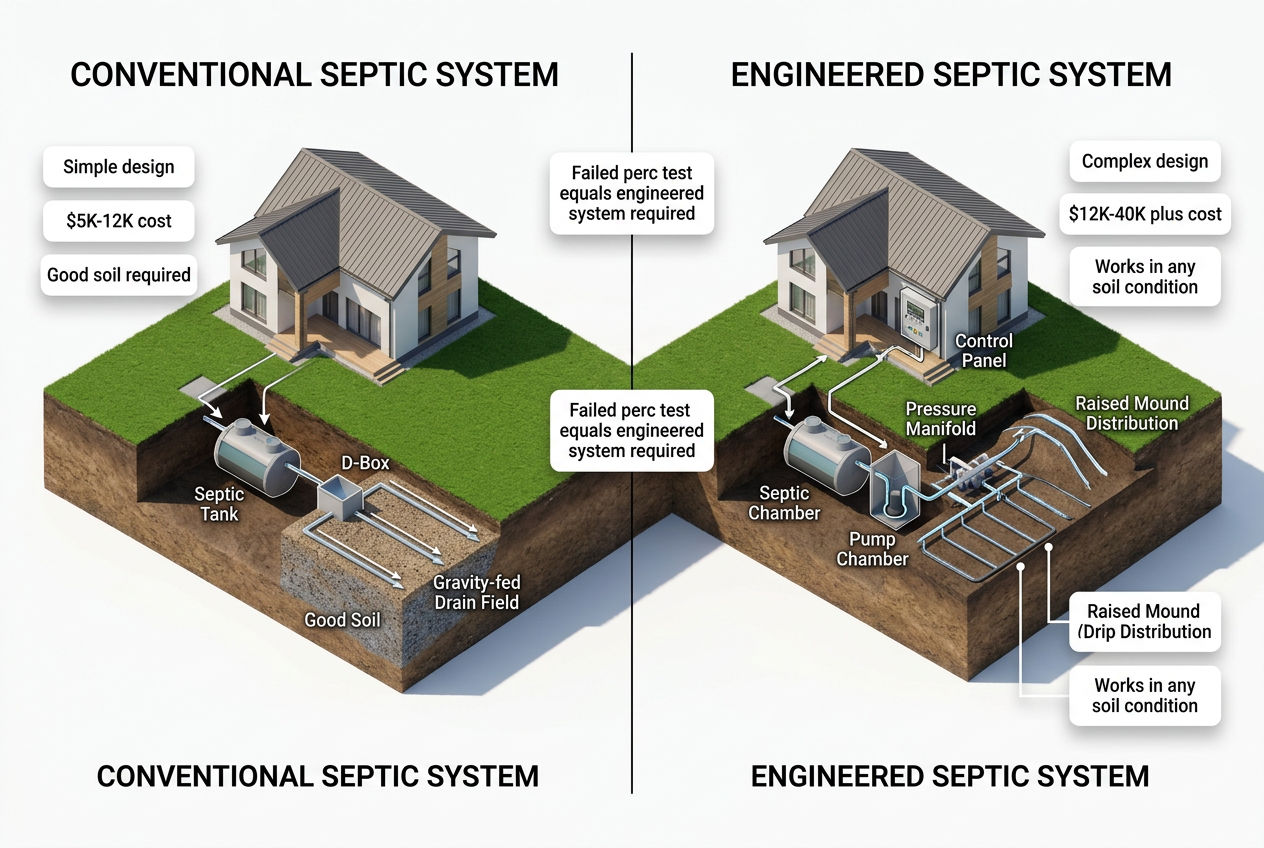
A conventional septic system works in two basic steps: solids settle in a tank, and liquid effluent flows by gravity into a drainfield where the native soil filters it. Simple. Inexpensive. Effective - when the soil cooperates.
An engineered system adds layers of treatment, alternative dispersal, or both. Instead of relying on native soil to do all the work, the design compensates for what the soil can't do on its own. For a side-by-side look at each approach, see our overview of alternative septic system options.
Key Differences at a Glance
| Feature | Conventional System | Engineered System |
|---|---|---|
| Installed cost | $3,000–$10,000 | $12,000–$30,000+ |
| Design required | Basic layout | Licensed PE or soil scientist |
| Soil requirement | Moderate percolation | Any - system compensates |
| Maintenance | Pump every 3–5 years | Varies; ATUs every 4–6 months |
| Lifespan | 20–30 years | 20–30+ years |
| Permit complexity | Standard | Site-specific engineering review |
Source: EPA Onsite Wastewater Treatment Systems Manual; NOWRA industry cost surveys
⚠️ Warning: If a conventional system in your county costs $7,000 installed, budget at least $15,000–$25,000 for an engineered alternative on the same lot. That gap is real, and you should factor it into any land purchase or construction budget.
What Are the Main Types of Engineered Septic Systems?
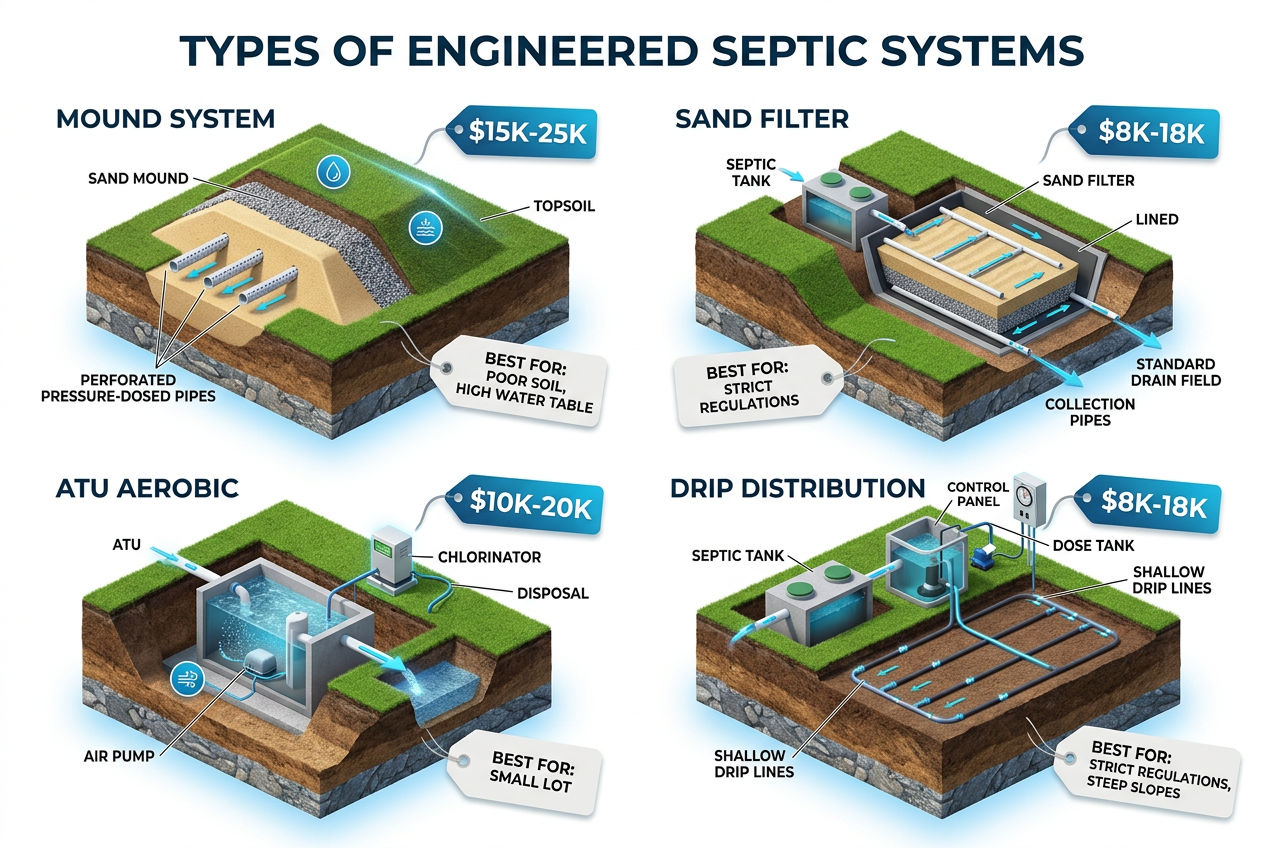
Engineered septic design isn't a single product - it's a category. The right type depends on your specific site conditions. Here are the systems you're most likely to encounter:
Mound Systems
A mound septic system is the most common engineered option in states with high water tables or slowly permeable soils. Sand and gravel are imported and placed above the natural grade, creating an elevated drainfield. The mound typically rises 2–5 feet above the existing soil surface.
Effluent is pumped from a dosing chamber up into the mound through pressure distribution pipes, usually spaced on 2-foot centers. The imported sand provides the filtration the native soil lacks. Minnesota effectively pioneered the modern mound system - they're so common there that contractors install hundreds per year in areas around lakes and wetlands.
Aerobic Treatment Units (ATUs)
An aerobic treatment unit introduces forced air into the treatment process, dramatically boosting bacterial activity. Where a conventional tank produces partially treated effluent, a quality ATU - like units manufactured by Norweco or Jet Inc. - can achieve BOD₅ and TSS levels below 30 mg/L, meeting secondary treatment standards.
ATUs are the dominant system type in Texas, where thin soils over limestone karst make conventional drainfields impractical. Texas regulates these as On-Site Sewage Facilities (OSSFs) under county-level authority, and most ATU owners are required to hold a maintenance contract. Budget $200–$500 per year for that contract, plus pump replacement every 7–10 years.
Drip Irrigation Systems
A drip irrigation septic system delivers treated effluent through small-diameter tubing buried 6–12 inches below the soil surface. Orenco Systems is a leading manufacturer of these setups. The shallow burial distributes effluent across a wide area at low doses, preventing saturation - and it can work on sites where slope or soil depth makes mounds impractical.
These systems require a higher level of pretreatment (usually an ATU) before dosing, and they include filtration components to prevent emitter clogging.
Sand Filter Systems
A sand filter system passes effluent through a bed of clean, uniformly graded sand before it reaches the drainfield or surface water. The sand acts as a biological filter, stripping nutrients and pathogens the septic tank alone can't remove. You'll see these in coastal areas - particularly in the Chesapeake Bay watershed and the Pacific Northwest - where states require advanced treatment to protect shellfish beds and sensitive waterways. Our guide to sand filter septic systems covers intermittent vs. recirculating designs and costs in detail.
Pressure Distribution Systems
Some engineered designs use the same soil conditions as a conventional system but add a pump chamber and pressure distribution manifold to dose effluent evenly across the drainfield. This prevents overloading any single area, extending drainfield life and improving treatment. It's often the lowest-cost step up from conventional design.
Engineered Septic Systems for Karst Topography (Arkansas, Tennessee, Kentucky)
Karst topography creates unique septic challenges that almost always require engineered systems. Found across Arkansas, Tennessee, Kentucky, the Missouri Ozarks, and parts of central Florida, karst terrain is built on limestone bedrock riddled with sinkholes, underground caves, and rapid groundwater conduits. Conventional drainfields can pollute drinking water aquifers almost immediately because effluent has a direct path to groundwater rather than slow soil filtration.
State-Specific Karst Septic Requirements
- Arkansas — The Arkansas Department of Health mandates deep soil borings and dye tracing studies in karst-prone counties before approving any onsite system. Most karst zones require advanced treatment (ATU or drip irrigation) plus enhanced setbacks from sinkholes and surface water features.
- Tennessee — Karst limestone surrounding Nashville and across Middle Tennessee triggers groundwater vulnerability assessments under TDEC Rules 0400-48-01. Wilson, Williamson, Rutherford, and Davidson counties enforce particularly strict setback distances from sinkholes and depressions.
- Kentucky — The Kentucky Division of Water requires alternative system designs whenever soil borings encounter solution channels, voids, or rapid percolation rates that indicate direct groundwater connection. Engineered systems with advanced pretreatment are typical in karst counties.
What Karst Soils Mean for Cost
Engineered systems in karst regions sit at the higher end of the price range — typically $20,000–$35,000+ installed — because they require:
- More extensive soil evaluation (dye tracing, deeper borings)
- Advanced pretreatment to reduce nitrogen and pathogens before effluent enters bedrock
- Larger setback distances that may require non-standard layouts
- Additional engineering review by state-level karst geology experts
⚠️ Warning: If you're buying property in a karst region, request the full soil evaluation report before closing — not just the perc test. A failed evaluation in karst country can mean a property simply cannot accept septic effluent without a $25,000+ engineered system, or in rare cases cannot be developed for residential use at all.
Who Designs an Engineered Septic System?
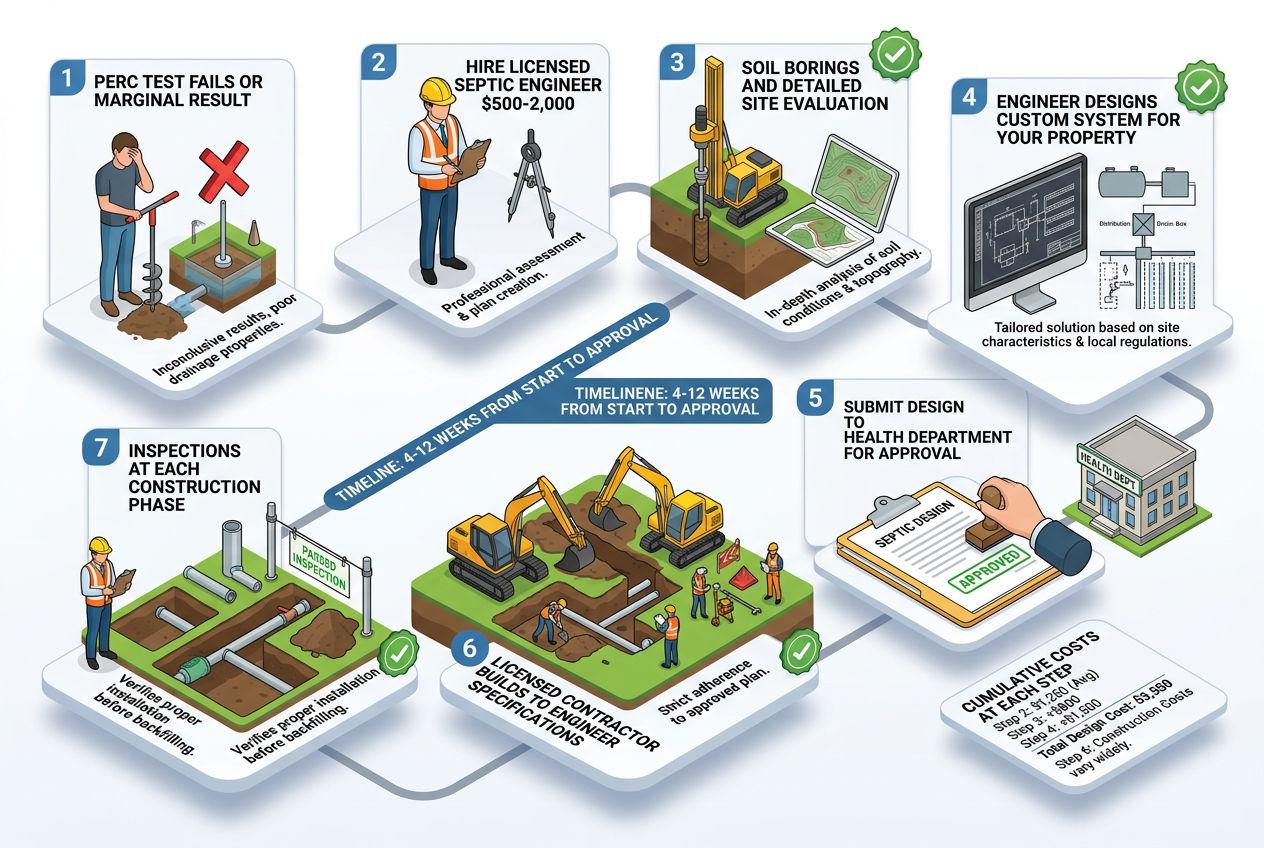
This is where it starts - before permits, before contractors, before any equipment is ordered. A licensed Professional Engineer (PE) with wastewater or civil engineering credentials, or a state-certified soil scientist, must evaluate your site and produce a stamped design.
The Design and Permitting Process
- Soil evaluation and perc test - A certified evaluator digs test pits and measures soil horizons, texture, structure, and the seasonal high water table. This typically costs $500–$2,500.
- Site survey - Topographic mapping of slopes, setback distances, and available space.
- System design - The engineer selects the system type and sizes components to your home's design flow rate. Most states use 150 gallons per day per bedroom as a baseline, though this varies.
- Permit application - The stamped design goes to your county health department or state environmental agency. Permitting fees range from $200 to $1,000 depending on jurisdiction.
- Engineering design fees - Expect $1,500–$5,000+ for the design package alone, separate from installation.
💡 Key Takeaway: In North Carolina - one of the national leaders in alternative system regulation - the state's On-Site Water Protection Branch reviews engineered designs and classifies systems into approval tiers. In Florida, the Department of Health oversees all septic permits through county environmental health offices. The point: every state does this differently. Check your county health department before assuming anything.
Does an Engineered Septic System Affect Property Value or Mortgages?
Here's the question buyers and sellers ask most, and the honest answer is: not the way you might fear.
Conventional lenders - including FHA, VA, and USDA Rural Development loan programs - regularly approve mortgages on properties with engineered septic systems, provided the system has a valid permit, passes inspection, and is properly maintained. A septic inspection is typically required at closing anyway, engineered or not.
Impact on Property Value
On property value: a well-maintained engineered system generally has zero negative impact. In many rural markets, properties with engineered systems command the same prices as those with conventional systems, because buyers understand that's what the site requires. What does hurt value is a failing system - conventional or engineered.
⚠️ Warning: ATUs with mandatory maintenance contracts add a recurring cost that some buyers will factor into their offer. Disclose it upfront and provide service records. Transparency closes deals. Surprises kill them.
How Long Does an Engineered Septic System Last?
With proper maintenance, engineered systems last 20–30+ years - comparable to or longer than conventional systems in poor soils, which often fail within 10–15 years when the native soil isn't suited for the load.
Variables That Shorten Lifespan
- Skipping ATU service contracts (aerator compressors, like the Hiblow HP-80, need inspection every 4–6 months)
- Flushing non-biodegradable materials that clog drip emitters
- Ignoring pump alarms on mound and pressure distribution systems
- Overloading the system beyond its design flow rate
✅ Pro Tip: Think of an engineered system like a well-maintained vehicle with more complex parts. You can't skip oil changes on a turbocharged engine and expect it to last 200,000 miles. Same logic applies here.
For routine maintenance schedules that apply to all system types, see our septic tank maintenance guide.
Regional Considerations: Your Location Changes Everything
Regulations and common system types vary dramatically by region. A few examples worth knowing:
| Region | Common Challenges | Dominant System Types | Key Regulatory Body |
|---|---|---|---|
| Upper Midwest (Minnesota, Wisconsin) | Frost lines 42–60", lakes & wetlands | Mound systems | Minnesota MPCA |
| Texas Hill Country | Limestone karst, minimal soil depth | Aerobic Treatment Units (ATUs) | County Designated Representatives |
| Pacific Northwest (Washington, Oregon) | Heavy rainfall, seasonal saturation | Drip irrigation, sand filters | State environmental agencies |
| Northeast (Maine, Vermont, NH) | Shallow bedrock, small lots | Mound systems, ATUs | State health departments |
| Coastal areas (nationally) | Nitrogen reduction requirements | Advanced treatment systems | Watershed-specific authorities |
📊 Quick Fact: Minnesota's MPCA has some of the country's most detailed mound system design standards, developed over decades of working with lake-country installations.
Whatever your region, the EPA's Septic Systems page is the right starting point for understanding federal guidance. Your state health department fills in the local details.
Finding a Qualified Professional
Once you know you need an engineered system, the sequence matters. Don't call an installer first. Start with a licensed soil scientist or PE who specializes in onsite wastewater - they'll produce the stamped design that contractors must follow. Then get at least three installation bids based on that same design document.
Our directory connects you with licensed engineers, soil scientists, and certified installers in your area. Find an engineered septic system professional near you and start with a site evaluation before any commitments are made.
Have questions? Find a septic professional near you on SepticTankHub.
Related reading: what is drain field.
Sources & Methodology
- U.S. Environmental Protection Agency - Septic Systems: Used for prevalence statistics (25% of U.S. homes on onsite systems) and treatment standard benchmarks (BOD₅/TSS secondary treatment levels).
- National Onsite Wastewater Recycling Association - NOWRA: Referenced for industry data on the share of new installations requiring alternative/engineered designs.
- USDA Rural Development: Referenced for loan program guidance on properties with alternative septic systems.
- State health department regulations: North Carolina On-Site Water Protection Branch; Florida Department of Health; Minnesota Pollution Control Agency (MPCA) - referenced for state-specific permitting and design standards.
- Manufacturer technical specifications: Orenco Systems (drip irrigation), Norweco and Jet Inc. (ATUs), Hiblow (aerator compressors) - used for system specifications and maintenance intervals.
Cost ranges reflect national installer surveys and regional market data as of 2026. Actual costs vary by soil conditions, system type, contractor rates, and local permitting fees. Always obtain multiple bids from licensed professionals.
About the Author: This article was researched and written by the editorial team at SepticTankHub.com, a national directory connecting homeowners with licensed septic service professionals. Our content is reviewed for technical accuracy against EPA guidelines and current state regulations.
Need help with your engineered septic system? Browse local septic engineers and installers in Arkansas, Tennessee, Texas, Maine, or Minnesota — or find a pro in any state on our homepage.
Free download
Not ready for the Blueprint? Start free.
Grab the free DIY Septic Planning Kit — the permit-first checklist, perc-test cheat sheet, and sizing tables that keep your build from getting red-tagged.
Was this article helpful?
Frequently Asked Questions
Recommended Resources
📖 Related Articles
💰 Cost Guides
🔧 Services
Find Septic Professionals Near You
Compare licensed, verified septic companies by area — top county markets and cities below, or browse all 50 states.
County markets
Popular cities
