
Quick Answer
A septic tank size chart translates the number of bedrooms in your home into the minimum gallon capacity your system needs to handle daily wastewater flow. Most jurisdictions follow the 150-gallons-per-day-per-bedroom rule, which means a standard 3-bedroom home requires at least a 1,000-gallon tank. Physical dimensions vary by material and manufacturer.
Key Takeaways
- The standard sizing rule is 150 gallons per day per bedroom — so a 3-bedroom home generates roughly 450 gallons per day (gpd)
- 1,000 gallons is the most common residential tank size installed in the U.S., and the minimum most states require for a 3-bedroom home
- Physical dimensions vary by material: a 1,000-gallon concrete tank runs roughly 8'–8'6" long × 4'–4'6" wide × 4'6"–5' deep
- Adding a garbage disposal can increase required tank capacity by 25–50% under many state codes
- These charts represent general guidelines — your local health department sets the enforceable minimum for your property
Septic Tank Size Chart by Number of Bedrooms
For most residential septic systems, tank size is determined by the number of bedrooms — not bathrooms, not square footage. Bedrooms serve as the proxy for how many people live in the home and therefore how much daily wastewater flow the system must handle.
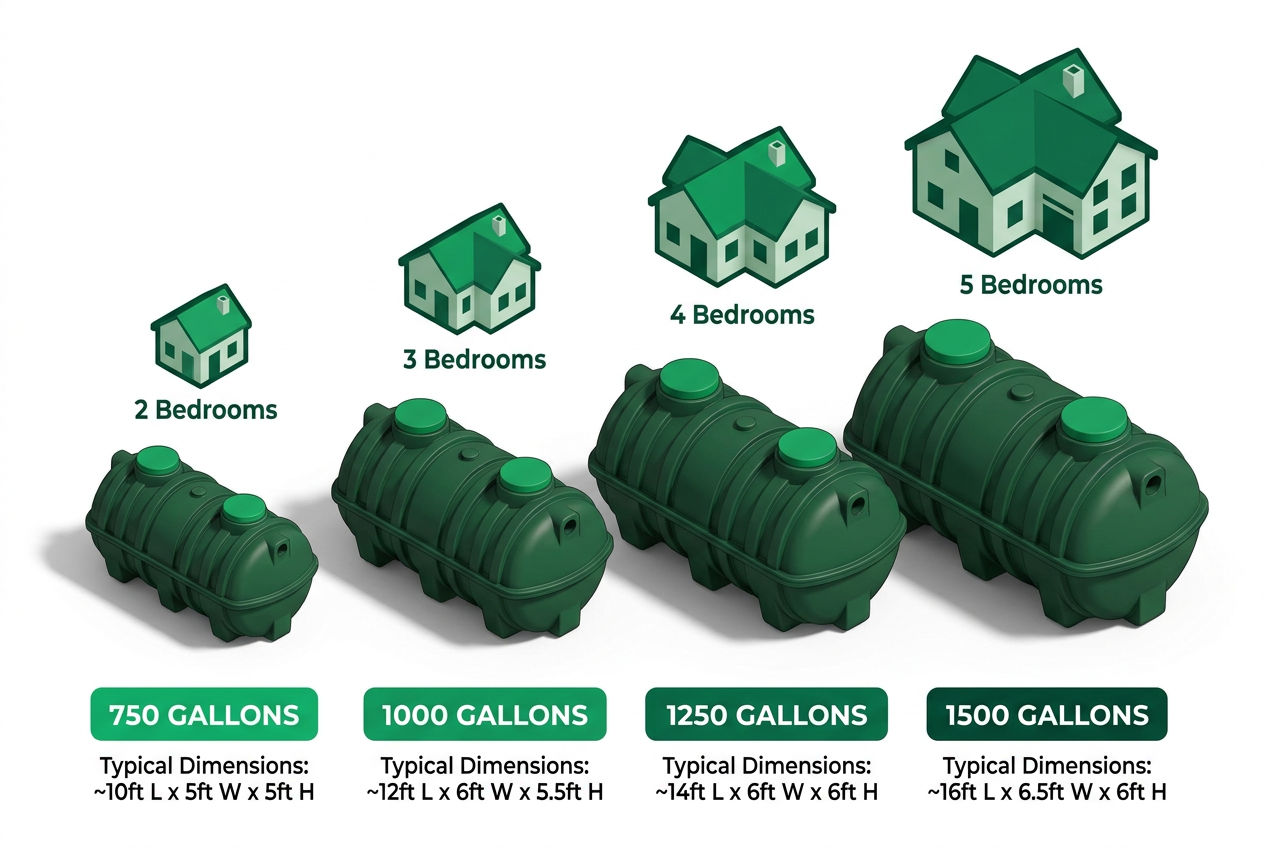
Here's the standard septic tank size chart based on the International Plumbing Code (IPC) Appendix H framework and common state-level adaptations:
| Bedrooms | Minimum Tank Size | Estimated Daily Flow |
|---|---|---|
| 1–2 bedrooms | 750 – 1,000 gal | 150 – 300 gpd |
| 3 bedrooms | 1,000 – 1,250 gal | 300 – 450 gpd |
| 4 bedrooms | 1,250 – 1,500 gal | 450 – 600 gpd |
| 5 bedrooms | 1,500 – 1,750 gal | 600 – 750 gpd |
| 6 bedrooms | 1,750 – 2,000 gal | 750 – 900 gpd |
Source: International Plumbing Code Appendix H; EPA septic system guidelines. These are general minimums. State and county codes vary — confirm requirements with your local health department before purchasing or installing any tank.
The 750-gallon mark is the absolute floor in most jurisdictions. Even a vacation cabin with a single bedroom rarely gets permitted below that threshold. Most installers and health departments default to a 1,000-gallon minimum regardless of bedroom count, because undersized tanks fail faster and cost more to maintain. Capacity is also the first calculation in our DIY septic system guide — whether you build or hire out, the sizing math is identical.
Your drain field sizing also scales with tank capacity and soil percolation rate — the tank size only tells half the story of your septic system's total capacity.
Standard Septic Tank Dimensions by Gallon Capacity
Knowing the right gallon capacity is step one. Knowing whether that tank will fit on your property — and through your access point — is step two. Dimensions vary by manufacturer and material, but these ranges give you a solid working reference.
| Tank Capacity | Approx. Length | Approx. Width | Approx. Depth | Common Materials |
|---|---|---|---|---|
| 500 gallon | 5'0" | 3'2" | 4'2" | Concrete, Poly |
| 750 gallon | 5'8" | 3'10" | 4'4" | Concrete, Poly |
| 1,000 gallon | 8'0"–8'6" | 4'0"–4'6" | 4'6"–5'0" | Concrete (most common) |
| 1,250 gallon | 8'6"–9'0" | 4'6"–5'0" | 5'0"–5'6" | Concrete |
| 1,500 gallon | 9'0"–10'0" | 5'0"–5'6" | 5'0"–5'8" | Concrete |
| 2,000 gallon | 10'0"–11'0" | 5'0"–6'0" | 5'6"–6'0" | Concrete |
| 2,500 gallon | 11'0"–12'0" | 5'6"–6'0" | 6'0"–6'6" | Concrete |
Dimensions are approximate and vary by manufacturer. Concrete tanks tend to be shorter and wider; poly and fiberglass tanks typically run taller and narrower. Always verify exact dimensions with your supplier before excavation.
One number that surprises almost every homeowner: a 1,000-gallon concrete tank weighs roughly 8,000–10,000 pounds. Getting it to your lot requires the right equipment and adequate access. That weight is also why shallow bedrock, tight lots, and low-clearance fences complicate otherwise straightforward installations. Learn more about what to expect during the full process in our septic system installation guide.
How Is Septic Tank Size Determined?
The 150-Gallon-Per-Bedroom Rule
The EPA's guidance and most state codes estimate that each bedroom in a home generates approximately 150 gallons of wastewater per day. This figure accounts for typical household activities — showers, toilet flushes, laundry, dishwashing — averaged across a two-person occupancy per bedroom.
So the math looks like this for a 3-bedroom home:
- 3 bedrooms × 150 gpd = 450 gallons per day
- A properly sized septic tank should hold at least 2–3 days of peak flow as a buffer
- 450 gpd × 2.5 days = 1,125 gallons → rounded up to a 1,250-gallon tank under stricter codes, though many jurisdictions accept 1,000 gallons as sufficient
That gap between 1,000 and 1,250 gallons is exactly why you see range entries in the size chart. The 1,000-gallon floor is the practical minimum; 1,250 gallons gives you meaningful cushion for guests, high-use events, or that extra bathroom your kids actually use.
Bedrooms vs. Bathrooms: Which One Drives Tank Size?
Bedrooms. Almost universally, bedrooms drive the sizing calculation — not bathrooms. The reasoning: bedrooms represent potential occupants. More occupants means more daily flow. An extra bathroom doesn't add people; it just adds fixtures.
That said, bathrooms are not irrelevant. A home with four bedrooms and four full bathrooms, a Whirlpool tub, and a water softener is going to stress a system harder than the same four-bedroom house with two modest bathrooms. Many codes do require upsizing when certain high-flow fixtures are present.
Garbage disposals get special attention here. If your kitchen has a garbage disposal, many state codes require you to increase tank capacity by 25–50%. A 1,000-gallon tank for a 3-bedroom home becomes a 1,250- or 1,500-gallon requirement once that InSinkErator gets added to the permit application. For a deeper look at how disposals affect your system, see garbage disposals and septic systems.
When You Need a Bigger Tank Than the Minimum
Minimums are floors, not recommendations. Consider sizing up if:
- Your household consistently exceeds 2 people per bedroom — a family of six in a 3-bedroom house will push system limits faster than the code assumption
- You have a home-based business with employees using the facilities
- You run water-heavy appliances frequently — water softeners, commercial-grade dishwashers, or steam showers add meaningful load
- Your soil percolation rate is slow — a slower perc test result means effluent moves through your drain field more slowly, so the tank needs more buffer capacity
- You're in a location with seasonal guests — a lake house that sits empty for eight months and then hosts 10 people every summer weekend is not a "normal use" scenario
Free download
Planning your own septic system?
Grab the free DIY Septic Planning Kit — the permit-first checklist, perc-test cheat sheet, and sizing tables that keep your build from getting red-tagged.
What Size Septic Tank for a 3-Bedroom House?
A 3-bedroom house needs a minimum of 1,000 gallons, and in many states that's exactly what you'll get permitted. Some jurisdictions push you to 1,250 gallons for a 3-bedroom home — Florida's DOH, for example, requires a minimum of 1,050 gallons for a standard 3-bedroom residence, slightly above the 1,000-gallon national norm.
Here's what that looks like in practice. Picture a family of four in a 3-bedroom suburban home in Ohio. Their daily water use comes in around 380–420 gpd — close to the 450 gpd estimate but slightly under because one kid is at college. A 1,000-gallon two-compartment concrete tank (split roughly ⅔ settling chamber / ⅓ outlet chamber, as many modern codes require) handles that load comfortably when pumped every 3–5 years, per EPA recommendations.
Add a garbage disposal and that pumping interval compresses. With a disposal running daily, solids accumulate roughly 30–40% faster. Expect pumping every 2–3 years instead. That's an extra $300–$500 service call every other year — real money over the life of the system.
The 1,000-gallon tank is also the most cost-effective entry point. A 1,000-gallon concrete tank typically runs $800–$1,500 for the tank alone, or $3,000–$7,000 fully installed depending on your region, soil conditions, and local labor rates. Our septic installation cost guide breaks down the full pricing picture.
For more detail on everything a 1,000-gallon tank involves, see our dedicated 1,000-gallon septic tank guide.
What Size Septic Tank for a 4-Bedroom House?
A 4-bedroom home requires a minimum tank size of 1,250–1,500 gallons under most state codes. Texas TCEQ is notably more permissive here — their rules allow a 1,000-gallon tank for homes up to 4 bedrooms, using a fixtures-based calculation that sometimes produces lower minimums than the bedroom-count method.
Most installers recommend going to 1,500 gallons for a 4-bedroom home, especially if:
- The home has 3+ bathrooms
- More than 6 people live there regularly
- A garbage disposal is present
- The lot has clay-heavy or slow-draining soil
The step from 1,250 to 1,500 gallons adds roughly $300–$600 to the tank cost and almost nothing to the labor side of installation. Over a 25–30 year system lifespan, that upsize pays for itself easily in avoided emergency pump-outs and extended drain field life.
Septic Tank Sizes by Material: Concrete vs. Plastic vs. Fiberglass
The gallon capacity is the same regardless of material. The physical size, weight, installation method, and long-term performance are not.
Concrete tanks are the default in most of the country. They're heavy (that 1,000-gallon tank at 8,000–10,000 lbs), require heavy equipment to place, and are vulnerable to cracking over decades — but they're durable, widely available, and accepted by every jurisdiction. The baffle walls inside concrete tanks can deteriorate, which is why modern installations use plastic or fiberglass baffles rather than poured-concrete ones.
Poly (plastic) tanks like those made by Infiltrator Water Technologies are lighter, easier to transport, and resistant to cracking and corrosion. The tradeoff: they're more susceptible to shifting in high water table areas because they can actually float if the tank is empty and groundwater pressure rises. They also tend to be taller and narrower than equivalent concrete tanks, which affects excavation geometry.
Fiberglass tanks split the difference — lighter than concrete, more rigid than poly, and highly resistant to corrosion. They're popular in coastal and high-moisture environments where concrete deteriorates faster. For a full breakdown of how these materials compare over the long run, see our concrete vs. plastic septic tank comparison.
State and Local Septic Tank Size Requirements
Here's the critical caveat: the charts above reflect general national guidelines. Your state and county may require something different — and the local health department's rules trump everything.
| State | Notable Sizing Rule |
|---|---|
| Texas | TCEQ: 1,000-gal minimum for up to 4 BR; uses fixtures-based calculation |
| Florida | DOH: 900-gal minimum for 2 BR; 1,050-gal for 3 BR |
| North Carolina | County health dept enforced; 900-gal minimum for ≤3 BR |
| Pennsylvania | Uses daily sewage flow calc (400 gpd for 3 BR); results may differ from chart |
| New York | Many counties require 1,000-gal minimum regardless of bedroom count |
| California | Extreme county-level variation; Sonoma and El Dorado counties have supplemental rules |
| New England | Frost depth affects installation depth requirements; capacity sizing follows national norms |
Before you order a tank, call your county health department or visit your state's environmental agency website. In most states, septic permits are issued at the county level, not the state level. California in particular — where county rules in El Dorado, Sonoma, and Marin diverge significantly — can catch homeowners off guard when they assume state averages apply to their lot.
For state-specific rules, explore our state regulation guides, including Florida septic regulations, Texas septic regulations, and California septic regulations.
How Do You Find Out What Size Septic Tank You Already Have?
If you're buying a home or inheriting a system, you need to know what's already in the ground. Four ways to find out:

-
Pull the permit records. Your county health department keeps septic installation permits on file. Call them with the property address. This is the most reliable source — permit records typically include tank size, installation date, and system type.
-
Check the as-built drawing. Many home sellers receive an as-built (a diagram of the system layout) at closing. If the previous owner has it, the tank size is usually labeled. If you're just buying, ask the seller's agent specifically for this document.
-
Look at the access risers. If your tank has septic tank risers at grade, a pump-out contractor can measure interior dimensions and calculate volume when they service the tank.
-
Hire a septic inspector. A licensed inspector can physically locate the tank, probe the access points, and give you a confident assessment of size and condition. If you're buying a home with a septic system, this is non-negotiable — see our septic inspection guide for home buyers.
Sources & Methodology
The size-by-bedroom data in this article is derived from the following sources:
- U.S. Environmental Protection Agency — Septic Systems Overview and supporting technical guidance documents. epa.gov/septic
- International Plumbing Code (IPC), Appendix H — The model code framework most states use as a baseline for residential septic sizing requirements.
- Florida Department of Health — Chapter 64E-6, Standards for Onsite Sewage Treatment and Disposal Systems, which sets Florida-specific minimum tank sizes by bedroom count.
- Texas Commission on Environmental Quality (TCEQ) — Title 30, Texas Administrative Code, Chapter 285, On-Site Sewage Facilities, which governs sizing in Texas.
- National Onsite Wastewater Recycling Association (NOWRA) — Industry standards and best practices for septic system design. nowra.org
Physical dimension ranges are based on published specifications from major manufacturers including Infiltrator Water Technologies and regional concrete tank producers. Dimensions vary by manufacturer and are presented as general reference ranges only.
Ready to Size Your System? Find a Local Septic Pro.
Getting the right tank size on paper is the first step. Getting it permitted, delivered, and installed correctly is where a qualified contractor earns their fee. Installation mistakes — wrong tank size, improper depth, inadequate drain field design — are expensive to fix and sometimes require complete system replacement.
Use the SepticTankHub directory to find licensed septic installers in your area. Whether you're spec'ing a new system for new construction or replacing a failing tank, a local pro who knows your county's specific requirements is worth the call before you commit to any equipment purchase.
You can also compare local septic companies and get competing quotes from multiple installers through our get quotes tool — it takes less time than a single phone call and puts competitive pressure on pricing.
Was this article helpful?
Frequently Asked Questions
Recommended Resources
📖 Related Articles
- What Is a Drain Field? (And How Does It Work?)
- What to Expect During Septic System Installation
- Can You Use a Garbage Disposal with a Septic System?
- Perc Test (Percolation Test): What It Is & How It Works
- Leach Field Size by Bedrooms: Drain Field Sizing Chart (2026)
- 1000-Gallon Septic Tank: Dimensions, Cost & Concrete vs Plastic
- Concrete vs Plastic Septic Tanks: Which Is Better?
- How to Install Septic Tank Risers (and Why You Should)
- Septic Inspection for Home Buyers: Complete Checklist
🔧 Services
Find Septic Professionals Near You
Compare licensed, verified septic companies by area — top county markets and cities below, or browse all 50 states.
County markets
Popular cities
