
Quick Answer
Using a garbage disposal on a septic system is possible, but it increases the solids load entering your tank by approximately 50%, according to University of Minnesota Extension research. That extra burden means more frequent pumping, closer attention to what goes down the drain, and - in some states - a larger tank requirement. Done right, it works. Done carelessly, it can shorten your drain field's life by years.
💡 Key Takeaways
- A garbage disposal is not banned by the EPA, but it adds roughly 1–2 gallons of solids per week to your septic tank
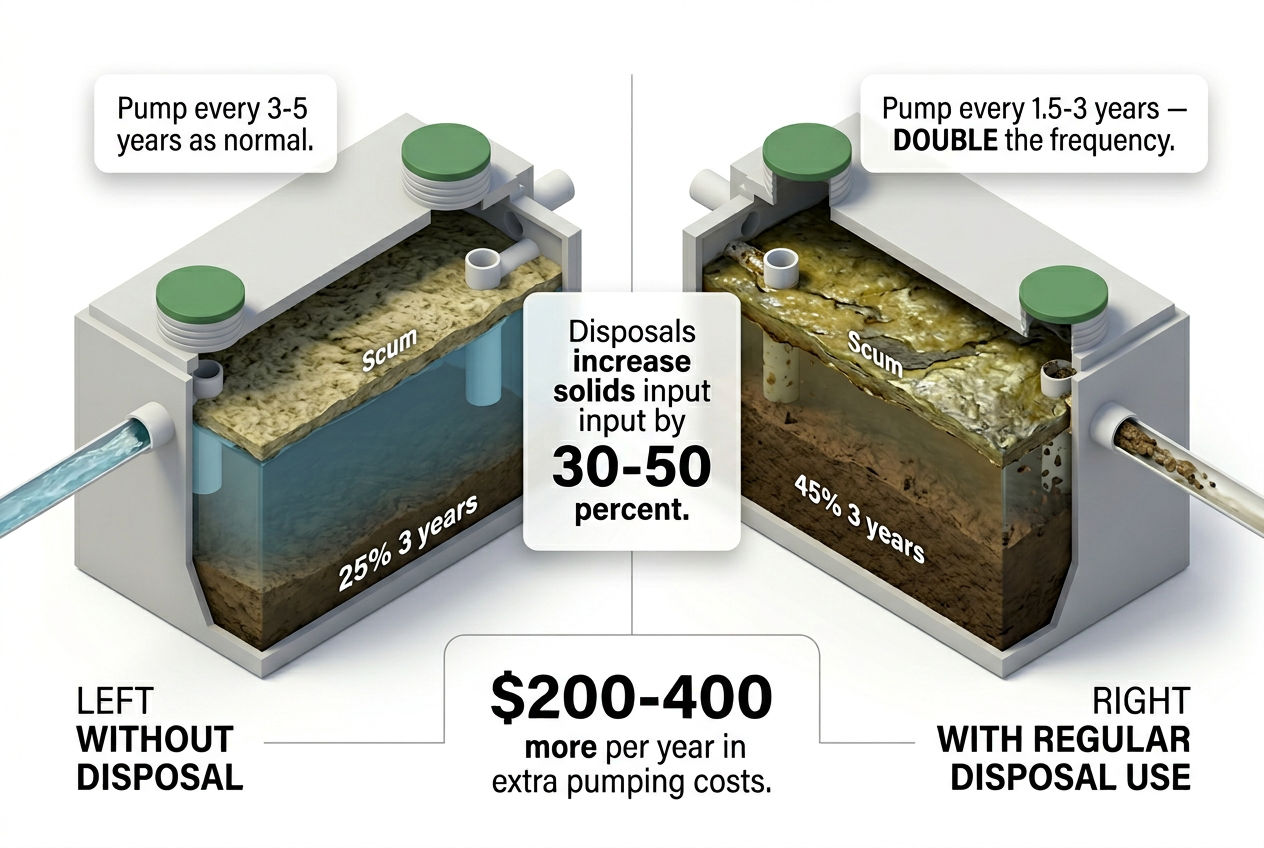
- Pumping frequency drops from every 3–5 years to every 1–3 years when a disposal is in regular use
- Septic-assist disposals (like the InSinkErator Evolution Septic Assist) grind waste finer and inject enzymes to reduce solids buildup
- Some states and counties - including parts of North Carolina and certain New England townships - require larger tanks or additional permits when disposals are present
- Composting is a zero-risk alternative that diverts about 30% of household waste from both your septic tank and the landfill
Does a Garbage Disposal Hurt a Septic System?
A garbage disposal does not automatically destroy a septic system, but it does stress it. The core problem is volume and composition. Your septic tank is a living system. Anaerobic bacteria break down organic solids in the tank's lower sludge layer, producing liquids and gases. The clarified effluent flows out to the drain field, where soil microbes handle the rest.
When you run food scraps through a standard disposal, you're adding finely ground organic material that the tank's bacteria can only partially process. Food waste is roughly 70–80% water by weight, but the remaining solids accumulate directly in the sludge layer. Over time, a sludge layer that would normally take 3–5 years to require pumping fills up in 1–2 years.
⚠️ Warning: When sludge gets deep enough to reach the outlet baffle, partially digested solids flow into your drain field - and that's where things get expensive. A failing drain field replacement can run $5,000–$20,000 depending on your region and system type.
The University of Minnesota Extension has documented the 50% solids increase figure across multiple household studies. That's not a worst-case scenario - that's average, everyday disposal use for a typical family.
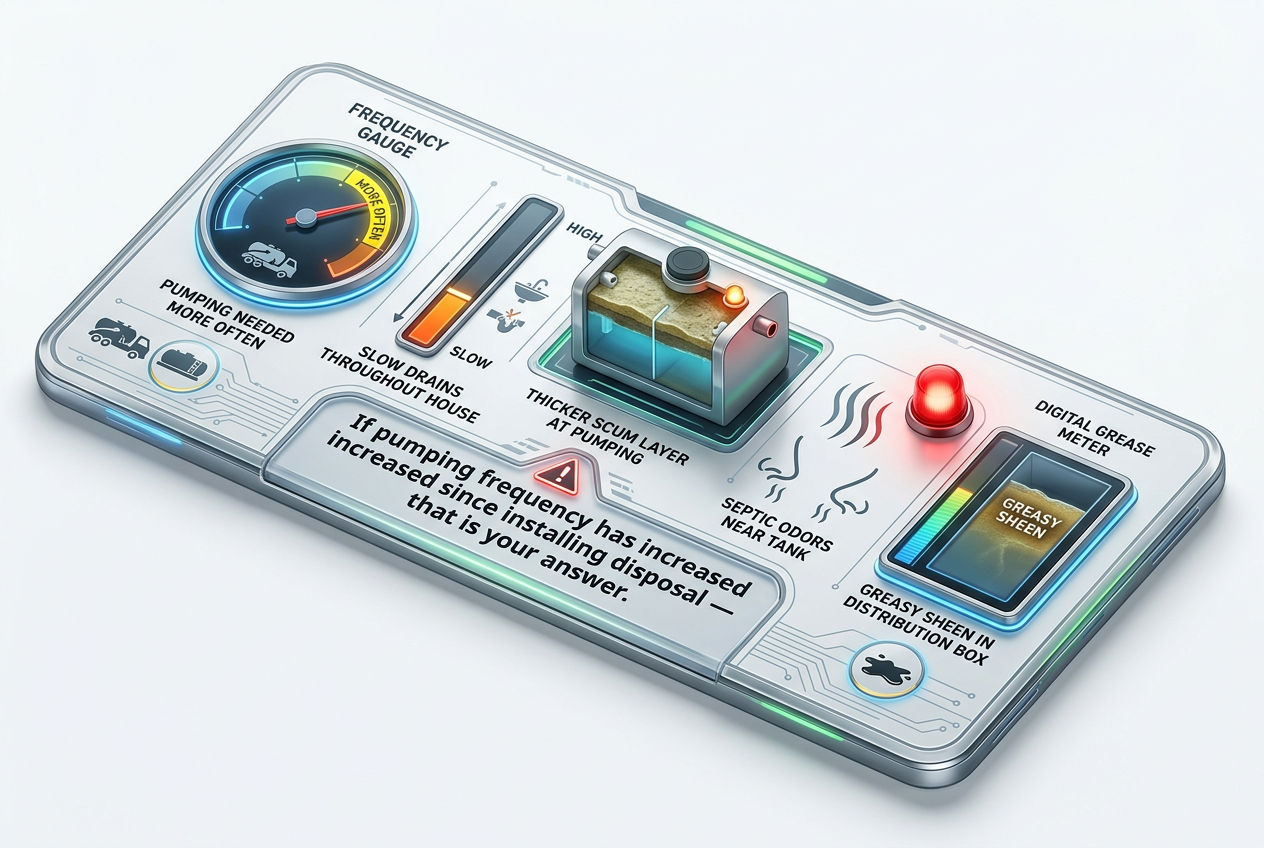
How Often Should You Pump Your Septic Tank If You Have a Garbage Disposal?
Without a garbage disposal, the EPA recommends pumping a standard residential septic tank every 3–5 years. Add a garbage disposal into the mix and that schedule compresses significantly.
Real-World Pumping Frequency Examples
Here's a real-world example. A 1,000-gallon tank serving a family of four without a disposal typically needs pumping every 3–4 years. Run a disposal for daily meal prep - rinsing vegetable peels, grinding the leftover pasta, disposing of coffee grounds - and that same tank likely needs pumping every 18–24 months. Heavy use in a household of five or six people? You're looking at annual pumping.
📊 Quick Fact: At the national average of $300–$600 per pump-out, that's an added $150–$300 per year in maintenance costs compared to a disposal-free home.
That's not a reason to avoid a disposal, but it should factor into your decision. You can get a clear picture of what pumping costs in your area through our septic pumping cost guide.
For a deeper breakdown of how household size and tank capacity affect your pumping timeline, see our guide on how often to pump your septic tank.
What Kind of Garbage Disposal Is Best for a Septic System?
Not all garbage disposals are equal where septic systems are involved. Standard disposals - the kind you'd find at any hardware store for $80–$150 - grind food waste to a coarse slurry and send it straight to your tank. They do the job, but they don't do anything to help your septic system handle the load.
Septic-Assist Disposals: A Better Option
Septic-assist disposals are a different category. The most widely recognized model is the InSinkErator Evolution Septic Assist, which runs a ¾ HP motor for finer grinding and automatically injects a Bio-Charge enzyme cartridge into every grinding cycle. The enzymes pre-treat the food waste, making it easier for the anaerobic bacteria in your tank to break it down before it settles into the sludge layer.
✅ Pro Tip: Each Bio-Charge cartridge lasts approximately 3–4 months and costs $12–$18 to replace - a minor ongoing expense compared to the cost of extra pumping.
Does it completely offset the increased solid load? No. You still need to pump more frequently than a disposal-free household. But it meaningfully reduces the risk, particularly for systems that are properly sized and maintained. Think of it as a harm-reduction tool, not a free pass.
If you decide to add enzyme-based treatments on top of a septic-assist disposal, our article on septic tank treatments covers what actually works and what doesn't.
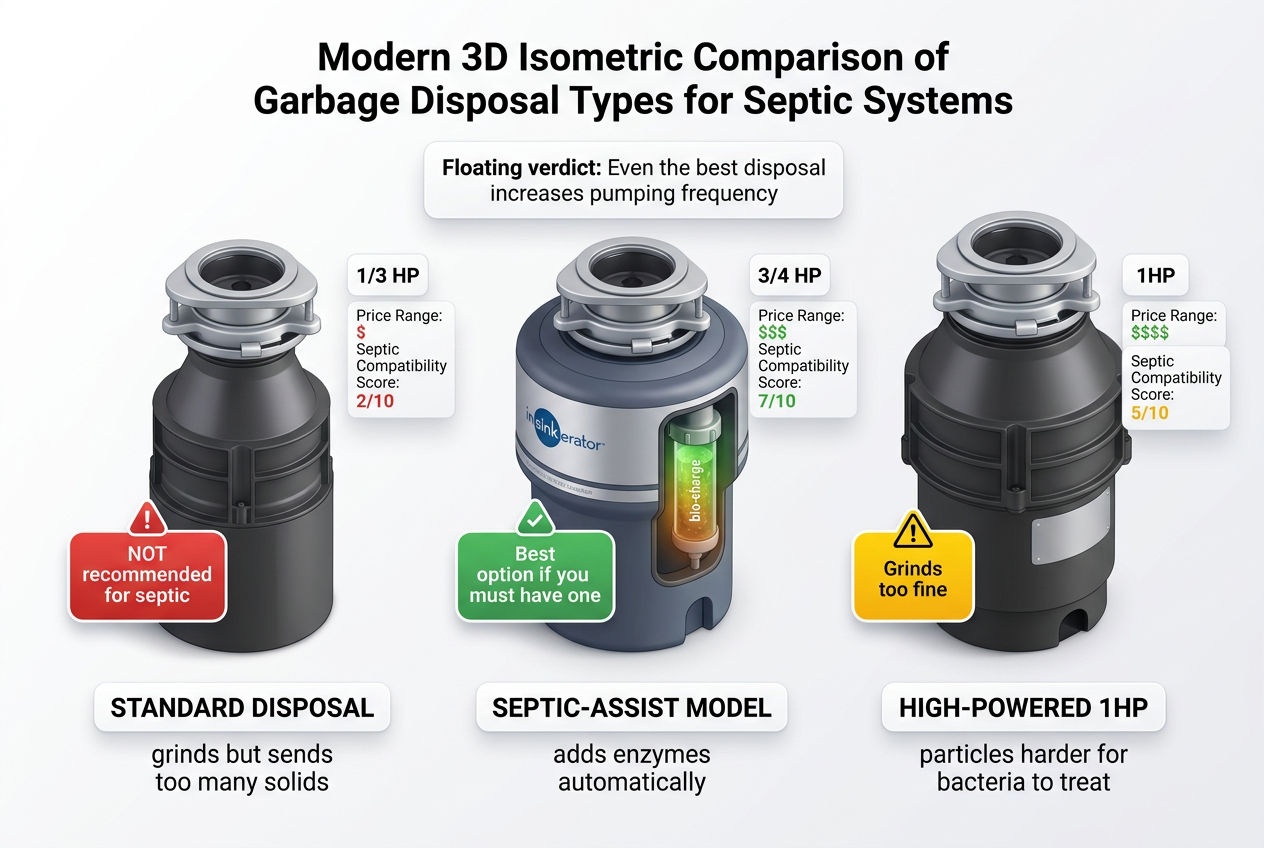
Septic Disposal Comparison: Standard vs. Septic-Assist Models
| Feature | Standard Disposal | Septic-Assist Disposal |
|---|---|---|
| Grind quality | Coarse slurry | Fine grind |
| Enzyme injection | None | Auto (Bio-Charge) |
| Motor size | ⅓–½ HP | ¾–1 HP |
| Typical cost | $80–$200 | $180–$350 |
| Recommended pumping | Every 1–2 years | Every 2–3 years |
| Septic system impact | High added solids | Moderate added solids |
Sources: InSinkErator product specifications; pumping frequency estimates based on University of Minnesota Extension data and EPA SepticSmart program guidance.
What Should You Never Put in a Garbage Disposal with a Septic System?
Even with a septic-assist disposal, some food waste categories can wreck your tank's bacterial balance or accelerate drain field clogging faster than the system can handle.
Foods That Should Never Go Down Your Disposal
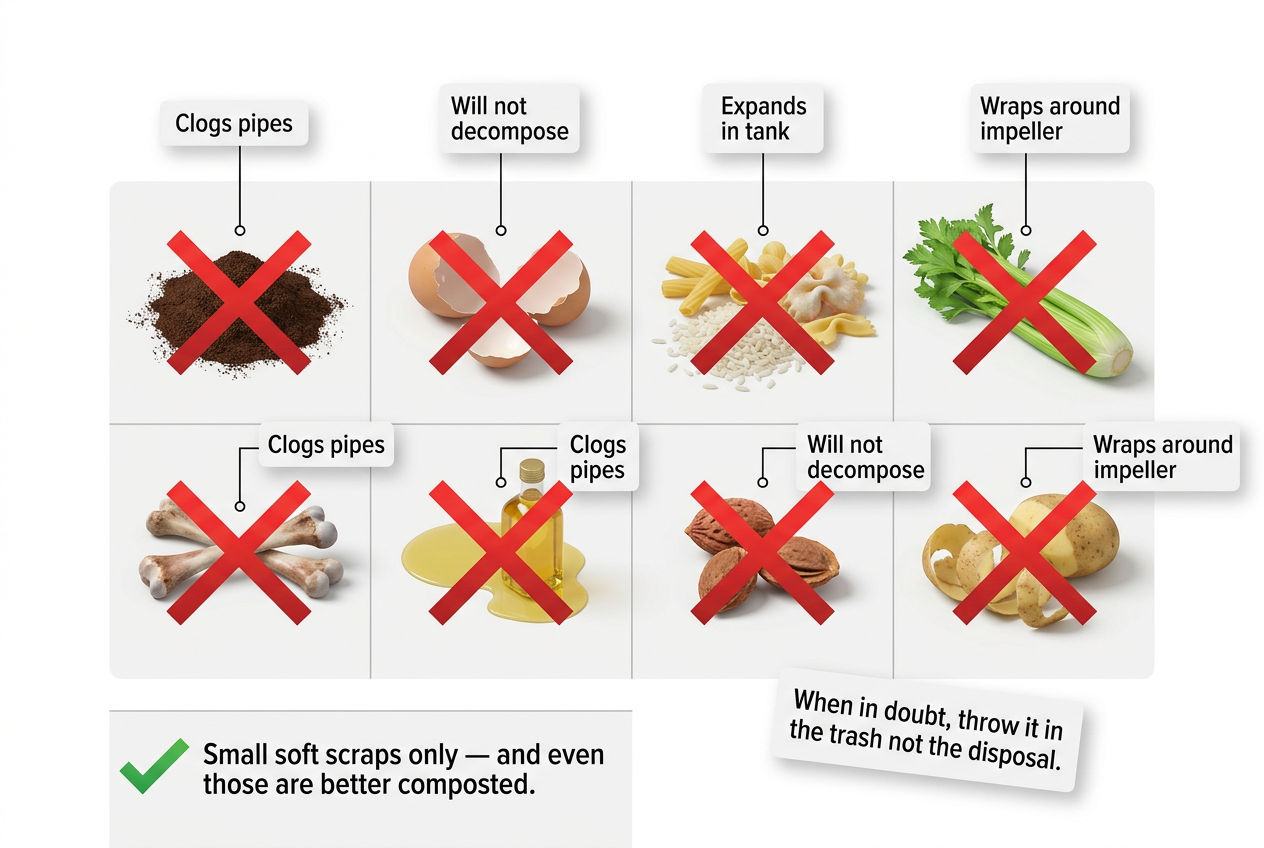
Avoid these entirely:
- Fats, oils, and grease (FOG): Grease doesn't break down in the tank. It floats to the scum layer, clogs the inlet baffle, and eventually moves into the drain field where it coats the soil pores. A greased-up drain field loses its ability to absorb effluent - and it does not recover.
- Fibrous vegetables: Celery, artichoke leaves, corn husks, and asparagus ends create stringy masses that clog the disposal's grinding chamber and enter the tank intact.
- Coffee grounds: Counterintuitive, because grounds seem harmless. But they accumulate as a dense sediment layer in the bottom of the tank and compact faster than other solids.
- Eggshells: The membrane inside the shell wraps around the grinder and passes into the tank as a fine, gritty material that adds to sludge without decomposing efficiently.
- Pasta, rice, and bread: Starches swell with water and keep swelling in the tank. They form a thick, doughy sludge that resists bacterial breakdown.
- Bones and hard pits: These will damage the disposal's grinding ring and enter the tank as oversized solids your system wasn't designed to handle.
⚠️ Warning: This list overlaps significantly with the broader category of things that shouldn't go into any septic system. Our guide on what not to flush with a septic system covers the full picture.
Do Garbage Disposals Add to Septic Tank Sludge?
Yes, directly and measurably. Every septic tank has three layers:
- A floating scum layer of fats and oils at the top
- A middle zone of clarified liquid effluent
- A sludge layer of settled solids on the bottom
Only the middle layer - the effluent - should be exiting through the outlet baffle toward the drain field.
How Food Waste Accumulates
When disposal-ground food waste enters the tank, the heavier particles sink and join the sludge layer. The anaerobic bacteria present do break some of it down, but not fast enough to keep pace with daily disposal use.
📊 Quick Fact: A 1,000-gallon tank handling a disposal-equipped household accumulates approximately 1–2 extra gallons of solids per week compared to a non-disposal household. That adds up to 50–100 gallons per year - a meaningful fraction of a tank's working capacity.
If sludge depth reaches within 12 inches of the outlet baffle (which a septic professional measures with a "sludge judge" - essentially a clear acrylic tube lowered into the tank), it's past time to pump. Solids entering the drain field clog the leach laterals and the biomat zone in the soil. Unlike a full tank, a clogged drain field usually can't be pumped back to health. For more on what this looks like in practice, see our drain field explainer.
Are InSinkErator Garbage Disposals Safe for Septic Systems?
The InSinkErator Evolution Septic Assist is specifically engineered for septic compatibility and is one of the few disposals the company explicitly recommends for homes on septic. The Bio-Charge enzyme injection system is the key differentiator - it doses each grinding cycle with microorganisms and enzymes designed to pre-digest food waste before it ever reaches your tank.
That said, "safe" needs a qualifier. No garbage disposal is risk-free on a septic system. The InSinkErator Septic Assist reduces the added burden; it doesn't eliminate it. You still need to pump more frequently than a disposal-free home, and you still need to avoid the problem foods listed above.
For standard InSinkErator models without the Septic Assist designation, the same rules apply as any standard disposal: more frequent pumping, stricter food waste habits, and ideally a larger tank to absorb the added load.
What Are the Garbage Disposal Alternatives for Septic Homeowners?
If you've done the math on increased pumping costs and decided a disposal isn't worth it, you have practical options that won't stress your system at all.
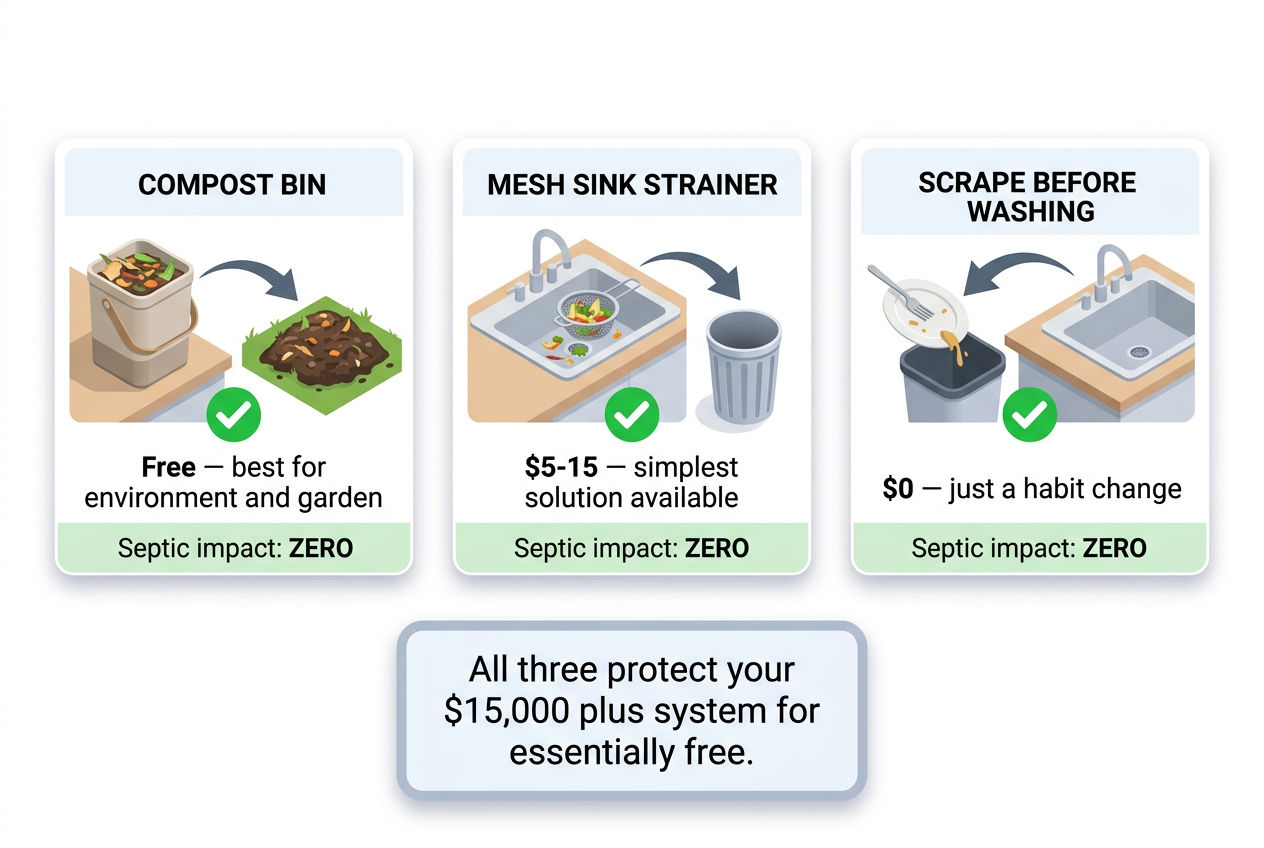
Three Zero-Impact Alternatives
Countertop composting is the closest functional replacement. A countertop bin with a carbon filter lid collects fruit scraps, vegetable peels, coffee grounds, and eggshells without odor problems. Many municipalities offer compost pickup, or you can run a backyard bin.
📊 Quick Fact: The EPA estimates composting can divert roughly 30% of household waste from the waste stream - and in this case, from your septic system entirely.
Sink strainers are the low-tech solution. A fine-mesh strainer over your drain catches food particles before they enter your plumbing system, giving you a disposable-only food waste habit with zero equipment cost.
Countertop electric composters (brands like Lomi) break food waste into a dry, soil-like material in 2–4 hours. They're quieter than a disposal and produce a usable garden amendment. Purchase price runs $300–$500, but there's no ongoing impact on your septic system.
For a broader look at how these choices fit into overall septic system care, our septic system maintenance guide is the best starting point.
Check Your Local Codes Before You Install
This is not optional if you're on septic. Garbage disposal regulations vary significantly by state and county, and some jurisdictions require action before you install - not after.
State and Local Regulation Examples
North Carolina is the clearest example. State code 15A NCAC 18A .1956 has historically required a larger septic tank when a garbage disposal is present - effectively mandating homeowners upsize their system or obtain a variance before installation. Similar requirements exist in parts of Indiana and several New England townships, where older, smaller-capacity systems are common and local health departments have imposed stricter rules.
The EPA's SepticSmart program (epa.gov/septic) does not prohibit garbage disposals outright and provides general guidance for homeowners. But federal guidelines don't override local code. Your county health department is the authoritative source.
✅ Pro Tip: If you're unsure what your local rules require, the fastest path is talking to a licensed septic contractor in your area. They'll know the specific permit requirements and tank sizing rules that apply to your property. Find a septic professional near you through the SepticTankHub directory.
If You Decide to Use a Disposal: A Practical Maintenance Plan
Committing to a disposal on a septic system means committing to a different maintenance schedule. Here's what that actually looks like:
Five Essential Maintenance Steps
1. Pump more often. For most households with regular disposal use, schedule pumping every 2 years as a baseline. If you have a large family, heavy cooking habits, or a 1,000-gallon or smaller tank, move to annual pumping.
2. Get a septic-assist model. The InSinkErator Evolution Septic Assist is the most widely available option. Budget $180–$350 for the unit and $50–$70 per year in Bio-Charge cartridges.
3. Know your tank size. If you have a 1,000-gallon tank and are adding a disposal, seriously consider whether the system was sized to handle it. Experts consistently recommend moving up one tank size - from a 1,000-gallon to a 1,250-gallon, or from a 1,250-gallon to a 1,500-gallon - when a disposal will be in regular use. This is a conversation to have with your installer before anything goes in the ground.
4. Run it cold. Always use cold water when running the disposal. Cold keeps fats solid so they break apart in the grinder rather than coating your pipes as liquid grease.
5. Schedule annual inspections. A technician can drop a sludge judge into your tank and give you an objective measurement of how fast solids are accumulating. That data tells you exactly whether your pumping schedule needs adjusting. See what a professional inspection involves through our septic inspection service page.
Free download
Free: the Septic Fridge Card — what to flush, what never to.
The Do / Don’t card the whole family can see, plus the Survival Kit: emergency flowchart, warning-sign decoder and pump-schedule card. One printable PDF.
For the full checklist of habits that protect a septic system - disposal or not - see our guide on how to keep your septic system healthy.
Need professional maintenance? Find a septic company near you on SepticTankHub.
Learn more about our septic pumping services.
Related reading: what is septic system.
Related: septic-safe garbage disposals
Sources & Methodology
University of Minnesota Extension - Septic System Owner's Guide: Primary source for the 50% solids increase figure and weekly solids volume estimates associated with garbage disposal use. Widely cited in state extension literature across the Midwest.
EPA SepticSmart Program: Federal guidance on septic system maintenance, pumping frequency recommendations, and homeowner best practices. Does not prohibit garbage disposal use.
North Carolina Administrative Code 15A NCAC 18A .1956: State-level regulation governing septic system requirements, including tank sizing provisions when garbage disposals are present.
InSinkErator Evolution Septic Assist Product Documentation: Source for motor specifications (¾ HP), Bio-Charge cartridge replacement intervals (3–4 months), and cartridge cost range ($12–$18).
National Association of Wastewater Technicians (NAWT) - nawt.org: Industry standards organization whose inspection protocols and technician training guidelines inform pumping frequency recommendations and tank inspection procedures cited throughout.
Reviewed for technical accuracy by a licensed septic system installer with 14+ years of field experience across residential conventional and alternative septic systems.
Need help with your septic system? Browse local septic companies in Texas or Florida.
Was this article helpful?
Frequently Asked Questions
Recommended Resources
📖 Related Articles
💰 Cost Guides
🔧 Services
Find Septic Professionals Near You
Compare licensed, verified septic companies by area — top county markets and cities below, or browse all 50 states.
County markets
Popular cities
