
Quick Answer
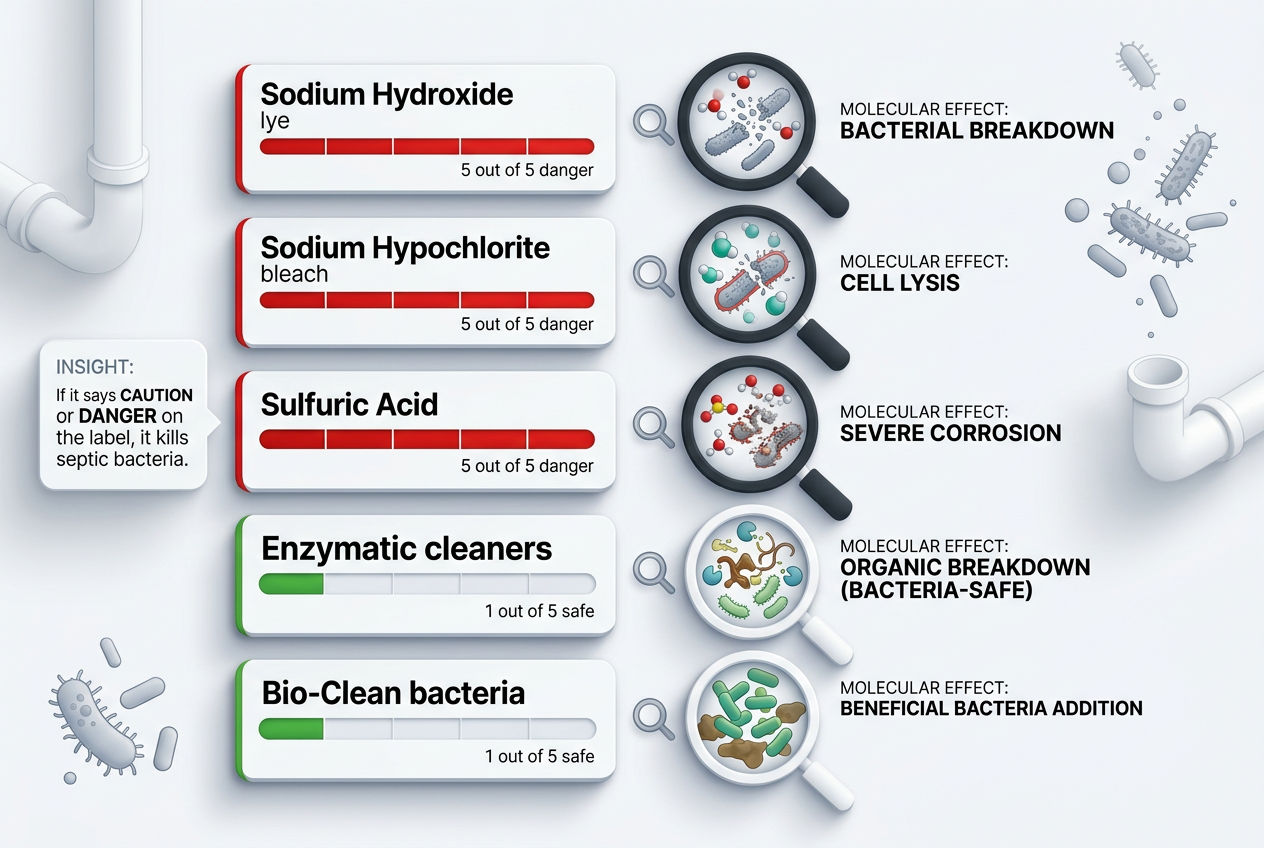
Drano is safe for septic systems only under very specific, limited conditions - and for most homeowners, the honest answer is: don't risk it. Drano's core ingredients are designed to dissolve organic matter fast, and your septic tank is full of exactly that: living organic matter in the form of billions of bacteria doing critical work. Pour enough of the wrong product down your drain and you're not just clearing a clog - you're killing the engine that runs your entire wastewater system.
💡 Key Takeaways
- Drano contains sodium hydroxide (pH ~13–14) and sodium hypochlorite, both of which kill the anaerobic bacteria your septic tank depends on.
- A healthy septic tank holds billions of bacteria per gallon. Even a single large Drano application can reduce bacterial activity by 40–80%.
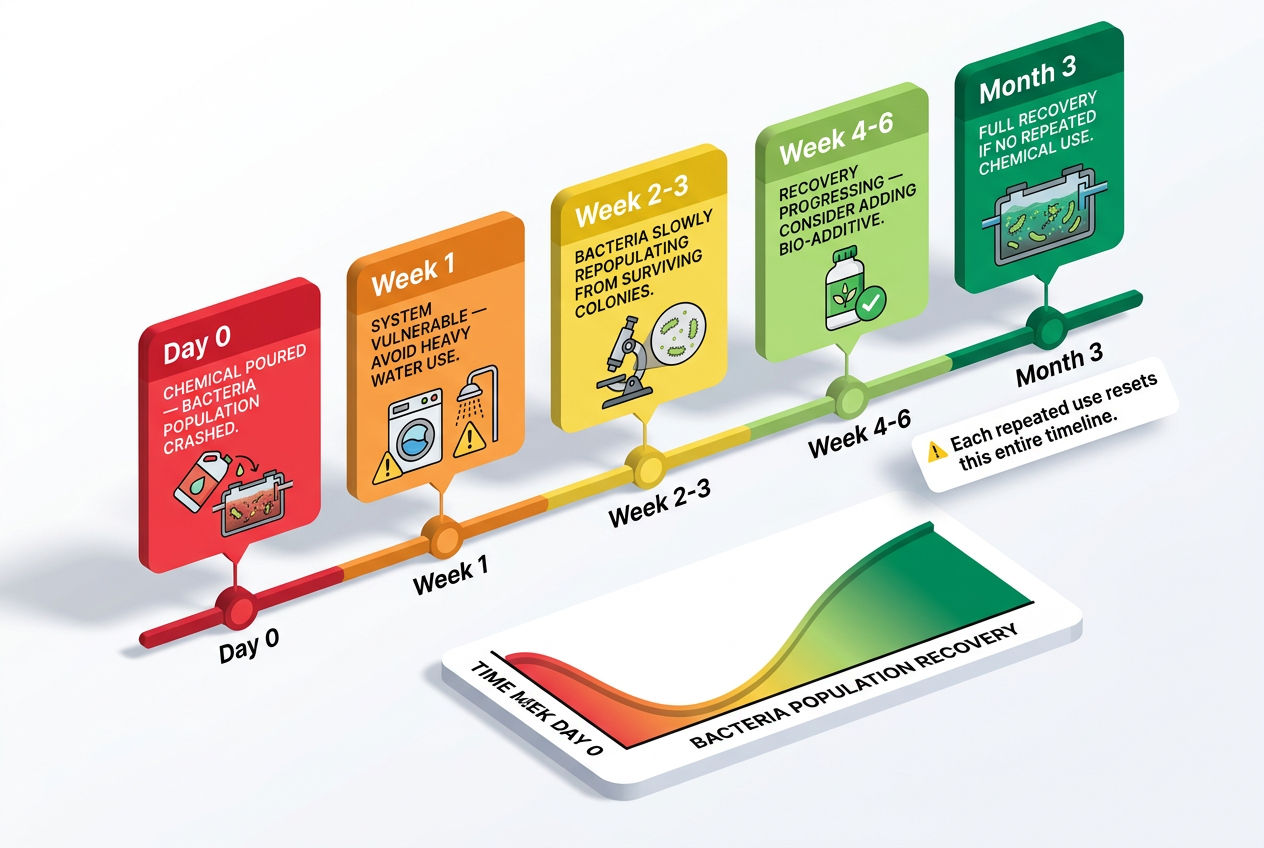
- Bacterial colonies can take 48 hours to 2+ weeks to recover after chemical drain cleaner exposure.
- Septic-safe alternatives include enzyme drain cleaners, mechanical tools, and the baking soda + vinegar method.
- If clogs keep coming back, a failing baffle wall or clogged effluent filter is likely the real culprit - not your drains.
What Does Drano Actually Do Inside Your Pipes?
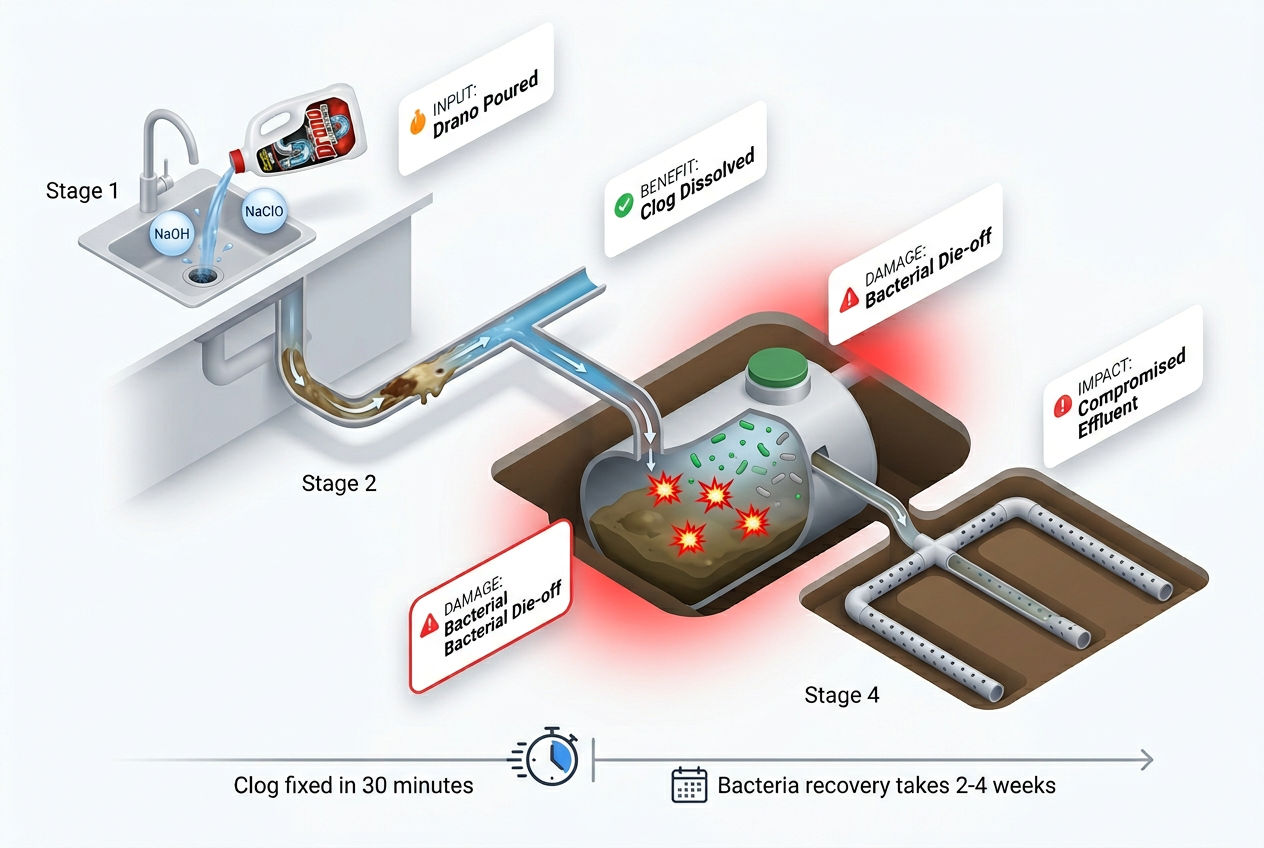
Drano works through an exothermic chemical reaction. When sodium hydroxide (lye) hits water, it generates heat - sometimes approaching 200°F inside the pipe - while breaking down grease, hair, and organic matter. Sodium hypochlorite (household bleach, typically 5–8% concentration) handles the biological material, effectively disinfecting whatever it contacts.
That's exactly the problem.
Your septic tank isn't a passive concrete box. It's a living biological reactor. A 1,000–1,500 gallon tank serving a typical 3-bedroom home contains billions of anaerobic bacteria per gallon. Those bacteria break down solid waste, prevent sludge buildup, and protect your drain field from failure. Sodium hydroxide at pH 13–14 doesn't distinguish between a hair clog and a bacterial colony. It kills both.
The heat generated by Drano's reaction also doesn't stay in your sink drain. Enough product - especially Drano Max Gel, which is formulated to cling to pipe walls - travels through your plumbing and reaches the tank. Once there, the combination of high pH and disinfecting bleach creates a hostile environment for microbial life.
Is Drano Safe for Septic Systems? Here's What the Label Actually Says
SC Johnson, which manufactures Drano, does label certain products as "septic safe." Drano Max Gel and several other variants carry this claim on the packaging. So who's right - the manufacturer or the warning?
Both, sort of.
⚠️ Warning: The "septic safe" label assumes occasional use, small amounts, and a properly sized, functioning system - not repeated applications or older tanks.
The "septic safe" label is based on the assumption that the product is used occasionally, in small amounts, in a properly sized and functioning septic system. A single, diluted application in a 1,500-gallon tank may not cause catastrophic bacterial die-off. Dilution matters: one 32 oz. bottle dispersed through 1,500 gallons of liquid creates a far lower chemical concentration than the same bottle used in a slow-draining pipe that trickles into a smaller, older tank.
The Hidden Limitation
Here's the honest limitation: that label doesn't account for repeated use, smaller tanks, older systems, or the cumulative effect of multiple chemical drain cleaners used over months. University extension research - including work from North Carolina State's Cooperative Extension program - indicates that harsh chemicals in septic systems can reduce bacterial activity by 40–80% depending on dosage and tank size. Recovery can take 48 hours to two full weeks.
If your household reaches for Drano every few months, you're not giving those bacteria enough time to recover between hits.
Can Chemical Drain Cleaners Kill Septic Tank Bacteria?
Yes - and this is the core issue. Chemical drain cleaners designed for municipal sewer systems assume that whatever goes down the drain gets diluted in thousands of gallons of municipal wastewater or treated by industrial-scale processes. Your septic system doesn't have that buffer.
A 1,000-gallon septic tank serving a family of four is already working near capacity on an average day. That tank's bacterial ecosystem is finely balanced: anaerobic bacteria in the lower sludge layer break down solids, while the liquid effluent above remains biologically active before passing through the outlet baffle into your drain field.
The Three Major Risks
Pour sodium hydroxide into that system repeatedly, and you risk:
- Sludge layer accumulation - with fewer bacteria breaking down solids, sludge builds up faster, requiring more frequent pumping (every 2 years instead of every 3–5)
- Effluent quality degradation - partially digested waste reaching your drain field leach laterals
- Drain field damage - biomat formation and lateral clogging that can cost $15,000–$30,000 to repair or replace
📊 Quick Fact: The EPA notes that approximately 21 million U.S. households - about 1 in 5 - rely on septic systems.
For those homeowners, what goes down the drain matters in a way it simply doesn't for sewer-connected homes.
For a deeper look at how bacterial balance fits into overall system health, see our septic tank maintenance guide.
Free download
Free: the Septic Fridge Card — what to flush, what never to.
The Do / Don’t card the whole family can see, plus the Survival Kit: emergency flowchart, warning-sign decoder and pump-schedule card. One printable PDF.
What About Liquid-Plumr? Is It Septic Safe?
Liquid-Plumr is another popular chemical drain cleaner that carries a "septic safe" label on select products. Its active ingredients are similar to Drano's - sodium hydroxide and sodium hypochlorite - so the same concerns apply.
Clorox (Liquid-Plumr's manufacturer) specifically markets Liquid-Plumr Clog Destroyer Plus+ as septic system compatible. As with Drano, the claim is based on dilution assumptions and occasional use. The chemical mechanism is nearly identical.
✅ Pro Tip: If you're choosing between Liquid-Plumr and Drano for your septic system, the more important question is why you keep getting clogs in the first place.
Bottom line: Liquid-Plumr and Drano carry the same risk profile for septic owners. Neither is truly septic-safe in the way that enzyme-based or biological drain cleaners are.
What Drain Cleaner Is Actually Safe to Use with a Septic System?
Septic-safe drain cleaners fall into two categories: enzyme-based and biological.
Enzyme Drain Cleaners
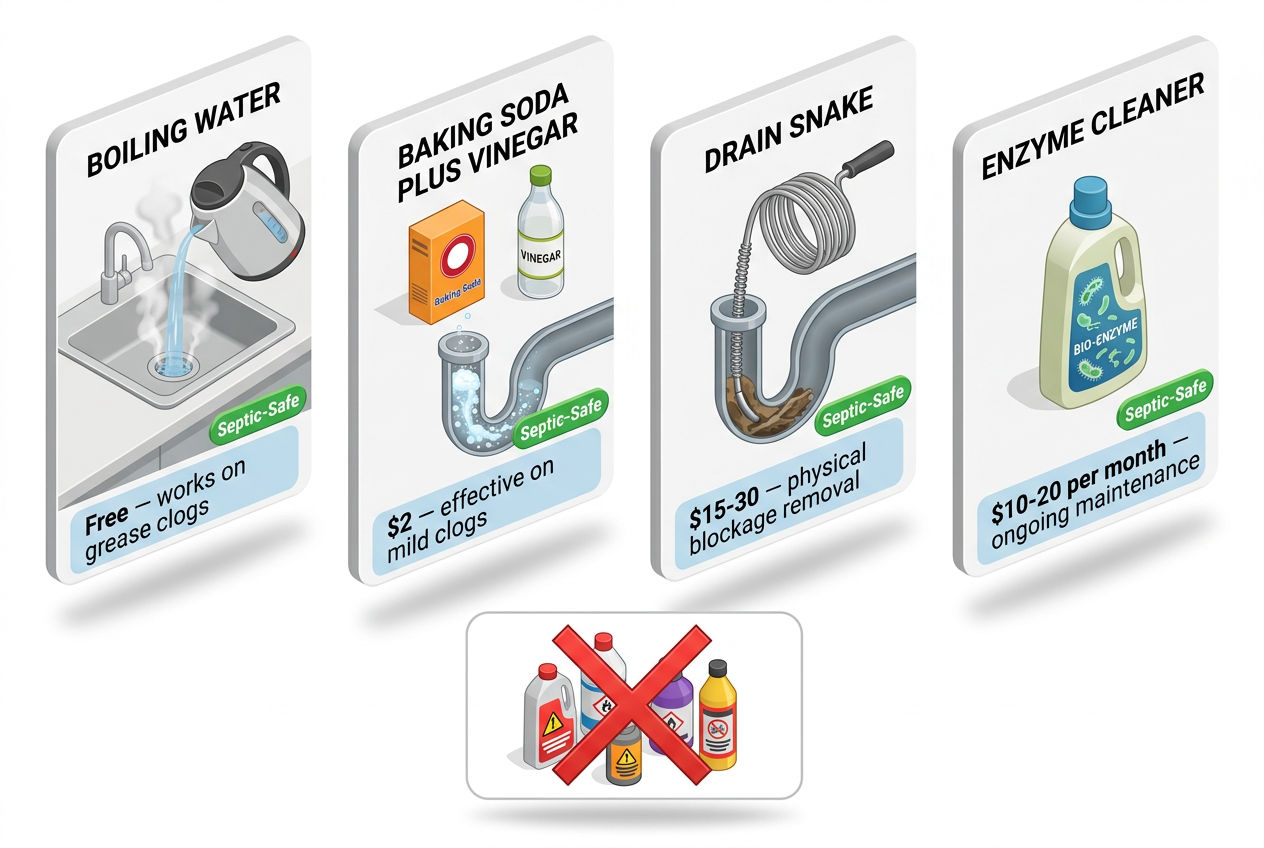
Enzyme drain cleaners use protease, lipase, and amylase enzymes to break down proteins, fats, and starches. They don't kill bacteria - they work alongside them.
Popular brands include:
- Bio-Clean
- RootX (for root intrusion)
- Green Gobbler Enzyme Drain Cleaner
Biological Drain Cleaners
Biological drain cleaners go a step further by introducing live bacterial cultures directly into your pipes and tank. These are the same bacteria your system naturally contains.
Examples include:
- Rid-X Monthly Treatment
- Cabin Obsession Septic Tank Treatment
The Time Trade-Off
The trade-off is time. Enzyme and biological cleaners typically require 6–24 hours to work, compared to Drano's 15–30 minutes. If you have a completely blocked drain, an enzyme cleaner won't solve your emergency tonight.
That's where mechanical methods come in. A $30 drain snake (also called a hand auger) physically breaks up and removes the clog without any chemical exposure whatsoever. For kitchen drains with grease buildup, boiling water flushed in stages is surprisingly effective - and completely safe for your tank's bacterial colonies.
For a curated list of tested products, see our guide to septic-safe products.
The Baking Soda + Vinegar Method: Does It Work?
The baking soda and vinegar drain cleaning method is popular, and it's genuinely septic-safe - but it's also frequently misunderstood.
The Actual Method
Here's the approach that has some practical basis:
- Pour ½ cup of baking soda (sodium bicarbonate) down the drain
- Follow with ½ cup of white vinegar
- The resulting fizzing reaction is largely CO₂ gas and water - a mild mechanical action that can dislodge light organic buildup
- Follow with a kettle of near-boiling water to flush the residue
What It Can and Cannot Do
| What It Does Well | What It Cannot Do |
|---|---|
| Light grease removal | Clear fully blocked drains |
| Mild soap scum buildup | Dissolve hair clogs |
| Slow drains with early-stage buildup | Address root intrusion |
✅ Pro Tip: The baking soda + vinegar combination is pH-neutral after the reaction completes and poses zero risk to your septic tank bacteria. That's its real advantage over Drano, not its raw cleaning power.
The Safer Alternatives at a Glance
| Method | Septic Safe? | Time to Work | Clog Severity | Avg. Cost |
|---|---|---|---|---|
| Enzyme drain cleaner | ✅ Yes | 6–24 hours | Mild to moderate | $10–$25 |
| Biological cleaner | ✅ Yes | 8–24 hours | Mild | $10–$20 |
| Baking soda + vinegar | ✅ Yes | 15–30 min | Very mild | <$5 |
| Hand auger / drain snake | ✅ Yes | Immediate | Moderate to severe | $20–$50 (tool) |
| Drano / Liquid-Plumr | ⚠️ Limited | 15–30 min | Moderate | $8–$15 |
Source: Product manufacturer specifications; EPA SepticSmart guidance; SepticTankHub editorial research.
What If You Already Used Drano? Here's What to Do
Don't panic. One application of Drano in a properly sized, healthy septic system isn't an automatic death sentence for your tank.
Practical Recovery Plan
1. Don't add more. Stop all chemical drain cleaner use immediately and switch to mechanical or enzyme-based methods going forward.
2. Add a bacterial supplement. A product like Rid-X or a professional-grade bacterial additive won't repair damage by itself - peer-reviewed research, including a University of Arkansas extension study, confirms that additives don't replace pumping or reverse drain field clogging. But they can help replenish bacterial populations faster after a chemical disruption.
3. Reduce water load for 48–72 hours.
- Shorter showers
- Fewer laundry loads
- Minimal dishwasher use
Give your bacterial colony time to reestablish without constant wastewater throughput.
4. Schedule a tank inspection. If you've used chemical drain cleaners repeatedly over several years, an inspection by a licensed professional can assess sludge depth (using a sludge judge tool) and check your outlet baffle and effluent filter for stress damage. Learn more about what a septic inspection covers and what it typically costs.
💡 Key Takeaway: If you're overdue for a pump-out, this is the time. The average septic pumping cost runs $300–$600 nationally - far cheaper than the $15,000–$30,000 drain field replacement you're trying to avoid.
When Should You Call a Professional?
If your drain is completely blocked and a hand auger isn't clearing it, call a plumber or septic service professional. Don't keep adding chemical drain cleaners hoping the clog will eventually give.
Warning Signs of Deeper Problems
Persistent clogs - especially in multiple fixtures at once - are rarely a drain problem. They're usually a symptom of something happening inside the tank or drain field:
- A failed or missing inlet baffle wall letting solids pass unchecked
- A clogged effluent filter (like a Polylok PL-122) that needs cleaning
- A full tank that hasn't been pumped in 5+ years
- Early-stage drain field saturation
📊 Quick Fact: A licensed septic pumper can pull the lid, check sludge depth, inspect the baffle walls, and clean your effluent filter in a single service call - typically $300–$600. That's a diagnostic visit and a maintenance service combined.
Compare that to an emergency drain service call at $150–$400+ that addresses the symptom but misses the underlying cause.
Cold Weather Considerations
If you're in the Southeast during winter, pay extra attention. Cold temperatures slow bacterial activity in septic tanks already, and in states like North Carolina or Tennessee where overnight temperatures stay near freezing for weeks, adding a chemical disruption on top of cold-slowed bacteria compounds the problem significantly.
Find licensed septic professionals near you through our national directory.
A Final Word on Drain Clogs and Septic Systems
Frequent drain clogs in a septic home are a signal, not just a nuisance. If you're reaching for a drain cleaner every few months, something upstream - your habits, your garbage disposal use, or your system itself - needs attention.
Review what goes down your drains. FOG (fats, oils, and grease) is the leading cause of kitchen drain clogs in septic homes. Our guide on what not to flush with a septic system covers the full list of household substances that put your system at risk - Drano included.
Protect your bacterial colonies. Keep up with regular septic maintenance. And when a clog defeats your drain snake, call a professional before reaching for the chemical solution.
Need professional maintenance? Find a septic company near you on SepticTankHub.
Learn more about our septic pumping services.
Related reading: how often pump septic tank.
Sources & Methodology
-
U.S. Environmental Protection Agency - Septic Systems: Used for the statistic that approximately 21 million U.S. households rely on septic systems and for SepticSmart program guidance on household chemical use.
-
SC Johnson Product Labeling - Drano Max Gel: Referenced for the manufacturer's "septic safe" label claim and active ingredient disclosure (sodium hydroxide, sodium hypochlorite).
-
NC State Cooperative Extension - Septic System Management: Referenced for the range of bacterial activity reduction (40–80%) associated with chemical drain cleaner use in residential septic systems.
-
University of Arkansas Cooperative Extension - Septic System Additives Research: Referenced for findings that bacterial additives support but do not replace pumping, and cannot reverse drain field clogging.
-
National Association of Wastewater Technicians (NAWT): Referenced for professional inspection standards and sludge measurement practices (sludge judge methodology).
Need help with your septic system? Browse local septic companies in Indiana or Alabama.
Was this article helpful?
Frequently Asked Questions
Recommended Resources
📖 Related Articles
💰 Cost Guides
Find Septic Professionals Near You
Compare licensed, verified septic companies by area — top county markets and cities below, or browse all 50 states.
County markets
Popular cities
