
Quick Answer
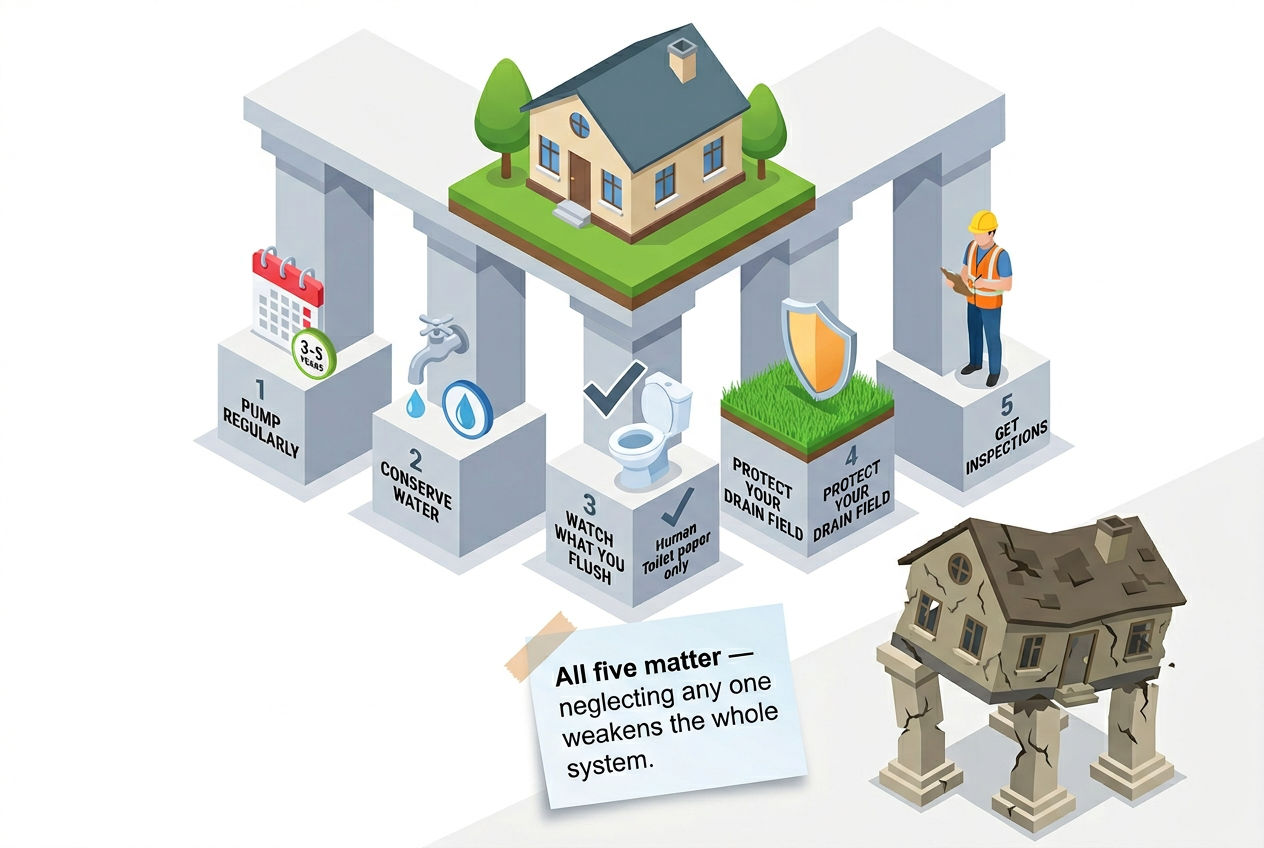
Keeping your septic system healthy starts with three habits: pump on schedule, control what enters the tank, and protect your drain field. Follow those three rules consistently, and a well-installed system can run cleanly for 40 years without a major repair.
💡 Key Takeaways
- The EPA recommends pumping every 3–5 years for a 4-person household - sooner if you have a garbage disposal
- Replacing a failed septic system costs $10,000–$30,000+; a pump-out runs $300–$600
- Harsh chemicals - even a single gallon of bleach - can wipe out beneficial bacteria in a 1,000-gallon tank for days
- Your drain field is just as important as the tank itself; driving over it or planting trees nearby can destroy it
- About 1 in 5 U.S. homes rely on septic - and an estimated 10–20% of those systems are malfunctioning right now
Picture this: you're selling your home and the buyer's inspector flags a saturated drain field and a tank that hasn't been pumped in 12 years. The buyer walks. You're now looking at a $22,000 repair bill before you can relist. That scenario plays out thousands of times a year - and nearly every one of those failures was preventable.
Roughly 21 million U.S. households depend on a septic system, according to the EPA's SepticSmart program. Most homeowners give it almost no thought until something goes wrong. The good news? Septic system health tips aren't complicated. The bad news? Ignoring them is expensive.
This guide covers everything you need to maintain a healthy septic system - with specific numbers, real scenarios, and honest advice about what actually works.
How Often Should You Pump Your Septic Tank to Keep It Healthy?
The EPA recommends pumping your septic tank every 3–5 years for a typical 4-person household. That number shifts based on your tank size, household size, and what goes down your drains. A 1,000-gallon tank serving two people might go 5–7 years between pump-outs. That same tank serving six people could need service every 2 years.
Garbage Disposals Accelerate Sludge Buildup
Add a garbage disposal and you'll want to shorten that interval. Garbage disposals push food solids - grease, fiber, starch - directly into the tank, accelerating sludge accumulation. Our full breakdown of garbage disposals and septic systems covers how much faster that sludge builds up and what it costs you long-term.
How to Know When Your Tank Is Actually Full
A licensed pumper uses a sludge judge - a clear calibrated tube - to measure the sludge layer at the bottom and the scum layer floating on top. When the sludge layer reaches within 12 inches of the outlet baffle, it's time. Don't guess. Schedule an inspection every 1–3 years so a professional can check these levels directly. Learn more about what that process involves at our septic inspection cost guide.
📊 Quick Fact: Average pump-out costs nationally run $300–$600. A 1,000-gallon residential tank in central Florida typically runs $275–$375. The same service in rural Minnesota can run $400–$550, partly because of longer drive times and trickier seasonal access when the ground is frozen.
See detailed regional pricing at our septic pumping cost guide.
What Should You Never Put Into a Septic System?
The wrong inputs kill a septic system faster than anything else. Your tank relies on a living ecosystem of anaerobic bacteria to break down waste. Disrupt that ecosystem and solids accumulate, the drain field clogs, and you're calling for emergency repairs.
Never Flush or Drain These Items:
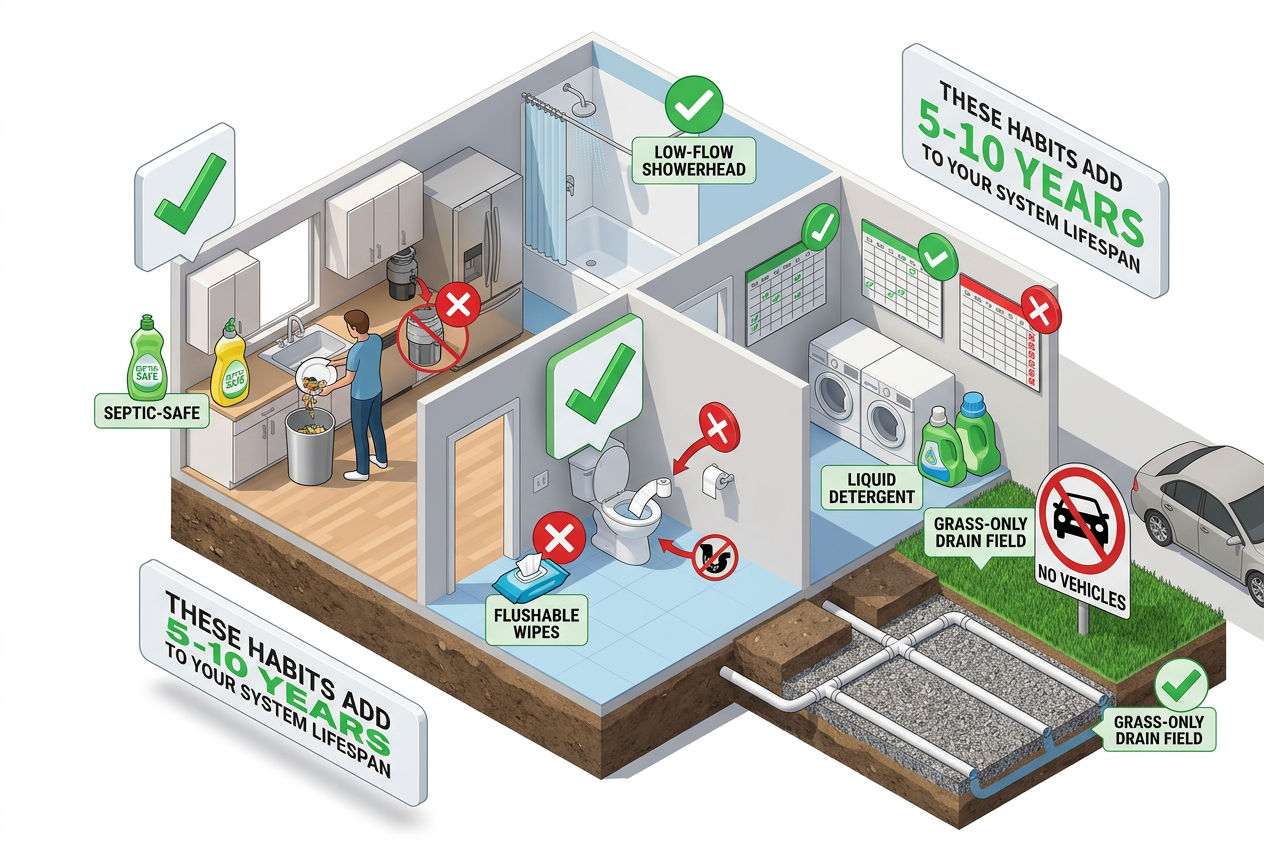
- "Flushable" wipes - they don't break down in the tank; they accumulate on baffle walls and clog outlet screens
- Cooking grease and fats - grease congeals in the tank and coagulates into the drain field's leach laterals
- Feminine hygiene products, cotton balls, paper towows - they don't decompose and fill tank volume fast
- Prescription medications - antibiotics in particular kill the beneficial bacteria your tank needs
- Paint, solvents, and motor oil - toxic to bacteria and can contaminate groundwater
- Cat litter - even "septic safe" varieties add clay and solids
For the full breakdown of what you can and can't flush, see our what can you flush with a septic system guide. And if you're comparing toilet paper options, our best toilet paper for septic systems article covers which brands dissolve quickly and which ones don't.
What About Bleach and Chemical Cleaners?
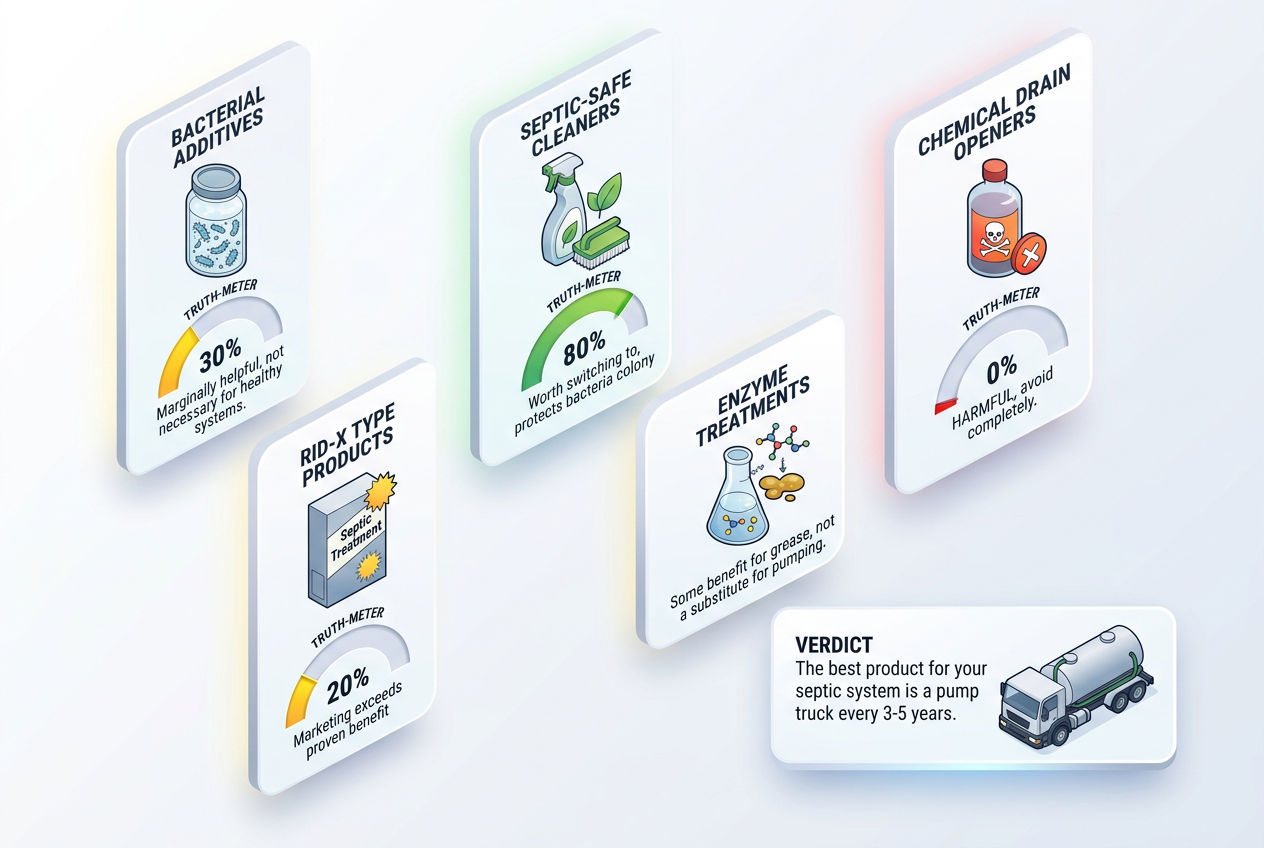
This is where homeowners get tripped up. For a full list of things that kill bacteria in your tank, see our detailed guide. A single gallon of household bleach or chemical drain cleaner can eliminate the beneficial bacterial population inside a 1,000-gallon tank for several days. That doesn't mean you can never use bleach - occasional toilet bowl cleaning with standard diluted bleach (roughly 1 tablespoon per flush cycle) won't devastate a healthy system.
⚠️ Warning: Pouring a full bottle of drain cleaner down a slow drain every month? That's a slow-motion tank killer.
Before you reach for Drano, read our guide on Drano and septic systems - the chemistry is worth understanding.
How Does Water Usage Affect Septic System Health?
Too much water entering the tank too fast is one of the most overlooked causes of septic failure. The average U.S. household uses 70–100 gallons per person per day. In a 4-person home, that's up to 400 gallons daily flowing into a 1,000- to 1,500-gallon tank. When water enters the tank faster than it can drain into the drain field, the field gets saturated. Saturated soil can't treat effluent. That's when you get sewage surfacing in your yard.
Practical Ways to Reduce Hydraulic Load:
- Spread laundry across the week. Doing six loads on Saturday dumps hundreds of gallons into the tank in a few hours. Doing one or two loads per day keeps the flow steady. Our laundry best practices guide covers detergent choices and load scheduling in detail.
- Fix leaking toilets and faucets. A running toilet can waste 200 gallons a day - straight into your septic system.
- Install high-efficiency fixtures. WaterSense-certified toilets use 1.28 gallons per flush vs. 3.5+ gallons for older models. High-efficiency fixtures can reduce household water load by 25–30%, according to EPA estimates.
- Avoid running dishwashers and washing machines simultaneously. Stagger high-volume appliances whenever possible.
✅ Pro Tip: Summer is especially hard on systems. House guests, extra laundry, outdoor hose use - it all adds up. If you're in the Southeast, the combination of increased summer usage and high water tables makes drain field flooding a real risk.
Florida homeowners with sandy soil face different challenges than homeowners in Oregon's Willamette Valley, where heavy clay soil already slows percolation year-round.
How Do You Protect Your Drain Field?
The drain field - also called the leach field - is where the real treatment happens. Clarified effluent from the tank flows through perforated pipes (leach laterals) into gravel trenches, where soil bacteria finish the purification process. Destroy that soil structure and you've destroyed the system.
Drain Field Do's and Don'ts:
| Do This | Avoid This |
|---|---|
| Plant shallow-rooted grass over the field | Trees or shrubs - roots seek water and crush pipes |
| Keep the area clear for service vehicle access | Parking cars, ATVs, or equipment on the field |
| Direct gutters and sump pumps away from the field | Any additional water source draining toward the field |
| Mark the field boundaries so you remember them | Building sheds, decks, or patios over the area |
| Inspect for wet spots, odors, or unusually lush patches | Ignoring early warning signs |
⚠️ Warning: Compaction is the silent killer. A single pass from a riding mower on a saturated field can crush the soil pore structure that allows drainage. A delivery truck driving across the field - even once - can collapse leach laterals.
If that happens, you're looking at drain field replacement costs that run $3,000–$15,000 for a conventional system, more for a mound or drip-irrigation replacement.
For a deeper look at how drain fields function and fail, see our guide on what a drain field is and how it works.
Do Septic Tank Additives Actually Work?
Bacterial additives like Rid-X and similar products add anaerobic microbes to your tank. The marketing promise is compelling: restore bacterial balance, reduce pumping frequency, keep your system healthy between service visits. Some homeowners also explore cleaning a septic tank without pumping as a supplement to regular service.
The Honest Answer Is More Complicated
A healthy, properly loaded septic system already contains billions of active bacteria from normal household waste. Peer-reviewed research, including studies referenced by the National Onsite Wastewater Recycling Association (NOWRA), consistently shows that bacterial additives don't eliminate the need for regular pumping and don't reverse established drain field damage. If your system is already failing, no additive will un-clog a biomat-saturated leach lateral.
💡 Key Takeaway: Additives aren't harmful to a healthy system, and there may be a modest benefit after events that stress your bacterial population - a heavy bleach cleaning, antibiotic use, or an extended period of low occupancy (like a vacation home sitting unused for months).
Our best septic tank treatment guide covers which products have the most credible formulations and which are mostly marketing.
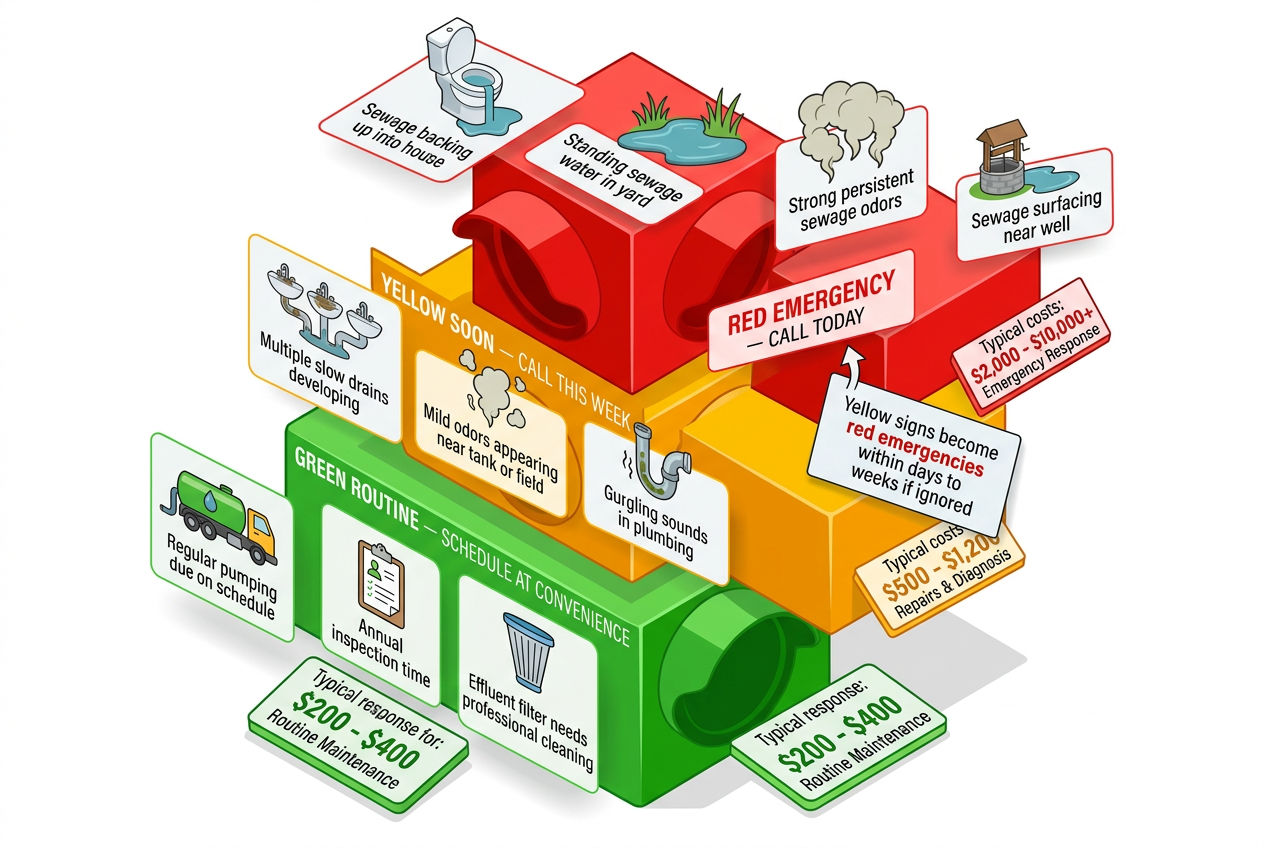
What Are the Warning Signs That Your Septic System Is Failing?
Catch these early and a repair might cost a few hundred dollars. Miss them and you could be replacing an entire system for $15,000–$30,000.
Early Warning Signs:
- Slow drains throughout the house (not just one fixture - that's usually a simple clog)
- Gurgling sounds from toilets and drains
- Sewage odors inside the home or near the tank and drain field
- Unusually lush, bright-green grass over the drain field - especially in a dry spell
- Wet, spongy ground over the drain field with no recent rain
- Sewage surfacing in the yard
⚠️ Warning: Any one of these signs means call a professional, not a DIY fix. If you're seeing multiple signs together, that's a system in active failure.
The septic repair cost guide breaks down what different failure modes typically cost to fix.
Seasonal Septic Care: A Quick Calendar
Your maintenance needs shift with the seasons.
Spring
Schedule your inspection and pump-out if you're due. Ground is accessible, and pumpers are busy - book early. Check for frost heave damage around risers and lids.
Summer
Watch water usage with guests in the house. Inspect for odors after heavy rain. In the Southeast, verify drain field isn't saturated from combined rainfall and increased usage.
Fall
If you're in a cold-climate state (Minnesota, Wisconsin, Vermont), this is the time to insulate exposed pipes. Rigid foam board over the first 10 feet of pipe from the house to the tank can prevent a $1,500–$2,500 freeze-thaw emergency call. Schedule service before the ground hardens.
Winter
In the Northeast, frost lines reach 42–60 inches deep. Tanks buried below 48 inches rarely freeze, but the inlet and outlet pipes are vulnerable. Keep snow cover over the drain field - it insulates the soil and keeps bacterial activity from shutting down.
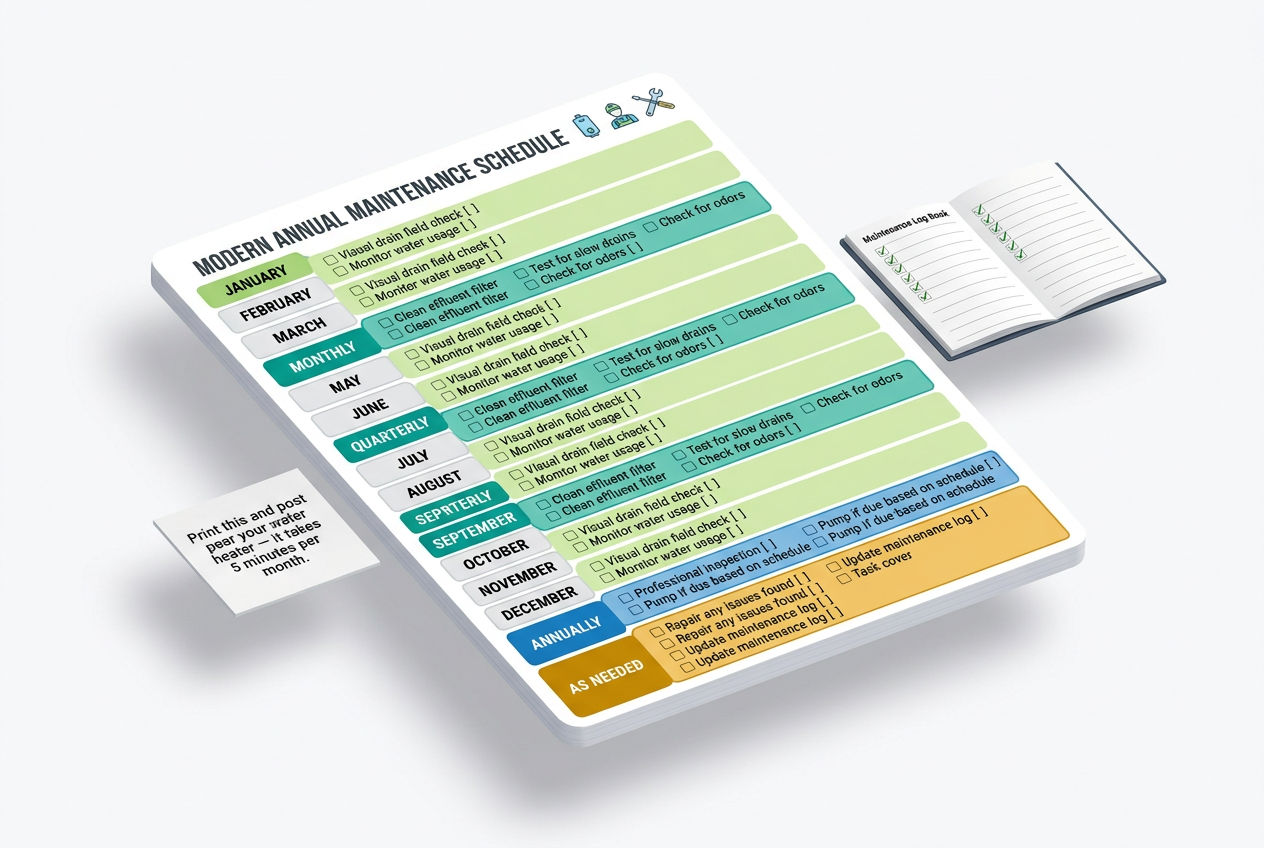
Your Septic System Maintenance Schedule at a Glance
| Task | Frequency | Who Does It | Typical Cost |
|---|---|---|---|
| Tank pump-out | Every 3–5 years | Licensed pumper | $300–$600 |
| Professional inspection | Every 1–3 years | NAWT-certified inspector | $100–$300 |
| Effluent filter cleaning (if installed) | Annually | DIY or pumper | $0–$75 |
| Check inlet/outlet baffles | At every pump-out | Pumper | Included |
| Drain field visual inspection | Every 6 months | Homeowner | Free |
Data sourced from EPA SepticSmart program and National Association of Wastewater Technicians (NAWT) guidelines.
How Long Does a Septic System Last With Proper Maintenance?
A conventional concrete septic tank with a properly functioning drain field can last 20–40 years with consistent maintenance. Neglect it - skip pump-outs, flush the wrong things, overload it with water - and that lifespan drops to 10–15 years. Full system replacement runs $10,000–$30,000+ depending on system type, soil conditions, and local permitting costs. For new installation pricing, see our septic installation cost guide.
📊 Quick Fact: The math is straightforward. Pumping every four years over a 40-year system lifespan costs roughly $3,000–$5,000 total. One system replacement costs 6–10 times that. Maintenance isn't optional - it's the cheapest line item in your home budget.
Find a Qualified Septic Professional in Your Area
Maintenance needs vary by region, system type, and soil conditions. A NAWT-certified technician or a licensed contractor who knows your local soil and climate is worth more than any generic advice. Find a septic service company near you through the SepticTankHub directory - every listing includes license verification and customer reviews.
For a complete framework of everything covered here and more, visit our septic tank maintenance guide - the central resource for every aspect of system upkeep.
Learn more about our septic pumping services.
Related reading: how often pump septic tank.
Related: a no-jargon septic care guide
Sources & Methodology
- U.S. Environmental Protection Agency - SepticSmart Program: Primary source for pumping frequency recommendations, household prevalence statistics, and water usage data.
- National Association of Wastewater Technicians (NAWT): Inspection cadence guidelines, technician certification standards, and industry best practices referenced throughout.
- National Onsite Wastewater Recycling Association (NOWRA): Additive efficacy data and system lifespan references.
- EPA WaterSense Program: Water conservation fixture efficiency data, including the 25–30% usage reduction figures cited for high-efficiency fixtures.
- State health department extension resources (Minnesota MPCA, Florida Department of Health): Regional regulatory context and freeze-depth data referenced in seasonal and geographic sections.
Cost ranges reflect 2024–2025 contractor estimates aggregated from SepticTankHub service listings and cross-referenced with homeowner survey data.
Need help with your septic system? Browse local septic companies in Tennessee or Virginia.
Free download
Not ready for the Handbook? Start with the free Fridge Card.
The Do / Don’t card the whole family can see, plus the Survival Kit: emergency flowchart, warning-sign decoder and pump-schedule card. One printable PDF.
Was this article helpful?
Frequently Asked Questions
Recommended Resources
📖 Related Articles
- Can You Use a Garbage Disposal with a Septic System?
- What Can You Flush with a Septic System? (Tampons, Wipes & More)
- What's the Best Toilet Paper for Septic Systems?
- Can You Use Drano with a Septic System?
- What Is a Drain Field? (And How Does It Work?)
- Do Septic Tank Treatments Actually Work?
- The Complete Septic Tank Maintenance Guide
- What Kills Septic Tank Bacteria? (14 Things to Avoid)
- Laundry and Septic Systems: How to Protect Your System
💰 Cost Guides
Find Septic Professionals Near You
Compare licensed, verified septic companies by area — top county markets and cities below, or browse all 50 states.
County markets
Popular cities
