
Quick Answer
Septic tank care for dummies comes down to this: your system runs on living bacteria, and your only job is to avoid killing them while keeping solids from piling up. Miss pumping cycles or flush the wrong things, and a $400 maintenance call turns into a $25,000 replacement. This guide covers every essential — pumping schedules, what destroys systems, warning signs, and seasonal protection — in plain language any new owner can act on today.
Key Takeaways
- The EPA recommends pumping most residential septic tanks every 3–5 years
- A full system replacement can cost $10,000–$30,000+ — routine maintenance costs a fraction of that
- "Flushable" wipes are not safe for septic systems — ever
- Healthy systems do not need additives; natural bacteria do the work
- Warning signs like slow drains, gurgling pipes, or wet yard patches mean call a pro now
How Does a Septic System Actually Work?
A conventional septic system has two main parts: the tank and the drainfield (also called a leach field). Wastewater flows from your house into the tank, where heavy solids sink to the bottom as sludge and lighter materials — grease, soap scum — float to the top. The liquid layer in the middle, called effluent, exits through an outlet baffle into the drainfield.
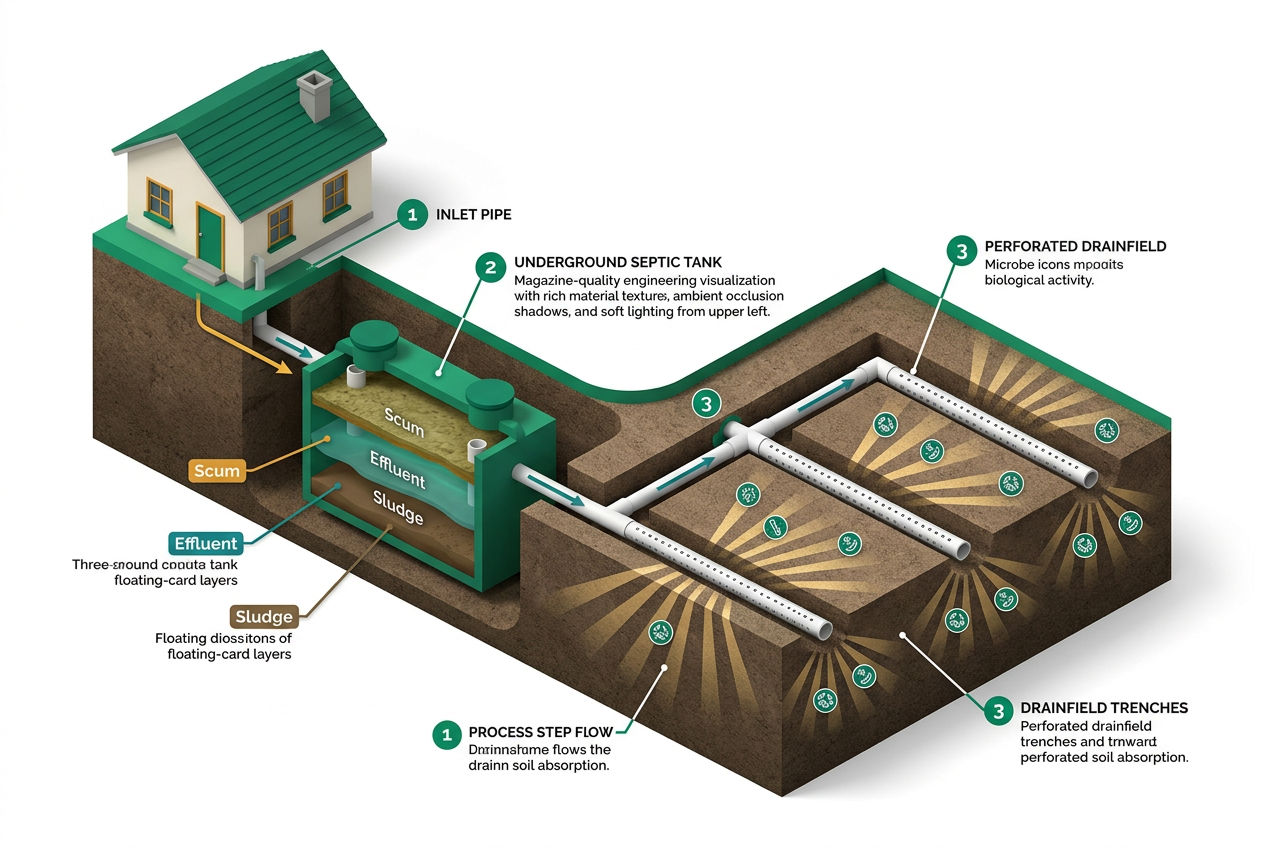
The drainfield is a network of perforated pipes buried in gravel trenches. Effluent seeps out of those pipes, filters through the soil, and naturally treated water re-enters the groundwater supply. Beneficial anaerobic bacteria living in the tank break down waste continuously — no electricity, no chemicals, no moving parts in a conventional system.
When it works, you never think about it. The problems start when you treat it like a municipal sewer, which it is not.
For a deeper look at how all the pieces fit together, see our guide to what a septic system is and how it works.
How Often Should You Pump a Septic Tank?
For most households, septic tank pumping every 3–5 years is the standard recommendation from the EPA. But the real answer depends on your tank size and how many people live in your home.
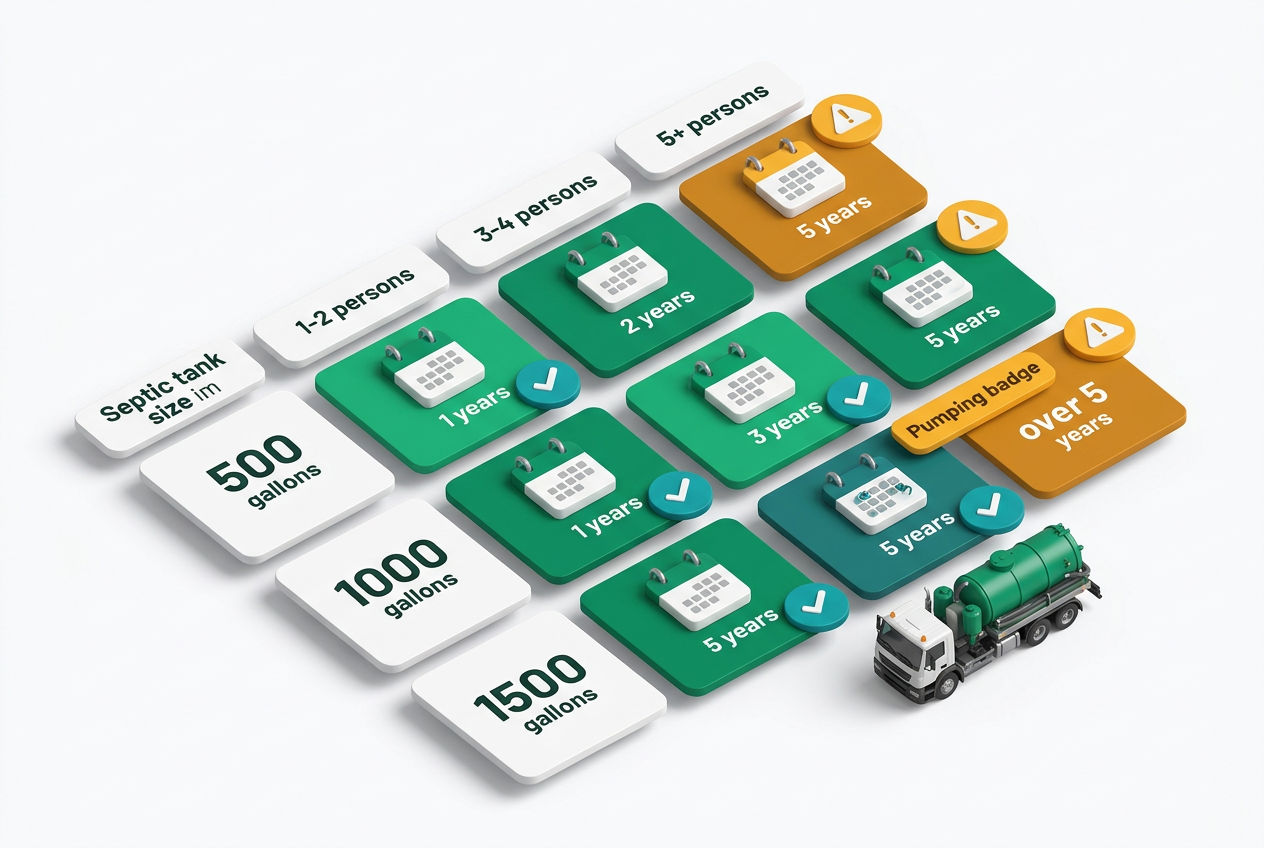
Here's a simple reference table:
| Household Size | Recommended Tank Size | Pumping Frequency |
|---|---|---|
| 1–2 people | 750–1,000 gallons | Every 4–5 years |
| 3–4 people | 1,000–1,200 gallons | Every 3–5 years |
| 5+ people | 1,250–1,500+ gallons | Every 2–3 years |
Source: U.S. EPA Septic Systems Overview (epa.gov/septic)
Worked example: Take a 1,000-gallon tank serving a four-person household. At normal usage, sludge accumulates roughly 1–2 inches per month. Over 36 months, that's 3–6 feet of buildup in a tank with about 8 feet of working depth — enough to push solids toward the outlet baffle. Add a garbage disposal and you're accelerating that timeline by 30–40%, dropping your safe pumping window to around 24 months. Skip year three and year four, and solids start migrating into the drainfield. That's when a $400 pump-out becomes a $6,000 drainfield repair.
Add a garbage disposal and subtract a year or two from those intervals. Garbage disposals push a significant load of food solids into a system designed to handle human waste, not kitchen scraps. For more on that tradeoff, read our article on garbage disposals and septic systems.
Fall is the ideal time to schedule a pump-out. The ground is accessible, the weather cooperates, and you're heading into winter with an empty tank rather than a nearly full one.
Find a licensed septic pumping company near you
What Happens If You Never Pump Your Septic Tank?
Skipping pump-outs is the single most common mistake new owners make — and the most expensive.
When the sludge layer at the bottom builds up enough, it starts crossing the outlet baffle. Solids migrate into the drainfield. Once that happens, the perforated pipes and the surrounding gravel clog with a thick black biomat. The soil stops accepting liquid. Effluent backs up toward the surface.
At that point, you're not looking at a pump-out. You're looking at drainfield repair ($2,000–$10,000) or full system replacement ($10,000–$30,000+). Late-1990s EPA literature estimated that 10–20% of U.S. septic systems are currently failing or operating at reduced capacity. Most of those failures trace back to years of skipped maintenance.
A pump-out runs $300–$600 nationally. Compare that to $25,000 for a new system and the math makes the decision for you.
For detailed cost breakdowns by tank size and region, see our septic pumping cost guide.
What Are the Worst Things to Put in a Septic Tank?
What goes down your drains determines how long your system lasts. Here's what a pumper sees destroy systems year after year:

Never flush or drain these:
- "Flushable" wipes — they don't break down. Licensed pumpers pull these out in thick, rope-like masses that clog baffles and pipes.
- Cooking grease and oil — solidifies in the tank and pipes, creates impermeable scum layers
- Medications — antibiotics in particular kill the beneficial bacteria your tank depends on
- Bleach in large quantities — occasional small amounts from laundry are tolerable, but daily heavy use disrupts bacterial balance significantly
- Feminine hygiene products, cotton balls, paper towels — none of these dissolve
- Drano or chemical drain cleaners — the sodium hydroxide (lye) base destroys bacterial colonies and corrodes baffles. Here's why Drano is a problem for septic systems
- Excess food waste from a garbage disposal — see above
- Cat litter — even "flushable" varieties create serious clogs
- Gasoline, paint thinner, solvents — these are groundwater contamination events, not just system problems
Safe for most systems in normal quantities:
- Standard toilet paper (single-ply dissolves fastest — see our best toilet paper for septic systems guide)
- Human waste
- Normal household wastewater from sinks and showers
- Septic-safe cleaning products (phosphate-free, labeled septic-safe)
The rule of thumb: if it didn't come out of a human body and it isn't toilet paper, it doesn't belong in a septic system. That single guideline prevents the majority of system failures we see in the field.
Is Bleach OK With a Septic System?
Occasional, moderate bleach use is generally tolerable. Running a bleach load of laundry every week or two won't crash your bacterial population. But pouring bleach directly into drains daily, using bleach tablets in every toilet tank, or running a bleach-based disinfectant cycle repeatedly — that will deplete the anaerobic bacteria that make your tank function.
The same logic applies to antibacterial soaps used constantly at every sink. They're not as damaging as bleach, but they're not helping.
If you're concerned about your household cleaning products, our septic-safe cleaning products guide walks through specific brands and what to look for on labels.
Do Septic Tank Additives Actually Work?
No — not if your system is healthy and you're pumping on schedule. Products like Rid-X add beneficial bacteria and enzymes to your tank. The marketing is compelling. But peer-reviewed research, including a widely cited study through the University of Arkansas Cooperative Extension, found that additives do not eliminate the need for pumping and provide no measurable benefit to a properly maintained system. The natural bacterial population in a healthy tank establishes itself without any help.
Important limitation: If your tank is already failing — biomat clogging the drainfield, solids in the laterals — no additive will reverse that damage. You need a pump-out, possibly drainfield remediation, and a conversation with a licensed contractor. This is one of the most common ways new owners waste money: buying bottles of Rid-X while their drainfield quietly dies.
For an honest look at what the science actually says, read our breakdown on whether septic additives work.
How Do You Know If Your Septic Tank Needs to Be Pumped?
Your system won't send you a calendar reminder. But it does send signals. Learn to read them.
Early warning signs:
- Drains running slower than usual — especially multiple drains at once
- Gurgling sounds from toilets or sink drains after flushing
- Toilets that won't flush normally despite no obvious clog
- Sewage odors inside the house or near the tank/drainfield area
Serious warning signs — call a pro today:
- Wet, spongy, or unusually green patches of grass directly above the drainfield
- Raw sewage smell outdoors near the tank or drainfield
- Sewage backing up into your lowest drains (floor drain, basement toilet)
- Visible standing liquid over the drainfield area
If you're seeing the serious signs, don't wait. Emergency septic service exists for a reason — raw sewage backup is both a health hazard and a sign that the system may be at a tipping point.
For a comprehensive rundown of symptoms and what each one means, see our guide to signs your septic tank needs pumping.
How Do You Protect Your Drainfield?
The drainfield is the most expensive component of your septic system to replace, and it's also the most vulnerable to everyday mistakes.
Rules for drainfield protection:
- Never drive or park vehicles over it. The soil compression from even a single pass from a loaded pickup truck can crush leach laterals or compact the soil enough to reduce percolation permanently. See why driving over a drain field is a bad idea.
- Keep trees away. Tree roots actively seek moisture and will find drain lines. Silver maple, willow, and poplar are the worst offenders — maintain at least a 30-foot buffer between any of these species and your drainfield perimeter.
- Divert surface water. Roof downspouts, sump pump discharge, and yard drainage that flows toward your drainfield saturate the soil and prevent effluent from percolating. Grade the area so water flows away.
- Don't cover it with impermeable surfaces. Concrete patios, plastic sheeting, and even thick mulch reduce the oxygen exchange that healthy drainfield soil requires.
- Spread out your water use. Doing five loads of laundry in a single afternoon floods the tank faster than the drainfield can process it. Spread laundry across the week.
Under Minnesota's MPCA regulations (Minn. R. 7080), setback requirements from drainfields to property features are codified in state law — a model many states follow in some form. Check your state's department of environmental quality for local setback rules that apply to landscaping, structures, and water features near your system.
For complete drainfield maintenance guidance, see our septic drain field maintenance guide.
What Does a Septic Inspection Actually Cover?
Free download
Free: the Septic Fridge Card — what to flush, what never to.
The Do / Don’t card the whole family can see, plus the Survival Kit: emergency flowchart, warning-sign decoder and pump-schedule card. One printable PDF.
A professional septic inspection, typically costing $100–$900 depending on scope and location (according to HomeAdvisor industry data), covers several components most homeowners never see.
A standard inspection under guidelines from the National Association of Wastewater Technicians (NAWT) includes:
- Tank condition — checking for cracks, corrosion, or damaged inlet/outlet baffles
- Sludge and scum measurement — using a Sludge Judge tube to measure actual layer depths and determine whether pumping is due
- Drainfield assessment — looking for surfacing effluent, soil saturation, or vegetation changes indicating failure
- Distribution box inspection — verifying even flow distribution to all lateral lines
- Riser and lid condition — checking for broken access covers that create safety hazards
Ask your inspector for a written report that includes sludge depth measurements and a recommended pump-out date. A verbal "looks fine" is not sufficient documentation for your records — or for future home sale disclosures, which are legally required in most states.
For a full walkthrough of what to expect, read our septic inspection process guide. To schedule a professional assessment, visit our septic inspection service page.
Septic System Maintenance by Season
Your system faces different pressures in different seasons. Here's what changes and what to do about it.

Spring: The ground thaws and water table rises. High water tables reduce the drainfield's ability to accept effluent — this is when you're most likely to see temporary surfacing even in a functional system. Schedule your inspection or pump-out in early spring if you're overdue, before the ground softens and access becomes difficult.
Summer: Houseguests and vacation schedules mean peak water usage. Fix a leaky toilet wasting 200+ gallons per day before summer — that volume alone can hydraulically overload a drainfield regardless of sludge levels. Leaky toilets are the leading cause of summer drainfield saturation in otherwise healthy systems.
Fall: Ideal pump-out season. Ground is firm and accessible, contractors have more availability than spring, and you're banking a full tank's worth of capacity before winter. If you're in a cold-climate state — Minnesota, Maine, Wisconsin, upstate New York — this is also the time to inspect pipe insulation.
Winter: Frost can penetrate 42–60 inches in upper Midwest states. Septic pipes that sit in compacted driveways or thin-soil areas lose their insulating snow cover and are vulnerable to freezing. Insulate the first 10 feet of pipe from the house foundation with rigid foam board rated for below-grade use. An emergency thaw call runs $1,500–$2,500 in most cold-climate markets.
For the complete seasonal guide, see our septic tank maintenance guide.
New Homeowner Checklist: First 30 Days
If you just closed on a home with a septic system, work through this list before you do anything else:
- Locate your tank and drainfield — request the as-built drawing from your county health department or previous owner
- Find your maintenance records — when was the last pump-out? If unknown, schedule an inspection now
- Identify your tank size — should be on the as-built drawing or inspection report; cross-reference with your household size using the pumping table above
- Check all toilets for leaks — put a few drops of food coloring in the tank; if color appears in the bowl without flushing, you have a flapper leak
- Note the drainfield location — flag it so guests, landscapers, and contractors know not to drive or dig there
- Locate the access risers — if your tank has no surface risers, budget to have them installed ($200–$500); digging to access buried lids adds cost and time to every future service call
- Schedule your first professional inspection via our septic inspection service page if no records are available
Frequently Asked Questions About Septic Tank Care
What is the basic septic tank care routine for a first-time owner?
Basic septic system maintenance for beginners follows four rules you can memorize in under a minute. First, pump your tank on schedule — every 3–5 years for most households, or more frequently if you have a large family or garbage disposal. Second, only flush toilet paper and human waste — no wipes, no paper towels, no feminine hygiene products, no matter what the packaging claims. Third, spread water use across the day and week rather than running multiple appliances simultaneously. Fourth, protect your drainfield by keeping vehicles, trees, and surface water away from it. That's the entire maintenance routine for a healthy system. If you follow those four rules and get your tank pumped before the sludge exceeds one-third of tank volume, you can realistically expect 25–40 years of trouble-free service from a conventional system. Everything else in this guide is detail that supports those four fundamentals.
How do I know if my septic tank is full or failing?
A full tank and a failing tank produce similar symptoms but require different responses, so the distinction matters. A tank that simply needs pumping typically shows slow drains throughout the house and gurgling sounds after flushing — fix this with a scheduled pump-out. A failing system goes further: you'll see wet, spongy ground over the drainfield even during dry weather, unusually lush green grass in a defined patch above the lateral lines, sewage odor outdoors, or effluent actually surfacing above ground. If multiple fixtures are backing up simultaneously — particularly your lowest fixtures like a basement toilet or floor drain — that's a serious warning. Call a licensed contractor the same day. Don't run more water into the system, don't add bacterial additives, and don't attempt to treat it with bleach or chemicals. Each of those responses makes the underlying problem worse. The EPA recommends professional evaluation any time you observe surfacing effluent, as it constitutes a public health violation in most states.
How do you maintain a septic system on a tight budget?
Septic tank care on a budget is mostly about timing and prevention rather than spending more money. The biggest financial mistake is deferring pump-outs — a $350–$500 pump-out every four years costs roughly $1,000 per decade. A drainfield replacement costs $10,000–$30,000. So the cheapest thing you can do is stay current on pumping, even if it feels like an unnecessary expense during years when nothing seems wrong. Beyond that, stop buying bacterial additives — peer-reviewed research from the University of Arkansas Cooperative Extension found they provide no measurable benefit to a properly maintained system. Fix leaky toilets promptly; a running toilet wastes 200+ gallons per day and hydraulically overloads your drainfield faster than any other household behavior. Use single-ply toilet paper, which dissolves faster than two-ply or quilted brands. Finally, get a written pump-out report each visit so you can track sludge accumulation rates and accurately time future service — avoiding both premature and overdue pump-outs.
Is there a difference between septic tank cleaning and pumping?
Yes, and the distinction affects what you're paying for. Pumping removes the liquid effluent and floating scum layer from your tank — it's the faster, less thorough service and what most routine maintenance calls involve. Cleaning goes further: it includes pumping, plus backwashing or jetting the tank walls to remove adhered biofilm and compacted sludge from the bottom. A full cleaning also typically includes inspection of the baffles, risers, and outlet line. Most homeowners only need pumping during routine maintenance cycles. Cleaning becomes valuable after a system has gone significantly overdue — if a previous owner skipped two or three pump-outs, a thorough cleaning helps reset the tank to a known baseline. When requesting service, ask specifically whether you're getting pumping only or a full clean, and request a written sludge-depth measurement before and after. That measurement is the only objective way to confirm the work was completed as described. Costs for full cleaning typically run $100–$300 more than pumping alone.
What septic-safe products should I actually use?
Septic-safe household product selection comes down to three label criteria: phosphate-free, no antibacterial agents (triclosan or benzalkonium chloride), and biodegradable surfactants. Seventh Generation dish soap, Method laundry detergent, and Biokleen drain cleaner all meet these criteria and are available at major retailers. For toilet bowl cleaners, avoid any product with bleach as the primary active ingredient — Seventh Generation Emerald Cypress & Fir toilet bowl cleaner uses plant-based acids instead. Standard white vinegar and baking soda handle most cleaning tasks and are fully septic-safe. The products to avoid most aggressively are foaming bathroom cleaners with sodium hypochlorite (bleach), automatic toilet tank tablets with paradichlorobenzene, and any product marketed as "antibacterial" for drain or sink use. One honest limitation worth noting: even switching every product in your home to septic-safe alternatives won't compensate for missed pump-outs or non-flushable items in the system. Product choice is the smallest of the three major maintenance levers; pumping schedule and what you flush matter far more.
Can a beginner do any septic maintenance themselves?
Some septic maintenance tasks are genuinely DIY-friendly, and knowing the line between what you can handle and what requires a licensed contractor saves money without risking your system. You can safely locate your tank using county as-built records, check your risers and lids for cracks or broken seals, fix running toilets, divert downspouts away from the drainfield, and document your pump-out history. You can also monitor the warning signs described in this guide and time your pump-out calls appropriately. What you cannot do yourself: pump the tank (requires a licensed vacuum truck and proper waste disposal permits in every state), inspect baffles or internal components (requires tank access and confined-space safety protocols), or assess drainfield condition below the soil surface. Some states, including California under Title 5 equivalents and Minnesota under MPCA rules, legally require that pump-outs be performed by a licensed hauler — attempting to self-pump is not just impractical but illegal. Budget for professional pumping as a non-negotiable line item; everything else is fair game for DIY attention.
Sources & Methodology
-
U.S. Environmental Protection Agency — Septic Systems Overview and How to Care for Your Septic System. epa.gov/septic. Referenced for pumping frequency recommendations, 21 million household figure, and 10–20% system failure estimate.
-
University of Arkansas Cooperative Extension — Peer-reviewed research on septic system additives. Referenced in the additives section for the finding that bacterial additives provide no measurable maintenance benefit.
-
National Association of Wastewater Technicians (NAWT) — Professional inspection standards referenced in the inspection section.
-
Minnesota Pollution Control Agency (MPCA) — Minn. R. 7080, Minnesota Individual Sewage Treatment System rules. Referenced for frost depth, setback requirements, and licensed hauler requirements.
-
HomeAdvisor Industry Cost Data — Inspection cost range ($100–$900) sourced from aggregated contractor data, cited for reference only; costs vary significantly by region and scope.
This guide reflects current EPA and industry guidance as of June 2025. Local regulations vary — consult your county health department or a licensed septic professional for requirements in your area.
Was this article helpful?
Frequently Asked Questions
Recommended Resources
📖 Related Articles
- What Is a Septic System? How It Works (Visual Guide)
- Can You Use a Garbage Disposal with a Septic System?
- Can You Use Drano with a Septic System?
- What's the Best Toilet Paper for Septic Systems?
- Septic-Safe Cleaning Products: The Complete List (Safe vs. Avoid)
- Do Septic Tank Additives Actually Work? (The Science)
- 8 Signs Your Septic Tank Needs to Be Pumped
- Can You Drive or Build Over a Drain Field?
- How to Handle Septic Drain Field Maintenance: Step by Step
- What Happens During a Septic Inspection?
- The Complete Septic Tank Maintenance Guide
💰 Cost Guides
Find Septic Professionals Near You
Compare licensed, verified septic companies by area — top county markets and cities below, or browse all 50 states.
County markets
Popular cities
