
Quick Answer
Septic safe cleaning products are those formulated without chemicals that kill the beneficial bacteria your septic tank depends on to break down waste. Products with a near-neutral pH (6–8), no triclosan, no quaternary ammonium compounds, and no heavy chlorine load are your safest choices across every product category — from laundry detergent to toilet bowl cleaner.
Key Takeaways
- Approximately 21 million U.S. homes rely on septic systems — roughly 1 in 5 households (EPA).
- A single laundry load with a high-chlorine detergent can kill 50% or more of the beneficial bacteria in your tank (University of Arkansas Cooperative Extension).
- Safe products fall in the pH 6–8 range; highly acidic or alkaline cleaners disrupt the bacterial balance that makes your system work.
- The EPA Safer Choice label is the fastest way to identify a vetted septic-friendly product.
- Using harsh chemicals regularly shortens pump-out intervals and pushes your maintenance cost from the typical $300–$600 toward the high end — more frequently.
Why Do Your Cleaning Products Affect Your Septic System?
Picture this: you're selling your home, the buyer's inspector scopes your drain field, and the diagnosis is biomat buildup — a thick, black layer of clogged organic material choking your leach laterals. The repair estimate is $4,000–$8,000. You flash back to years of bleach-heavy bathroom scrubs, antibacterial dish soaps, and economy-bin laundry detergent. Coincidence? Maybe not.
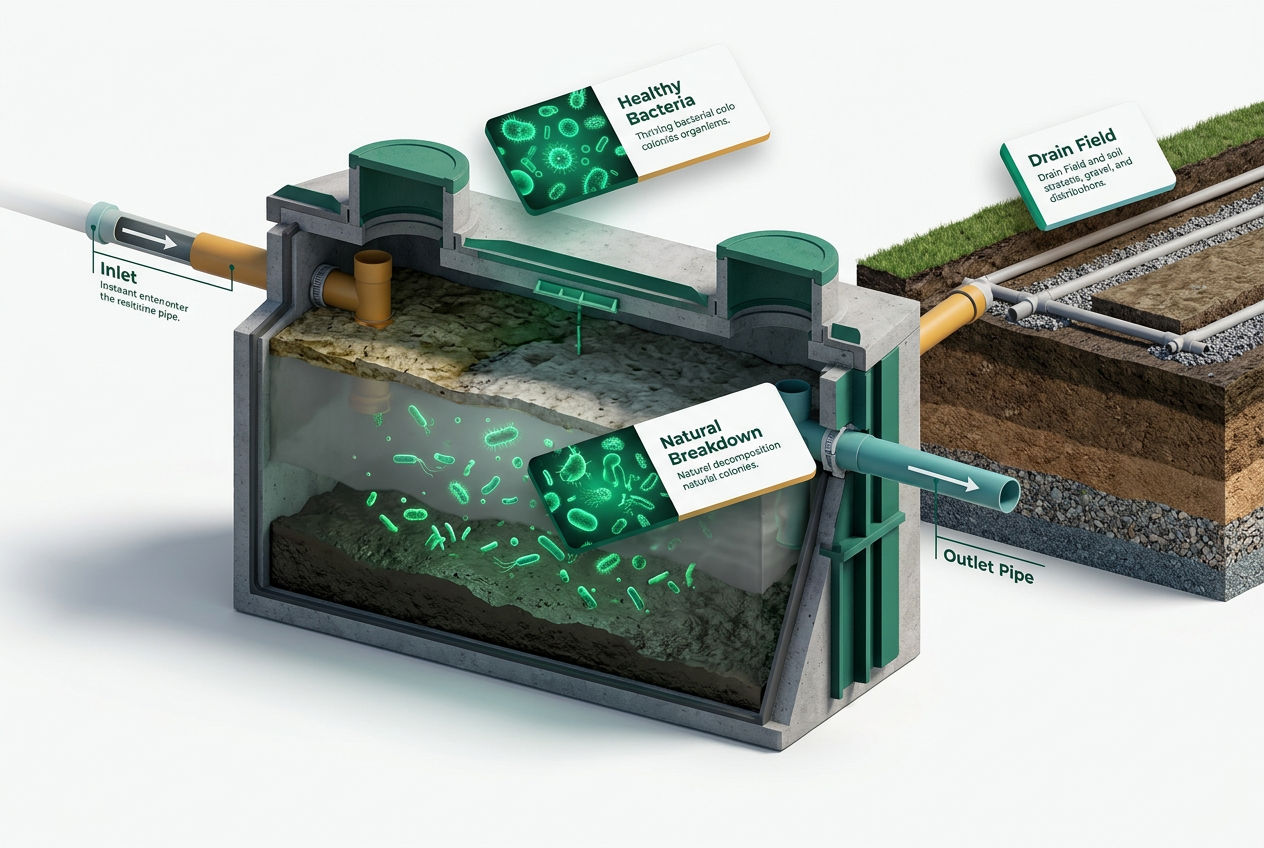
Your septic tank isn't just a holding container. It's a living biological reactor. Billions of anaerobic bacteria inside a healthy 1,000–1,500-gallon concrete tank continuously digest solid waste, separating it into effluent that flows out to your drain field. Kill those bacteria and the solids don't break down. Sludge accumulates faster. Your pump-out schedule compresses from every 3–5 years (the EPA's general guidance for most households) to every 1–2 years — at $300–$600 per service call.
The cleaning products you pour down your drain reach that bacterial colony every single day. That's why this list matters. To understand exactly how a septic system processes what goes down your drains, it helps to read the full explainer — but the short version is this: you need those bacteria alive.
Which Ingredients Are Dangerous to a Septic System?
Before you even look at brand names, learn to read labels. These are the chemical names that signal danger to your septic system. If you see them on a product, think twice.
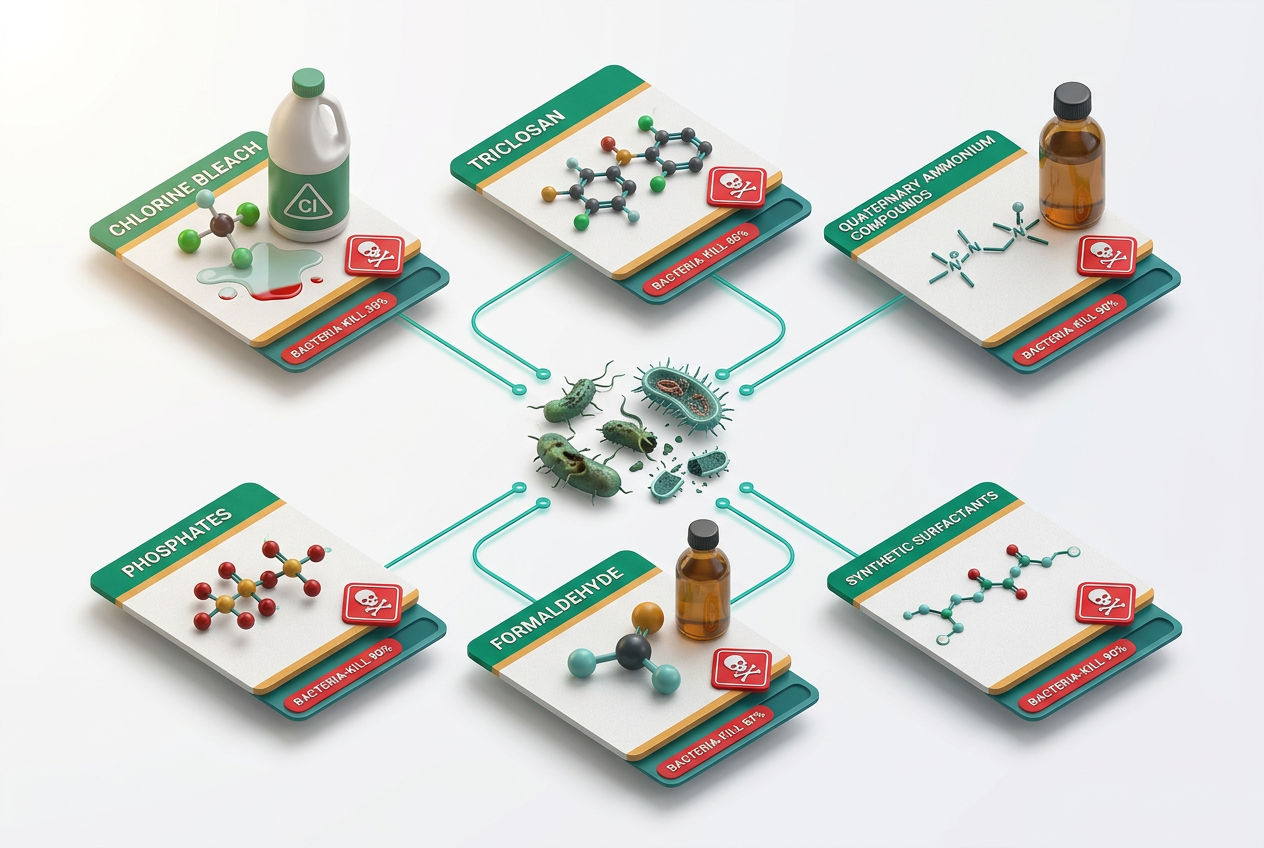
Avoid or minimize products containing:
- Triclosan — antibacterial agent, destroys beneficial bacteria; banned by the FDA in consumer hand soaps in 2016 but still present in some household products
- Quaternary ammonium compounds (quats) — found in disinfecting wipes and sprays; highly toxic to tank microbes
- Sodium hypochlorite (bleach) in high concentrations — kills bacteria at high volumes; tolerable only in small doses
- Phosphates — cause algae blooms and drain field clogging; banned or restricted in 17+ states
- Methylene chloride — solvent found in some paint strippers; never goes near a septic system
- Formaldehyde — biocide that kills tank bacteria
- Petroleum-based surfactants — slow to biodegrade, accumulate in the drain field
- Ammonia in large quantities — disruptive to bacterial colonies at high concentrations
Safe ingredient markers to look for:
- Sodium lauryl sulfate (SLS) or sodium laureth sulfate (SLES) — biodegradable, generally septic tolerable
- Citric acid (in small amounts)
- Plant-derived surfactants (coconut oil, corn-derived)
- Enzymes (protease, amylase, lipase)
✅ What Septic Safe Cleaning Products Should You Actually Use?
The following products are organized by category. Each section identifies what to look for on labels, which brands consistently meet those criteria, and which specific formulations to choose or avoid within a brand.
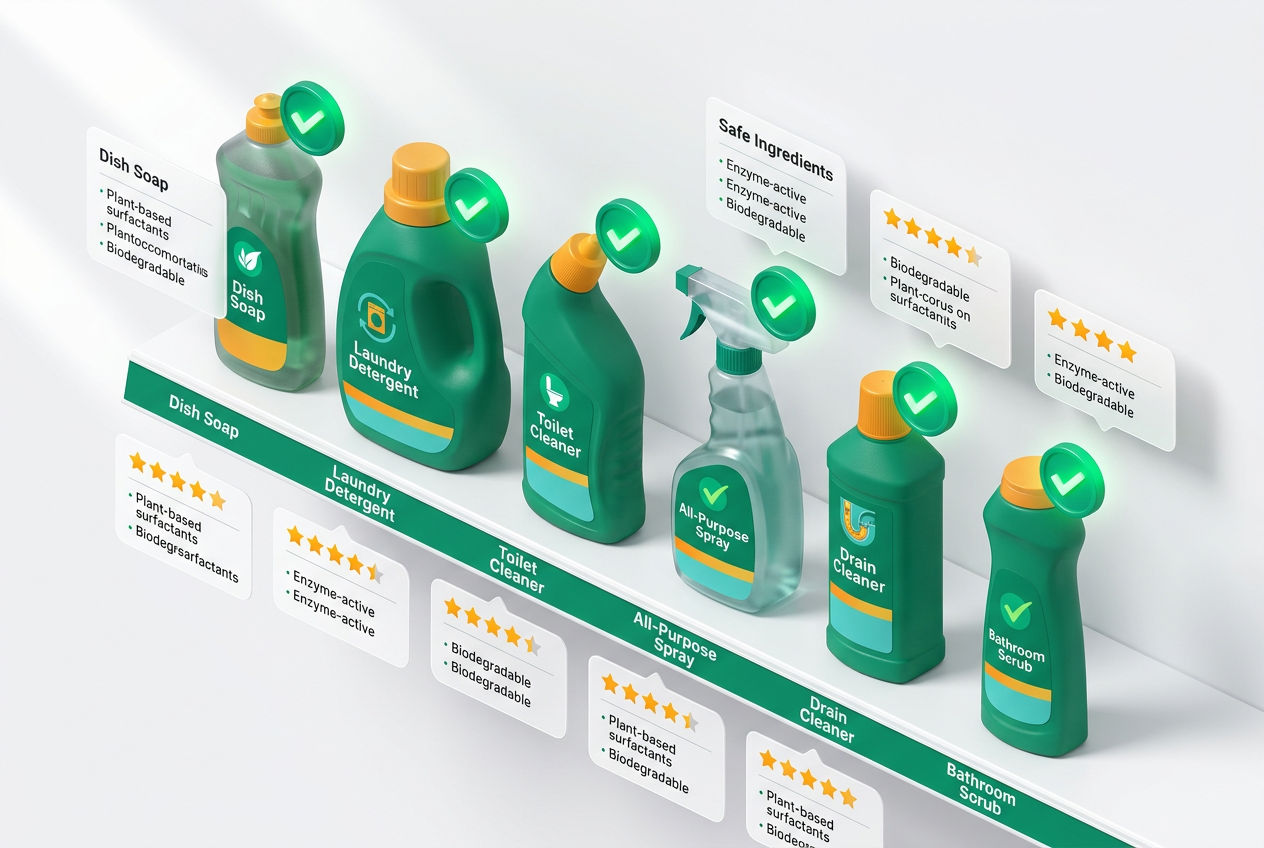
Septic Safe Laundry Detergent
Septic safe laundry detergent is one of the highest-impact choices you'll make, because laundry is a high-volume, high-frequency water input into your system. A 4-person household running 8–10 loads per week pushes a significant amount of surfactant into the tank.
What makes a laundry detergent septic safe:
- Phosphate-free (look for the phosphate-free label — 17 states plus Washington D.C. have restricted phosphates in laundry products)
- Low-sudsing formula (high suds = more surfactant, harder to biodegrade)
- Liquid formulas over powder when possible (powders can clump and add to sludge)
- pH close to neutral
Safe laundry detergent brands and products:
- Seventh Generation Free & Clear — plant-based, phosphate-free, EPA Safer Choice certified
- Ecos Laundry Detergent — hypoallergenic, biodegradable, pH-balanced, EPA Safer Choice certified
- Arm & Hammer Sensitive Skin Free & Clear — low-cost, fragrance-free, phosphate-free
- Molly's Suds Original Laundry Powder — short ingredient list, mineral-based
- Charlie's Soap Laundry Powder — widely recommended by septic professionals, rinses clean
- Tide Free & Gentle — mainstream option; phosphate-free, lower chemical load than standard Tide
- All Free Clear — dermatologist-tested, phosphate-free, widely available
- Method 4x Concentrated Laundry Detergent — plant-based surfactants, concentrated (less volume per load)
- Oxygen bleach booster (sodium percarbonate) — OxiClean Versatile Stain Remover or bulk sodium percarbonate are solid choices for whitening and stain removal. Decomposes to washing soda, water, and oxygen — no persistent antimicrobial residual. Stick to formulas where sodium percarbonate and sodium carbonate are the only listed actives; skip any "oxy" product that contains quaternary ammonium compounds or optical brighteners.
Also: stagger your laundry loads across the week rather than doing 8 loads on Saturday. A 1,000-gallon tank can only process so much water at once — flooding it in one day pushes partially treated effluent into your drain field before solids have settled. For more on how laundry habits affect your septic system, including how many loads per week is too many, that guide breaks it down.
Septic Safe Dish Soap
Is Dawn dish soap safe for septic systems? Yes — Dawn Original is generally considered septic safe in normal household quantities. It's biodegradable, doesn't contain phosphates, and its surfactant concentration is low enough that routine handwashing volumes don't meaningfully harm tank bacteria. That said, Dawn Antibacterial is a different story (see the "Avoid" section below).
Safe dish soap options:
- Dawn Original (Blue) — biodegradable, phosphate-free, widely used by septic owners
- Seventh Generation Dish Liquid — plant-based, fragrance-free, EPA Safer Choice
- Ecos Dish Soap — palm oil free, pH balanced, biodegradable surfactants
- Mrs. Meyer's Clean Day Dish Soap — plant-derived, biodegradable (note: some scented versions contain essential oils that some professionals advise limiting)
- Palmolive Pure + Clear — free of phosphates and antibacterial agents
- Method Dish Soap — plant-based, biodegradable, septic-compatible
For septic safe dishwasher detergent specifically — what goes into your automatic dishwasher — the formulations are different and the stakes slightly higher because dishwasher detergents historically contained the highest phosphate concentrations of any household product.
Septic Safe Toilet Bowl Cleaner
This category is tricky because most conventional toilet bowl cleaners are highly acidic (pH 1–3) and loaded with sodium hypochlorite. That combination is one of the fastest ways to disrupt your tank's bacterial colony — and it flows directly from bowl to tank.
Safe toilet bowl cleaner options:
- Seventh Generation Toilet Bowl Cleaner — plant-based, biodegradable, no bleach
- Ecos Toilet Bowl Cleaner — pH balanced, EPA Safer Choice certified
- Method Antibac Toilet Bowl Cleaner — uses lactic acid (a natural organic acid) instead of sodium hypochlorite; gentler on bacteria
- Better Life Natural Toilet Bowl Cleaner — plant- and mineral-derived, no synthetic fragrance
- Biokleen Bac-Out Bathroom Cleaner — enzyme-based, designed specifically to be microbe-safe
For a complete breakdown of septic safe toilet bowl cleaners, including specific pH readings and ingredient comparisons, that guide goes deeper than this overview can.
Septic Safe Bathroom Cleaner (All-Purpose)
Safe bathroom cleaner options:
- Seventh Generation Tub & Tile Cleaner — no bleach, no phosphates, plant-derived surfactants
- Biokleen Bathroom Cleaner — enzyme-based, biodegradable
- Bon Ami Powder Cleanser — gentle abrasive (feldspar), no bleach, no phosphates; a classic that septic professionals often recommend
- Bar Keepers Friend (original powder) — oxalic acid-based, lower toxicity to tank bacteria than bleach-based alternatives; use in modest amounts
- Method Daily Shower Spray — plant-based, no harsh disinfectants
- Branch Basics All-Purpose Spray — concentrate diluted with water; no quats, no bleach, no synthetic fragrance
- Oxygen bleach powder (sodium percarbonate) — Effective on tub surfaces, tile, and grout staining. Make a paste with water, apply, let it sit for 10–15 minutes, then scrub and rinse. Decomposes to soda ash, water, and oxygen before reaching your tank, leaving no biocidal residue. Use bulk sodium percarbonate or a fragrance-free product with minimal added ingredients for the safest result.
Septic Safe Drain Cleaner
This is the category where most homeowners do the most damage without realizing it. Chemical drain openers — particularly lye-based (sodium hydroxide, pH 13–14) or acid-based products — can wipe out a significant portion of your tank's bacterial population in a single use.
Safe drain cleaner options:
- Bio-Clean Drain Septic Bacteria — specifically formulated with live bacteria and enzymes to clear organic clogs without harming tank biology
- Green Gobbler Drain Clog Dissolver — enzyme-based, biodegradable
- Earth Enzymes Drain Opener — bacterial/enzyme formula
- Baking soda + vinegar flush — effective for minor buildup; pour ½ cup baking soda followed by 1 cup white vinegar, wait 30 minutes, flush with hot water
Never use: Drano, Liquid-Plumr, or any product with sodium hydroxide (lye) as the primary active ingredient. These products work by chemically dissolving organic material — including the bacteria in your tank.
For the full guide on septic safe drain cleaners and what to do when you have a serious clog, that article covers enzymatic alternatives and when to call a professional instead of reaching for a chemical fix.
Septic Safe All-Purpose Cleaners
- Method All-Purpose Cleaner — plant-based, no quats, biodegradable
- Seventh Generation All-Purpose Cleaner — EPA Safer Choice, no bleach, no phosphates
- Branch Basics Concentrate — dilute-to-use, free of all major septic hazards
- Better Life All-Purpose Cleaner — plant-derived, fragrance from essential oils only
- Puracy Natural All-Purpose Cleaner — enzyme-based, biodegradable, pH 8 or below
Quick Reference Table: Septic Safe Cleaning Products by Category
| Category | ✅ Safe | ⚠️ Use With Caution | ❌ Avoid |
|---|---|---|---|
| Laundry Detergent | Seventh Generation, Ecos, Charlie's Soap | Arm & Hammer (standard) | Tide Original, Gain with Febreze |
| Dish Soap | Dawn Original, Seventh Generation, Ecos | Mrs. Meyer's (scented) | Dawn Antibacterial, Ajax with bleach |
| Toilet Bowl Cleaner | Seventh Generation, Method Antibac | Bar Keepers Friend | Lysol Toilet Bowl Cleaner, Clorox Toilet Bowl |
| Bathroom Cleaner | Bon Ami, Biokleen, Branch Basics | Hydrogen peroxide (dilute) | Tilex, Scrubbing Bubbles, Comet with bleach |
| Bleach / Whitener | Oxygen bleach (sodium percarbonate) — OxiClean Versatile, bulk percarbonate | Borax (watch for drainfield boron buildup with heavy use) | Chlorine bleach (sodium hypochlorite) as a routine cleaner; any "oxy" product containing quaternary ammonium compounds |
| Drain Cleaner | Bio-Clean, Green Gobbler, baking soda/vinegar | Enzyme-based commercial openers | Drano, Liquid-Plumr, any lye-based product |
| All-Purpose | Method, Seventh Generation, Puracy | Vinegar-based sprays (diluted) | Lysol Multi-Surface, Pine-Sol original |
❌ What Cleaning Products Are Bad for Septic Systems?
The following categories and specific products consistently rank as the most damaging to septic tank biology. This isn't about occasional accidents — it's about regular use over months and years that degrades your tank's bacterial population to the point where it can't adequately process waste.
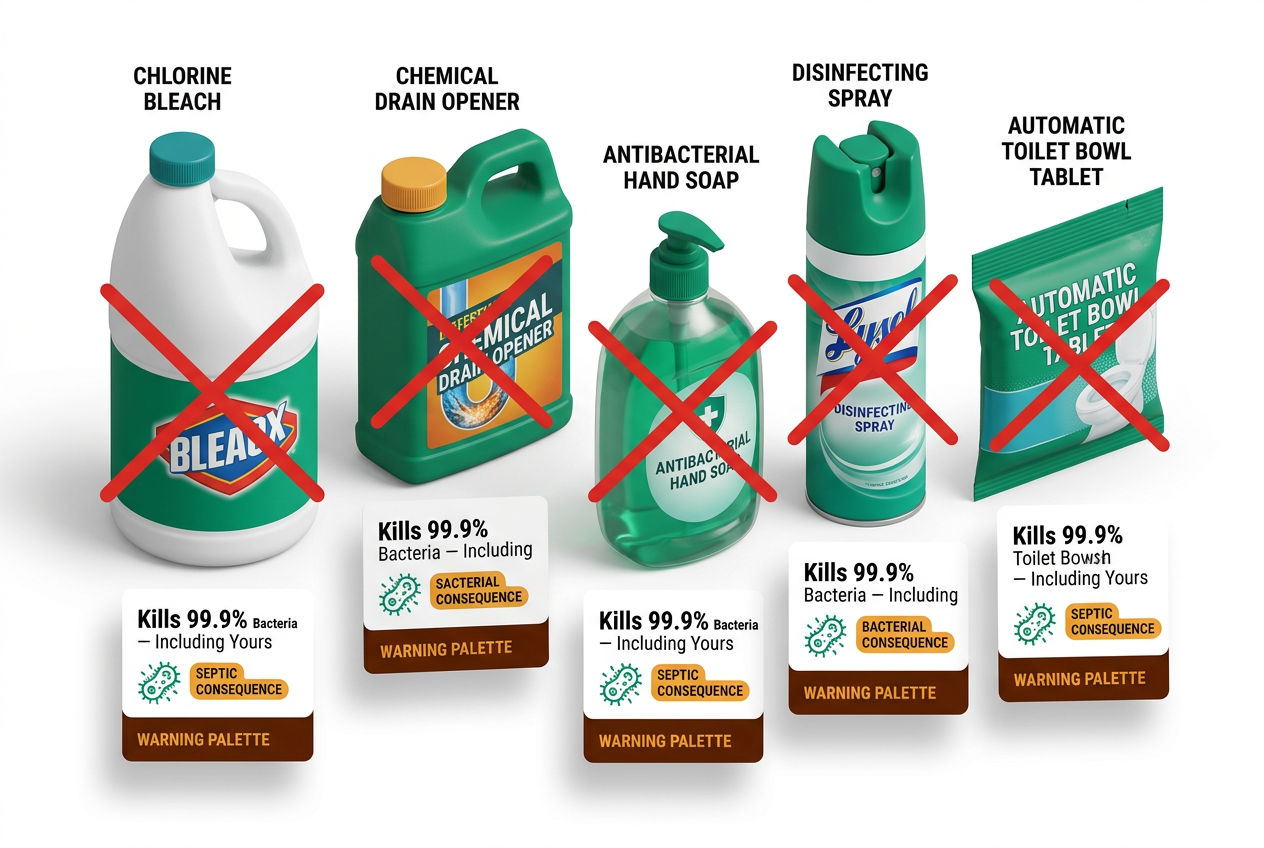
Antibacterial Soap and the Septic Tank Problem
Is antibacterial soap bad for septic systems? Yes — and this applies to hand soaps, dish soaps, and any cleaning product labeled "antibacterial" or "antimicrobial." The active ingredients (triclosan, benzalkonium chloride, or other quats) are specifically engineered to kill microorganisms. Your septic tank is populated by microorganisms. The math isn't complicated.
The FDA banned triclosan from consumer hand soaps in 2016, but it persists in some product lines and many international formulations. Quaternary ammonium compounds (benzalkonium chloride, didecyl dimethyl ammonium chloride) replaced triclosan in many products and are equally problematic for tank biology.
Products to specifically avoid:
- Dawn Antibacterial
- Dial Antibacterial Hand Soap (all variants)
- Softsoap Antibacterial
- Lysol Antibacterial Soap
- Any hand soap or dish soap labeled "kills 99.9% of bacteria"
- Disinfecting wipes (Lysol, Clorox) — high quat concentration
For more on why flushable wipes aren't actually septic safe — a related issue — that guide covers both the chemical and physical damage wipes cause.
Bleach and the Septic System
Bleach (sodium hypochlorite) is the most misunderstood product in this space. It isn't banned from septic households — but volume and frequency matter enormously.
The University of Minnesota Extension guidance holds that occasional, diluted bleach use — a small amount in a load of laundry, or a diluted spray for bathroom surfaces — is tolerable for a healthy tank. What "tolerable" means: ¼ cup or less of liquid bleach per wash load, used occasionally rather than as a default. At that volume, the bleach is sufficiently diluted by the tank's water volume that it doesn't cause catastrophic bacterial die-off.
What crosses the line:
- Using bleach-heavy toilet bowl cleaners daily (direct tank contact with high-concentration product)
- Running multiple bleach laundry loads per week
- Pouring bleach directly down drains to clear clogs or odors
For the full analysis of bleach and septic systems, including how different concentrations affect bacterial populations, that guide has the detailed breakdown.
What Chemicals Should You Never Put in a Septic Tank?
Some products represent absolute prohibitions — not gray zones. These should never enter a system connected to a septic tank:
- Paint thinner, mineral spirits, turpentine — solvents that kill bacteria and contaminate groundwater
- Motor oil or gasoline — petroleum products that accumulate in the drain field and are nearly impossible to remediate
- Pool chemicals — highly chlorinated; a single dose can wipe out the bacterial population of a 1,000-gallon tank
- Photographic chemicals — silver-based compounds are biocidal
- Prescription medications — pharmaceuticals pass through tank bacteria without breaking down and contaminate drain field groundwater
- Lye-based drain openers (Drano, Liquid-Plumr) — pH 13–14, sufficient to cause mass bacterial die-off in a single use
The question of using Drano with a septic system comes up often enough that it deserves its own treatment — the short answer is never, but the why is instructive.
⚠️ Are Common "Natural" Cleaners Actually Septic Safe?
Free download
Free: the Septic Fridge Card — what to flush, what never to.
The Do / Don’t card the whole family can see, plus the Survival Kit: emergency flowchart, warning-sign decoder and pump-schedule card. One printable PDF.
Several products occupy a middle ground — they're not as damaging as bleach-heavy conventional cleaners, but they're not unconditionally safe either. This section covers the most common ones homeowners ask about.
Is Borax Safe for Septic Tanks?
Borax (sodium tetraborate) is often marketed as a natural, green cleaning alternative, and it does have a more benign environmental profile than many synthetic chemicals. But it sits in a complicated position for septic systems. At low concentrations, borax appears to have minimal impact on tank bacteria. At higher concentrations or with regular use as a primary cleaning agent, it has demonstrated antibacterial properties that can suppress beneficial microbial populations. University of Arkansas Cooperative Extension research on borax concludes that occasional use in laundry is likely fine — daily use as a general cleaner is less advisable. The full borax and septic tank guide covers the concentration data in detail. If you're deciding between borax and oxygen bleach as a laundry booster, oxygen bleach (sodium percarbonate) is the cleaner choice for your septic system: its decomposition products are transient and completely benign, while borax leaves behind borate that persists in drainfield soil and groundwater and is toxic to many plants at moderate concentrations.
Is Oxygen Bleach Safe for Septic Systems?
Yes — oxygen bleach (sodium percarbonate) is one of the more septic-compatible whitening and stain-removal options available, and it is meaningfully safer than chlorine bleach for your tank's bacterial colony. Here's why that's true, and where the limits are.

What oxygen bleach actually is. Sodium percarbonate is a dry adduct of sodium carbonate and hydrogen peroxide. When it dissolves in water, it releases those two components: washing soda (sodium carbonate) and hydrogen peroxide. The hydrogen peroxide then breaks down further into water and oxygen. That's the entire decomposition chain — the end products are sodium carbonate, water, and oxygen.
Why it's different from chlorine bleach. Chlorine bleach (sodium hypochlorite) works by releasing hypochlorous acid, a persistent, cell-penetrating biocide that continues killing bacteria for hours to days and produces chlorinated organic byproducts in the process. Bacteria have no reliable enzymatic defense against it. Hydrogen peroxide works differently: virtually all bacteria — including the anaerobes in your tank — produce catalase, an enzyme that destroys hydrogen peroxide almost instantly (it converts H₂O₂ to water and oxygen as a normal metabolic function). By the time a laundry load's worth of sodium percarbonate reaches a tank holding a thousand gallons of water, the hydrogen peroxide is diluted to a tiny fraction of a percent, and the bacteria enzymatically neutralize what little remains. There is no persistent antimicrobial residual, which is the critical difference.
Practical dosing. A standard scoop of product per laundry load, used daily or even twice daily, is not a concern based on the chemistry and the dilution math. The one precautionary note worth following: avoid dumping a large, concentrated soaking solution — say, a full sink or tub of heavily dosed water — all at once down the drain. Dilute it with running water or drain it in stages. This is the same common-sense advice that applies to nearly any cleaning product and septic systems.
Honest limitations. Be aware that published guidance dealing specifically with oxygen bleach and septic systems is thin — we could not find a university extension service or the EPA addressing it directly. The safety case here rests on the decomposition chemistry and dilution, not on field trials in working septic tanks. More importantly: oxygen bleach is not a disinfectant. At laundry concentrations it whitens and removes stains — it will not reliably kill norovirus, C. difficile, or blood-borne pathogens. When actual disinfection is required, chlorine bleach or an EPA-registered disinfectant is appropriate, and the occasional septic impact is an acceptable trade-off.
Watch the label closely. "Oxygen bleach" is not a regulated term. Some products sold under oxy branding contain surfactants, optical brighteners, fragrances, or — most problematically — quaternary ammonium compounds (quats), which are genuine biocides that will harm your tank biology just as chlorine bleach does. If septic safety is the goal, look for products where sodium percarbonate and sodium carbonate are the only active ingredients, or use bulk sodium percarbonate with no additives.
Is Hydrogen Peroxide Safe for Septic Systems?
Hydrogen peroxide is used in some "oxygen-based" cleaners as a bleach alternative. At the 3% concentration sold in drugstores, it breaks down rapidly into water and oxygen — and its septic impact at those concentrations is minimal. At higher concentrations (10%+, used in some commercial cleaners), it can be more disruptive. The critical issue: "oxygen bleach" products marketed as natural sometimes contain hydrogen peroxide at concentrations that aren't specified on the label. The hydrogen peroxide and septic systems guide walks through the concentration thresholds and which specific products are within safe limits.
Is OxiClean Septic Safe?
OxiClean Versatile (the standard blue-container powder) uses sodium percarbonate as its active ingredient — which breaks down into sodium carbonate and hydrogen peroxide in water. At recommended usage levels, it's generally considered septic-tolerable by most septic professionals. However, OxiClean's product line has expanded considerably, and other formulations in the OxiClean family include different active ingredients, some of which are less benign. Check the specific product label rather than assuming all OxiClean products are equivalent. The OxiClean septic compatibility guide breaks down the product line formulation by formulation.
Are Natural and Homemade Cleaners Actually Better for Septic Systems?
Generally, yes — with caveats. The septic professionals most commonly endorse this combination for routine maintenance: baking soda + white vinegar + castile soap. Each ingredient is worth understanding independently.
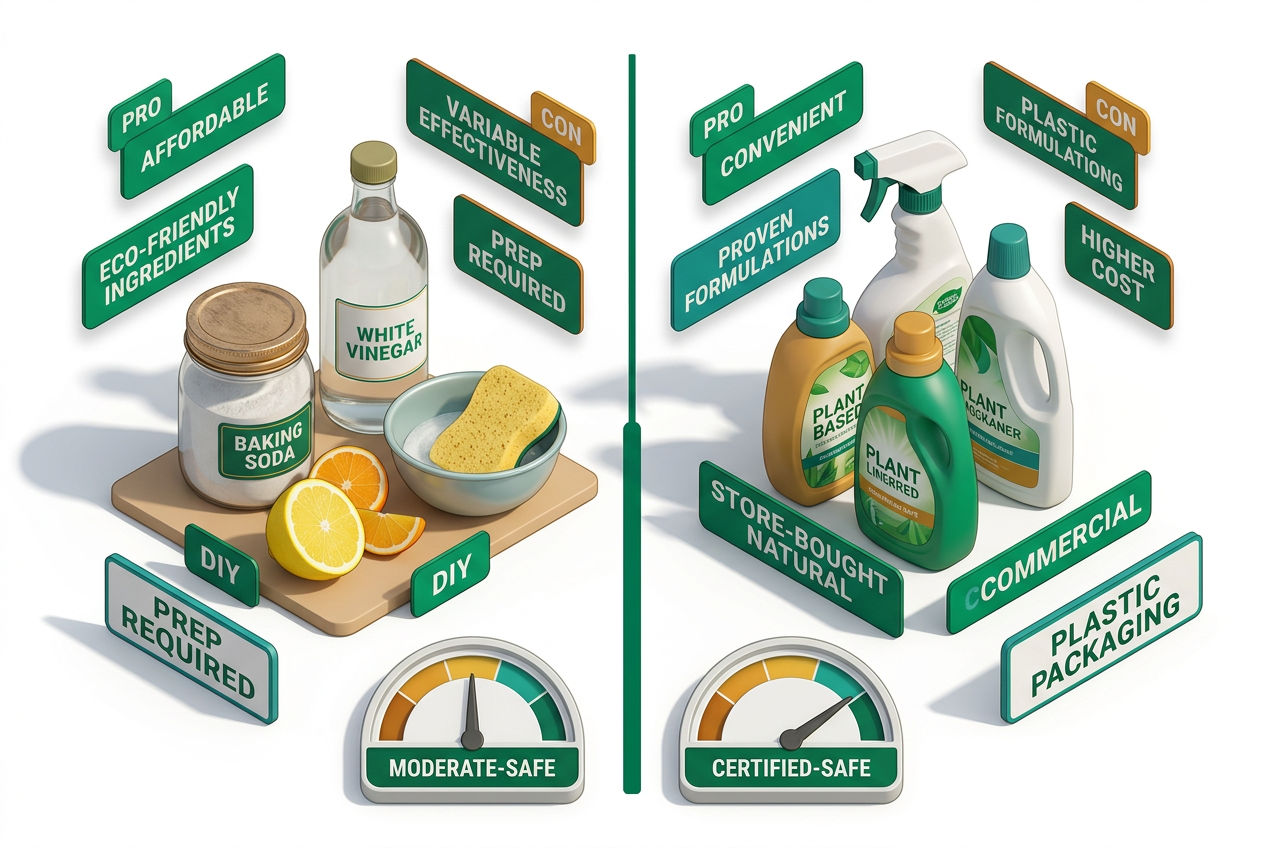
Baking soda (sodium bicarbonate): pH 8.3 — slightly alkaline, but well within the safe range for tank bacteria. Effective mild abrasive and deodorizer. Completely biodegradable. No known negative impact on septic biology at household use levels.
White vinegar (acetic acid, ~5% solution): pH 2.5 — acidic, which raises concern. However, at 5% concentration diluted in normal household water volumes, it's buffered sufficiently before reaching the tank to avoid meaningful pH disruption. The is vinegar safe for septic systems guide has the pH buffering analysis if you want to go deeper. The short version: occasional use is fine; daily undiluted application to drains is unnecessary and inadvisable.
Castile soap (Dr. Bronner's and similar): Made from plant oils (coconut, olive, hemp), with a pH around 9–9.5 in concentrated form. Diluted for cleaning use, it falls within tolerable range. Highly biodegradable. No quats, no synthetic antibacterials. One of the most consistently recommended products by septic professionals for general household cleaning.
What homemade cleaners can't do: Heavy disinfection. If you have a genuine pathogen concern — after illness, for example — plant-based cleaners aren't a substitute for effective disinfection. The practical answer for septic households: use targeted disinfection (a small amount of bleach, properly diluted) when you actually need it, rather than using antibacterial products as your daily default.
Does "EPA Safer Choice" Mean Septic Safe?
The EPA Safer Choice program evaluates every ingredient in a product against safety criteria for human health, aquatic life, and environmental persistence. Products that earn the label have passed ingredient-level scrutiny — not just the finished product tested in bulk.
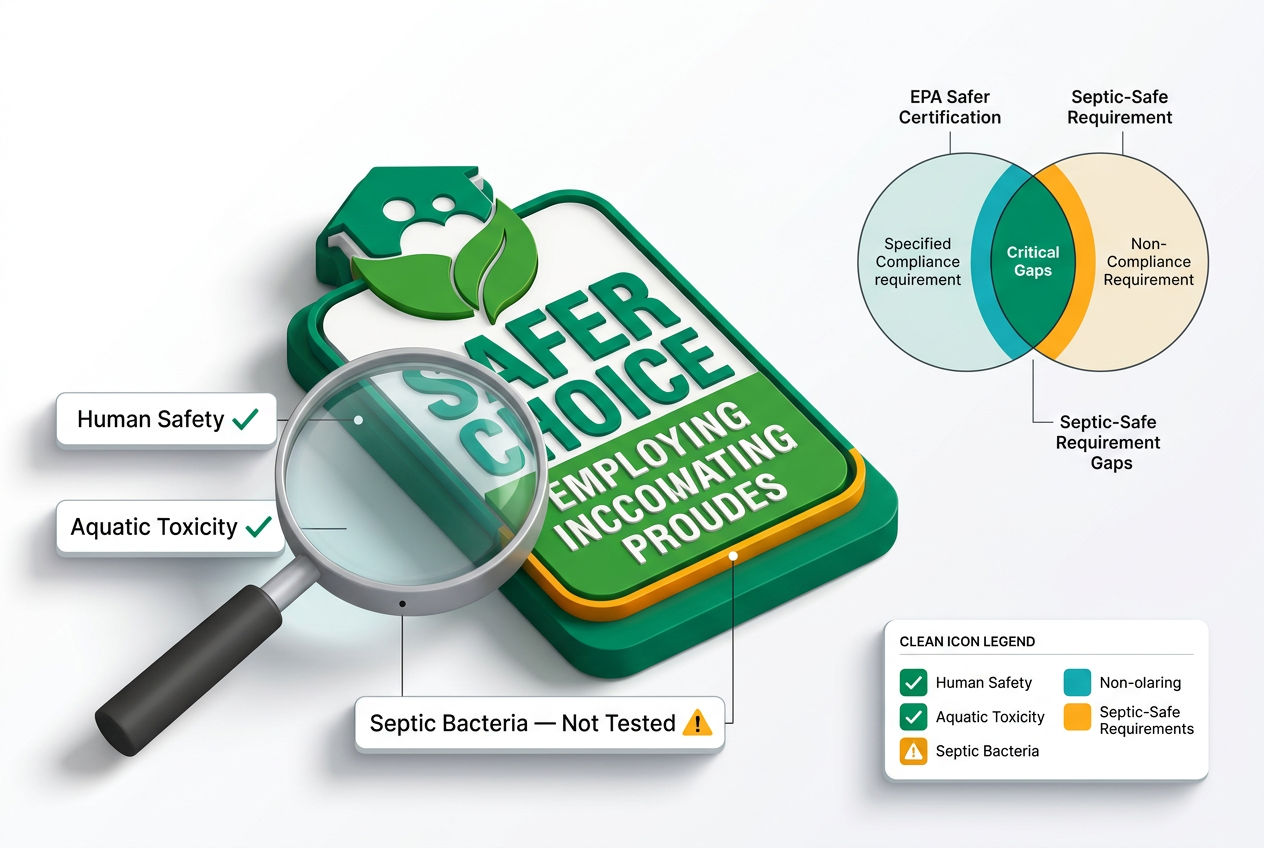
For septic purposes, EPA Safer Choice is the most reliable single label to use as a shopping filter. The program explicitly excludes persistent chemicals, many of the worst offenders for septic biology (quats, certain surfactants, phosphates), and it requires biodegradability data for surfactants.
What it doesn't guarantee: The EPA Safer Choice label wasn't designed specifically for septic compatibility, so it's possible for a Safer Choice product to have an ingredient profile that's suboptimal for high-volume septic use — though in practice, Safer Choice products consistently outperform conventional alternatives on every metric relevant to septic health.
Formerly the "Design for the Environment" (DfE) program: If you see DfE on older product packaging, it's the same program under a previous name.
NSF/ANSI 60 certification is a separate standard — it governs chemicals used in drinking water treatment, not household cleaning products. Don't confuse the two when reading product claims.
How Harsh Chemicals Accelerate Your Pump-Out Schedule (And Your Costs)
The financial case for using septic safe cleaning products is straightforward and worth working through explicitly.
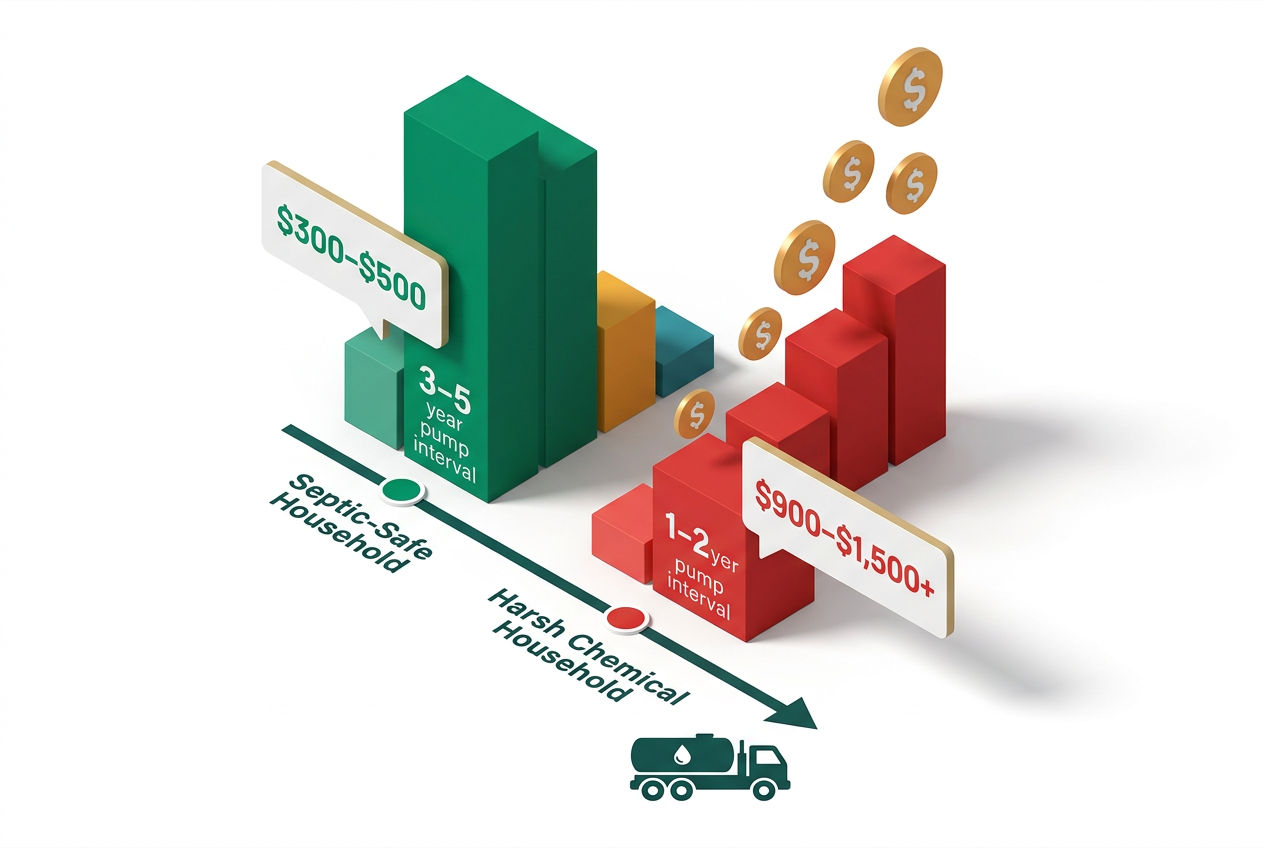
A 1,000-gallon tank serving a 4-person household without garbage disposal use should be pumped every 3–5 years under the EPA's general guidance. At $300–$600 per pump-out, that's $60–$200 per year in maintenance cost at the normal schedule. See current septic tank pump-out costs for regional pricing data.
When bacterial populations are consistently suppressed by harsh cleaning products, solids don't break down adequately. Sludge accumulates at an accelerated rate. Your pump-out interval compresses to every 1–2 years. At $450 average:
- Normal schedule (4 years): $450 every 4 years = ~$112/year
- Compressed schedule (2 years): $450 every 2 years = ~$225/year
- 10-year difference: ~$1,130–$1,500 in additional pump-out costs
That's before accounting for the downstream consequences: biomat formation in the drain field, which can run $2,000–$10,000 to address depending on severity. Signs your drain field is failing don't always appear until damage is advanced — another reason preventive product choices pay off. If you're already seeing symptoms, the septic system repair guide covers remediation options and cost ranges.
The fix is simple: swap your high-risk products for septic-compatible alternatives. In most cases, the price difference is negligible — and the Safer Choice options frequently outperform conventional products on cleaning efficacy per unit of active ingredient anyway.
What's the High-Risk Window for Septic System Damage From Cleaning?
If you have a septic system, spring cleaning is your highest-risk period. Homeowners run through more cleaning products in March through May than any other stretch of the year — bathrooms get scrubbed, floors get deep-cleaned, laundry backlogs get cleared. That concentrated chemical load hits your tank at exactly the wrong moment.
In northern states (Minnesota, Wisconsin, Maine, Vermont), your system is already running with reduced bacterial activity in late winter. Cold ground temperatures slow microbial metabolism — your tank's bacterial colony is operating below its normal processing capacity through February and March. When spring cleaning impulse peaks in March and April, you're hitting a biologically depleted system with your highest chemical load of the year.
The fix is behavioral, not just product-based. Spread your spring cleaning across several weeks rather than one intensive weekend. Run enzyme-based additives (see the section below) in early spring to support bacterial recovery. Choose septic safe cleaning products for every category during the high-use period.
A Note on Septic Tank Additives vs. Cleaning Products
You may encounter marketing for biological additives — products that claim to "replenish" or "supercharge" your tank's bacteria. These are separate from cleaning products but related enough to address here.
Do septic additives work? The evidence is mixed. Do septic additives work? goes through the peer-reviewed literature in detail. The short version: biological additives (live bacteria, enzyme cultures) have some support for use after a system has been stressed — after heavy antibiotic use, after a bleach incident, or after the bacterial population has been disrupted. They're not a substitute for using septic safe cleaning products in the first place, and most healthy systems with competent product choices don't need them.
Chemical additives (acid-based or solvent-based products) have essentially no evidence base and several documented cases of harm. Avoid them entirely.
If you operate an aerobic septic system, the bacterial dynamics differ significantly from a conventional anaerobic tank — aerobic systems introduce oxygen to support a different class of microbes, and some product considerations change accordingly.
Protecting Your Septic System: Best Practices Summary
The short list that covers 90% of the risk:
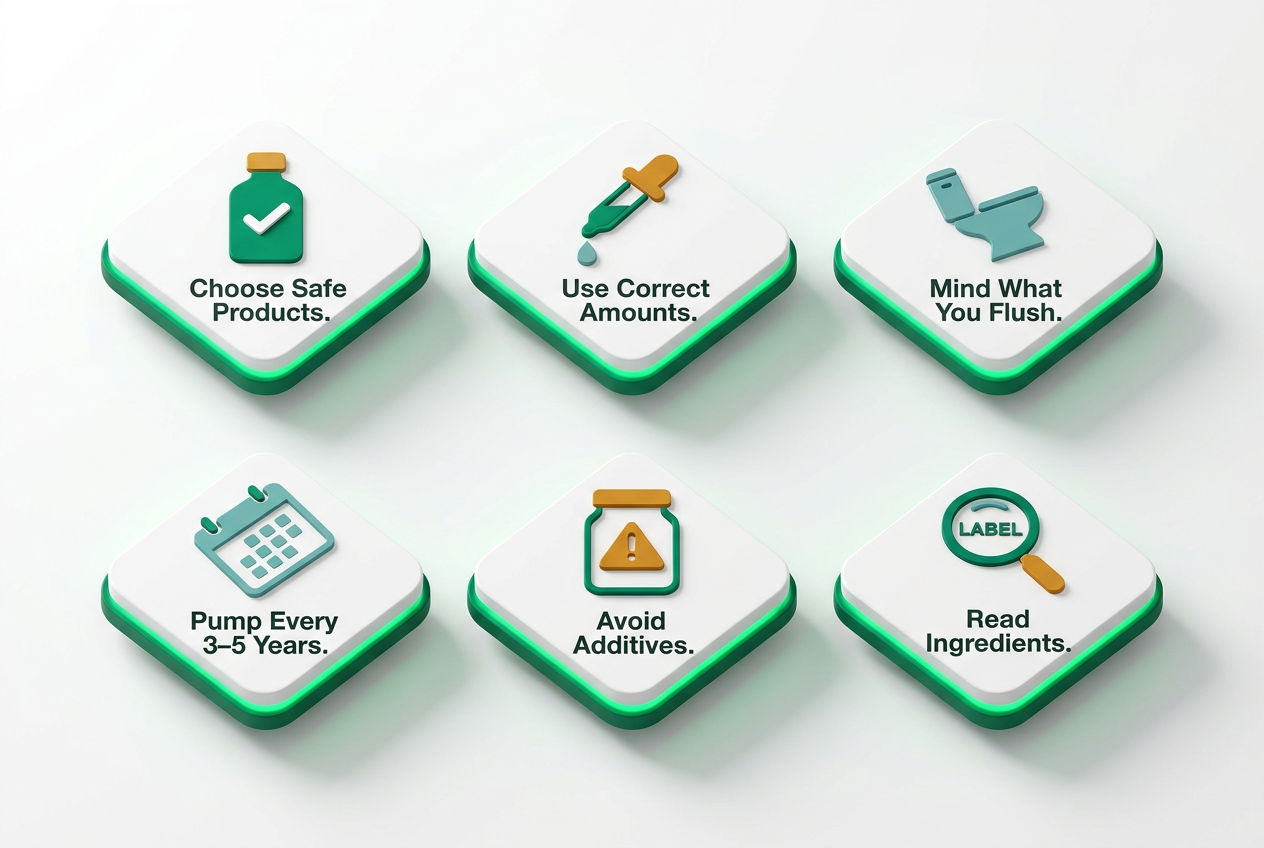
- Use EPA Safer Choice certified products wherever possible — laundry, dish, bathroom, all-purpose
- Never use antibacterial soaps, wipes, or disinfectants as your everyday cleaning default
- Treat bleach like a power tool — use it targeted and occasionally, not as your default cleaning agent
- Never pour lye-based drain openers (Drano, Liquid-Plumr) into a drain connected to your septic system
- Stagger laundry loads across the week — don't flood the tank in a single day
- Spread spring cleaning across several weeks to avoid concentrated chemical surges
- Read ingredient labels — the red-flag list above is your shopping filter
For the complete maintenance framework — pump-out schedules, inspection timelines, what to do when something goes wrong — the full septic tank maintenance guide is the comprehensive resource. How often to pump a septic tank specifically addresses the scheduling question that most homeowners get wrong.
Ready to schedule a pump-out or have your system inspected? Find a septic service professional near you — regular professional maintenance catches problems before they become expensive repairs.
Sources & Methodology
-
U.S. Environmental Protection Agency (EPA) — Septic system statistics (1 in 5 households), pump-out frequency guidance, and Safer Choice program criteria. epa.gov/septic
-
University of Minnesota Extension — Guidance on bleach concentration thresholds tolerable for septic systems; behavioral recommendations for laundry load distribution. extension.umn.edu
-
University of Arkansas Cooperative Extension — Research on the impact of antibacterial compounds (including triclosan and quaternary ammonium compounds) on septic tank bacterial populations; borax concentration analysis. uaex.uada.edu
-
U.S. Food and Drug Administration (FDA) — 2016 ruling banning triclosan and 18 other antimicrobial ingredients from consumer hand soaps. fda.gov
-
National Sanitation Foundation (NSF) — NSF/ANSI 60 certification scope and limitations relative to household cleaning product claims. nsf.org
Product recommendations reflect publicly available formulation data and should be verified against current product labels, as formulations change. A licensed septic system professional reviewed this article for technical accuracy prior to publication.
Related Guides in This Series
- The Best Septic-Safe Drain Cleaners (and What to Never Pour In)
- The Best Septic-Safe Laundry Detergents
- The Best Septic Safe Toilet Bowl Cleaner (Top Picks)
- The Best Septic Safe Dishwasher Detergent (Top Picks)
- Is Vinegar Safe for Septic Systems?
- Is Bleach Safe for Septic Systems?
- Is Borax Safe for Septic Tanks?
- Are Flushable Wipes Septic Safe?
- Is Oxiclean Septic Safe?
- Is CLR Septic Safe?
- Is Hydrogen Peroxide Safe for Septic Systems?
- The Best Septic Safe Garbage Disposal (Top Picks)
Frequently Asked Questions
Are septic safe cleaning products as effective as conventional cleaners?
Yes — septic safe cleaning products perform comparably to conventional alternatives for everyday household cleaning tasks. The misconception that "natural" or plant-based formulas clean less effectively comes from early-generation products that prioritized safety over performance. Modern EPA Safer Choice certified products from brands like Seventh Generation, Ecos, and Method use enzyme-based surfactants and plant-derived active ingredients that lift grease, remove stains, and clean surfaces as well as their conventional counterparts in controlled consumer testing. The one area where septic safe products genuinely differ is heavy disinfection — killing 99.9% of pathogens typically requires the antimicrobial compounds (quats, triclosan, high-concentration bleach) that harm your tank biology. For routine cleaning, this isn't a meaningful limitation. Reserve targeted disinfection for genuine pathogen concerns, use it sparingly, and rely on septic safe cleaning products for your daily routine. The bacteria in your tank will thank you.
What makes a cleaning product safe for septic systems?
A cleaning product is safe for a septic system when its ingredients biodegrade readily, don't kill beneficial bacteria, and don't disrupt the tank's pH balance. Specifically, safe products have a pH between 6 and 8, contain no triclosan, no quaternary ammonium compounds (quats), no high-concentration sodium hypochlorite (bleach), and no phosphates. They use surfactants that break down quickly in the anaerobic environment of a septic tank — plant-derived surfactants (coconut- or corn-based), sodium lauryl sulfate, and enzyme-based formulations are all good indicators. The EPA Safer Choice label is the most reliable shortcut: it evaluates every ingredient in a product against safety and biodegradability criteria, not just the finished product in bulk. If a product carries that label, it's been through ingredient-level scrutiny that filters out most of the compounds harmful to septic biology. Look for the label on laundry, dish, bathroom, and all-purpose cleaners.
How often should I use bleach if I have a septic system?
Use bleach sparingly and never as a default cleaning product. The University of Minnesota Extension guidance — widely cited by septic professionals — holds that a healthy septic tank can tolerate approximately ¼ cup of liquid bleach per laundry load used occasionally, because it's diluted sufficiently by the tank's water volume before it reaches the bacterial colony. What that means in practice: one bleach laundry load per week is likely tolerable for most systems; multiple bleach loads daily, combined with bleach-heavy toilet bowl cleaners and bathroom sprays, is not. The compounding effect across product categories is the real risk. A single product's bleach load may be tolerable in isolation — but if your laundry detergent, toilet bowl cleaner, bathroom spray, and drain flush all contain sodium hypochlorite, the cumulative concentration reaching your tank can cause meaningful bacterial die-off. Choose one category where bleach is non-negotiable, minimize it everywhere else, and use septic safe cleaning products as your daily baseline.
Is antibacterial soap bad for septic systems?
Yes — antibacterial soap is one of the most consistently problematic product categories for septic systems. The active ingredients in antibacterial soaps — triclosan (now FDA-banned from consumer hand soaps but still present in some products), benzalkonium chloride, and other quaternary ammonium compounds — are specifically designed to kill microorganisms. A septic tank's function depends entirely on a healthy population of anaerobic bacteria. Regular use of antibacterial soaps, dish soaps, and cleaning sprays introduces a steady stream of antimicrobial compounds into the tank, suppressing bacterial populations over time. A tank with depleted bacteria can't process solids adequately — sludge accumulates faster, pump-out intervals compress, and the risk of biomat formation in the drain field increases. Switch to plain soap (not antibacterial-labeled) for handwashing, choose Dawn Original rather than Dawn Antibacterial for dishes, and avoid disinfecting wipes entirely — the quat concentration in wipes is particularly high relative to their volume.
What are the best septic safe cleaning products for a whole-house switch?
For a complete whole-house product swap, these are the highest-impact categories and top picks in each. For laundry: Seventh Generation Free & Clear or Ecos Laundry Detergent — both EPA Safer Choice certified, phosphate-free, and widely available. For dish soap: Dawn Original (Blue) or Seventh Generation Dish Liquid. For toilet bowl cleaning: Seventh Generation Toilet Bowl Cleaner or Method Antibac (which uses lactic acid rather than bleach). For bathroom surfaces: Bon Ami Powder Cleanser for scrubbing, Branch Basics All-Purpose Spray for daily wiping. For drain maintenance: Bio-Clean Drain Septic Bacteria for clogs; baking soda and white vinegar for routine maintenance flushes. For all-purpose: Method or Puracy. Switching all five categories simultaneously eliminates the compounding chemical load that does the most long-term damage. The total monthly cost difference between conventional and septic safe products is typically under $10–$15 for most households — modest insurance against pump-out acceleration and drain field damage.
Can I use vinegar and baking soda to clean if I have a septic system?
Yes — vinegar and baking soda are among the most consistently recommended cleaning agents for septic households. Baking soda (sodium bicarbonate, pH 8.3) is a mild alkaline abrasive that deodorizes and cleans without any known negative impact on septic bacteria at household use levels. White vinegar (5% acetic acid, pH 2.5) sounds concerning given its acidity, but at normal household concentrations and volumes, it's diluted and buffered before reaching the tank in quantities that would disrupt bacterial pH. The combination — pour ½ cup baking soda into a drain, follow with 1 cup white vinegar, wait 30 minutes, flush with hot water — is an effective maintenance flush for minor buildup and drain odor. Septic professionals commonly recommend this as a monthly maintenance step. The caveat: vinegar and baking soda are not disinfectants. Don't rely on them for pathogen control. For general cleaning, deodorizing, and light drain maintenance, they're safe, inexpensive, and effective choices for any septic system.
Is oxygen bleach safe for septic systems?
Yes, oxygen bleach (sodium percarbonate) is one of the more septic-compatible options for whitening and stain removal. It breaks down in water into hydrogen peroxide and washing soda; the hydrogen peroxide then decomposes to water and oxygen. Crucially, bacteria in your septic tank produce catalase, an enzyme that destroys hydrogen peroxide almost instantly, so there is no persistent biocidal residue the way there is with chlorine bleach. At normal laundry doses, the chemistry and dilution math are both reassuring. Two caveats: first, oxygen bleach is not a disinfectant — if you need to kill pathogens, chlorine bleach or an EPA-registered disinfectant is required. Second, read labels carefully, because some products marketed as "oxygen" or "oxy" cleaners contain quaternary ammonium compounds, which are biocidal and harmful to septic bacteria. Stick to products where sodium percarbonate and sodium carbonate are the only active ingredients.
How does oxygen bleach compare to chlorine bleach for a septic system?
The difference is qualitative, not just a matter of degree. Chlorine bleach releases hypochlorous acid, a persistent biocide that continues killing bacteria for hours to days, doesn't break down cleanly, and produces chlorinated organic byproducts in the process. Bacteria have no enzymatic way to neutralize it. Oxygen bleach releases hydrogen peroxide, which bacteria destroy almost instantly using their own catalase enzymes — it's a normal part of bacterial metabolism. By the time a laundry load's worth of sodium percarbonate reaches a 1,000-gallon tank, the hydrogen peroxide is already diluted to a fraction of a percent and is rapidly consumed. No antimicrobial residue remains. That said, oxygen bleach is not a substitute for chlorine bleach when actual disinfection is the goal — it whitens and removes stains but does not reliably kill pathogens at laundry concentrations.
Was this article helpful?
Frequently Asked Questions
Recommended Resources
📖 Related Articles
- What Is a Septic System? How It Works (Visual Guide)
- The Best Septic-Safe Laundry Detergents
- Laundry and Septic Systems: How to Protect Your System
- The Best Septic Safe Dishwasher Detergent (Top Picks)
- The Best Septic Safe Toilet Bowl Cleaner (Top Picks)
- The Best Septic-Safe Drain Cleaners (and What to Never Pour In)
- Are Flushable Wipes Septic Safe?
- Is Bleach Safe for Septic Systems?
- Can You Use Drano with a Septic System?
- Is Borax Safe for Septic Tanks?
- Is Hydrogen Peroxide Safe for Septic Systems?
- Is Oxiclean Septic Safe?
- Is Vinegar Safe for Septic Systems?
- Signs Your Drain Field Is Failing (And What to Do)
- How to Repair a Septic System: DIY vs Professional
- Do Septic Tank Additives Actually Work? (The Science)
- Aerobic vs Anaerobic Septic Systems: How They Compare
- The Complete Septic Tank Maintenance Guide
- How Often Should You Pump Your Septic Tank?
💰 Cost Guides
🔧 Services
Find Septic Professionals Near You
Compare licensed, verified septic companies by area — top county markets and cities below, or browse all 50 states.
County markets
Popular cities
