
Quick Answer
title: "The Best Septic-Safe Laundry Detergents (And What to Avoid)" meta_description: "Discover the best septic safe laundry detergent brands, ingredients to avoid, and laundry habits that protect your drain field — with product comparisons and expert tips." published: "March 14, 2024" updated: "June 12, 2025"
Septic safe laundry detergent is any formula that skips phosphates, antibacterial agents, and high-suds surfactants — ingredients that kill the anaerobic bacteria your tank depends on to break down waste. The right detergent protects your drain field. The wrong one can cost you thousands in repairs.
Key Takeaways
- About 21 million U.S. households rely on septic systems, making detergent choice a real maintenance issue — not a marketing gimmick.
- Phosphates, sodium lauryl sulfate (SLS), chlorine bleach, and optical brighteners are the four ingredient categories most damaging to septic bacteria.
- The EPA Safer Choice certification is the most reliable third-party signal that a detergent is drain field safe.
- Use 1–2 tablespoons per HE load — overdosing creates biofilm buildup in your leach laterals over time.
- Spread laundry across the week. Five loads in one afternoon can hydraulically overload a standard 1,000-gallon tank.
Why Does Laundry Detergent Actually Matter to Your Septic System?
Your septic tank works because of bacteria — specifically anaerobic bacteria living in a 1,000- to 1,500-gallon concrete or fiberglass tank buried in your yard. Those microbes digest solid waste, convert it to effluent, and allow clarified wastewater to flow out to your drain field without clogging the soil.
Now think about your laundry routine. The average U.S. household runs roughly 300 loads of laundry per year — about 8 loads per week. Each load sends 15–40 gallons of greywater through your system. That's 400–500 gallons of detergent-laden water hitting your tank every single week, according to EPA estimates.
Harsh detergent ingredients can reduce your tank's bacterial population by 50% or more within days of heavy exposure — a finding documented by University of Arkansas Cooperative Extension research on household chemical impacts to onsite wastewater systems. When you combine antibacterial surfactants, chlorine, and synthetic fragrances in a confined biological environment, that microbial colony doesn't gradually decline — it crashes.
Learn more about what kills septic bacteria and why protecting that microbial colony is the single most important thing you can do for your system. If you want to understand the full picture of how your septic system works, it helps to see why even small chemical choices compound over years of use.
What Ingredients in Laundry Detergent Are Bad for Septic Tanks?
The worst offenders fall into six categories. Some kill bacteria directly. Others create physical problems in your drain field — like biofilm clogging in leach laterals or surfactant buildup in the soil matrix.
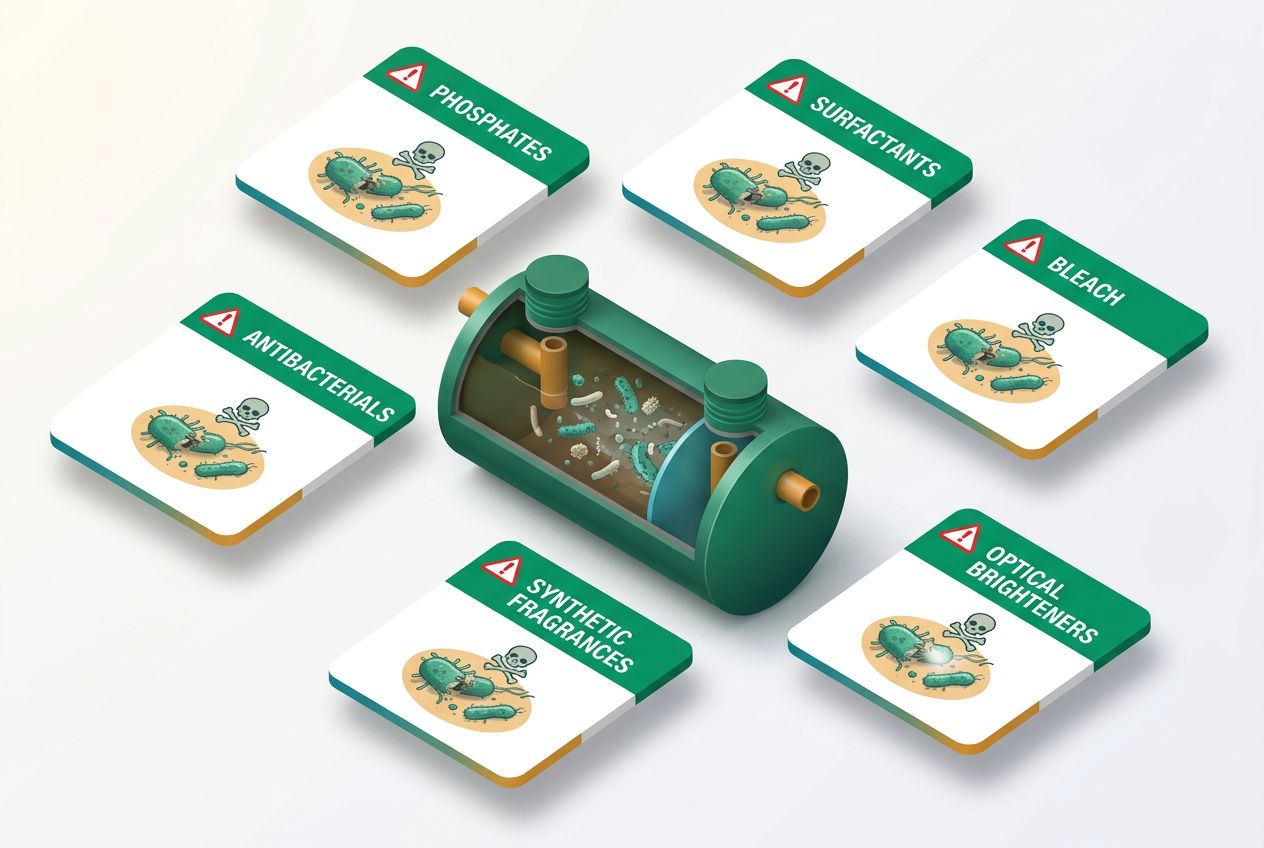
Phosphates — Once common in detergent formulas, phosphates cause algae blooms in waterways and disrupt septic chemistry. Most U.S. detergents removed them after state-level bans, but some budget imports still contain them. Always check.
Sodium Lauryl Sulfate (SLS) and Sodium Laureth Sulfate (SLES) — These high-foaming surfactants are tough on septic bacteria and produce excess suds that interfere with the settling process in your tank's baffle chambers. Look for sulfate-free detergent formulas when shopping for a laundry detergent safe for septic tanks.
Chlorine bleach — The fastest way to crash your tank's bacterial colony. Even a single heavy-bleach wash can set your system back. If you need whitening, opt for oxygen-based alternatives. We cover this in more detail in our guide on whether bleach is safe for septic systems.
Antibacterial agents (triclosan, benzalkonium chloride) — Marketed as a selling point on your detergent label, these are the enemy of your tank. They don't distinguish between harmful pathogens and the beneficial bacteria breaking down your waste. Under EPA's Design for the Environment guidelines, triclosan is flagged as incompatible with biological wastewater treatment systems.
Nonylphenol ethoxylates (NPEs) — A class of surfactant found in older "budget" formulas. They're slow to biodegrade and can persist in drain field soil, eventually disrupting effluent treatment. The EPA has flagged NPEs as endocrine disruptors.
Optical brighteners — These UV-reactive compounds don't rinse out completely. They accumulate in drain field soil and resist biodegradation. Not the most immediately damaging ingredient, but a long-term problem for drain field health.
1,4-Dioxane — A trace contaminant formed during manufacturing of certain ethoxylated surfactants. Not intentionally added, but worth knowing about. It doesn't biodegrade easily.
Synthetic fragrances — Not always harmful in small amounts, but many fragrance compounds are non-biodegradable and can stress the microbial ecosystem in your tank over time.
A note on why surfactant type matters: linear alkylbenzene sulfonates (LAS) — the surfactants found in many safer detergents — degrade within 1–3 weeks in a healthy system. Older branched-chain surfactants resist breakdown almost entirely. This is why "biodegradable laundry detergent" matters as a label — but only when the surfactant type actually qualifies.
The Best Septic Safe Laundry Detergents Available Right Now
Here are eight products that septic professionals and homeowners with well-maintained systems actually use. None of these contain the problem ingredients above.
1. ECOS Laundry Detergent (Free & Clear) ECOS earns an EPA Safer Choice certification and uses plant-derived surfactants. It's phosphate-free, SLS-free, and fragrance-free. A 200-load bottle runs about $16–$18, putting you at roughly $0.08–$0.09 per load — one of the best values in this category. Works in cold water, which is a plus for households in the rural Northeast where cold-water washing is common year-round.
2. Seventh Generation Free & Clear Another EPA Safer Choice product with a strong biodegradable formula. The 66-load bottle sells for around $12–$14 ($0.18–$0.21/load). Seventh Generation publishes full ingredient transparency, so you're never guessing what's in the formula. Widely available at mainstream retailers.
3. Charlie's Soap Laundry Powder A cult favorite among rural homesteaders and septic-system households. It's hyper-concentrated — you use just 1 tablespoon per load, and a 128-load bag costs about $25 ($0.20/load). No fragrances, no optical brighteners, no synthetic surfactants. The powder format is lower-sudsing than most liquids, which is a genuine benefit for septic systems. Unlike many powders, Charlie's Soap dissolves reliably below 60°F — important for cold-water washing common in the rural Northeast.
4. Arm & Hammer Sensitive Skin Free & Clear Not a "natural" brand, but this formula passes the key tests: no phosphates, no dyes, no fragrances, low-suds. It's one of the most affordable options at around $0.12–$0.15 per load for a 100-load bottle. Widely available. A practical choice for households where budget is a real factor.
5. ALL Free Clear Dermatologist-recommended and septic-compatible. Free of dyes and fragrances, certified by the National Psoriasis Foundation (which signals minimal chemical additives). Around $0.13–$0.16 per load. HE-compatible and low-sudsing.
6. Biokleen Free & Clear A plant-based, phosphate-free formula with no synthetic fragrances or optical brighteners. The USDA BioPreferred certification makes it a reliable choice. A 64-load bottle runs about $14–$16 ($0.22–$0.25/load). Biokleen also avoids 1,4-dioxane, which many brands don't explicitly address.
7. Seventh Generation Ultra Power Plus (for HE machines) Specifically formulated for high-efficiency machines with a low-suds profile. Strong stain performance without harsh chemistry. Around $0.20–$0.25/load. A solid HE septic safe detergent for families running HE machines who want serious cleaning power without compromising the tank.
8. Mrs. Meyer's Clean Day Laundry Detergent Contains plant-derived surfactants and no phosphates or SLS. It does contain fragrance (essential oil-based), so it's not fully fragrance-free — but it avoids the synthetic fragrance compounds that create the most problems. Around $0.22–$0.28/load. Popular in the Pacific Northwest where eco-certifications matter to buyers.
Septic-Safe Laundry Detergent Comparison
| Product | Price/Load | EPA Safer Choice | HE Compatible | Fragrance-Free |
|---|---|---|---|---|
| ECOS Free & Clear | ~$0.09 | Yes | Yes | Yes |
| Seventh Generation F&C | ~$0.19 | Yes | Yes | Yes |
| Charlie's Soap Powder | ~$0.20 | No | Yes | Yes |
| Arm & Hammer Sensitive | ~$0.13 | No | Yes | Yes |
| ALL Free Clear | ~$0.14 | No | Yes | Yes |
| Biokleen Free & Clear | ~$0.23 | No | Yes | Yes |
| Mrs. Meyer's Clean Day | ~$0.25 | No | Yes | No |
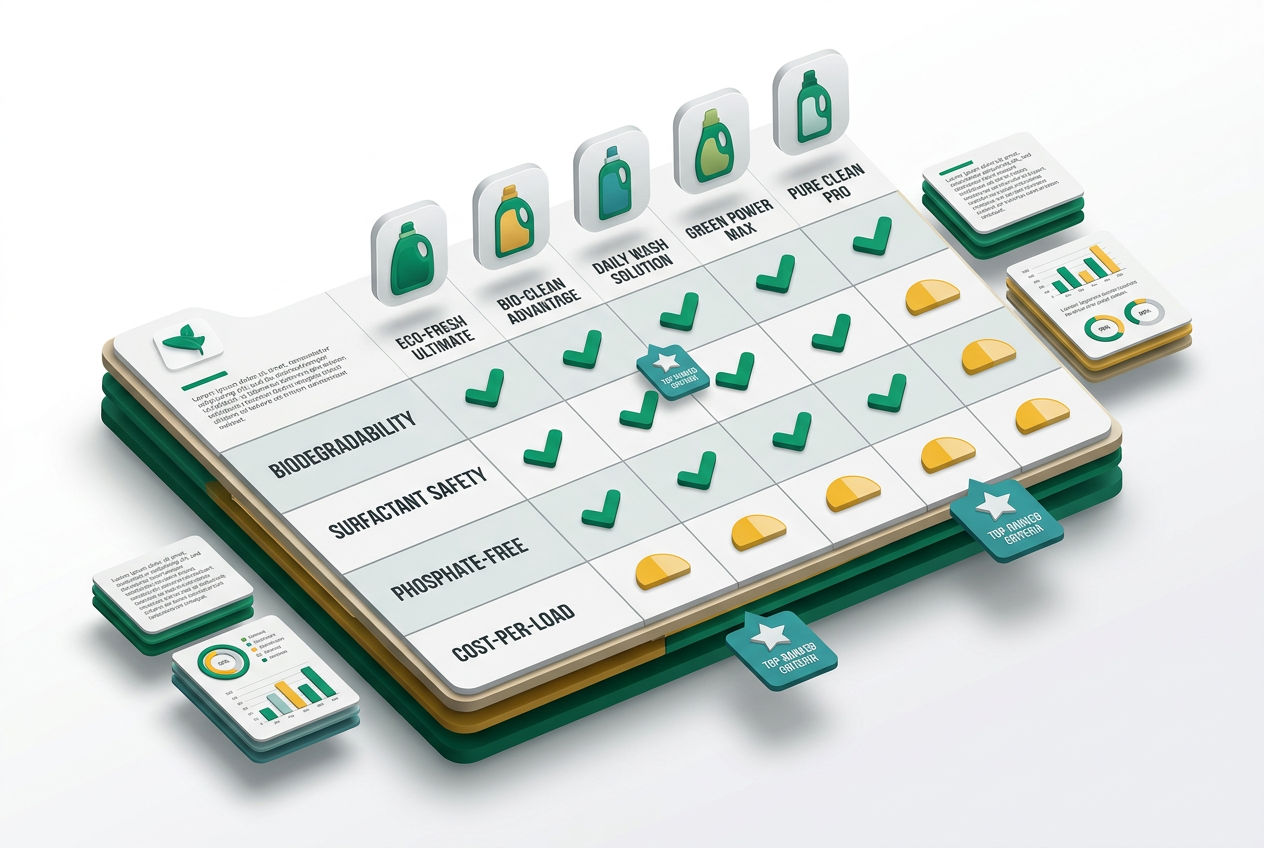
Prices based on standard retail packaging as of mid-2025. Per-load costs vary by retailer and package size.
Is Liquid or Powder Detergent Better for Septic Systems?
Powder detergent has a slight edge for septic systems, but the ingredient list matters more than the format. Here's the breakdown.
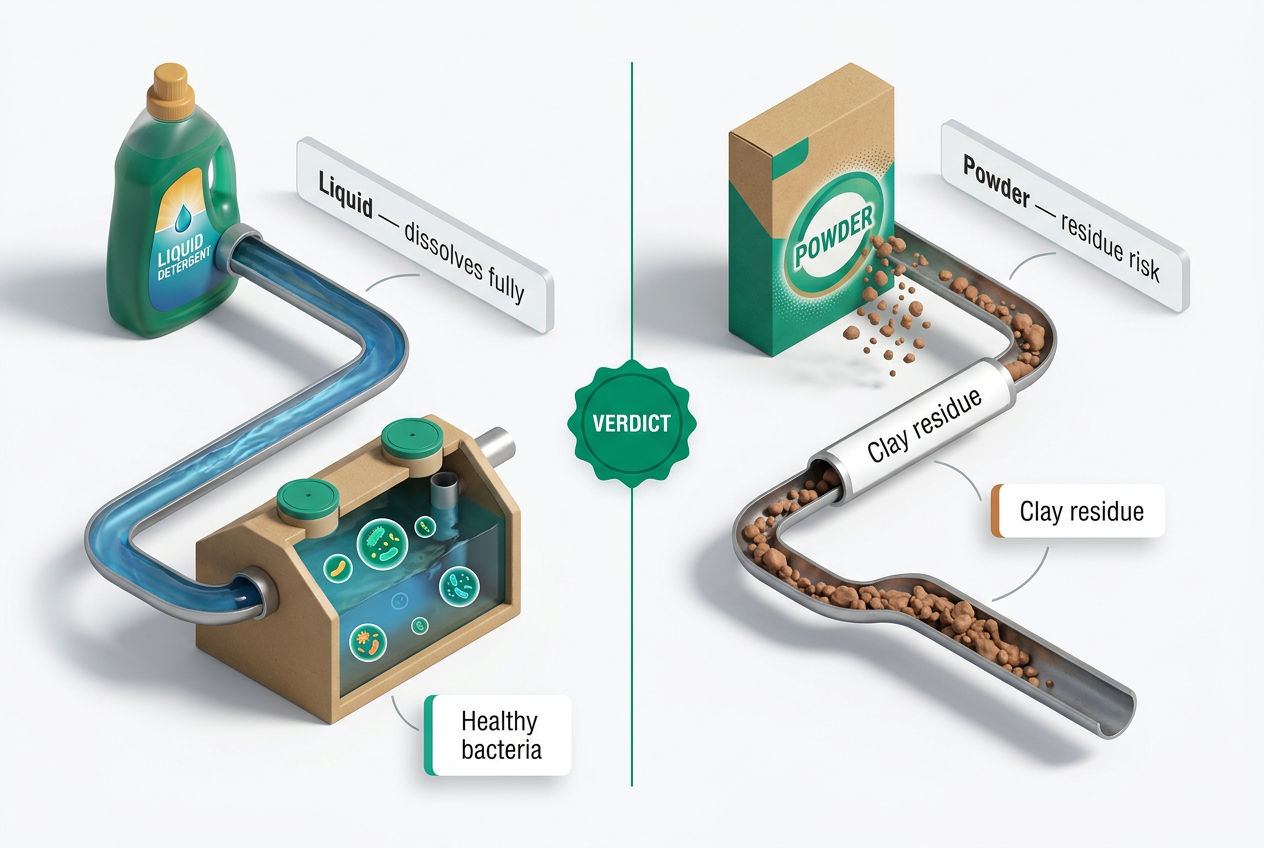
Powder detergents tend to be lower-sudsing than liquids, and they typically don't contain the same concentration of surfactants. They also tend to be phosphate-free because phosphate powder clumped badly in older washing machine formats — so manufacturers dropped it early.
The downside? Some powder formulas don't dissolve completely in cold water, leaving undissolved particles that can accumulate in your system's inlet baffle or tank bottom. If you use powder, run warm or hot wash cycles periodically to clear any residue.
Liquid detergents dissolve completely and are more convenient, but they often contain higher concentrations of surfactants and preservatives. Concentrated "3x" formulas can be misleading — they encourage users to overdose because the measuring lines are hard to read at small volumes.
Pods and unit-dose packs are the trickiest category. Many contain polyvinyl alcohol (PVA) film — a synthetic polymer that dissolves in water but biodegrades slowly. Research published in the International Journal of Environmental Science and Technology (2021) found measurable PVA concentrations in wastewater treatment effluent, suggesting incomplete breakdown. In a septic context, this slow degradation represents a low-level but persistent chemical load on your tank's bacterial colony.
Bottom line: for a septic-safe laundry routine, a powder or liquid from the recommended list above beats any pod or packet — regardless of brand claims.
How Much Laundry Detergent Should You Use With a Septic System?
Use less than you think — usually about half of what the label recommends.
Here's a worked example. A 4-person household running 8 loads per week uses roughly 416 loads per year. At the label-recommended dose of 2.5 oz per load (a common liquid measuring line for standard machines), that's 1,040 oz of detergent per year flowing through your system. Drop to 1.25 oz — half the label dose, still effective in an HE machine — and you're at 520 oz annually. That's a 50% reduction in surfactant and preservative load on your bacterial colony without changing a single product.
For HE machines specifically: 1 tablespoon (0.5 oz) per load is sufficient for a normal load. Top-loaders can use up to 2 tablespoons. If your machine produces visible suds at the door seal, you're overdosing.
Overdosing doesn't just stress your tank. Excess suds interfere with the settling process in your tank's baffle chambers, allowing solids to travel toward the outlet baffle and, eventually, into your drain field. See our guide on how many loads of laundry are safe for a septic system for the full hydraulic load picture.
Do Certifications and Labels Actually Mean Something for Septic Systems?
Free download
Free: the Septic Fridge Card — what to flush, what never to.
The Do / Don’t card the whole family can see, plus the Survival Kit: emergency flowchart, warning-sign decoder and pump-schedule card. One printable PDF.
Not all certifications are equal — but a few carry real weight.
EPA Safer Choice — The gold standard for septic-safe cleaning products. To earn this label, every ingredient in a formula must meet EPA safety criteria for human health and environmental impact. This includes biodegradability requirements that directly protect drain field soil. Check the full database at saferchoice.epa.gov before purchasing any product you're unsure about.
USDA BioPreferred — Certifies that a product contains a minimum percentage of bio-based ingredients. It does not evaluate every chemical in the formula, so it's a weaker signal than EPA Safer Choice — but still meaningful as a secondary indicator.
EWG Verified — Environmental Working Group's mark means a product scores well on their ingredient hazard database. It overlaps significantly with EPA Safer Choice criteria and is another reliable third-party signal.
"Natural" or "Green" — Unregulated marketing terms. A product can claim to be "natural" while containing NPEs, synthetic fragrances, and optical brighteners. These words alone mean nothing without a certification behind them.
Dermatologist-tested / Hypoallergenic — These claims relate to skin irritation, not environmental or septic impact. A hypoallergenic detergent can still contain ingredients harmful to your tank's bacteria.
For septic households, EPA Safer Choice should be your first filter. If a product you prefer doesn't carry that mark, cross-reference its ingredient list against the six harmful categories above before using it.
What Laundry Habits Keep a Septic System Healthy Beyond Detergent Choice?
Switching detergents is the first step. These habits compound the benefit — and some matter as much as what's in your bottle.
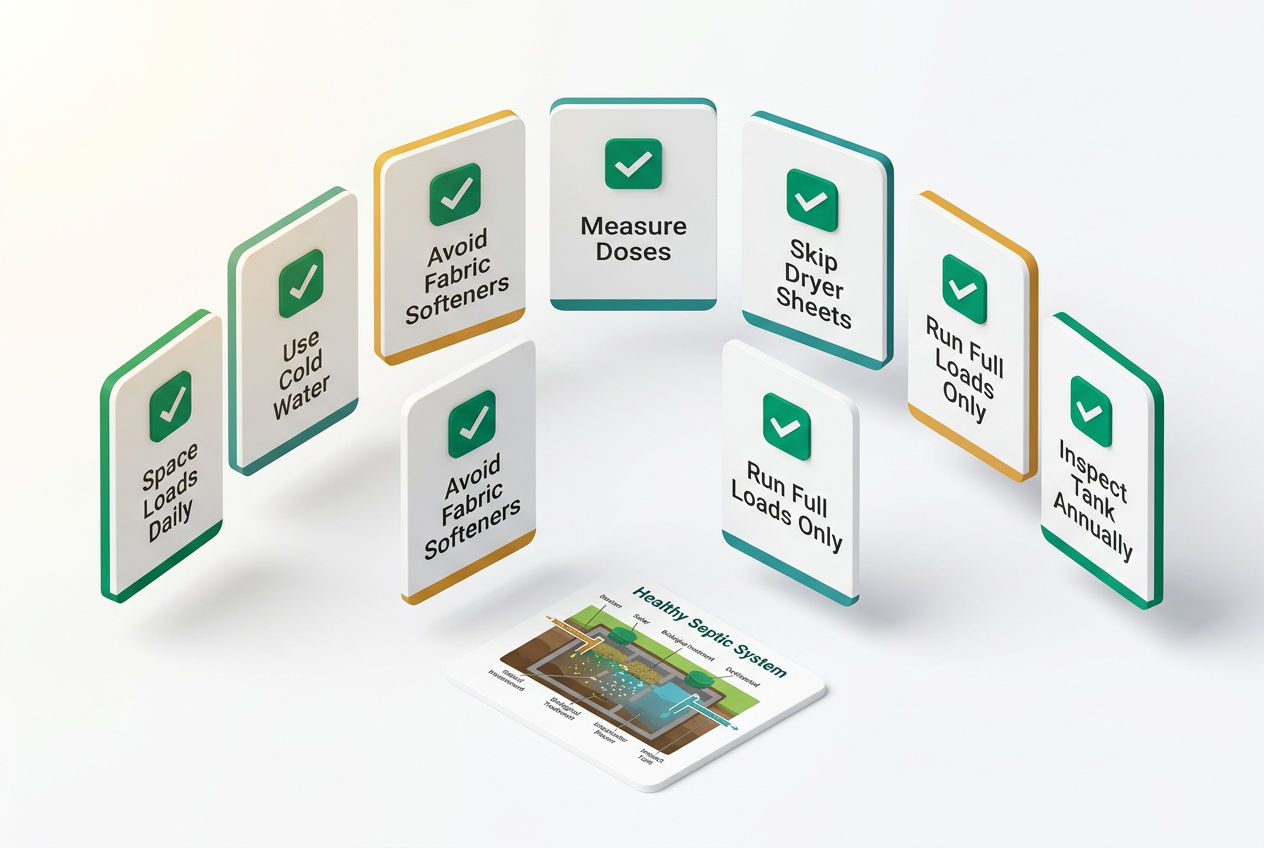
Spread loads across the week. A standard 1,000-gallon tank processes wastewater continuously, but it has limits. Running five loads on a Saturday afternoon can hydraulically overload your system — pushing partially treated effluent into your drain field before bacteria have finished their work. For a 4-person household, a practical rule is no more than 2 loads per day, spread across 6 days per week.
Skip fabric softener entirely. Liquid fabric softeners contain quaternary ammonium compounds (quats) — the same class of chemicals used in hospital disinfectants. They are genuinely bactericidal inside your tank. Replace them with wool dryer balls (~$15 for a six-pack), which soften fabric mechanically without any chemical load.
Maintain your effluent filter. If your tank has an effluent filter installed at the outlet baffle — a unit like the Polylok PL-122 is common in installations from the late 1990s onward — pull and rinse it annually. A clogged effluent filter backs up solids into your system regardless of how carefully you manage your detergent choice.
Avoid drain-cleaning products after laundry backups. It's tempting to reach for chemical drain cleaners when a slow drain follows a heavy laundry day. Most contain sodium hydroxide or sulfuric acid — both devastating to septic bacteria. Call a professional instead. You can find vetted local professionals through our septic inspection service page.
Consider an annual system check. A septic pumping and inspection every 3–5 years catches sludge accumulation before it reaches your drain field. Changing to a safer detergent helps, but it doesn't reverse damage already done by years of harsh chemistry.
For a complete maintenance routine, the septic tank maintenance guide covers pump schedules, inspection checklists, and what to expect from a professional service visit. You'll also find a broader list of septic-safe cleaning products — covering dish soap, bathroom cleaners, and disinfectants — if you want to extend the same thinking beyond laundry.
Does Your Location Change Which Laundry Detergent You Should Use?
Geography affects how aggressively you need to protect your system — soil type, water table depth, and local regulations all play a role.
Georgia red clay soils drain slowly. Effluent sits longer in the leach laterals, which means surfactant and chemical buildup concentrates more than it would in faster-draining soils. Households on red clay benefit disproportionately from low-surfactant, biodegradable formulas — and from the strictest dose discipline.
Coastal Florida sandy soils drain quickly — sometimes too quickly for effective treatment. Wastewater moves through the soil matrix so fast that biological treatment is incomplete. This means surfactant residues can reach groundwater faster than in denser soils. The Florida Department of Health has flagged this in guidance on onsite system performance in high-water-table coastal counties.
Pacific Northwest — Washington and Oregon have some of the strictest environmental regulations around household chemical use in the country. Several Washington counties have issued informal recommendations (not yet codified as law) that households with onsite systems use only EPA Safer Choice certified products for all laundry and household cleaning.
Rural New England — Cold groundwater temperatures year-round slow bacterial activity in septic tanks. A system that runs efficiently in Georgia may underperform in Vermont in January simply because the biology slows down. In colder climates, using powder detergent that dissolves only in warm water — and then cold-washing — can leave undissolved residue that accumulates faster than it breaks down.
If you're unsure how your local soil type or water table affects your system, a septic inspection can include a site evaluation that answers those questions directly.
Frequently Asked Questions
Is there a laundry detergent safe for septic tanks that also works in hard water?
Hard water compatibility is a real practical concern, and several septic-safe detergents handle it well. ECOS Free & Clear includes citric acid — a natural water softener — in its formula, which helps it perform in high-mineral water without requiring a separate softening agent. Charlie's Soap Laundry Powder also performs well in hard water because its formula relies on sodium carbonate, which neutralizes calcium and magnesium ions that reduce surfactant effectiveness.
What you want to avoid is adding conventional water softener salts or pods to compensate for hard water. Many softening agents contain sodium compounds that, in large volumes, can shift the chemistry inside your tank and stress bacterial populations.
If your water hardness exceeds 200 mg/L (moderately hard), consider pairing ECOS or Charlie's Soap with a reusable magnetic water conditioner on your supply line — these create no chemical byproduct and won't affect your tank. A standard hard-water test kit, available at most hardware stores for under $10, will tell you where your supply falls. For households with very hard water (above 300 mg/L), reducing detergent dose slightly and using warm water helps prevent mineral-surfactant deposits from accumulating in your inlet baffle.
What is the best HE septic safe detergent for a large family running many loads per week?
For large households running 10 or more loads per week, volume and concentration both matter. The best HE septic safe detergent in this situation is ECOS Free & Clear — at roughly $0.08–$0.09 per load for a 200-load bottle, it's the most economical EPA Safer Choice certified option available at mainstream retailers.
For families prioritizing cleaning performance over cost, Seventh Generation Ultra Power Plus (HE formulation) delivers stronger enzyme-based stain removal while remaining low-sudsing and septic-compatible. At $0.20–$0.25 per load, it costs more, but a single bottle handles a high-volume laundry week without compromising your tank.
The critical factor for large households isn't just which detergent you use — it's how many loads you run per day. Even the safest detergent creates a hydraulic load problem when 10 loads run in a single afternoon. Spreading loads across the week (no more than 2 per day) protects your system regardless of formula. See the how many loads of laundry are safe for a septic system guide for the math behind daily load limits at different tank sizes.
Can I use biodegradable laundry detergent in a septic system, or does "biodegradable" not always mean safe?
"Biodegradable" on a detergent label does not automatically mean septic-safe — and this distinction trips up a lot of buyers. The term is loosely regulated. Under FTC Green Guide standards, a product can claim biodegradability if it breaks down "in a reasonably short period of time" — a definition that is not time-specific and is not tied to septic performance.
The meaningful question is what the surfactant type is and how quickly it degrades in an anaerobic environment. Linear alkylbenzene sulfonates (LAS) — found in many safer detergents — biodegrade within 1–3 weeks in a functioning septic system. Older branched-chain surfactants may take months or never fully break down, even if a label claims biodegradability.
Polyvinyl alcohol (PVA) film used in laundry pods is technically biodegradable under aerobic conditions, but research published in the International Journal of Environmental Science and Technology (2021) found measurable PVA in wastewater effluent — suggesting the anaerobic environment inside a septic tank does not break it down efficiently.
The reliable shortcut: look for EPA Safer Choice certification, which requires documented biodegradability evidence for every ingredient, not just the primary surfactant. A claim of "plant-based" or "natural" without that certification is not a substitute.
How does liquid vs. powder detergent affect a septic system differently?
Powder and liquid formats have distinct effects on septic systems, and the differences go beyond convenience. Powder detergents are generally lower-sudsing, which reduces foam interference with your tank's settling chambers. They also tend to contain fewer preservatives than liquids — preservatives like methylisothiazolinone (MIT) are added to liquid formulas to prevent microbial growth in the bottle, but those same compounds reach your tank with every wash.
The tradeoff with powder is cold-water dissolution. Some powder formulas don't fully dissolve below 60°F, and undissolved granules can accumulate at your tank's inlet baffle over time. If you use powder and wash primarily in cold water, run a warm cycle at least once a month to clear residue.
Liquid detergents dissolve completely regardless of water temperature, but concentrated formulas encourage overdosing — the measuring cup lines at small volumes are easy to misread. Overdosing with a liquid creates excess surfactant buildup in leach laterals faster than powder overdosing would. Pods are the most problematic format for septic systems: PVA film degrades slowly in anaerobic conditions, and many pod formulas contain higher concentrations of surfactants per unit than their liquid equivalents. For a functioning septic system, powder or liquid from a vetted brand consistently outperforms pods.
Does the volume of laundry I do weekly affect my septic system as much as what detergent I use?
Both factors matter, and their effects multiply each other — a harsh detergent at high volume is dramatically worse than either problem alone. That said, many homeowners focus exclusively on detergent choice and overlook the hydraulic load side of the equation.
A standard 1,000-gallon septic tank is sized for roughly 300–400 gallons of daily flow for an average household. A modern washing machine uses 15–25 gallons per cycle for HE models, and up to 40 gallons for older top-loaders. Running five full loads in a single afternoon on an older machine pushes 150–200 gallons of greywater into your tank within a few hours — nearly half your tank's daily capacity in one session. That sudden surge can push partially treated effluent through your outlet baffle and into your drain field before biological treatment is complete.
The practical fix: no more than 2 loads per day, regardless of machine type or detergent brand. For a 4-person household averaging 8 loads per week, spreading across 4–5 days with no more than 2 loads on any given day keeps hydraulic flow within manageable limits. Pair that discipline with a septic-safe detergent at the correct dose, and you've addressed both halves of the problem. The septic tank maintenance guide covers how to audit your current habits against your system's actual capacity.
What should I know about switching to septic-safe detergent if my system is already showing problems?
Switching detergents is worthwhile even if your system is symptomatic — but it will not fix existing damage on its own. This is an honest limitation of the advice in this article, and it matters before you make any purchasing decisions.
If your drain field is already showing signs of failure — slow drains, wet spots above the leach field, sewage odors near the tank — the bacterial colony damage and soil clogging that caused those symptoms won't reverse simply because you stop using harsh detergents. A damaged biomat in the soil matrix around your leach laterals requires physical intervention, not just a chemistry change.
What switching detergents does accomplish in a symptomatic system: it stops adding to the damage. It gives whatever bacterial population remains a chance to stabilize rather than continuing to decline. In some cases, particularly where the problem is recent and the drain field hasn't fully clogged, reducing chemical load combined with rest periods (not using the system for 12–24 hours at a stretch) allows partial recovery.
For any system showing active symptoms, a professional septic inspection is the necessary first step. An inspector can assess whether the drain field is recoverable or requires replacement — a determination no detergent switch can substitute for. Detergent choice is a maintenance strategy, not a remediation strategy.
Sources & Methodology
- U.S. EPA Safer Choice Program. Safer Choice Standard and Certified Products Database. saferchoice.epa.gov
- University of Arkansas Cooperative Extension. Household Chemical Impacts on Onsite Wastewater Systems (Publication FSA-6117). Division of Agriculture Research & Extension.
- U.S. EPA. Design for the Environment: Antimicrobial Pesticides — Triclosan. Office of Pollution Prevention and Toxics.
- Rolsky, C., et al. (2021). Degradation of Polyvinyl Alcohol in US Wastewater Treatment Plants and Subsequent Nationwide Emission Estimate. International Journal of Environmental Science and Technology.
- U.S. EPA. Nonylphenol (NP) and Nonylphenol Ethoxylates (NPEs) Action Plan. Office of Pollution Prevention and Toxics.
- Florida Department of Health. Onsite Sewage Treatment and Disposal Systems: Performance in High Water Table Coastal Soils. Bureau of Onsite Sewage Programs.
- FTC. Green Guides: Environmental Marketing Claims. 16 CFR Part 260.
Product prices verified against Amazon, Walmart, and Target retail listings as of June 2025. Per-load costs calculated using standard package sizes. Ingredient assessments cross-referenced against EPA Safer Choice database and manufacturer-published Safety Data Sheets.
Was this article helpful?
Frequently Asked Questions
Recommended Resources
📖 Related Articles
- What Kills Septic Tank Bacteria? (14 Things to Avoid)
- What Is a Septic System? How It Works (Visual Guide)
- Is Bleach Safe for Septic Systems?
- How Many Loads of Laundry Can You Do With a Septic System?
- The Complete Septic Tank Maintenance Guide
- Septic-Safe Cleaning Products: The Complete List (Safe vs. Avoid)
💰 Cost Guides
🔧 Services
Find Septic Professionals Near You
Compare licensed, verified septic companies by area — top county markets and cities below, or browse all 50 states.
County markets
Popular cities
