
Quick Answer
A septic safe drain cleaner relies on enzymes or live bacteria to dissolve clogs rather than using harsh chemicals that kill the microbial colonies your tank depends on. Enzyme and bacterial formulas work more slowly than chemical alternatives — typically 6–8 hours versus 15–30 minutes — but they leave your septic system intact and functioning.
Key Takeaways
- Enzyme and bacterial drain cleaners are the only reliably safe options for septic systems
- Traditional chemical drain cleaners (Drano, sulfuric acid openers) can disrupt your tank's bacterial balance for weeks to months
- Replacing a failed septic system costs $10,000–$25,000+ — the right drain cleaner is cheap insurance
- The EPA recommends pumping every 3–5 years; damaging your bacterial colonies accelerates that timeline
- Baking soda and vinegar is safe but only effective for minor, grease-based slowdowns — not hard clogs
Over 21 million U.S. households rely on a septic system, according to the EPA — roughly one in five homes. If you're one of them, that slow kitchen drain isn't just an inconvenience. It's a decision point. Reach for the wrong product and you could be looking at a drain field repair that runs $5,000–$15,000, or a full system replacement pushing $25,000.
That's the realistic end point when people repeatedly pour the wrong things down their drains.
This guide covers the best septic-safe options on the market, explains exactly why certain products are so damaging, and answers the big brand-name questions — including the Drano one. For the full picture on protecting your system, the septic-safe cleaning products guide is worth bookmarking.
What Makes a Drain Cleaner Safe for Septic Tanks?
Your septic tank is a living system. Billions of anaerobic bacteria inside a 1,000–1,500 gallon concrete or fiberglass tank break down solid waste into sludge, liquid effluent, and gases. That bacterial colony is the whole ballgame. Without it, solids don't digest, your tank fills faster, and eventually untreated waste pushes into the drain field — where it causes the kind of damage that doesn't repair itself.
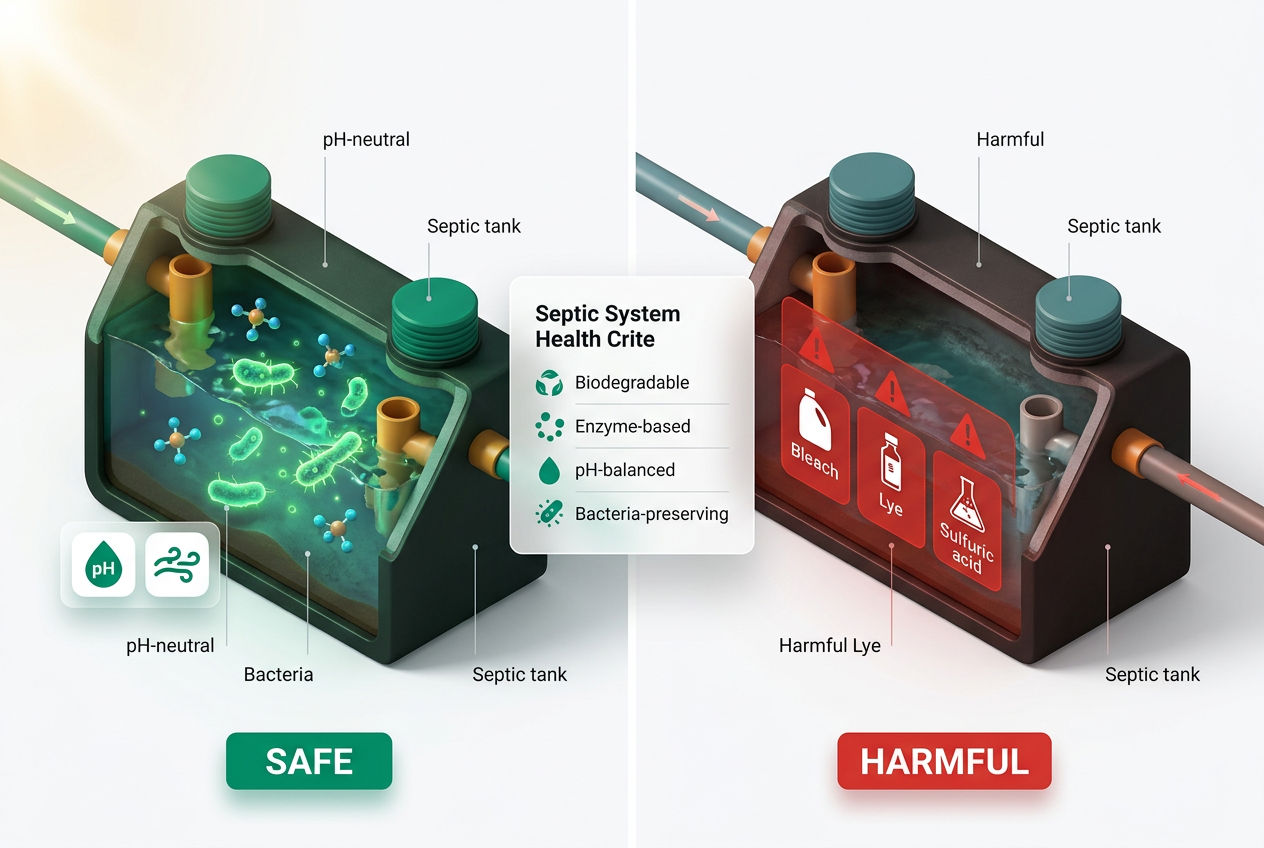
A drain cleaner safe for septic systems works with that biology instead of against it. That means:
- No sodium hydroxide (lye) — typically present at 30–50% concentration in chemical drain cleaners, it raises tank pH to 11–13, far outside the healthy range of 6.5–7.5 that bacteria need to survive
- No sulfuric acid — professional-grade drain openers can contain 93–98% sulfuric acid; even diluted, this destroys microbial colonies instantly
- No quaternary ammonium compounds — antimicrobial agents found in some household cleaners that persist in the tank and continue killing bacteria after the initial dose
- No large doses of bleach — more than a few tablespoons can begin disrupting bacterial balance; a full cup is significantly harmful (see our deeper look at bleach and septic systems)
Safe products use enzymes (proteins that catalyze breakdown reactions), live bacterial cultures, or plant-based surfactants that biodegrade quickly and don't accumulate in the tank.
Here's a worked example of why this matters: A 1,000-gallon tank operating at healthy bacterial density processes roughly 150–200 gallons of daily household wastewater without issue. Pour in 32 oz of a sodium hydroxide drain cleaner at 30% concentration and the resulting pH spike — briefly reaching 11–13 in the inlet zone — can kill 60–80% of active bacterial colonies within 24 hours, according to wastewater microbiology research. At half bacterial capacity, that same 1,000-gallon tank may need pumping every 18 months instead of every 3–5 years. Over a decade, that's potentially $2,000–$4,000 in unnecessary pumping costs from a single repeated product choice.
The 6 Best Septic-Safe Drain Cleaners
1. Green Gobbler Drain Clog Dissolver
Form: Liquid | Active Ingredient: High-density formula with biodegradable surfactants and enzyme accelerants | Price: ~$20–$25 for a 31 oz bottle
Green Gobbler is probably the most recognized name in septic-safe clog removal. It's safe for use in bathroom drains, kitchen sinks, and shower drains. The formula is non-caustic and biodegradable, which means it breaks down quickly in the tank without lingering to harm bacteria.
Honest limitation: it works well on grease, soap scum, and hair clogs, but a hardened clog — think compacted food waste in an older pipe — may need a second application or a mechanical assist.
2. Bio-Clean Drain Septic Bacteria
Form: Powder | Active Ingredient: Live bacterial cultures + enzyme blend | Price: ~$40–$70 for a 2-lb container (treats multiple drains over months)
Bio-Clean is a professional-grade bacterial drain cleaner. It contains billions of live bacteria that colonize your drain pipes and continue digesting organic matter long after the initial application. Plumbers in rural areas with older systems often recommend this one specifically because it doubles as a gentle septic tank treatment.
The trade-off? It takes longer. For a serious clog, you may need to use it overnight for 5–7 consecutive nights. This is a maintenance product as much as a clog remover. If you need your drain clear tonight, pair it with a plunger first.
3. RID-X Septic Safe Drain Opener
Form: Liquid | Active Ingredient: Enzyme blend (lipase, protease, amylase, cellulase) | Price: ~$8–$12 per bottle
RID-X's drain-specific formula is different from their regular septic tank treatment packets. The four-enzyme blend targets the most common clog culprits: fats (lipase), proteins (protease), starches (amylase), and paper/organic fiber (cellulase). It's one of the most affordable septic safe drain clog remover options, and it's widely available at hardware stores and big-box retailers.
Effective for routine slowdowns. Less effective on clogs caused by foreign objects, roots, or completely blocked pipes.
4. Earthworm Family-Safe Drain Cleaner
Form: Liquid | Active Ingredient: Bacterial cultures + plant-based surfactants | Price: ~$12–$16 per 32 oz bottle
Earthworm is formulated without synthetic chemicals, fragrances, or dyes — making it a solid natural drain cleaner for septic systems. The plant-based surfactants loosen buildup while the bacterial cultures start digesting organic material. It's a strong pick for households in the Pacific Northwest and New England where people care about what goes down the drain and cold temperatures slow bacterial activity in the tank (more on that in a moment).
5. Roto-Rooter Pipe Shield Drain Cleaner
Form: Liquid | Active Ingredient: Enzyme and bacterial formula | Price: ~$10–$14 per bottle
Yes, Roto-Rooter makes a product you can buy at the store — separate from their service. Pipe Shield is designed for preventive monthly use rather than emergency clog clearing. It's marketed specifically as safe for septic systems and works by maintaining the microbial population inside your drain pipes before buildup becomes a full clog.
6. Professor Amos SuperFast Drain Cleaner
Form: Liquid | Active Ingredient: Enzyme-based formula | Price: ~$15–$20 per 32 oz bottle
Professor Amos is popular in rural communities and frequently recommended in septic owner forums. It's a biodegradable drain cleaner with a faster action time than pure bacterial products — typically 1–2 hours for mild clogs — while remaining safe for septic systems. If you want something faster than an overnight enzyme treatment but don't want to touch caustic chemicals, this is the one to reach for.
Septic-Safe Drain Cleaner Comparison
| Product | Type | Treatment Time | Best For | Approx. Price |
|---|---|---|---|---|
| Green Gobbler | Enzyme/surfactant | 30 min–2 hrs | Hair, grease, soap clogs | $20–$25 |
| Bio-Clean | Live bacteria + enzyme | 6–8 hrs (overnight) | Maintenance + tough clogs | $40–$70 |
| RID-X Drain Opener | Enzyme blend | 6–8 hrs | Routine slowdowns | $8–$12 |
| Earthworm | Bacteria + plant surfactant | 6–8 hrs | Eco-conscious households | $12–$16 |
| Roto-Rooter Pipe Shield | Enzyme + bacteria | Preventive use | Monthly maintenance | $10–$14 |
| Professor Amos | Enzyme | 1–2 hrs | Faster enzyme option | $15–$20 |
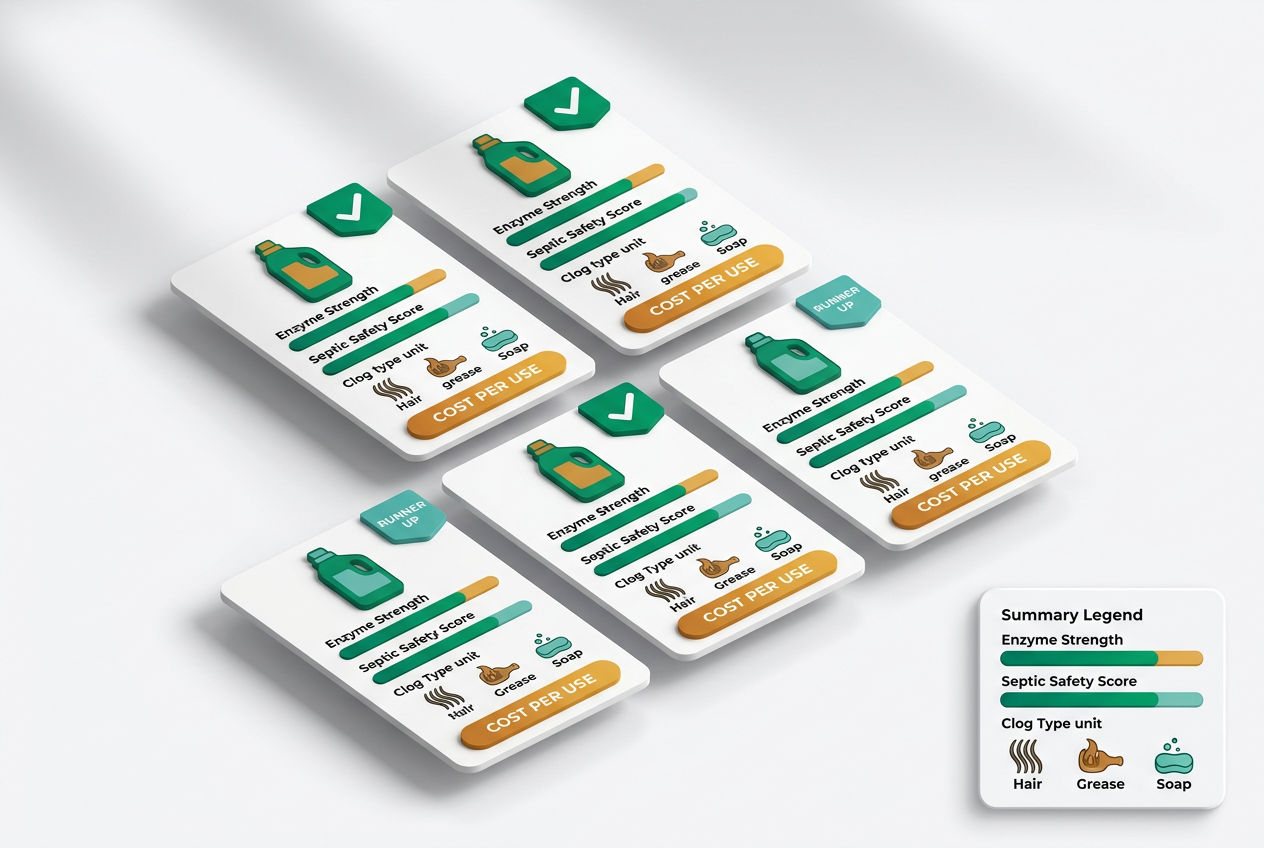
Prices based on national retail averages as of 2025. Actual prices vary by retailer.
Is Drano Safe for Septic Tanks?
No — standard Drano is not safe for septic tanks. Traditional Drano Max Gel and similar formulations use sodium hydroxide (lye) as their active ingredient, often at concentrations above 30%. That raises the pH inside your tank far beyond the 6.5–7.5 range where septic bacteria thrive. After a single heavy use, bacterial colony recovery can take weeks to months — during which your tank processes waste less efficiently and pumping intervals shorten.
Drano does market a "Drano Max Build-Up Remover" product that uses a bacterial/enzyme formula and is labeled septic-safe. That specific product is a different animal from standard Drano. But the classic blue-and-yellow bottle? Keep it away from any drain that connects to your tank.
If you're unsure which version you have, check the back label for sodium hydroxide or sodium hypochlorite in the ingredient list. Either one is a hard stop for septic users. For a more detailed breakdown, we've covered Drano and septic systems separately.
Is Liquid-Plumr Safe for Septic Systems?
Same story as Drano, mostly. Standard Liquid-Plumr formulas contain sodium hydroxide and sodium hypochlorite — both harmful to septic bacteria. Liquid-Plumr does manufacture a "Septic System Clog Remover" that they label as septic-safe, but even that product is worth scrutinizing. The safer move is to stick with products specifically formulated around enzyme or bacterial action rather than relying on "septic-safe" label claims from brands whose core products are caustic.
What Should You Never Put Down the Drain With a Septic System?
Beyond chemical drain cleaners, several common household products can wreck your tank's bacterial balance. The biggest offenders:
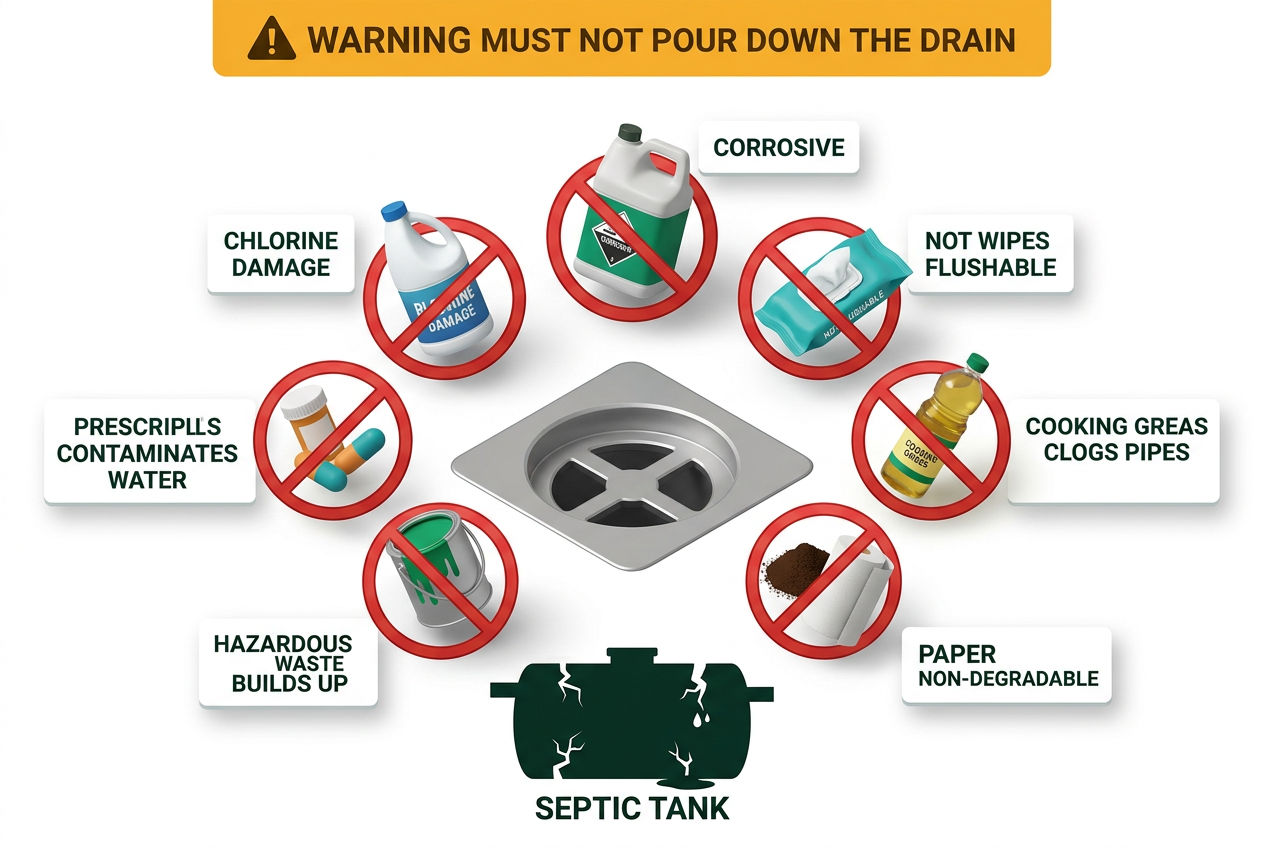
- Antibacterial soaps and cleaners — products containing triclosan or benzalkonium chloride kill bacteria on contact surfaces and continue killing in the tank
- Grease and cooking oil — fats congeal in the inlet pipe and build a scum layer faster than bacteria can break it down; a single Thanksgiving turkey's worth of drippings can create a noticeable acceleration in sludge buildup
- Prescription medications — antibiotics in particular pass through partially intact and disrupt tank biology; the FDA and EPA both recommend disposing of medications through take-back programs, not drains
- Paint, solvents, and paint thinner — even small amounts of petroleum-based solvents are toxic to anaerobic bacteria and persist in soil if they reach the drain field
- "Flushable" wipes — these do not break down at the rate the label implies; they accumulate in the tank and require more frequent pumping
For a complete rundown of what's off-limits, the what not to flush with a septic system guide covers both drains and toilets. The what kills septic bacteria article goes deeper on the chemistry side.
Is Baking Soda and Vinegar Safe for Septic Systems?
Yes — baking soda and vinegar are safe for septic systems. They won't harm your bacterial colonies. The question is whether they'll actually fix your problem.
The short answer: for a minor, grease-based slowdown, yes. For an actual clog, no.
How to use it correctly:
- Pour ½ cup of baking soda down the slow drain
- Follow immediately with 1 cup of white vinegar
- Let the fizzing reaction work for 15–20 minutes — don't run water during this window
- Flush with hot (not boiling) water for 30–60 seconds
Why not boiling water? If your drain pipes are PVC — which most post-1980 homes use — boiling water can soften joints and cause slow leaks over time. Hot tap water is enough to move loosened grease.
This method works on slow drains caused by grease film and light soap scum. It does nothing for hair clogs, compacted food waste, or any obstruction with physical mass. If your drain is completely stopped rather than slow, skip straight to a plunger or enzyme product. See our longer look at vinegar and septic systems for more context.
How Do You Unclog a Drain on a Septic System?
The right sequence depends on severity. Here's how to work through it without harming your tank:
Step 1: Plunger first. A standard cup plunger handles most bathroom sink and tub clogs. A flange plunger works better for toilets. Twenty seconds of consistent pressure clears a surprising percentage of clogs with no product needed at all.
Step 2: Hand snake for hair and debris clogs. A basic hand drain snake ($25–$50 at any hardware store) reaches 15–25 feet into the pipe and physically breaks up or retrieves the obstruction. This is the right tool for shower drains that plunging won't clear.
Step 3: Enzyme drain cleaner for organic buildup. If the drain is slow rather than stopped, an enzyme drain cleaner that's septic safe — Green Gobbler, RID-X, or Professor Amos — applied overnight will dissolve grease, soap scum, and light organic accumulation. Pour it before bed, don't use the drain until morning.
Step 4: Call a professional if multiple drains are slow simultaneously. One slow drain is a drain problem. Multiple slow drains at the same time — especially combined with gurgling sounds or sewage odors — is a tank or drain field problem. That requires a septic inspection, not a drain cleaner. More on that in the next section.
A Note on Cold Weather and Enzyme Cleaners
Does cold temperature affect how well enzyme drain cleaners work? Yes — and if you're in Minnesota or New England in January, this is worth knowing.
Bacterial enzyme activity slows significantly below 50°F. For drain pipes, this matters less than for the tank itself, because household drain water runs warm. But for your tank — especially in tanks buried less than 48 inches below grade — winter soil temperatures can slow bacterial digestion noticeably.
Two practical adjustments for cold-weather septic households:
-
Use enzyme products in the fall, before temperatures drop. September and October applications allow bacterial colonies to establish fully before winter slows their activity. This is far more effective than trying to jump-start a cold tank in February.
-
Pour enzyme cleaner before a holiday gathering, not after. Thanksgiving and Christmas generate significant grease, protein, and starch loads in kitchen drains. Dosing your drains 24–48 hours before the cooking surge gives the enzymes time to establish before the load hits.
In warmer climates — Florida, Georgia, South Carolina — temperature isn't a limiting factor, but sandy, saturated soil creates its own drain field vulnerability. In those regions, drain field replacement costs often run at the higher end of the $5,000–$15,000 range because of the excavation complexity in loose soil.
When the Clog Is Actually a System Problem
Not every slow drain is a drain problem. If you're seeing any of these signs, put the drain cleaner back on the shelf and call a septic professional:
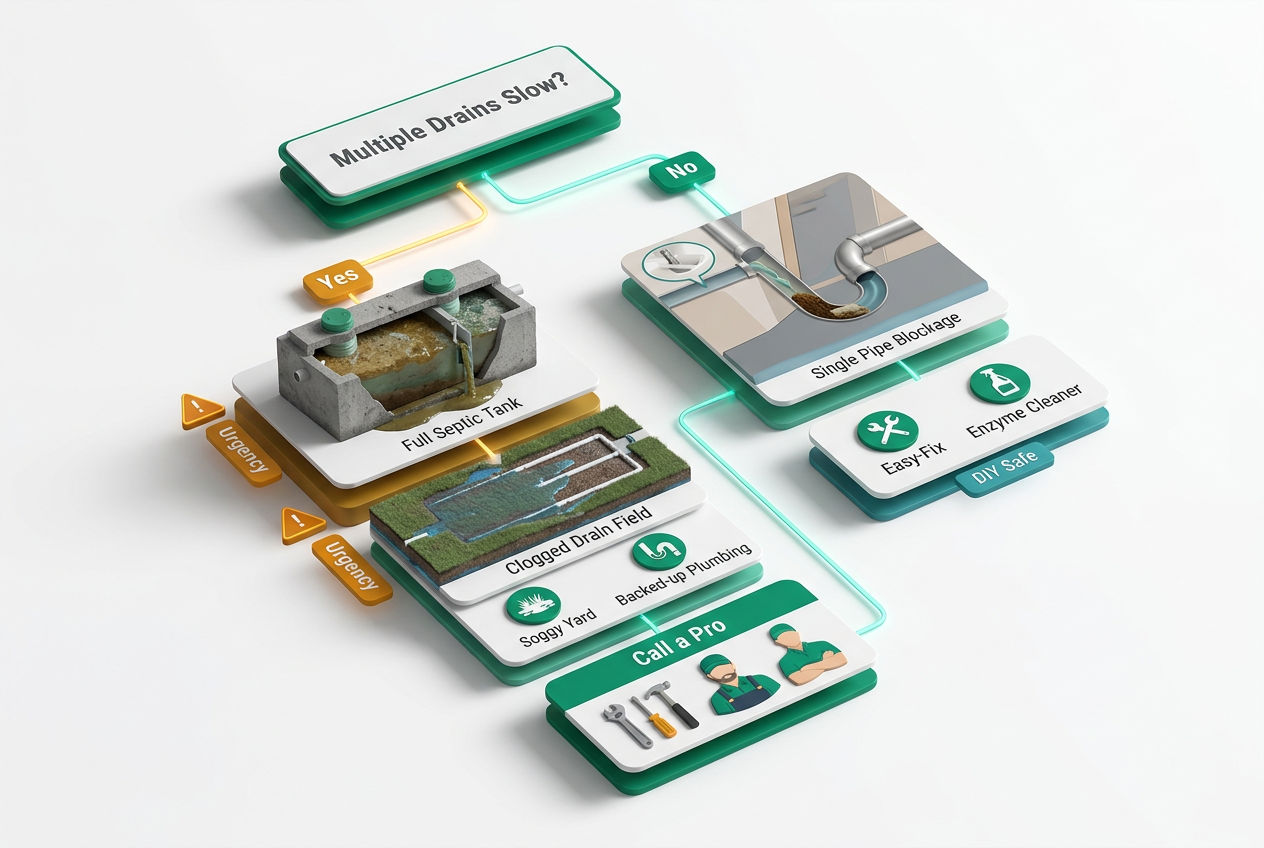
- Multiple drains slow at the same time — this points to a full tank or blocked outlet baffle, not a localized pipe clog
- Gurgling sounds from multiple fixtures — a sign of venting problems or a tank that's near capacity
- Sewage odors inside the house — a blocked vent stack or failing inlet baffle
- Soggy ground or lush green patches over the drain field — possible sign of drain field saturation or failure; see signs your drain field is failing
- Sewage backup in the lowest drain in the house — the tank is full or the outlet is blocked; this requires emergency pumping
In any of these situations, the right call is septic pumping and inspection — not another bottle of drain cleaner. Drain cleaners address drain pipes. They don't fix a tank that needs pumping, a failing baffle, or a saturated drain field. Using them when the real problem is downstream of the tank is, at best, wasted money. At worst, it delays a diagnosis that gets more expensive the longer it sits.
For context on what drain field repair or replacement actually costs, the drain field replacement cost guide breaks down the numbers by system type and region.
Frequently Asked Questions
Is there an enzyme drain cleaner that's septic safe and works fast?
Yes — enzyme drain cleaners that are septic safe and faster-acting do exist, though none match the speed of caustic chemical products. Professor Amos SuperFast Drain Cleaner typically clears mild organic clogs in 1–2 hours, making it the quickest enzyme option on this list. Green Gobbler runs 30 minutes to 2 hours for grease and soap-scum clogs. For context, standard chemical drain cleaners like Drano Max Gel work in 15–30 minutes but do so by raising your tank's pH to dangerous levels, potentially killing the majority of your bacterial colony. The trade-off is real: you gain speed, you lose your tank's biology. For most household slowdowns — hair, grease, soap buildup — a 1–2 hour enzyme product paired with a plunger first will resolve the issue without putting your system at risk. If a clog is completely blocking flow rather than just slowing it, reach for a hand snake before any liquid product.
What is the best septic safe drain cleaner for kitchen sinks?
For kitchen sink clogs, the best septic safe drain cleaner is one with lipase enzyme activity — specifically targeting fats and cooking oils, which are the dominant culprit in kitchen drains. RID-X Drain Opener's four-enzyme formula (lipase, protease, amylase, cellulase) is well-matched to kitchen drain chemistry and runs $8–$12 per bottle. Green Gobbler also performs well on grease-based kitchen clogs in the 30-minute to 2-hour range. For households that cook heavily or fry frequently, Bio-Clean used as a monthly maintenance treatment prevents grease accumulation before it becomes a full blockage. One honest limitation: no enzyme drain cleaner dissolves a compacted food-waste plug in a garbage disposal line effectively. If your kitchen drain is completely stopped and the disposal isn't involved, run a hand snake first to break up the mass, then follow with an enzyme product overnight to clear residue. According to the University of Arkansas Cooperative Extension, grease buildup in kitchen drain lines is the leading cause of slow drains in homes with septic systems.
Can I use a biodegradable drain cleaner for septic systems every month?
Yes — monthly use of a biodegradable drain cleaner for septic systems is not only safe but actively beneficial as a preventive strategy. Products like Roto-Rooter Pipe Shield are specifically designed for this maintenance-interval use. Monthly enzyme or bacterial treatments keep organic buildup from accumulating in drain pipes, reducing the likelihood of a full clog developing. Bio-Clean, used at a reduced maintenance dose (as specified on the label — typically one tablespoon per drain monthly after the initial treatment), continuously replenishes bacterial colonies in the drain lines. The best timing for monthly treatments is before bed, when drains won't be used for 6–8 hours. For seasonal households or winter climates, a heavier fall application in September or October gives bacterial cultures time to establish before cold soil temperatures slow activity. None of the enzyme or bacterial products reviewed here accumulate harmfully in the tank — they biodegrade rapidly and actually supplement the bacterial work your tank is already doing.
How is a drain cleaner safe for septic systems different from regular drain cleaner?
A drain cleaner safe for septic systems uses biological or plant-based chemistry instead of caustic alkalis or strong acids. Standard drain cleaners — Drano Max Gel, most Liquid-Plumr formulas, professional-grade sulfuric acid openers like Zep or Rooto — work by chemically burning or dissolving clog material through extreme pH reactions. Sodium hydroxide at 30–50% concentration raises local pH to 11–13; sulfuric acid at 93–98% concentration drops it catastrophically. Either extreme kills the anaerobic bacteria in your septic tank that are responsible for breaking down solid waste. Septic-safe drain cleaners use enzymes (lipase, protease, amylase, cellulase) that catalyze breakdown reactions without altering pH, or live bacterial cultures that colonize drain pipes and digest organic matter. They're slower — 1–8 hours versus 15–30 minutes — but they leave your tank's biology intact. Under EPA guidance, maintaining healthy septic bacteria is the primary way to extend the 3–5 year pumping interval and avoid $10,000–$25,000 system failures.
Does baking soda and vinegar work as a natural drain cleaner for septic systems?
Baking soda and vinegar is safe for septic systems and works as a natural drain cleaner for mild, grease-based slowdowns — but it won't clear a real clog. The fizzing reaction between sodium bicarbonate and acetic acid loosens light grease film and soap scum on pipe walls. To use it correctly: pour ½ cup of baking soda into the drain, follow immediately with 1 cup of white vinegar, let the reaction work for 15–20 minutes without running water, then flush with hot tap water (not boiling — boiling water can soften PVC joints in post-1980 plumbing). For a drain that is completely stopped rather than just slow, this method won't generate enough force or enzyme activity to dislodge a physical obstruction. In that case, start with a plunger or hand snake. Baking soda and vinegar works best as a monthly freshening treatment between enzyme applications, not as a stand-alone clog solution. Neither ingredient harms septic bacteria — the pH of the resulting reaction is effectively neutral after the fizzing completes.
What should I do if drain cleaner isn't fixing my slow drain?
If a septic-safe drain cleaner isn't resolving a slow drain after one or two overnight treatments, the problem is likely physical rather than organic buildup. Start with a hand drain snake ($25–$50 at any hardware store), which physically breaks up or retrieves hair, soap aggregates, or foreign objects that enzymes can't dissolve. If snaking clears the individual drain but the slowness returns within days, the issue may be in the main line rather than the branch drain. If multiple drains in the house are slow simultaneously — especially combined with gurgling sounds from other fixtures or sewage odors — stop using drain cleaners and call a septic professional. Multiple slow drains signal a full tank, blocked outlet baffle, or early drain field failure: none of which respond to drain cleaner. A septic inspection will identify whether the problem is mechanical (baffle replacement, $200–$500) or systemic (tank pumping, $300–$600; drain field repair, $5,000–$15,000). Using drain cleaner when the real problem is downstream of the tank delays diagnosis and adds cost.
Sources & Methodology
How we evaluated these products: Products were assessed on active ingredient safety for anaerobic bacterial colonies, label transparency (full ingredient disclosure), independent user reporting from septic owner communities, and consistency between manufacturer claims and known microbiology of septic tank function. No manufacturer paid for inclusion or placement in this guide.
Sources cited:
-
U.S. Environmental Protection Agency — Septic Systems Overview and How Your Septic System Works. EPA estimates 21 million U.S. households use septic systems; pumping recommendation of every 3–5 years. epa.gov/septic
-
University of Arkansas Cooperative Extension — Homeowner's Guide to Septic Systems. Research on grease accumulation as the leading cause of kitchen drain failure in septic households; impact of household chemicals on septic bacteria. Cited in kitchen sink FAQ above.
-
National Onsite Wastewater Recycling Association (NOWRA) — Industry standards for septic-safe product formulation and the distinction between enzyme-based and caustic drain products. NOWRA's position that products containing sodium hydroxide, sodium hypochlorite, or quaternary ammonium compounds at functional concentrations are incompatible with healthy septic system operation.
-
FDA and EPA joint guidance — Don't Flush Medications. Recommendation to dispose of antibiotics and prescription medications through take-back programs rather than household drains, due to documented effects on wastewater microbiology.
-
Product label review — Active ingredient disclosures for Green Gobbler Drain Clog Dissolver, Bio-Clean, RID-X Septic Safe Drain Opener, Earthworm Family-Safe Drain Cleaner, Roto-Rooter Pipe Shield, Professor Amos SuperFast Drain Cleaner, Drano Max Gel, Drano Max Build-Up Remover, and Liquid-Plumr Septic System Clog Remover. Reviewed February–May 2025.
Free download
Not ready for the Handbook? Start with the free Fridge Card.
The Do / Don’t card the whole family can see, plus the Survival Kit: emergency flowchart, warning-sign decoder and pump-schedule card. One printable PDF.
Was this article helpful?
Frequently Asked Questions
Recommended Resources
📖 Related Articles
- Septic-Safe Cleaning Products: The Complete List (Safe vs. Avoid)
- Is Bleach Safe for Septic Systems?
- Do Septic Tank Treatments Actually Work?
- Can You Use Drano with a Septic System?
- What Can You Flush with a Septic System? (Tampons, Wipes & More)
- What Kills Septic Tank Bacteria? (14 Things to Avoid)
- Is Vinegar Safe for Septic Systems?
- Signs Your Drain Field Is Failing (And What to Do)
💰 Cost Guides
Find Septic Professionals Near You
Compare licensed, verified septic companies by area — top county markets and cities below, or browse all 50 states.
County markets
Popular cities
