
Quick Answer
title: "Is Vinegar Safe for Septic Systems?" description: "Yes — vinegar is safe for septic systems in normal cleaning amounts. Learn exactly how much is too much, what the science says, and which cleaners actually harm your tank." published: "June 2, 2025" updated: "June 2, 2025"
Vinegar is safe for septic systems in the quantities you'd use for everyday cleaning. A cup or two of white vinegar — diluted across a 1,000-gallon concrete tank — drops the tank's pH by a fraction of a point, not nearly enough to harm the anaerobic bacteria breaking down your waste. The danger zone is large, repeated doses. Use it sensibly and it's one of the best natural septic safe cleaners you'll find.
Key Takeaways
- Normal cleaning amounts of white or apple cider vinegar (1–2 cups per use) are safe for septic systems
- Your septic tank's ideal pH range is 6.8–7.2; white vinegar sits at pH 2.4–3.0 but dilutes rapidly in a large tank
- Pouring multiple gallons at once can temporarily disrupt bacterial balance — so don't use it as a drain-field treatment
- Vinegar is fully biodegradable and breaks down within days in a septic environment
- Bleach and antibacterial soaps are far more damaging to septic bacteria than vinegar at typical household concentrations
Does Vinegar Kill the Good Bacteria in a Septic Tank?
No — not at the volumes used for household cleaning. Your septic tank depends on anaerobic bacteria to digest solids and break down organic waste. Those bacteria thrive in a pH range of 6.8 to 7.2 — roughly neutral. White vinegar has a pH of about 2.4 to 3.0 (it's about 5% acetic acid), which sounds alarming until you do the math.
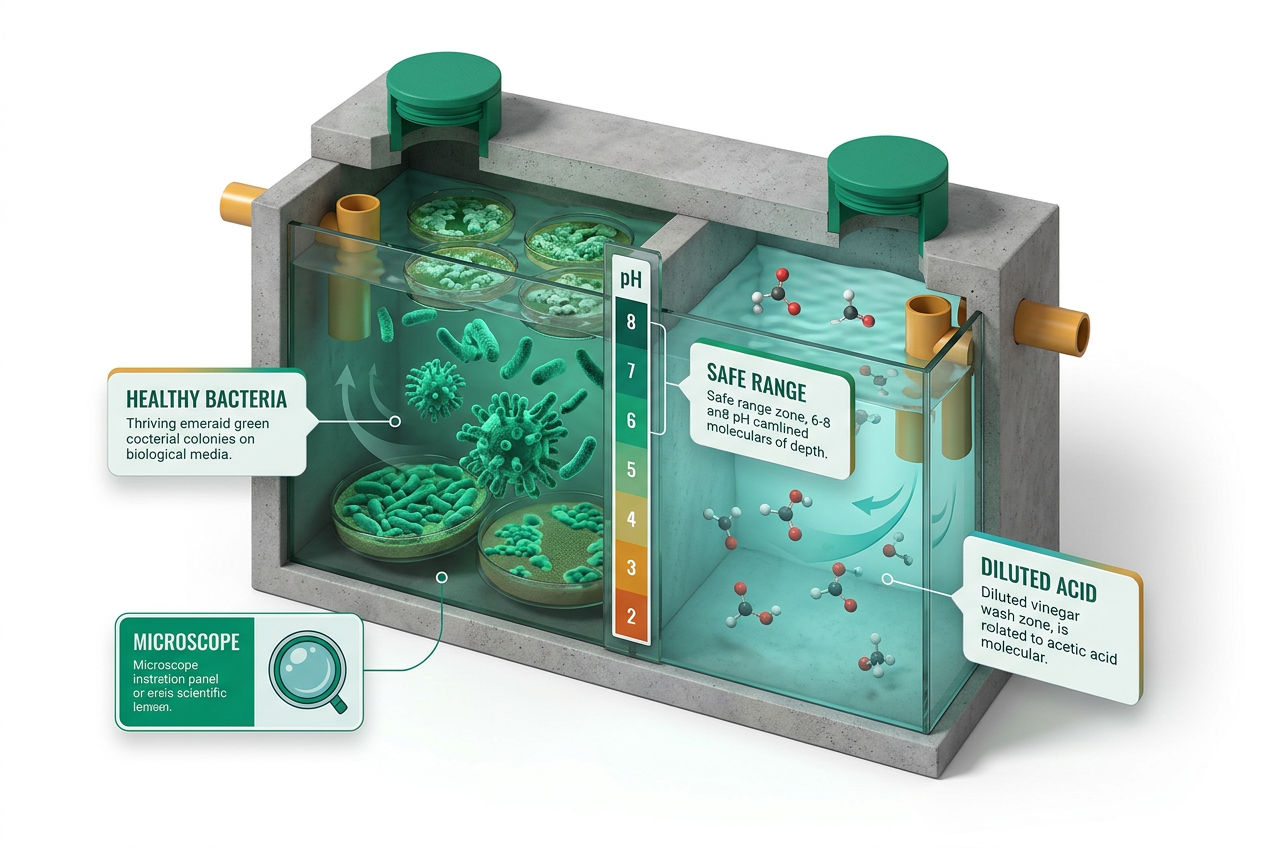
Say you use 1 cup of white vinegar to scrub your bathroom tile. That cup rinses down the drain and eventually reaches a 1,000-gallon septic tank. One cup is 0.0625 gallons. You're adding 0.006% acidity to 1,000 gallons of liquid. The tank's existing buffering capacity — the alkalinity from organic matter, soil, and water — absorbs that change almost instantly. Your bacteria never notice.
Penn State Extension's guidance on household chemical impacts on septic systems confirms that small amounts of acidic or alkaline cleaners are neutralized quickly in a properly functioning tank. Septic bacteria are more resilient than most homeowners give them credit for — the bacterial community has buffers working in its favor at every step between your drain and the tank.
What does kill septic bacteria? Pour a cup of undiluted bleach down your drain and you've introduced a substance that kills bacteria at parts-per-million concentrations — far more aggressively than acetic acid. Antibacterial soaps containing triclosan, drain cleaners with sodium hydroxide, and solvent-based degreasers are the real threats. If you want a deeper look at what genuinely harms your system, the septic safe cleaning products guide covers the full picture.
How Much Vinegar Is Too Much for a Septic System?
The threshold where vinegar becomes a genuine concern is well above what any normal cleaning routine requires. General guidance from cooperative extension programs — including the University of Minnesota Extension — places the safe limit at household cleaning quantities: 1 to 2 cups per use, multiple times per week without issue. At that level, dilution in even a modestly sized tank keeps the pH impact negligible.
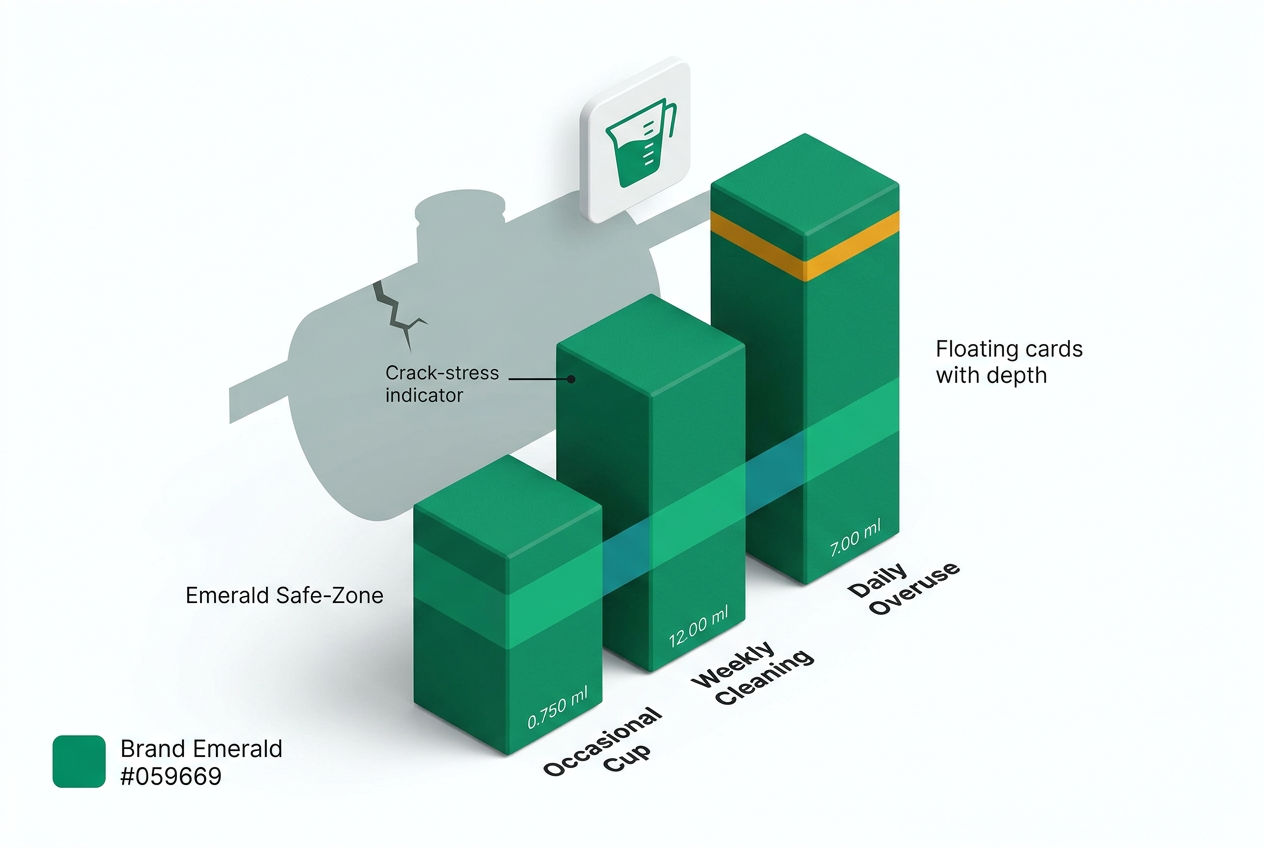
The risk starts when someone treats vinegar like a system-wide maintenance product and dumps it in large quantities. Think 1 to 2 gallons poured directly into a toilet with the goal of "cleaning the tank." At those volumes, you're delivering a meaningful acid load. A temporary pH dip below 6.0 can slow bacterial activity. A sustained pH below 5.0 starts killing off sensitive bacterial strains. Recovery typically takes a few days once dilution catches up, but why stress the system unnecessarily?
The practical rules:
- 1–2 cups per cleaning session: No concern whatsoever
- A full bottle (32 oz) occasionally: Still unlikely to cause measurable harm in most tanks
- 1 gallon or more poured at once: Proceed cautiously — spread it out over time if you feel you need that volume
- Repeated gallon-plus doses daily: Not recommended; you're fighting your own bacteria
One scenario worth flagging: aerobic treatment units (ATUs), which rely on aerobic bacteria and are common in parts of Texas and Florida, may be slightly more sensitive to pH swings than conventional anaerobic tanks. If you have an ATU rather than a standard two-compartment tank, keep your vinegar use on the conservative end.
Is Apple Cider Vinegar Safe for Septic Tanks?
Apple cider vinegar is safe for septic systems in normal use. Its pH typically runs between 3.1 and 5.0 — slightly less acidic than white distilled vinegar. Some homeowners use it as a fabric softener substitute or a natural rinse aid in the dishwasher. From a septic standpoint, it behaves essentially the same way white vinegar does. The acetic acid concentration is similar, the biodegradability is identical, and the volume used in any single application is small enough that dilution handles the rest.
Apple cider vinegar contains more organic particulate matter than distilled white vinegar — that's the cloudiness you see in unfiltered versions. In very large amounts, this extra organic load could theoretically add a small burden to your scum layer, but at the teaspoons-to-cups level you'd use for cleaning or personal care, it's inconsequential.
Can You Use Baking Soda and Vinegar Together If You Have a Septic System?
Yes, and the combination is actually less aggressive than either ingredient sounds on paper. When baking soda (sodium bicarbonate, pH ~8.3) and vinegar (pH ~2.5) mix, they produce a fizzing reaction — carbon dioxide gas and water. The acid and base largely neutralize each other. What reaches your septic tank is mostly carbonated water with trace sodium and acetate ions. Neither harms your bacteria.
The fizzing action can help clear light organic buildup in drain lines, which makes this combo a reasonable maintenance tool for slow drains. It won't dissolve a hard blockage — for that, you need mechanical snaking or professional jetting — but for routine drain freshening, it's among the gentler options available.
If you're comparing drain maintenance approaches, our guide on septic safe drain cleaners breaks down which products are actually effective versus which are just marketed that way.
What Cleaning Products Should You Avoid With a Septic System?
Vinegar barely registers as a threat compared to what's actually under most people's kitchen and bathroom sinks.
Bleach-based cleaners are the most commonly misused. A single toilet bowl cleaning tablet containing sodium dichloroisocyanurate releases enough chlorine to measurably reduce bacterial populations in a tank. Used daily, they cause cumulative damage. The EPA's SepticSmart program specifically flags chlorine bleach as a product to minimize in septic households.
Antibacterial soaps and hand washes containing triclosan or quaternary ammonium compounds pass through your plumbing and arrive in the tank ready to kill bacteria — which is exactly what they're designed to do. Regular hand soap without antibacterial agents is fine.
Chemical drain cleaners like those containing lye (sodium hydroxide) or sulfuric acid are designed to dissolve organic clogs through highly corrosive chemistry. That same chemistry continues working in your tank. Drano and similar products are among the worst things you can pour into a septic-connected drain.
Solvents and paint thinners — even small amounts — can destroy entire bacterial colonies and persist in the tank environment for weeks.
By contrast, white vinegar, castile soap, and baking soda are all septic-compatible choices that won't undercut your system's biology. The what kills septic bacteria guide lists specific products with their relative impact levels if you want to audit your cleaning cabinet.
Vinegar vs. Common Household Cleaners: Septic Impact at a Glance
Free download
Free: the Septic Fridge Card — what to flush, what never to.
The Do / Don’t card the whole family can see, plus the Survival Kit: emergency flowchart, warning-sign decoder and pump-schedule card. One printable PDF.
| Product | pH | Bacterial Impact | Safe for Septic? |
|---|---|---|---|
| White vinegar (1–2 cups) | 2.4–3.0 | Negligible when diluted | ✓ Yes |
| Apple cider vinegar (1–2 cups) | 3.1–5.0 | Negligible when diluted | ✓ Yes |
| Baking soda + vinegar combo | ~7.0 after reaction | None | ✓ Yes |
| Bleach-based cleaner (regular use) | 11–13 | High — kills bacteria at ppm | ✗ Avoid |
| Antibacterial soap (triclosan) | 5.5–7.0 | Moderate — persistent bactericide | ✗ Minimize |
| Chemical drain cleaner (lye-based) | 13–14 | Severe | ✗ Never |
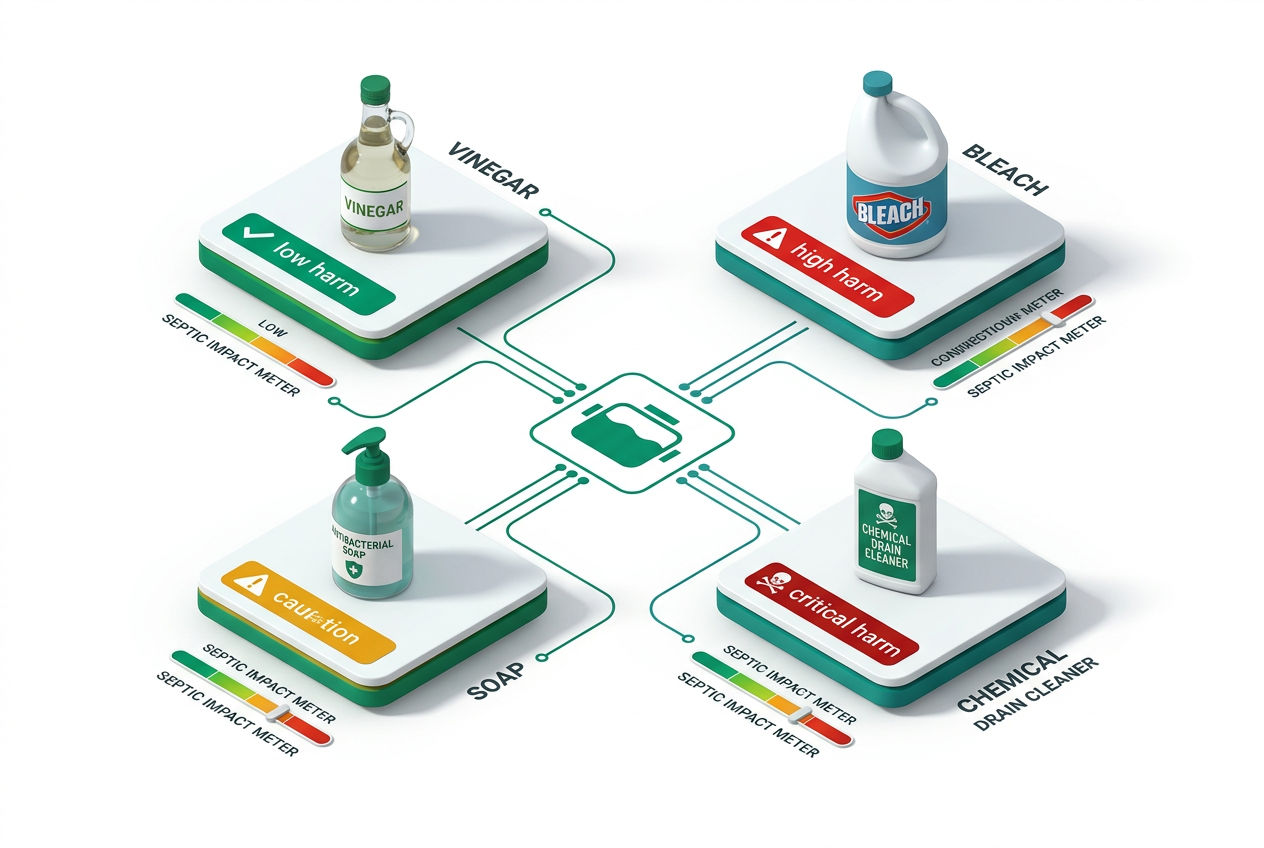
Note: Bacterial impact ratings assume typical household single-use concentrations reaching a 1,000-gallon tank. Sources: EPA SepticSmart Program; Penn State Extension; University of Minnesota Extension Septic System Program.
Is Vinegar Safe for Septic Systems? Here's the Bottom Line
Short answer: yes, with one honest caveat. Vinegar used as a drain cleaner or household surface cleaner — the "vinegar as drain cleaner septic" scenario that many homeowners ask about — poses no real threat to your system. The math simply doesn't support concern at those volumes.
The caveat: vinegar is not a disinfectant at household concentrations. Studies reviewed by the EPA's Design for the Environment program show that 5% acetic acid does not achieve the log-reduction kills required to be classified as a disinfectant. So if you're hoping vinegar will sanitize a surface the way diluted bleach does, that's a limitation worth knowing. For cleaning and deodorizing, it works. For true disinfection — particularly relevant if someone in your household is immunocompromised — you need something stronger, applied carefully and infrequently to protect your tank.
A note on using vinegar specifically as a natural septic safe cleaner for laundry: half a cup in the rinse cycle is a widely used fabric softener substitute and remains well within safe limits. Our guide on how many loads of laundry a septic system can handle covers the water volume side of that equation, which matters as much as what detergent you're using.
Where Vinegar Fits in Your Overall Septic Maintenance Routine
Choosing the right cleaning products matters — but it's one piece of a larger puzzle. The EPA recommends pumping a typical residential septic tank every 3 to 5 years. A 1,000-gallon tank serving a four-person household generally hits that 3-to-4-year mark. Add a garbage disposal and you're probably looking at every 2 years, because the extra food solids accelerate sludge accumulation.
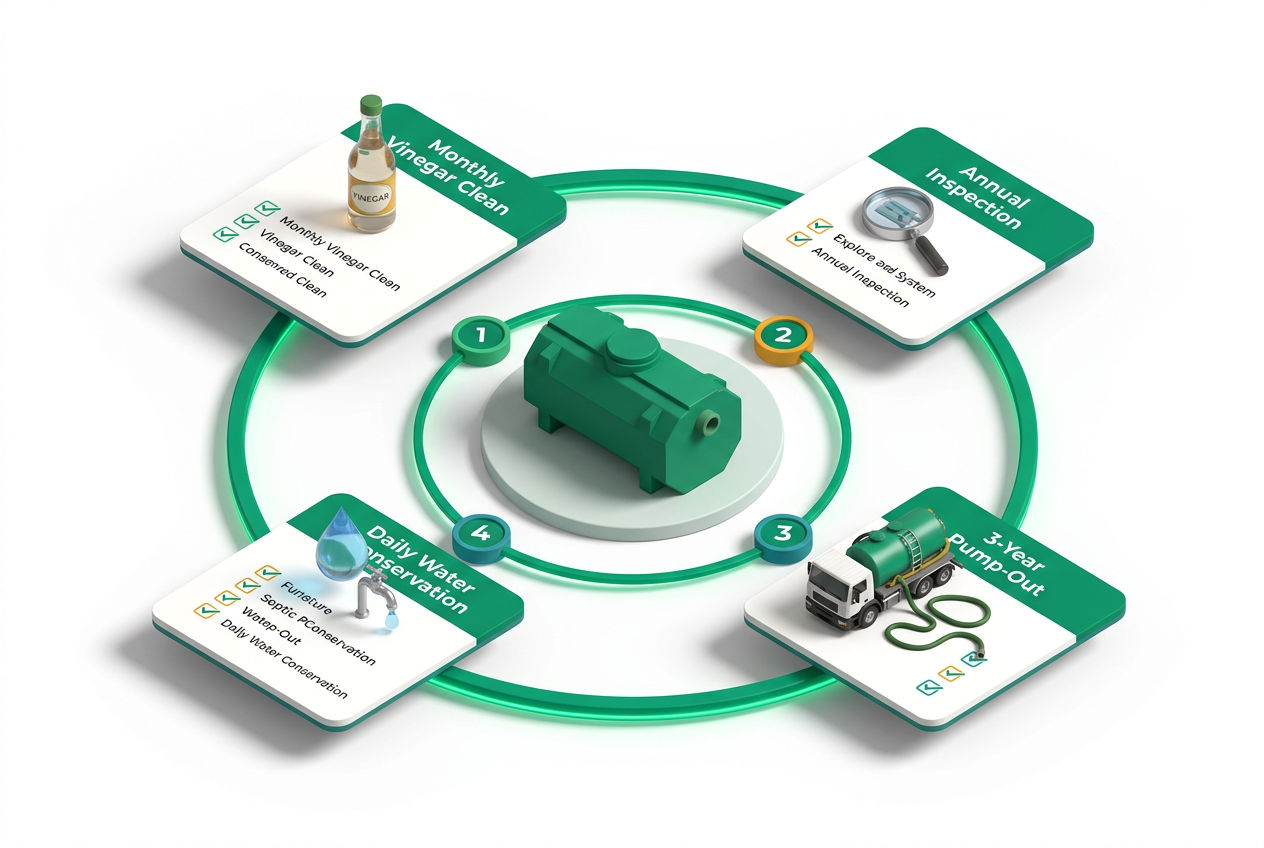
You can see current pump-out costs by region in our septic pumping cost guide — national averages run $300 to $600 for a standard residential tank.
Beyond pumping, late-1990s EPA literature noted that approximately 10 to 20 percent of septic systems malfunction due to improper use and maintenance. According to the EPA's Onsite Wastewater Treatment Systems Manual (2002), the leading contributors to premature system failure are chemical damage to bacterial populations and hydraulic overload — not age. That makes product choices like this one genuinely consequential over a 20- to 30-year system lifespan.
If your system uses an aerobic treatment unit with a component like a Hiblow HP-80 aerator compressor, or includes a Polylok PL-122 effluent filter, those components operate in tighter performance windows than a conventional gravity-flow tank. For ATU owners, the conservative approach to any acidic cleaner — including vinegar — is the right call.
Cold-climate note: if you're in Minnesota, Maine, Vermont, or another state where tanks sit in frozen ground through winter, bacterial activity slows significantly between November and March. Bacterial populations rebound in spring. Scheduling your vinegar-heavy deep cleaning for April onward gives your system's biology a running start before you introduce any additional variables.
A yearly septic inspection — particularly one that includes an effluent quality check and a visual inspection of baffles and lids — catches problems long before they become failures. You can book that through our septic inspection service or use our full septic tank maintenance guide to build out a complete annual checklist.
Frequently Asked Questions
Can I use vinegar to clean my septic tank directly?
No — and this is one of the most common misunderstandings about vinegar and septic systems. Pouring vinegar directly into your toilet to "treat" the tank is not a recognized maintenance practice, and doing it in gallon-plus quantities can temporarily depress the tank's pH below 6.0, slowing bacterial activity. Vinegar's legitimate role is as a surface cleaner and deodorizer upstream of your tank — on countertops, tile grout, sinks, and appliances. When it reaches your tank in those diluted amounts, it does no harm. If you want a septic-safe approach to reducing odor or buildup inside the tank itself, the correct answer is regular pump-outs every 3 to 5 years by a licensed technician, not DIY chemical treatments. According to the University of Minnesota Extension, no household cleaner — vinegar included — substitutes for mechanical pumping when it comes to managing sludge accumulation. Save the vinegar for surfaces; let the professionals handle the tank.
Is white vinegar or apple cider vinegar better for septic systems?
Both are safe for septic systems at normal cleaning volumes, and neither offers a meaningful advantage over the other from a septic health standpoint. White distilled vinegar (pH 2.4–3.0) is slightly more acidic than apple cider vinegar (pH 3.1–5.0), but both dilute to negligible concentrations well before reaching your tank's bacterial population. The practical difference is that apple cider vinegar contains more organic particulate matter — the cloudiness in unfiltered versions — which adds a trace amount of organic load to your system. At teaspoons-to-cups quantities, that difference is inconsequential. Choose based on the task: white vinegar is sharper for cutting mineral deposits and soap scum; apple cider vinegar is commonly preferred as a fabric softener substitute or rinse aid. If you have an aerobic treatment unit rather than a conventional septic tank, stick to the lower end of usage for either type, since ATUs can be more sensitive to pH fluctuation than standard anaerobic systems.
Does vinegar kill septic bacteria when used as a drain cleaner?
At the volumes typically used for drain maintenance — a half cup to one cup poured down a slow drain — vinegar does not kill septic bacteria. Here's the math: one cup (0.0625 gallons) entering a 1,000-gallon tank represents a 0.006% acid addition. The tank's existing alkalinity buffer — from organic matter, water, and soil chemistry — neutralizes that shift almost immediately. Penn State Extension's guidance on household chemical impacts confirms that properly functioning tanks handle small acidic inputs without measurable bacterial disruption. Where drain-cleaner quantities become a concern is if you're pouring multiple cups repeatedly into a single drain in a short window, which could produce a localized acid pulse. For that reason, mechanical approaches — a drain snake or a plumber's auger — remain the better choice for genuine blockages. Vinegar works well for light organic buildup and odor; it cannot dissolve a grease plug or hair clog regardless of septic safety.
What natural septic safe cleaners can I substitute for bleach-based products?
Several natural cleaners are genuinely septic safe and effective for everyday use. White vinegar handles mineral deposits, hard water stains, and light soap scum. Baking soda deodorizes drains and acts as a mild abrasive for porcelain and tile. Castile soap — a plant-based surfactant with no synthetic antibacterial agents — is safe for dishes, laundry, and general surface cleaning. Hydrogen peroxide at 3% concentration (the standard drugstore formulation) breaks down rapidly into water and oxygen and is considered low-risk for septic systems at household quantities, though it should not be used daily in large volumes. The products to avoid are those containing chlorine bleach, triclosan, quaternary ammonium compounds, or sodium hydroxide. According to the EPA's SepticSmart program, minimizing chlorine-based cleaners is one of the highest-impact behavioral changes a septic homeowner can make. A useful benchmark: if a cleaner's label warns against contact with skin or requires ventilation, treat it as septic-suspect until you can verify its active ingredients.
How does vinegar compare to commercial septic additives?
Vinegar outperforms most commercial septic additives on one simple metric: it doesn't claim to do something it can't. Many commercial septic additives — enzyme treatments, bacterial inoculants, "tank refreshers" — are marketed as ways to boost bacterial populations or accelerate breakdown. The EPA, along with multiple state extension programs, has consistently found insufficient evidence that these products provide meaningful benefit to a properly functioning septic system. A healthy tank already contains billions of bacteria; adding more rarely changes outcomes. Vinegar makes no such claim. Used as a surface cleaner, it cleans surfaces. That honesty is actually its advantage. At roughly $3 to $4 per gallon versus $8 to $15 for commercial septic treatments, white vinegar is also the cheaper choice. The real drivers of septic system health are pump-out frequency, water usage habits, and avoiding genuinely harmful chemicals — not additives. If your system needs bacterial support after antibiotic overuse or chemical damage, consult a licensed septic professional rather than reaching for a bottle from the cleaning aisle.
Sources & Methodology
-
Penn State Extension — Septic System Owner's Guide (extension.psu.edu). Used to verify bacterial pH tolerance ranges and the neutralization behavior of acidic cleaners in active septic tanks.
-
University of Minnesota Extension — Septic System Maintenance (extension.umn.edu, updated 2021). Used for safe usage thresholds, pump-out frequency guidance, and cold-climate operational recommendations.
-
U.S. Environmental Protection Agency — SepticSmart Program (epa.gov/septic). Used for the list of household chemicals flagged as harmful to septic systems, including chlorine bleach and antibacterial agents.
-
U.S. Environmental Protection Agency — Onsite Wastewater Treatment Systems Manual (EPA/625/R-00/008, 2002). Used for the 10–20% malfunction statistic and leading causes of septic system failure.
-
EPA Design for the Environment Program — Acetic acid hazard assessment. Used to confirm that 5% acetic acid (household vinegar) does not meet disinfectant classification thresholds.
Was this article helpful?
Frequently Asked Questions
Recommended Resources
📖 Related Articles
- Septic-Safe Cleaning Products: The Complete List (Safe vs. Avoid)
- The Best Septic-Safe Drain Cleaners (and What to Never Pour In)
- Can You Use Drano with a Septic System?
- What Kills Septic Tank Bacteria? (14 Things to Avoid)
- How Many Loads of Laundry Can You Do With a Septic System?
- The Complete Septic Tank Maintenance Guide
💰 Cost Guides
🔧 Services
Find Septic Professionals Near You
Compare licensed, verified septic companies by area — top county markets and cities below, or browse all 50 states.
County markets
Popular cities
