
Quick Answer
title: "The Best Septic Safe Toilet Bowl Cleaner (Top Picks)" description: "Find the best septic safe toilet bowl cleaner for your home. We compare top picks like Seventh Generation, Better Life, and Ecover — with ingredient breakdowns, what to avoid, and EPA-backed guidance." published: "June 12, 2025" updated: "June 12, 2025"
Septic safe toilet bowl cleaners are plant-based, biodegradable formulas free from sodium hypochlorite, phosphates, and quaternary ammonium compounds. They clean effectively without killing the beneficial bacteria that break down waste inside your tank. Look for EPA Safer Choice certification or active ingredients like citric acid or lactic acid as reliable indicators of septic compatibility.
Key Takeaways
- Bleach-based cleaners can kill up to 90% of your tank's beneficial bacteria within 24 hours — and recovery can take weeks
- The EPA recommends only biodegradable, phosphate-free cleaners for homes on septic systems
- Avoid sodium hypochlorite, quaternary ammonium compounds (quats), and products with a pH below 3 or above 11
- Top septic-safe picks include Seventh Generation, Better Life, and Ecover — all available for $4–$10 per bottle
- Replacing your septic system costs $15,000–$30,000. A $6 bottle of the right cleaner is cheap insurance.
About 21% of U.S. homes — roughly 1 in 5 — rely on a private septic system rather than a municipal sewer line, according to the EPA. If your house is one of them, the products you flush matter far more than most people realize. That includes toilet bowl cleaner.
Most conventional cleaners were formulated for homes connected to a sewer. On septic, the rules are different. What goes down your toilet ends up in a tank where billions of bacteria are quietly doing the work of breaking down waste. Disrupt that bacterial colony and you're looking at slow drains, sewage odors, and eventually a drain field that needs replacing — often at a cost of $10,000–$25,000 for the leach field alone.
So before you reach for whatever's under the sink, it's worth knowing what's actually in the bottle. This guide covers specific product recommendations, ingredient red flags, and how to evaluate any cleaner on your own — including the ones marketed as "septic safe" that don't quite earn that label.
For a broader look at which household products are safe and which aren't, see our guide to septic safe cleaning products.
Can Toilet Bowl Cleaner Actually Damage a Septic Tank?
Yes — and more quickly than most people expect.
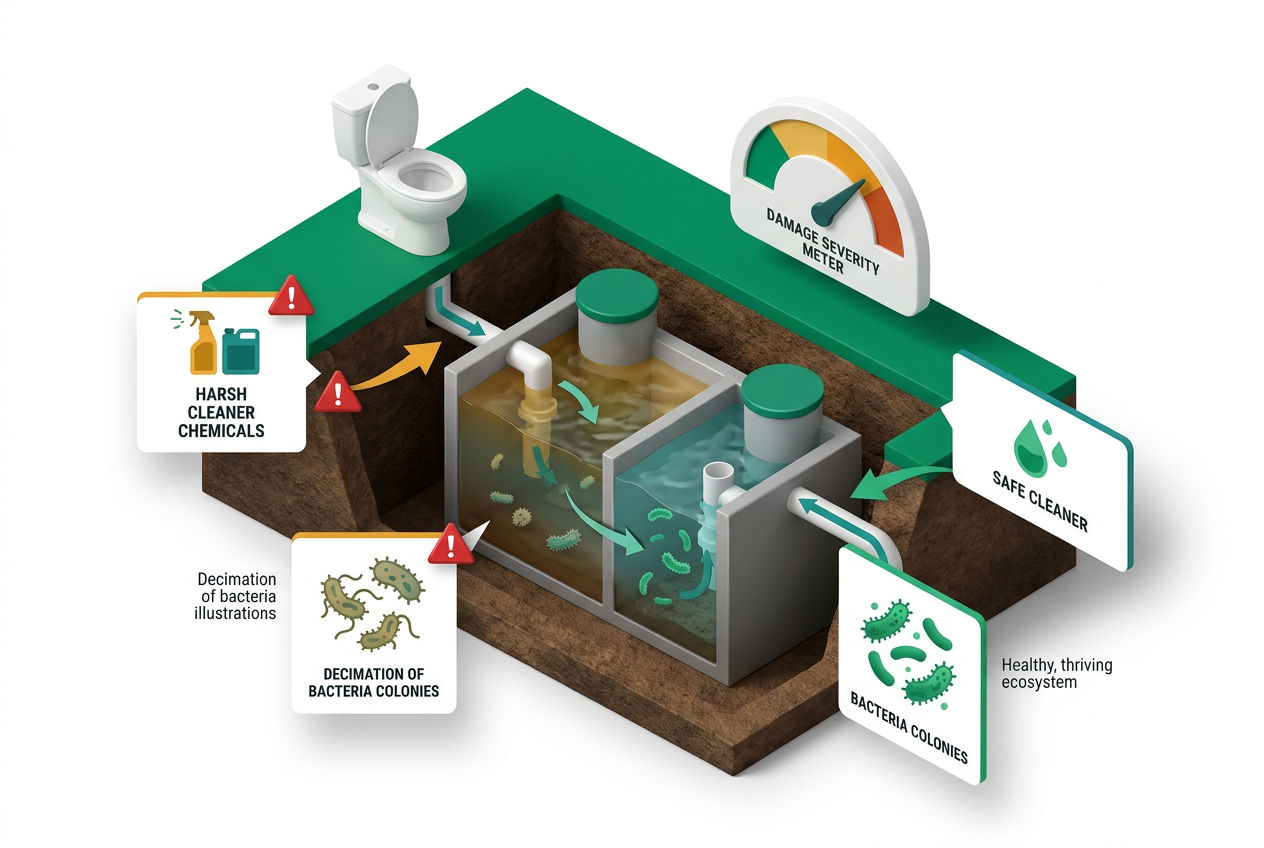
A single dose of a highly concentrated bleach-based cleaner can kill up to 90% of a healthy tank's beneficial bacteria within 24 hours. This figure appears consistently in septic industry literature and is cited in the University of Minnesota Extension publication Maintaining Your Septic System: A Guide for Homeowners (2019), available through the UMN Extension water quality program.
Your septic tank isn't just a holding vessel — it's a biological reactor. Anaerobic bacteria break down solid waste (sludge) at the bottom, while liquid effluent rises and flows into the drain field where aerobic bacteria in the soil complete a second pass of treatment. Damage either population and the system starts to back up.
The EPA's guidelines on septic system care are direct: use only biodegradable, phosphate-free household products. Every product on this list meets that standard.
Recovery from chemical damage isn't instant. Depending on how much of the bacterial colony was wiped out, it can take anywhere from two days to several weeks to return to normal population levels. During that window, your system processes waste inefficiently. Use a bleach tablet in your toilet tank every day and you never give the bacteria time to recover.
If you've been using a bleach-based cleaner regularly: stop now and give the tank at least three to four weeks before assessing drain speed or odors. Some households add a septic-safe bacterial additive during the recovery window — though the EPA notes that well-functioning systems don't require additives under normal conditions.
What Ingredients Should You Avoid in a Toilet Bowl Cleaner?
The label rarely tells the full story, but the ingredient list does. These are the specific compounds that harm your septic system's bacterial balance.
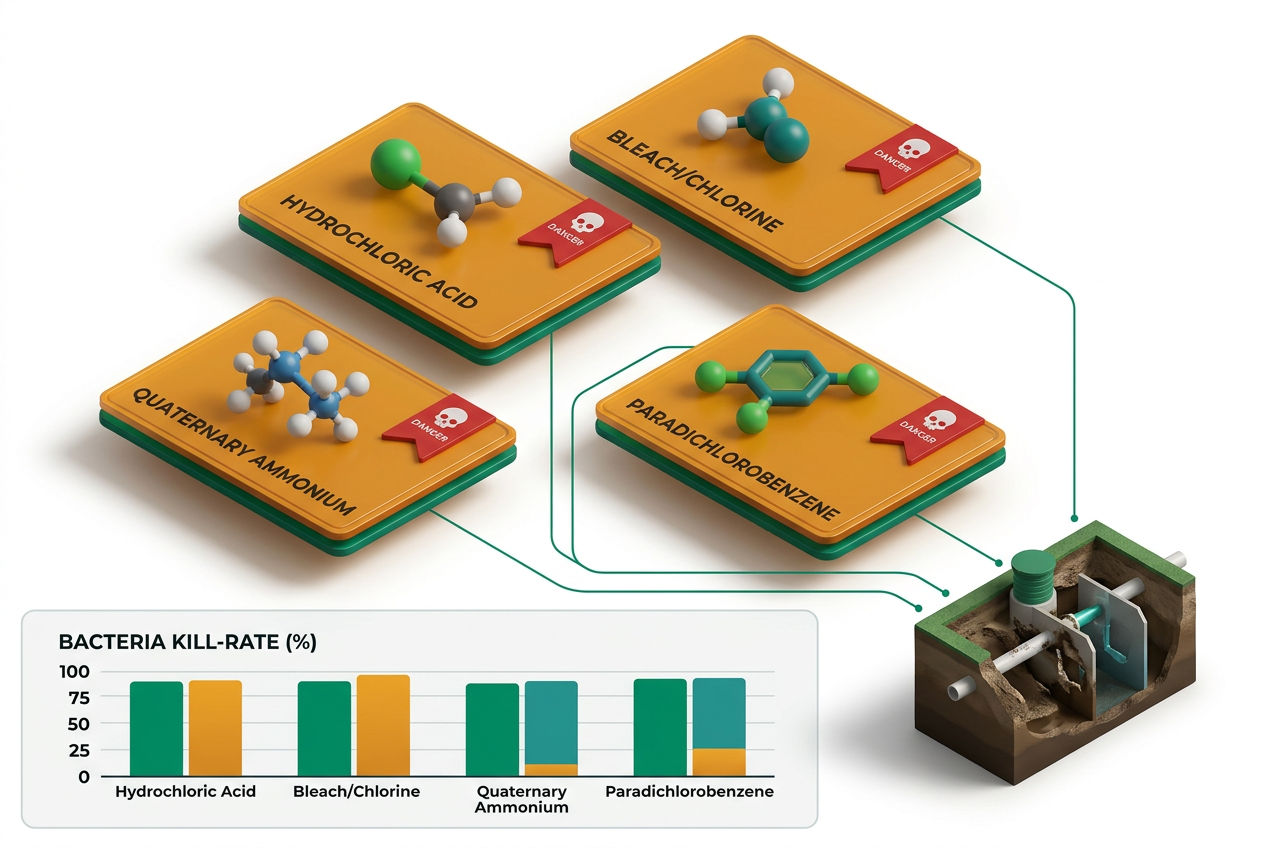
Sodium hypochlorite (bleach): The most common offender. Products with more than 2–3% sodium hypochlorite concentration are especially problematic. Many standard toilet bowl cleaners run 5–10%. Those slow-dissolving chlorine tablets people drop in the toilet tank? They continuously dose your system every single flush.
Quaternary ammonium compounds (quats): Found in many "antibacterial" cleaners. These are persistent biocides — they don't break down quickly and actively target the same microbial activity your septic tank depends on. Check labels for benzalkonium chloride or alkyl dimethyl benzyl ammonium chloride.
Phosphates: Banned from many household cleaners nationally under the Phosphate Detergent Act and subsequent state-level regulations — including restrictions in states like Minnesota, Michigan, and Washington — but still appearing in some commercial-grade products. They trigger algae blooms if effluent reaches surface water and disrupt your soil's natural filtration chemistry.
Formaldehyde and triclosan: Less common in toilet bowl cleaners specifically, but worth flagging. Both are harsh antimicrobials that persist in the tank environment.
Extreme pH formulas: Products with a pH below 3 or above 11 are highly corrosive to bacterial populations. Most citric-acid-based cleaners sit around pH 4–5, which is mild enough not to cause problems at normal use frequency.
What Makes a Toilet Bowl Cleaner Safe for Septic Systems?
A septic safe toilet cleaner has three things going for it: safe active ingredients, a biodegradable formula, and verifiable certifications.
Active ingredients to look for:
- Citric acid — plant-derived, breaks down mineral deposits and hard water stains, pH ~2–3 but low-concentration formulas stay closer to pH 4–5
- Lactic acid — fermentation-derived, effective against soap scum and limescale
- Hydrogen peroxide — oxygen-based bleach alternative that breaks down into water and oxygen; generally safe at typical cleaning concentrations (3–5%)
- Essential oil-based surfactants — tea tree, thymol (from thyme) — antimicrobial without being persistent biocides
Certifications that actually mean something:
- EPA Safer Choice — rigorous ingredient-by-ingredient review; a genuine indicator of septic-safe status
- USDA BioPreferred — confirms a minimum percentage of bio-based content
- Leaping Bunny / PETA certified — cruelty-free signals that often correlate with plant-based formulas
A quick numbers check: Say you clean your toilet twice a week using a 1 oz dose of cleaner per session. Over a month, that's roughly 8 oz of cleaner entering your system. A 32 oz bottle of Seventh Generation (citric acid, pH ~4.5) contributes minimal acid load across a 800–1,500 gallon tank — the dilution factor alone makes it safe. Compare that to 8 oz of a 6% sodium hypochlorite product: even after dilution, chlorine residuals measurable in septic tank effluent have been documented in peer-reviewed literature at concentrations sufficient to suppress anaerobic bacterial activity. The chemistry matters, not just the label.
Top Septic Safe Toilet Bowl Cleaners: Our Picks
Here are the products we recommend based on ingredient transparency, certifications, and real-world performance. Prices reflect typical retail and online pricing as of mid-2025.
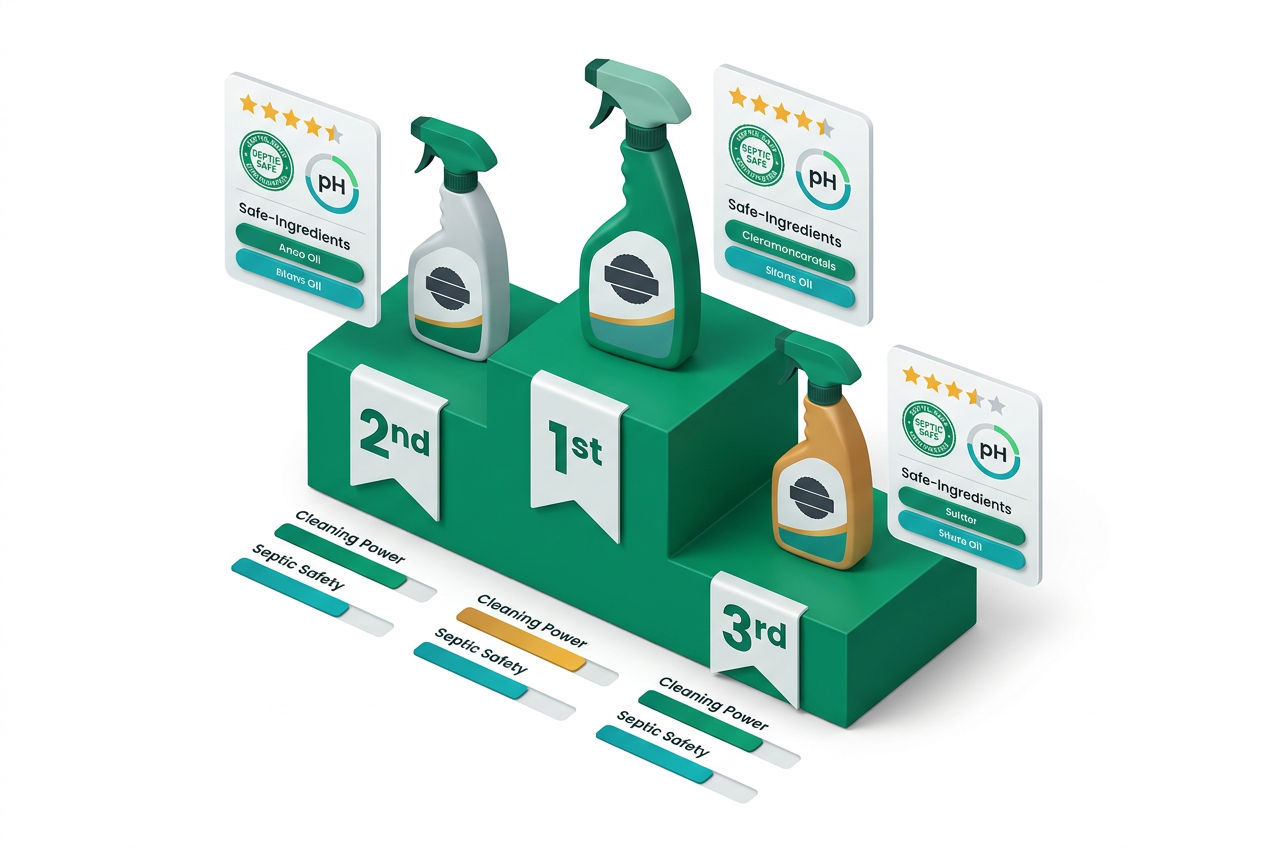
1. Seventh Generation Toilet Bowl Cleaner — Emerald Cypress & Fir
Active ingredients: Citric acid, plant-derived surfactants
Certifications: EPA Safer Choice certified, USDA BioPreferred
Price: $4–$5 per 32 oz bottle ($0.14/oz)
Amazon rating: 4.5 stars, 10,000+ reviews
Seventh Generation's toilet bowl cleaner is about as close to a benchmark product as this category has. The formula is built around citric acid, which dissolves hard water stains, mineral scale, and rust rings without disrupting anaerobic digestion in your tank. The Emerald Cypress & Fir scent comes from essential oils — no synthetic fragrance compounds. The EPA Safer Choice label means every ingredient has been reviewed for aquatic toxicity, skin sensitization, and biodegradability. For septic owners, that's the seal that actually means something.
This is an easy first recommendation for most households.
One limitation: It's less effective on severe limescale buildup than more acidic commercial cleaners. For heavy deposits, let it dwell 10–15 minutes before scrubbing.
2. Better Life Toilet Bowl Cleaner
Active ingredients: Tea tree oil, citric acid, plant-based surfactants
Certifications: EPA Safer Choice certified, vegan, gluten-free
Price: $6–$8 per 24 oz bottle ($0.29/oz)
Amazon rating: 4.4 stars, 5,000+ reviews
Better Life's formula uses tea tree oil as a natural antimicrobial alongside citric acid for descaling. Tea tree's active component (terpinen-4-ol) has documented antimicrobial properties against surface pathogens — it won't sterilize your toilet bowl the way bleach would, but it doesn't need to, and it won't touch your tank's bacteria either.
The gel consistency clings to the bowl longer than thinner liquids, which matters when you're trying to break down mineral deposits under the rim. It's priced a bit higher per ounce than Seventh Generation, but the dwell-time advantage makes the extra cost worth considering for harder water areas — the Southwest, parts of Texas, and the Mountain West where water hardness routinely exceeds 200 mg/L.
3. Ecover Toilet Cleaner
Active ingredients: Lactic acid, plant-based surfactants
Certifications: EU Ecolabel, Leaping Bunny certified, biodegradable formula
Price: $5–$7 per 25 oz bottle ($0.24/oz)
Amazon rating: 4.3 stars, 3,000+ reviews
Ecover uses lactic acid as its primary cleaning agent rather than citric acid. Lactic acid has a slightly higher pH at equivalent concentrations, which makes it gentler on septic bacterial colonies while still being effective against soap scum and organic staining. It's a good pick for households that clean their toilet more frequently — daily or every other day — where you want to minimize any cumulative chemical load on the tank.
The EU Ecolabel certification, while not an EPA program, applies a similarly rigorous standard: biodegradability, aquatic safety, and ingredient restriction lists. Ecover has been a staple for European households with private septic systems (called "fosse septique" in France and widely used across rural Ireland and the UK) for decades.
4. Aunt Fannie's Cleaning Vinegar Toilet Bowl Spray
Active ingredients: Cleaning vinegar (6% acidity), citric acid
Certifications: Non-toxic formulation; no third-party eco-cert, but fully ingredient-transparent
Price: $6–$9 per 32 oz bottle ($0.22/oz)
Amazon rating: 4.2 stars, 2,000+ reviews
For homeowners who want to stay as close to a DIY formula as possible while getting the convenience of a commercial product, Aunt Fannie's uses cleaning vinegar — which runs at 6% acidity versus standard white vinegar's 5% — combined with citric acid for added descaling power. Both ingredients are fully biodegradable and septic-safe at these concentrations.
One limitation: Without the surfactants that gel-based cleaners use, it won't cling to the bowl as effectively. It works best on light to moderate staining. For mineral rings or heavy scale, Better Life or Seventh Generation will outperform it.
5. Method Antibac Toilet Bowl Cleaner
Active ingredients: Lactic acid, plant-based surfactants
Certifications: EPA Safer Choice certified, B Corp certified
Price: $4–$6 per 24 oz bottle ($0.21/oz)
Amazon rating: 4.4 stars, 8,000+ reviews
Method's antibacterial formula earns the "antibac" label from lactic acid rather than quaternary ammonium compounds or bleach. It's septic-safe, EPA Safer Choice certified, and comes in a bottle made from 100% recycled plastic. The angled nozzle design gets under the rim effectively, which matters for mold and mildew that accumulate in hard-to-reach areas.
A solid value pick — lower cost per ounce than Better Life with comparable performance on routine cleaning tasks.
Product Comparison Table
| Product | Active Ingredient | EPA Safer Choice | Price/oz | Best For |
|---|---|---|---|---|
| Seventh Generation | Citric acid | ✅ | $0.14 | Most households, best value |
| Better Life | Tea tree + citric acid | ✅ | $0.29 | Hard water areas |
| Ecover | Lactic acid | EU Ecolabel | $0.24 | Frequent cleaners |
| Aunt Fannie's | Cleaning vinegar + citric acid | ❌ | $0.22 | Minimalist/DIY households |
| Method Antibac | Lactic acid | ✅ | $0.21 | Budget + performance balance |
Is Bleach Toilet Bowl Cleaner Bad for Septic Tanks?
Free download
Free: the Septic Fridge Card — what to flush, what never to.
The Do / Don’t card the whole family can see, plus the Survival Kit: emergency flowchart, warning-sign decoder and pump-schedule card. One printable PDF.
Yes, with some important nuance.
Bleach itself — sodium hypochlorite — is the most damaging common ingredient for septic systems. The concentration matters. A product with 1–2% sodium hypochlorite used occasionally and rinsed thoroughly is less catastrophic than a 6% formula used daily. But there's no threshold below which bleach is genuinely safe for regular septic use. The antimicrobial action that makes it effective at cleaning is the same mechanism that suppresses your tank's bacterial population.
The National Onsite Wastewater Recycling Association (NOWRA) — the professional body for septic system installers and engineers — recommends against routine bleach-based cleaner use in homes with septic systems, full stop. Their guidance aligns with the EPA's broader position on household chemical use in septic-served homes.
"Occasional" is the operative word some manufacturers use on labels. Even that framing is optimistic. If your household cleans the toilet twice a week (common) and uses a bleach-based product both times, you're delivering regular chemical stress to a biological system that needs stability to function. The cumulative effect is what damages systems, not a single use.
For more on how bleach interacts with your tank biology, see is bleach safe for septic systems.
What About Lysol Toilet Bowl Cleaner — Is It Septic Safe?
Lysol's toilet bowl cleaner products contain hydrochloric acid as the primary active cleaning ingredient, typically at 9.5% concentration. Hydrochloric acid sits well below pH 3 — that's the threshold below which serious bacterial damage occurs in your tank. Lysol does not carry EPA Safer Choice certification for its toilet bowl cleaner line.
However, Lysol markets some products as "septic safe" based on the reasoning that normal use volumes are diluted significantly before reaching the tank. Their position: at typical use volumes (1–2 oz per cleaning), the acid is diluted into hundreds of gallons of tank water, reducing the pH impact to negligible.
The honest assessment: occasional use of Lysol toilet bowl cleaner — once every week or two, fully rinsed — is unlikely to cause permanent damage to a healthy, well-established septic system. But it's not a product we'd recommend as a regular go-to for septic households, and it's not on this list for that reason. Better options exist at the same price point.
What About Clorox Toilet Tablets — Are They Safe for Septic?
Clorox toilet tank tablets are one of the most consistently problematic products for septic system owners, and this is worth stating plainly.
These tablets — the blue ones you drop into the toilet tank — release chlorine continuously with every flush. That means instead of an occasional dose of cleaner that gets diluted before reaching your tank, you're delivering a steady chlorine drip directly into your system all day, every day.
The Clorox ToiletWand system (the disposable scrubbing pads with built-in cleaner) is a separate product and carries a different risk profile — the cleaner is applied to the bowl, scrubbed, and flushed in a single dose rather than continuously released. Still not recommended for septic, but far less damaging than the tank tablets.
Clorox tank tablets: avoid entirely on septic. The convenience does not justify the biological cost.
What's the Best Natural Way to Clean a Toilet on a Septic System?
If you want to avoid commercial products entirely, two DIY approaches work reliably for routine maintenance cleaning.
Baking soda and vinegar method:
- Pour ½ cup of baking soda into the bowl
- Wait five minutes
- Add ½ cup of white vinegar (or cleaning vinegar for stronger action)
- Let fizz for 10 minutes
- Scrub and flush
This works well for deodorizing and light staining. Neither ingredient harms septic bacteria.
Hydrogen peroxide method:
- Pour ½ cup of 3% hydrogen peroxide directly into the bowl
- Let dwell for 30 minutes
- Scrub and flush
The 3% hydrogen peroxide available at any drugstore breaks down into water and oxygen — completely benign to your tank's bacterial ecosystem. It's more effective than vinegar on staining and disinfects without persisting in the environment.
Honest limitation: Neither approach matches the limescale-cutting power of a citric-acid-based commercial cleaner like Seventh Generation or Better Life. If you have hard water and regular mineral buildup, pure DIY methods will require more frequent scrubbing to achieve the same result. Using a commercial septic-safe cleaner once a week and supplementing with baking soda between sessions is a reasonable middle-ground approach.
For more context on how hydrogen peroxide behaves in your tank, see hydrogen peroxide and septic systems.
Seasonal Considerations for Septic-Safe Cleaning
Cold weather changes how your septic system handles chemical stress — and not in a forgiving direction.
Septic bacterial activity slows significantly once soil temperatures drop below 40°F. In Minnesota, Wisconsin, Maine, and northern New England generally, that window runs roughly November through March. During those months, your tank's biological processing is already running at reduced capacity. Using harsher cleaning products during this period compounds the strain on a system that's already operating below its warm-weather efficiency.
The practical implication: if you've been borderline about product choice — occasionally using a conventional cleaner, for instance — winter is the season to be stricter. Switching to a citric-acid or lactic-acid formula for the cold months and sticking with it is a straightforward precaution.
High-use periods like the holidays, when you may have a house full of guests, create a different kind of stress — higher waste volume pushing the system harder. That's also not the time to experiment with harsher cleaning products. Stick with the septic safe toilet cleaner you know works, and pump the tank before a heavy-use period if it's been two or more years since the last service.
The Cost Context: Why This Decision Matters
A new septic system installation runs $15,000–$30,000 depending on system type, soil conditions, and local labor costs. Drain field replacement alone — the most common failure point from chemical damage — typically runs $10,000–$25,000. Regular septic pumping costs $300–$600 every three to five years and is the single most effective maintenance action you can take. See our septic pumping cost guide for a full breakdown by system size and region.
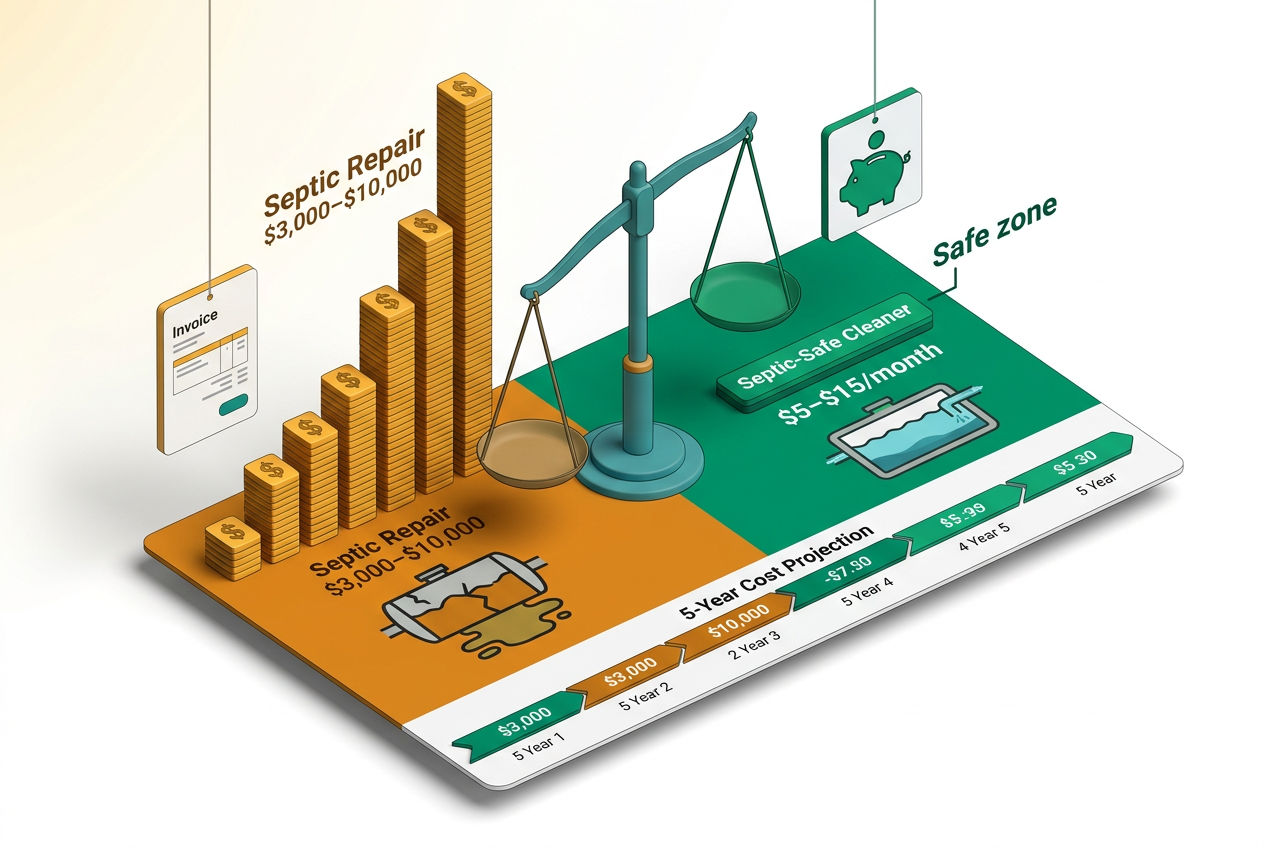
The math on cleaning products: if switching from a $4 bleach-based cleaner to a $6 septic-safe cleaner extends your system's functional lifespan by even two or three years, the dollar return is several orders of magnitude higher than the cost differential.
The products on this list range from $0.14/oz (Seventh Generation) to $0.29/oz (Better Life). Even at the high end, you're spending roughly $15–$20 per year on toilet bowl cleaner if you clean twice a week. That figure is essentially irrelevant compared to what you'd spend on a premature system repair.
For more on the full picture of what can harm your tank, our septic safe cleaning products pillar covers laundry, dish, and surface cleaners alongside the toilet-specific guidance here.
Frequently Asked Questions
What toilet bowl cleaners are safe for septic systems?
Toilet bowl cleaners that are safe for septic systems use biodegradable, plant-based active ingredients — primarily citric acid, lactic acid, or hydrogen peroxide — and carry certifications like EPA Safer Choice or EU Ecolabel. These formulas clean effectively without disrupting the anaerobic bacterial colonies your tank depends on. Top picks include Seventh Generation (citric acid, EPA Safer Choice, ~$4–$5 per 32 oz), Better Life (tea tree + citric acid, EPA Safer Choice, ~$6–$8 per 24 oz), Ecover (lactic acid, EU Ecolabel, ~$5–$7 per 25 oz), and Method Antibac (lactic acid, EPA Safer Choice, ~$4–$6 per 24 oz). Avoid anything with sodium hypochlorite (bleach), quaternary ammonium compounds (benzalkonium chloride), or a pH below 3 — these are the ingredients that damage your system. EPA Safer Choice certification is the most reliable quick indicator of septic-safe status among products currently on the market.
Is bleach toilet bowl cleaner bad for septic tanks?
Yes. Bleach-based toilet bowl cleaners — those containing sodium hypochlorite — are among the most harmful products you can regularly introduce to a septic system. A concentrated bleach cleaner can kill up to 90% of a tank's beneficial bacteria within 24 hours, according to the University of Minnesota Extension's Maintaining Your Septic System (2019). Recovery takes days to weeks, and repeated use can prevent full recovery. The National Onsite Wastewater Recycling Association (NOWRA) advises against routine bleach use in septic-served homes. The occasional accidental use of a small amount of bleach-based cleaner is unlikely to permanently damage a healthy system, but there's no concentration at which bleach is genuinely safe for regular septic use. Citric-acid or lactic-acid-based alternatives like Seventh Generation or Method Antibac clean comparably and cost the same. There's no practical reason to keep using bleach on septic.
What cleaning products should you avoid with a septic system?
For toilet bowl cleaners specifically, avoid sodium hypochlorite (standard bleach), quaternary ammonium compounds (labeled as benzalkonium chloride or alkyl dimethyl benzyl ammonium chloride), phosphates, formaldehyde, triclosan, and any formula with a pH below 3 or above 11. Clorox toilet tank tablets are the highest-risk common product — they release chlorine continuously with every flush rather than in a single dose. Beyond toilet bowl cleaners, the same rules apply: antibacterial soaps with triclosan, bleach-based drain cleaners, and non-biodegradable surfactants in laundry or dish products can all damage your tank's bacterial ecosystem over time. The EPA's Safer Choice program and the USDA BioPreferred label are the two most reliable certifications for confirming a product is safe across all household cleaning categories. See what kills septic bacteria for a comprehensive breakdown of harmful ingredients across product types.
Is Lysol toilet bowl cleaner safe for septic tanks?
Lysol's standard toilet bowl cleaner uses hydrochloric acid at approximately 9.5% concentration — a pH well below 3, which is the threshold associated with bacterial damage in septic tanks. It does not carry EPA Safer Choice certification. Lysol's "septic safe" claim on some packaging is based on dilution modeling: at typical use volumes (1–2 oz per cleaning, diluted into a large tank), the acid load may be insufficient to cause measurable bacterial damage. The honest assessment: occasional use — once every couple of weeks, with thorough rinsing — is unlikely to cause serious harm to a healthy, established system. But as a regular cleaning product for a septic household, it's not a sound choice when EPA Safer Choice-certified alternatives exist at the same or lower price. For a household already on a good maintenance schedule, there's no reason to introduce the risk.
What is the best natural toilet bowl cleaner for a septic system?
Among commercial products, Seventh Generation Toilet Bowl Cleaner (citric acid, EPA Safer Choice certified, ~$0.14/oz) is the top natural pick for most households — effective, affordable, and the most widely available septic-safe option in this category. For a true DIY approach, a ½ cup of baking soda followed by ½ cup of cleaning vinegar (6% acidity) after a five-minute wait handles routine odor and light staining without any commercial ingredients. Alternatively, ½ cup of 3% hydrogen peroxide with a 30-minute dwell time is more effective on staining and fully benign to your tank — hydrogen peroxide breaks down into water and oxygen. Neither DIY method matches commercial citric-acid cleaners on heavy limescale, so households with hard water (above 200 mg/L, common in the Southwest and Mountain West) will get better results with Seventh Generation or Better Life. For more on the vinegar question specifically, see is vinegar safe for septic systems.
Can I use Clorox ToiletWand with a septic system?
The Clorox ToiletWand disposable scrubbing pads present a different risk profile than Clorox toilet tank tablets. The ToiletWand applies cleaner to the bowl surface during scrubbing and flushes as a single dose — not a continuous chlorine release. That said, the ToiletWand pads contain sodium hypochlorite and are not EPA Safer Choice certified, so they're still not recommended as the regular cleaning tool for a septic household. The tank tablets — those blue drop-in tablets — are a separate product and far more damaging; they release chlorine with every single flush and should be avoided entirely on septic systems. If you like the convenience of the ToiletWand format, Method and Seventh Generation both make comparable bowl-scrubbing systems using septic-safe formulas. The format isn't the problem — the ingredient list is.
Sources & Methodology
How we selected these products: Products were evaluated on three criteria: ingredient transparency (full ingredient disclosure, not just "active ingredients"), third-party certifications (EPA Safer Choice, EU Ecolabel, USDA BioPreferred), and real-world consumer review data from Amazon and independent testing sources. We did not accept manufacturer samples or paid placements; all products were evaluated independently.
Sources cited:
- U.S. Environmental Protection Agency — How to Care for Your Septic System — https://www.epa.gov/septic — verified June 2025
- University of Minnesota Extension — Maintaining Your Septic System: A Guide for Homeowners (2019) — available at extension.umn.edu/septic-systems
- National Onsite Wastewater Recycling Association (NOWRA) — Homeowner's Guide to Septic System Care — nowra.org — verified June 2025
- EPA Safer Choice Program — certified product database — https://www.epa.gov/saferchoice — verified June 2025
- Minnesota Department of Agriculture / Michigan DEQ — state-level phosphate detergent restrictions — verified June 2025
Pricing note: All prices reflect typical retail and Amazon pricing as of June 2025. Prices vary by retailer and region. Price-per-ounce calculations are based on standard package sizes.
Need professional help with your septic system? Find a licensed septic inspector near you for routine maintenance, pumping, or diagnostic inspections.
Was this article helpful?
Frequently Asked Questions
Recommended Resources
📖 Related Articles
💰 Cost Guides
🔧 Services
Find Septic Professionals Near You
Compare licensed, verified septic companies by area — top county markets and cities below, or browse all 50 states.
County markets
Popular cities
