
Quick Answer
Hydrogen peroxide is safe for septic systems when used in standard household concentrations of 3%, in moderate amounts. A typical pour — a cup or two down a drain — dilutes harmlessly in a 1,000-gallon tank and won't disrupt your system's bacterial population. High-concentration formulas (35% or higher) are a different story and can cause serious damage if misused.
Key Takeaways
- Standard 3% hydrogen peroxide used occasionally in small amounts (1–2 cups) poses no meaningful risk to a 1,000–1,500-gallon septic tank.
- Concentrated H₂O₂ (35%+) can kill the beneficial bacteria your system depends on and should only be used by licensed septic professionals.
- Hydrogen peroxide breaks down into water and oxygen within minutes to hours — it leaves no harmful residue, unlike bleach.
- H₂O₂ is safer for septic systems than sodium hypochlorite (bleach), which leaves chlorinated byproducts that persist longer.
- Replacing a failed drainfield runs $5,000–$20,000+. The chemicals you pour down your drain today are a real financial risk.
Will Hydrogen Peroxide Kill the Good Bacteria in My Septic Tank?
At household concentrations, a small amount of 3% hydrogen peroxide will not kill the beneficial bacteria in your septic tank. Here's why: your tank holds 1,000–1,500 gallons of liquid. One cup of 3% H₂O₂ added to a 1,000-gallon tank dilutes to roughly 0.002% concentration — far below the bactericidal threshold. At that level, the oxidizing effect is negligible before H₂O₂ even breaks down completely.
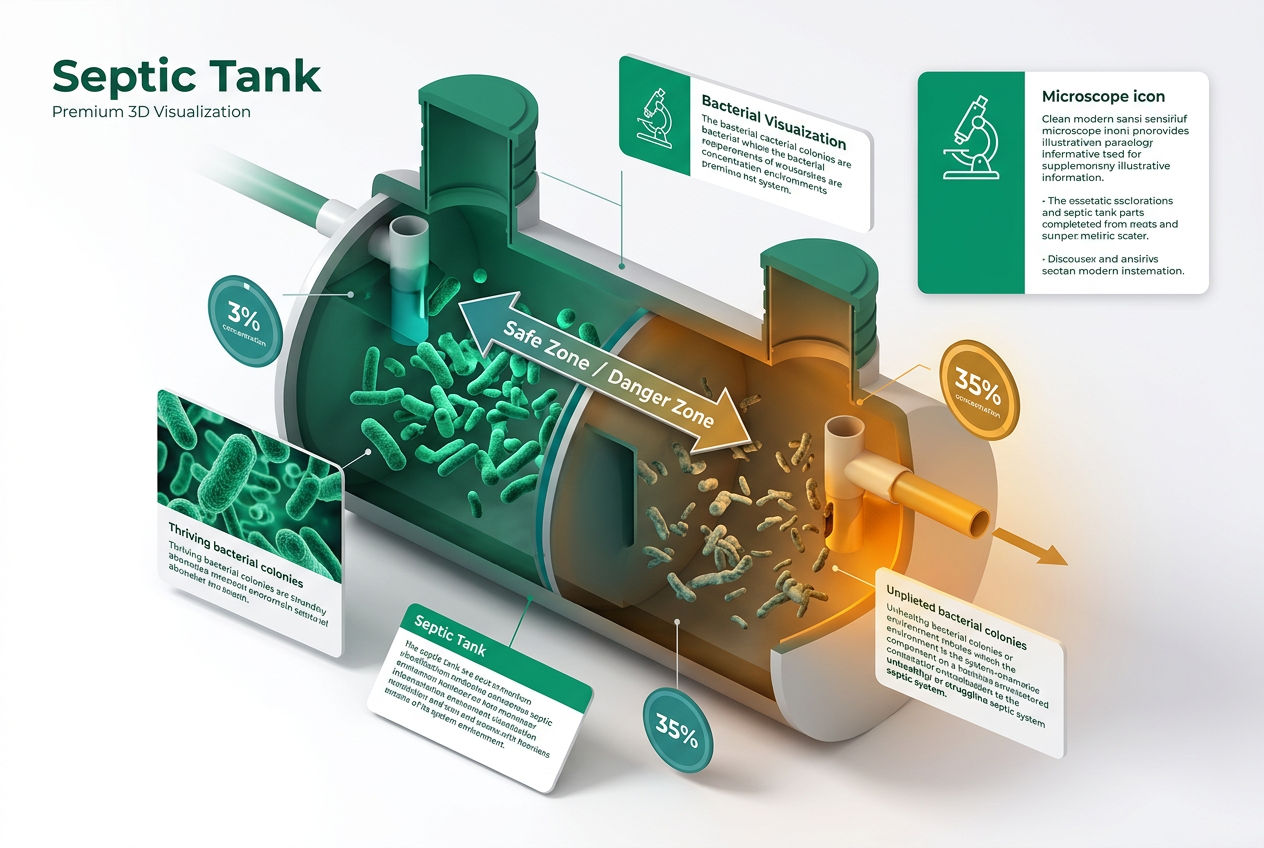
The chemistry works in your favor. Hydrogen peroxide is inherently unstable. In an organic-rich environment like your septic tank — full of bacteria, enzymes, and organic solids — H₂O₂ rapidly decomposes through the reaction:
H₂O₂ → H₂O + O₂
The half-life of hydrogen peroxide in contact with organic matter is measured in minutes to a few hours, not days. By the time a dilute solution reaches your tank's active bacterial zones, much of it has already converted to water and oxygen gas.
That said, concentration matters enormously. Laboratory research shows that sustained contact with solutions of 3% or higher concentration can kill bacteria — that's why it's sold as an antiseptic. The difference in a septic context is dilution. A capful of 3% H₂O₂ cleaning a wound stays concentrated. That same capful in a 1,000-gallon concrete tank is essentially nothing.
Where things go wrong is volume and concentration together. Pouring a gallon of 3% H₂O₂ down your drain repeatedly, or using any amount of 35% food-grade hydrogen peroxide without professional guidance, creates a real bactericidal risk inside your tank.
Can I Pour Hydrogen Peroxide Down the Drain If I Have a Septic System?
Yes — with conditions. Using 3% hydrogen peroxide for routine household cleaning is generally fine. Wiping down counters, cleaning a toilet bowl, rinsing a wound — none of these activities will produce a volume or concentration that threatens your system.
The same goes for products like oxygen-based cleaners, which use sodium percarbonate (a compound that releases hydrogen peroxide when dissolved). Used as directed, these are among the more septic-safe cleaning products available.
What you shouldn't do:
- Pour large volumes (a quart or more at once) of 3% H₂O₂ into a single drain
- Use 35% food-grade hydrogen peroxide as a DIY drain cleaner or septic treatment
- Add hydrogen peroxide directly to your septic tank as a "treatment" without professional input
If you're dealing with a clogged drain, check out your options for a septic-safe drain cleaner before reaching for anything stronger than 3% H₂O₂.
How Does Hydrogen Peroxide Compare to Bleach for Septic Systems?
Hydrogen peroxide is meaningfully safer for septic systems than sodium hypochlorite (liquid bleach). This isn't just marketing — there's a chemical reason.
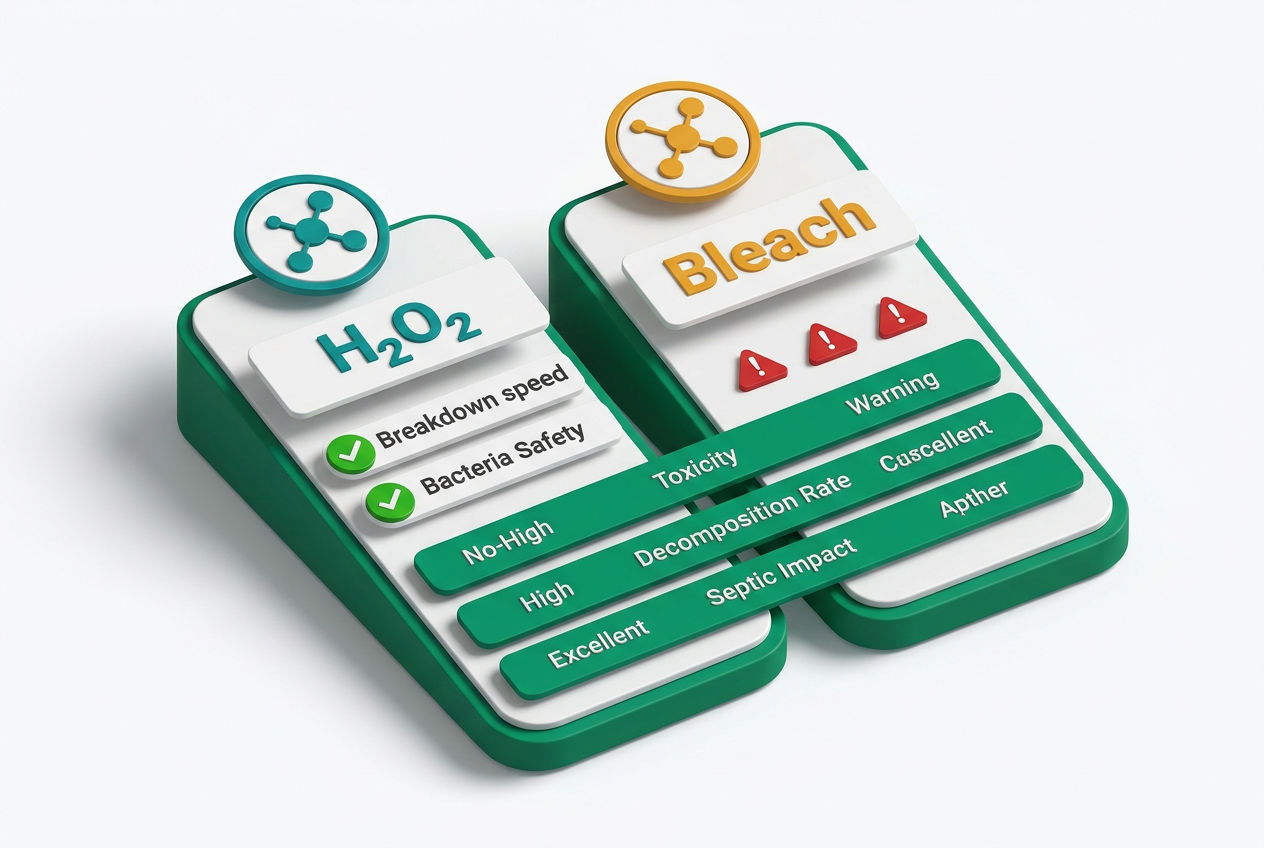
| Factor | 3% Hydrogen Peroxide | Household Bleach (5.25% NaOCl) |
|---|---|---|
| Breakdown products | Water + oxygen | Chlorinated compounds, sodium chloride |
| Half-life in organic environment | Minutes to hours | Hours to days |
| Bactericidal risk at dilution | Very low (household use) | Moderate — chlorine persists longer |
| Septic-safe at low volumes | Yes | Yes, but with stricter limits |
| Residual environmental impact | None | Chlorinated byproducts in effluent |
| Safe for drainfield soil bacteria | Yes, when diluted | Potentially damaging with repeated use |
Source: EPA Septic Systems Overview; Penn State Extension — Household Chemicals and Septic Systems
Bleach breaks down more slowly and generates sodium chloride and chlorinated organic compounds that can linger in your effluent. These compounds don't destroy a system with a single use, but they accumulate with repeated exposure — and the soil bacteria in your drainfield are more vulnerable than tank bacteria because they're in a smaller, less-buffered environment.
Read the full comparison in our article on whether bleach is safe for septic systems. If you're looking at other alternatives, vinegar is often cited as a gentler option — see our breakdown of whether vinegar is safe for septic systems for how it stacks up.
How Much Hydrogen Peroxide Is Safe for a Septic System?
Up to 1–2 cups of 3% hydrogen peroxide at a time is generally safe for a standard 1,000-gallon septic tank. Here's the math behind that guideline.
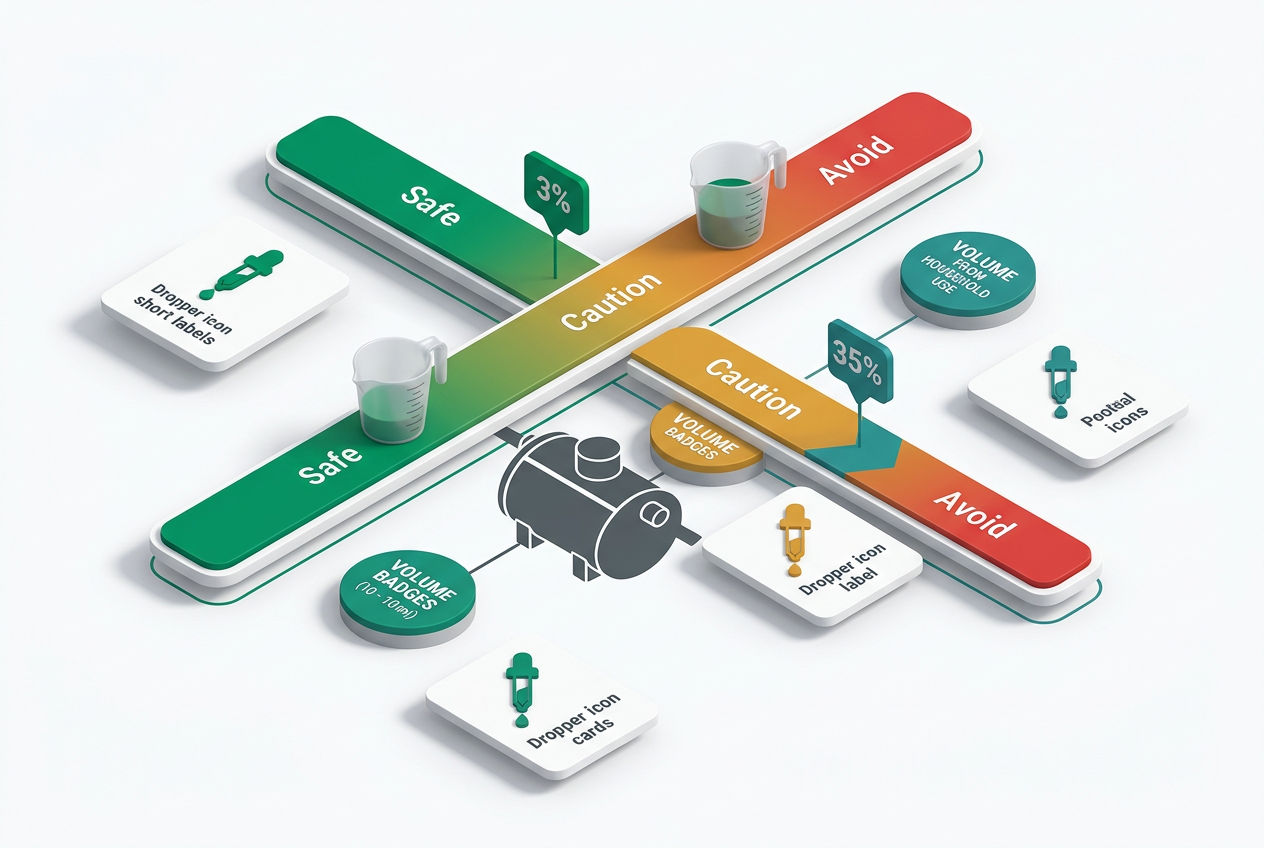
A 1,000-gallon septic tank serving a 3-bedroom home contains roughly 1,000 gallons of mixed liquid at any given time. One cup (8 oz) of 3% hydrogen peroxide added to that volume dilutes to approximately 0.0016% — about 16 parts per million. That's below the concentration at which H₂O₂ begins meaningfully disrupting microbial activity, and the solution will break down further within hours of entering the warm, bacteria-rich tank environment.
According to University of Minnesota Extension, dilution and frequency are the determining factors for chemical safety in septic systems, not ingredient identity alone. That framing is consistent with guidance from similar land-grant extension programs across the country.
What changes the calculus:
- Cold climates in winter. Bacterial activity in septic tanks slows significantly when soil temperatures drop. In Minnesota, Wisconsin, or Maine, your system's microbial population is already under stress from November through March. Even modest chemical disruptions can have a larger impact when your colony is operating at reduced capacity.
- Already-stressed systems. If your tank hasn't been pumped in six or more years, or you're noticing slow drains and odors, your bacterial population may already be depleted. This isn't the moment to experiment with oxidizing agents.
- Aerobic treatment units (ATUs). Systems with aerator compressors like the Hiblow HP-80 rely on a specialized aerobic bacterial colony that's more sensitive to chemical disruption than the anaerobic bacteria in a conventional tank. Check with your service provider before using any chemical cleaner if you have an ATU.
Regular pumping remains your best investment. For most 1,000-gallon tanks serving a 3-4 person household, that means service every 3–4 years. Our guide to how often to pump your septic tank walks through the full math.
Can Hydrogen Peroxide Unclog a Septic Drain Field?
Free download
Free: the Septic Fridge Card — what to flush, what never to.
The Do / Don’t card the whole family can see, plus the Survival Kit: emergency flowchart, warning-sign decoder and pump-schedule card. One printable PDF.
Yes — but only under specific professional conditions, and it's not a reliable fix. Some licensed septic contractors use controlled injections of 35% hydrogen peroxide to restore biomat-clogged drainfields, with mixed results. A biomat is a dense layer of organic slime that forms in the soil beneath your leach laterals when the system receives more organic load than it can process. It's the #1 reason drainfields fail.
The theory behind H₂O₂ drainfield treatment: injecting a controlled oxidizing solution into the gravel bed and perforated leach pipes briefly disrupts the anaerobic biomat, allows oxygen into the soil profile, and gives the drainfield soil a chance to recover biological function. Some contractors report success; the scientific literature is mixed.
Here's the honest limitation: this is not a DIY fix, and it's not a guaranteed fix at any price. Injecting 35% hydrogen peroxide without proper equipment and soil analysis can over-oxidize the soil bacterial community, damage Infiltrator chamber systems or perforated PVC laterals if applied incorrectly, and create oxygen off-gassing in confined spaces that presents a real physical hazard.
If your drainfield is struggling, a licensed contractor can assess whether H₂O₂ injection is appropriate, or whether you need a drain field repair or full replacement. That replacement, by the way, runs $5,000–$20,000+ depending on soil conditions, system size, and region — a number worth keeping in mind before pouring anything experimental into your system. See our drain field replacement cost guide for regional breakdowns.
For more on what causes drainfield failure and how to recognize it early, see our article on signs your drain field is failing.
What Cleaning Products Should You Actually Avoid with a Septic System?
Hydrogen peroxide is not the enemy. These are:
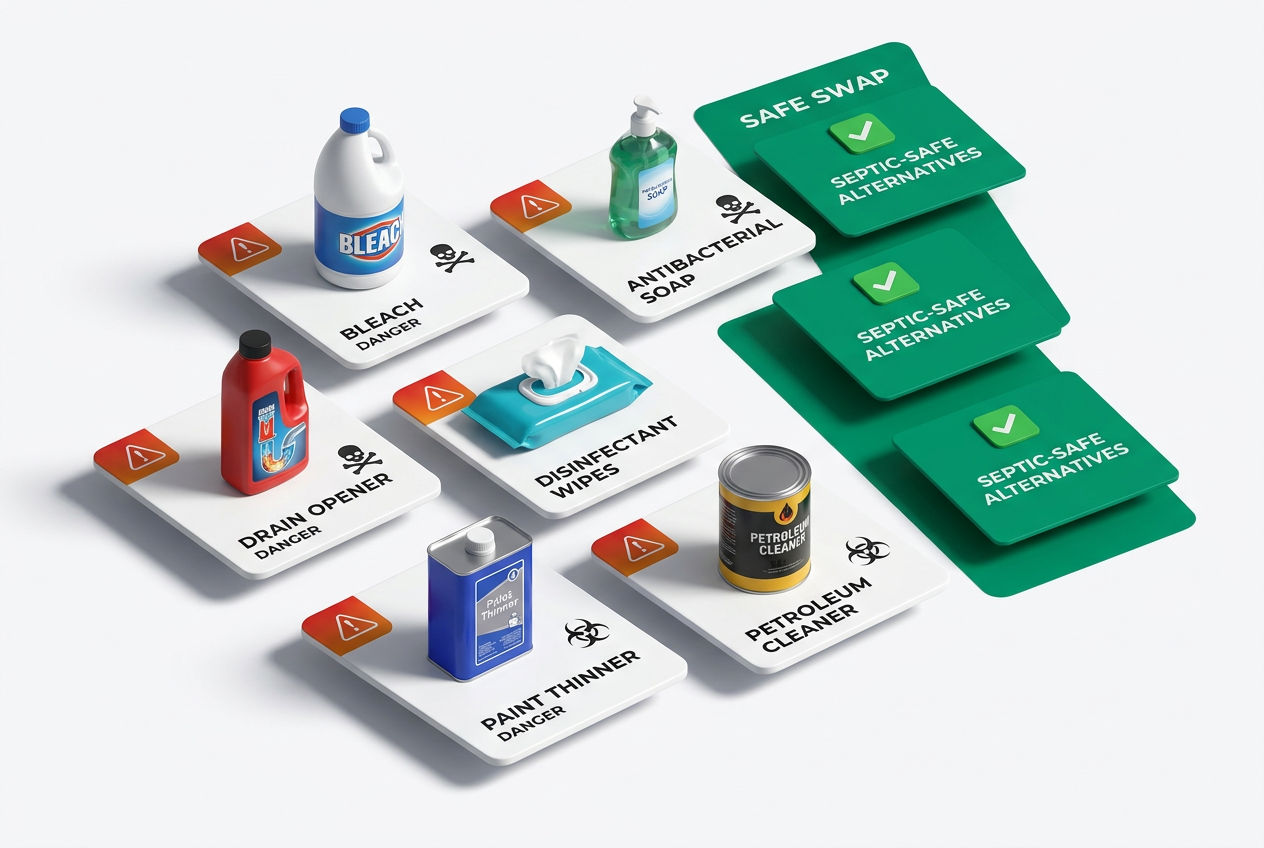
Antibacterial soaps and cleaners with triclosan — triclosan is specifically designed to kill bacteria and persists long enough to reach your tank's active zones.
Drain-clearing chemicals — products like Drano use sodium hydroxide (lye) at concentrations that will genuinely disrupt your tank's biological balance. Check our full article on whether you can use Drano with a septic system.
CLR and descalers — calcium, lime, and rust removers use strong acids. Even small volumes can drop the pH in your tank enough to stress your bacterial colony. See our breakdown of whether CLR is septic safe.
High-volume bleach pours — rinsing a single bleached item is fine. Sanitizing an entire rental unit between tenants with multiple gallons of bleach flushed down drains is not.
The common thread: high concentrations, persistent chemistry, and large volumes are what actually damage septic systems — not any single ingredient in normal household use. Borax, for example, gets flagged frequently but is actually quite gentle at typical laundry doses. See our article on whether borax is safe for septic tanks for that breakdown.
Does Hydrogen Peroxide Break Down Completely in a Septic Tank?
Yes — completely, and quickly. This is one of hydrogen peroxide's most important properties from a septic safety standpoint. Unlike bleach, which generates persistent chlorinated byproducts, H₂O₂ decomposes entirely into water and oxygen gas. There are no residual compounds to accumulate in your tank, travel through your drainfield, or leach into groundwater.
The decomposition rate depends on temperature, pH, and the concentration of organic material and catalytic metals (like iron) in your tank. In a typical active septic tank — warm, organically rich, slightly acidic — 3% H₂O₂ will break down within minutes to a few hours. At 35% concentration, the process is faster due to autocatalytic decomposition, but the initial oxidizing damage to bacteria happens before breakdown completes, which is why concentration and volume still matter.
This is a minor point and shouldn't be taken as a reason to add hydrogen peroxide as a "treatment" — your system doesn't need an oxygen boost from H₂O₂. But it does mean that the cleanup risk after a standard household exposure is essentially zero.
A Note on State Regulations
Some states regulate septic system additives more strictly than others. According to the Washington State Department of Health, chemical additives — including oxidizing agents — are not approved for use as septic treatments without specific authorization. Washington's regulations under WAC 246-272A are among the most explicit on this point in the country.
If you're considering any chemical treatment beyond routine household cleaning, contact your county's environmental health office first. Regulations vary significantly: what's permitted in a rural Texas county may require a permit in Oregon or Vermont.
For licensed professional help with your system, find a contractor through our septic repair services directory.
Frequently Asked Questions
Is hydrogen peroxide septic safe at 3% concentration?
Yes, 3% hydrogen peroxide is septic safe when used in typical household quantities. The critical factor is dilution: one cup of 3% H₂O₂ in a 1,000-gallon tank dilutes to approximately 16 parts per million — well below any meaningful bactericidal threshold. At that concentration, the hydrogen peroxide breaks down into water and oxygen within hours before it can disrupt the anaerobic bacteria your tank depends on. Routine uses — cleaning countertops, disinfecting a toilet bowl, treating a minor wound — generate nowhere near the volume needed to threaten your system. The distinction to keep in mind is that 3% is safe in normal use; 35% food-grade hydrogen peroxide is not appropriate for household septic use under any circumstances. If you use oxygen-based laundry boosters that contain sodium percarbonate, those are also generally safe, as they release dilute hydrogen peroxide when dissolved in wash water. Stick to household concentrations and moderate quantities and your system will not be affected.
Will hydrogen peroxide kill septic bacteria?
At household concentrations and typical volumes, hydrogen peroxide will not kill septic bacteria. The anaerobic bacterial colonies inside a 1,000–1,500-gallon tank are protected by sheer dilution: a cup of 3% H₂O₂ becomes roughly 0.0016% by the time it mixes into your tank's liquid volume. According to Penn State Extension's guidance on household chemicals and septic systems, it is concentration and frequency — not the presence of an ingredient — that determines biological harm. Where hydrogen peroxide does kill septic bacteria is at high concentrations (35%+) applied in volume, or when 3% product is added repeatedly in large quantities to an already-stressed system with a depleted bacterial population. If your tank hasn't been pumped recently, if you're in a cold-climate region during winter months, or if you have an aerobic treatment unit, your bacterial colony is more vulnerable and standard cautions apply with greater force. Under normal household conditions, the risk is negligible.
Can hydrogen peroxide unclog a drain in a house with a septic system?
Hydrogen peroxide can help clear minor organic buildup in drain lines, and it's among the safer options for homes on septic systems — but it has real limitations. Pouring half a cup of 3% H₂O₂ down a slow drain, followed by hot water, can help break up soap scum and light organic deposits without threatening your tank's bacterial balance. What it won't do is clear a genuine blockage caused by grease buildup, root intrusion, or a collapsed pipe — and reaching for a higher concentration to compensate is not safe in a septic context. Products like Drano or lye-based drain openers should be avoided entirely; their chemistry is far more disruptive to septic biology than H₂O₂ ever is. If a drain remains slow after a hydrogen peroxide flush, the problem is mechanical, not biological, and a licensed plumber or septic professional should assess the line. See our guide on septic-safe drain cleaners for ranked options.
How much hydrogen peroxide can I safely pour down the drain with a septic tank?
Up to 1–2 cups (8–16 oz) of 3% hydrogen peroxide at a time is a safe threshold for a standard 1,000-gallon septic tank used by a household of 3–4 people. That volume dilutes to roughly 16–32 parts per million in your tank — a concentration that degrades to nothing within hours in an active biological environment. The calculation changes if you're using it frequently: daily or near-daily pours of even modest volumes can maintain a higher sustained concentration in your tank than a single occasional use. A practical rule is to treat hydrogen peroxide the same way you'd treat any cleaning chemical — use what you need for the task, and don't treat your drain as a disposal route for excess product. If you're cleaning with 3% H₂O₂ and rinsing normally, you're almost certainly fine. If you're pouring out partial bottles on a regular basis, you're adding unnecessary chemical load that a simpler routine would avoid.
Is hydrogen peroxide safe for septic systems compared to other disinfectants?
Yes — hydrogen peroxide is one of the safer disinfectants for septic systems when compared directly to the alternatives. Sodium hypochlorite (bleach) generates chlorinated byproducts that persist in your effluent and can accumulate in drainfield soil over time. Triclosan-based antibacterial soaps are specifically engineered to kill bacteria and survive long enough in wastewater to reach your tank's active zones. Quaternary ammonium compounds (quats), found in many disinfectant sprays, are similarly persistent. Hydrogen peroxide's advantage is its breakdown chemistry: H₂O₂ decomposes entirely into water and oxygen, leaving no residual compounds. According to the EPA Septic Systems Overview, products that break down quickly and completely are significantly less likely to cause lasting harm to the biological processes a septic system depends on. That said, "safer than bleach" is not the same as "use without limits." Volume and concentration still matter, and 35% H₂O₂ in any quantity is not a safe household septic product.
Sources & Methodology
-
EPA Septic Systems Overview — U.S. Environmental Protection Agency guidance on household chemical impacts on onsite wastewater treatment systems. Used for breakdown chemistry comparisons and drainfield soil biology references.
-
Penn State Extension — Household Chemicals and Septic Systems — Extension publication on bactericidal thresholds, dilution principles, and chemical persistence in conventional septic tanks.
-
University of Minnesota Extension — Septic System Owner's Guide — Cited for guidance on dilution as the primary safety determinant and seasonal bacterial activity in cold-climate systems.
-
Washington State Department of Health — WAC 246-272A — State regulation governing chemical additives in onsite sewage systems; cited for regulatory variability context.
-
NSF International — Standard 40 for Residential Wastewater Treatment Systems — Referenced for aerobic treatment unit (ATU) sensitivity to chemical disruption, relevant to the Hiblow HP-80 and similar compressor-driven ATU systems.
Was this article helpful?
Frequently Asked Questions
Recommended Resources
📖 Related Articles
- Septic-Safe Cleaning Products: The Complete List (Safe vs. Avoid)
- The Best Septic-Safe Drain Cleaners (and What to Never Pour In)
- Is Bleach Safe for Septic Systems?
- Is Vinegar Safe for Septic Systems?
- How Often Should You Pump Your Septic Tank?
- Signs Your Drain Field Is Failing (And What to Do)
- Can You Use Drano with a Septic System?
- Is CLR Septic Safe?
- Is Borax Safe for Septic Tanks?
💰 Cost Guides
🔧 Services
Find Septic Professionals Near You
Compare licensed, verified septic companies by area — top county markets and cities below, or browse all 50 states.
County markets
Popular cities
