
Quick Answer
Is CLR septic safe? Yes — CLR Calcium, Lime & Rust Remover is septic safe when used as directed. Manufacturer Jelmar states this explicitly on their product documentation, and CLR carries the EPA Safer Choice certification — a program that requires ingredient-level safety reviews for every compound in the formula. Occasional household use sends only a few ounces into a tank holding 1,000–1,500 gallons, making harmful concentration levels unlikely.
Key Takeaways
- CLR Calcium, Lime & Rust Remover is officially septic safe per manufacturer Jelmar and carries EPA Safer Choice certification.
- CLR's active ingredients — lactic acid, gluconic acid, and lauramine oxide — replaced older, harsher phosphoric acid formulas.
- Not all CLR products are equal: CLR Mold & Mildew Stain Remover contains sodium hypochlorite (bleach) and is not septic safe.
- A few ounces of CLR dilutes into 1,000+ gallons of tank volume — context that makes occasional use low-risk.
- Daily or heavy use of any acidic cleaner can shift the pH balance inside your tank and stress beneficial bacteria.
Does CLR Harm Septic Tank Bacteria?
Not significantly, when used occasionally. CLR's formula has a pH of approximately 2.0–2.5 — highly acidic out of the bottle. That sounds alarming, but dilution changes everything.
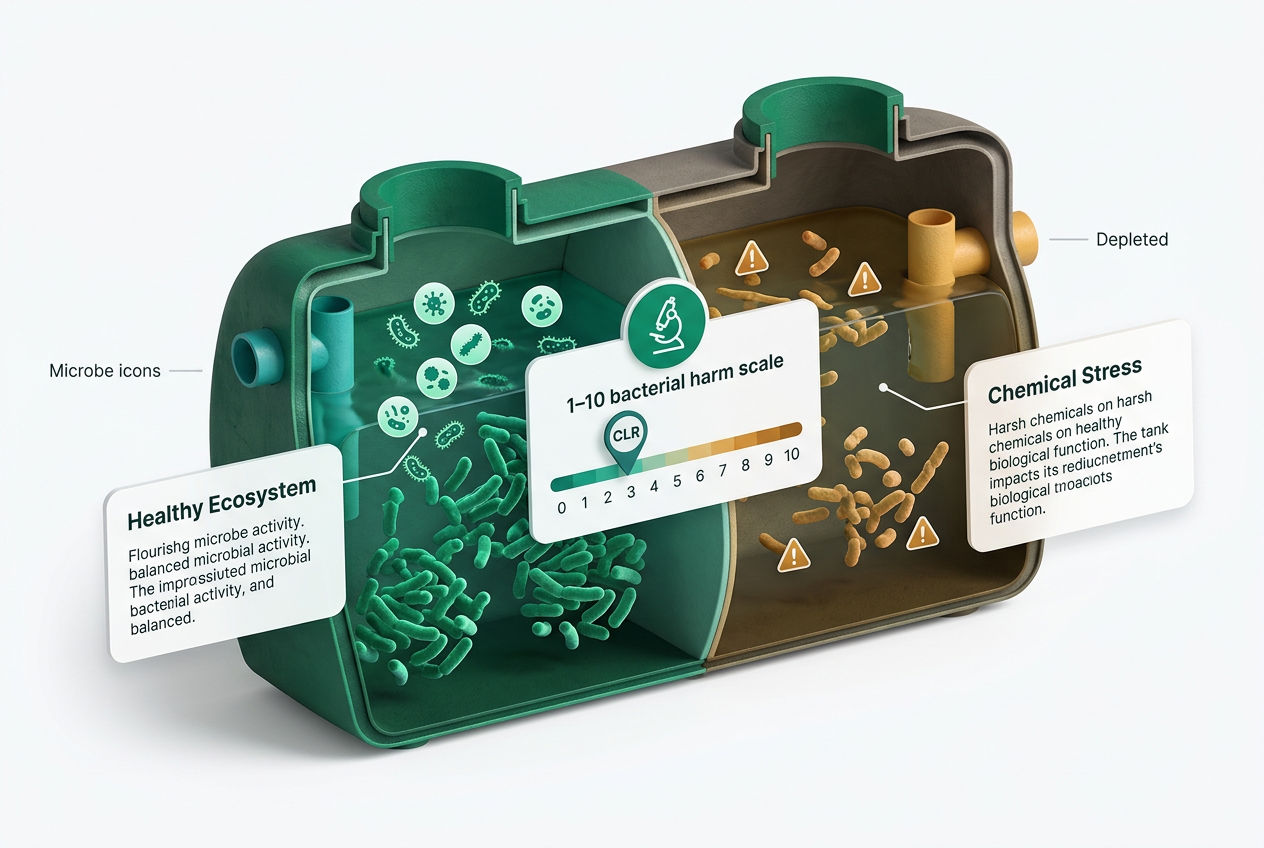
Here's a concrete example: you use CLR to descale a bathroom faucet and rinse roughly 3 ounces down the drain. Your 1,000-gallon septic tank contains approximately 8,000 pints of liquid. Those 3 ounces represent about 0.002% of the tank volume. Even if CLR entered the tank at full strength — which it doesn't, because it dilutes through 20–40 feet of drain pipe first — the resulting pH shift inside the tank is negligible. Running the dishwasher twice in a row or doing four back-to-back laundry loads introduces more chemical stress than a single CLR rinse.
University of Minnesota Extension research on septic system management notes that beneficial anaerobic bacteria can recover from minor chemical exposure within 24–48 hours, provided the exposure isn't continuous. One periodic cleaning with CLR doesn't constitute a bacterial wipeout.
Where problems start is frequency. If you're soaking shower components in CLR weekly, running it through your coffee maker and dishwasher regularly, and using other acid-based cleaners simultaneously, the cumulative effect can stress the bacterial colonies your tank depends on. Occasional use? Low risk. Daily or weekly use across multiple fixtures? That's worth reconsidering.
One honest limitation here: most of the data on septic chemical tolerance comes from studies on bleach and sodium hydroxide, not lactic-acid-based cleaners specifically. The "occasional use is safe" conclusion for CLR is supported by EPA Safer Choice certification and Jelmar's product documentation — but no long-term controlled study exists on CLR's cumulative effect in residential septic tanks at high usage frequencies. That gap is worth acknowledging.
Which CLR Products Are Septic Safe — and Which Aren't?
Not all CLR products share the same septic safety status — and grabbing the wrong one is a common mistake.
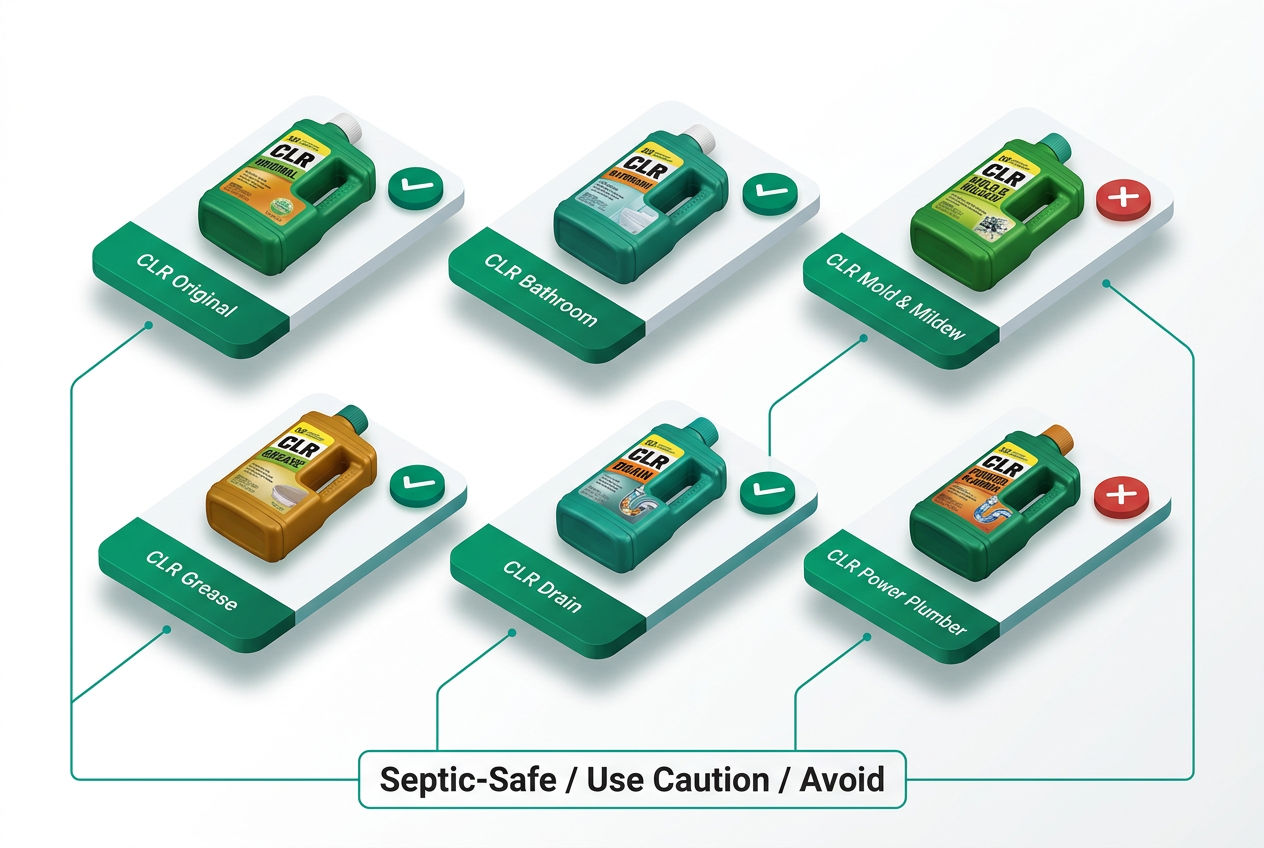
"CLR" is a product family, not a single formula. Jelmar makes several products under the CLR name, and their ingredients vary significantly.
| CLR Product | Active Ingredients | Septic Safe? |
|---|---|---|
| CLR Calcium, Lime & Rust | Lactic acid, gluconic acid, lauramine oxide | ✅ Yes — when used as directed |
| CLR Bath & Kitchen Cleaner | Surfactants, water-based formula | ✅ Generally yes |
| CLR Brilliant Bath | Lactic acid base | ✅ Yes — per Jelmar |
| CLR Mold & Mildew Stain Remover | Sodium hypochlorite (bleach) | ❌ No — bleach-based |
| CLR Fresh Scents Septic Treatment | Bacterial enzyme formula | ✅ Yes — designed for septic use |
Source: Jelmar product documentation (jelmar.com/products) and EPA Safer Choice program records (epa.gov/saferchoice/products).
The red flag product is CLR Mold & Mildew Stain Remover. Homeowners often grab it assuming anything with "CLR" on the label behaves similarly. It doesn't. Sodium hypochlorite — the active ingredient in bleach — kills both the harmful organisms and the beneficial anaerobic bacteria your tank needs to break down solids. Even small quantities flushed regularly can disrupt the bacterial balance in a conventional septic system.
For a deeper look at how bleach affects your septic system, that article breaks down the concentration thresholds in detail.
Always flip the bottle over and read the active ingredients before buying. If you see sodium hypochlorite or any quaternary ammonium compound ("quats"), keep it out of a septic-connected drain.
What Makes CLR (the Original) Safer Than Other Descalers?
CLR reformulated its flagship product away from phosphoric acid — a harsher compound that's slower for bacteria to process — toward lactic acid and gluconic acid. That single change is the foundation of its septic compatibility.
Both lactic acid and gluconic acid are organic acids that biodegrade more readily than phosphoric acid. Lactic acid, in particular, is naturally produced by bacteria during fermentation — it's not a foreign compound to a bacterial environment. Lauramine oxide, the surfactant in the mix, also biodegrades relatively quickly compared to petroleum-derived surfactants found in many conventional cleaners.
That reformulation is why CLR earned the EPA Safer Choice certification. To carry that label, every ingredient in a product has to pass an EPA review for human health, environmental, and aquatic toxicity criteria. It's not marketing language — it's a meaningful third-party signal backed by ingredient-level documentation.
Compare that to other common cleaners:
- Drano/Liquid-Plumr: Sodium hydroxide (lye) at extremely high pH. Aggressive enough to create problems in a septic system, particularly with repeated use.
- Bleach-based bathroom sprays: Directly lethal to bacterial colonies in high enough doses.
- Antibacterial hand soaps and cleaners: The triclosan era is largely over, but quaternary ammonium compounds in many "antibacterial" products persist in tank environments and suppress bacterial activity.
CLR's original formula sits in a meaningfully less disruptive category for septic systems than the above — not because acid is harmless, but because lactic acid and gluconic acid break down faster and at lower concentrations than the alternatives.
How Much CLR Is Too Much for a Septic System?
There's no single threshold published for CLR specifically, but the underlying principle comes from how septic systems handle chemical load: it's cumulative.
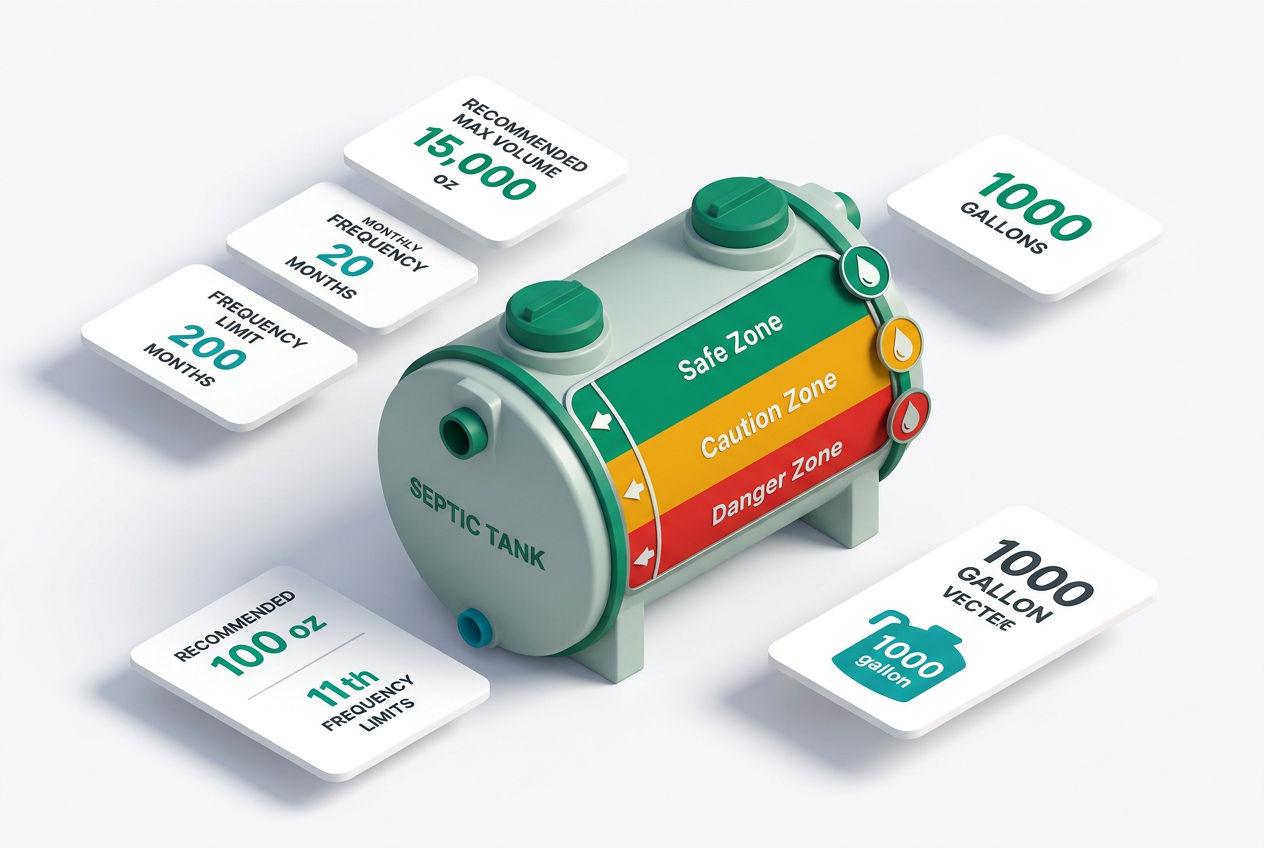
A 1,500-gallon concrete tank on a 4-person household is designed to receive roughly 300–400 gallons of wastewater per day. Under normal conditions, the bacterial colonies inside — tucked in the sludge layer at the bottom and the scum layer at the top — process incoming waste continuously. The effluent that exits through the baffle wall and flows to your drain field should be relatively clarified liquid, not solids.
To put the numbers in perspective: 3 ounces of CLR entering a 1,500-gallon tank represents a dilution ratio of roughly 1:6,400. At that concentration, the lactic acid component — which has a half-life of under 24 hours in aerobic conditions — reaches the tank already partially neutralized. The concern isn't a single use event; it's sustained accumulation across multiple products.
If every cleaning product entering that tank is acidic or antibacterial, the bacteria work under constant stress. Jelmar's guidance for CLR is "occasional use," which aligns with what most extension service septic advisors recommend for any acid-based cleaner: once or twice a month per application point, not daily.
A practical guideline: if you're using CLR on a faucet aerator once a month, you're fine. If you're using it in three bathrooms every week and running bleach-based toilet tabs and using antibacterial dish soap daily, your tank's bacterial population is under sustained pressure. You might not notice for months — until you notice slow drains, odors near the drain field, or a tank that's filling with undigested solids faster than it should.
The EPA recommends pumping a residential septic tank every 3–5 years. A 1,000-gallon tank serving a family of four typically needs pumping every 3–4 years under normal chemical load. Overload the tank with bactericide-heavy cleaners and that interval can shorten — meaning more frequent septic pumping costs that run $300–$600 per service call in most parts of the country.
Is CLR Safe to Pour Directly Down the Drain?
Free download
Free: the Septic Fridge Card — what to flush, what never to.
The Do / Don’t card the whole family can see, plus the Survival Kit: emergency flowchart, warning-sign decoder and pump-schedule card. One printable PDF.
Yes — for normal cleaning use. You're rinsing a treated surface, not dumping the bottle. The typical application sends 1–4 ounces into the drain, which dilutes rapidly.
That's very different from pouring a quart of undiluted acid directly into a drain line with the intent of clearing a clog. CLR isn't marketed as a drain cleaner, and you shouldn't use it as one. If you have a slow drain on a septic system, septic-safe drain cleaners based on enzymatic or bacterial formulas are a better fit. They address organic buildup without the acid load.
For routine descaling — showerheads, faucet aerators, coffee makers, washing machine drums — rinsing CLR down the drain after use is fine. Follow the product directions, which typically involve soaking for 2 minutes, then rinsing thoroughly with water. That rinse water is carrying a diluted residue, not a concentrated dose.
How Does CLR Compare to Other Septic-Safe Cleaners?
For descaling tasks specifically, CLR is one of the better-tolerated options available on a septic system — but it's not the only one worth knowing.
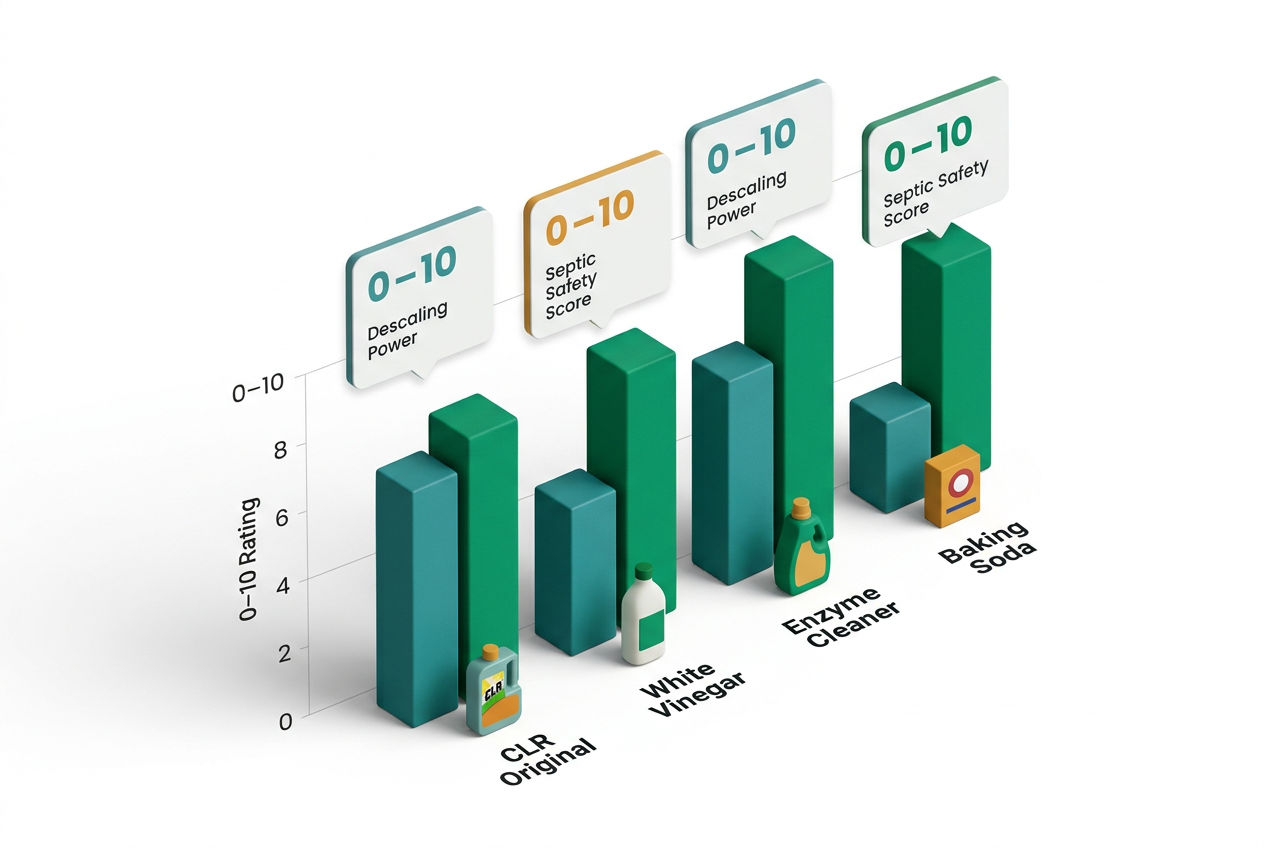
If you're building a cleaning routine around septic-safe cleaning products, CLR fits in the "approved" column for descaling tasks. Some comparisons worth knowing:
- White vinegar: pH around 2.5 — nearly identical to CLR's acidity. Genuinely septic safe, biodegradable, and effective for light mineral buildup. For heavy scale, CLR outperforms it. Vinegar's full septic profile is worth reading if you prefer natural options.
- OxiClean: Oxygen-based, not acid-based. OxiClean's septic compatibility is generally positive for occasional use, though it works on different types of stains than CLR.
- Borax: A mild alkaline cleaner. Borax and septic systems have a complicated relationship — it's less harmful than bleach but still bacteriostatic in high concentrations.
- Hydrogen peroxide: Breaks down into water and oxygen. Hydrogen peroxide in septic systems is generally tolerated, particularly at household concentrations (3%).
For descaling specifically — the core job CLR was designed for — CLR or diluted white vinegar are your two best septic-compatible options. CLR wins on heavy mineral deposits; vinegar wins on cost and simplicity.
What Should You Avoid Putting in a Septic System?
CLR's original formula doesn't make this list. These products do — and several are common enough that homeowners use them without realizing the risk:
- Bleach in large quantities: A single bleach load of laundry is tolerable. Daily use of bleach-based toilet bowl cleaners, bathroom sprays, and laundry products in combination is not.
- Antibacterial soaps with quats: Quaternary ammonium compounds persist in tank environments longer than most surfactants and suppress the anaerobic bacteria that process waste.
- Chemical drain openers (Drano, Liquid-Plumr): High-pH sodium hydroxide formulas attack bacterial colonies and can corrode older concrete tank components. See our full breakdown on whether you can use Drano with a septic system.
- "Flushable" wipes: Not a chemical issue — a physical clog issue. They don't break down in tank conditions the way toilet paper does.
- Prescription medications: Hormones, antibiotics, and other pharmaceuticals flushed down the drain pass through the tank largely intact and can suppress bacterial activity.
- Paint, solvents, and automotive fluids: These don't belong in any residential drain system, septic or otherwise.
The septic tank maintenance guide covers the full avoidance list in detail, including products that seem safe but accumulate over time.
Frequently Asked Questions
Is CLR safe for septic tanks, or will it kill the bacteria?
CLR Calcium, Lime & Rust Remover is safe for septic tanks when used occasionally. The formula's active ingredients — lactic acid, gluconic acid, and lauramine oxide — are organic compounds that biodegrade relatively quickly and carry EPA Safer Choice certification, which requires ingredient-level toxicity review. When you rinse 2–4 ounces of CLR off a faucet aerator or showerhead, it dilutes through 20–40 feet of pipe before reaching your tank. Inside a 1,000-gallon tank, that represents a dilution ratio of roughly 1:6,400 — too low to meaningfully alter pH or bacterial populations. University of Minnesota Extension notes that anaerobic bacteria recover from minor chemical exposure within 24–48 hours when exposure isn't continuous. The risk isn't a single CLR cleaning; it's using multiple bactericidal products simultaneously across every fixture in your home on a daily basis. For occasional descaling, CLR poses no meaningful threat to septic bacteria.
Does CLR hurt septic systems if you use it every week?
Weekly CLR use across multiple fixtures is where the risk becomes real. A single occasional use is low-risk due to extreme dilution — but cumulative chemical load matters. If you're applying CLR to three bathrooms weekly, running it through a coffee maker, and using bleach-based toilet tabs and antibacterial dish soap simultaneously, your tank's bacterial population is working under sustained stress. The beneficial anaerobic bacteria in your tank process waste continuously; suppress them long enough and solids accumulate rather than break down. The practical result is a tank that fills faster than normal, requiring pump-outs sooner than the EPA's recommended 3–5 year interval. Those pump-outs cost $300–$600 per service call in most regions. Jelmar's own guidance for CLR is "occasional use" — not weekly. Treat it as a periodic descaler for stubborn mineral buildup, not a routine cleaning product you apply on a schedule, and your septic system will handle it without issue.
What is CLR septic safe for — what can I actually clean?
CLR Calcium, Lime & Rust Remover is septic safe for any standard descaling task in a home connected to a septic system. That includes: faucet aerators with mineral buildup, showerheads clogged with calcium deposits, coffee makers accumulating lime scale, washing machine drums with hard-water residue, toilet bowls with rust or calcium staining, and dishwasher interiors. For each of these, the method is the same — apply CLR per label directions (typically a 2-minute soak or direct application), then rinse thoroughly with water. The rinse water carries diluted residue into the drain, not concentrated product. What CLR is not designed for — and should not be used as on a septic system — is drain clearing. Pouring a significant volume of undiluted CLR into a drain to clear a clog sends a far higher acid load into the system than a surface cleaning rinse. For slow drains on septic systems, enzymatic drain cleaners are the safer choice.
Is CLR Mold and Mildew Remover septic safe?
No — CLR Mold & Mildew Stain Remover is not septic safe. Unlike CLR Calcium, Lime & Rust, this product contains sodium hypochlorite as its active ingredient, which is the same compound found in household bleach. Sodium hypochlorite doesn't distinguish between harmful pathogens and the beneficial anaerobic bacteria your septic tank depends on to break down waste. Even small, repeated doses of bleach-based products can disrupt the bacterial balance in a conventional septic system. This is the most common CLR-related mistake homeowners make: assuming all products in the CLR family share the same formula. They don't. Before buying any CLR product, flip the bottle and check the active ingredients. If you see sodium hypochlorite or any quaternary ammonium compound, keep it away from septic-connected drains. For mold and mildew treatment on a septic system, look for hydrogen peroxide-based or enzyme-based alternatives that don't carry bleach's bactericidal risk.
How does CLR compare to vinegar for septic-safe descaling?
Both CLR and white vinegar are septic-safe descaling options, and their pH levels are nearly identical — vinegar runs around 2.5, CLR approximately 2.0–2.5. The difference is performance and cost. For light mineral deposits — a faucet aerator with minor buildup, a coffee maker run quarterly — distilled white vinegar works well and costs almost nothing. For heavy calcium and lime scale, particularly in high-iron or hard-water areas where deposits have built up over months, CLR's lactic acid and gluconic acid formula is meaningfully more effective. Vinegar's acetic acid works more slowly on dense mineral scale. Neither product poses meaningful risk to a healthy septic system at normal household usage volumes. If you're choosing between them on septic safety grounds alone, both pass. If you're choosing on effectiveness for serious mineral buildup, CLR is the stronger tool. If cost and simplicity matter more than descaling power, vinegar is the practical choice for routine maintenance.
Are there any CLR products actually designed for septic systems?
Yes — CLR Fresh Scents Septic Treatment is a CLR-branded product specifically formulated for septic system maintenance rather than household cleaning. Unlike the acidic descalers in the CLR line, CLR Fresh Scents uses a bacterial enzyme formula designed to support — not stress — the microbial populations inside a septic tank. It works by introducing additional bacterial cultures and enzymes that accelerate the breakdown of organic solids in the tank. This type of product is sometimes called a septic tank activator or biological additive. Whether septic additives meaningfully extend pump-out intervals remains debated among wastewater professionals; the National Onsite Wastewater Recycling Association (NOWRA) notes that a healthy, properly loaded tank generally doesn't require biological supplements. That said, CLR Fresh Scents won't harm your system the way a bleach-based product would, and some homeowners use it after a pump-out or following a period of heavier chemical use as a precaution. It's the one product in the CLR line purpose-built for septic compatibility.
Sources & Methodology
- Jelmar product documentation — Jelmar.com/products: Active ingredient lists, septic safety statements, and usage guidance for CLR Calcium Lime & Rust, CLR Brilliant Bath, CLR Mold & Mildew Stain Remover, and CLR Fresh Scents Septic Treatment.
- EPA Safer Choice program — epa.gov/saferchoice/products: Certification records and ingredient review criteria for CLR Calcium, Lime & Rust Remover.
- University of Minnesota Extension, Septic System Owner's Guide — Bacterial recovery timelines and chemical tolerance guidance for residential septic systems.
- U.S. Environmental Protection Agency, Septic Systems Overview — epa.gov/septic: Pumping frequency recommendations (every 3–5 years) and general household chemical load guidance.
- National Onsite Wastewater Recycling Association (NOWRA) — Position guidance on biological additives and septic system maintenance best practices.
Was this article helpful?
Frequently Asked Questions
Recommended Resources
📖 Related Articles
- Is Bleach Safe for Septic Systems?
- Can You Use Drano with a Septic System?
- What Is a Drain Field? (And How Does It Work?)
- The Best Septic-Safe Drain Cleaners (and What to Never Pour In)
- Septic-Safe Cleaning Products: The Complete List (Safe vs. Avoid)
- Is Vinegar Safe for Septic Systems?
- Is Oxiclean Septic Safe?
- Is Borax Safe for Septic Tanks?
- Is Hydrogen Peroxide Safe for Septic Systems?
- The Complete Septic Tank Maintenance Guide
💰 Cost Guides
Find Septic Professionals Near You
Compare licensed, verified septic companies by area — top county markets and cities below, or browse all 50 states.
County markets
Popular cities
