
Quick Answer
Borax is generally safe for septic tanks when used in typical household quantities — about ½ cup per laundry load. It is far less harmful than chlorine bleach or antibacterial cleaners. However, borax raises solution pH to around 9.3, which can inhibit beneficial bacteria if used in large or concentrated amounts.
Key Takeaways
- ½ cup of borax per laundry load is the widely accepted safe threshold for septic systems
- Borax raises solution pH to ~9.3; a healthy septic tank runs best between pH 6.5–7.5
- It is significantly less damaging than chlorine bleach, which can kill anaerobic bacteria at concentrations as low as 1 part per million
- 20 Mule Team Borax carries no septic-unsafe warning on its label and is broadly considered septic-compatible at normal use rates
- Excessive or daily concentrated use can stress your system's bacterial biome over time
You're switching to more natural cleaners. Borax keeps coming up — it's cheap, it whitens laundry, it scrubs tile, and people call it "natural." But you've got a septic tank out back, and you know that what goes down your drain ends up in a concrete or plastic tank where billions of bacteria are doing the work of breaking down everything your household sends their way.
So before you dump a scoop into your washing machine, you want to know: is borax actually safe for septic systems, or is it just marketing?
Fair question. Here's the real answer.
What Is Borax, Exactly?
Borax is the common name for sodium borate (Na₂B₄O₇·10H₂O). It's a naturally occurring mineral salt mined primarily from evaporite deposits in California and Turkey. You'll find it in the laundry aisle under the brand name 20 Mule Team Borax — the same product that's been on store shelves since 1891.
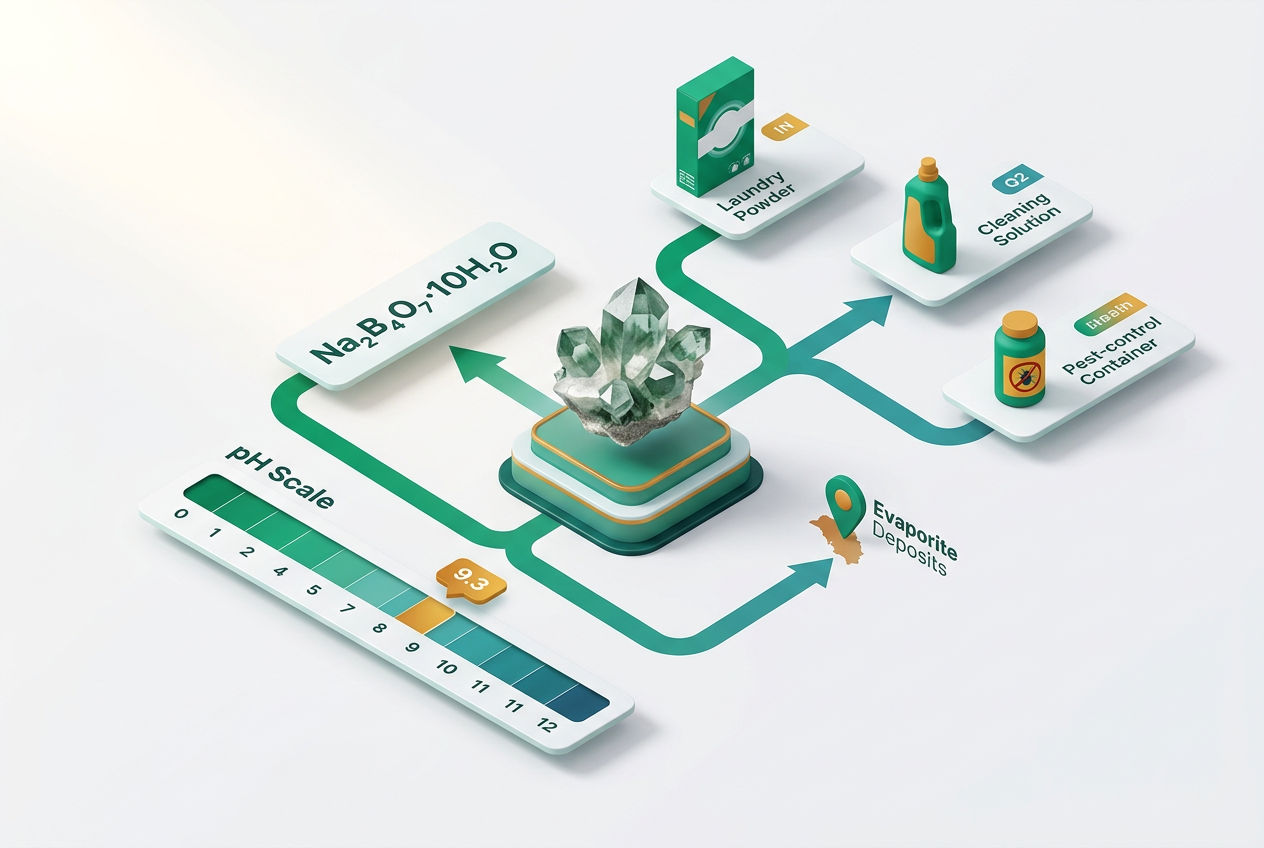
In solution, borax dissolves into borate ions and sodium ions. It does not release chlorine gas. It doesn't contain phosphates the way older laundry detergents did. It's not EPA-registered as a pesticide for septic use, meaning it wasn't designed or approved to kill microorganisms in wastewater systems.
That last point matters. A lot of the "natural" cleaners people worry about — bleach, quaternary ammonium compounds, triclosan-based antibacterial soaps — are specifically engineered to kill microbes. Borax isn't. That's a meaningful distinction when your goal is protecting the beneficial bacteria in your septic tank.
Does Borax Kill the Good Bacteria in a Septic Tank?
In normal household concentrations, borax does not kill the beneficial bacteria in your septic tank. The concern is indirect: borax raises the pH of its solution to approximately 9.3, and a healthy septic system operates best at a pH between 6.5 and 7.5. Push that pH high enough, for long enough, and you can slow down the anaerobic and facultative bacteria doing the heavy lifting inside your tank.
But here's what that actually looks like in practice. Your average top-loading washing machine uses 15–30 gallons of water per cycle. A standard residential septic tank holds 1,000–1,500 gallons. When ½ cup of borax dissolves into even 15 gallons of wash water, and that water enters a 1,000-gallon tank, the dilution ratio is enormous. The pH spike that borax creates at the washing machine level gets absorbed and neutralized by the buffering capacity of the tank's existing liquid — called the "liquid effluent" or tank liquor — without meaningfully shifting the tank's overall pH.
The University of Minnesota Extension, which publishes some of the most cited guidance on household chemicals and septic systems, notes that most household cleaning products used in normal quantities don't threaten septic function. The threat comes from volume and frequency — not a single ½-cup scoop.
Compare that to chlorine bleach, which can disrupt anaerobic bacterial colonies at concentrations as low as 1 part per million. If you're doing multiple bleach-heavy loads per week, you're doing real, measurable damage. Borax at ½ cup per load? Not in the same category. For a direct comparison of how these products stack up, see our article on whether bleach is safe for septic systems.
Is 20 Mule Team Borax Safe for Septic Tanks?
Yes. 20 Mule Team Borax does not carry a septic-unsafe warning on its packaging, and the product has been evaluated in the context of household wastewater for decades. The EPA has not classified sodium borate as a regulated aquatic toxin at household use rates, and it does not increase biological oxygen demand (BOD) the way many synthetic surfactants do — meaning it doesn't deplete the oxygen supply that certain bacteria need to function.
That said, 20 Mule Team isn't magic. Using it every single day as a multi-purpose cleaner — floors, laundry, toilet scrub, bathroom spray, all in one household — starts to add up. A family of four that runs borax through five laundry loads per week plus uses it for weekly bathroom cleaning isn't likely to crash their system, but they're pushing closer to the edge than a household that uses it once or twice a week.
Borax vs. Bleach vs. Other Cleaners: How Do They Compare?
This is the question most homeowners actually need answered. Here's how common cleaners stack up against your septic system's bacterial population.
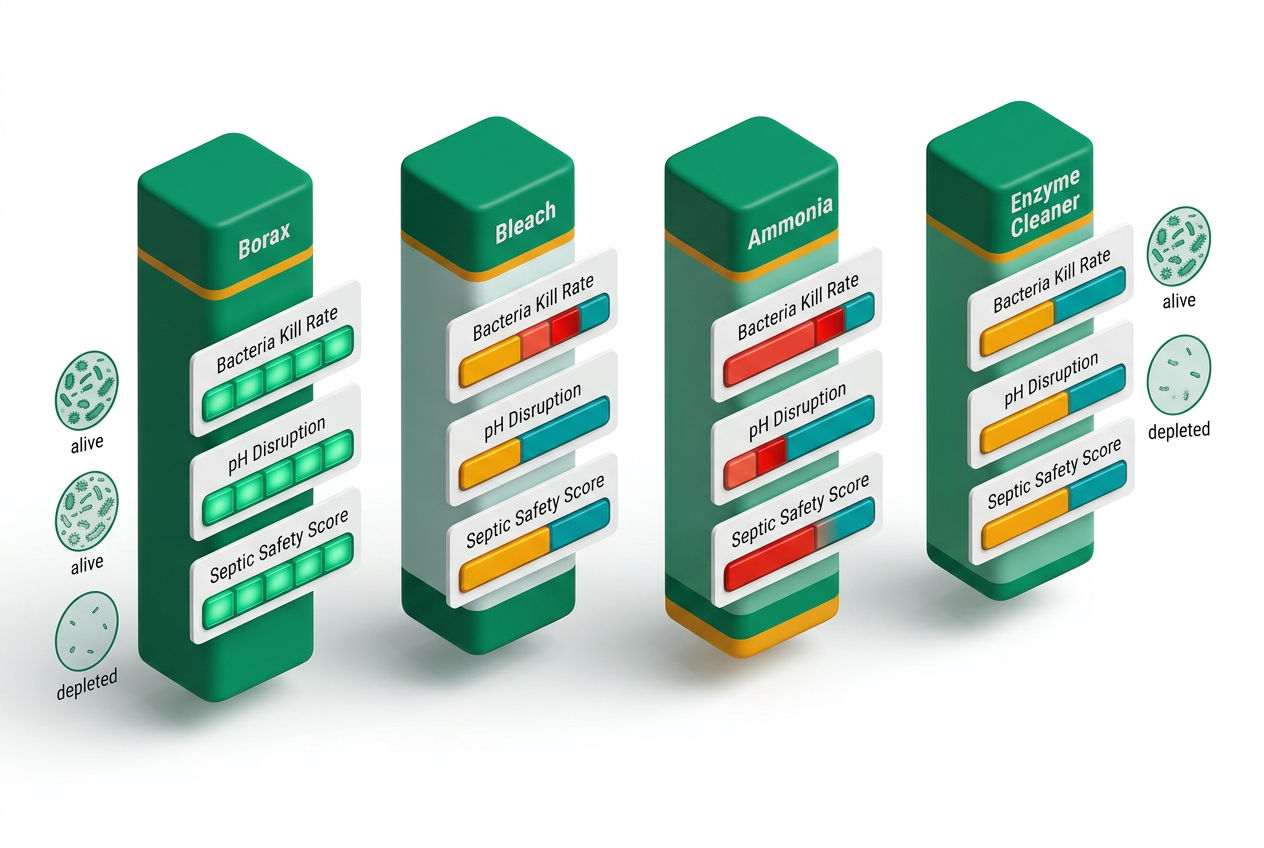
| Cleaner | pH in Solution | Bacterial Risk | Septic-Safe at Normal Use? |
|---|---|---|---|
| Borax (sodium borate) | ~9.3 | Low — indirect via pH | Yes, ½ cup per load |
| Chlorine bleach | ~12.5 | High — direct kill | Use sparingly; 1 load/week max |
| Baking soda | ~8.3 | Very low | Yes |
| White vinegar | ~2.4 | Low — temporary pH dip | Yes, normal quantities |
| Antibacterial soap (triclosan) | ~7.0 | Moderate — antimicrobial agent | Avoid or minimize |
| Commercial septic-safe detergent | Varies | Very low | Yes — as labeled |
Sources: EPA Septic Systems guidance (epa.gov/septic); University of Minnesota Extension; product safety data sheets
The takeaway from that table is clear: borax sits comfortably between totally inert baking soda and genuinely problematic chlorine bleach. It's not your riskiest option by a long stretch.
For a full breakdown of septic-safe cleaning products across every category — laundry, kitchen, bathroom, and more — our pillar guide covers each product type in detail.
How Much Borax Can You Safely Use With a Septic Tank?
Free download
Free: the Septic Fridge Card — what to flush, what never to.
The Do / Don’t card the whole family can see, plus the Survival Kit: emergency flowchart, warning-sign decoder and pump-schedule card. One printable PDF.
Quantity guidelines matter here. The widely cited safe threshold is:
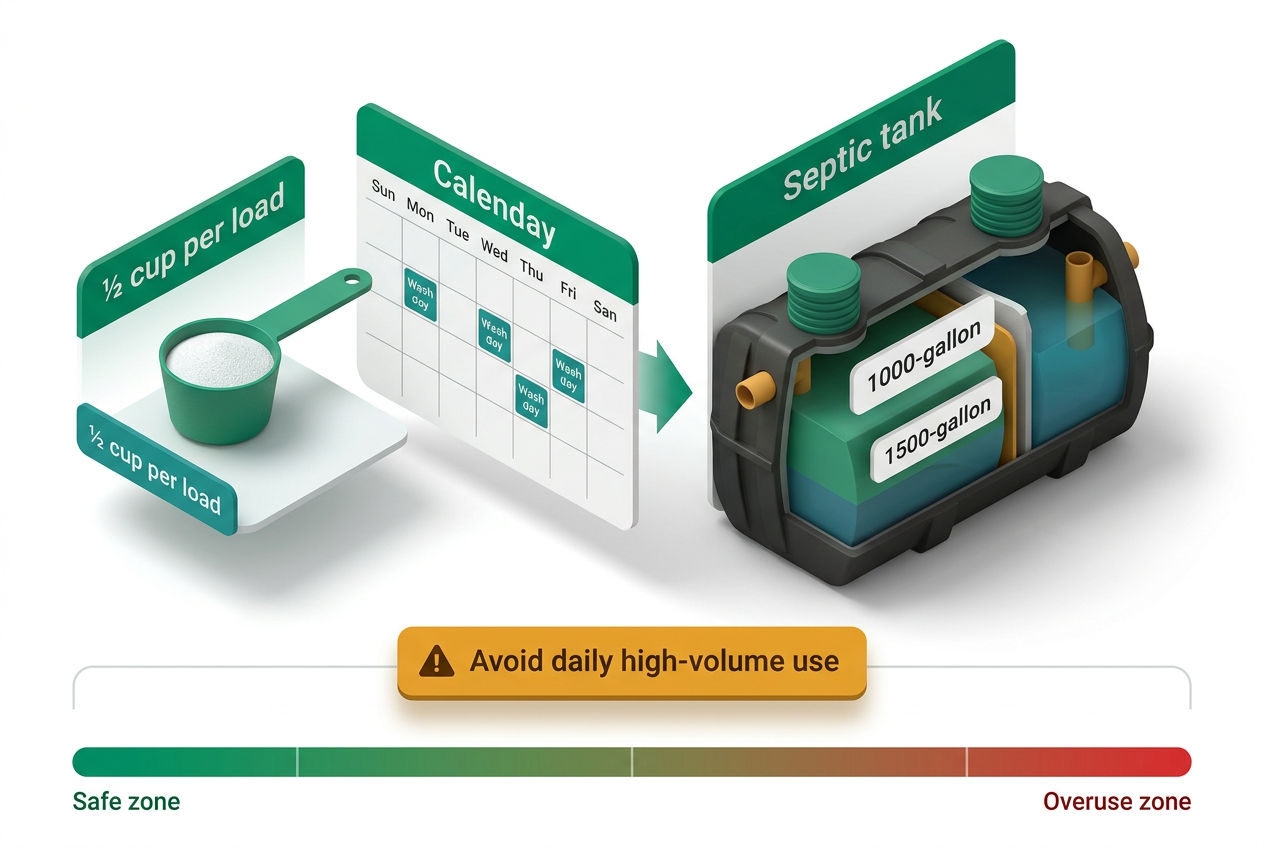
- Per laundry load: ½ cup (approximately 65 grams)
- Per week for a standard household: Up to 3–4 laundry loads using borax, with occasional use in other cleaning tasks
- Avoid: Using borax in concentrated paste form directly in drains, or as a daily tile-scrub rinse that sends undiluted amounts down the sink
Picture this scenario: you're using borax as a pre-soak treatment, dissolving 2 cups in a small bucket of water and then pouring it directly into a utility sink drain. That's a much higher concentration hitting your pipes — and eventually your 1,000-gallon tank — than the same amount spread through a 20-gallon wash cycle. The dilution changes everything.
One more factor worth considering: if you're also on a private well, boron from borax can theoretically leach through soil and reach groundwater if your drain field is undersized or if your soil has poor filtration. The EPA's drinking water health advisory for boron is 6 mg/L — a level that household borax use at normal quantities is extremely unlikely to reach, but it's a data point worth having if you're in a sensitive watershed area.
When Should You Be More Careful With Borax?
A few scenarios call for extra caution:
Cold-climate households: In Minnesota, Maine, Vermont, and other northern states, septic bacterial activity slows significantly during winter months. Anaerobic microbes are already under stress when soil temperatures drop. During the winter, borax's pH effect is slightly more pronounced because the bacterial population has less buffering capacity. Cut back to ¼ cup per load if you're in a cold-climate state and running your system hard in January or February.
Recently pumped or new systems: After a septic pump-out, your tank's bacterial colony is rebuilding from a much smaller base. Give your system 2–3 weeks of conservative chemical use before returning to normal borax quantities. Same rule applies to new systems during the first 60 days.
Small tanks (750 gallons or less): If you're on a 750-gallon tank — common in older rural homes and some manufactured housing — the dilution math changes. What's safe for a 1,500-gallon tank is less forgiving in a smaller system. Stick to ¼ cup per load.
Aerobic treatment units (ATUs): Aerobic septic systems — common in Texas and parts of the Southeast — use aerobic bacteria and an aerator compressor (like the Hiblow HP-80) to process effluent. These systems can be slightly more sensitive to pH shifts than conventional anaerobic systems. Use borax sparingly and check with your ATU service provider if you're uncertain.
What Are the Best Natural Cleaners for Septic Systems?
If borax's pH still makes you nervous, or you want to build a cleaning routine that's clearly in the safe zone, here are the top alternatives:
Baking soda — pH of 8.3 in solution, nearly harmless to septic bacteria, effective for deodorizing and mild abrasion.
White vinegar — Mildly acidic (pH ~2.4), which creates a brief and self-correcting pH dip in the tank. Effective for mineral deposits and mold. Pairs well with baking soda.
Enzyme-based cleaners — Products like BioKleen or Earth Friendly Products use plant-derived enzymes that actually support septic bacterial activity rather than competing with it.
Castile soap — Made from vegetable oils, biodegrades cleanly, no synthetic surfactants, and is gentle on both surfaces and septic systems.
For laundry specifically, check our guide to septic-safe laundry detergents — it covers liquid vs. powder formulas, surfactant loads, and specific brand recommendations.
What Cleaning Products Should You Never Use With a Septic System?
Some products cause real, lasting damage to septic bacterial populations. Avoid:
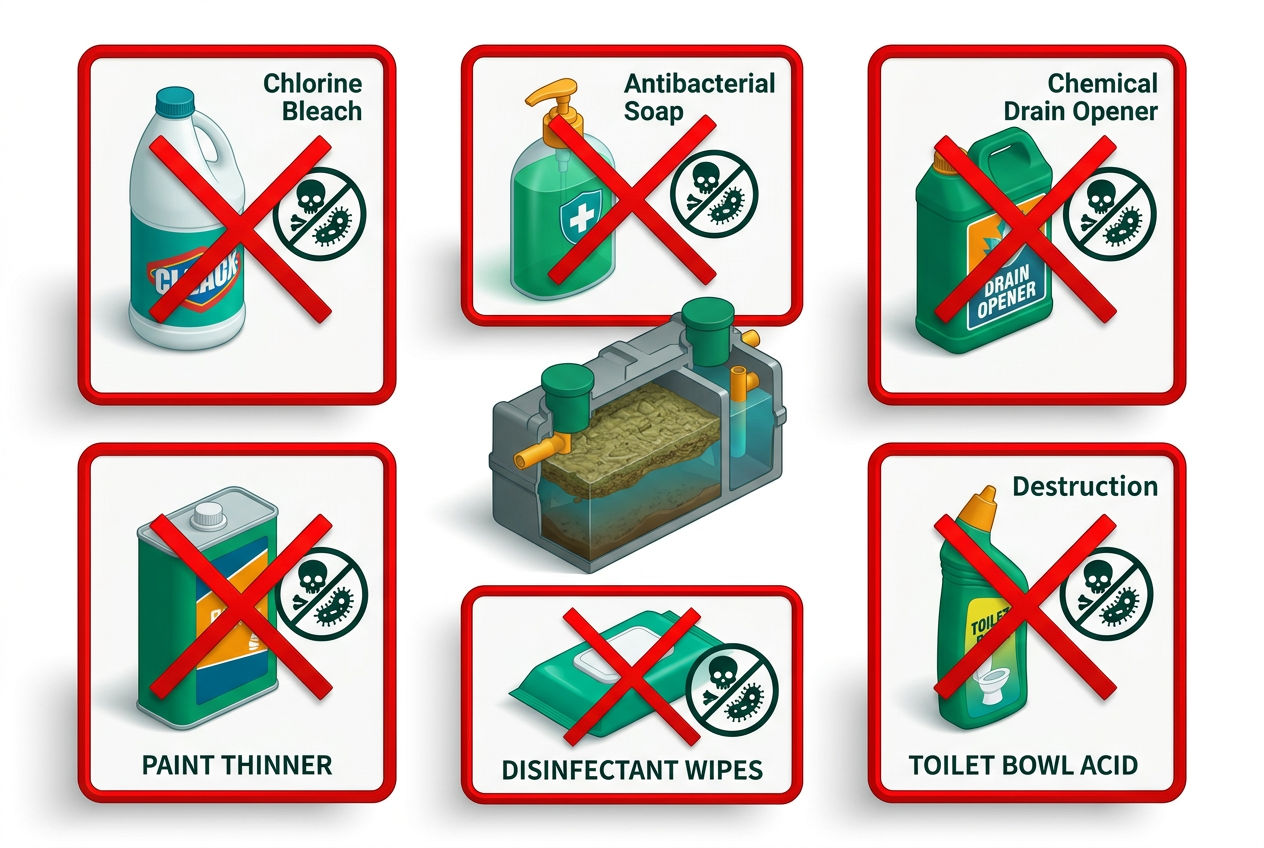
- Drain cleaners containing lye (sodium hydroxide) or sulfuric acid — these have extreme pH values (13+ or 1–2) and directly destroy anaerobic bacteria. Our guide on septic-safe drain cleaners covers safer alternatives.
- Chlorine bleach in large quantities — one bleach load per week is manageable for most systems, but daily bleach use is not
- Antibacterial soaps with triclosan or benzalkonium chloride — these are literally designed to kill bacteria and do exactly that in your tank
- Products containing formaldehyde — sometimes found in RV holding tank treatments; toxic to septic bacteria
- High-phosphate cleaners — less common since EPA phosphate restrictions, but still found in some commercial products; cause algae bloom issues in drain fields
If you're not sure where a specific product falls, the what kills septic bacteria guide is a useful reference.
Should You Call a Pro Before Changing Your Cleaning Routine?
For most homeowners switching from bleach-heavy products to borax or other natural cleaners, the answer is no — you don't need professional input to make that change. It's a straightforward upgrade.
But if your system is already showing signs of trouble — slow drains, gurgling sounds from toilets, a wet spot in the yard over your drain field — don't assume changing your cleaning products will fix it. Those are signs of a failing drain field or a tank that needs pumping. Cleaning product adjustments won't reverse a biomat or unclog saturated leach laterals.
A septic inspection runs $300–600 nationally for a standard inspection of a conventional system. That's cheap compared to a drain field replacement, which averages $4,000–20,000 depending on system type, soil conditions, and state permitting requirements. If you haven't had your tank pumped in the last four or five years and you're a four-person household on a 1,000-gallon tank, start there before worrying about borax.
Find a licensed septic service company near you to schedule an inspection or pump-out.
Sources & Methodology
-
U.S. Environmental Protection Agency — Septic Systems (epa.gov/septic): Referenced for general septic system guidance, household chemical impact thresholds, and boron drinking water health advisory data.
-
University of Minnesota Extension — Protecting Water Quality at Home: Cited for guidance on household cleaning products and their effect on septic bacterial populations in cold-climate states.
-
20 Mule Team Borax Product Safety Data Sheet: Reviewed for pH data, chemical composition (sodium tetraborate decahydrate), and absence of septic-unsafe labeling.
-
National Environmental Services Center (NESC) — Small Flows Quarterly: Referenced for residential septic tank capacity ranges and typical household wastewater volumes per laundry load.
-
Penn State Extension — Homeowner's Guide to Septic Systems: Referenced for pH range guidance for healthy septic system operation (6.5–7.5) and seasonal bacterial activity considerations.
Frequently Asked Questions
Was this article helpful?
Frequently Asked Questions
Recommended Resources
📖 Related Articles
- How Septic Tank Bacteria Work (And Why They Matter)
- Is Bleach Safe for Septic Systems?
- Septic-Safe Cleaning Products: The Complete List (Safe vs. Avoid)
- How Much Does a Well and Septic System Cost?
- How Are Septic Tanks Pumped? The Complete Process
- The Best Septic-Safe Laundry Detergents
- The Best Septic-Safe Drain Cleaners (and What to Never Pour In)
- What Kills Septic Tank Bacteria? (14 Things to Avoid)
- Signs Your Drain Field Is Failing (And What to Do)
💰 Cost Guides
Find Septic Professionals Near You
Compare licensed, verified septic companies by area — top county markets and cities below, or browse all 50 states.
County markets
Popular cities
