
Quick Answer
Is bleach safe for septic systems? Yes — but only in small amounts. Regular heavy use can devastate the bacterial colonies your tank depends on to function. A single cup of chlorine bleach can kill a significant percentage of the bacteria in a 1,000-gallon septic tank — and without those microbes breaking down waste, solids overflow into your drain field. That's where a $300 pump-out turns into a $20,000 drain field replacement.
Key Takeaways
- Normal household bleach use — about ¾ cup per wash load — is generally safe for most septic systems due to dilution from daily water use.
- Concentrated or frequent bleach use kills the anaerobic bacteria that break down solids in your tank, disrupting the septic tank bacterial balance.
- After a large bleach event, bacterial colonies may take 1–2 weeks to fully recover to effective treatment levels.
- Oxygen bleach (sodium percarbonate) is significantly safer for septic systems than chlorine bleach.
- If you suspect bleach has compromised your system, an inspection and possible pump-out are your next steps — not a bacterial additive alone.
Does Bleach Kill the Good Bacteria in a Septic Tank?
Yes — chlorine bleach kills the anaerobic bacteria that your septic tank needs to process waste. A healthy 1,000-gallon tank contains billions of bacteria per milliliter of effluent. These microbes digest solids, separate liquids, and keep sludge from overflowing into your leach laterals. Pour enough bleach in, and you're not just cleaning a toilet bowl — you're sterilizing the ecosystem that makes your whole system work.
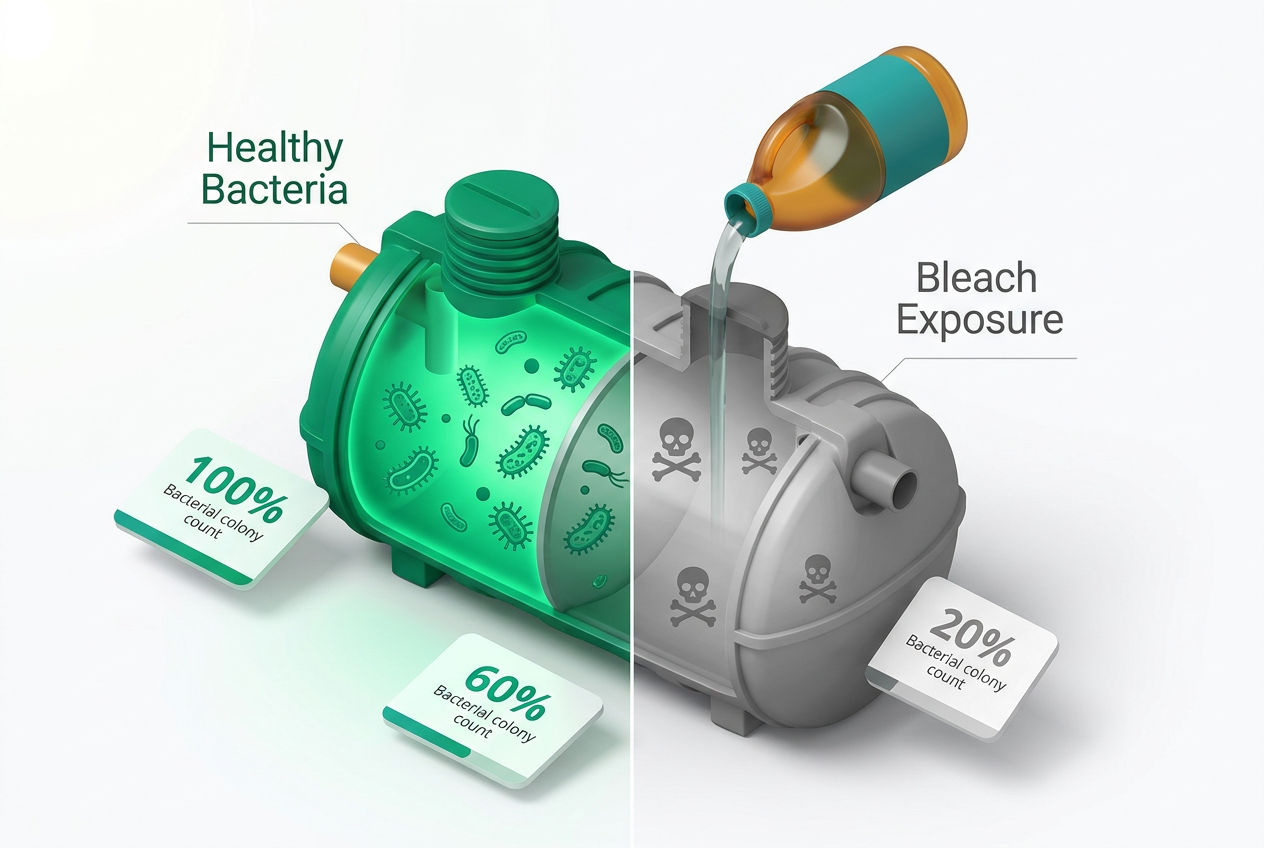
Here's the biology. Septic bacteria thrive in a pH range of approximately 6.5–7.5. Bleach is highly alkaline — it spikes the tank's pH well outside that range and introduces sodium hypochlorite, which is toxic to microorganisms even at low concentrations. Standard household bleach runs 5.25%–8.25% sodium hypochlorite. "Ultra" or concentrated versions sit at the high end of that range and carry more punch per ounce.
The good news? Dilution matters enormously. The average household sends 70–100 gallons of water per person per day into the septic system. A ¾-cup splash of bleach hitting 300–400 gallons of daily water flow gets diluted to levels most healthy bacterial colonies can handle. The damage happens when you dump multiple cups at once — or when you're doing bleach-heavy cleaning several times a week.
Want to understand more about what kills septic bacteria beyond bleach? That article covers the full list of household chemical offenders.
How Much Bleach Is Safe for a Septic System?
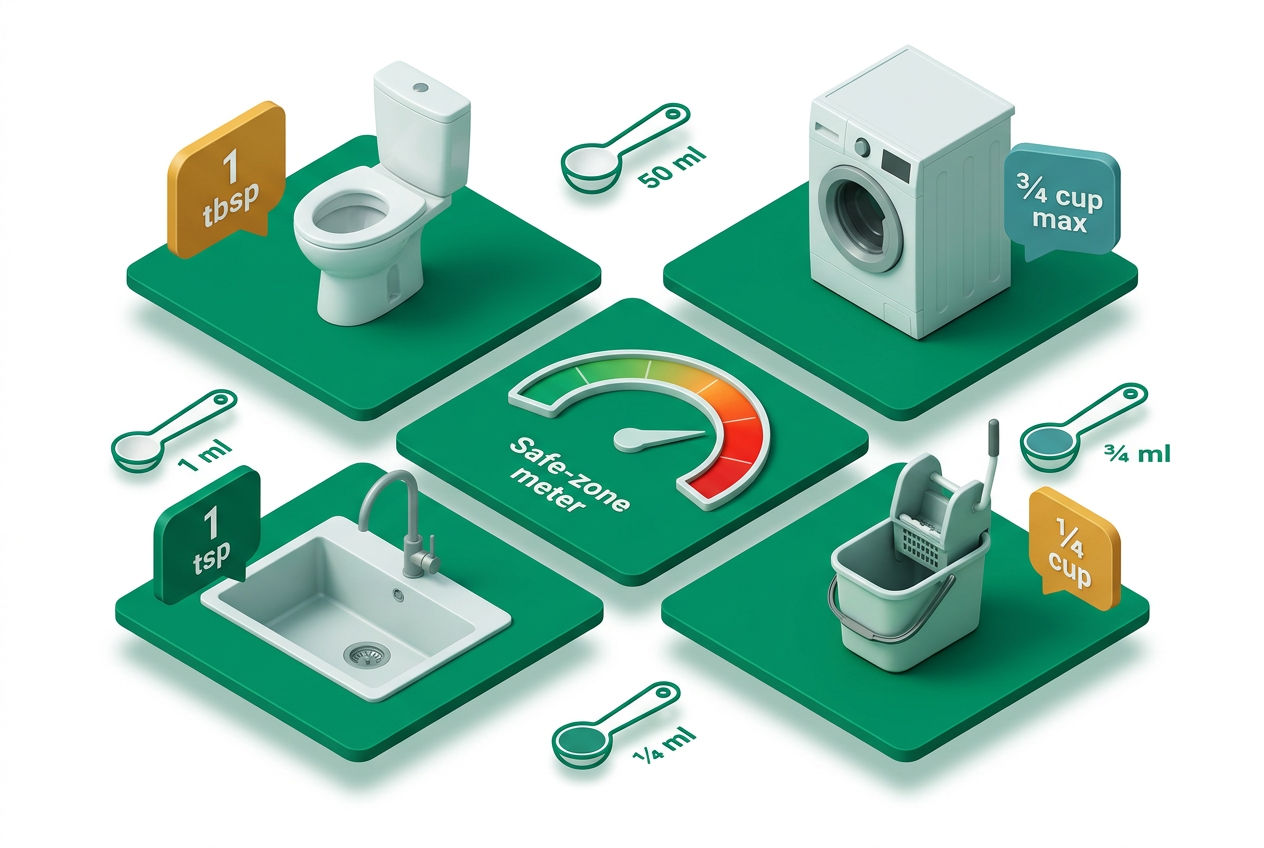
Safe threshold: ¾ cup (about 6 ounces) of standard 5.25%–6% chlorine bleach per laundry load, used no more than a few times per week.
At that level and with normal household water dilution, most septic tanks can maintain adequate bacterial populations. Problems start when you cross into multiple cups per load, daily bleach disinfection routines, or simultaneous use across multiple cleaning tasks.
Consider this real-world scenario. A family of four in a home with a 1,000-gallon concrete tank does laundry five days a week using ¾ cup of bleach per load. Their daily water output — showers, dishwasher, faucets — is roughly 300–400 gallons. That bleach is diluted to a fraction of its original concentration before it ever reaches the tank. The bacterial population fluctuates slightly but recovers.
Now picture the spring cleaning weekend: bleach in the toilets, bleach mopping the floors, bleach in the laundry, and a cup poured down the kitchen sink to "freshen the drain." That's potentially 3–4 cups of undiluted chlorine bleach hitting your system in 48 hours — without the normal dilution buffer.
Studies suggest that a single cup of liquid chlorine bleach can kill a significant percentage of the bacteria in a 1,000-gallon tank. Two to four cups in a compressed time frame? Full biological recovery from that event can take 48–72 hours for initial rebound and 1–2 weeks to reach effective treatment levels again.
The EPA's guidelines on septic system maintenance emphasize that household chemicals used in moderation pose minimal risk — but the word "moderation" is doing a lot of work there.
Bleach Dosage Guide by Use Case
| Cleaning Task | Typical Bleach Amount | Septic Risk Level | Safer Swap |
|---|---|---|---|
| Laundry (per load) | ¾ cup / 6 oz | Low — if diluted | Oxygen bleach or none |
| Toilet bowl cleaning | ¼ cup in bowl | Low | Septic-safe toilet cleaner |
| Mopping floors | ½–1 cup per bucket | Medium | Vinegar solution |
| Disinfecting sinks | Multiple applications | Medium–High | Hydrogen peroxide |
| Drain deodorizing | Full cup poured in | High | Never pour bleach in drains |
Sources: EPA Septic Systems guidance; NC State University Extension Service; typical product label dosing
Is Oxygen Bleach Safer Than Chlorine Bleach for Septic Systems?
Oxygen bleach is significantly safer than chlorine bleach for septic systems, and most septic professionals recommend it as the default swap. Oxygen bleach — products like OxiClean or store-brand sodium percarbonate powder — releases hydrogen peroxide and soda ash when dissolved in water. Neither compound is as toxic to anaerobic bacteria as sodium hypochlorite, and both break down quickly before reaching effective concentrations in your tank.
Chlorine bleach (sodium hypochlorite) is persistent in water and directly antimicrobial. Oxygen bleach degrades faster and poses far less risk to the microbial community in your septic tank. That doesn't mean you can pour oxygen bleach recklessly — but routine use of an oxygen-based laundry booster is a reasonable choice for septic-owning households.
If you're already using OxiClean and wondering whether it's fully safe, our dedicated breakdown of is OxiClean septic safe covers concentrations, frequency, and what the research actually shows.
What Cleaning Products Should You Avoid With a Septic System?
Drain cleaners, antibacterial soaps, and solvents can cause the same bacterial die-off as bleach — or worse, corrode your tank components. Several common household chemicals bad for septic systems go unnoticed until the damage shows up in your drain field.
Avoid or severely limit:
- Chlorine bleach — as discussed; the sodium hypochlorite is the primary threat
- Antibacterial soaps and disinfectants — triclosan and quaternary ammonium compounds are designed to kill bacteria, which is exactly what your tank doesn't need
- Drain cleaners (including Drano) — lye-based formulas create an intensely alkaline environment that can wipe out bacterial colonies and potentially damage PVC baffles and effluent filters like a Polylok PL-122; read more at can you use Drano with septic
- Paint thinners, solvents, and pesticides — these don't dilute safely and can leach into groundwater through the drain field
- Excessive amounts of any chemical — even "septic-safe" products cause harm at high enough concentrations
Our guide to septic-safe cleaning products is the most complete resource we have on this topic — bookmark it before your next shopping trip.
What Happens If You Pour Too Much Bleach Down a Septic Drain?
The damage unfolds in stages. How far it goes depends on how much bleach hit the system and how healthy the bacterial population was beforehand.
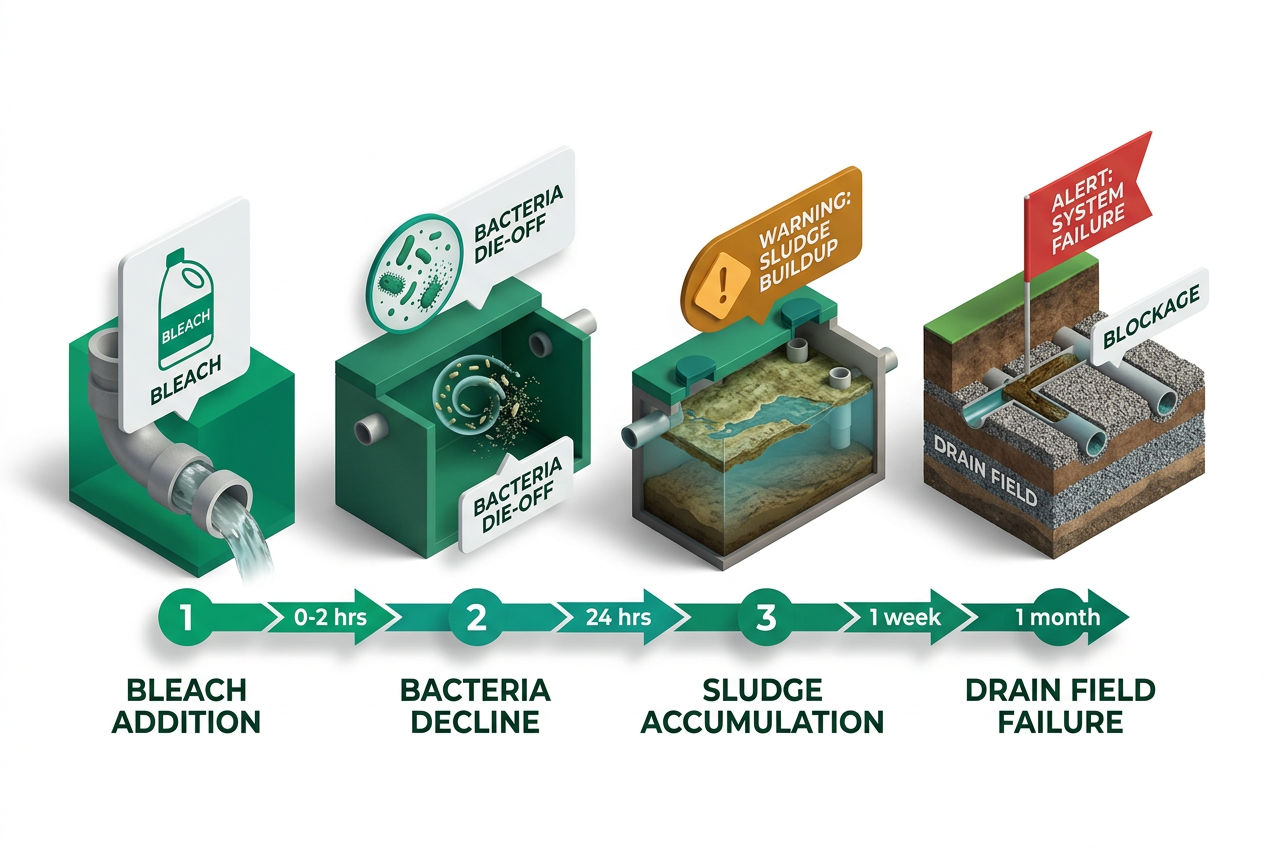
Stage 1 — Bacterial disruption (hours to days): Beneficial anaerobic bacteria die off. Solids that would normally be digested begin to accumulate. The effluent quality dropping out of your tank toward the drain field degrades.
Stage 2 — Sludge accumulation (days to weeks): Without active digestion, the sludge layer in your tank grows faster than normal. The scum layer thickens. If you were already close to needing a pump-out, you may tip into overflow territory faster than expected. The EPA recommends pumping every 3–5 years for most households — but a significant bleach event can compress that timeline.
Stage 3 — Drain field stress (weeks to months of repeated abuse): Partially treated effluent carrying higher-than-normal solids reaches the distribution box and flows into your leach laterals. Solids clog the soil around perforated pipes. Biomat — a layer of anaerobic slime — forms at the soil interface and reduces infiltration. This is biomat formation, and it's the precursor to drain field failure.
Stage 4 — Drain field failure: At this point you're looking at drain field replacement costs ranging from $5,000 for a simple lateral repair to $15,000–$30,000+ for a full system replacement, depending on your lot, soil conditions, and state regulations. That is the kind of bill homeowners face after years of aggressive chemical cleaning.
How Long Does It Take for Septic Bacteria to Recover After Bleach Exposure?
After a single moderate bleach exposure, bacterial populations typically show initial rebound within 48–72 hours. Full recovery to effective treatment levels takes 1–2 weeks, assuming no additional bleach enters the system during that window.
After a heavy exposure — multiple cups of concentrated bleach in a short period — recovery can be slower. If the tank hasn't been pumped recently and sludge levels are already high, the recovery environment is compromised.
Here's a worked example to make that concrete. Say a household of three pours roughly 2.5 cups of Clorox Regular Bleach (7.5% sodium hypochlorite) into their system over a single Saturday of deep cleaning. Their 1,000-gallon tank is about 18 months past its last pump-out, so sludge already occupies an estimated 20–25% of tank capacity. At that sludge level, according to NC State University Extension Service guidance, the effective liquid volume available for dilution is already reduced — meaning the bleach hits a more concentrated bacterial environment than it would in a freshly pumped tank. Initial bacterial rebound in this scenario would likely take the full 72-hour window, and effective treatment levels may not return for 10–14 days. During that window, the family would be wise to avoid any additional disinfectant use and reduce water consumption where possible to limit the load on a compromised system.
Can I Use Clorox If I Have a Septic Tank?
Yes — but the specific product and quantity matter. Clorox Regular Bleach sits at 7.5% sodium hypochlorite, slightly above the standard 5.25%–6% range. That higher concentration means the per-ounce impact on bacterial populations is greater.
For laundry, ¾ cup of Clorox Regular per load remains within the generally accepted safe threshold — provided your household is generating normal daily water volume to dilute it. Where homeowners run into trouble is with Clorox Disinfecting products designed for surface sanitizing. These are often used undiluted directly on surfaces that drain into sinks, and multiple applications per day across bathrooms and kitchens can add up to more chlorine load than a laundry routine.
Clorox itself carries a Safer Choice designation from the EPA for some products in its line — but that certification applies to the product's environmental profile in municipal wastewater systems, not specifically to septic bacterial ecosystems. Read labels carefully and treat any Clorox product the same way: small amounts, well diluted, infrequently.
Safer Alternatives to Chlorine Bleach for Septic Owners
If you want to protect your system without giving up cleaning effectiveness, there are real alternatives that work:
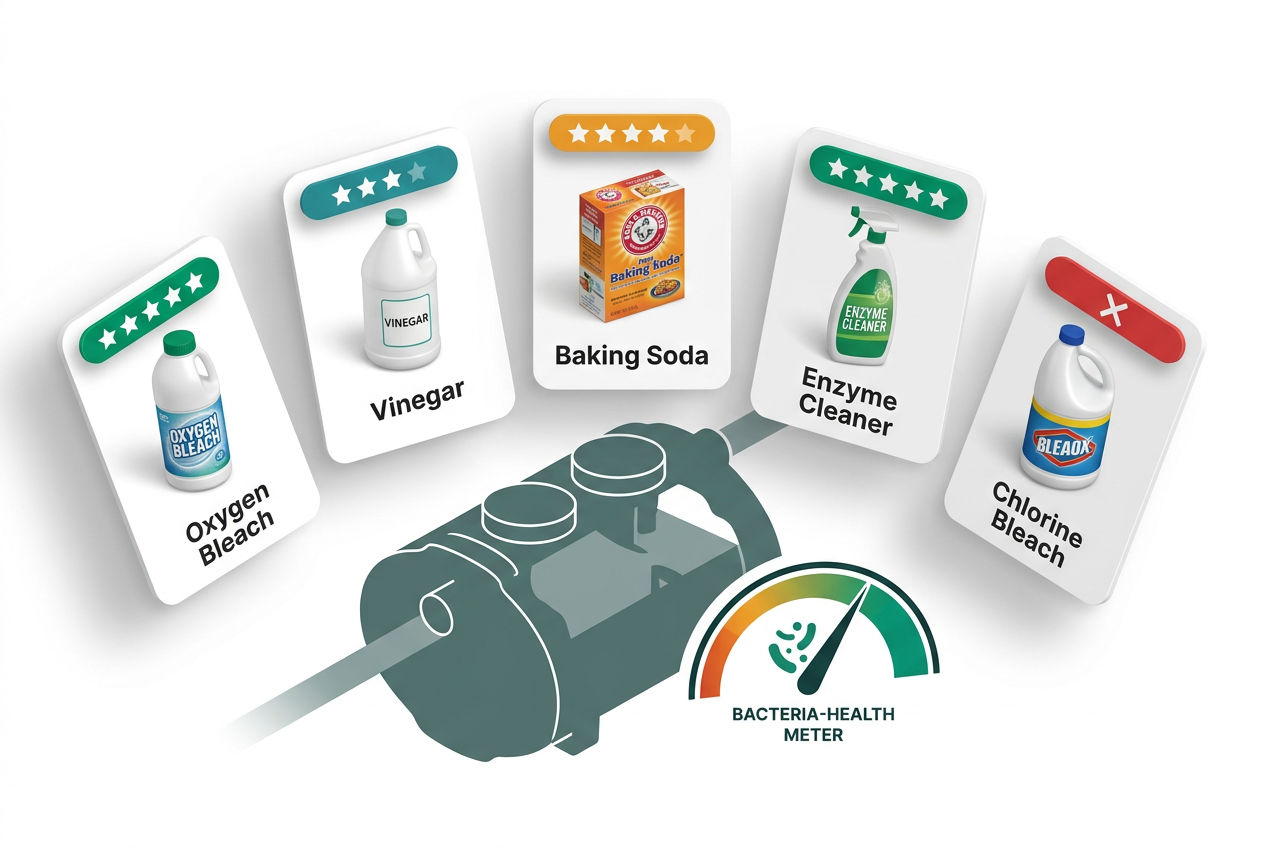
- Oxygen bleach (OxiClean, store-brand sodium percarbonate) — for laundry brightening and surface cleaning; degrades quickly and poses minimal bacterial risk
- Hydrogen peroxide — a 3% solution works as a disinfectant for surfaces without persisting in the tank the way chlorine does
- Vinegar — mildly acidic, effective for mineral deposits and general cleaning; safe for septic use in normal amounts
- Borax — a naturally occurring mineral compound used as a laundry booster; septic professionals generally consider it low-risk
- Septic-safe laundry detergent — formulations without phosphates, surfactant overloads, or antibacterial additives; Seventh Generation Free & Clear is a commonly recommended option
None of these alternatives give you the same kill-rate on pathogens as chlorine bleach. If you need true disinfection — after illness in the household, for example — a controlled, limited use of chlorine bleach is still the most effective tool. The goal isn't zero bleach. It's disciplined, intentional use.
Seasonal Timing: When Does Bleach Pose the Most Risk to Septic Systems?
Two windows deserve extra attention: spring cleaning season (March–May) and the winter holiday period (November–December).
Spring cleaning is when households are most likely to run multiple bleach-heavy cleaning sessions in quick succession — floors, bathrooms, laundry, and outdoor surfaces all in a single week. If that coincides with a septic system that's been sitting through a cold winter, the risk compounds.
In northern states — Minnesota, Michigan, Wisconsin, and similar climates — soil temperatures below 40°F slow bacterial activity significantly. A tank emerging from winter may already be operating at reduced biological capacity. A spring cleaning bleach load hits a system that's running below full strength.
Holiday guest overload is the other risk window. More people in the house means more water use, more laundry, and often more aggressive bathroom cleaning before guests arrive. If you're pumping extra bleach into the system right as you're also spiking water volume by 30–50%, you're compressing two stressors into the same week. According to the National Onsite Wastewater Recycling Association (NOWRA), holiday-period strain is one of the most common precursors to urgent pump-out calls in January. Check your pump-out schedule before Thanksgiving, not after.
What To Do If You've Been Using Too Much Bleach in Your Septic System
If you recognize that your household has been using bleach aggressively — and especially if you're seeing early warning signs like slow drains, gurgling pipes, or odors near the drain field — here's the sequence that actually helps:
- Stop all bleach use for 2–4 weeks. Give your bacterial population a window to recover without additional chemical disruption. Switch to oxygen bleach or enzyme-based cleaners immediately.
- Reduce water load where possible. Short showers, full dishwasher loads only, spreading laundry across the week rather than concentrating it. A recovering tank benefits from lower hydraulic stress.
- Check for early signs of drain field failure. Wet spots over the leach field, sewage odors outside, or unusually green grass over your drain field lines are red flags that go beyond bacterial disruption.
- Schedule a pump-out if you're within 12 months of your due date. Don't wait for the 3–5 year mark if you've had a significant bleach event. A pump-out removes accumulated sludge and gives recovering bacteria a cleaner environment to reestablish. See how often to pump a septic tank for standard schedules by household size.
- Consider a professional inspection, not just additives. Products like Rid-X introduce bacterial cultures, but research from university extension programs — including University of Arkansas Cooperative Extension — is consistent that additives don't eliminate pumping needs and shouldn't be used as a substitute for a proper assessment. An inspection runs $150–$450 and tells you what's actually happening in your tank.
A septic pumping service is the single most effective recovery tool available — more reliable than any additive on the market.
Sources & Methodology
- U.S. Environmental Protection Agency. Septic Systems Overview. https://www.epa.gov/septic
- NC State University Extension Service. Maintaining Your Septic System: A Guide for Homeowners.
- University of Arkansas Cooperative Extension. Septic System Maintenance and Additives.
- National Onsite Wastewater Recycling Association (NOWRA). Industry guidance on seasonal system stress.
- National Association of Wastewater Technicians (NAWT). Inspection standards and pump frequency guidelines.
- Clorox product specifications: Regular Bleach at 7.5% sodium hypochlorite (per product label).
- Polylok PL-122 effluent filter specifications: product documentation.
Dosage thresholds and recovery timelines cited in this article represent ranges drawn from extension service research and professional industry guidance. Individual system results vary based on tank size, bacterial population health, water use, and ambient soil temperature.
Frequently Asked Questions
Is bleach safe for septic systems if I only use it occasionally?
Yes — bleach is safe for septic systems when used occasionally and in normal household quantities. The key variable is dilution. When you use ¾ cup of standard chlorine bleach in a laundry load and your household is generating 300–400 gallons of water per day, that bleach reaches your tank at a concentration low enough that most healthy bacterial colonies can handle it without lasting disruption. The bacteria population may dip temporarily but rebounds within 48–72 hours under normal conditions. The risk threshold is when "occasional" becomes "frequent" — daily disinfection routines, multiple cleaning tasks in a single day, or several cups poured in at once. A single toilet bowl cleaning or one bleach load per week is unlikely to cause measurable harm to a properly functioning 1,000-gallon septic system. If your system is older, undersized, or already stressed, apply extra caution and lean toward oxygen bleach as your default.
What is the best septic-safe laundry detergent to use instead of bleach?
The best septic-safe laundry detergent options avoid phosphates, antibacterial agents, and surfactant overloads that can disrupt tank biology. Seventh Generation Free & Clear is one of the most consistently recommended by septic professionals — it uses plant-derived surfactants, carries EPA Safer Choice certification, and contains no optical brighteners or chlorine compounds. Method Free + Clear and Ecos Laundry Detergent are similarly formulated. For whitening and brightening, pair a phosphate-free detergent with an oxygen bleach booster like OxiClean Free or a store-brand sodium percarbonate powder instead of reaching for chlorine bleach. According to NC State University Extension Service, the most important factors in laundry product selection for septic owners are low surfactant concentration per load and the absence of antibacterial additives — not any single brand. Our septic-safe laundry detergent guide ranks the most common products with full ingredient breakdowns.
Is vinegar safe for septic systems as a bleach alternative?
Yes — vinegar is safe for septic systems in normal cleaning quantities and is one of the most commonly recommended chlorine bleach alternatives for septic owners. White distilled vinegar is mildly acidic (typically around pH 2.5), which might raise concerns about pH disruption, but the volumes used in household cleaning are too small to meaningfully shift a tank's pH away from the 6.5–7.5 range that septic bacteria prefer. A half-cup to cup of vinegar used for mopping, descaling, or surface cleaning reaches the tank heavily diluted and poses negligible risk to bacterial populations. Vinegar does not have the same pathogen-kill rate as chlorine bleach — it's effective against some bacteria and mold but is not a registered disinfectant. For routine cleaning tasks like removing mineral deposits, cutting grease, and deodorizing drains, it performs well. For situations requiring genuine disinfection, a controlled small amount of chlorine bleach remains more effective. See our full breakdown at is vinegar safe for septic systems.
Is borax safe for septic tanks?
Borax is generally considered safe for septic tanks when used in standard laundry quantities. Borax — sodium tetraborate — is a naturally occurring mineral compound that acts as a laundry booster, whitener, and mild disinfectant. Unlike chlorine bleach, it does not release sodium hypochlorite and is significantly less toxic to the anaerobic bacterial communities in a septic tank. Research reviewed by university extension programs has not identified borax as a meaningful threat to septic system biology at the ½-cup-per-load quantities typical in laundry use. That said, borax does have some antimicrobial properties, which is why it functions as a cleaning booster — and at very high concentrations, any antimicrobial compound poses risk to tank bacteria. The practical guidance: using borax as a laundry additive a few times per week is low-risk. Using it as a primary cleaning agent across multiple household tasks daily pushes into territory where caution applies. For a full assessment, see is borax safe for septic tanks.
How do I know if bleach has already damaged my septic system's bacterial balance?
You won't see a direct readout of your tank's bacterial balance — but there are warning signs that suggest biological disruption has progressed far enough to affect system performance. Slow-draining fixtures throughout the house (not just one sink or toilet) can indicate that solids are accumulating faster than bacteria can process them, reducing effective tank capacity. Gurgling sounds in drains after flushing suggest pressure changes that can follow partial blockage from excess sludge. Sewage odors inside the home or near cleanout access points indicate gases that a healthy system would normally process. Outside, wet spots or unusually lush green grass over your drain field lines — without recent rain — may mean partially treated effluent is surfacing. If you observe two or more of these simultaneously and you've recently had a significant bleach event, the right move is a professional inspection rather than waiting. A technician can measure sludge depth directly and tell you whether a pump-out is warranted now. Inspection costs run $150–$450 and are significantly cheaper than the alternative.
Free download
Not ready for the Handbook? Start with the free Fridge Card.
The Do / Don’t card the whole family can see, plus the Survival Kit: emergency flowchart, warning-sign decoder and pump-schedule card. One printable PDF.
Was this article helpful?
Frequently Asked Questions
Recommended Resources
📖 Related Articles
- What Kills Septic Tank Bacteria? (14 Things to Avoid)
- Is Oxiclean Septic Safe?
- Can You Use Drano with a Septic System?
- Septic-Safe Cleaning Products: The Complete List (Safe vs. Avoid)
- Septic Tank Biomat: What It Is and When It's a Problem
- Is Hydrogen Peroxide Safe for Septic Systems?
- Is Vinegar Safe for Septic Systems?
- Is Borax Safe for Septic Tanks?
- The Best Septic-Safe Laundry Detergents
- Signs Your Drain Field Is Failing (And What to Do)
- How Often Should You Pump Your Septic Tank?
💰 Cost Guides
Find Septic Professionals Near You
Compare licensed, verified septic companies by area — top county markets and cities below, or browse all 50 states.
County markets
Popular cities
