
Quick Answer
Flushable wipes are not septic safe. Despite what the label says, these wipes do not break down the way toilet paper does. They stay intact inside your septic tank, build up over time, and can cause blockages that run from a nuisance pump-out to a full drain field replacement costing $5,000–$20,000.
Key Takeaways
- "Flushable" is a marketing claim, not an engineering standard — independent tests show these wipes fail to break down in septic conditions.
- A 2019 study by Ryerson University (now Toronto Metropolitan University) tested 101 single-use wipes; zero passed flushability testing.
- Wipes accumulate in your tank, disrupt the bacterial digestion process, and can physically block inlet and outlet baffles.
- Regular pump-outs cost $400–$600; emergency clog service runs $1,000–$3,000+; drain field replacement can hit $20,000.
- Switching to septic-rated toilet paper is the simplest, cheapest fix.
Do Flushable Wipes Actually Break Down in a Septic Tank?
No. Flushable wipes do not break down meaningfully inside a septic tank. Toilet paper disintegrates in agitation tests within 1–4 minutes. Flushable wipes, tested under the same conditions, remain largely intact after 24 hours — and many are still structurally whole after several weeks. Your septic tank does not agitate water. It holds it. That makes breakdown even slower than lab results suggest.
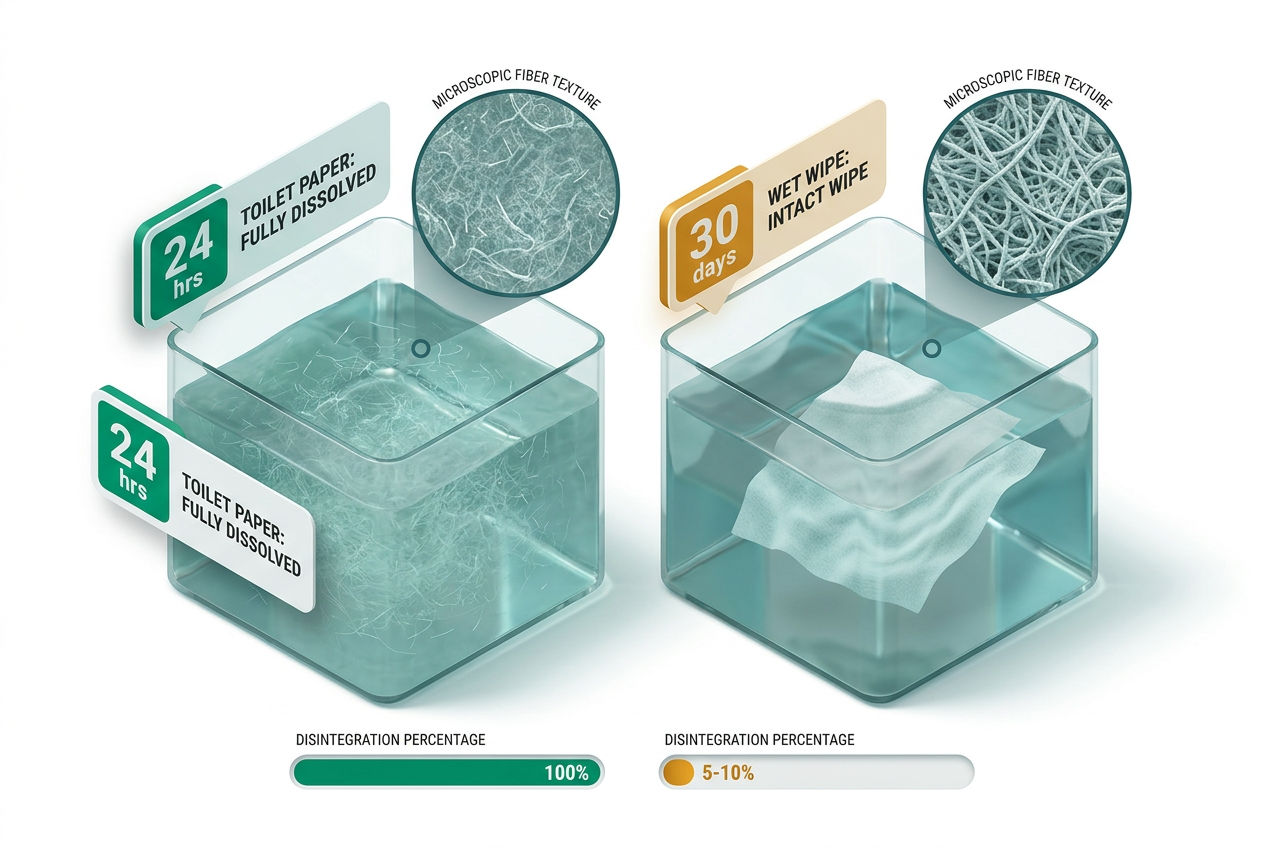
The 2019 Ryerson University study is the most cited independent research on this topic. Researchers tested 101 different single-use wipe products sold as "flushable." Not one passed flushability testing under conditions designed to simulate real sewer and septic flow. That's 101 out of 101 failing — not a margin of error problem.
The industry has its own standard: the INDA/EDANA GD4 Guidelines for Assessing the Flushability of Disposable Nonwoven Products. These guidelines set criteria for how quickly a product must disperse in water. Multiple independent reviews have found that many "flushable" wipes don't consistently meet even this industry-drafted benchmark. So the label "flushable" reflects marketing, not verified performance in your 1,000-gallon concrete tank sitting 4 feet underground.
What Happens When You Flush Wipes Into a Septic System?
Picture this: you've been flushing one or two wipes a day for two years. You don't think much of it. Then your toilets start backing up slowly, you notice a faint sewage smell near the drain field, and a pumper pulls your tank lid to find a thick mat of woven fabric covering the inlet baffle like a blanket.
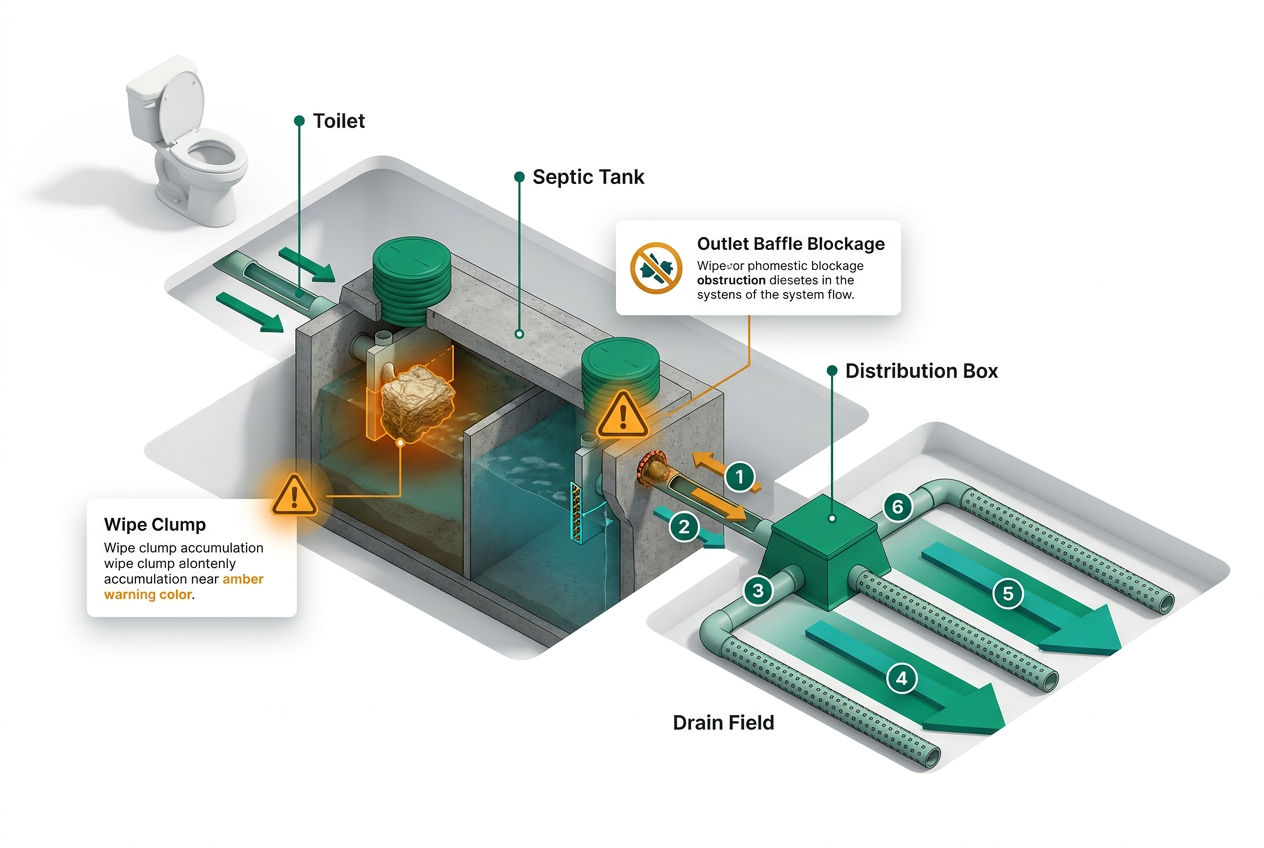
That is what happens inside a conventional septic system — a 1,000- or 1,500-gallon tank — when wipes accumulate unchecked.
Here's the chain of events:
1. Wipes enter the tank and float. Unlike toilet paper, which falls apart and joins the liquid layer, wipes hold their shape. They collect near the surface and at the inlet baffle — the T-shaped fitting that directs incoming wastewater downward into the tank.
2. They form a mat layer. Over months, individual wipes knit together into a dense raft of material. This mat physically blocks the inlet baffle, restricting flow from your house into the tank. Sewage backs up toward your drains.
3. Bacterial digestion is disrupted. Your septic tank works because anaerobic bacteria break down solid waste. That process depends on the right conditions — undisturbed sludge layers, proper liquid levels, and access to organic material. A wipe mat alters the tank's internal dynamics, shades the bacterial environment, and can carry antibacterial chemicals (many wipes contain preservatives) that suppress microbial activity. For a deeper look at how bacteria keep your system alive, see our guide to septic tank bacteria.
4. Solids pass into the drain field. When the tank is partially blocked and not processing waste efficiently, partially digested solids escape through the outlet baffle into the drain field. Out there, among the leach laterals and soil absorption zones, those solids create a biomat — a slimy layer that clogs pores in the soil and prevents effluent from dispersing properly. Once a drain field clogs, you're looking at drain field repair or replacement at $5,000–$20,000.
Understanding the full septic system process helps explain why a small piece of fabric causes such expensive problems. Our what is a septic system primer walks through the mechanics in plain language.
Can Flushable Wipes Damage Your Drain Field?
Yes, and this is where the costs get serious. The drain field — also called a leach field or soil absorption system — is the most expensive component of your septic setup. A conventional drain field for a 3-bedroom home might use 300–500 linear feet of perforated leach lateral pipe set in gravel trenches. Soil pores do the final treatment of wastewater before it returns to the groundwater.
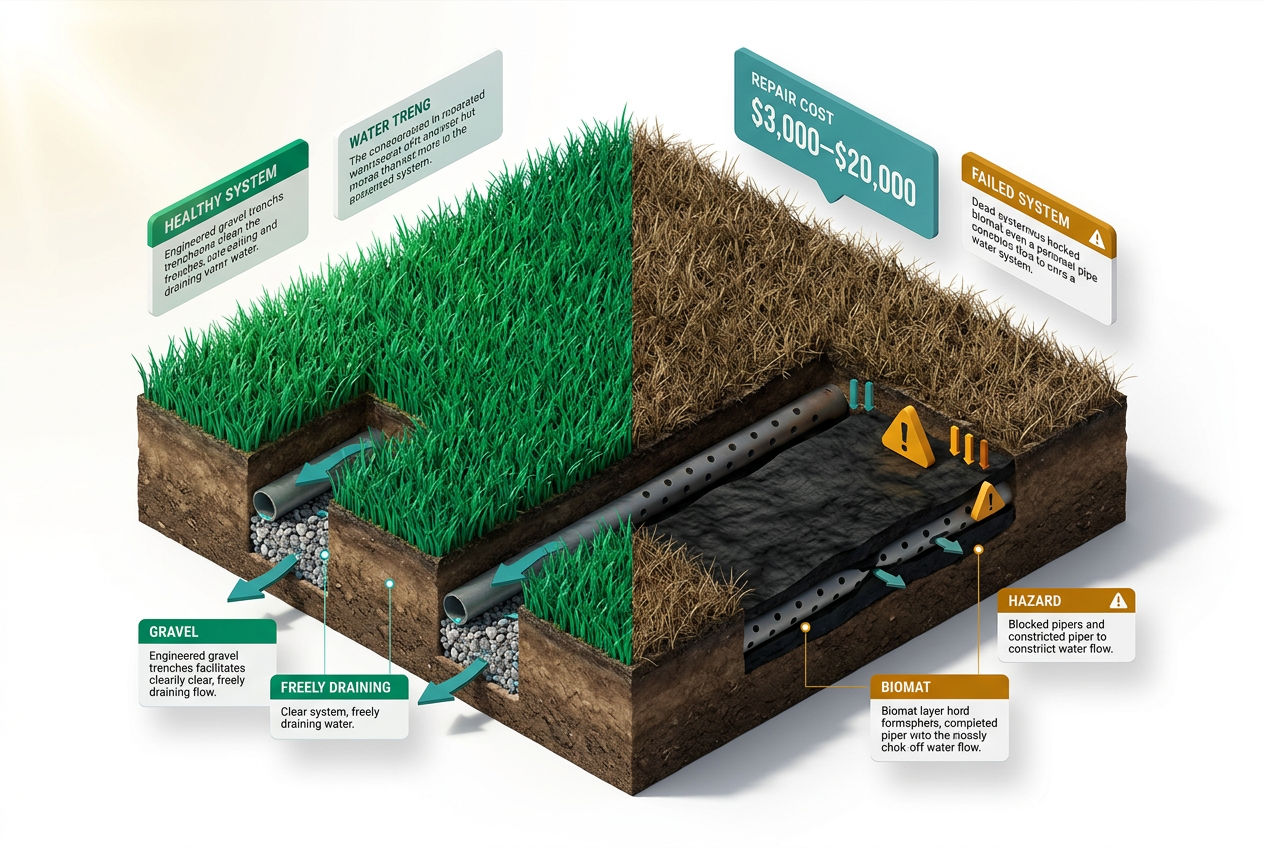
When wipes-related solids overload the field, a biomat forms along the bottom and sides of those trenches. Unlike a clogged pipe, a biomat can't be snaked out. The field needs to rest, be treated with aeration, or — in the worst cases — be completely excavated and rebuilt.
Drain field replacement costs range from $5,000 for a small mound system repair to $20,000+ for full excavation and reinstallation on a difficult lot. Compare that to the $400–$600 you'd spend on a routine pump-out every 3–5 years if you protect your system properly.
For more on what warning signs look like from the outside, check signs your drain field is failing.
How Long Does It Take for Flushable Wipes to Dissolve?
Free download
Free: the Septic Fridge Card — what to flush, what never to.
The Do / Don’t card the whole family can see, plus the Survival Kit: emergency flowchart, warning-sign decoder and pump-schedule card. One printable PDF.
They essentially don't — not on any timeline that matters for a septic system. Toilet paper is engineered to shed fibers immediately when wet. Manufacturers use short, loosely bonded cellulose strands that separate with minimal agitation. Wipes, by contrast, are made from nonwoven polyester, rayon, or polypropylene fibers that are bonded by heat or chemical treatment specifically to remain intact when wet. That's the whole point of a wipe: it needs to hold together while you use it.
Some wipe manufacturers claim their products will eventually break down in a high-flow municipal sewer environment over long distances. Even if that's partially true, your septic tank sits 20–50 feet from your house. There's no sustained flow, no turbulence, no 500 feet of 8-inch sewer main to work the fibers apart. The wipe goes in intact. It stays intact. Given enough time in anaerobic conditions, some partial degradation occurs — but the studies suggest this takes months to years, not hours.
What Is the Difference Between Flushable Wipes and Regular Wipes?
Not much — at least not in terms of how they behave inside your septic tank. Both are made from nonwoven fabric that holds together when wet. The distinction is mostly regulatory and legal, not physical.
"Regular" wipes (baby wipes, disinfecting wipes, makeup remover wipes) carry no flushability claim, so most consumers don't flush them. "Flushable" wipes carry a label implying they're safe to flush, which causes consumers to treat them like toilet paper. The FTC has scrutinized these marketing claims, and multiple class-action lawsuits have resulted in settlements against major manufacturers including Nice-Pak and Kimberly-Clark. The settlements didn't require removing the "flushable" label — they resulted in modified marketing language — which means the products are still on shelves with essentially the same claims.
Municipal sewer systems spend an estimated $440 million per year in the U.S. on blockages caused by wipes, according to data from the National Association of Clean Water Agencies (NACWA). Wipes combine with fats, oils, and grease in sewer pipes to form "fatbergs" — dense, rock-like blockages that require high-pressure water jetting and sometimes excavation to remove. If wipes cause this in large-diameter municipal mains with continuous flow, imagine what they do in a 4-inch inlet pipe feeding into a residential tank.
Are Any Wipes Truly Safe to Flush With a Septic System?
Practically speaking, no. No wet wipe product on the mass market today has passed independent third-party flushability testing under septic conditions. The honest answer from any experienced septic professional is: if it isn't toilet paper, don't flush it.
That said, if you're looking for wet-cleaning options that work with a septic system, the alternatives are straightforward:
- Dampened toilet paper — wet a square or two at the sink before use. It breaks down identically to dry toilet paper once flushed.
- Bidet attachments — non-electric bidet seats start around $30–$80 and use your existing water supply. No wipes needed.
- Flushable-labeled toilet paper wipes — a few products, like Cottonelle FreshCare, market themselves specifically as toilet paper wipes rather than nonwoven fabric wipes. Their fiber composition differs. They perform better in breakdown tests than conventional flushable wipes, though they still don't match plain toilet paper. Use sparingly if at all.
For a broader look at which products play nicely with your system, our septic-safe cleaning products guide covers everything from wipes to household chemicals.
The best toilet paper for septic systems article breaks down which TP brands actually dissolve quickly — and which ones behave more like wipes than you'd expect.
What Should You Do If You've Been Flushing Wipes?
Don't panic, but don't ignore it either. The damage depends on how long you've been flushing them and how heavily.
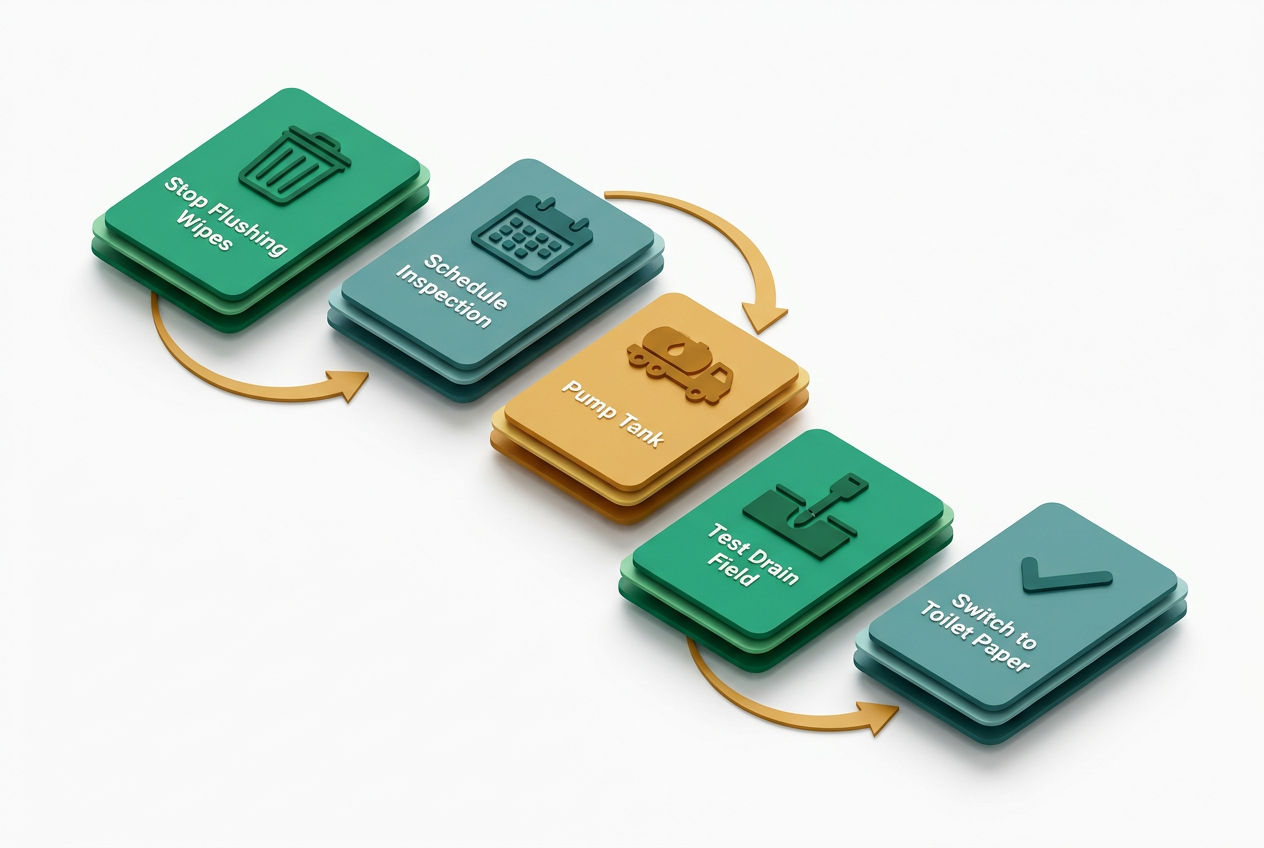
Step 1: Stop immediately. Every wipe you don't flush is one less problem.
Step 2: Schedule an inspection and pump-out. A licensed pumper can pull the lid and tell you what's accumulating inside. If there's a wipe mat forming at the baffles, they'll clear it during the pump-out. Most septic pumping services include a visual baffle inspection. Average cost: $400–$600 for a standard residential tank.
If you've been flushing wipes for years and you're already noticing slow drains, gurgling sounds, or wet spots above the drain field, you may be past the pump-out stage. Get a full inspection — not just a pump-out — before assuming everything's fine. Our septic inspection guide explains what a thorough inspection covers.
Step 3: Increase pump frequency temporarily. If you flushed wipes for a year or more, consider pumping every 18–24 months for the next cycle rather than the standard 3–5 years, until you're confident the system has stabilized. For context on normal schedules, see how often to pump a septic tank.
Step 4: Check your outlet baffle and effluent filter. Many modern tanks use an effluent filter (such as a Polylok PL-122) at the outlet baffle to catch solids before they reach the drain field. If yours has one, the wipes may have clogged it. A clogged effluent filter causes sewage to back up into the tank and eventually into the house — but it also means the filter did its job. Your pumper can clean or replace it during service.
The Real Cost Math
Here's the worked example that makes the risk concrete:
A family of four in rural North Carolina flushes one "flushable" wipe per person per day — about 1,460 wipes per year into a 1,250-gallon concrete tank. Over two years, that's roughly 2,900 wipes. The tank was due for pumping in year four of a normal schedule.
Instead, it backs up in year two. Emergency pump-out and blockage clearing: $1,200. Outlet baffle replacement because the wipes accelerated corrosion on the original concrete baffle: $450. Lost workday to deal with it: priceless (and annoying).
If a partial clog had sent solids into the drain field over those two years, the repair estimate climbs to $4,000–$8,000 for leach lateral jetting and possible partial field replacement.
The pack of wipes that started this cost $4.99.
Seasonal Note
If you're in a cold-weather state — Minnesota, Vermont, Maine, or anywhere the frost line reaches 42 inches or deeper — your septic tank bacteria slow down significantly in winter. That means wipes accumulate faster during cold months because microbial activity is reduced. A wipe mat that takes 18 months to become a problem in Georgia might become a problem in 10 months in northern Wisconsin. Plan your inspection timing accordingly: late spring, after bacterial activity has resumed, is ideal in northern climates.
Sources & Methodology
-
Ryerson University (Toronto Metropolitan University), 2019 — Independent study testing 101 single-use wipe products labeled "flushable." Zero products passed flushability testing. Referenced throughout as primary evidence for wipe breakdown failure.
-
U.S. Environmental Protection Agency (EPA) — Septic Systems (epa.gov/septic) — Source for the statistic that approximately 21 million U.S. households (roughly 1 in 5) rely on septic systems.
-
National Association of Clean Water Agencies (NACWA) — Source for the $440+ million annual estimate of wipes-related sewer blockage costs borne by U.S. municipalities.
-
INDA/EDANA GD4 Guidelines for Assessing the Flushability of Disposable Nonwoven Products — The nonwoven products industry's own flushability benchmark, referenced to establish that even the industry's own standard is routinely failed by independent review.
-
Grand View Research, 2023 — U.S. wipes market valuation (~$4.5 billion) and flushable wipes segment CAGR (~5%), used to contextualize the scale of the issue.
Cost ranges for pump-outs, emergency service, and drain field replacement are derived from contractor pricing data aggregated across SepticTankHub.com's national directory network and corroborated against EPA and state health department cost benchmarks.
Was this article helpful?
Frequently Asked Questions
Recommended Resources
📖 Related Articles
- How Septic Tank Bacteria Work (And Why They Matter)
- What Is a Septic System? How It Works (Visual Guide)
- Signs Your Drain Field Is Failing (And What to Do)
- Septic-Safe Cleaning Products: The Complete List (Safe vs. Avoid)
- What's the Best Toilet Paper for Septic Systems?
- What Happens During a Septic Inspection?
- How Often Should You Pump Your Septic Tank?
💰 Cost Guides
Find Septic Professionals Near You
Compare licensed, verified septic companies by area — top county markets and cities below, or browse all 50 states.
County markets
Popular cities
