
Quick Answer
A septic safe garbage disposal is one that grinds food waste into fine enough particles to minimize solids accumulation in your septic tank — ideally paired with built-in enzyme or microbe injection to help break down organic matter before it reaches your tank's baffle walls. Not every disposal qualifies.
Key Takeaways
- The EPA estimates that garbage disposals can increase septic tank solids by 30–50%, cutting pumping intervals from every 3–5 years down to every 1–2 years.
- Multi-stage grinding and enzyme injection technology are the two features that matter most for septic compatibility.
- A minimum 1,000-gallon tank is recommended if you run a disposal; some county codes require an extra 250-gallon capacity.
- The InSinkErator Evolution Septic Assist is the gold standard, but strong budget and mid-range alternatives exist.
- Always confirm local plumbing codes before installation — a few jurisdictions restrict disposals on septic entirely.
About 21% of U.S. households — roughly 25 million homes — rely on septic systems, according to the EPA. If you're in that group and you want a garbage disposal, you're not picking any disposal off a shelf at a big-box store. You're making a decision that directly affects the bacterial ecosystem living in your tank. Get it wrong, and you'll be calling a pumper truck every 18 months instead of every 4 years. Get it right, and you can run a disposal indefinitely without harming your system.
This guide covers the best options on the market, what makes them septic-safe, and what you absolutely need to know before you buy. For a broader look at what products are and aren't safe for your system, see our guide to septic safe cleaning products.
Do Garbage Disposals Harm Septic Systems?
Standard garbage disposals can stress a septic system significantly — but the damage isn't instant, and it's not inevitable. The real issue is solids loading. Your septic tank works by separating waste into three layers: a floating scum layer on top, a liquid effluent layer in the middle, and a sludge layer settling at the bottom. Beneficial bacteria break down organic matter in the sludge zone. That process takes time.
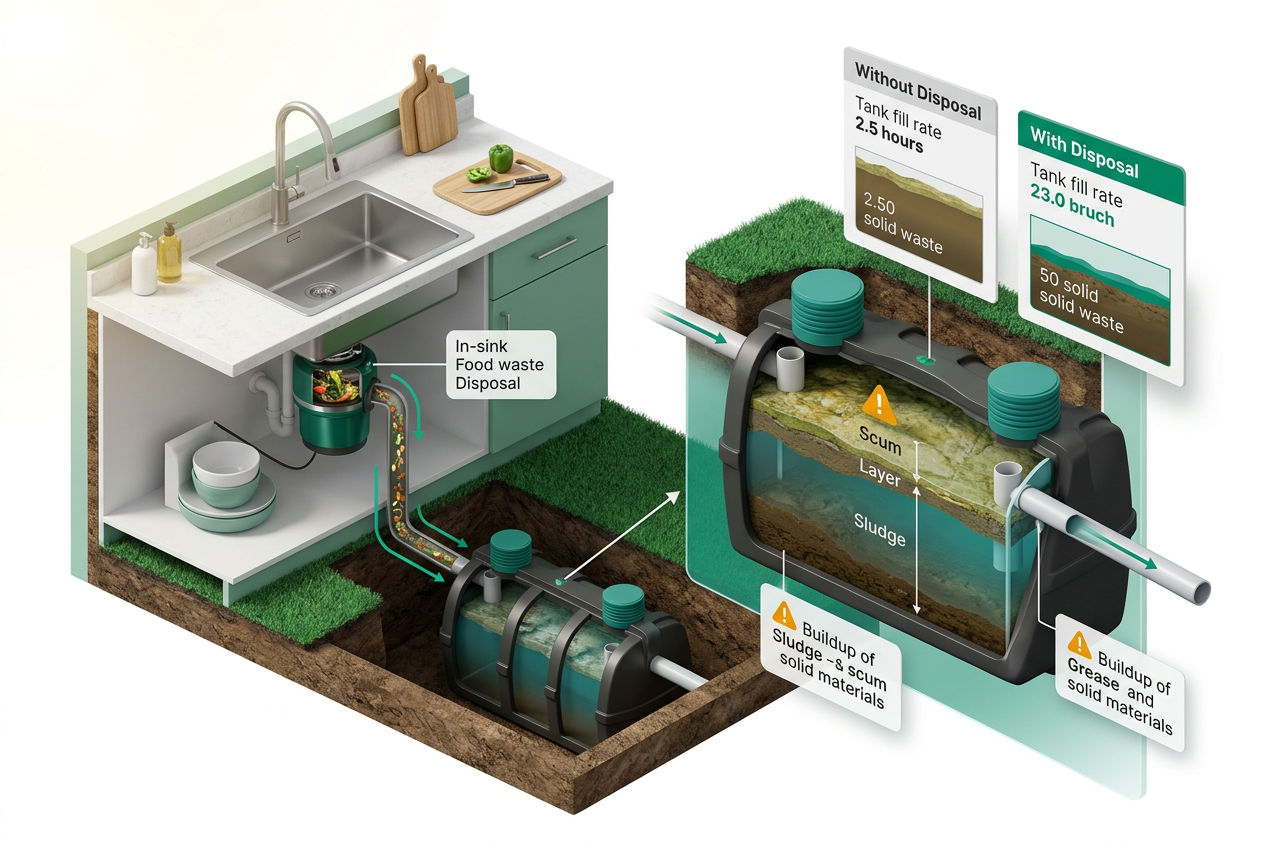
When you run a conventional disposal, you're sending undigested food particles — fats, starches, proteins — directly into that tank. The EPA notes this can increase the solids load by 30–50%. A 1,000-gallon tank serving a 4-person household typically needs pumping every 3–4 years. Add a standard disposal and that drops to every 1–2 years. That's an extra pump-out every cycle, which at $300–$500 per service adds up fast. You can check current septic pumping costs to understand what that frequency difference means for your budget.
Septic-specific disposals fight this problem in two ways: finer grinding and active enzyme or microbe dosing.
What Makes a Garbage Disposal "Septic Safe"?
Three factors separate a septic safe disposal unit from a generic one.
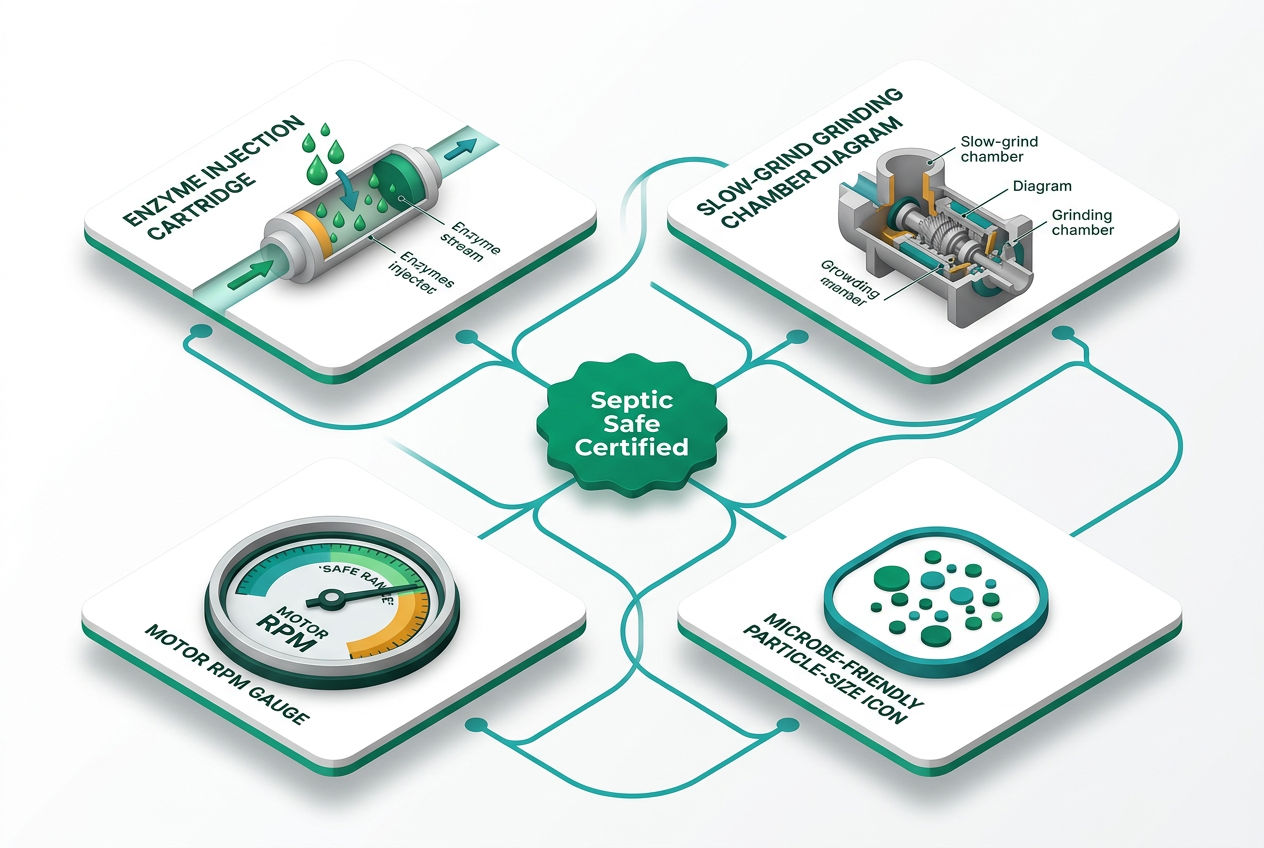
1. Multi-Stage Grinding
The finer the particle, the faster your tank's bacteria can break it down. Single-grind models produce coarser particles that accumulate in the sludge layer faster. Two-stage and three-stage grinding systems (sometimes called MultiGrind technology) reduce particles significantly before they hit your tank. Think of it like chewing your food thoroughly before swallowing — your stomach handles it better.
2. Enzyme or Microbe Injection
Some disposals — most notably InSinkErator's SepticAssist line — include a Bio-Charge reservoir that automatically doses a measured amount of microbes into the waste stream with each use. These aren't the same bacterial strains already in your tank; they're targeted cultures designed to begin breaking down food waste before it even reaches the tank. Each cartridge lasts roughly 3–4 months and costs $10–$15 to replace.
3. Lower Horsepower (For Lighter Use)
Counterintuitively, a smaller motor isn't always worse for septic. A 1/3 HP disposal runs intermittently on light kitchen scraps. A 3/4 HP or 1 HP unit can handle bones and fibrous vegetables — but it also encourages heavier use, sending more volume through your system. Match your motor to your actual cooking habits.
Top Picks: Best Septic Safe Garbage Disposals
1. InSinkErator Evolution Septic Assist — Best Overall
Model: 1SEASST | HP: 3/4 | Price: ~$220–$280
This is the disposal built specifically for septic systems, and it shows. The Evolution Septic Assist uses InSinkErator's three-stage MultiGrind technology, running at 1,725 RPM with a Dura-Drive induction motor. That motor is quieter and more durable than the universal motors used in budget models.
The defining feature is the Bio-Charge system: a reservoir holds a concentrated solution of septic-safe microbes. Every time you run the disposal, it automatically injects a measured dose into the waste stream. Those microbes get to work breaking down food particles before they reach your tank's inlet baffle. Replace the cartridge every 3–4 months. At $10–$15 per cartridge, that's roughly $35–$60 per year — a fraction of what you'd spend on an extra pump-out.
The SoundSeal technology wraps the motor in anti-vibration material, reducing noise by roughly 40% compared to a standard disposal. The grinding chamber holds 40 oz. InSinkErator backs it with a 7-year in-home warranty on parts and labor — the longest in the residential market.
The limitation: This disposal doesn't eliminate the need for regular septic maintenance. It reduces solids loading; it doesn't eliminate it. You'll still need pumping, just less frequently.
2. InSinkErator Evolution Excel — Best Premium Pick
Model: Excel-1.0 | HP: 1 | Price: ~$350–$420
The Excel isn't marketed specifically as a septic disposal, but its three-stage MultiGrind system grinds waste so fine that it performs comparably to the Septic Assist in real-world use — minus the Bio-Charge dosing. If you're already adding a monthly bacterial treatment like Rid-X or a similar product to your tank, the Excel's grinding quality alone does most of the work.
The 1 HP Dura-Drive motor runs at 1,725 RPM and handles anything you throw at it — including small bones and corn cobs. SoundSeal technology and an anti-vibration mounting make it one of the quietest disposals available. The 7-year in-home warranty matches the Septic Assist.
The tradeoff: at 1 HP, it encourages heavier use. If you're disciplined about what goes in (no grease, no fibrous vegetables like celery), it works well on septic. If you treat it like a trash can, your tank will feel it.
3. Waste King L-8000 — Best Budget Pick
Model: L-8000 | HP: 1 | Price: ~$80–$110
The Waste King L-8000 is the value champion. It runs at a high 2,800 RPM using a high-speed permanent magnet motor — faster than InSinkErator's induction motors — which produces a finer grind than you'd expect at this price point.
It's not purpose-built for septic systems. There's no enzyme injection, no Bio-Charge cartridge. But if you already treat your tank regularly with beneficial bacteria — which you should be doing regardless — the L-8000's high-speed grinding does a reasonable job of minimizing particle size.
The 20-year warranty is remarkable for the price. It's louder than premium models, but it's compact and easy to install. If your budget is tight and you're disciplined about what goes down the drain, this is a workable septic-compatible option. Pair it with a consistent septic additive routine and scheduled pumping, and many homeowners manage just fine.
4. Moen GXS75C GX Series — Best Mid-Range Pick
Model: GXS75C | HP: 3/4 | Price: ~$130–$160
Moen entered the disposal market with a thoughtfully designed mid-range unit. The GX Series 3/4 HP model uses a pre-installed power cord (a feature InSinkErator's base models lack), vortex motor technology, and a sound dampening shield that cuts noise noticeably.
The grinding quality sits between the Waste King's brute speed and InSinkErator's multi-stage refinement. No enzyme system, but it handles everyday food scraps efficiently. Moen backs it with a limited lifetime warranty for residential use.
For a household that does light-to-moderate cooking and already maintains their septic system with regular bacterial treatment, the GX Series is a solid mid-tier pick that won't break the bank.
5. InSinkErator Badger 5 — What to Avoid If You're on Septic
Model: Badger 5 | HP: 1/2 | Price: ~$95–$120
The Badger 5 is one of the most popular disposals sold in America — reliable, affordable, and widely available at every home improvement retailer. On a municipal sewer connection, it's a perfectly competent choice. On a septic system, it's the wrong tool for the job.
Single-grind technology, a 1,725 RPM induction motor, and no septic-assist features mean it sends relatively coarse food particles straight to your tank. The 2-year limited in-home warranty pales against premium alternatives. The extra $100–$150 for an Evolution Septic Assist is money well spent if you're on septic.
Septic Safe Garbage Disposal Comparison
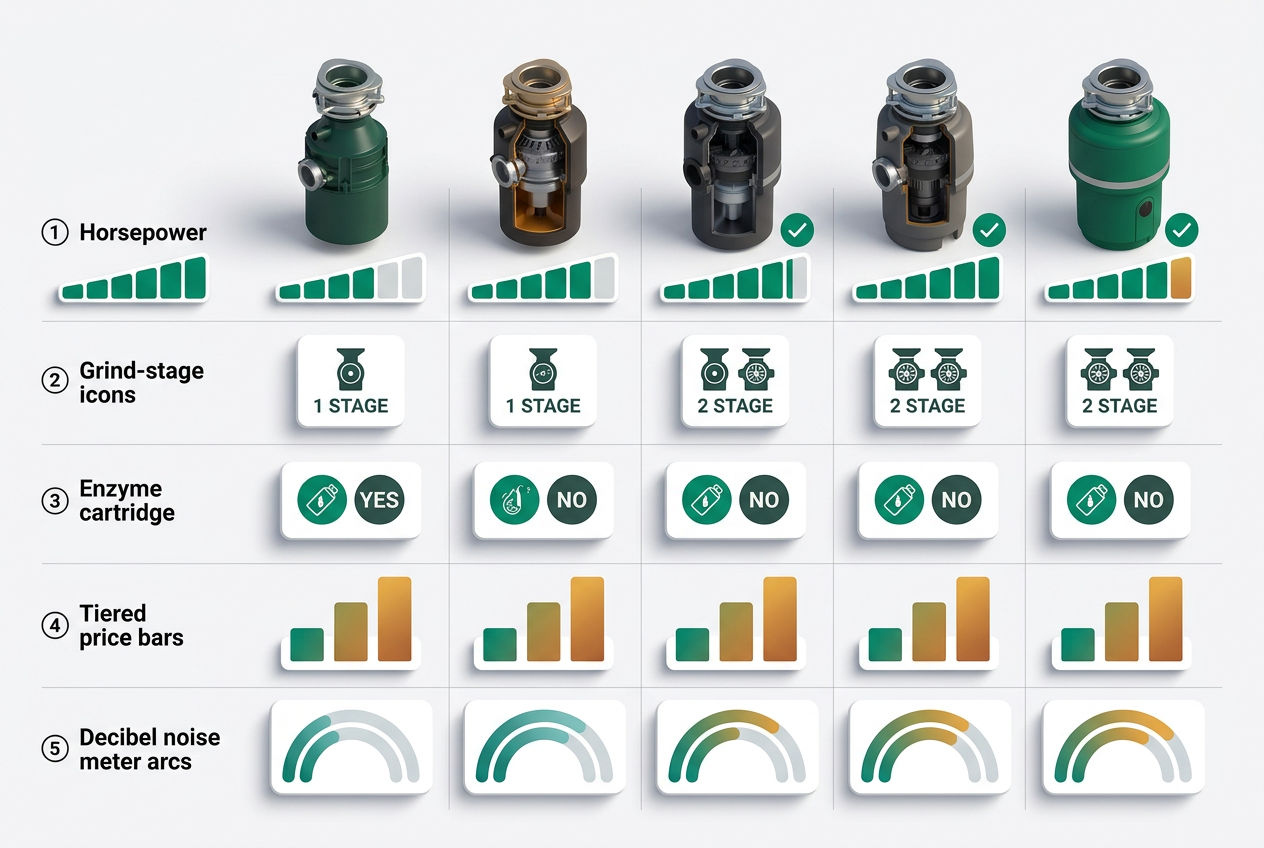
| Model | HP | Grinding Stages | Enzyme System | Warranty | Price Range |
|---|---|---|---|---|---|
| InSinkErator Evolution Septic Assist | 3/4 | Three-stage | Yes (Bio-Charge) | 7 years | $220–$280 |
| InSinkErator Evolution Excel | 1 | Three-stage | No | 7 years | $350–$420 |
| Waste King L-8000 | 1 | Single (high RPM) | No | 20 years | $80–$110 |
| Moen GXS75C GX Series | 3/4 | Single (vortex) | No | Lifetime (limited) | $130–$160 |
| InSinkErator Badger 5 | 1/2 | Single | No | 2 years | $95–$120 |
How Often Will You Need to Pump If You Use a Disposal?
With a septic-specific disposal, most 4-person households on a 1,000-gallon tank pump every 2–3 years rather than every 1–2 years with a standard disposal. Here's a worked example showing what that means for your wallet over a 10-year period.
Scenario: 4-person household, 1,000-gallon tank, pump-out cost $400
| Setup | Pump Frequency | Pump-Outs Over 10 Years | Total Pumping Cost |
|---|---|---|---|
| No disposal | Every 3–4 years | 2–3 | $800–$1,200 |
| Standard disposal (Badger 5) | Every 1–2 years | 5–10 | $2,000–$4,000 |
| Septic Assist disposal | Every 2–3 years | 3–5 | $1,200–$2,000 |
The difference between a standard disposal and a septic-specific one is $800–$2,000 in pumping costs alone over a decade — far more than the $100–$150 price gap between models. That math makes the upgrade an obvious choice.
According to the National Onsite Wastewater Recycling Association (NOWRA), food waste grinders increase the frequency of required tank maintenance when not properly matched to system capacity, and they recommend sizing up tank volume by at least 250 gallons when adding any disposal. For current septic pumping frequency guidance, see our dedicated article.
Do You Need a Bigger Septic Tank If You Install a Disposal?
Free download
Free: the Septic Fridge Card — what to flush, what never to.
The Do / Don’t card the whole family can see, plus the Survival Kit: emergency flowchart, warning-sign decoder and pump-schedule card. One printable PDF.
Possibly. The general industry guidance — supported by the EPA's Onsite Wastewater Treatment Systems Manual — recommends a minimum 1,000-gallon tank for a 3–4 bedroom home running a disposal. If your tank is undersized (750 gallons or less), adding any disposal, even a septic-specific one, accelerates solids accumulation faster than your system can handle.
Some county health departments go further. North Carolina, for example, has county-level health department rules that specifically address disposal use on septic systems — in some districts requiring documented tank capacity verification before a disposal permit is issued. Regions within the Chesapeake Bay watershed and parts of New England actively discourage or restrict disposal installation on septic entirely, citing nitrogen loading concerns in sensitive watersheds.
Before you buy anything, call your county health department. Ask two questions: Is a garbage disposal permitted on my septic system? Does my tank size require an upgrade? This call takes five minutes and could save you a failed inspection or a tank replacement.
For help assessing your current system's condition and capacity, our septic inspection service can give you a clear picture before you commit to any installation.
Buying Guide: What to Look for in a Garbage Disposal for Septic Systems
Motor Size by Household Profile
| Household Size | Cooking Frequency | Recommended HP |
|---|---|---|
| 1–2 people | Light | 1/3 – 1/2 HP |
| 2–4 people | Moderate | 1/2 – 3/4 HP |
| 4+ people | Heavy | 3/4 HP with enzyme system |
Avoid 1 HP disposals on septic unless you're unusually disciplined about what goes in. The power encourages use, and more use means more solids.
Grinding Technology
Multi-stage grinding is the single most important feature. Two-stage is acceptable; three-stage is ideal. Check manufacturer spec sheets — "MultiGrind" and "Vortex" motor terminology both refer to enhanced grinding, though InSinkErator's three-stage system remains the benchmark for particle reduction.
Enzyme or Microbe Injection
Only InSinkErator's SepticAssist line currently offers built-in enzyme injection as a standard feature. If you choose any other model, budget for a monthly septic additive (Rid-X, Cabin Obsession, or a similar biological treatment). This isn't optional — it's what keeps your tank's bacterial ecosystem healthy when you're adding food waste to the system.
Noise Rating
Decibel ratings matter if your kitchen is open-plan. InSinkErator's SoundSeal models run around 40–45 dB (roughly conversation level). Budget models without insulation run 70+ dB. Moen's GX Series falls in the middle at approximately 55 dB.
Warranty
Treat the warranty as a proxy for build quality. A 20-year warranty (Waste King) signals confidence in the motor. A 7-year in-home warranty (InSinkErator's premium line) means a technician comes to you — you don't ship the unit back. Two-year warranties on budget models reflect what the manufacturer expects from the product.
What to Avoid Putting Down the Disposal on a Septic System
Even the best garbage disposal for septic tank use can't compensate for bad habits. These inputs cause disproportionate damage:
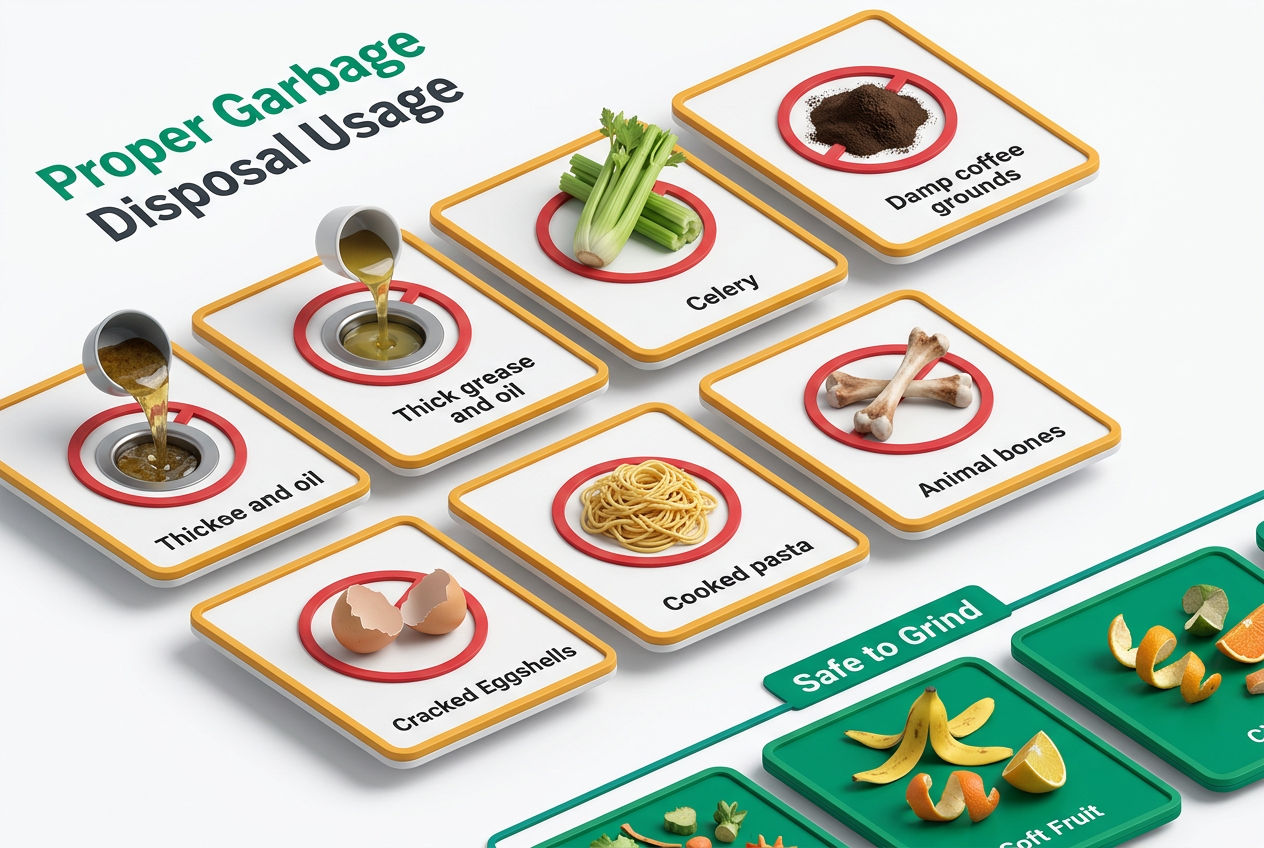
Fats, Oils, and Grease (FOG): These solidify in the tank's scum layer and don't break down efficiently. A single heavy grease dump can create a scum mat that blocks your outlet baffle.
Fibrous Vegetables: Celery, artichoke leaves, asparagus ends. The fibers don't grind down completely and can wrap around impellers. They also mat together in the sludge layer.
Eggshells: A persistent myth says eggshells sharpen disposal blades (disposals don't have blades — they have impellers). The membrane inside the shell wraps around the impellers and creates clogs. In the tank, eggshell grit contributes to non-biodegradable solids.
Starchy Foods in Large Quantities: Pasta, rice, potato peels. These expand in water and create a paste-like consistency that slows bacterial breakdown.
Coffee Grounds in Volume: Small amounts are fine. Large daily quantities accumulate as dense sediment in the sludge layer faster than bacteria can process them.
For a complete list of what should and shouldn't enter your system, see our article on what you can flush on a septic system.
Before You Buy: A Quick Checklist
- Verify your tank size. 1,000 gallons minimum for a disposal. If you're under that, consult a professional before adding any disposal to your system.
- Check local codes. Call your county health department. Some jurisdictions require permits; a few prohibit disposals on septic entirely.
- Review your pumping history. If you've been pumping more than every 2–3 years without a disposal, your tank is already stressed. Address that first.
- Budget for ongoing costs. Bio-Charge cartridges ($35–$60/year) or monthly septic additives ($50–$100/year) are part of the real cost of running a disposal on septic.
- Schedule a post-installation inspection at 12 months. The first year reveals whether your system is handling the added load. Our septic tank maintenance guide covers what to watch for. If you want professional eyes on it, our septic pumping and cleaning service can assess solids accumulation and catch problems before they compound.
Install after your next scheduled pump-out, not before. Starting with a clean tank gives you an accurate baseline for how the disposal is affecting your system.
FAQ: Garbage Disposals and Septic Systems
Is it safe to use a garbage disposal with a septic system?
Yes, it is safe to use a garbage disposal with a septic system — but only if you choose the right model and maintain the system properly. Standard single-grind disposals send coarse food particles directly into your tank, increasing solids accumulation by 30–50% according to the EPA, which can cut your pumping interval from every 3–4 years to every 1–2 years. A septic safe garbage disposal — specifically one with multi-stage grinding and enzyme or microbe injection like the InSinkErator Evolution Septic Assist (Model 1SEASST) — significantly reduces that burden by producing finer particles and introducing beneficial microbes into the waste stream before it reaches your tank. You'll still need regular pumping and a bacterial additive routine, but a properly matched disposal won't harm a healthy, adequately sized septic system. Confirm your tank is at least 1,000 gallons before installing any unit.
What is the best garbage disposal for a septic tank?
The best garbage disposal for a septic tank is the InSinkErator Evolution Septic Assist (Model 1SEASST), which is the only widely available disposal purpose-engineered for septic use. It combines three-stage MultiGrind technology — which reduces food particles to near-liquid consistency — with a Bio-Charge reservoir that automatically injects measured doses of septic-safe microbes into the waste stream every time you run the unit. Those microbes begin breaking down organic matter before it ever reaches your tank's inlet baffle. The 3/4 HP Dura-Drive induction motor runs at 1,725 RPM and is backed by a 7-year in-home warranty. At $220–$280, it costs roughly $100–$150 more than a standard disposal but saves $800–$2,000 in avoided pump-outs over a decade. For tighter budgets, the Waste King L-8000 paired with a monthly bacterial additive is the next best option.
How much does it cost to install a garbage disposal on a septic system?
Installing a garbage disposal on a septic system costs $150–$400 for professional installation, plus the unit itself. The InSinkErator Evolution Septic Assist runs $220–$280, putting total installed cost at approximately $370–$680 depending on your region and whether any electrical work is needed. If you're handy, most disposals are DIY-installable in 30–60 minutes using the included mounting hardware and a standard power cord. Ongoing costs matter too: Bio-Charge cartridge replacements for the Septic Assist run $35–$60 per year, and monthly bacterial additives for non-enzyme models add $50–$100 annually. Compare that against the pumping cost savings — $800–$2,000 over ten years versus a standard disposal — and the math favors investing in a septic-specific unit upfront. For full cost context, see our septic pumping cost guide.
Can you use a garbage disposal with a 750-gallon septic tank?
Using a garbage disposal with a 750-gallon septic tank is strongly discouraged and may violate local health codes. The EPA and the National Onsite Wastewater Recycling Association (NOWRA) both recommend a minimum 1,000-gallon tank capacity when a disposal is in use. A 750-gallon tank serving a 2-person household sits right at the margin — add a disposal and increased solids loading can overwhelm the tank's biological processing capacity, accelerating sludge buildup and pushing effluent into your drain field before solids have settled. Some counties, particularly in North Carolina and parts of the Chesapeake Bay watershed, have specific regulations requiring verified tank capacity before issuing a disposal permit. If your tank is undersized, the solution is either upgrading to a larger tank (a significant cost) or forgoing the disposal. Schedule a septic inspection to assess your current capacity before making any decisions.
Do septic safe garbage disposals really work?
Yes — septic safe garbage disposals genuinely reduce the impact on your tank compared to standard models, though they don't eliminate it entirely. Independent testing and real-world use data support the effectiveness of multi-stage grinding: finer particles break down faster in your tank's anaerobic environment, reducing sludge accumulation rate. The Bio-Charge enzyme injection system in InSinkErator's Septic Assist adds a second layer of protection by pre-treating food waste before it enters the tank. In practical terms, households using a septic-compatible garbage disposal and maintaining a bacterial additive routine typically pump every 2–3 years rather than every 1–2 years with a standard disposal — a meaningful difference over time. The honest limitation: no disposal fully negates the added load on your system. You'll still need regular pumping, you'll still need to avoid grease and fibrous vegetables, and you'll still need to treat your tank with beneficial bacteria. See our septic tank maintenance guide for the full routine.
What should I never put in a garbage disposal on a septic system?
Never put fats, oils, or grease (FOG) into a garbage disposal connected to a septic system — these solidify in the scum layer and can block your outlet baffle. Fibrous vegetables like celery and artichoke leaves don't grind down fully and mat together in the sludge zone. Eggshells are a persistent problem: the inner membrane wraps around the disposal's impellers, and the grit accumulates as non-biodegradable sediment in your tank. Large quantities of starchy foods — pasta, rice, potato peels — expand in water and form a paste that slows bacterial digestion significantly. Coffee grounds seem harmless in small amounts but accumulate as dense sediment faster than your tank's bacteria can process them in volume. Even with the best septic safe disposal unit on the market, sending these materials through regularly will shorten your pumping interval and stress your system. For a comprehensive reference, see our full guide on what you can flush on a septic system.
Sources & Methodology
-
U.S. Environmental Protection Agency — Septic Systems Overview and Onsite Wastewater Treatment Systems Manual. Used for statistics on household septic prevalence (21%, ~25 million homes) and the 30–50% solids increase estimate associated with garbage disposal use. Available at epa.gov/septic.
-
National Onsite Wastewater Recycling Association (NOWRA) — Industry guidance on food waste grinders and septic system sizing. Source for the 250-gallon tank upsizing recommendation. Available at nowra.org.
-
InSinkErator Product Specifications — Model 1SEASST (Evolution Septic Assist), Excel-1.0. RPM ratings, grinding chamber capacity (40 oz.), SoundSeal noise reduction claims, and warranty terms sourced from manufacturer spec sheets and InSinkErator's professional installer documentation.
-
Waste King / Anaheim Manufacturing — L-8000 motor speed (2,800 RPM), warranty terms (20 years), and permanent magnet motor specifications sourced from manufacturer product documentation.
-
Moen Incorporated — GXS75C GX Series specifications including vortex motor technology, sound dampening shield, and lifetime residential warranty terms sourced from Moen's product specification documentation.
Was this article helpful?
Frequently Asked Questions
Recommended Resources
📖 Related Articles
💰 Cost Guides
Find Septic Professionals Near You
Compare licensed, verified septic companies by area — top county markets and cities below, or browse all 50 states.
County markets
Popular cities
