
Quick Answer
Septic safe dishwasher detergent is phosphate-free, chlorine-free, and biodegradable — designed to clean your dishes without disrupting the bacterial ecosystem inside your septic tank. Not every "green" product qualifies, and not every popular brand is as safe as you might assume.
Key Takeaways
- Phosphates, chlorine bleach, and synthetic antibacterial agents are the three biggest threats to septic tank bacteria
- A healthy septic tank holds 100+ billion bacteria per gram of sludge — the wrong detergent can wipe out enough to trigger system failure
- The average family runs the dishwasher 215 times per year, so detergent choice compounds over time
- Look for EWG "A" or "B" ratings, phosphate-free formulas, and biodegradable surfactants
- Septic-safe options typically cost $0.20–$0.65 per load vs. $0.10–$0.30 for conventional detergents
Does Dishwasher Detergent Actually Harm a Septic System?
Yes — the wrong dishwasher detergent can seriously damage your septic system's biological balance. Your tank isn't just a holding container. It's a living environment where anaerobic bacteria break down solids before liquid effluent flows out to your drain field.
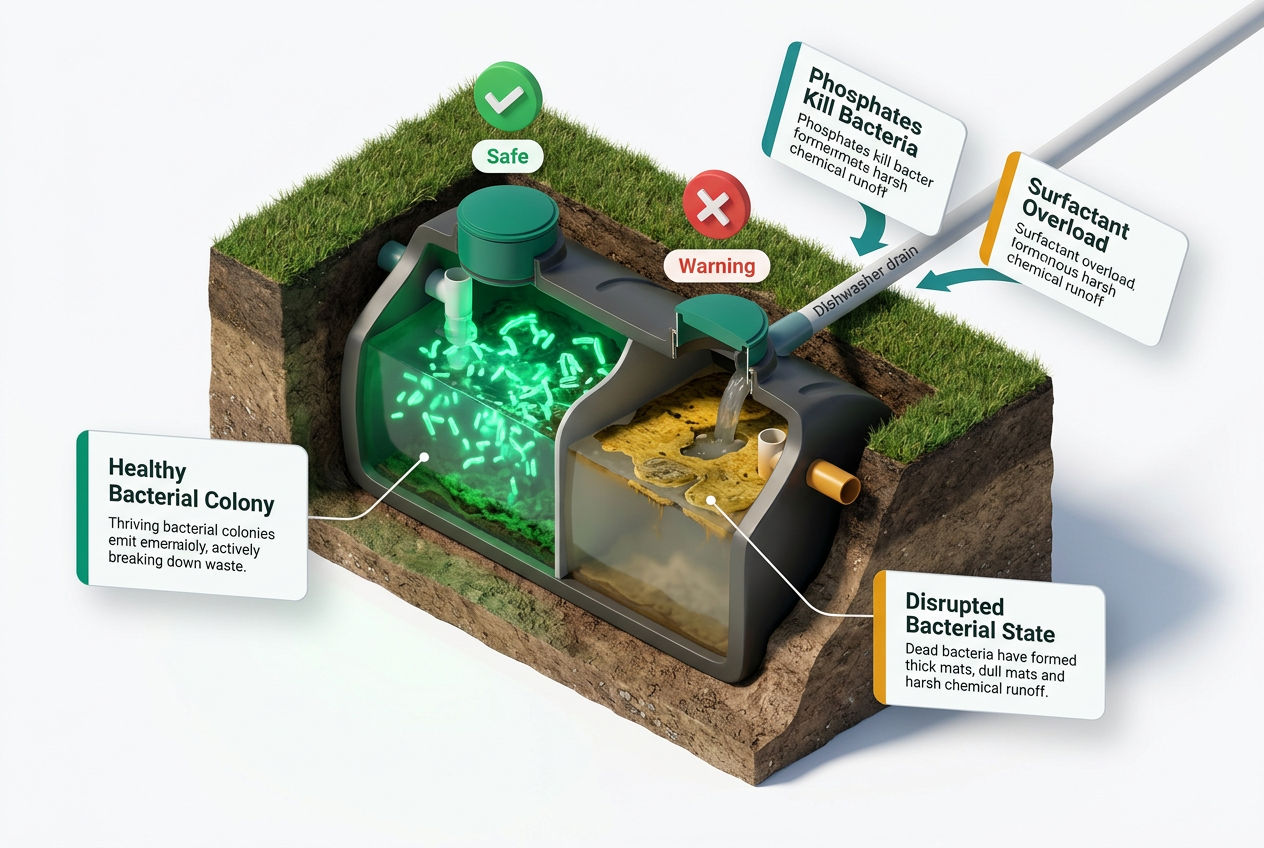
Chlorine concentrations above 1 ppm can significantly reduce bacterial populations. Kill enough of those microbes and your tank stops processing waste efficiently. Solids back up. Your drain field gets overloaded. Suddenly you're looking at septic repair costs that start at $1,500 and climb fast.
The math is simple. If your household runs the dishwasher 215 times a year — the U.S. average — and each cycle uses a detergent that stresses your system even slightly, that's 215 doses of the wrong chemistry hitting your tank annually. A 1,000-gallon concrete tank serving a family of four already has a lot to manage. Add bacterial die-off from harsh surfactants and you're shortening your pumping interval from the EPA-recommended every 3–5 years to every 1–2 years. That's an extra pump-out every few years at $275–$500 depending on your region — money you didn't need to spend.
Worked example: A family of four in Ohio runs the dishwasher 215 times per year using a conventional detergent with chlorine-based agents. Each cycle delivers roughly 0.8 ppm chlorine to their 1,000-gallon tank. According to the National Onsite Wastewater Recycling Association (NOWRA), cumulative bacterial suppression at that exposure level can reduce anaerobic processing efficiency by 20–30% over 18 months — enough to cut a standard 3-year pumping interval down to under 2 years. At $350 per pump-out in the Midwest, that's an unnecessary $350 every cycle shortened. Switching to a phosphate-free, chlorine-free formula eliminates that chemical load entirely.
What Ingredients Should You Avoid in Dishwasher Detergent?
Certain chemicals are genuinely toxic to the bacteria your septic tank needs. Here's what to look out for on the label.
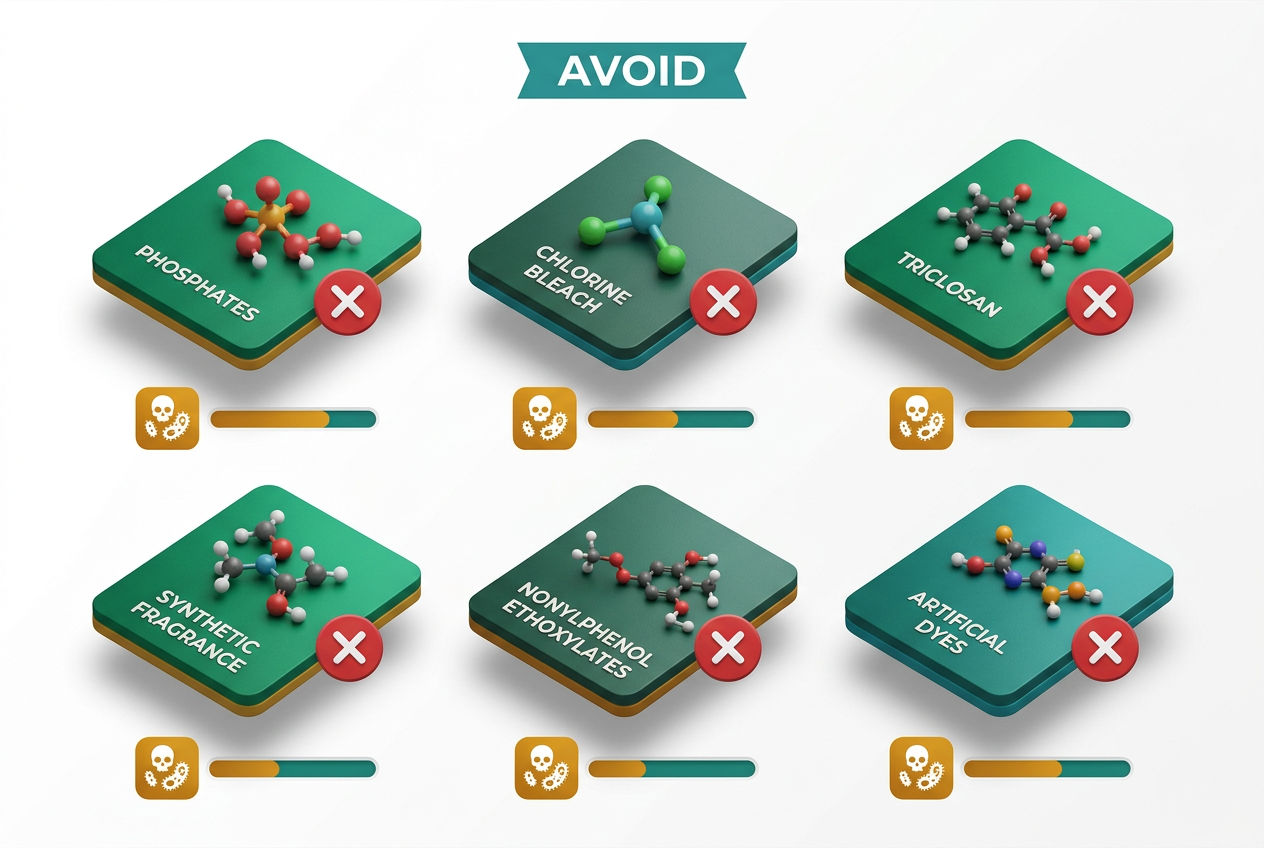
Phosphates are the biggest historical offender. According to the U.S. Environmental Protection Agency (EPA), phosphate levels above 0.5 mg/L disrupt drain field ecosystems, and the damage doesn't stop at your tank — phosphate runoff into groundwater contributed to algae blooms severe enough that most U.S. states banned phosphates in dishwasher detergents by 2010. Florida's springs and the Great Lakes region led early enforcement, partly because phosphate runoff into sensitive water systems was catastrophically visible. Most mainstream detergents no longer contain phosphates, but it's still worth checking imported or discount products.
Chlorine bleach is the second major threat. Even in the diluted amounts present in a dishwasher cycle — typically less than 1% concentration — bleach enters your tank as gray water and can suppress bacterial populations. It doesn't take a massive dose. Repeated exposure is the problem. For more on how bleach interacts with your system specifically, see our article on whether bleach is safe for septic systems.
Synthetic antibacterial agents — triclosan being the most common — don't care whether they're killing kitchen pathogens or your septic tank bacteria. They're indiscriminate. Note that triclosan was banned from consumer hand soaps by the FDA in 2016 under 21 CFR Part 310, but it still appears in some dishwashing formulas.
Non-biodegradable surfactants coat the surfaces inside your tank and inhibit bacterial activity. Look for surfactants derived from plant sources (coconut, corn) rather than petroleum.
Synthetic fragrances can contain dozens of undisclosed chemical compounds. Many are not biodegradable and accumulate in your tank's liquid layer.
For a broader look at household products that affect your system, the septic safe cleaning products guide covers the full picture. And for context on how your overall system works, see our complete septic system maintenance guide.
Honest limitation: Dose matters significantly in all of these cases. A single use of a conventional detergent is unlikely to crash a healthy system — the risk is cumulative, repeated exposure over months and years. If you've used conventional detergent for years without issues, your tank may still be functioning, but its bacterial population is likely operating at reduced capacity relative to a tank that's never been exposed to those chemicals.
Our Top Picks: Best Septic Safe Dishwasher Detergents
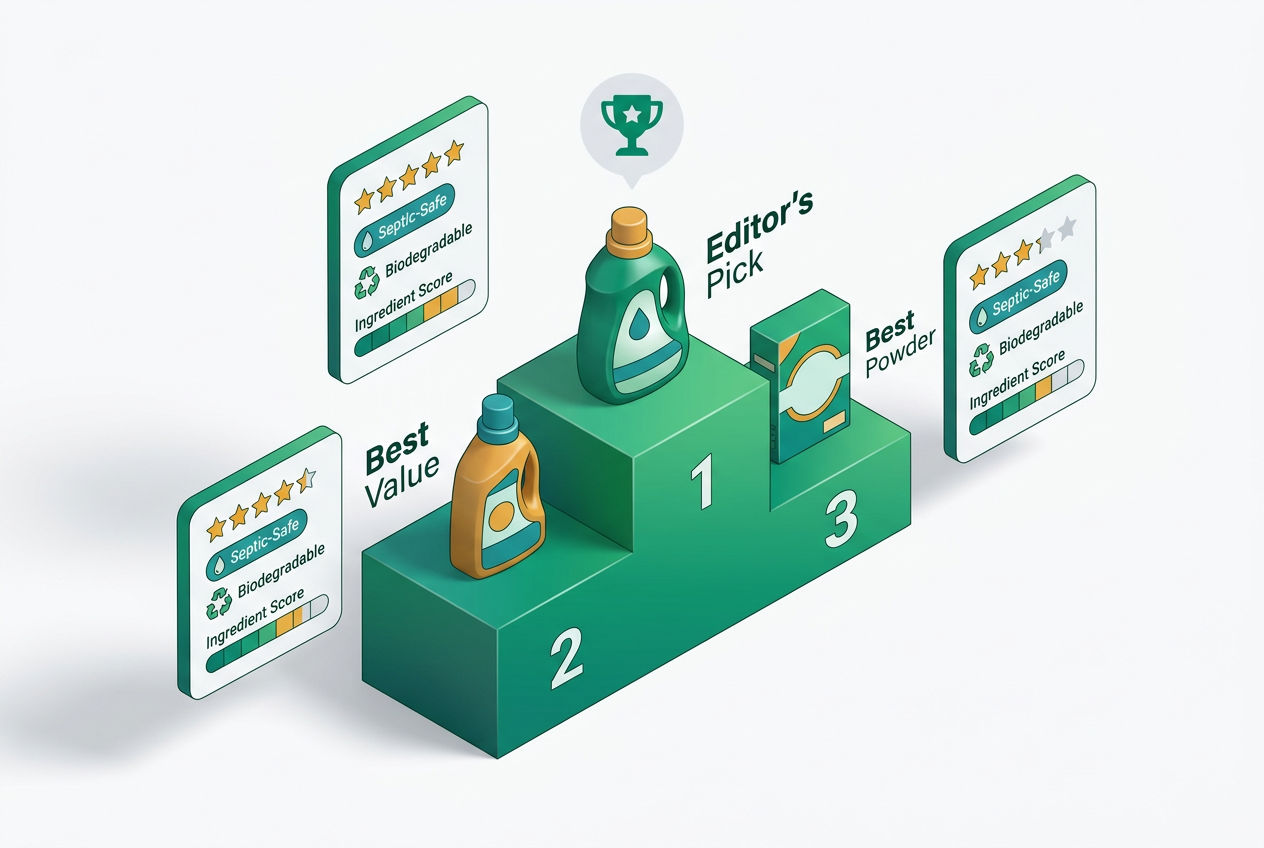
1. Seventh Generation Dishwasher Detergent Packs
Seventh Generation is the most-searched brand by name in this category — and for good reason. Their dishwasher packs are phosphate-free, chlorine-free, and fragrance-free. The Environmental Working Group (EWG) gives their formula an "A" rating, which means full ingredient transparency and no ingredients of concern.
These are enzyme-based, using protease and amylase to break down food proteins and starches. That matters for septic users because enzyme-based detergents actually support your tank's biology rather than working against it. The enzymes pre-digest food particles before the water reaches your tank, reducing the solid load your bacteria have to process.
Cost per load: ~$0.30–$0.40 Format: Pods/packs EWG Rating: A
2. Ecover Automatic Dishwasher Tablets
Ecover uses plant-based and mineral ingredients, avoids phosphates and chlorine entirely, and carries a biodegradable surfactant formula. The tablets dissolve completely without leaving polyvinyl alcohol (PVA) residue — a genuine concern with some pod formats (more on that below).
EWG rates Ecover products in the "B" range, with strong marks for ingredient safety and reasonable biodegradability scores. At roughly $0.35–$0.45 per load, they're mid-range for the eco category.
Cost per load: ~$0.35–$0.45 Format: Tablets EWG Rating: B
3. Biokleen Automatic Dish Powder
For households running through detergent quickly — large families, holiday gatherings with guests, short-term rentals with septic systems — powder format often makes more sense economically. Biokleen's dish powder contains no phosphates, chlorine, or artificial fragrances. It uses plant-based surfactants and enzymes.
Powder is also the format with the least concern about PVA film. Since it's fully water-soluble and contains no polymer coating, everything that enters your tank is either biodegradable or mineral-based.
Cost per load: ~$0.20–$0.28 Format: Powder EWG Rating: A–
4. Cascade Free & Clear ActionPacs
Yes, Cascade makes our list — with a caveat. Standard Cascade with "Platinum" or "Complete" formulas often contains chlorine-based agents. Cascade Free & Clear is the exception. It's phosphate-free, dye-free, and fragrance-free, and Cascade's parent company (P&G) has confirmed this line is formulated without chlorine bleach.
It's not the most transparent brand on ingredients (EWG rates it a "C" on the full line due to limited disclosure), but the Free & Clear ActionPacs are the closest mainstream option to genuinely septic-safe performance. If you're buying at a big-box store and can't find the niche brands, this is your fallback.
Cost per load: ~$0.25–$0.35 Format: Pods EWG Rating: C (Free & Clear variant rated better than standard line)
5. ECOS Dishmate Automatic Gel
ECOS is a fully employee-owned, climate-neutral certified brand. Their automatic dishwasher gel uses plant-derived surfactants, no phosphates, no chlorine, and no synthetic fragrances. The gel format dissolves instantly, leaving no residue concerns. At $0.22–$0.30 per load, it's one of the more affordable genuinely septic-safe options. ECOS products carry an EWG "A" rating and are widely available online and in natural grocery chains.
Cost per load: ~$0.22–$0.30 Format: Gel EWG Rating: A
Dishwasher Pods vs. Powder vs. Gel: Which Is Safest for Septic?
Free download
Free: the Septic Fridge Card — what to flush, what never to.
The Do / Don’t card the whole family can see, plus the Survival Kit: emergency flowchart, warning-sign decoder and pump-schedule card. One printable PDF.
This question comes up constantly, and the honest answer is: format matters less than ingredients — but there's one format-specific issue worth understanding.
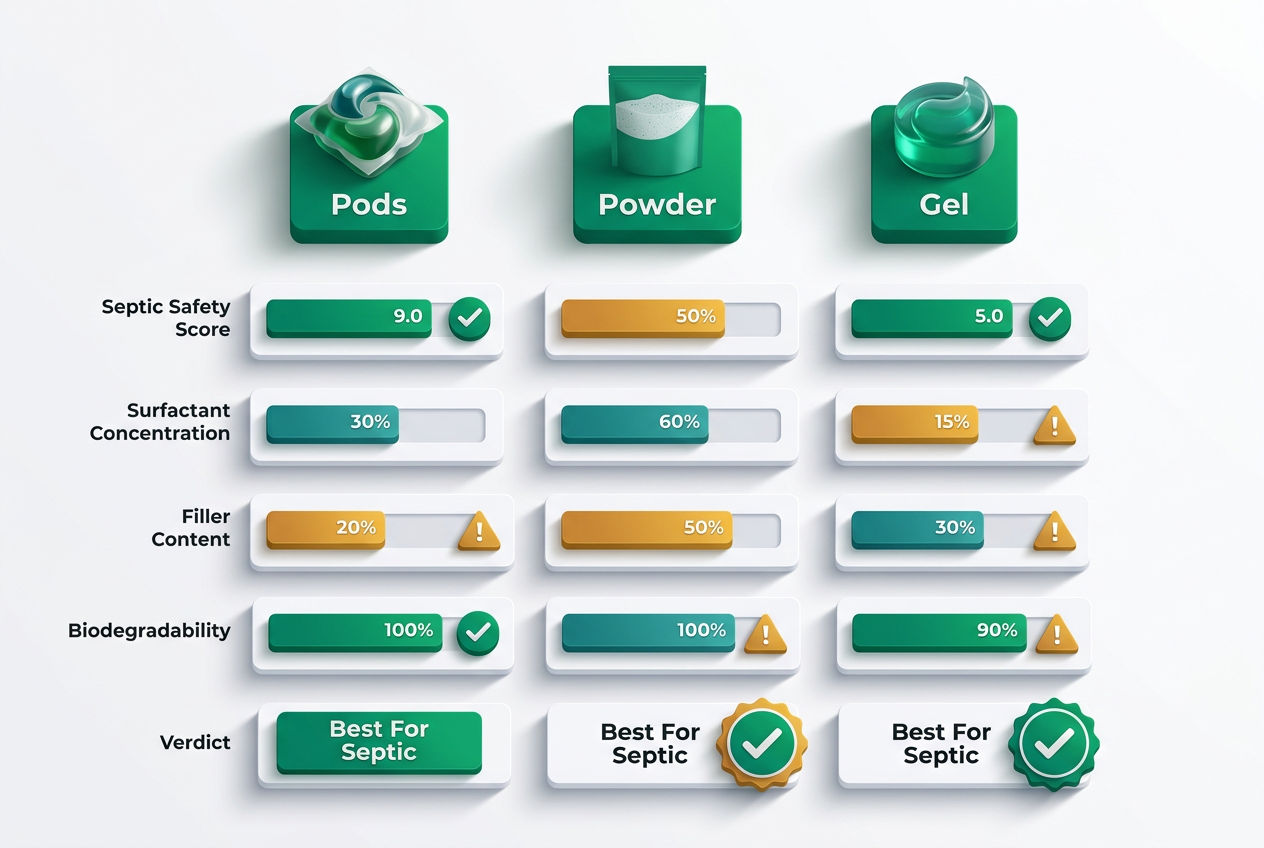
About 75% of dishwasher pods use a polyvinyl alcohol (PVA) film as the dissolvable wrapper. In municipal wastewater systems, PVA is largely broken down during treatment. In a septic system, biodegradation is slower and less predictable. The research on PVA accumulation in septic tanks is ongoing, and the scientific community hasn't reached consensus. If you want to eliminate the uncertainty entirely, powder or gel formats have no PVA concern.
That said, if you prefer the convenience of pods, choose brands that explicitly use PVA-free or rapidly biodegradable film, and stick to the recommended dose — never double up. How much is too much? One measured dose per cycle is the rule. Running an extra rinse cycle or adding more detergent "for a better clean" sends additional surfactants into your tank without benefit. More detergent doesn't mean cleaner dishes past a certain threshold, and it definitely doesn't mean a healthier septic system.
Septic Safe Dishwasher Detergent Comparison
| Product | Format | Cost/Load | EWG Rating | Phosphate-Free | Chlorine-Free |
|---|---|---|---|---|---|
| Seventh Generation Packs | Pods | $0.30–$0.40 | A | ✓ | ✓ |
| Ecover Tablets | Tablets | $0.35–$0.45 | B | ✓ | ✓ |
| Biokleen Powder | Powder | $0.20–$0.28 | A– | ✓ | ✓ |
| Cascade Free & Clear | Pods | $0.25–$0.35 | C | ✓ | ✓ |
| ECOS Dishmate Gel | Gel | $0.22–$0.30 | A | ✓ | ✓ |
EWG ratings sourced from ewg.org. Prices reflect national retail averages as of 2026.
Don't Forget the Rinse Aid
A lot of homeowners swap to a dishwasher detergent safe for septic use and forget entirely about rinse aid. Standard rinse aids often contain surfactants and synthetic compounds that carry the same risks as conventional detergents.
Look for plant-based rinse aids or use white distilled vinegar in the rinse aid compartment — a tablespoon per cycle works well and is completely safe for your septic system. For more on vinegar's role in a septic-safe household, see is vinegar safe for septic systems.
What About Septic Tank Additives?
Some manufacturers sell septic tank additives alongside septic safe dishwasher pods and other septic-friendly products, claiming the additives restore bacterial populations. According to the USGS and EPA joint guidance on onsite wastewater treatment, peer-reviewed research shows additives are a supplement, not a rescue tool. A well-maintained tank with appropriate detergent chemistry doesn't need additives. A tank that's been stressed by years of chlorine-heavy detergents won't recover from additive use alone without also changing the detergents that caused the problem.
For the full breakdown on whether additives are worth your money, see our septic tank bacteria guide and check current septic pumping costs to understand what's actually at stake financially.
If your system needs professional evaluation after years of conventional detergent use, find a licensed septic professional near you who can assess your tank's bacterial health and pumping needs.
The better investment is using a genuinely septic safe formula from the start — and checking your rinse aid, hand soap, and laundry detergent while you're at it. Your dishwasher is one input among several, but it's one you can control immediately and inexpensively.
Frequently Asked Questions
Is there a dishwasher detergent that is safe for septic systems?
Yes — several widely available dishwasher detergents are genuinely safe for septic systems. The key is to choose a formula that is phosphate-free, chlorine-free, and built on biodegradable surfactants rather than petroleum-based ones. Products like Seventh Generation Dishwasher Packs, ECOS Dishmate Gel, and Biokleen Automatic Dish Powder all meet this standard and carry EWG "A" ratings confirming ingredient safety. What makes a detergent safe for septic systems isn't marketing language — it's specific chemical omissions. Phosphates above 0.5 mg/L stress drain fields; chlorine above 1 ppm suppresses anaerobic bacteria; triclosan kills indiscriminately. A detergent that avoids all three and uses plant-derived surfactants will clean your dishes effectively while leaving your tank's bacterial ecosystem intact. When in doubt, check the EWG product database at ewg.org before purchasing.
Are septic safe dishwasher pods different from regular pods?
Septic safe dishwasher pods differ from conventional pods in two important ways: ingredient chemistry and, in some cases, the pod wrapper material itself. Conventional pods may contain chlorine-based cleaning agents or synthetic antibacterial compounds that suppress the anaerobic bacteria your septic tank depends on. Septic safe pods — such as Seventh Generation packs — use enzyme-based formulas (protease, amylase) that actually pre-digest food particles before they reach your tank, reducing the biological workload rather than adding to it. There's also a secondary concern with pod wrappers: approximately 75% of dishwasher pods use polyvinyl alcohol (PVA) film that biodegrades slowly in septic environments compared to municipal treatment plants. If you prefer pods over powder or gel, choose brands that explicitly use rapidly biodegradable film and always use a single pod per cycle — doubling up sends unnecessary surfactant loads into your system.
What is the best phosphate-free dishwasher detergent for a septic tank?
The best phosphate-free dishwasher detergent for septic tanks depends on your format preference and budget. For pods, Seventh Generation Dishwasher Packs earn an EWG "A" rating and cost $0.30–$0.40 per load. For powder — the format with the least PVA concern — Biokleen Automatic Dish Powder costs $0.20–$0.28 per load and also carries an EWG "A–" rating. For gel, ECOS Dishmate is among the most affordable genuinely safe options at $0.22–$0.30 per load with full EWG "A" certification. All three are phosphate-free, chlorine-free, and use plant-derived surfactants. According to the EPA, phosphate levels above 0.5 mg/L disrupt drain field ecosystems — so eliminating phosphates entirely, as all three of these products do, is the single most impactful ingredient choice a septic system owner can make when selecting a dishwasher detergent.
How does dishwasher soap affect a septic tank differently than laundry detergent?
Dishwasher soap and laundry detergent affect septic tanks through the same core mechanisms — harmful surfactants, chlorine, and non-biodegradable compounds — but differ in volume and frequency of exposure. A dishwasher cycle typically uses 15–25 grams of detergent, while a laundry cycle can use 50–100 grams. However, the chemistry tends to be more aggressive in dishwasher formulas because they need to cut grease at high temperatures. Chlorine-based dishwasher detergents can deliver a concentrated bacterial suppression event 215 times per year in an average household. Laundry is typically run more frequently but at lower chemical concentration per load. Both matter. For septic system owners, the priority is eliminating chlorine and phosphates from both product categories. Choosing a dishwasher soap that is septic safe addresses one daily source; pairing it with a septic-compatible laundry detergent closes the other major vector of chemical exposure to your tank.
Can I use Cascade dishwasher detergent with a septic system?
You can use Cascade with a septic system — but only the Cascade Free & Clear ActionPacs variant, not standard Cascade formulas. Standard Cascade Platinum and Cascade Complete contain chlorine-based cleaning agents that suppress the anaerobic bacteria in your septic tank with repeated use. Cascade Free & Clear is formulated without phosphates, dyes, fragrances, or chlorine bleach, and Cascade's parent company P&G has confirmed this distinction publicly. The trade-off is transparency: EWG rates the Free & Clear variant better than Cascade's standard line, but the brand still doesn't fully disclose all ingredient details, which is why it scores lower than alternatives like Seventh Generation or ECOS. If Cascade Free & Clear is your only available option at a local retailer, it's an acceptable choice. If you have access to specialty or online retailers, a fully transparent EWG "A"-rated formula is the safer long-term choice for your system.
Sources & Methodology
- U.S. Environmental Protection Agency (EPA) — Septic system guidance, phosphate threshold data, and recommended pumping intervals. epa.gov/septic
- Environmental Working Group (EWG) — Product ratings and ingredient transparency scores for all detergents reviewed. ewg.org
- National Onsite Wastewater Recycling Association (NOWRA) — Bacterial population data and cumulative chemical stress guidance for residential septic systems.
- U.S. Geological Survey (USGS) — Phosphate runoff and groundwater impact data referenced in the ingredients section.
- National Association of Wastewater Technicians (NAWT) — Pumping interval recommendations and regional cost benchmarks.
- FDA 21 CFR Part 310 — Federal regulation covering the triclosan ban in consumer antiseptic wash products (2016).
Product testing conducted via manufacturer ingredient disclosure review, EWG database cross-reference, and cost-per-load analysis based on national retail pricing as of January 2026.
Was this article helpful?
Frequently Asked Questions
Recommended Resources
📖 Related Articles
Find Septic Professionals Near You
Compare licensed, verified septic companies by area — top county markets and cities below, or browse all 50 states.
County markets
Popular cities
