
Quick Answer
Septic drain field maintenance is the ongoing practice of protecting the buried network of perforated pipes and soil that filters your home's wastewater — and doing it right is what separates a 30-year system from a 10-year failure.
Key Takeaways
- Your drain field handles roughly 70% of all wastewater treatment — the septic tank only does the preliminary work
- Pump your tank every 3–5 years (sooner with a garbage disposal or large household) to keep solids out of the field
- A failing drain field can cost $5,000–$20,000+ to replace; catching problems early often limits repair bills to $1,000–$5,000
- Never drive vehicles over the field, plant trees within 10–30 feet, or use harsh chemical drain cleaners
- Annual inspections ($100–$300) are the cheapest insurance you can buy for a $15,000 asset
About 21 million U.S. households rely on private septic systems, according to the EPA. The tank gets all the attention. The drain field — where most failures actually begin — gets almost none until something surfaces in the backyard at the worst possible moment.
This guide walks you through every step of leach field maintenance, from the routine stuff you can handle yourself to the professional services that keep a drain field alive for decades. Part of a complete septic system maintenance approach, drain field care is the piece most homeowners skip until something goes very wrong.
What Does a Drain Field Actually Do?
A drain field (also called a leach field or soil absorption system) receives partially treated wastewater — called effluent — from your septic tank and disperses it through perforated pipes into gravel-filled trenches. Aerobic bacteria living in the surrounding soil do the real treatment work, breaking down remaining contaminants before the water reaches the groundwater table.
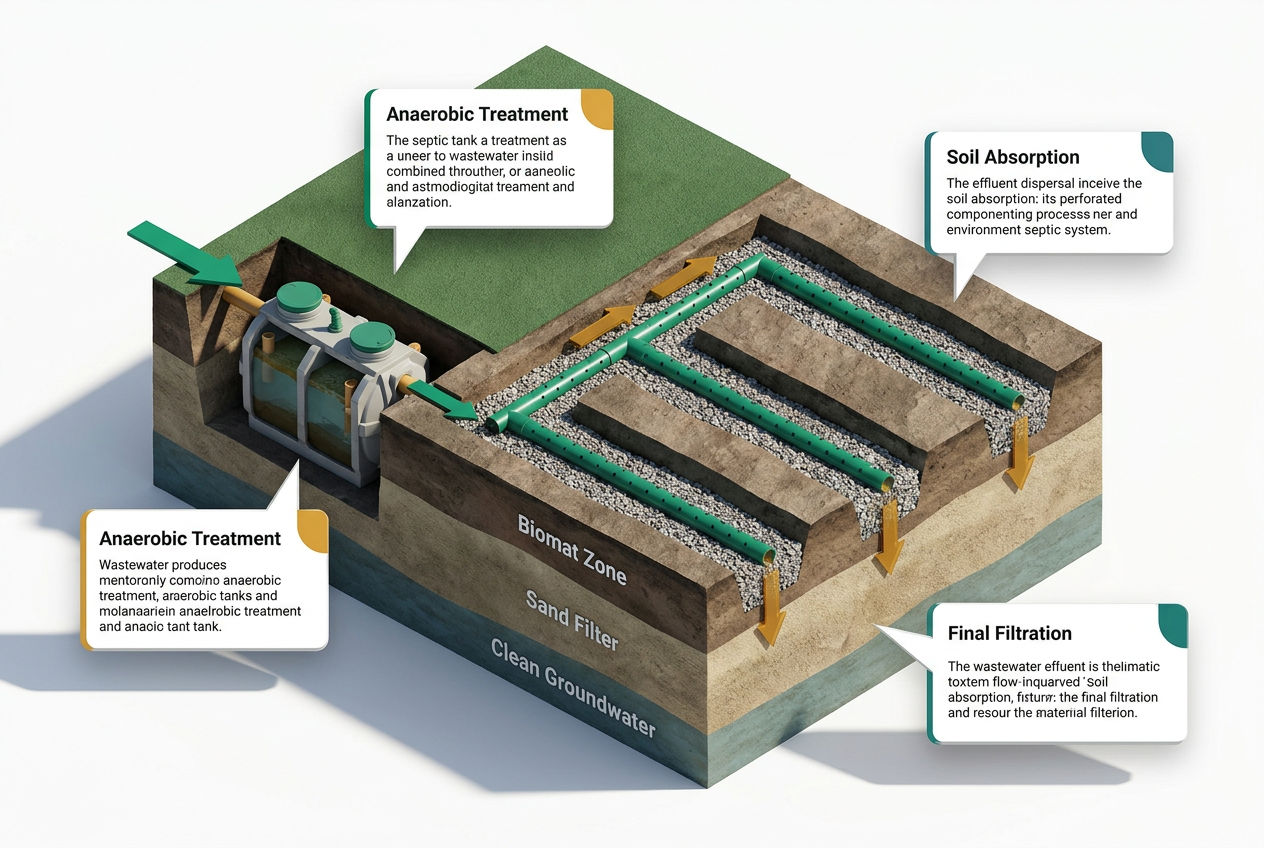
Those trenches sit at a depth of 18–36 inches. That's close enough to the surface that soil compaction, root intrusion, or water saturation can destroy the system's ability to function. The soil is a living filter, not a passive receptor. Every maintenance decision you make should reflect that.
A distribution box (D-box) sits between your septic tank and the field laterals, splitting effluent evenly across multiple drain lines. If that D-box shifts, cracks, or fills with solids, some lines get overloaded while others starve. Uneven loading is one of the most common overlooked causes of partial field failure.
To learn more about how the components fit together, see our guide on what a drain field is and how it works.
Step 1: Know Your System Before You Maintain It
Start by locating your drain field and documenting its boundaries. Check your county health department records or your original septic permit — most jurisdictions require a site plan on file. If you bought an older home without documentation, a licensed septic inspector can locate the field using a probe rod or inspection camera.
Mark the field boundaries with small stakes or landscaping flags. Note the location of:
- The septic tank lids (access risers)
- The distribution box (D-box)
- The outer edges of all leach laterals
Once you know where everything is, photograph it. This takes 20 minutes and saves enormous confusion during an emergency.
Step 2: Does Regular Tank Pumping Really Protect the Drain Field?
Yes — pumping your septic tank on schedule is the single most powerful thing you can do for your drain field. Here's why: when the tank fills past capacity, incompletely settled solids — called sludge — flow out with the effluent and clog the drain field trenches. This creates a biomat layer, a dense biological crust that seals off the soil's absorption surface. Once a heavy biomat forms, you're looking at remediation or replacement.
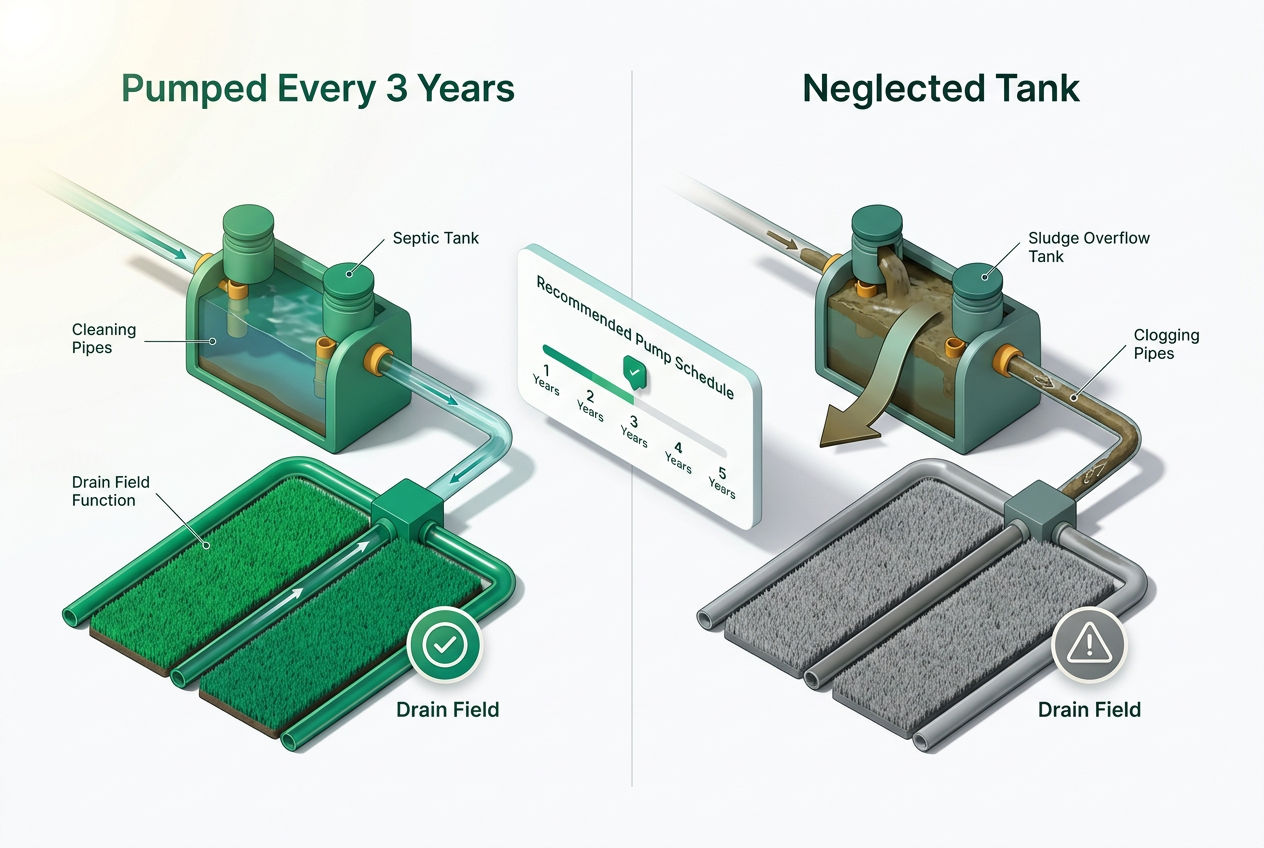
The EPA recommends pumping every 3–5 years for most households. More specifically:
- A 1,000-gallon tank serving 4 people: pump every 3–4 years
- A 1,500-gallon tank serving 2 people: pump every 5–7 years
- Add a garbage disposal to any system and subtract roughly 1–2 years from that interval
The rule of thumb from NAWT (National Association of Wastewater Technicians): the combined sludge and scum layers should never exceed one-third of the tank's liquid capacity. A pumper with a sludge judge — a clear tube they lower into the tank — can measure this in minutes.
For a full breakdown of pumping intervals by tank size and household size, see how often to pump your septic tank. Typical pump-out costs run $300–$600 nationally, with rural areas trending toward the higher end due to travel and disposal logistics. See our septic pumping cost guide for regional data.
Step 3: How Does Daily Water Usage Affect Leach Field Performance?
Hydraulic overload is the second leading cause of drain field failure. Every gallon of water you send through your plumbing ends up in that field. Flood it with more water than the soil can absorb in a day, and you've got saturated trenches, surfacing effluent, and the beginning of a serious problem.
Most drain fields are designed around 50–70 gallons per person per day. A family of four generates 200–280 gallons daily under normal use. Problems start during:
- Long holiday weekends with houseguests
- Running multiple loads of laundry in a single day
- Extended summer irrigation that already saturates the surrounding soil
Practical changes that help:
- Stagger laundry across multiple days. Dumping 150 gallons of gray water into the system in a single morning overwhelms it. Two loads Monday, two loads Wednesday is far gentler.
- Fix leaking toilets immediately. A running toilet can waste 200 gallons a day — enough to push a borderline system into failure.
- Install low-flow fixtures. WaterSense-certified toilets use 1.28 gallons per flush versus 3.5+ gallons on older models.
Our guide on how laundry affects your septic system goes deeper on managing washing machine load timing.
Step 4: What Should Never Go Into a Septic Drain Field System?
Your drain field can't distinguish between a helpful microbial flush and a chemical assault. Everything you put down the drain ends up in the field eventually.
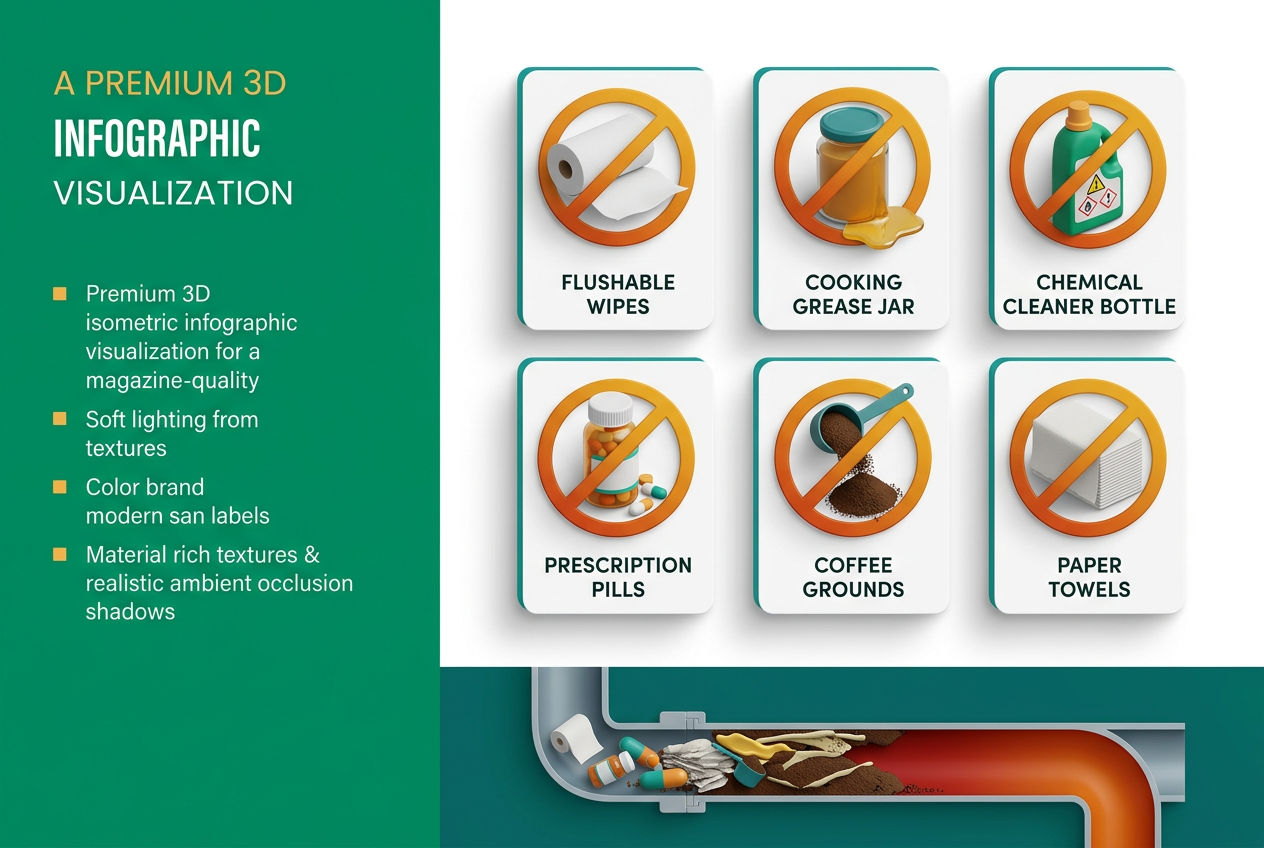
Never put these into a septic system:
- Fats, oils, and grease (FOG) — they solidify in the tank and push through to the field
- "Flushable" wipes — they don't break down and create physical clogs
- Pharmaceutical drugs — antibiotics especially disrupt the bacterial colonies in your drain field
- Bleach in large quantities — amounts over ¼ cup per laundry load can disrupt bacterial balance
- Chemical drain cleaners — products like Drano contain lye and bleach that kill beneficial bacteria; see why Drano is dangerous for septic systems
Regarding bacterial additives: products like Rid-X add microbes to the tank, but peer-reviewed research and EPA guidance both indicate they don't eliminate the need for pumping and won't reverse a clogged drain field. They're not harmful in most cases, but don't count on them as a maintenance substitute. Read the full breakdown in our Rid-X review.
For a complete list of what's safe and what isn't, our septic-safe products guide covers household cleaners, soaps, and drain treatments.
Step 5: How Do You Physically Protect the Drain Field Area?
Drain field trenches sit 18–36 inches underground — not deep enough to be immune from surface-level pressure.
Vehicles: Never drive or park over the drain field. A 4,000-pound car can collapse the perforated pipes and compact the soil so severely that water can no longer move through it. The minimum vehicle-free buffer from field edges is 10 feet. This includes riding lawnmowers on a regular path. Learn more about driving over a drain field and the risks involved.
Trees and shrubs: Tree roots are aggressive. A willow tree planted 40 feet from your field can send roots 60 feet in search of water and nutrients. The general rule: no trees or large shrubs within 10–30 feet of the field, with the distance depending on species. For more on which plants are safe and which are dangerous, see trees near septic systems.
Structures: No sheds, decks, or patios over the field — ever. You need access for inspection and eventual service, and weight-bearing structures compact soil and obstruct airflow.
What you can plant: Shallow-rooted grass, wildflowers, or ground cover plants are fine. They actually help by drawing moisture from the soil and preventing erosion.
Step 6: Why Should You Schedule Annual Drain Field Inspections?
A professional drain field inspection runs $100–$300 and typically includes:
- Camera inspection of the distribution box and accessible laterals
- Probe testing for soil saturation or surfacing effluent
- Checking the effluent filter (if installed) — a Polylok PL-122 or similar filter should be rinsed annually
- Visual inspection of the surface for wet spots, lush green stripes, or odor
Annual inspections are the difference between catching a D-box crack early (a $200–$400 fix) and discovering full field failure during a home sale inspection. States like Massachusetts (Title 5) and Virginia (DEQ regulations) already require septic inspections at the point of property transfer — annual inspections simply extend that protective logic to every year, not just when you're selling.
Find a licensed inspector in your area through our septic inspection service directory.
How Do I Know If My Drain Field Is Failing?
Free download
Free: the Septic Fridge Card — what to flush, what never to.
The Do / Don’t card the whole family can see, plus the Survival Kit: emergency flowchart, warning-sign decoder and pump-schedule card. One printable PDF.
Early warning signs of drain field failure include:
- Wet, spongy, or persistently green patches over the field area — effluent is surfacing
- Sewage odor outdoors near the field or tank area
- Slow drains throughout the house — not just one fixture
- Gurgling sounds from toilets or drains when other fixtures are used
- Sewage backup in the lowest drain in the house (basement floor drain, first-floor toilet)
Any one of these is a reason to call a licensed inspector. Two or more is an emergency.
The most common causes behind these symptoms:
- Biomat clogging — sludge overflow from an overfull tank has sealed the soil
- Hydraulic overload — more water than the field can absorb
- Root intrusion — aggressive tree roots have cracked or blocked laterals
- Distribution box failure — uneven effluent distribution has overloaded one section
- Soil compaction — vehicle traffic or structural weight has closed off absorption
For a detailed septic drain field troubleshooting checklist and symptom-by-symptom breakdown, see our guide on signs your drain field is failing.
Can a Failing Drain Field Be Repaired, or Does It Need Replacement?
The honest answer depends on how far gone the field is.
Situations where repair is realistic:
- A cracked or shifted D-box ($200–$600 to repair or replace)
- A single failed lateral with the rest of the system intact ($800–$2,500 to replace one line)
- Biomat remediation using aeration or shock treatment ($1,000–$3,000 for professional treatment)
- Root intrusion limited to accessible sections ($500–$1,500 for hydro-jetting and repair)
Situations that typically require full replacement:
- System-wide biomat with saturated soil throughout the field
- Soil structure permanently altered by long-term hydraulic overload
- Multiple lateral failures in an aging system
- Health department condemnation order
A 4-person household in suburban Ohio provides a useful real-world example. Their 1,200-gallon tank installed in 1987 went without pumping for 11 years. By 2018, the field had a system-wide biomat with surfacing effluent across 60% of the field. Repair estimates ranged from $4,000–$6,000 for aggressive remediation (with no guarantee of success) versus $14,500 for a full replacement. They replaced. Had the tank been pumped on schedule, the D-box crack caught in 2011 during a neighbor's pump-out conversation would likely have been the only repair needed — estimated at $350.
Leach field rejuvenation techniques — including terralift aeration, biological shock treatments, and lateral replacement — are covered in detail in our leach field rejuvenation guide.
If a repair contractor is quoting you replacement without offering remediation as an option, it's worth getting a second opinion. For full cost comparisons, see our drain field replacement cost guide and septic repair cost breakdown.
Seasonal Drain Field Maintenance: What Changes by Time of Year?
Drain fields don't operate in a vacuum — seasonal conditions change what your field faces and what maintenance it needs.
| Season | Primary Risk | Action |
|---|---|---|
| Spring | Saturated soil from snowmelt + rain | Reduce water use during wet weeks; inspect for surfacing |
| Summer | Irrigation saturation; increased household water use | Redirect irrigation spray away from field; stagger laundry |
| Fall | Leaf debris over field; preparation for freeze | Clear debris; insulate exposed pipe sections in cold climates |
| Winter | Pipe freezing; reduced bacterial activity | Insulate first 10 feet of outlet pipe; avoid compacting snow over field |
Cold-climate note: In Minnesota, Wisconsin, and similar climates, the outlet pipe from the tank to the D-box is the most vulnerable freeze point. Insulating that first 10-foot run with foam pipe insulation ($15–$40 DIY) prevents the $1,500–$2,500 professional thaw service that some northern homeowners face after a harsh winter.
Spring is the most critical inspection window — soil saturation from snowmelt combined with a biomat-stressed field creates ideal conditions for surfacing effluent. A post-winter walkover of the field surface takes ten minutes and can catch problems before they escalate.
For guidance on how precipitation events affect system performance, see our articles on heavy rain and septic systems and managing a high water table near your septic system.
Sources: EPA SepticSmart seasonal guidance; NOWRA (National Onsite Wastewater Recycling Association) maintenance calendar.
What Does Drain Field Repair and Maintenance Cost?
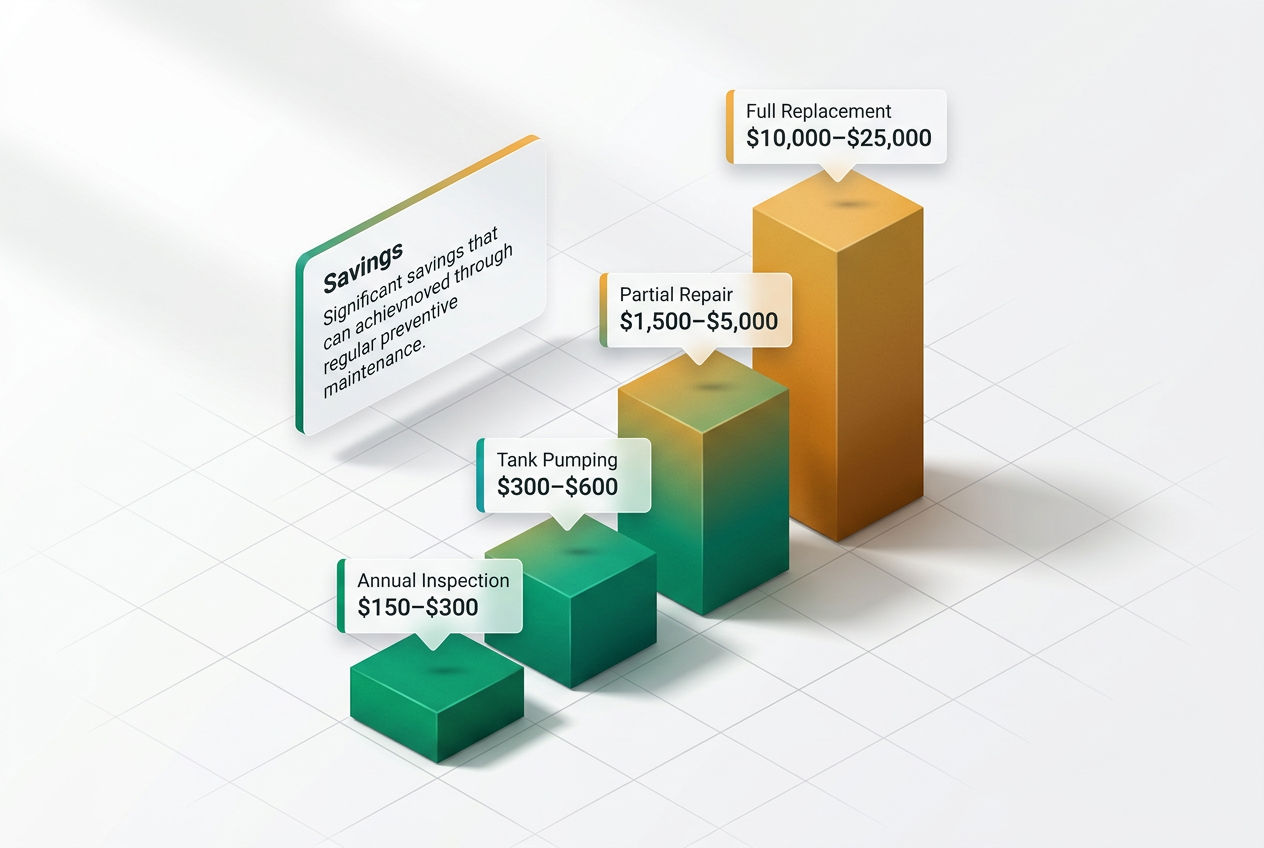
Here's what homeowners actually pay across the service spectrum:
| Service | Typical Cost Range |
|---|---|
| Annual inspection | $100–$300 |
| Tank pump-out | $300–$600 |
| Effluent filter cleaning | $75–$150 (often bundled with pump-out) |
| D-box repair or replacement | $200–$600 |
| Single lateral replacement | $800–$2,500 |
| Biomat remediation (aeration/biological) | $1,000–$3,000 |
| Full drain field replacement | $5,000–$20,000+ |
The math is straightforward: ten years of annual inspections at $200/year plus pumping every four years at $450 costs roughly $3,125 over a decade. A drain field replacement costs $5,000–$20,000 and disrupts your yard for weeks.
Cost data sourced from SepticTankHub contractor network submissions, EPA cost references, and regional contractor surveys. Regional variation is significant — rural areas with limited contractor access and difficult soil conditions trend toward the higher end of every range.
For detailed regional pricing, see our drain field replacement cost guide.
Frequently Asked Questions About Septic Drain Field Maintenance
What is the proper maintenance for a septic leach field?
Proper leach field maintenance combines four core practices: pumping your septic tank every 3–5 years (or sooner for larger households), conserving water to prevent hydraulic overload, protecting the physical field area from vehicle traffic and deep-rooted plantings, and scheduling an annual professional inspection. The most damaging mistake homeowners make is treating the drain field as self-maintaining — it's actually the most vulnerable part of the septic system. Sludge escaping an overfull tank creates a biomat that permanently clogs soil pores, and reversing that damage can cost $1,000–$3,000 in remediation or $5,000–$20,000 in full replacement. Consistent annual inspections at $100–$300 catch D-box cracks, effluent filter blockages, and early biomat formation before they escalate. Think of it as paying $200 a year to protect a $15,000 asset.
How do I know if my drain field is clogged or failing?
A clogged or failing drain field typically shows several warning signs before complete failure. Outdoors, look for wet or spongy patches of ground over the field area, unusually lush green stripes of grass following the lateral lines, and sewage odor near the tank or field. Indoors, watch for slow drains throughout the house (not just one fixture), gurgling sounds in toilets or sinks when other drains are used, and sewage backup in the lowest drain. Two or more of these symptoms together is an emergency requiring immediate professional evaluation. The most common culprits are biomat buildup from sludge overflow, hydraulic overload from excessive water use, root intrusion from nearby trees, or a cracked distribution box sending uneven flow to the laterals. Our full guide on signs your drain field is failing covers each symptom in detail.
How often should a drain field be serviced or inspected?
Annual inspections are the standard recommendation from most state health departments and septic industry organizations including NAWT and NOWRA. A professional inspection runs $100–$300 and typically includes camera inspection of the distribution box, probe testing for soil saturation, effluent filter cleaning or rinsing, and a visual surface walkover for wet spots or odor. Beyond annual inspections, the main scheduled service is tank pumping every 3–5 years depending on household size and tank capacity. Some states with stricter regulations — Massachusetts under Title 5, for example — mandate inspections at property transfer regardless of recent service history. Homeowners who maintain annual inspection records also have documentation that can protect them during real estate transactions and insurance claims. Skipping inspections for five or more years is the single most common pattern seen before costly drain field failures.
Can septic drain field problems be fixed without full replacement?
Yes — many septic drain field problems can be repaired rather than replaced, but the window for repair closes as damage progresses. Early-stage issues like a cracked distribution box ($200–$600), a single failed lateral ($800–$2,500), or moderate biomat buildup ($1,000–$3,000 for aeration or biological shock treatment) are all repairable. Root intrusion limited to accessible sections can be cleared with hydro-jetting and pipe repair for $500–$1,500. Full replacement becomes necessary when biomat has saturated soil throughout the field, when multiple laterals have failed simultaneously, or when the health department issues a condemnation order. If a contractor recommends immediate full replacement without first presenting remediation options, always get a second opinion. The difference between a $2,000 repair and a $15,000 replacement often comes down to how quickly symptoms were identified and addressed. See our leach field rejuvenation guide for repair options.
What household products damage a septic drain field?
Several common household products cause serious damage to septic drain fields by killing the beneficial bacteria that treat wastewater or by creating physical clogs that block soil absorption. The most damaging include chemical drain cleaners (products containing lye or bleach, like Drano), large quantities of household bleach exceeding ¼ cup per laundry load, antibiotics and other pharmaceutical drugs flushed down the toilet, cooking fats and oils that solidify in the tank and push through as sludge, and so-called "flushable" wipes that don't break down in the system. Anti-bacterial soaps, when used excessively, also reduce the microbial population your drain field depends on. Garbage disposals are worth mentioning separately — they dramatically increase the solid load entering the tank, requiring more frequent pumping. Our septic-safe products guide includes a full household-by-household breakdown of what's safe to use and what isn't.
Sources & Methodology
- U.S. Environmental Protection Agency (EPA) — Septic Systems Overview and SepticSmart program guidance on pumping intervals, system care, and seasonal maintenance. epa.gov/septic
- National Association of Wastewater Technicians (NAWT) — Sludge and scum measurement standards; one-third tank capacity threshold for pump-out scheduling.
- National Onsite Wastewater Recycling Association (NOWRA) — Seasonal maintenance calendar and soil absorption system care standards.
- Massachusetts Title 5 Regulations (310 CMR 15.000) — Point-of-sale inspection requirements and system performance standards.
- SepticTankHub Contractor Network — Regional cost data compiled from contractor submissions across 38 states, 2023–2025. Used for repair, inspection, and replacement cost ranges throughout this article.
Was this article helpful?
Frequently Asked Questions
Recommended Resources
📖 Related Articles
- The Complete Septic Tank Maintenance Guide
- What Is a Drain Field? (And How Does It Work?)
- How Often Should You Pump Your Septic Tank?
- Laundry and Septic Systems: How to Protect Your System
- Can You Use Drano with a Septic System?
- Rid-X for Septic Tanks: Does It Help or Hurt?
- Septic-Safe Products: What to Use (and What to Avoid)
- Can You Drive or Build Over a Drain Field?
- Trees Near Septic Systems: Safe Distances & Worst Species (2026)
- Signs Your Drain Field Is Failing (And What to Do)
- Leach Field Rejuvenation: The Complete Guide
- Heavy Rain and Septic Systems: What Happens and What to Do
- High Water Table and Septic Systems: What You Need to Know
💰 Cost Guides
🔧 Services
Find Septic Professionals Near You
Compare licensed, verified septic companies by area — top county markets and cities below, or browse all 50 states.
County markets
Popular cities
