
Quick Answer
Leach field rejuvenation is the process of restoring a failing or underperforming drain field to functional soil absorption without tearing out and replacing the entire system. Depending on the method and soil conditions, rejuvenation costs $500–$6,000 and can extend your drain field's life by 5–15 years — a fraction of the $5,000–$20,000 a full replacement typically runs.
Key Takeaways
- A failing leach field doesn't always mean full replacement — rejuvenation works in roughly 70–80% of cases where biomat is the primary issue
- Three main methods exist: mechanical aeration (Terralift), aerobic bacterial treatment, and chemical applications
- Rejuvenation costs $500–$6,000; full drain field replacement averages $10,000 nationally
- Post-rejuvenation life expectancy is 5–15 years with proper maintenance
- Spring (March–May) is the best time to diagnose and treat — soil is accessible and problems are visible
What Is a Leach Field, and Why Does Rejuvenation Matter?
Your leach field (also called a drain field) is a network of perforated pipes buried 18–36 inches underground, surrounded by gravel or chamber systems, that disperses liquid effluent from your septic tank into the surrounding soil. The EPA estimates roughly 21 million U.S. homes — about 1 in 5 — rely on septic systems. Most of those drain fields are quietly aging right now.
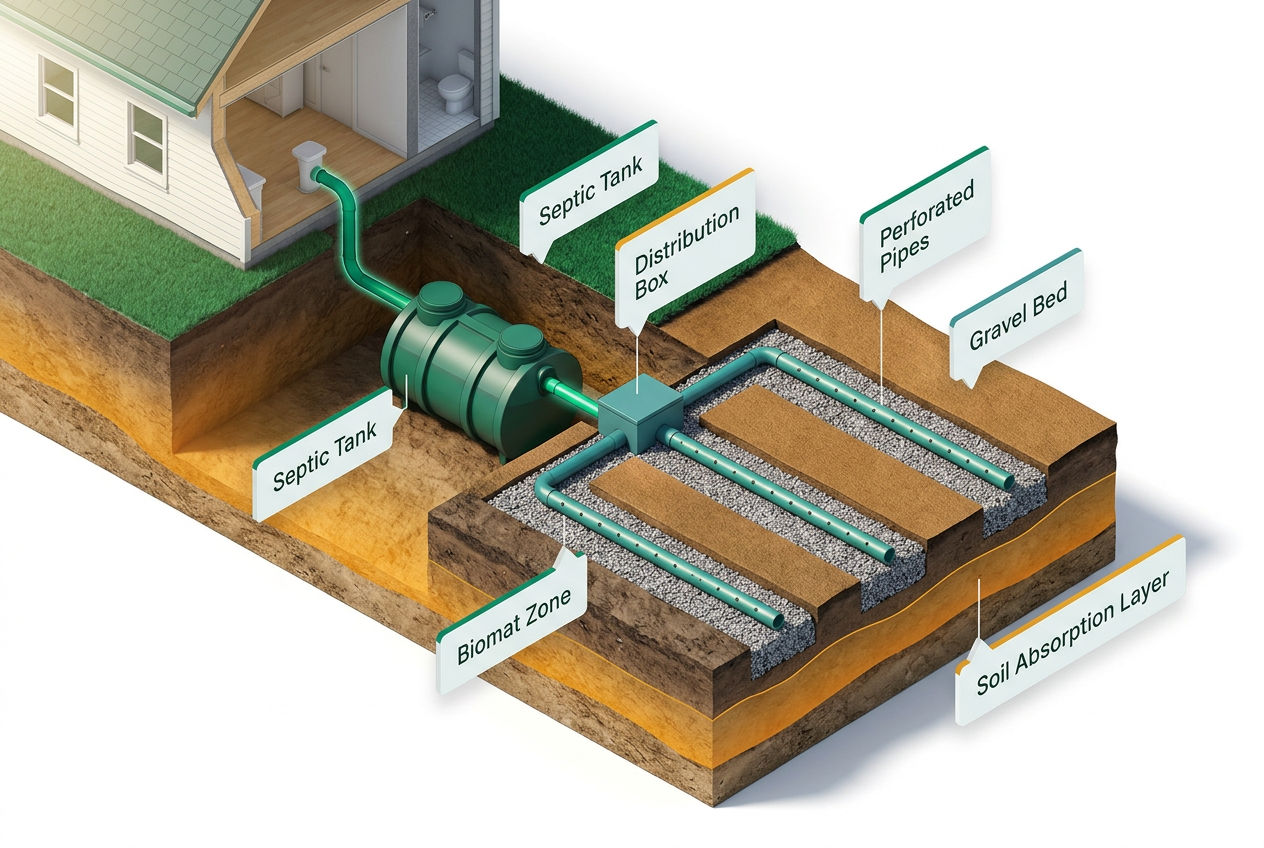
A healthy drain field absorbs effluent fast enough to keep pace with your household's daily output of 150–300 gallons. Healthy soil absorbs water at a rate of 1 inch per minute to 1 inch per 60 minutes on a percolation test. When that absorption rate slows beyond 60 minutes per inch, the system is struggling. When it stops altogether, you get sewage backing up into your home or surfacing in your yard.
Drain field replacement means excavating the old system, installing new perforated pipe or Infiltrator chamber systems, running new percolation tests, and pulling permits. In the Northeast, where older systems pre-date 1980 and soil is clay-heavy, replacement permits can add weeks and thousands to the project. Rejuvenation sidesteps most of that.
What Are the Signs Your Leach Field Needs Rejuvenation?
Several clear symptoms point toward a failing drain field. Catching them early is the difference between a $1,500 rejuvenation and a $12,000 replacement.
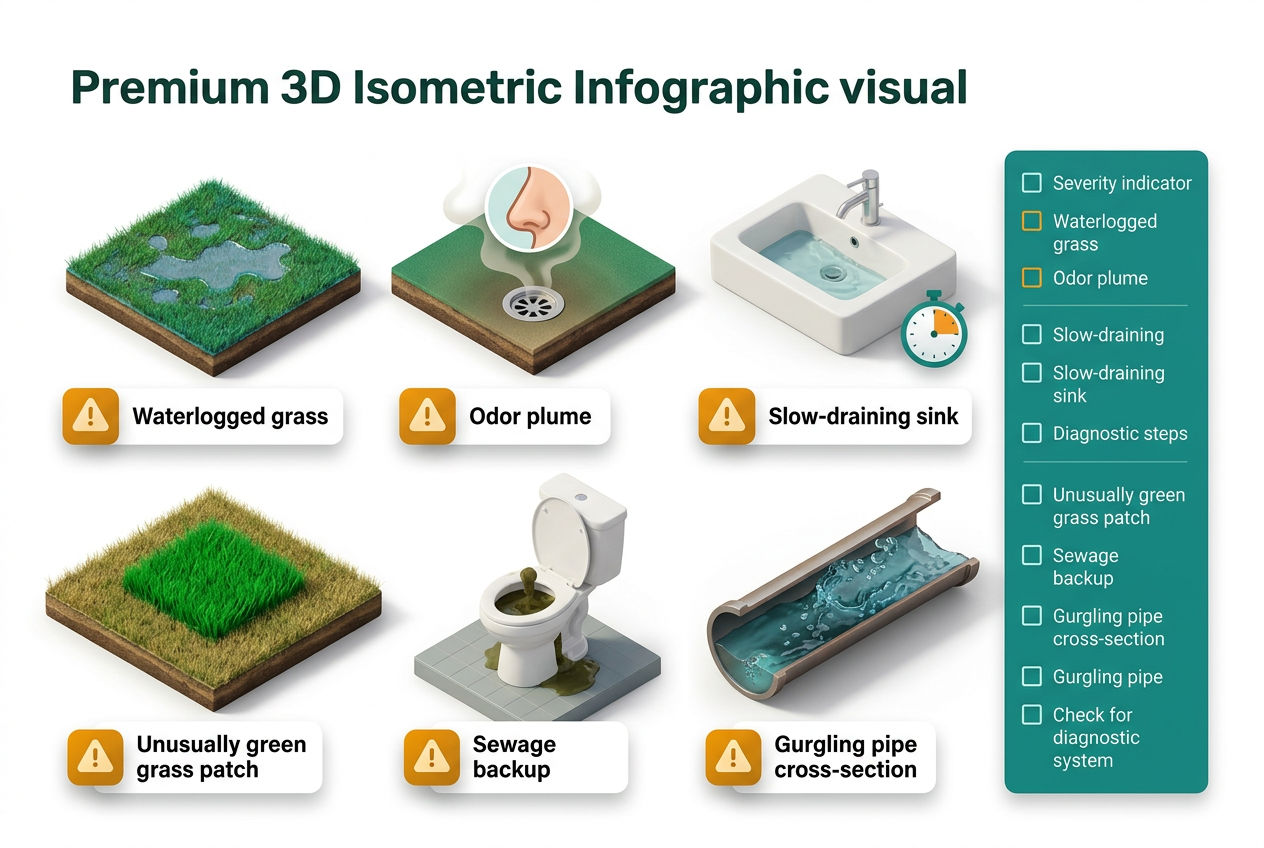
Watch for:
- Standing water or soggy ground directly over the leach field lines — not just after heavy rain, but days afterward
- Sewage odors in the yard, particularly concentrated near the drain field area
- Unusually green, lush grass strips running in a line over buried leach laterals — the effluent is feeding the surface
- Slow drains throughout the house — not just one sink, but multiple fixtures simultaneously
- Sewage backup at the lowest drain in your home, often a basement floor drain
- Rapid tank refill between pumping cycles, suggesting effluent has nowhere to go
If you're seeing more than two of these at once, don't wait. Get a professional septic inspection before the situation forces your hand. For a detailed breakdown of what each symptom means, see our guide on signs your drain field is failing.
What Causes Leach Field Failure?
Understanding the root cause determines which rejuvenation method — if any — will actually work.
Biomat formation is responsible for the majority of drain field failures. A biomat is a dense, slimy biological layer that forms at the soil-pipe interface as anaerobic bacteria process organic waste. It begins forming within 2–5 years of system installation and becomes seriously problematic at the 10–20 year mark. The biomat's low permeability directly chokes the soil's ability to absorb effluent. Our septic biomat guide covers this in detail.
Soil compaction is the second most common culprit — usually from vehicles driving over the field, construction equipment, or years of heavy foot traffic. The soil pores that allow drainage simply collapse. If you've had work trucks parked on your lawn over the field, this is worth suspecting. (Here's why driving over your drain field is never a good idea.)
Root intrusion from trees planted too close can physically block perforated pipes and distribution boxes. A 40-foot oak can have roots extending 80 feet from the trunk. For more on this, see our article on trees near septic systems.
Hydraulic overloading — sending more water through the system than it was designed to handle — accelerates biomat formation. A 1,000-gallon conventional tank designed for a 3-bedroom home can handle roughly 300–450 gallons per day. Add a large family, frequent laundry loads, a leaky toilet running 200 gallons per day, and you've overloaded a system that was otherwise healthy.
In the arid Southwest — Arizona, New Mexico, parts of Texas — mineral and salt buildup in caliche soil layers creates a different failure mode than the biomat clogging common in wetter climates. Chemical treatment approaches differ accordingly.
What Are the Main Leach Field Rejuvenation Methods?
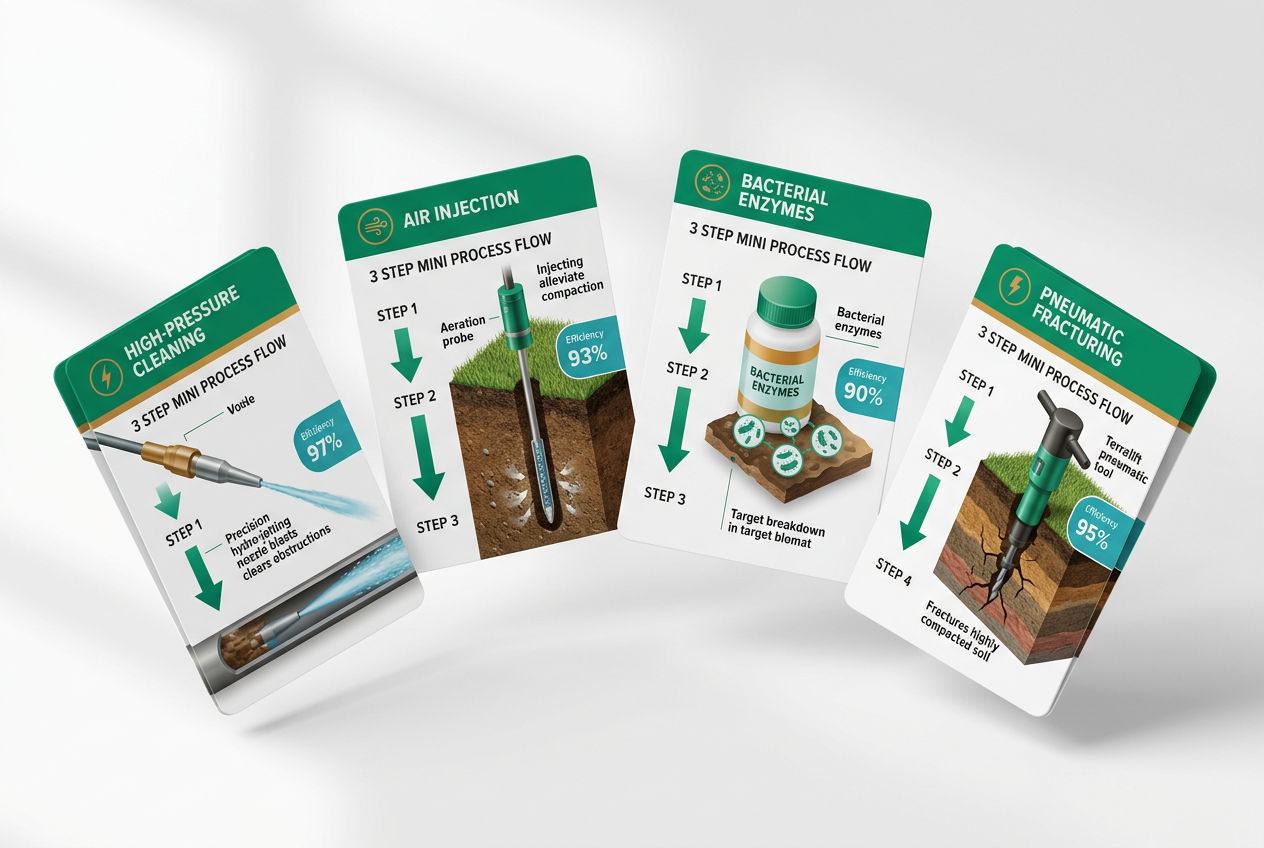
Three broad approaches exist. Each targets a different cause of failure, and the right choice depends on what's actually wrong with your system.
Mechanical Aeration — Terralift and Soil Fracturing
A Terralift machine drives a pneumatic probe 4–6 feet into the ground alongside the leach field lines. It then injects compressed air in short, powerful bursts to fracture the surrounding soil, breaking up compaction and reopening soil pores. Operators often inject polystyrene beads along with the air to prop open the newly created channels long-term.
This method directly addresses compaction and advanced biomat — it physically breaks apart what's clogging the soil. Treatment typically covers the entire drain field in a single day. Expect to pay $2,000–$6,000 for a standard residential Terralift treatment, varying by field size and region. Success rates for mechanical methods reach 70–80% when compaction or biomat is the primary issue, according to industry estimates from NOWRA (National Onsite Wastewater Recycling Association).
The limitation: Terralift doesn't work well when pipe integrity has failed or root intrusion has physically damaged the laterals. It also won't help if your system was undersized for your household from day one.
Aerobic Bacterial Treatment
This approach introduces oxygen and aerobic bacteria into the drain field to accelerate biomat decomposition. Aerobic bacteria (which need oxygen to function) can break down the anaerobic biomat layer far more aggressively than the naturally occurring anaerobic bacteria in a conventional septic environment.
Some contractors use air injection systems that continuously aerate the drain field area. Others apply concentrated bacterial cultures directly to the leach laterals through inspection ports. Professionally applied aerobic bacterial treatment runs $500–$2,000, while DIY bacterial products cost $100–$500.
Here's the honest limitation: bacterial products applied without addressing the underlying hydraulic overload or soil compaction will only buy temporary relief. If your household is consistently sending 400 gallons per day into a system designed for 250, bacteria alone won't keep up. This is why septic additives are not magic bullets.
Chemical Treatment — Hydrogen Peroxide and Alternatives
Hydrogen peroxide treatment involves flushing diluted hydrogen peroxide solutions (typically 25–35% concentration) through the leach field to oxidize and dissolve the biomat. It's been around since the 1980s and remains controversial. Some contractors report excellent results; University of Arkansas research has found the benefits inconsistent across soil types.
Cost for professional hydrogen peroxide treatment: $1,000–$3,000. DIY applications using hardware-store hydrogen peroxide (3% concentration) are essentially ineffective — the concentration is far too low to reach meaningful soil depth.
Chemical treatment works best as a complement to mechanical methods, not a standalone fix.
How Much Does Leach Field Rejuvenation Cost?
| Method | DIY Cost | Professional Cost | Typical Lifespan Gain |
|---|---|---|---|
| Terralift / Soil Fracturing | Not DIY-able | $2,000–$6,000 | 5–15 years |
| Aerobic Bacterial Treatment | $100–$500 | $500–$2,000 | 2–7 years |
| Hydrogen Peroxide Treatment | Not recommended | $1,000–$3,000 | 3–10 years |
| Hydro-Jetting (Pipe Clearing) | Not DIY-able | $1,000–$3,000 | Varies |
| Full Field Replacement (comparison) | Not DIY-able | $5,000–$20,000 | 15–30 years |

Source: NOWRA industry data; contractor cost surveys; EPA SepticSmart program guidelines
Here's a real-world scenario: a 4-bedroom home in central Georgia has a 1,500-gallon septic tank and a 900-square-foot conventional gravel leach field installed in 2001. The field is showing soggy spots and slow drains. A Terralift treatment costs $3,800. Full replacement in Georgia's clay soil — requiring new percolation tests, permits from the county health department, and gravel trenching — runs $11,000–$14,000. Even if the Terralift buys only 8 more years, that's money the homeowner keeps.
For a full breakdown of replacement costs, see our drain field replacement cost guide.
Rejuvenation vs. Replacement: How Do You Decide?
Rejuvenation makes sense when:
- Biomat is the primary cause (confirmed by inspection)
- The leach field is 10–25 years old with no pipe damage
- Soil type is compatible with the chosen treatment method
- The existing field is properly sized for your household
Replacement is the better call when:
- Pipes have physically collapsed or been severed by root intrusion
- The original system was never correctly sized (a 600-gallon field for a 5-bedroom house)
- Multiple rejuvenation attempts have already failed
- The field is over 30 years old and soil is saturated beyond recovery
- Local regulations require upgrade to current standards during any permitted work
A professional drain field repair assessment combined with a camera inspection of the laterals gives you the data to make this decision confidently — not based on guesswork.
Can You DIY Leach Field Rejuvenation?
Partially. You can purchase bacterial treatment products and apply them through your system's cleanout ports or inspection risers. Products like bio-stimulant cultures applied monthly can slow biomat development, particularly in a system that's marginal but not fully failed.
What you cannot DIY: Terralift treatment (specialized equipment, trained operators), hydrogen peroxide injection at effective concentrations (hazardous materials handling), hydro-jetting of leach lines, or any work that involves excavating around the distribution box or lateral pipes.
If your field is actively surfacing sewage, this is not the moment for a DIY experiment. That's a public health issue. Contact your local county health department — many states, including North Carolina and Florida, require licensed contractors for any septic system work beyond basic maintenance. Florida requires all septic contractors to hold a Registered Septic Tank Contractor (RSTC) license through the Department of Health.
How Long Does Leach Field Rejuvenation Last?
Post-rejuvenation lifespan varies significantly by method and how rigorously you maintain the system afterward.
- Terralift / mechanical treatment: 5–15 years of additional functional life, with 8–10 years being typical in well-maintained systems
- Aerobic bacterial treatment alone: 2–7 years before retreatment is needed
- Combined mechanical + bacterial approach: Toward the higher end of the range
The single biggest factor in extending post-rejuvenation life is reducing hydraulic load on the system. Fix any leaking toilets (a running toilet can dump 200+ gallons per day into your tank), spread laundry loads across the week instead of doing six loads on Saturday, and install a Polylok PL-122 effluent filter on your septic tank outlet if one isn't already there. That filter keeps larger solids from ever reaching the leach field.
Drain fields under normal conditions last 15–30 years. Rejuvenation doesn't reset that clock to zero — but it can meaningfully push the replacement date further out.
How to Prevent Future Drain Field Failure
The cheapest rejuvenation is the one you never need.
Pump your tank on schedule. A 1,000-gallon tank serving a 4-person household needs pumping every 3–4 years. Add a garbage disposal and that interval drops to every 2 years. Skipping pumps allows sludge to carry over into the leach field, accelerating biomat formation. See our guide on how often to pump your septic tank.
Protect the field surface. No vehicles, no garden beds, no hardscape. The soil above your leach lines needs to breathe and drain. Review our drain field size guide to know exactly what area to protect.
Watch what goes down the drain. Antibacterial soaps, bleach wipes, and non-septic-safe products kill the beneficial bacteria your system depends on. Our septic safe cleaning products guide lists what's safe and what isn't.
Schedule a professional septic inspection every 1–3 years. A licensed inspector using a sludge judge to measure tank layers and a camera to check lateral pipes can spot early biomat formation before it becomes a $5,000 problem. The cost of a septic inspection — typically $300–$600 — is the best money you'll spend on your system.
Manage water input during peak periods. Spring snowmelt in the Midwest and Northeast saturates soil, reducing the drain field's absorption capacity just when it needs it most. During heavy rain events, minimize laundry and dishwasher use to give the field a chance to catch up.
Find a Leach Field Rejuvenation Professional Near You
Not every septic company offers Terralift treatment or aerobic soil injection — it requires specialized equipment and training. The professionals in the SepticTankHub directory are vetted, licensed contractors who specialize in drain field repair and restoration.
Find a certified septic professional in your area →
Give them the symptoms you've observed, the age of your system, and whether you know the field's square footage. The more information you bring to that first call, the faster they can diagnose whether rejuvenation is viable for your specific situation.
Sources & Methodology
- U.S. Environmental Protection Agency — Septic Systems Overview (epa.gov/septic): Used for household septic adoption statistics (21 million homes), recommended maintenance intervals, and SepticSmart program guidelines.
- National Onsite Wastewater Recycling Association (NOWRA) (nowra.org): Industry data on rejuvenation success rates, method classifications, and contractor standards.
- National Association of Wastewater Technicians (NAWT) (nawt.org): Professional certification standards referenced for contractor qualification guidance.
- University of Arkansas Cooperative Extension: Referenced for peer-reviewed findings on hydrogen peroxide treatment effectiveness across soil types.
- Florida Department of Health (floridahealth.gov): State licensing requirements for Registered Septic Tank Contractors (RSTC).
Frequently Asked Questions
Q: How much does it cost to rejuvenate a leach field?
Leach field rejuvenation costs range from $500 to $6,000 depending on the method chosen. Aerobic bacterial treatments professionally applied run $500–$2,000. Hydrogen peroxide injection costs $1,000–$3,000. Terralift mechanical soil fracturing — the most robust option — typically runs $2,000–$6,000 for a standard residential drain field. For comparison, full drain field replacement averages $10,000 nationally and can reach $20,000 in areas with restrictive regulations or challenging soil conditions. Most homeowners find that even a $4,000 rejuvenation treatment that buys 8–10 additional years represents significant savings over immediate replacement. Always get at least two quotes, and ask contractors specifically what method they're using and what their success rate is for your soil type.
Q: Can a failed drain field be restored without replacing it?
Yes — in roughly 70–80% of cases where biomat is the primary cause of failure, professional rejuvenation can restore meaningful drain field function without full replacement. The key is accurate diagnosis. A professional inspection using camera inspection of the leach laterals and a percolation assessment can confirm whether the soil is recoverable. Rejuvenation is not viable when pipes have physically collapsed, root intrusion has destroyed the lateral network, or the system was never correctly sized for the household. It's also less effective on fields that are more than 30 years old with severely degraded soil structure. If you're not sure, a septic system inspection is the first step — not a commitment to any particular repair approach.
Q: How long does leach field rejuvenation last?
Post-rejuvenation lifespan typically ranges from 5 to 15 years, depending heavily on which method was used and how well the system is maintained afterward. Terralift mechanical aeration combined with aerobic bacterial treatment tends to deliver the longest results — 8–12 years is realistic for well-maintained systems. Bacterial treatment alone may need retreatment every 2–5 years. The most important factor in extending rejuvenation results is reducing hydraulic load: fix running toilets, spread laundry loads across the week, and pump your septic tank on schedule (every 3–4 years for a 1,000-gallon tank serving four people). A Polylok effluent filter installed on the tank outlet will also prevent solids from prematurely re-clogging treated leach field soil.
Q: Does hydrogen peroxide really work on a clogged drain field?
Hydrogen peroxide treatment can work, but results are inconsistent and highly dependent on soil type and biomat severity. At effective concentrations (25–35%), hydrogen peroxide oxidizes the organic biomat layer, reopening soil pores. However, University of Arkansas research found benefits were not uniform across different soil compositions. Consumer-grade 3% hydrogen peroxide from a pharmacy is far too dilute to reach meaningful soil depth — don't bother. Professional application costs $1,000–$3,000 and works best as a complement to mechanical treatment, not a standalone fix. If a contractor is proposing hydrogen peroxide as your only treatment for a severely failing field, ask specifically about their success data for your soil type before committing.
Q: Is it better to rejuvenate or replace a drain field?
Rejuvenation is better when the failure cause is biomat or mild compaction, the system is 10–25 years old, pipes are structurally intact, and the field is correctly sized for your home. Replacement is the right call when pipes have collapsed, root intrusion has caused physical damage, multiple prior rejuvenation attempts have failed, or the system was undersized from installation. A helpful way to frame the decision: if a $3,500 rejuvenation buys 10 years before replacement, that's effectively $350 per year to delay a $12,000 project. But if rejuvenation only delays the inevitable by 18 months, replacement now may be the smarter financial move. A professional drain field repair assessment with camera inspection gives you the data to make that call objectively.
Free download
Not ready for the Handbook? Start with the free Fridge Card.
The Do / Don’t card the whole family can see, plus the Survival Kit: emergency flowchart, warning-sign decoder and pump-schedule card. One printable PDF.
Was this article helpful?
Frequently Asked Questions
Recommended Resources
📖 Related Articles
- What Is a Drain Field? (And How Does It Work?)
- Infiltrator Septic Chambers: How They Work, Cost & Installation
- Signs Your Drain Field Is Failing (And What to Do)
- Septic Tank Biomat: What It Is and When It's a Problem
- Can You Drive or Build Over a Drain Field?
- Trees Near Septic Systems: Safe Distances & Worst Species (2026)
- Do Septic Tank Additives Actually Work? (The Science)
- How Many Loads of Laundry Can You Do With a Septic System?
- How Long Do Drain Fields Last? Lifespan Guide
- How Often Should You Pump Your Septic Tank?
- Leach Field Size by Bedrooms: Drain Field Sizing Chart (2026)
- Septic-Safe Cleaning Products: The Complete List (Safe vs. Avoid)
💰 Cost Guides
🔧 Services
Find Septic Professionals Near You
Compare licensed, verified septic companies by area — top county markets and cities below, or browse all 50 states.
County markets
Popular cities
