
Quick Answer
A leach field and a drain field are the same thing. There is no functional difference - they describe the identical component of a septic system. The confusion comes entirely from regional naming habits, and if you've seen both terms used in a home inspection report or a contractor's quote, you were reading about the same piece of infrastructure.
Key Takeaways
- "Leach field," "drain field," and "absorption field" are interchangeable terms for the same septic system component.
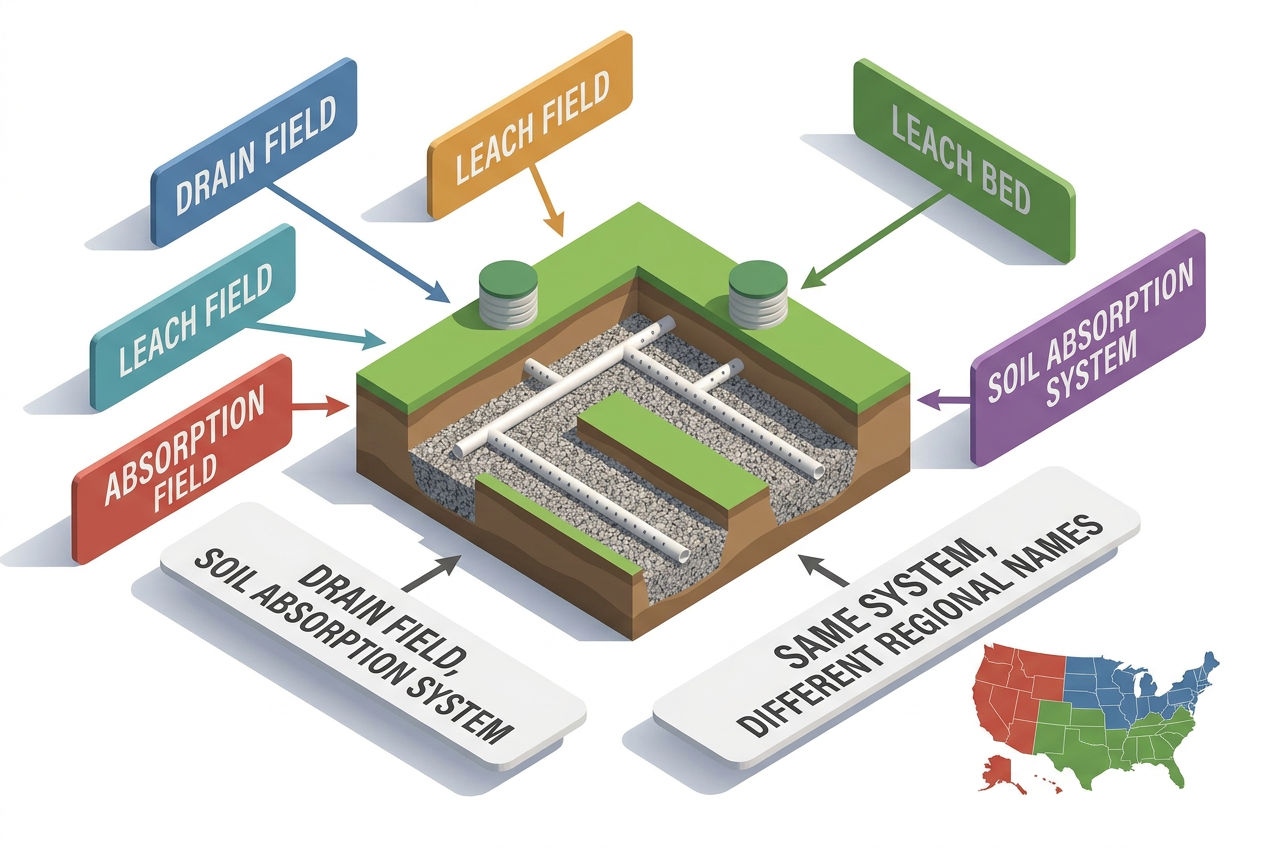
- The naming difference is regional: "leach field" dominates in the Northeast; "drain field" is more common in the South and West.
- A typical residential leach field covers 4,500–10,000 square feet of soil.
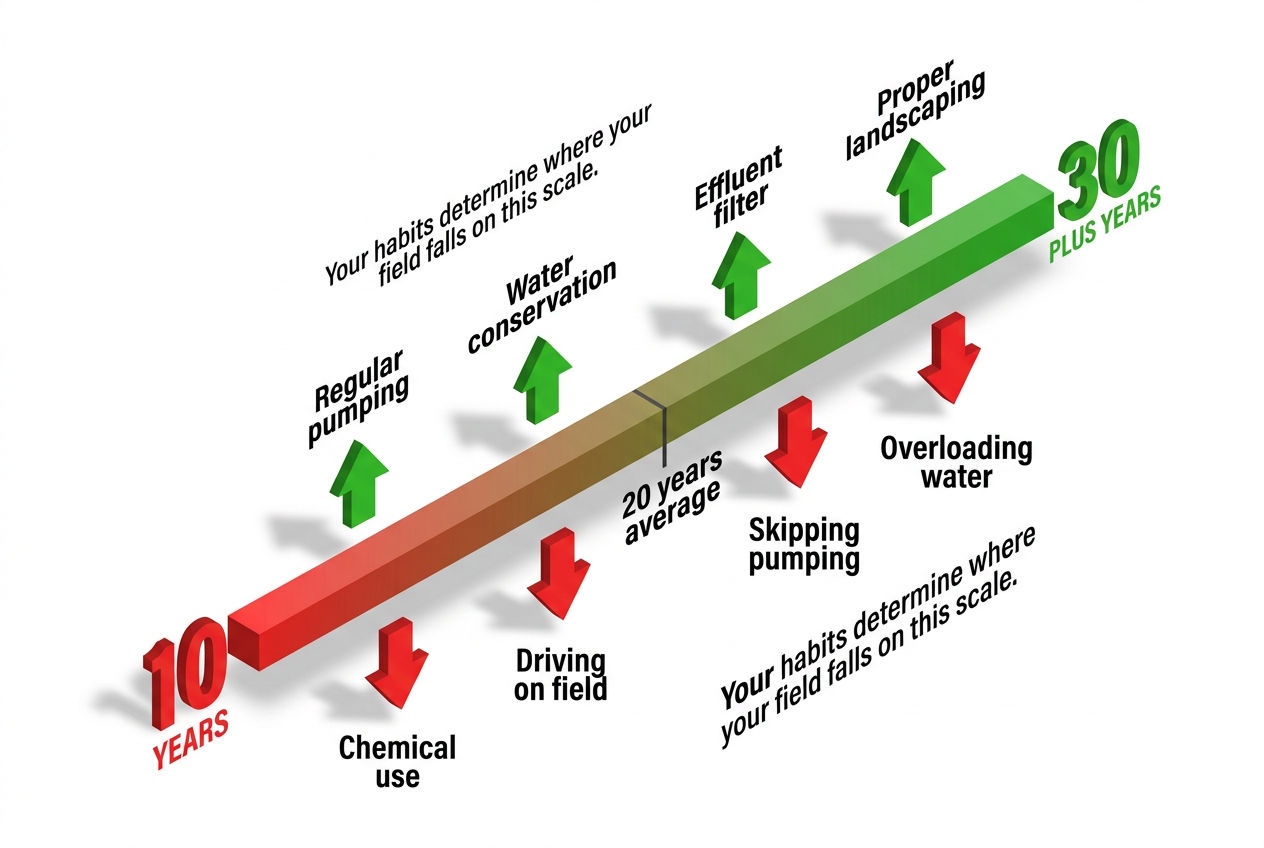
- With proper maintenance, a drain field lasts 15–25 years - some exceed 30.
- Replacement costs range from $5,000–$20,000+, making early failure detection critical.
What Is a Leach Field for a Septic Tank?
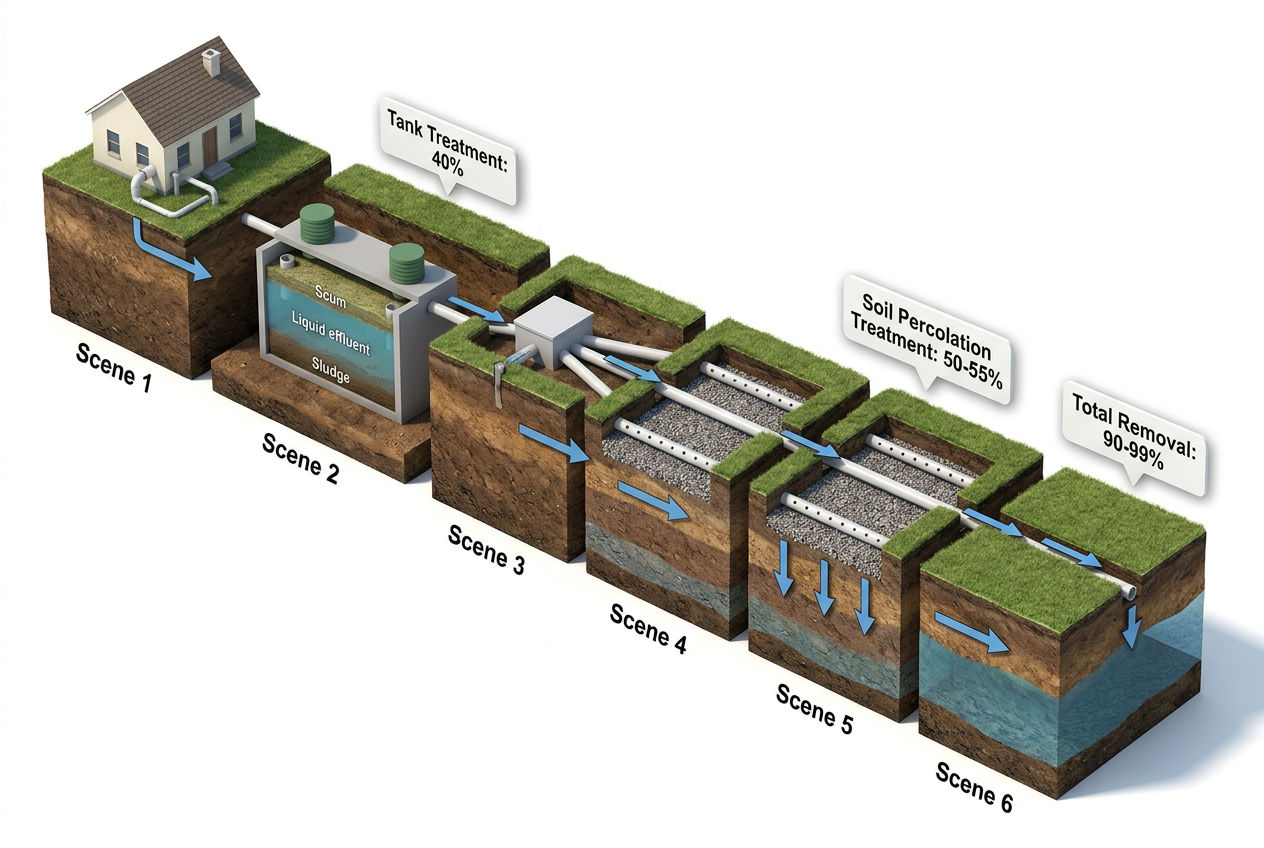
A leach field - also called a drain field, absorption field, or soil absorption system - is the final treatment stage of a conventional septic system. After solids settle inside your septic tank and anaerobic bacteria break down waste, the remaining liquid (called effluent) flows out through an outlet baffle into a distribution box (D-box). From there, it travels through perforated 4-inch PVC or polyethylene pipes laid in gravel-lined trenches. The effluent slowly seeps out of those perforations into the surrounding soil, where naturally occurring bacteria complete the treatment process.
That's it. Whether your contractor calls it a leach field, your county health department calls it a soil absorption system, or your home inspector's report says drain field - they're describing the same network of underground pipes doing the same job.
📊 Quick Fact: The EPA estimates that roughly 21 million homes in the United States - about one in five households - rely on septic systems. If you own one of them, you have some version of this system under your yard right now.
For a deeper look at how all the components work together, see our guide to how septic systems work.
Why Are There Two Different Names?
The short answer: geography and habit.
Regional Terminology Patterns
"Leach field" is the dominant term in New England and parts of the Midwest. Drive south or west and you'll hear "drain field" far more often in the Carolinas, Florida, Texas, and along the Pacific Coast. State and county health departments frequently use "absorption field" or "soil absorption system" in regulatory documents - that language appears in the International Private Sewage Disposal Code, which explicitly treats all three terms as interchangeable.
This isn't a quirk limited to homeowners. Septic contractors, home inspectors, and real estate agents in different parts of the country use whichever term they grew up hearing. You can have two licensed septic professionals standing over the same trench using different words to describe it.
✅ Pro Tip: If you're buying a home and the inspection report mentions a leach field, the seller's disclosure says drain field, and the county permit calls it a soil absorption system - those documents are all talking about the same thing.
How Does a Drain Field Actually Work?
Understanding the mechanics helps you recognize problems early.
The Treatment Flow
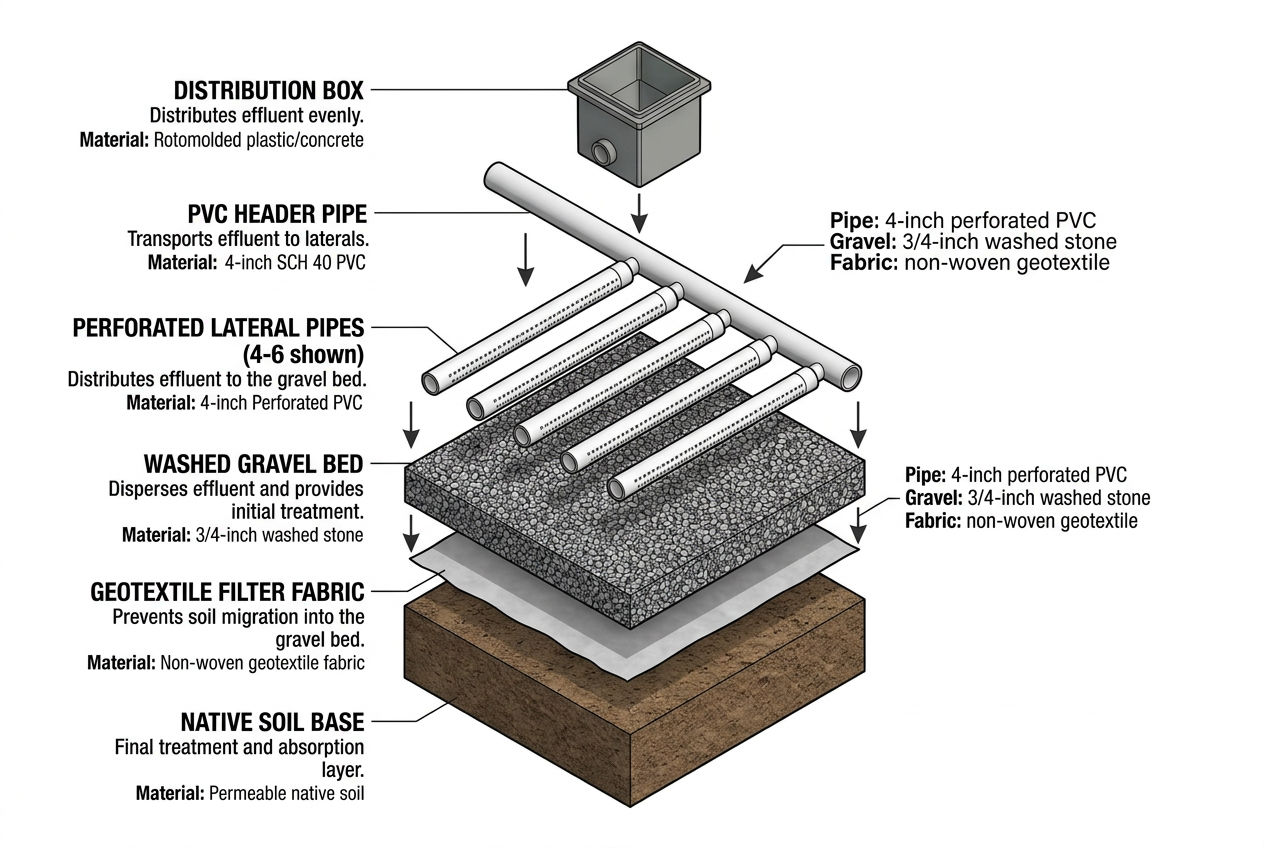
Effluent exits your septic tank through the outlet baffle and flows by gravity (or, in some systems, a pump) to the distribution box. The D-box is a small concrete or plastic junction that splits flow evenly across multiple leach laterals - the individual perforated pipe runs buried in your drain field.
Trench Structure & Components
Each lateral sits in a trench with these layers:
- Width: 1–3 feet
- Depth: 2–4 feet below surface
- Gravel bed: 6–12 inches of washed gravel surrounding the pipe
- Geotextile fabric: Barrier layer below gravel preventing soil migration
- Native soil: Where the actual biological treatment happens
The gravel supports the pipe, prevents soil collapse into the perforations, and creates void space for effluent to pool briefly before seeping downward. Below the gravel, the geotextile fabric keeps fine soil particles from migrating up and clogging the system.
The Biomat: Nature's Filter
As effluent percolates through the soil beneath the trenches, aerobic bacteria in the top 12–18 inches of native soil remove pathogens and nutrients. That biological treatment layer - called the biomat - is what makes the whole system work. It's also what eventually degrades and fails in older systems.
📊 Quick Fact: A conventional residential drain field covers 4,500–10,000 square feet, though the actual size depends on your soil's percolation rate, local health department requirements, and your home's bedroom count.
Sandy soils absorb effluent quickly and allow smaller fields. Clay-heavy soils common in the Midwest and Southeast absorb water slowly, requiring larger fields - or alternative systems entirely, like a mound system.
Want to understand sizing in detail? Our drain field size guide covers the calculations.

DIY Septic Blueprint
Thinking about building it yourself?
The complete, plain-English plan to size, permit and install your own septic system — designed for homeowners, not contractors. Skip the $15,000–$25,000 quotes and do it right the first time.
Get the DIY Blueprint — $67 →Instant download · 8 modules + 3 bonus guides · 60-day money-back guaranteeDrain Field vs. Leach Field vs. Absorption Field: A Direct Comparison
| Term | Region Where Common | Who Uses It | Same Component? |
|---|---|---|---|
| Leach field | Northeast, Midwest | Homeowners, contractors | Yes |
| Drain field | South, West, Mid-Atlantic | Homeowners, inspectors, contractors | Yes |
| Absorption field | Regulatory documents nationwide | Health departments, code officials | Yes |
| Septic drain field | National (general use) | Industry publications, EPA | Yes |
| Soil absorption system | Technical/code language | Engineers, regulators | Yes |
Source: International Private Sewage Disposal Code; EPA Septic Systems Overview (epa.gov/septic)
💡 Key Takeaway: All five terms describe the same underground infrastructure. If a contractor quotes you for a "leach field replacement" and another quotes "drain field repair," compare the scope of work - not the terminology.
What About the Perc Test?
Before any leach field gets installed, the soil has to prove it can handle the job. That's what a percolation test (perc test) measures - how quickly water drains through your native soil.
The Testing Process
A licensed engineer or soil evaluator:
- Digs test holes at proposed field locations
- Fills them with water
- Measures the drop rate in inches per hour
- Calculates absorption capacity based on soil type
That number determines whether a conventional drain field is viable, how large it needs to be, and whether your lot can support a septic system at all. Perc tests typically cost $250–$1,000 depending on your state and how many test holes are required.
⚠️ Warning: Fail a perc test - common in clay-heavy or high-water-table areas - and you're looking at a mound system, drip irrigation system, or other alternative septic system design. Florida, the Carolinas, and coastal regions of the Pacific Northwest deal with this regularly due to high water tables and saturated soils.
How Long Does a Drain Field Last?
A properly maintained drain field lasts 15–25 years. Some exceed 30 years. A neglected one can fail in under 10.
The Critical Factor: Tank Maintenance
The single biggest factor in drain field longevity is septic tank maintenance. When your tank goes too long without pumping, sludge and scum layers build up past the outlet baffle and push solids into the drain field. Solids clog the gravel trenches and biomat, cutting off the soil's ability to absorb effluent. That damage is largely irreversible without excavation and replacement.
Recommended Pumping Schedule
The EPA recommends pumping your septic tank every 3–5 years for most households:
- 1,000-gallon tank serving a family of four: every 3–4 years
- With garbage disposal: drop to every 2 years
- Larger households or smaller tanks: more frequent pumping needed
Our guide to how often to pump your septic tank has a full breakdown by household size and tank capacity.
For more on what actually determines how many years your system has left, see how long drain fields last.
What Are the Signs of a Failing Leach Field?
Catch these early and you might get away with a repair. Miss them and you're looking at full replacement.
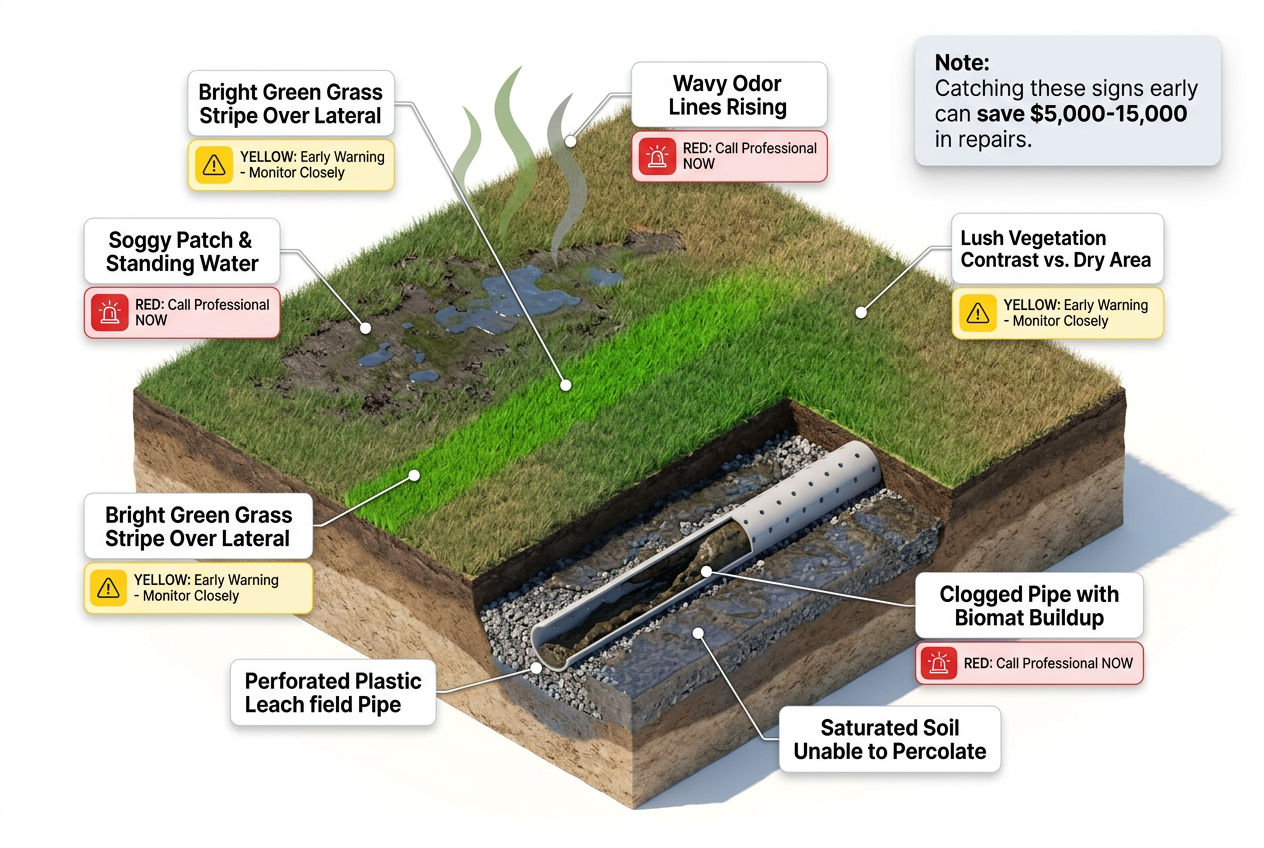
1. Wet, Spongy Grass Over the Drain Field
Effluent surfacing above ground is a textbook failure sign. If you're mowing over a soggy patch that never seems to dry out - especially after rain or heavy household water use - that's not good drainage. That's your drain field rejecting effluent.
2. Sewage Odors Outside
A faint sulfur smell near your drain field or around your yard isn't normal. It means effluent is reaching the surface or very near it.
3. Slow Drains and Gurgling Pipes Inside the House
When the drain field backs up, everything upstream backs up too. If multiple fixtures drain slowly at the same time, suspect the field before you call a plumber.
4. Unusually Green, Lush Grass Over the Field
This one catches homeowners off guard. A strip of vivid, fast-growing grass directly above your leach field laterals often means effluent is fertilizing the root zone from below - which means it's not going deep enough.
5. High Nitrate Levels in a Nearby Well
If you have well water and your annual test shows elevated nitrates, a failing septic drain field is a prime suspect. This is an environmental and health issue, not just a plumbing inconvenience.
⚠️ Warning: Picture this: it's spring, snowmelt has the ground saturated, and you notice a wet depression forming exactly where your leach field is mapped on the county permit. That's the scenario that typically triggers the phone call to a septic company - and by that point, repair options may already be limited.
Our article on signs your drain field is failing goes deeper on each symptom and what to do next.
Can You Drive or Build Over a Leach Field?
No. And this is one of the most common mistakes homeowners make.
The Compaction Problem
Driving vehicles or parking equipment over a drain field compacts the soil. Soil compaction reduces the pore space that allows effluent to percolate downward, and it can crush the perforated pipes buried 2–4 feet below the surface. Even a single incident with a heavy vehicle - a delivery truck, an RV, a bobcat - can cause damage you won't notice until the system starts backing up.
Building Restrictions
Building over a drain field is even worse. Structures block maintenance access, add permanent load to the soil, and typically violate local health department regulations.
Off-limits above leach field trenches:
- Concrete patios
- Sheds (even temporary ones)
- Swimming pools
- Decks and gazebos
- Driveways or parking areas
Tree Root Intrusion
Planting trees near the field is also a problem. Root intrusion from willows, maples, and other fast-growing trees is one of the leading causes of drain field failure. Keep trees at least 30–50 feet away from laterals when possible.
For a full breakdown of what's safe, read can you drive over a drain field.
How Much Does Leach Field Replacement Cost?
Replacing a drain field is expensive. Full replacement typically runs $5,000–$20,000 for a conventional system, with the wide range driven by system size, soil conditions, local labor rates, and whether a pump system or alternative design is required.
Real-World Cost Examples
| Location | Soil Type | System Type | Typical Cost Range |
|---|---|---|---|
| Rural Georgia | Sandy-loam | Conventional gravity | $7,000–$10,000 |
| Coastal Connecticut | Rocky, clay-heavy | Conventional with challenges | $15,000–$20,000 |
| Florida coastal | High water table | Mound or alternative | $12,000–$25,000+ |
Repair vs. Replacement
Partial repairs cost far less - often $1,500–$4,000:
- Replacing a clogged distribution box
- Repairing a single failed lateral
- Clearing root intrusion from one section
💡 Key Takeaway: This is why catching failure signs early matters. A $2,500 repair beats a $15,000 replacement every time.
See our drain field replacement cost guide for a full regional breakdown. If you're weighing other system repairs, the septic repair cost guide covers the full spectrum.
How to Protect Your Drain Field
Maintenance isn't glamorous, but it's a fraction of what replacement costs.
Essential Maintenance Actions
1. Pump your septic tank on schedule.
This is the single highest-impact maintenance action. Don't skip it because the system seems to be working fine - by the time problems surface, the field may already be compromised.
2. Spread water use throughout the day.
Doing five loads of laundry back-to-back saturates the drain field faster than it can recover. Spacing laundry across two or three days gives the soil time to absorb between cycles.
3. Use water-efficient fixtures.
High-efficiency toilets (1.28 gallons per flush vs. 3.5 for older models) and low-flow showerheads meaningfully reduce the hydraulic load on your system.
4. Divert surface water away from the field.
Roof gutters, downspouts, and yard grading that direct rainwater toward your drain field add to soil saturation. Keep water moving away from the field perimeter.
5. Never flush non-biodegradables.
Wipes (even "flushable" ones), feminine hygiene products, medications, and cooking grease all cause tank and field problems. The tank baffles and effluent filters like the Polylok PL-122 can catch some solids, but nothing replaces user discipline.
✅ Pro Tip: Our septic tank maintenance guide covers the full annual maintenance checklist.
When Should You Call a Septic Professional?
If you're seeing any of the failure signs described above, don't wait. Call a licensed septic contractor for an inspection before the problem escalates.
Key Scenarios Requiring Professional Inspection
You should also schedule a professional septic inspection if you're:
- Buying a home with an existing septic system (see our septic inspection guide)
- Selling a home and want to know your system's condition before it becomes a negotiation issue
- Adding a bedroom or bathroom, which increases hydraulic load and may require a field expansion
- Noticing any of the failure signs listed above, even intermittently
Find a licensed septic professional near you through the SepticTankHub directory. Every listing includes license verification, service area, and customer reviews.
Need drain field help? Find a qualified contractor near you on SepticTankHub.
Learn more about our drain field services services.
Related reading: septic system installation process.
Sources & Methodology
This article draws on the following primary sources:
- U.S. Environmental Protection Agency - Septic Systems Overview: System statistics, maintenance recommendations, and groundwater contamination data.
- International Private Sewage Disposal Code: Terminology definitions treating "leach field," "drain field," and "absorption field" as interchangeable.
- National Onsite Wastewater Recycling Association (NOWRA): Industry standards for system design and terminology.
- State health department regulatory documents (referenced by region throughout): Setback requirements, perc test protocols, and licensing standards vary by state and county.
- University extension service publications: Soil absorption and percolation data referenced in sizing and soil-type discussions.
Cost ranges reflect contractor pricing data compiled from regional service providers across multiple U.S. markets. Individual costs will vary based on soil conditions, system size, local labor rates, and permit requirements.
Need help with your septic system? Browse local septic companies in Indiana or Alabama.
Free download
Not ready for the Blueprint? Start free.
Grab the free DIY Septic Planning Kit — the permit-first checklist, perc-test cheat sheet, and sizing tables that keep your build from getting red-tagged.
Was this article helpful?
Frequently Asked Questions
Recommended Resources
📖 Related Articles
- What Is a Septic System? How It Works (Visual Guide)
- Leach Field Size by Bedrooms: Drain Field Sizing Chart (2026)
- How to Install a Septic Drain Field
- How Often Should You Pump Your Septic Tank?
- How Long Do Drain Fields Last? Lifespan Guide
- Signs Your Drain Field Is Failing (And What to Do)
- Can You Drive or Build Over a Drain Field?
- The Complete Septic Tank Maintenance Guide
💰 Cost Guides
🔧 Services
Find Septic Professionals Near You
Compare licensed, verified septic companies by area — top county markets and cities below, or browse all 50 states.
County markets
Popular cities
