
Quick Answer
A residential drain field layout is the engineered site plan that determines exactly where your drain field trenches go on your property — factoring in soil conditions, lot topography, well location, building positions, and setback requirements from your county health department. The layout is designed before installation begins by a licensed septic designer, and it dictates everything from trench length and spacing to the location of the mandatory reserve area. Understanding your layout helps you protect it, maintain it, and avoid costly mistakes.
Key Takeaways
- A drain field layout is designed by a licensed septic professional based on perc test results and site evaluation
- Standard residential layouts use 3-6 parallel trenches totaling 200-600 linear feet
- Setback requirements dictate minimum distances: 50-150 ft from wells, 10-20 ft from buildings, 5-10 ft from property lines
- Every layout must include a reserve area of equal size for future replacement
- The layout is part of your septic permit — changing it requires county approval
Your drain field isn't just buried pipe in random trenches — it's a carefully engineered system designed to match your specific property. The layout determines how effluent spreads across the soil, how far the field sits from your water supply, and whether there's room for a replacement field when the original one eventually reaches end of life.
Most homeowners never see their drain field layout because the designer submits it directly to the county for permitting. But understanding what goes into the design — and keeping a copy of the plan — helps you protect your investment and avoid problems down the road.
This guide covers the five factors that determine your layout, standard setback requirements, the reserve area requirement, and how to read a drain field site plan.
Find a licensed septic designer in your area on SepticTankHub.com
The 5 Factors That Determine Your Drain Field Layout
Every residential drain field layout is shaped by five site-specific factors. No two properties produce exactly the same layout, which is why generic "standard" designs don't exist — every field is custom-designed for the lot.
Factor 1: Soil Percolation Rate
Your perc test measures how fast the soil absorbs water at the proposed drain field location. This rate directly determines how much linear footage of trench you need — fast-absorbing sandy soils need less pipe, slow-absorbing clay soils need significantly more.
| Perc Rate (min/inch) | Soil Type | Trench Footage Needed (3-BR) | Layout Impact |
|---|---|---|---|
| 1-10 | Sand/gravel | 150-250 feet | Compact layout, fewer trenches |
| 10-30 | Sandy loam | 250-400 feet | Standard layout, 4-5 trenches |
| 30-60 | Loam/silt loam | 350-500 feet | Larger layout, 5-6 trenches |
| 60-120 | Clay loam | 500-800 feet | Extensive layout, 6+ trenches or alternative system |
Source: University of Minnesota Extension design standards and state health department sizing tables
The perc rate also affects trench depth — slower soils typically require shallower installation to keep the absorption surface within the most aerobic (and most effective) soil zone.
Key Insight: The perc test determines your drain field's footprint more than any other single factor. A property with sandy soil might need a 30x40 foot area for the field. The same house on clay soil might need a 60x80 foot area — four times larger. This is why perc testing happens before you buy property if you're planning to build with a septic system.
Factor 2: Lot Topography and Slope
The shape of your land determines whether the field uses a parallel layout (flat ground), serial drop-box layout (sloped ground), or a pressure-dosed system (irregular terrain). For a detailed comparison of these pipe layout patterns, see our pipe layout guide.
Flat lots (0-5% slope): Standard parallel layout with a distribution box feeding all trenches evenly. This is the simplest and most common residential configuration.
Moderate slopes (5-15%): Serial distribution with drop boxes connecting trenches that step down the hillside. Trenches run along the contour (perpendicular to the slope) to prevent effluent from flowing to one end.
Steep slopes or irregular terrain (15%+): Pressure-dosed systems or alternative designs like drip distribution. Conventional gravity-fed layouts don't work when the grade is too steep for even distribution.
Low-lying or flat with high water table: The layout must position trenches above the seasonal high water table. If the water table is close to the surface, a mound system or raised bed design may be required, which changes the layout significantly.
Factor 3: Setback Requirements
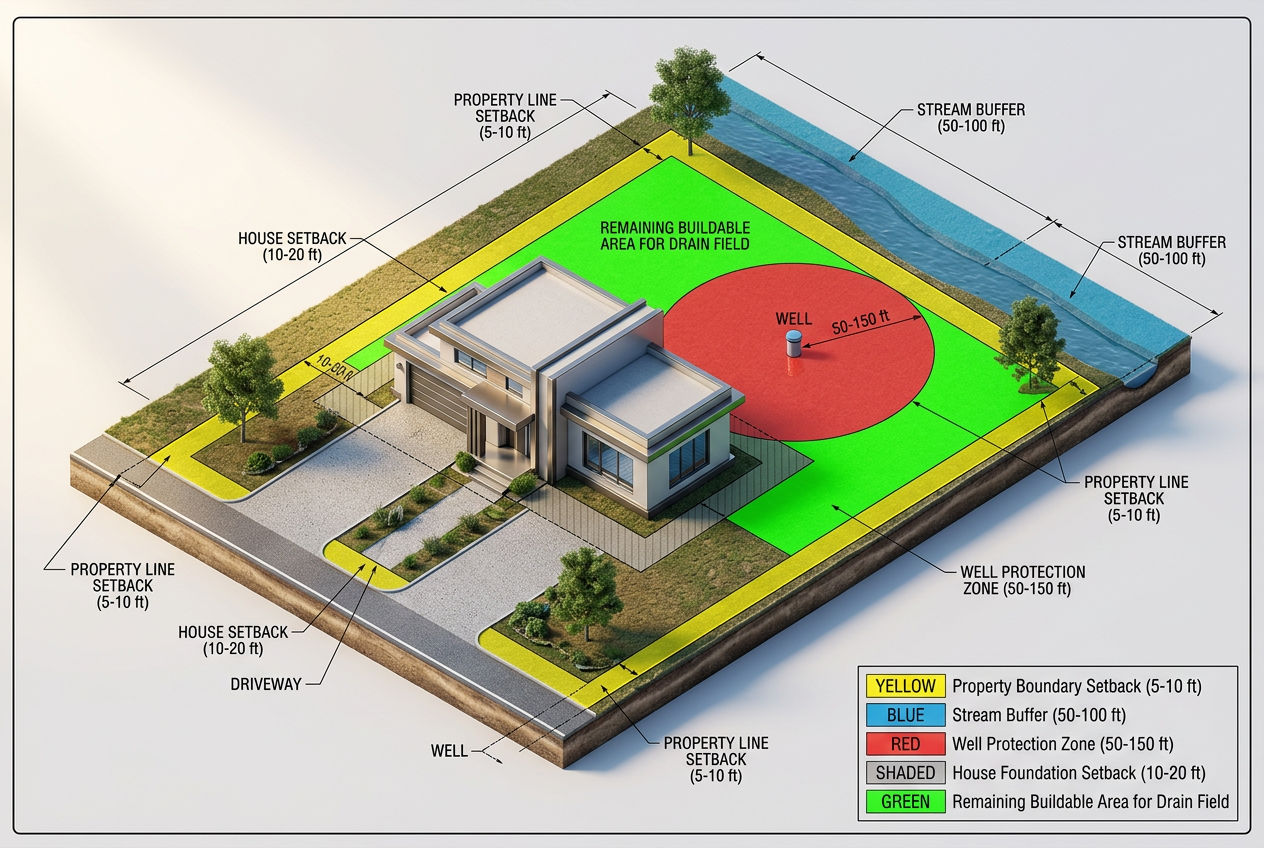
Every drain field layout must comply with minimum setback distances from specific features on and around your property. These setbacks exist to protect water supplies, prevent structural damage, and maintain public health. For the complete setback guide, see our septic system setback requirements article.
| Feature | Typical Minimum Setback |
|---|---|
| Private drinking water well | 50-150 feet |
| Public water supply well | 100-200 feet |
| House foundation | 10-20 feet |
| Property line | 5-10 feet |
| Surface water (streams, ponds, lakes) | 50-100 feet |
| Swimming pool | 15-25 feet |
| Driveway or paved surface | 10 feet |
| Water supply line | 10-25 feet |
| Septic tank | 5-10 feet |
| Large trees | 10-30 feet |
Source: International Private Sewage Disposal Code model standards. Actual distances vary by state and county — always verify with your local health department.
Setbacks are the primary constraint on where the field can go. On many properties — especially small lots — the setback zones overlap so much that there's only one possible location for the field. Your designer maps these zones first, then fits the trench layout into the remaining buildable area.
Pro Tip: Before buying property for new construction, ask the seller for a copy of the site evaluation and perc test. If neither exists, budget $500-$1,500 for testing before closing. A property that can't accommodate a drain field layout within setback requirements may require an expensive engineered system — or may not be buildable at all.
Factor 4: Household Size and Water Use
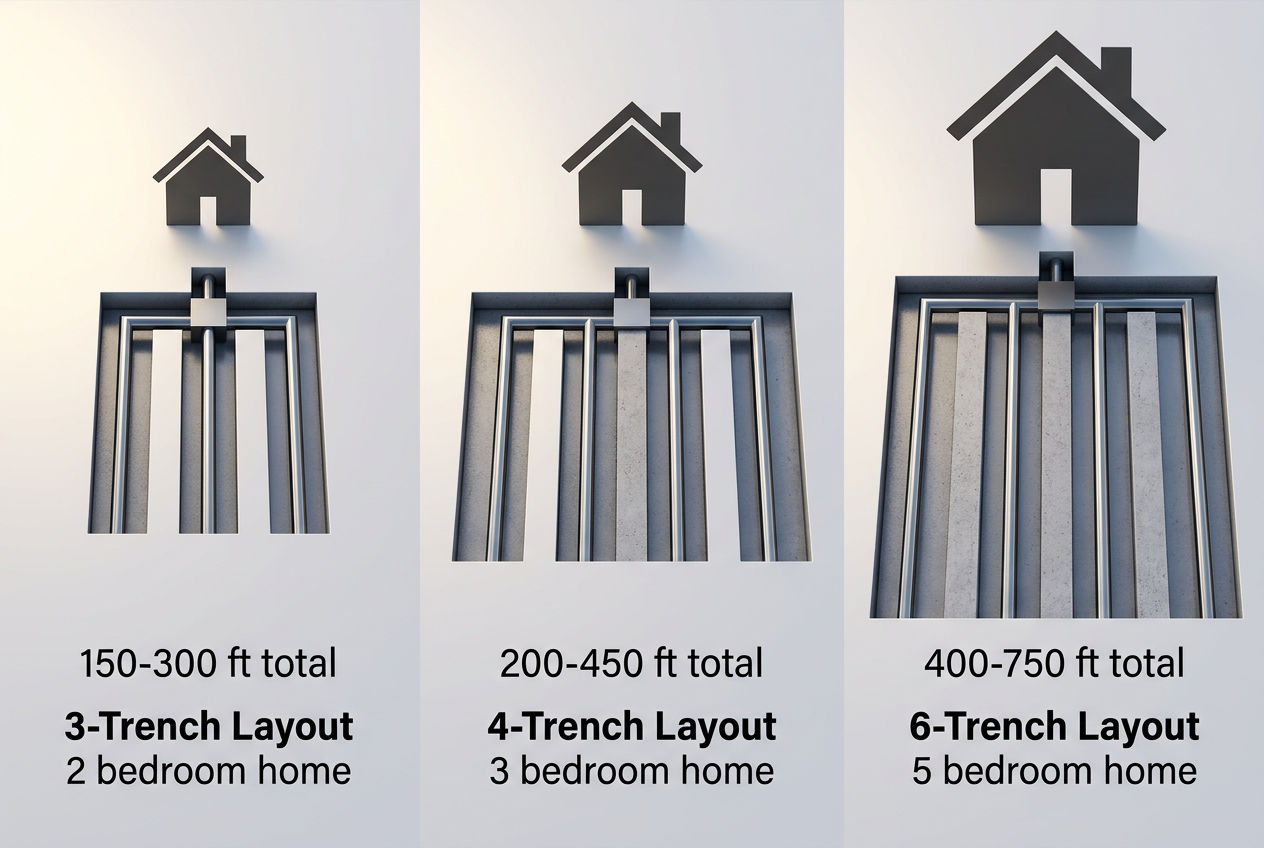
Your household size determines the daily wastewater volume the field must handle, which directly affects the total trench footage in the layout. This is calculated from the number of bedrooms (not bathrooms or current occupants), because bedroom count represents the maximum potential occupancy.
| Bedrooms | Daily Flow (gallons) | Typical Trench Footage | Trenches Needed |
|---|---|---|---|
| 1-2 | 200-300 | 150-300 feet | 3-4 |
| 3 | 300-450 | 200-450 feet | 4-5 |
| 4 | 400-600 | 300-600 feet | 5-6 |
| 5+ | 500-750+ | 400-750+ feet | 6+ |
Source: EPA residential sewage flow estimates and state health department design standards
The flow calculation also considers special fixtures: garbage disposals add 10-15% to the daily volume, hot tubs add discharge volume, and water softener backwash can increase flow by 50+ gallons per regeneration cycle.
For detailed sizing calculations based on your specific soil type and household, see our drain field size guide.
Factor 5: Available Space and Future Planning
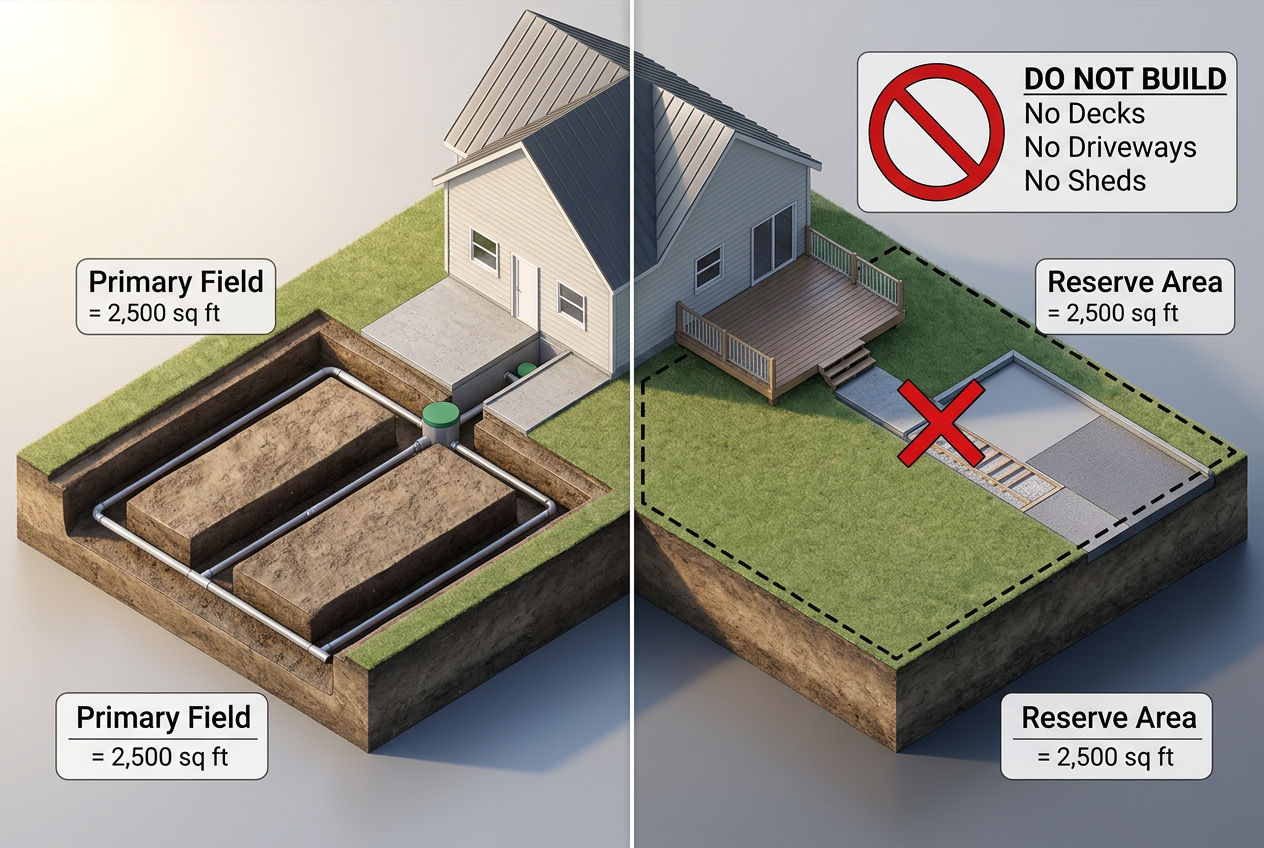
The layout must fit not just the primary drain field but also a reserve area (replacement area) of equal size. This means the total land area needed for your septic system is at least double the drain field footprint.
Primary field area: The active trenches plus the undisturbed soil strips between them. A typical 3-bedroom system occupies a 30x50 to 40x80 foot area.
Reserve area: A section of your property that meets the same soil and setback requirements as the primary field, held in reserve for future replacement. You cannot build on, pave, plant deep-rooted trees on, or otherwise develop the reserve area.
Access for maintenance: The layout should allow equipment access to the distribution box, trench ends, and the tank. A pump truck needs to reach the tank, and any future repair or replacement requires excavation equipment access to the field.
Common Mistake: Building a deck, patio, shed, garden bed, or driveway extension over the reserve area because "it's just empty space." Once you develop the reserve area, you've eliminated your only option for field replacement without the enormous cost and disruption of relocating the entire system to a new location on the property — if one even exists.

DIY Septic Blueprint
Thinking about building it yourself?
The complete, plain-English plan to size, permit and install your own septic system — designed for homeowners, not contractors. Skip the $15,000–$25,000 quotes and do it right the first time.
Get the DIY Blueprint — $67 →Instant download · 8 modules + 3 bonus guides · 60-day money-back guaranteeHow to Read a Drain Field Site Plan
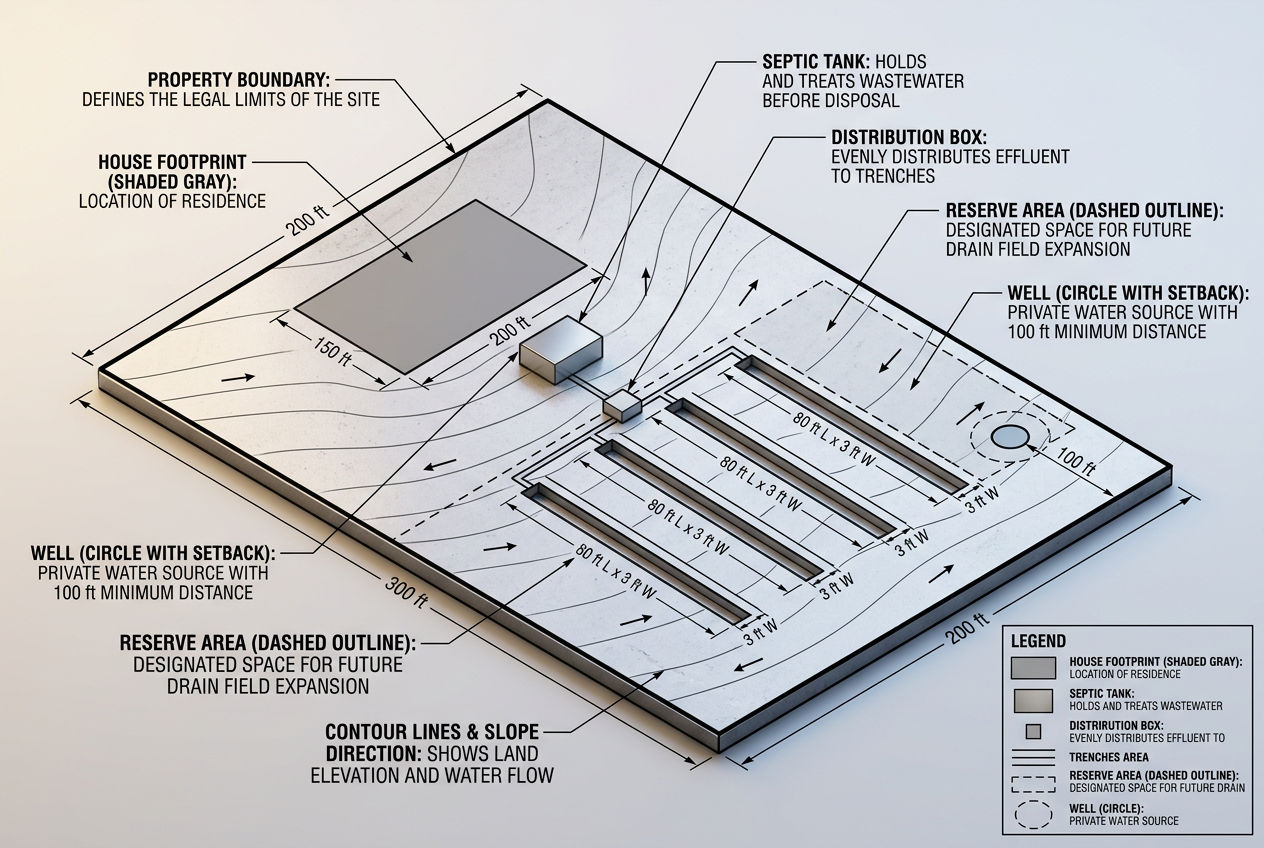
Your septic permit includes a site plan drawn by the designer. Knowing how to read it helps you protect the field and communicate with contractors. Here's what you'll see on a typical residential drain field layout drawing:
Property boundaries drawn to scale with dimensions. The entire lot is shown so setback distances can be measured from all features.
Building footprint showing the house, garage, sheds, and any other structures with their distances from the proposed field.
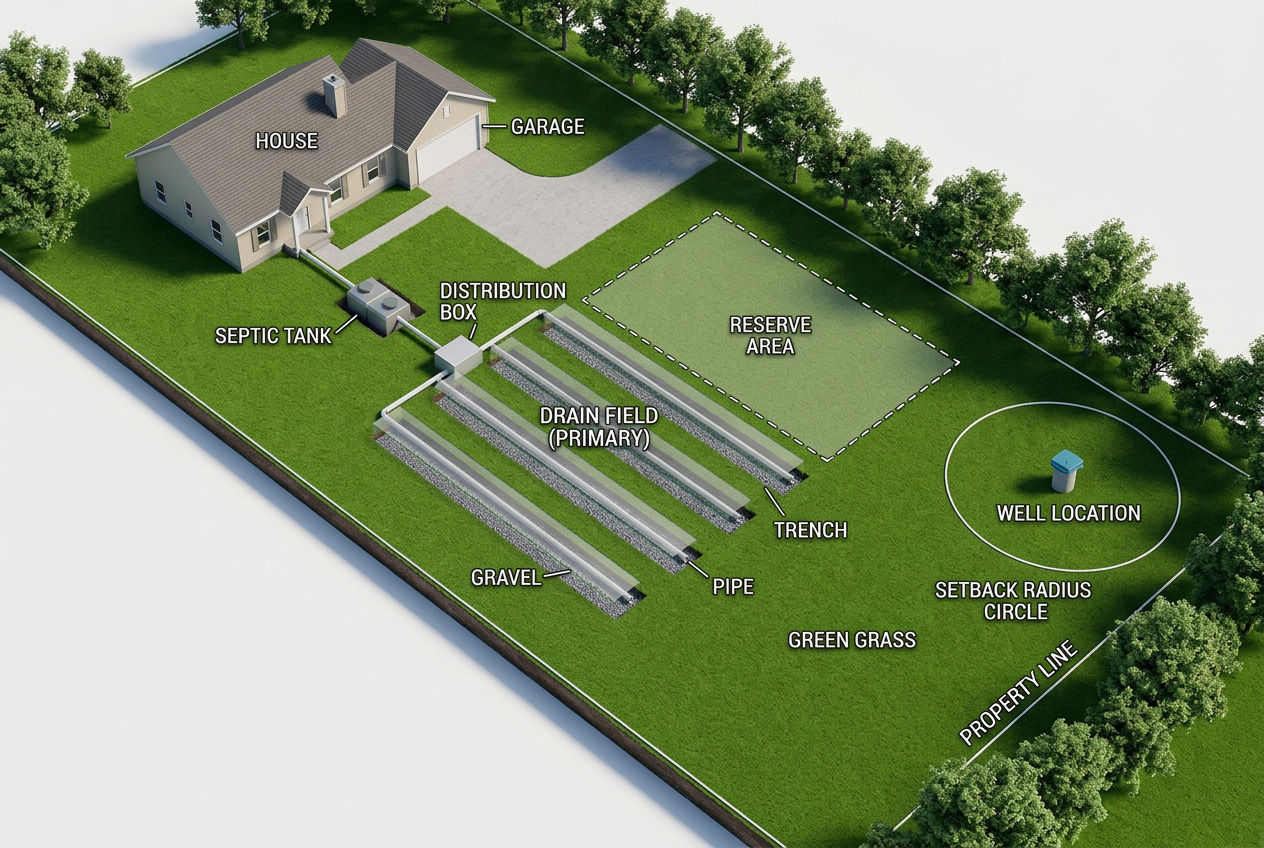
Well location with the setback radius drawn as a circle. The drain field must fall entirely outside this circle.
Tank location with the pipe run from the house to the tank marked with distances and slope.
Trench layout showing each trench as a rectangle with length, width, and spacing dimensions. The distribution box or drop box connections are shown at the header end of each trench.
Reserve area outlined with a dashed line or shaded differently from the primary field. It should be labeled "reserve" or "replacement area."
Contour lines or spot elevations showing the slope direction and grade across the field area. These confirm the pipe slope and distribution method.
Setback lines drawn from all relevant features (well, property lines, water bodies, structures). The field and reserve area must sit entirely within the setback-compliant zone.
Keep a copy of this plan permanently — filed with your property documents, not in a drawer you'll forget about. Every future septic contractor, home inspector, and real estate agent will need this document at some point.
For a visual overview of how the drain field fits into the complete system, see our septic system diagram.
Common Layout Challenges and Solutions
Some properties make drain field layout straightforward. Others require creative solutions:
Small lot with tight setbacks: When setback zones leave minimal room, the designer may recommend a chamber system (shorter trenches than conventional pipe-and-gravel) or pressure-dosed design (uses soil more efficiently). Our small lot septic guide covers alternative approaches in detail.
Irregular lot shape: Trenches don't have to be straight lines on properties with curved boundaries or irregular shapes. Pipe can follow gentle curves, and trench lengths can vary as long as the total absorption area meets the required square footage.
Multiple soil types across the lot: Large properties sometimes have different soil conditions in different areas. The perc test may show excellent rates on one side and poor rates on the other. The designer places the field where soil conditions are best, which may not be the most convenient location.
Existing trees in the only buildable area: Removing trees to accommodate the drain field is common. Root barriers can protect the field from regrowth, but most designers prefer to remove trees entirely rather than risk future root intrusion into the trenches.
To learn more about the full installation process from design through final inspection, see our installation guide. For a cost breakdown of the complete project, see our septic installation cost guide.
Find a licensed septic designer to evaluate your property on SepticTankHub.com
Sources & Methodology
EPA — Septic Systems Overview — Federal guidelines on residential septic system siting, setback requirements, and design standards
International Code Council — International Private Sewage Disposal Code — Model code for drain field layout, setback distances, reserve area requirements, and trench specifications
University of Minnesota Extension — Designing a Septic System Drainfield — Research-based guidance on site evaluation, layout design, and soil-based sizing calculations
National Environmental Services Center — Onsite Wastewater Treatment Systems — Technical guidance on residential drain field design for various site conditions and topographies
SepticTankHub.com Internal Data — Residential drain field layout patterns and site constraint data from 4,200+ listed septic companies
Free download
Not ready for the Blueprint? Start free.
Grab the free DIY Septic Planning Kit — the permit-first checklist, perc-test cheat sheet, and sizing tables that keep your build from getting red-tagged.
Was this article helpful?
Frequently Asked Questions
Recommended Resources
📖 Related Articles
- What Is a Drain Field? (And How Does It Work?)
- Leach Field Size by Bedrooms: Drain Field Sizing Chart (2026)
- How Deep Should a Drain Field Be?
- Drain Field Pipe: Types, Layout Patterns & Specifications
- How to Install a Septic Drain Field
- Perc Test (Percolation Test): What It Is & How It Works
- Septic System Diagram: How Every Part Works (Labeled Guide)
- Septic System Setback Requirements: How Far From the House?
- Septic System for Small Lots: Options When Space Is Tight
🔧 Services
Find Septic Professionals Near You
Compare licensed, verified septic companies by area — top county markets and cities below, or browse all 50 states.
County markets
Popular cities
