
Quick Answer
How to do a perc test is simple in outline: dig three or more 6- to 8-inch holes to trench depth, roughen the sides, presoak overnight, refill to 6 inches, and time the water drop every 30 minutes. Divide the minutes by the inches dropped to get minutes per inch (MPI).
Key Takeaways
- A DIY perc test is a screening tool. Most counties only accept results from a licensed evaluator or a test their sanitarian witnesses.
- Dig at least 3 holes, 6 to 8 inches wide, to the depth of your future trench bottom (usually 18 to 36 inches).
- Presoak at least 4 hours, and overnight in clay, or your numbers will read too fast.
- Roughly 5 to 60 MPI passes for a conventional system in many states. Slower than 60 usually means a mound or other engineered design.
What Does a Perc Test Actually Measure?
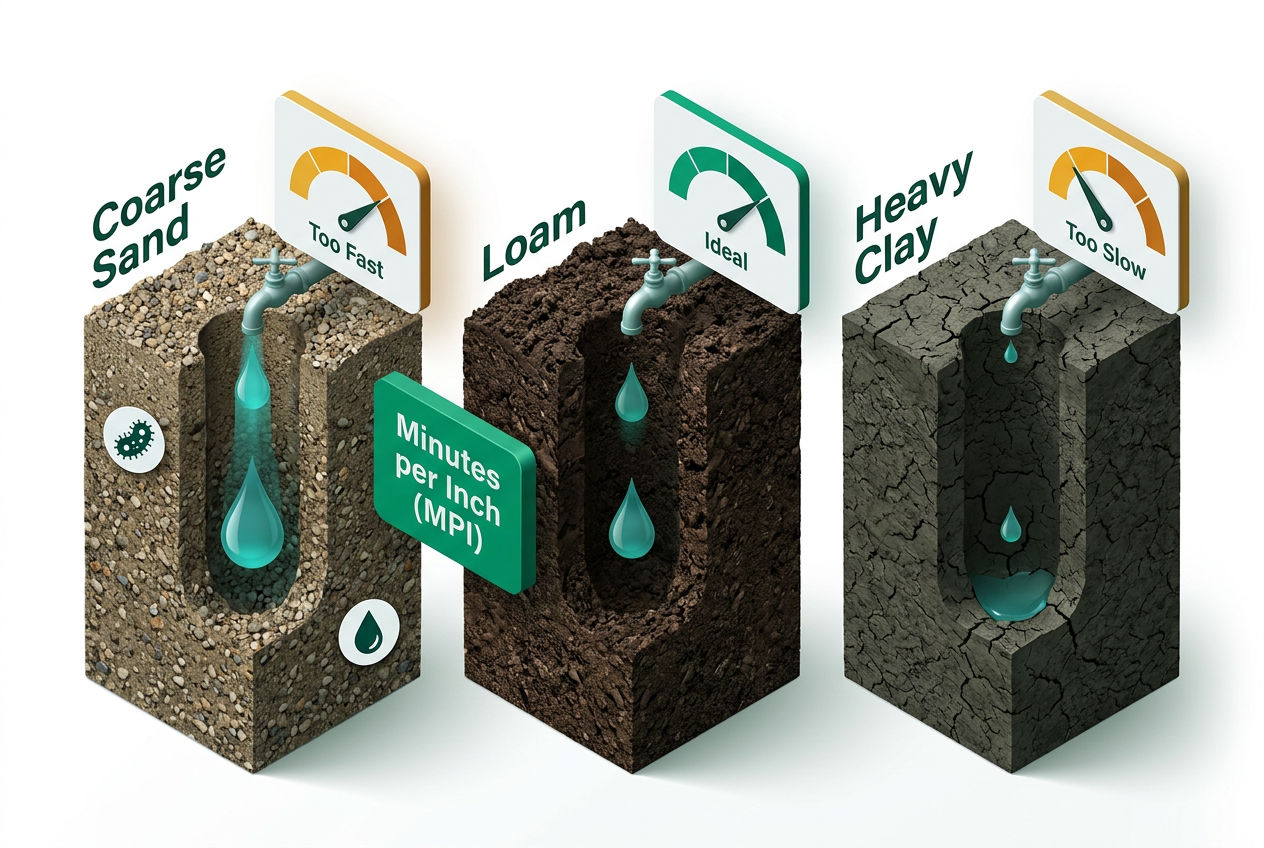
A perc test measures how fast water soaks into saturated soil at the depth where your drain field will sit. The result is reported in minutes per inch (MPI). That one number tells a designer whether the soil can treat septic effluent and how many square feet of trench you'll need.
Think of it as a speed test for dirt. Effluent leaving your tank needs time in the soil so bacteria can break down pathogens. Soil that drains too slowly makes effluent surface in the yard. Soil that drains too fast, like coarse sand or gravel, can send untreated wastewater into groundwater before it's cleaned.
The rate also drives cost. Slower soil means a bigger drain field, and a bigger field means more excavation, more pipe or chambers, and more money. If you want the background on how results are graded across states, our perc test guide covers the full picture. This article is about doing the test with your own hands.
Can You Do Your Own Perc Test for a Septic Permit?
You can do your own perc test to screen a lot, but most counties won't issue a septic permit from it. Permit-grade tests are usually performed or witnessed by a county sanitarian, a licensed soil evaluator, or a professional engineer. Your own test tells you whether paying for the official one makes sense. For the rest of the job, check whether your state lets homeowners install their own septic system.
Rules vary a lot by state. A few examples:
- Pennsylvania requires the township's Sewage Enforcement Officer (SEO) to conduct or witness the test, and the state's Chapter 73 rules call for at least six test holes.
- New York, under Health Department Appendix 75-A, pairs the perc test with a deep test pit and treats rates faster than 1 MPI or slower than 60 MPI as unsuitable for a conventional system.
- North Carolina and Minnesota size systems mainly from a soil profile evaluation, where an evaluator reads soil texture, structure, and color in an open pit. A perc test may play a small role or none at all.
So why bother? Picture this: you've found 5 wooded acres for $40,000 and the listing says "perc not guaranteed." A weekend and a post-hole digger can tell you whether the soil is promising or a heavy clay that will need a $25,000 mound. That's worth knowing before you make an offer. Check the septic system permit requirements for your state first, and get the seller's written permission before you dig on land you don't own yet.
What Tools Do You Need for a DIY Perc Test?
A DIY perc test needs a post-hole digger or 6-inch hand auger, a ruler or yardstick, a straight board to span each hole, a timer, a few gallons of pea gravel, and plenty of water. Most people already own the tools, so the out-of-pocket cost is usually under $100.
Here's the full checklist:
- Hand auger or clamshell post-hole digger (6 to 8 inch). A gas auger works but tends to smear clay walls.
- Tape measure or yardstick marked in 1/8-inch increments.
- A 2x4 or straight board about 3 feet long. This is your fixed reference point.
- Knife, nail, or small garden fork to scratch the hole walls.
- Coarse sand or 1/4-inch pea gravel, about 2 inches per hole.
- Water: plan on 25 to 50 gallons per hole for presoaking in loam or clay. A 275-gallon IBC tote in a pickup bed saves a lot of trips.
- Notebook, stakes, and flagging tape to mark and number each hole.
- Stopwatch or phone timer.
Before you dig, call 811 at least a few business days ahead to have buried utility lines marked. It's free, and most states require it.
How to Do a Perc Test Step by Step
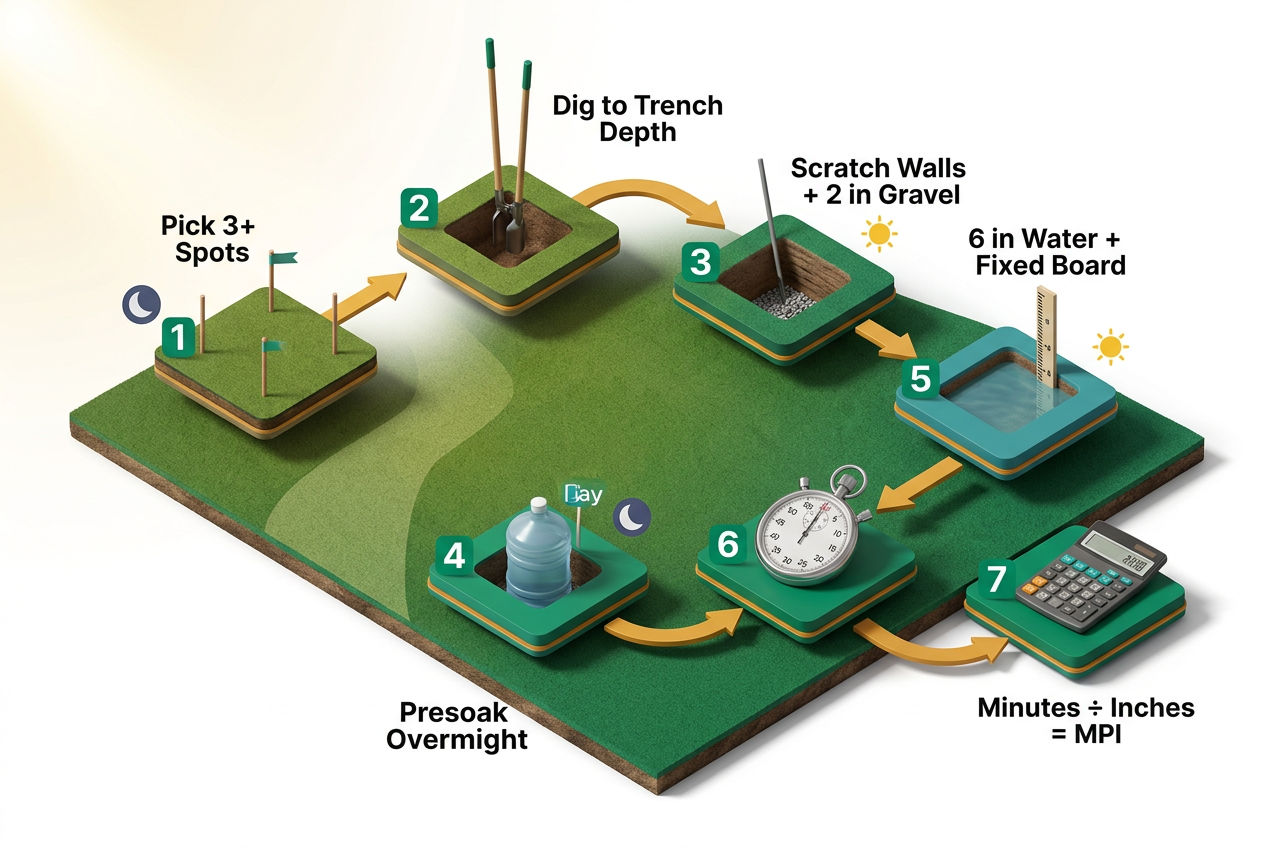
How to do a percolation test, in practice, takes two days: dig and presoak on day one, then take readings for about four hours on day two. The procedure below follows the falling-head method in the EPA's 1980 Onsite Wastewater Treatment and Disposal Systems design manual, which many state codes still mirror. Mark each test hole as you go, because the locations have to appear on your septic site plan.
Step 1: Pick your hole locations
Choose the spot where the drain field would actually go. It should be downhill from the house site, at least 100 feet from any well in most states, and out of drainage swales. Space at least three holes evenly across the area, roughly 20 to 30 feet apart. Avoid filled ground, old foundations, and tire ruts. Disturbed soil gives you useless numbers.
Step 2: Dig to trench depth
Bore each hole 6 to 8 inches wide with vertical sides. Dig to the depth of your future trench bottom. That's commonly 18 to 36 inches, though some codes test as deep as 48 inches. If you hit bedrock, standing water, or gray, mottled soil before reaching depth, stop and write it down. Those are red flags on their own, and a high water table can sink a site even when the perc rate looks fine.
Step 3: Prepare the hole
Scratch the side walls with a knife or nail to open up pores that the auger smeared shut. Scoop out the loose crumbs from the bottom. Add about 2 inches of coarse sand or pea gravel to keep the bottom from scouring when you pour water in.
Step 4: Presoak the soil
Fill each hole with at least 12 inches of water and keep it topped up for a minimum of 4 hours. Overnight is better, and in clay it's close to mandatory. Clay swells as it gets wet, and dry clay reads far faster than it will ever drain in a wet April.
There's one shortcut for sandy soil. If 12 inches of water drains away in under 10 minutes twice in a row, the soil is already saturated enough. You can skip the long presoak and test right away.
Step 5: Set the water level and a fixed reference
The next day, check each hole. Lay your board across the top and measure down from the same mark on it every time. If water is still standing, adjust it to 6 inches above the gravel. If the hole is dry, add 6 inches of fresh water.
Step 6: Take readings
For most soils, measure the drop every 30 minutes for 4 hours. Refill to 6 inches whenever the level falls too low to read. The drop in the final 30-minute period is the one that counts, because by then the soil is fully saturated.
In sandy soil where the first 6 inches drains in under 30 minutes, switch to 10-minute readings for 1 hour and use the last 10-minute drop.
Step 7: Calculate minutes per inch
Divide the interval length by the inches dropped. A 1.5-inch drop in 30 minutes is 30 ÷ 1.5 = 20 MPI. Repeat for every hole. Depending on your county, the designer uses either the slowest hole or the average.
What Is a Good Perc Test Result?
A good perc test result for a conventional gravity septic system usually falls between about 5 and 30 minutes per inch. Rates from 30 to 60 MPI generally pass but need a larger drain field. Faster than 1 to 5 MPI or slower than 60 MPI usually rules out a standard trench system.
| Perc Rate (MPI) | Soil Type (Typical) | What It Usually Means |
|---|---|---|
| Under 1–5 | Coarse sand, gravel | Too fast; special design |
| 5–15 | Sand, sandy loam | Good; smaller field |
| 16–30 | Loam, silt loam | Good; standard field |
| 31–60 | Clay loam | Passes; larger field |
| Over 60 | Heavy clay | Fails conventional |
Source: General ranges adapted from the EPA Onsite Wastewater Treatment and Disposal Systems design manual and state codes such as New York Appendix 75-A. Exact cutoffs vary by state and county.
Some states stretch these limits for engineered systems. Certain codes allow mound, drip, or pretreatment systems on soils up to roughly 120 MPI. Your county's code is the only cutoff that matters for your lot.
Worked Example: Turning Readings Into a Drain Field Size
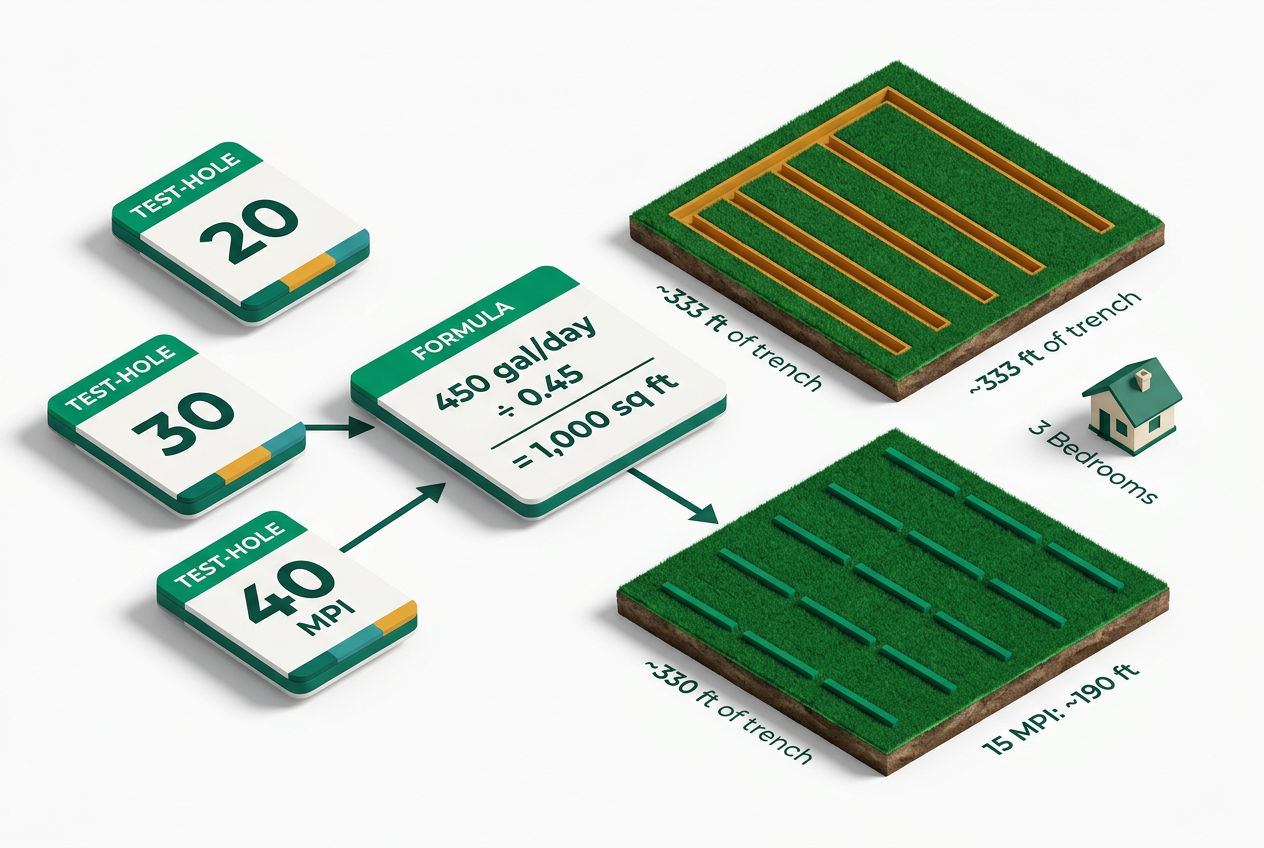
Your perc rate converts to drain field size through your county's loading-rate table. Take three test holes reading 20, 30, and 40 MPI on a lot for a 3-bedroom house. Using the slowest hole and a typical loading rate, you'd need roughly 1,000 square feet of trench bottom.
Here's how that math plays out. Say your state sizes flow at 150 gallons per day per bedroom (many use 110 to 150). A 3-bedroom home is designed for 450 gallons per day.
Several state tables assign soil in the 31 to 60 MPI band a loading rate near 0.45 gallons per square foot per day. That gives 450 ÷ 0.45 = 1,000 square feet of trench bottom. In 3-foot-wide trenches, that's about 333 linear feet. Now compare a lot that tested at 15 MPI with a rate near 0.8. It needs only about 560 square feet, or roughly 190 feet of trench.
That gap is real money. Every extra 100 feet of trench can add several thousand dollars to a job, which is why perc results show up in every line of the septic installation cost estimate. Our drain field size guide walks through the tables in more detail.
Common DIY Perc Test Mistakes That Skew Results

DIY Septic Blueprint
Thinking about building it yourself?
The complete, plain-English plan to size, permit and install your own septic system — designed for homeowners, not contractors. Skip the $15,000–$25,000 quotes and do it right the first time.
Get the DIY Blueprint — $67 →Instant download · 8 modules + 3 bonus guides · 60-day money-back guaranteeThe most common DIY perc test mistakes are skipping the presoak, testing at the wrong depth, smearing the hole walls, and measuring from a moving reference point. Each one pushes your number in a misleading direction, and most of them make bad soil look better than it is.
Watch out for these:
- Short presoak. Thirty minutes of soaking can make a 70 MPI clay read 25 MPI. You'll buy the land, and the official test will fail it.
- Wrong depth. Topsoil drains much faster than the subsoil 30 inches down. Test where the trench will be.
- Smeared walls. A power auger in wet clay polishes the sides like pottery. Always scratch them open.
- Floating reference. Measuring from the ground surface, which crumbles, adds errors. Use a fixed board and the same mark every time.
- Testing after a dry spell or a downpour. Cracked summer clay reads fast. Soil soaked by last week's storm reads slow.
- One hole only. Soils change across a few yards. Three is a bare minimum, and Pennsylvania wants six.
If you're running the test because you want to build the system yourself too, read our DIY septic system pillar guide before you go further. It covers which states let owners install their own system and what inspections you'll face.
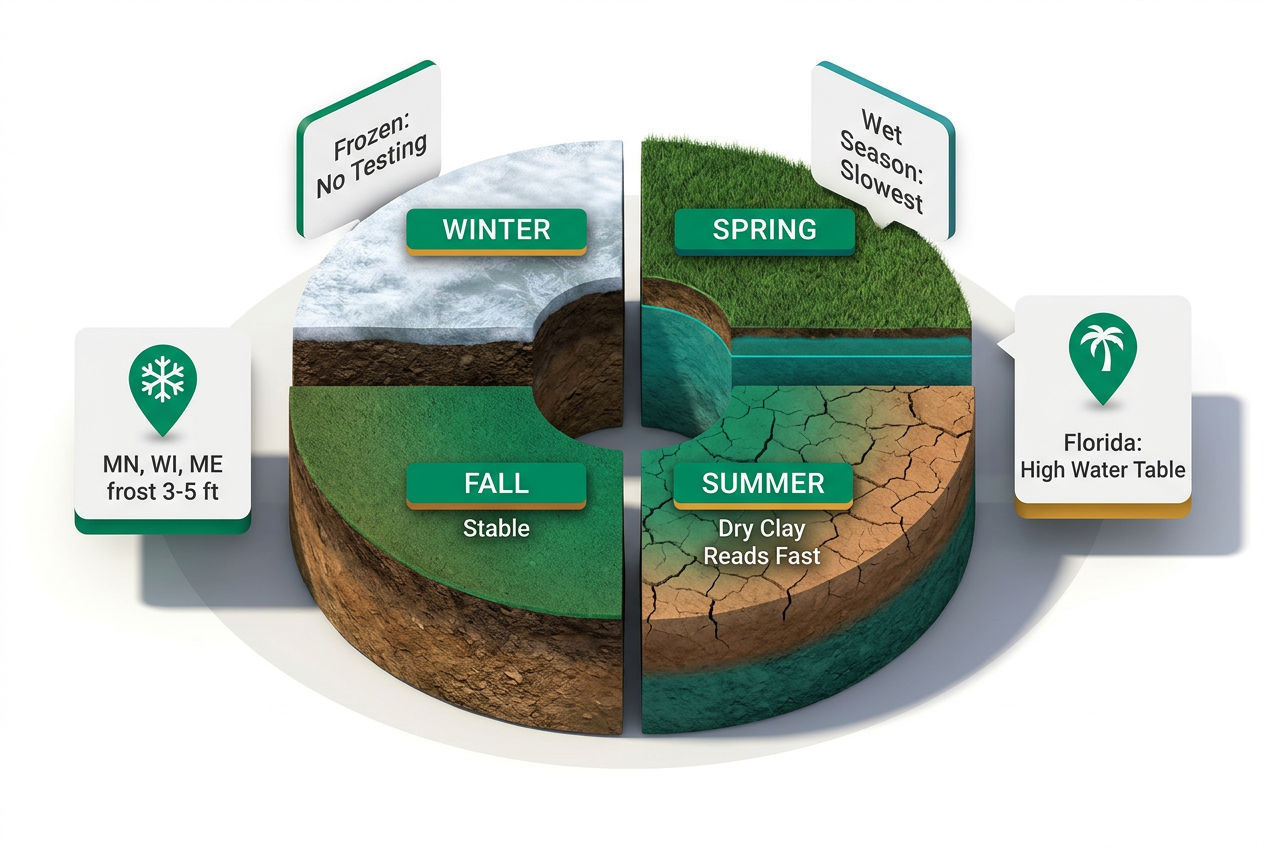
Does the Time of Year Change Perc Test Results?
Yes. Season changes perc test results because soil moisture and groundwater levels shift through the year. Most jurisdictions won't accept tests in frozen ground, and some require wet-season testing, usually late winter through spring, so the result reflects the soil at its wettest and slowest.
In northern states like Minnesota, Wisconsin, and Maine, frost can sit 3 to 5 feet deep, so testing typically shuts down from December into April. In Florida and the Gulf Coast, sandy soils often perc fast, but the limiting factor is the seasonal high water table. Florida's Department of Health puts heavy weight on how close that water table comes to the surface in the rainy season.
Regional soils matter too. The red clays of the Georgia and Carolina Piedmont often test slow. Glacial till in Ohio and Michigan can vary from one hole to the next. If your lot sits on clay, our guide to a septic system for clay soil explains the designs that work there.
What Happens If Your Land Fails the Perc Test?
If your land fails a perc test, it usually isn't the end. A failed result rules out a conventional gravity trench, but engineered systems such as mounds, sand filters, drip irrigation, or aerobic treatment units are designed for slow or shallow soils. They cost more, often $15,000 to $30,000 or more installed.
A mound septic system is the most common fix for slow clay or a high water table. It builds a sand bed above grade so effluent gets treated before it reaches native soil. You can also retest another spot on the lot, since soils can change within 50 feet. Our article on failed perc test options lays out every route, including variances.
Your DIY results have honest limits here. They can't tell you what the official evaluator will find, and they can't replace the soil profile reading that many states now require. Treat a passing DIY number as "worth paying for the real test," not "approved."
How Much Does a Professional Perc Test Cost?
A professional perc test costs about $750 to $1,850 for most homeowners in 2026. A bare county-run test can be a few hundred dollars, while a full soil evaluation with excavator time, an engineer, and a system design can top $3,000. County permit and application fees are often billed separately.
Prices climb with the number of holes, rocky ground, and travel distance in rural areas. Rocky New England lots that need a backhoe for test pits often run higher than sandy lots in the Southeast. See our breakdown of perc test cost by state for local ranges.
When you're ready for an official test, a licensed installer can usually schedule the evaluator, the test pits, and the design. Browse local pros on our septic installation services page, or search your city from the SepticTankHub homepage to compare companies near your land.
Sources & Methodology
- U.S. Environmental Protection Agency, Septic Systems program (epa.gov/septic): General guidance on soil suitability and drain field function. The test procedure follows the falling-head method in the EPA's 1980 Onsite Wastewater Treatment and Disposal Systems design manual.
- New York State Department of Health, Appendix 75-A: Percolation test procedure and the 1 to 60 MPI suitability range for conventional systems.
- Pennsylvania Department of Environmental Protection, Chapter 73 rules: Sewage Enforcement Officer oversight and minimum test-hole counts.
- Minnesota Pollution Control Agency (Chapter 7080) and North Carolina Department of Health and Human Services: Soil profile evaluation approaches that reduce or replace the perc test. pca.state.mn.us
- Cost data: Ranges drawn from SepticTankHub's perc test and installation cost research, 2025–2026.
Codes change. Confirm the current test procedure and cutoffs with your county health department before you dig.
Primary sources to read: New York 10 NYCRR 75.5 (onsite system standards) · NYSDOH residential onsite design handbook · 25 Pa. Code Chapter 73 (onlot sewage standards) · Minnesota Rules chapter 7080 (SSTS standards) · USDA NRCS Web Soil Survey
More Septic Design & Install Guides
- Septic system design: the complete guide
- Septic options for clay soil
- Mound system design
- How to draw a septic site plan
- Leach field design and sizing
- What septic system design costs
- Can you install your own septic system? Rules by state
Frequently Asked Questions
Can you do a DIY perc test for a septic permit?
A DIY perc test usually can't be used for a septic permit. Most states require the test to be run or witnessed by a county sanitarian, a licensed soil evaluator, a registered sanitarian, or a professional engineer. Pennsylvania, for example, requires the township's Sewage Enforcement Officer to oversee it. Where your own test helps is screening. Before you buy rural land or pay $750 to $1,850 for an official evaluation, a weekend DIY test can show whether the soil drains in a promising range or sits in heavy clay. If your readings come in slower than 60 minutes per inch after a proper overnight presoak, expect the official test to call for an engineered system. Always ask your county health department what it accepts. A few rural counties let owners dig the holes so the inspector only needs to take readings, which can lower the fee.
How do you do a percolation test step by step?
To do a percolation test, dig at least three holes 6 to 8 inches wide to your planned trench depth, usually 18 to 36 inches. Scratch the side walls, clean out loose soil, and add 2 inches of pea gravel to the bottom. Fill each hole with 12 inches of water and keep it filled for at least 4 hours, or overnight in clay. The next day, set the water 6 inches above the gravel. Measure the drop every 30 minutes for 4 hours from a fixed board laid across the hole, refilling as needed. Use the final 30-minute drop. Divide 30 by the inches dropped to get minutes per inch. In fast sandy soil, take readings every 10 minutes for 1 hour instead and use the last reading.
How deep should the holes be when you do a perc test for a septic system?
When you do a perc test for a septic system, dig each hole to the depth of the future drain field trench bottom. That's commonly 18 to 36 inches below the surface, and some codes test as deep as 48 inches. Testing shallower than trench depth is one of the biggest DIY errors, because topsoil drains much faster than the subsoil your effluent will actually reach. If you don't know the trench depth yet, ask your county health department or a local installer what's typical in your area. Also watch what you hit on the way down. Bedrock, standing water, or gray and rust-mottled soil before you reach depth signal a shallow limiting layer. That can rule out a conventional trench no matter how good the perc rate looks, and it often points toward a mound system.
How long should you presoak when doing a percolation test?
Presoak each hole for at least 4 hours with 12 or more inches of water, and leave it overnight, about 24 hours, if you have clay soil. The presoak saturates the soil and lets clay swell, which mimics how the ground behaves when a drain field runs year-round. Skipping it is the fastest way to get a falsely good result. Dry clay can read two or three times faster than it truly drains. Keep topping the holes up during the presoak so the water never drops below about 12 inches. Sandy soil is the exception. If 12 inches of water drains completely in under 10 minutes on two fills in a row, the soil is already saturated. You can start readings right away, using 10-minute intervals for one hour.
What is a passing result on a DIY perc test?
A passing result on a DIY perc test generally falls between about 5 and 60 minutes per inch for a conventional septic system, though cutoffs vary by state. Rates of 5 to 30 MPI are ideal and need a smaller drain field. Rates of 31 to 60 MPI usually pass but require more trench area, which raises installation cost. Faster than 1 to 5 MPI means sandy or gravelly soil that may not treat effluent before it reaches groundwater. Slower than 60 MPI usually fails for a standard trench and points to a mound, sand filter, or drip system, which some states allow on soils up to about 120 MPI. New York, for example, treats anything faster than 1 or slower than 60 MPI as unsuitable for conventional systems. Treat any DIY pass as a reason to order the official test.
Free download
Not ready for the Blueprint? Start free.
Grab the free DIY Septic Planning Kit — the permit-first checklist, perc-test cheat sheet, and sizing tables that keep your build from getting red-tagged.
Was this article helpful?
Frequently Asked Questions
Recommended Resources
📖 Related Articles
- Perc Test (Percolation Test): What It Is & How It Works
- Septic System Permit Cost & State Requirements (2026 Guide)
- High Water Table and Septic Systems: What You Need to Know
- Leach Field Size by Bedrooms: Drain Field Sizing Chart (2026)
- DIY Septic System: How to Build Your Own (Step-by-Step)
- Mound Septic System: $10K–$25K Cost & How It Works (2026)
- Land Failed the Perc Test? Here Are Your Options
- How Much Does a Perc Test Cost? (2026 Pricing)
🔧 Services
Find Septic Professionals Near You
Compare licensed, verified septic companies by area — top county markets and cities below, or browse all 50 states.
County markets
Popular cities
