
Quick Answer
Septic design cost ranges from $400 to $8,000 or more in 2026, depending on system complexity, lot conditions, and who signs the plans. A conventional gravity-fed system on a flat lot with sandy soil sits at the low end. An engineered mound or drip system on a steep, clay-heavy lot with a high water table sits at the high end — and sometimes well beyond it.
Key Takeaways
- Basic conventional septic design costs $400–$1,500. Engineered and alternative systems run $1,500–$8,000+.
- The full pre-construction package — design, perc test, site survey, and permits — typically costs $1,000–$10,000.
- Most states require a licensed designer or Professional Engineer (PE) to prepare septic plans. True DIY design is legal in very few states.
- Regional costs vary dramatically: California and the Northeast average 3–5× more than rural Southwest states.
- Start the design process 3–6 months before your intended construction date to avoid permit delays.
How Much Does Septic Design Cost in 2026?
Professional septic design fees in 2026 range from $400 for a basic conventional system in a low-regulation state to $8,000 or more for a complex engineered design in California or the Northeast. Most homeowners building a standard 3–4 bedroom home in average soil conditions pay $800–$2,500 for design alone.
That figure doesn't include everything that has to happen before a shovel goes in the ground. Here's the full picture:
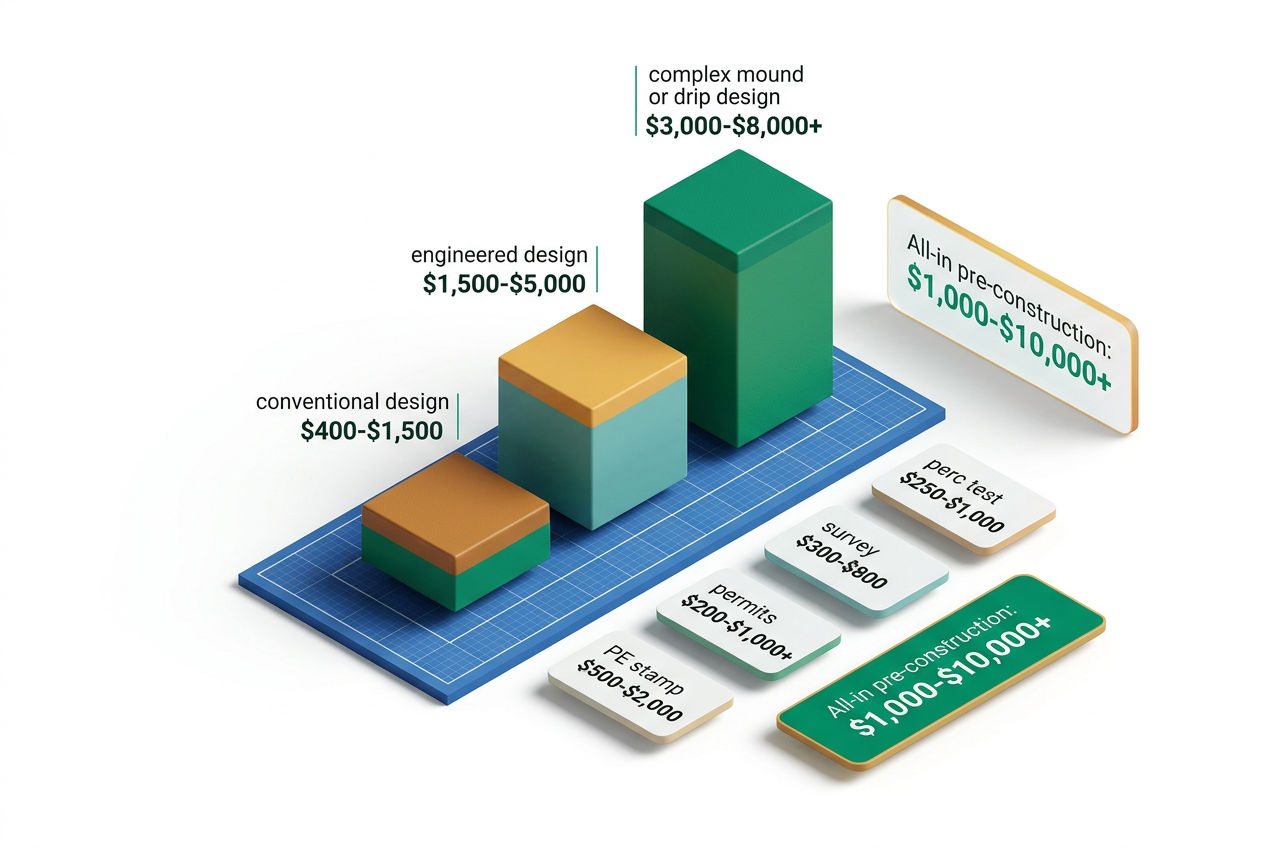
| Pre-Construction Cost Item | Typical Range (2026) |
|---|---|
| Basic conventional system design | $400 – $1,500 |
| Engineered / alternative system design | $1,500 – $5,000 |
| Complex site design (mound, ATU, drip) | $3,000 – $8,000+ |
| Perc test / soil evaluation | $250 – $1,000 |
| Site survey (if needed separately) | $300 – $800 |
| Septic permit fees (county/state) | $200 – $1,000+ |
| PE stamp (if required, on top of design fee) | $500 – $2,000 |
| Design revision (failed perc or site changes) | $100 – $500/revision |
| Total all-in pre-construction cost | $1,000 – $10,000+ |
Sources: NOWRA national contractor survey data; EPA Septic Systems overview; regional health department fee schedules.
Design fees represent roughly 5–15% of total septic installation cost. Since a full septic system installation runs $5,000–$30,000 depending on system type, skimping on a solid design to save $500 upfront can cost you $5,000–$15,000 in failed drain fields later.
Engineering and surveying labor costs have increased approximately 3–6% annually since 2022, so the ranges above reflect current 2026 market conditions.
Do I Need a Septic Engineer or a Septic Designer?
The answer depends on your state, your system type, and your lot's complexity. These are two distinct credentials — and the difference directly affects what you'll pay.
A licensed septic designer (sometimes called a Registered Environmental Health Specialist, Soil Scientist, or Licensed Site Evaluator, depending on the state) can produce plans for most conventional systems. They understand soil science, local code, and drain field design. In many states, this is all you need for a standard gravity-fed system serving a 3–4 bedroom home with a 1,000–1,250 gallon septic tank.
A Professional Engineer (PE) with onsite wastewater experience is required when:
- Your state mandates PE-stamped plans for all systems (Massachusetts, New Jersey, and several others)
- You're installing an alternative system — mound, aerobic treatment unit (ATU), drip irrigation, or recirculating sand filter
- Your lot presents unusual challenges (steep slopes, high water table, shallow bedrock, tight setbacks)
- Your local health department requests a PE stamp for a variance
PE involvement typically adds $500–$2,000 to the base design fee. In complex cases where the PE is the primary designer from site visit to plan submission, total fees can reach $5,000–$8,000 on their own.
For alternative septic systems, a PE isn't optional — it's the law in most jurisdictions. If you're on a lot that failed a standard perc test, don't assume a designer can get you through. Check with your county health department first.
What Is Included in a Septic System Design?
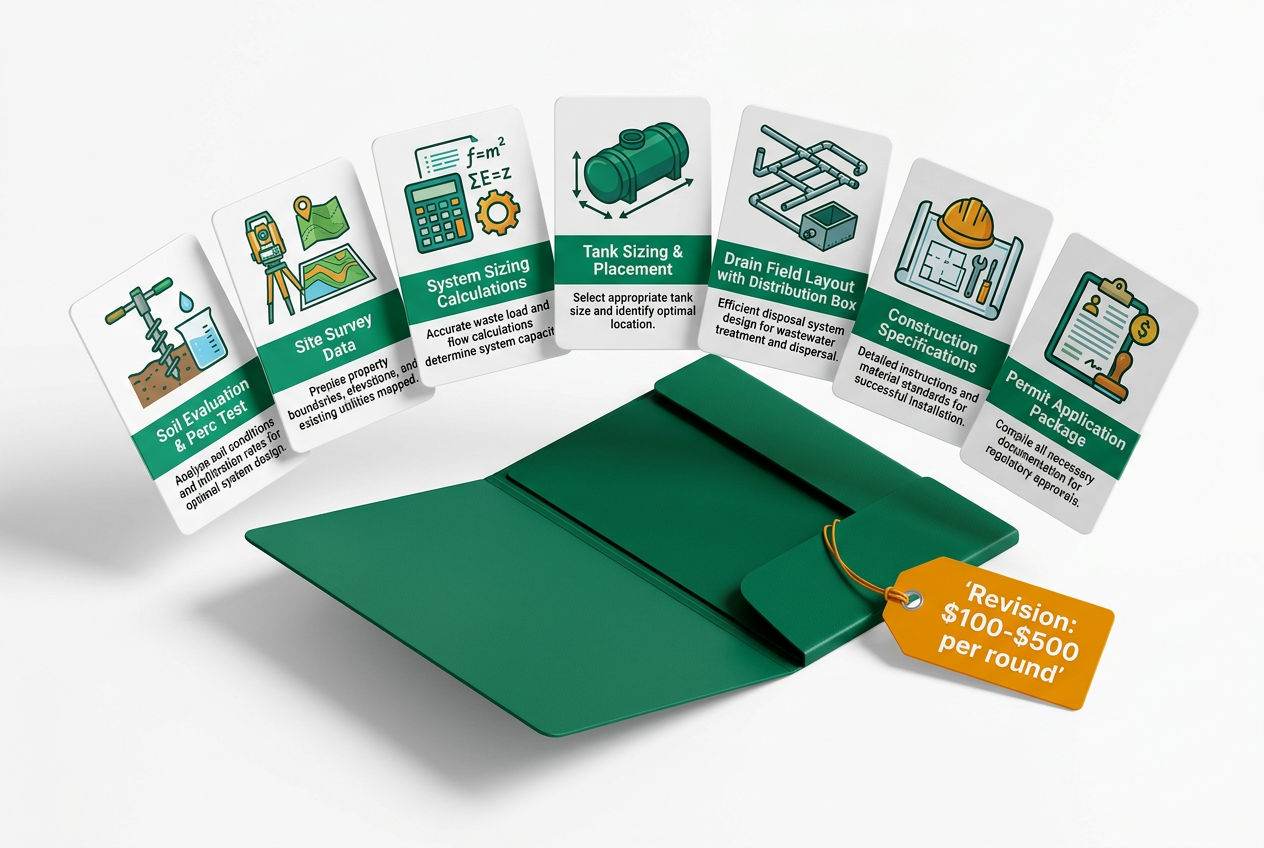
A complete septic site plan is more than a sketch on graph paper. When you hire a licensed designer, the deliverable package typically includes:
- Soil evaluation and percolation test — sometimes bundled, sometimes billed separately (see below)
- Site survey data integration — topography, setback measurements, well locations, property lines
- System sizing calculations — based on bedroom count, daily flow estimates, and soil absorption rate
- Tank sizing and placement — a 1,000-gallon tank for a 2-bedroom home, 1,250–1,500 gallons for 3–4 bedrooms
- Drain field layout — leach lateral spacing, depth, distribution box placement, and total square footage
- Construction specifications — materials, pipe grades, inspection ports, effluent filter requirements
- Permit application package — forms, fees, and supporting documents submitted to the health department
Some designers handle the permit submission as part of their fee. Others hand you the plans and bill separately for permit running. Ask upfront.
The septic system design process ties all of this together. Miss one element and the county will send the application back — triggering the revision fees ($100–$500 per round) listed in the table above.
Is a Perc Test Included in the Septic Design Cost?
Sometimes, but not always. This is one of the most common sources of budget confusion homeowners face.
A perc test (percolation test) measures how quickly water moves through your soil. It's the foundation of drain field design — a designer can't size your leach field without it. Most states require a formal soil evaluation and/or perc test before plans can be submitted.
Here's how bundling typically breaks down:
- Bundled (most common with smaller firms): The designer performs the site visit, soil evaluation, and perc test as part of one quoted fee. You pay $1,200 and get everything through permit submission.
- Separate (more common with larger engineering firms): A soil scientist or certified evaluator charges $250–$1,000 for the perc test, then the designer uses those results to build the plans. You receive two invoices.
If your lot has poor drainage — heavy clay soil, a high water table, shallow hardpan — perc tests can fail. A failed test doesn't end the project, but it does mean evaluating alternative options and usually a redesign, which adds cost.
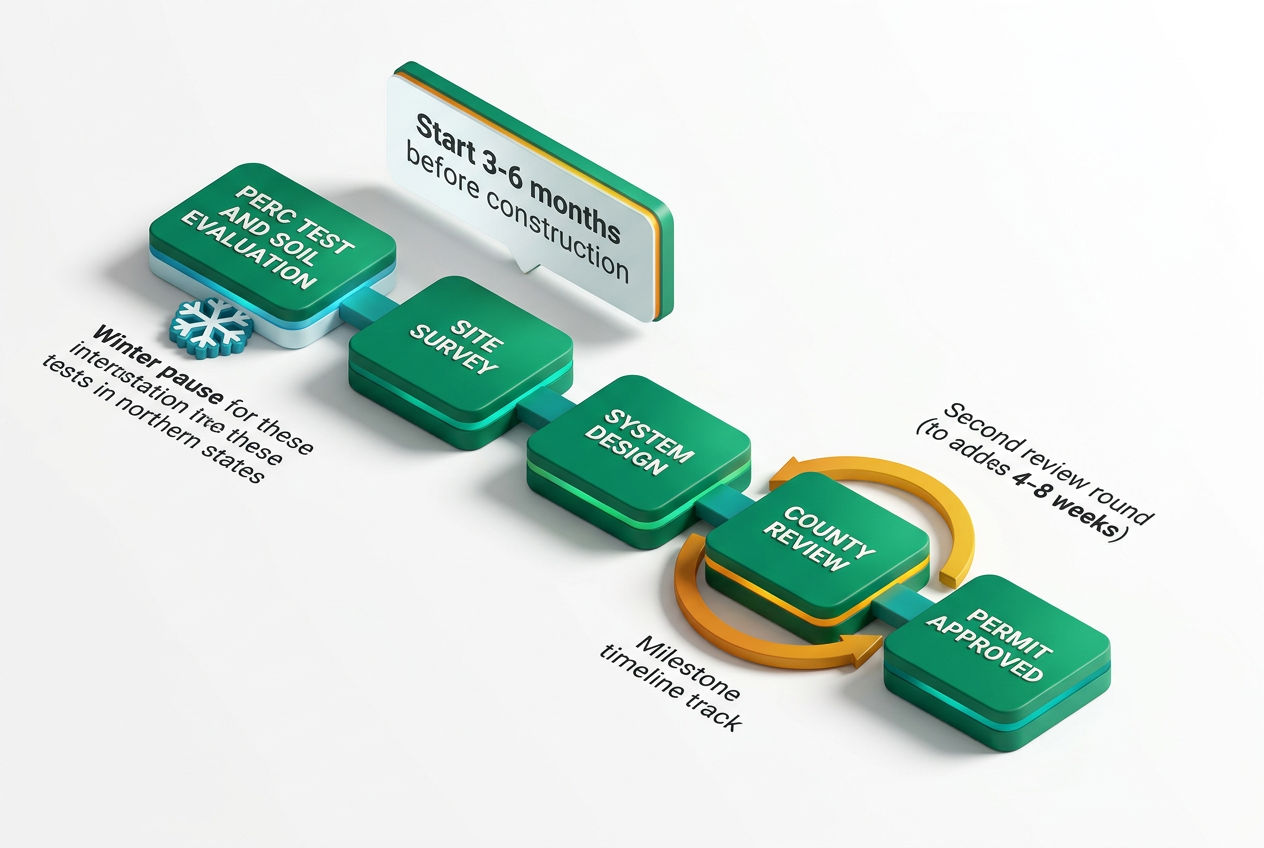
Perc testing is typically restricted to spring and fall in northern states. In Minnesota and Wisconsin, frozen ground prevents meaningful soil evaluation from December through March. In Florida and Georgia, saturated conditions after heavy summer rain can skew results. Plan your timeline accordingly.
What Factors Drive Septic Design Cost Up?
A flat, sandy lot in rural Texas is easy to design for. A steep, rocky hillside lot in Vermont next to a stream is not. These variables push design cost from the low end to the high end fast:
Lot topography: Sloped lots require pressure distribution systems instead of simple gravity flow. Mound systems on steep terrain need hydraulic modeling. Each step up in complexity adds $500–$2,000 to the design fee.
Soil type: Sandy loam is a designer's friend — fast drainage, predictable perc rates. Clay-heavy soil absorbs water slowly and requires larger drain fields or alternative systems. Shallow bedrock limits burial depth and may require a mound or drip system entirely.
Water table depth: A seasonal high water table above 24 inches in many states triggers an automatic requirement for an engineered septic system rather than a conventional gravity system. More engineering equals higher fees.
Number of bedrooms: System capacity ties directly to bedroom count. A 5-bedroom home needs a larger tank (typically 1,500 gallons minimum) and significantly more drain field square footage than a 2-bedroom cabin. More capacity means more design work.
Setback challenges: Wells, streams, property lines, and structures all impose setback requirements. Tight lots in New England often require variance applications, adding $300–$800 in additional design and paperwork hours.
System type required: Conventional gravity systems are the least expensive to design. Pressure distribution systems cost more. Mound, ATU (aerobic treatment unit), recirculating sand filter, and drip irrigation systems cost the most. See our guide to types of septic systems for a full breakdown.
Local regulatory complexity: A county that requires two rounds of review before approval adds 4–8 weeks and potentially $500 in revision time versus a county with a single-review process.
How Does Septic Design Cost Vary by Region?
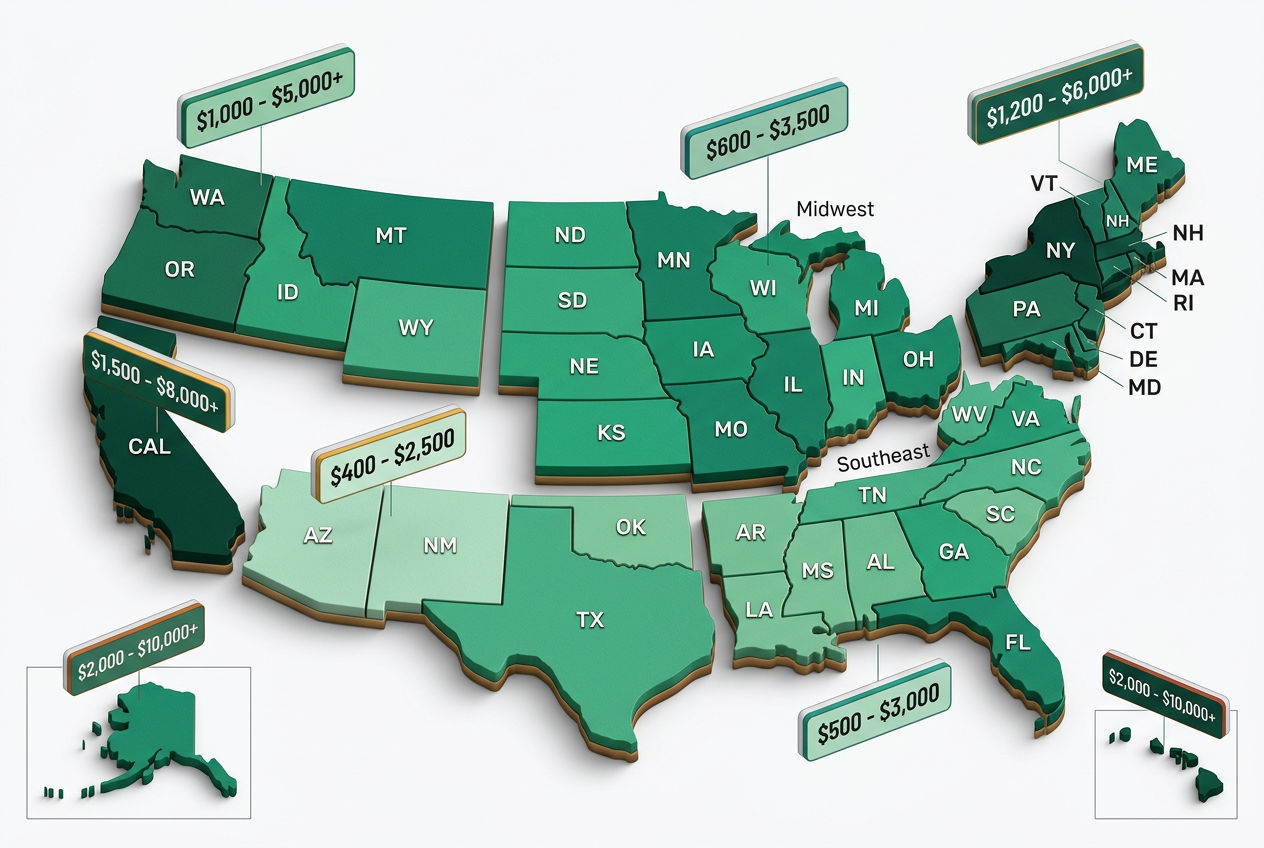
Septic regulations are hyperlocal. What a designer charges — and what they're legally required to produce — varies not just state to state but county to county. Here's a realistic regional snapshot:
Northeast (MA, CT, NY, NJ, PA): $1,200–$6,000+. Some of the strictest regulations in the country. Many counties require PE-stamped plans for all systems. Rocky and clay soils are common. Environmental sensitivity near coastal areas adds review layers. Expect the high end.
Pacific Northwest (WA, OR): $1,000–$5,000+. Strict environmental regulations, high rainfall, and shallow water tables in many areas mean engineered systems are common. Oregon's DEQ requires detailed soil morphology reports alongside standard perc data.
California: $1,500–$8,000+. OWTS (onsite wastewater treatment system) policies vary dramatically by county. Many counties require both a licensed soil scientist and a PE. Los Angeles County and Marin County have some of the most extensive review processes in the country.
Midwest (OH, IN, MI, WI, MN): $600–$3,500. Costs vary significantly by county. Clay-heavy glacial soils in many areas increase system complexity. Minnesota's MPCA has detailed design standards that push fees upward in heavily regulated watersheds.
Southeast (NC, SC, GA, FL): $500–$3,000. Sandy inland soils keep conventional designs affordable. Coastal areas with high water tables in Florida frequently require mound or drip systems — pushing fees toward $3,000.
Southwest (AZ, NM, TX): $400–$2,500. Favorable arid soils, lower labor costs, and less regulatory intensity in rural counties keep this region at the low end nationally. Texas delegates septic oversight to county-level Authorized Agents, creating significant cost variation county to county.
Alaska and Hawaii: $2,000–$10,000+. Limited designer availability, extreme conditions (permafrost in Alaska, volcanic basalt and lava rock in Hawaii), and remote site access create costs that can exceed anything seen in the continental U.S.
Can I Design My Own Septic System?

DIY Septic Blueprint
Thinking about building it yourself?
The complete, plain-English plan to size, permit and install your own septic system — designed for homeowners, not contractors. Skip the $15,000–$25,000 quotes and do it right the first time.
Get the DIY Blueprint — $67 →Instant download · 8 modules + 3 bonus guides · 60-day money-back guaranteeHonestly? In most states, no — not legally. Installation rules are separate from design rules, so also check whether your state lets you install your own septic system.
The vast majority of states require septic plans to be prepared by a licensed professional before the county will accept a permit application. That means a licensed designer, soil scientist, environmental health specialist, or PE, depending on your state.
The states that allow any form of homeowner self-design are limited. Some rural counties in states like Idaho, Montana, and Wyoming allow homeowners to submit basic designs for simple conventional systems on their own land, but these exceptions are narrow and typically require the homeowner to pass a demonstration of technical knowledge or submit to extensive county review.
Before assuming you can self-design, call your county health department or environmental agency directly. Ask: "Can a homeowner submit their own septic design plans for a permit?" Get the answer in writing.
If you're asking because you want to save money, there are smarter options. Our DIY septic vs. professional cost comparison breaks down where homeowner labor actually saves money versus where cutting corners creates liability. The design phase is usually not where you save — it's where you protect every dollar you invest in installation.
The EPA's septic systems resource page also provides state-by-state regulatory contacts if you want to verify requirements before calling your county.
How Long Does Septic Design and Permitting Take?
Timeline matters as much as cost if you're planning a construction start date. Here's what to realistically expect:
- Conventional system, cooperative county: 2–6 weeks from initial site visit to approved permit
- Engineered or alternative system: 4–16 weeks, depending on system complexity and county review backlog
- Variance required (challenging lot, setback issues): Add 4–8 weeks minimum for board review
Permit offices in rural counties often have a single reviewer handling all applications. During spring construction season — February through May — that reviewer is buried. Applications submitted in January clear faster than ones submitted in April.
For new construction septic system projects, permits are typically required before a building permit is issued. That means your septic design has to be approved before framing starts. Miss that window and your whole construction schedule slips.
Start the design process 3–6 months before your intended ground-breaking. If you're in a northern state and need a perc test, schedule it for fall before the ground freezes — not spring, when every other homeowner is trying to do the same thing.
Why Does Septic Design Cost So Much?
A fair question. Here's what you're actually paying for:
A licensed septic designer or PE carries professional liability for every plan they stamp. If the system fails because of a design error, they're legally and financially exposed. That liability — and the insurance that covers it — costs money, and it flows into your fee.
Beyond liability, a quality design requires a site visit, soil sampling, lab analysis, perc testing, survey data review, local code research, hydraulic calculations, drafting, and permit coordination. For a complex site, that's 20–40 hours of professional time. At $80–$150/hour for a licensed designer or $150–$250/hour for a PE, the math adds up quickly.
What you're not paying for is guesswork. A properly designed drain field built to your specific soil absorption rate — say, 45 minutes per inch on a moderate clay-loam — will outlast a system sized by estimate. We've seen homeowners try to shortcut design and end up replacing a $12,000 drain field within 7 years because the original system was undersized.
That's the real cost of cheap design.
Finding a Septic Designer Near You
Find licensed septic designers and engineers near you through the SepticTankHub directory. Filter by state and system type to connect with professionals who handle the specific design your lot requires.
Before you call anyone, pull together: your property survey (if you have one), the number of bedrooms in the planned home, any existing perc test results, and your county health department's specific submittal requirements. A prepared homeowner gets faster quotes and avoids paying for a second site visit.
Sources & Methodology
EPA Septic Systems (epa.gov/septic): Used for regulatory framework context and homeowner guidance on onsite wastewater treatment.
NOWRA (National Onsite Wastewater Recycling Association — nowra.org): Industry survey data on design fee ranges and professional licensing requirements by state.
State Health Department Fee Schedules: Regional cost data sourced from publicly available permit fee schedules from health departments in California, Florida, Minnesota, Oregon, Texas, and New York.
USDA Rural Development (rd.usda.gov): Referenced for rural septic system program data and design cost benchmarks in underserved areas.
SepticTankHub Market Research (2025–2026): Contractor-reported design fees collected from directory-listed professionals across all 50 states, weighted by system type and region.
Primary sources to read: EPA onsite wastewater design manuals · Texas TCEQ: OSSF permits · Florida DEP: onsite sewage permitting FAQ · California OWTS Policy
More Septic Design & Install Guides
- Septic system design: the complete guide
- How to draw a septic site plan
- How to do a perc test
- Mound system design
- Leach field design and sizing
- How long a septic install takes
- Can you install your own septic system? Rules by state
Frequently Asked Questions
How much does it cost to design a septic system?
Septic system design cost ranges from $400–$1,500 for a basic conventional system to $3,000–$8,000 or more for complex engineered alternatives like mound systems or drip irrigation systems. Most homeowners building a 3–4 bedroom home in average soil conditions pay $800–$2,500 for design services alone. When you add the perc test ($250–$1,000), site survey ($300–$800), and county permit fees ($200–$1,000+), the total pre-construction cost lands between $1,000 and $10,000. Regional location significantly affects the final number — California and the Northeast run 3–5 times higher than rural Southwest states for the same scope of work.
Do I need a septic engineer or a licensed designer?
It depends on your state and system type. A licensed septic designer — often a certified soil scientist or registered environmental health specialist — can prepare plans for most conventional gravity-fed systems. A Professional Engineer (PE) with onsite wastewater experience is required when your state mandates PE-stamped plans for all systems (as Massachusetts and New Jersey do), when you're installing an alternative system like a mound, ATU, or drip system, or when your lot has unusual challenges such as steep slopes, high water table, or tight setbacks. PE involvement adds $500–$2,000 to base design fees. When in doubt, call your county health department and ask what credentials they require on submitted plans before the permit review begins.
Can I design my own septic system to save money?
In most states, no. The vast majority of jurisdictions require septic plans to be prepared and signed by a licensed professional — a designer, soil scientist, or PE — before the county will accept a permit application. A small number of rural counties in states like Idaho, Montana, and Wyoming allow homeowners to submit basic designs for conventional systems on their own land, but these exceptions are narrow and heavily scrutinized. Attempting to self-design in a state that prohibits it won't just get your permit rejected — it can disqualify your property from obtaining a valid permit at all. Before assuming DIY is an option, call your county health department directly and ask in writing whether homeowner-prepared plans are accepted.
Is the perc test included in the septic design cost?
Sometimes, but not always — and this is where many homeowners get surprised. Some designers bundle the site visit, soil evaluation, and percolation test into a single quoted fee. Others, particularly larger engineering firms, bill the perc test separately through a licensed soil scientist, adding $250–$1,000 to your costs. When you're getting design quotes, ask specifically: "Does your fee include the soil evaluation and perc test?" A failed perc test doesn't end your project, but it usually requires a redesign for an alternative system and adds revision fees of $100–$500 per round. In northern states like Minnesota and Wisconsin, frozen ground prevents perc testing from December through March, so schedule soil work in fall if you're planning a spring construction start.
What is a septic system design and what does it include?
A septic system design — also called a septic site plan — is the complete engineered document package required before your county issues a construction permit. It includes soil evaluation and perc test results, system sizing calculations based on bedroom count and daily flow estimates, tank sizing and placement specifications (such as a 1,500-gallon concrete tank for a 4-bedroom home), drain field layout with leach lateral spacing and distribution box placement, construction specifications covering pipe materials and grades, and a full permit application package for submission to the health department. Some designers also handle permit running and coordination with county reviewers as part of their fee, while others hand you the plans and charge separately for submission. Confirm scope upfront to avoid surprises.
Free download
Not ready for the Blueprint? Start free.
Grab the free DIY Septic Planning Kit — the permit-first checklist, perc-test cheat sheet, and sizing tables that keep your build from getting red-tagged.
Was this article helpful?
Frequently Asked Questions
Recommended Resources
📖 Related Articles
- Alternative Septic Systems: Types, Costs & When You Need One
- Septic System Design: Layouts, Drawings & Requirements
- Perc Test (Percolation Test): What It Is & How It Works
- Land Failed the Perc Test? Here Are Your Options
- Engineered Septic System Cost: $12K–$30K+ (2026)
- Types of Septic Systems: Complete Comparison Guide
- DIY Septic vs Professional: Which Is Better?
- Building a House With Septic: Complete New Construction Guide
🔧 Services
Find Septic Professionals Near You
Compare licensed, verified septic companies by area — top county markets and cities below, or browse all 50 states.
County markets
Popular cities
