
Quick Answer
When homeowners ask about DIY septic vs professional service, the answer hinges on the specific task — not the system as a whole. Bacterial treatments, filter cleaning, and riser installation are safe for homeowners. Pumping, inspections, drain field repair, and new septic installation require a licensed contractor in most U.S. states and carry permit requirements that can void insurance or trigger fines if ignored.
About 21 million U.S. households — roughly one in five — rely on a private septic system. The question of DIY septic vs professional work lands differently depending on whether you're adding bacteria tablets or trying to replace a leach field. Some tasks are genuinely homeowner-friendly. Others look manageable on YouTube but carry real legal, health, and financial consequences when they go sideways. And a few are flatly illegal to DIY in most states.
This guide breaks it down by task so you can spend money wisely — not recklessly in either direction.
Key Takeaways
- Homeowners can safely handle a short list of maintenance tasks: bacterial treatments, effluent filter cleaning, and riser lid installation.
- Pumping, inspections, repairs, and new installations require a licensed septic contractor in most U.S. states.
- A neglected system that fails can cost $10,000–$30,000 to replace — dwarfing years of professional service fees.
- Septic system lifespan with proper maintenance is 25–30 years; neglected systems can fail in under 10.
- Always verify your state and county permit requirements before touching anything beyond basic maintenance.
DIY vs. Professional Septic: Key Differences at a Glance
| Task | DIY Feasible? | Typical DIY Cost | Professional Cost | Notes |
|---|---|---|---|---|
| Bacterial additive treatment | ✅ Yes | $10–$50/treatment | N/A | Supplements; doesn't replace pumping |
| Effluent filter cleaning | ✅ Yes (with care) | $0 (labor only) | $50–$150 | Annual task; messy but manageable |
| Riser lid installation | ✅ Yes | $50–$200 in materials | $150–$400 installed | Improves future access |
| Locating your tank | ✅ Yes | $0–$50 | $100–$300 | Use as-built drawings first |
| Septic tank pumping | ❌ No | N/A | $300–$600 | Requires vacuum truck + disposal permit |
| Septic inspection | ❌ Usually no | N/A | $100–$900 | Often legally required for home sales |
| Drain field repair | ❌ No | N/A | $3,000–$15,000+ | Permit required in virtually all states |
| New system installation | ❌ No | N/A | $10,000–$30,000 | Licensed contractor + permit mandatory |
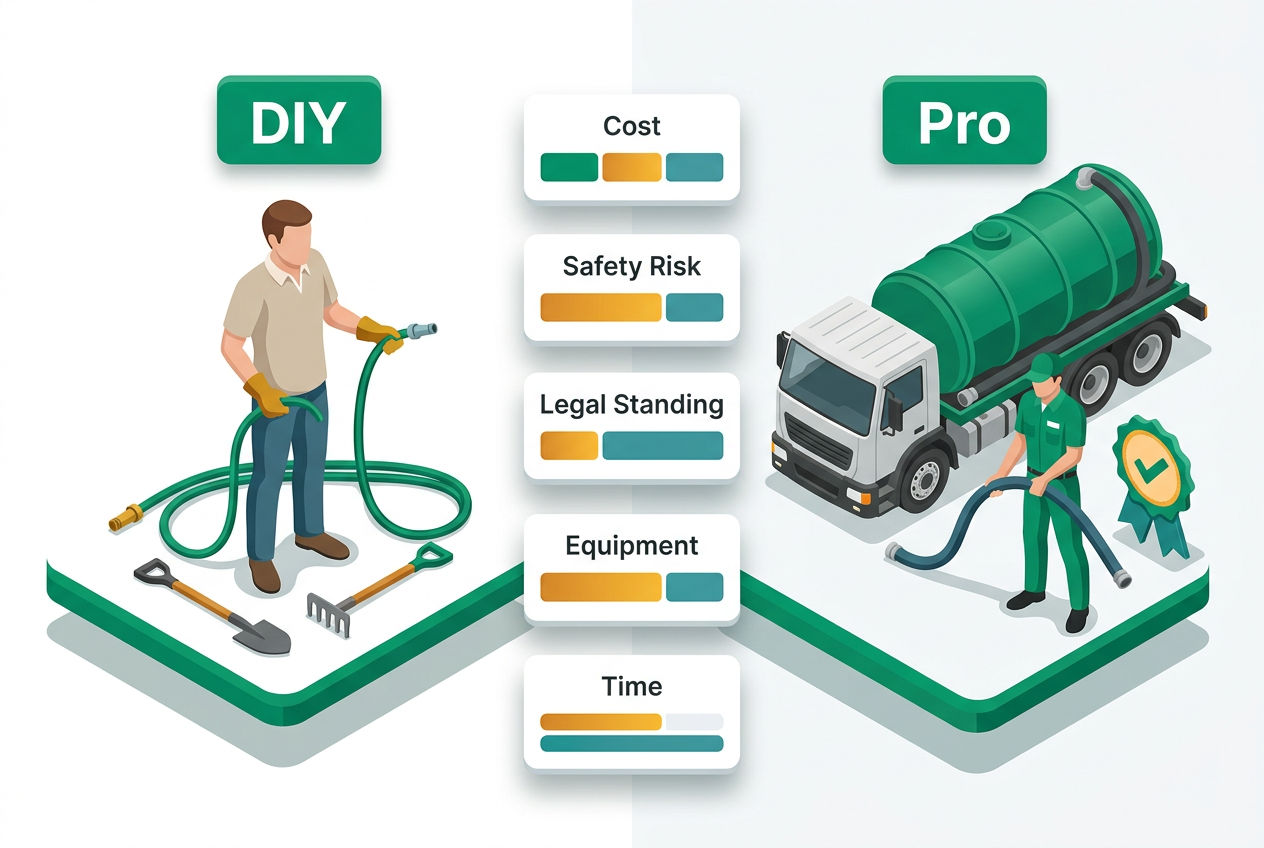
Cost data: EPA SepticSmart program, NAWT national service surveys, contractor estimates 2024–2025.
What Septic Maintenance Can You Do Yourself?
A handful of tasks fall squarely in the homeowner's lane — no special license, no heavy equipment, no permit required.

Bacterial and enzyme treatments. Products like Rid-X or Septifix add beneficial anaerobic bacteria to your tank. They're legitimate supplements that can help maintain a healthy microbial population, especially after heavy antibiotic use or a period of low household occupancy. You can read a full breakdown in our Rid-X review and septic tank bacteria guide.
But — and this matters — research from the University of Arkansas and Penn State Extension has consistently shown that bacterial additives do not eliminate the need for pumping. If your baffle walls are deteriorating or your scum layer has reached 12 inches, no additive reverses that. Treatments cost $10–$50 per application and work best as preventive maintenance on a healthy system.
Cleaning your effluent filter. If your system has an effluent filter — a Polylok PL-122 or Zabel A1800 are common models installed in the outlet baffle — cleaning it once a year is something most homeowners can handle. You pull the filter cartridge from the outlet tee, rinse it with a garden hose back into the tank (not onto the ground), and reinstall it. It's messy. Wear gloves, eye protection, and old clothes you don't mind discarding — raw effluent exposure is a real biohazard risk. If the cartridge shows cracked ribs or deformed mesh when you pull it, replace rather than rinse; a damaged Polylok PL-122 retails for around $40–$60 and is worth replacing immediately rather than letting compromised filtration pass solids toward the leach field. Skipping annual cleaning is one of the leading causes of early leach lateral failure. Honest limitation: if you're on a system older than 15 years with no maintenance history, have a licensed technician do the first cleaning so they can assess baffle condition at the same time.
Installing septic tank risers. If your tank lids are buried 18–24 inches underground, adding polyethylene risers to bring access to grade is a DIY-friendly upgrade. You'll spend $50–$200 in materials depending on tank diameter and riser height. The benefit: every future pump-out becomes faster (less digging = lower service bills), and you can spot problems at the surface. Our septic tank risers guide walks through the process in detail.
Locating your tank. Before any service call, knowing where your tank and distribution box sit saves time and money. Start with your property's as-built drawings (often on file with your county health department). No drawings? A metal probe rod, a soil probe, or tracing the sewer line from your cleanout will usually get you there. See our guide on how to find your septic tank for step-by-step guidance.
Water use management. Not glamorous, but effective. Staggering laundry loads, fixing leaky faucets, and avoiding high-volume water days protect your system's hydraulic balance. According to the EPA's SepticSmart program, reducing daily water use by 25% measurably extends drain field life. That figure comes from the EPA's own field data — it's not a general estimate.
Can You Pump Your Own Septic Tank?
No — homeowners cannot practically pump their own septic tank, and attempting it risks regulatory violations, equipment costs that dwarf any potential savings, and improper waste disposal that carries federal penalties.
The mechanics aren't complicated in theory: you'd need a vacuum pump capable of moving 1,500–4,000 gallons per minute, a sealed tanker truck for transport, and a permitted disposal site. The equipment alone runs $20,000–$80,000. More importantly, septic waste is classified as a regulated material in all 50 states. Licensed pumpers are required to transport it to an approved treatment facility and, in states like Minnesota, file a disposal manifest with the county after every service call.
A worked example on pumping frequency. According to the EPA, professional pumping is recommended every 3–5 years for most households. Here's how that math works in practice: a 1,000-gallon tank serving a 4-person household accumulates roughly 270 gallons of sludge and scum annually under normal use. At that rate, the tank hits the critical one-third threshold — where solids begin migrating toward the outlet — in approximately 3.7 years. Add a garbage disposal and annual accumulation jumps to roughly 340–380 gallons, pushing the safe interval down to every 2 years. A household that flushes non-degradable wipes or uses heavy antibiotics regularly may need to pump as frequently as every 18 months. You can get exact intervals for your household size and tank volume from our guide on how often to pump your septic tank.
The cost? Most homeowners pay $300–$600 nationally for a standard pump-out. Geography matters significantly here. A 1,000-gallon tank in Central Florida typically runs $275–$375. The same service in rural Minnesota costs $350–$500, driven by longer drive times and seasonal access constraints. A full breakdown by state is available at our septic pumping cost guide.
If you're not sure whether it's time, our guide on signs your septic tank needs pumping covers the indicators in detail.
Is DIY Septic Installation or Repair Legal in Your State?
In most U.S. states, any septic work beyond basic homeowner maintenance requires either a permit, a licensed contractor, or both — and the penalties for skipping that step range from fines to voided homeowner's insurance to mandatory system removal at your expense.

Florida requires all septic contractors to hold a Registered Septic Tank Contractor (RSTC) license through the Florida Department of Health, and permits are required for virtually any repair or modification. Massachusetts Title 5 regulations (310 CMR 15.000) are among the strictest in the nation — nearly all system work requires a licensed inspector and approved contractor. California regulations vary dramatically by county, with some counties (Santa Cruz, Marin) requiring professional involvement for any tank access beyond routine maintenance. Texas delegates oversight to county-level Designated Representatives, so rules differ significantly from one county to the next.
If you're researching your specific state, check our state septic regulations hub. For example: Florida septic regulations, Massachusetts septic regulations, or California septic regulations.
Our dedicated article on septic work without a license covers the legal exposure in detail — including scenarios where unpermitted work has voided homeowner's insurance claims and triggered health code violations.
The permit question also matters financially. Drain field repairs typically require a permit in most jurisdictions. Do the work without one, and you're not just risking a fine — you're creating a disclosure problem if you ever sell the home. See septic system permit requirements for jurisdiction-specific guidance.
For homeowners weighing septic system decisions against broader property infrastructure choices, our home inspection cost guide and well water system overview provide useful cross-reference context on how septic status affects property value assessments and inspection outcomes.
What Happens If You Skip Professional Septic Service?

DIY Septic Blueprint
Thinking about building it yourself?
The complete, plain-English plan to size, permit and install your own septic system — designed for homeowners, not contractors. Skip the $15,000–$25,000 quotes and do it right the first time.
Get the DIY Blueprint — $67 →Instant download · 8 modules + 3 bonus guides · 60-day money-back guaranteeSkipping professional septic service doesn't save money — it converts a $300–$600 maintenance expense into a $10,000–$30,000 emergency that arrives without warning, often at the worst possible time.
Here's a real-world scenario drawn from what licensed inspectors report regularly: a homeowner skips pump-outs for eight years, assuming the system is working because drains are flowing. A buyer's inspector orders a full septic inspection at closing. The report comes back with biomat clogging in three leach laterals and a cracked distribution box. The buyer demands a $12,000 credit before closing — or walks. According to NAWT (National Association of Wastewater Technicians) member surveys, deferred maintenance is the single most common cause of system failure at point-of-sale inspections. That $12,000 is 20 years of routine pump-outs.
The failure costs break down this way:
- Sewage cleanup after a system failure: $7,000–$20,000+
- Drain field repair: $3,000–$15,000 depending on extent
- Full system replacement: $10,000–$30,000 for a conventional system; more for mound or alternative systems
- A skipped pump-out: $300–$600
A properly maintained septic system lasts 25–30 years. One that's been neglected — no pumping, no filter cleaning, non-septic-safe products flushed regularly — can fail in under 10 years. The signs of drain field failure include slow drains throughout the house, wet spots or unusually lush grass over the drain field, and sewage odors near the tank or yard. If you're seeing any of these, a professional septic inspection should happen before the weekend is over.
According to the EPA, failing septic systems contribute to an estimated 4 billion gallons of wastewater released into U.S. groundwater daily — pathogens and excess nutrients from failing systems reach groundwater, streams, and coastal areas. That's not just your problem — it's why state regulators enforce licensing requirements as strictly as they do. For buyers evaluating a home with an existing system, our septic inspection guide for home buyers walks through exactly what to request and what the report should contain.
When Should You Hire a Septic Professional? A Scenario-Based Verdict
Not every situation is obvious. Here's how to read the specific circumstances you might actually face.

Scenario 1: You just moved into a home with no maintenance history. Hire a professional immediately for inspection and pumping. You have no baseline. A licensed technician can measure sludge depth, assess baffle condition, and give you a written report that becomes your maintenance starting point. Cost: $400–$900 for inspection plus pump-out. This is non-negotiable.
Scenario 2: Your drains are slow but the system is less than 5 years old with documented pump history. Start with DIY diagnosis — check the effluent filter first (it may just be clogged), verify no non-flushable items have entered the system, and test for hydraulic overload by reducing water use for 48 hours. If drains clear, you likely have a filter or hydraulic issue, not a field problem. If they don't clear within 48 hours, call a professional.
Scenario 3: You're adding a bathroom or increasing household size. This always requires professional involvement — you may need a system capacity evaluation, a permit for system modification, and potentially a new drain field sizing calculation based on your state's perc test requirements. DIY is not an option here regardless of skill level.
Scenario 4: You see wet spots over the drain field after heavy rain. Surface effluent is a public health violation in most states, not just a maintenance issue. Call a licensed contractor the same day. Do not use the system heavily until assessed. This is one of the clearest indicators covered in our signs of drain field failure guide.
Scenario 5: You want to add bacterial treatments between scheduled pump-outs. This is squarely DIY territory. Products like Rid-X are legal, safe, and appropriate homeowner maintenance. Just don't let them substitute for your scheduled pump-out cycle. Review professional septic pumping and cleaning services to understand what a professional pump-out includes that no additive can replicate.
Frequently Asked Questions About DIY Septic vs Professional Service
Can I pump my own septic tank to save money?
No — homeowners cannot legally or practically pump their own septic tank in any U.S. state. Septic waste is a regulated material under federal and state law, and its transport requires a licensed hauler with a vacuum truck and a permitted disposal facility. The equipment costs alone ($20,000–$80,000 for a vacuum truck) make DIY septic tank pumping economically absurd even if regulations permitted it. In Minnesota, licensed pumpers must file a disposal manifest with the county after each service call — a requirement that has no homeowner equivalent. Professional pump-outs run $300–$600 nationally, and for most households, that expense occurs every 3–5 years. Attempting to DIY this task risks regulatory fines, illegal waste disposal charges, and potential groundwater contamination liability. The math simply doesn't support DIY pumping at any cost level. See our septic pumping cost guide for regional pricing and what the service includes.
What septic system maintenance can homeowners do themselves?
Homeowners can safely perform four categories of DIY septic maintenance without a license or permit: bacterial and enzyme additive treatments (products like Rid-X or Septifix, applied monthly or quarterly), annual effluent filter cleaning (pulling and rinsing a Polylok PL-122 or Zabel A1800 cartridge back into the tank), septic tank riser installation (adding polyethylene risers to bring buried lids to grade level for $50–$200 in materials), and tank location using county as-built drawings or a probe rod. These tasks are genuinely homeowner-appropriate and skipping them — particularly the effluent filter cleaning — contributes directly to premature drain field failure. What homeowners should not attempt: pumping, inspections for home sales, any drain field repair or modification, and new system installation. The legal and financial consequences of crossing that line far exceed any service fee savings. Our septic tank bacteria guide covers the additive side in detail.
Is it illegal to do your own septic repair without a license?
In most U.S. states, yes — any septic repair beyond basic homeowner maintenance is illegal without a licensed contractor and the appropriate permit. Florida requires contractors to hold a Registered Septic Tank Contractor (RSTC) license through the Florida Department of Health. Massachusetts Title 5 (310 CMR 15.000) mandates licensed inspectors and approved contractors for nearly all system work. California delegates authority to counties, with some (Marin, Santa Cruz) requiring professional involvement even for routine tank access beyond filter cleaning. Texas works through county-level Designated Representatives with significant local variation. Unpermitted work creates multiple problems beyond fines: it can void homeowner's insurance coverage for related claims, create mandatory disclosure obligations when selling the property, and in some jurisdictions trigger mandatory system removal and reinstallation at the homeowner's cost. Check septic work without a license for a state-by-state breakdown of legal exposure.
How much does professional septic service cost compared to DIY?
For tasks where DIY is legal, the savings are modest: effluent filter cleaning costs $0 in labor vs. $50–$150 professionally; bacterial treatments cost $10–$50 per application with no professional equivalent; riser installation costs $50–$200 in materials vs. $150–$400 installed. For tasks that require a professional, there's no DIY comparison — pumping runs $300–$600, inspections run $100–$900, drain field repairs run $3,000–$15,000, and full system replacement runs $10,000–$30,000. The real cost comparison isn't DIY vs. professional on any single task — it's the cumulative cost of deferred professional maintenance. A household that skips pump-outs for 10 years saves roughly $1,500–$2,000. A system failure triggered by that neglect costs $10,000–$30,000. According to NAWT member surveys, deferred maintenance is the leading cause of premature system failure. Our septic pumping cost guide breaks down regional pricing in detail.
How do I know when to hire a septic professional vs. handle it myself?
Hire a septic professional any time the task involves moving waste, diagnosing system failure, making structural repairs, or triggering a permit requirement. Specifically: hire a professional for your first inspection after buying a home with unknown maintenance history, any time you see wet spots or sewage odors over the drain field, before adding bedrooms or increasing household size, and on a scheduled 3–5 year pump-out cycle regardless of apparent system function. Handle it yourself when the task involves adding bacterial treatments, cleaning an accessible effluent filter on a system with a known maintenance history, installing risers to improve tank access, or locating your tank before a service call. The dividing line is structural intervention vs. supplemental maintenance. A useful rule: if the task requires tools heavier than a garden hose or creates a situation where waste could be released to the surface or groundwater, it requires a licensed contractor. See our professional septic inspection service for what a full assessment covers.
What are the risks of DIY septic installation?
DIY septic installation is illegal in all U.S. states — it is not a permitted homeowner activity under any jurisdiction's regulations. The risks aren't just legal: an improperly installed system can fail within 2–5 years, contaminate drinking water wells (a particular concern on properties where the well and septic are within the required setback distance), and expose the homeowner to liability for neighboring property damage if effluent migrates. New system installation costs $10,000–$30,000 for a conventional system and requires soil testing, a perc test, engineered design in many states, a licensed contractor, and final inspection by the local health authority. In states like Massachusetts (under Title 5) and Florida (through the Department of Health), the inspector and contractor must be separately licensed — meaning even a licensed plumber cannot legally install a septic system without the specific septic contractor credential. Attempting DIY installation voids any possibility of permitted resale and creates an unlawful structure on your property.
Sources & Methodology
- EPA SepticSmart Program — national recommendations on pumping frequency, water use reduction, and system maintenance best practices (epa.gov/septic)
- National Association of Wastewater Technicians (NAWT) — national service cost surveys 2024–2025, member reported data on maintenance-related system failures
- University of Arkansas Cooperative Extension / Penn State Extension — peer-reviewed research on bacterial additive efficacy in residential septic systems
- Florida Department of Health — Registered Septic Tank Contractor (RSTC) licensing requirements and permit mandates
- Massachusetts Title 5 (310 CMR 15.000) — comprehensive septic system regulations including inspection, repair, and contractor licensing requirements
- Minnesota Pollution Control Agency — disposal manifest requirements for licensed septic pumpers
Cost ranges reflect contractor estimates collected 2024–2025 and are intended as planning benchmarks. Individual quotes will vary by tank size, access conditions, local labor rates, and system type. This article cannot substitute for consultation with your local health department or a licensed septic professional in your jurisdiction.
Free download
Not ready for the Blueprint? Start free.
Grab the free DIY Septic Planning Kit — the permit-first checklist, perc-test cheat sheet, and sizing tables that keep your build from getting red-tagged.
Was this article helpful?
Frequently Asked Questions
Recommended Resources
📖 Related Articles
- Rid-X for Septic Tanks: Does It Help or Hurt?
- How Septic Tank Bacteria Work (And Why They Matter)
- How to Install Septic Tank Risers (and Why You Should)
- How Often Should You Pump Your Septic Tank?
- 8 Signs Your Septic Tank Needs to Be Pumped
- Can You Do Your Own Septic Work Without a License?
- Septic System Permit Cost & State Requirements (2026 Guide)
- Signs Your Drain Field Is Failing (And What to Do)
- Septic Inspection for Home Buyers: Complete Checklist
💰 Cost Guides
Find Septic Professionals Near You
Compare licensed, verified septic companies by area — top county markets and cities below, or browse all 50 states.
County markets
Popular cities
