
Quick Answer
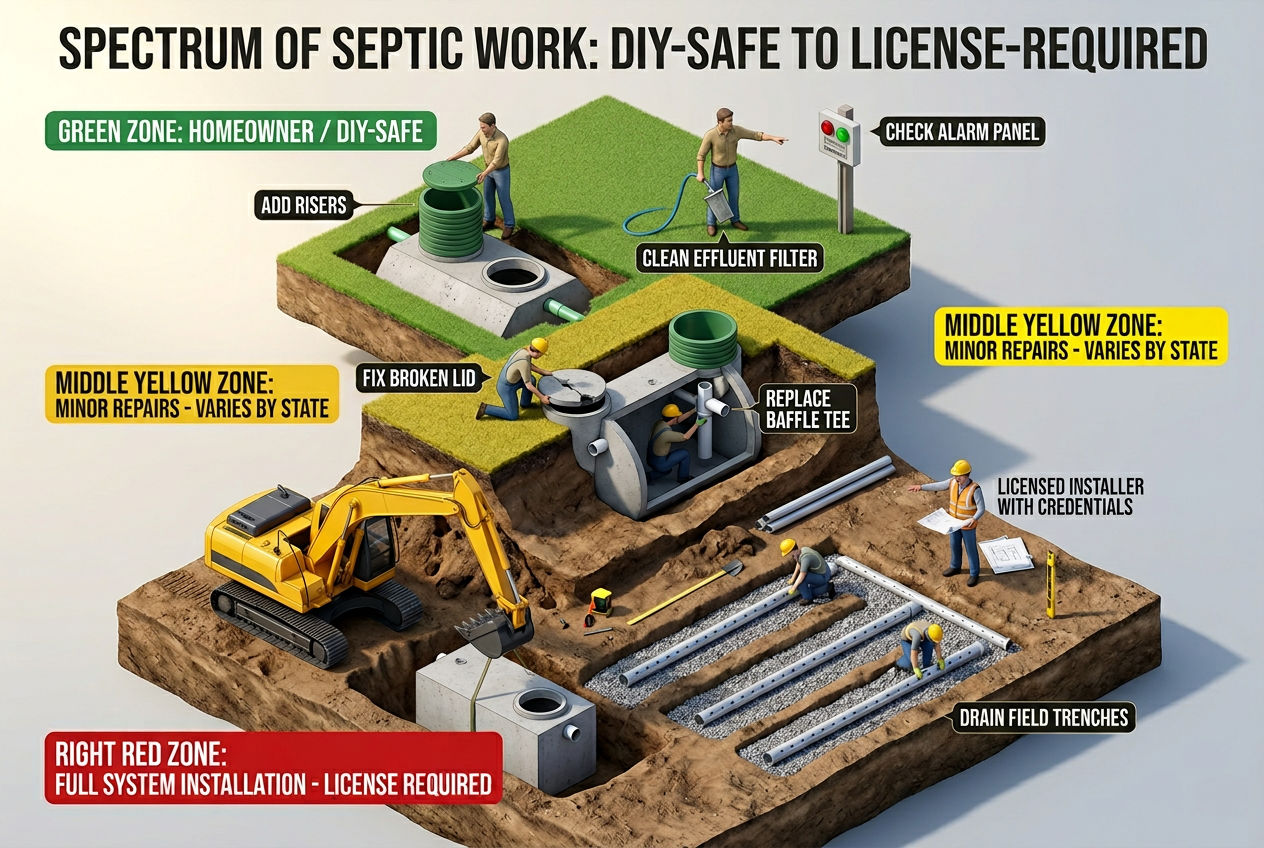
Septic system work without a license sits in a legal gray zone that trips up a lot of homeowners. Some tasks are completely fair game. Others will land you in front of a county health department inspector — or cost you a real estate deal years down the road.
The short answer: what you can legally do yourself depends entirely on the type of work AND the state (sometimes the county) where you live.
💡 Key Takeaways
- Routine maintenance — visual inspections, vegetation management, minor lid repairs — is legal for homeowners in every state.
- About 30 states offer a "homeowner exemption" for septic installation, but nearly all still require permits and a licensed inspector at completion.
- Septic pumping almost always requires a licensed waste hauler — not because of the pumping itself, but because of septage transport and disposal regulations.
- Unpermitted septic work can result in fines of $500–$10,000+, mandatory tearout, and real estate complications you won't see coming until the worst possible moment.
- When in doubt, contact your county health department before you pick up a shovel.
Why Is Septic System Work Regulated at All?
Roughly 20% of U.S. homes — about 60 million people — rely on onsite wastewater treatment systems (OWTS) rather than municipal sewer. The EPA consistently identifies failing septic systems as one of the leading sources of groundwater contamination in the country. That's why regulations exist.
A poorly installed drain field doesn't just smell bad — it can leach nitrates, pathogens, and pharmaceuticals into the soil and eventually into drinking water wells. Your neighbor's well is often only 50–100 feet away. A botched 1,500-gallon concrete tank installation isn't just your problem.
📊 Quick Fact: State environmental health regulations and county health departments are the primary enforcers. The EPA sets the broad framework, but day-to-day permitting and inspections happen at the state and local level.
Can You Do Septic System Work Without a License? A Work-by-Work Breakdown
The most useful way to think about this isn't "licensed vs. unlicensed" — it's by work category. Each category carries different rules. Whether septic system work without a license is legal in your situation depends almost entirely on which of these categories your project falls into.
Routine Maintenance — Almost Always Allowed Without a License
You don't need a license, a permit, or a contractor for routine maintenance tasks. These include:
- Visually inspect your tank lids and risers for cracks or signs of settling
- Monitor water usage and spread laundry loads throughout the week
- Keep heavy vehicles off your drain field
- Maintain the grass cover over the drain field area
- Replace a riser lid or access cover (the plastic or concrete ring at the surface)
- Check and clean an effluent filter like a Polylok PL-122 or Zabel A1800 (a 15-minute job once you locate the outlet baffle)
- Keep records of pump-out dates and service history
- Cut tree roots away from the drain field perimeter
✅ Pro Tip: This category is your territory. No permits, no inspections, no contractor required.
For more on what homeowners can do proactively, the septic tank maintenance guide covers a full checklist.
Minor Repairs — Usually Allowed With Permits
Replacing a cracked baffle, swapping a damaged distribution box outlet, or repairing a riser extension — these are gray-area tasks. In most states, homeowners can do minor repairs on their own property without a septic installer license. But "without a license" doesn't automatically mean "without a permit."
Many county health departments require a repair permit even for relatively small jobs if you're touching anything below the tank lid. Permit fees for minor repairs typically run $75–$300 depending on jurisdiction.
⚠️ Warning: If you're opening the tank or disturbing soil near the drain field, call your county health department first. A five-minute phone call beats a $3,000 remediation order.
Major Repairs and Drain Field Work — Restricted in Most States
Drain field repair is the most commonly attempted DIY job — and the one most likely to get homeowners into trouble. Replacing failed leach laterals, installing new distribution lines, or rehabilitating a clogged biomat layer is considered major work in most states.
The cost of drain field replacement ranges from $2,000 for a localized lateral swap to $15,000+ for a full system replacement — that's exactly the kind of bill that tempts people to grab a shovel and a roll of perforated pipe.
But most states require a permit for any drain field disturbance, and many require the work to be performed or directly supervised by a licensed septic installer. If you live in a state like Florida or California, unlicensed drain field work isn't just illegal — it's also a significant environmental liability if the repair fails.
New Septic System Installation — Owner-Builder Exemptions for Unlicensed Work
Here's where the homeowner exemption comes in. Can you do full septic system work without a license and install your own system from scratch? In about 30 states, yes — with conditions.
The typical owner-builder septic exemption requires:
- Primary residence status — The property must be your primary residence (investment properties and rental units are almost universally excluded)
- Permit acquisition — You must obtain a permit before breaking ground
- Professional design — System design must usually be completed by a licensed engineer or certified designer (you cannot simply sketch a tank-and-pipe layout on graph paper)
- Soil evaluation — A soil evaluation and perc test must be conducted by a certified soil scientist or county evaluator (see our perc test guide for what that process involves)
- Licensed inspection — A licensed inspector must approve the completed installation before the system goes into service
- Sale restrictions — In many states, you cannot sell or rent the property for a set period after self-installing (typically 1–3 years)
💡 Key Takeaway: "Owner-builder" doesn't mean unsupervised. It means you can do the physical labor — digging, placing the tank, laying the distribution laterals — but the design and final sign-off still go through the regulatory system.
For a full walkthrough of the installation process, the septic system installation process guide breaks down each phase.
Septic Pumping — Almost Always Requires a License
Do you need a license to pump a septic tank? If you're asking whether you can rent a pump and empty your own tank, the answer is technically yes in some rural jurisdictions. But the license requirement isn't really about the pumping — it's about what you do with the septage afterward.
Septage (the liquid and solid waste removed from your tank) is classified as regulated waste under most state environmental health regulations. It must be transported by a licensed waste hauler and disposed of at an approved facility. You can't spread it on your backyard or haul it to the dump in a rented trailer.
The result: commercial septic pumping almost universally requires a licensed pumper with a registered vacuum truck and an approved disposal manifest. Average septic pumping costs run $300–$600 for a 1,000-gallon residential tank nationally. That's cheap enough that DIY pumping rarely makes financial sense even where it's legal.
State-by-State Septic System Work Without a License: Permit and Exemption Rules
Regulations vary dramatically across jurisdictions. Here's a snapshot of 10 key states:
| State | Homeowner Exemption? | Permit Required? | Governing Authority | Fine Range |
|---|---|---|---|---|
| Florida | Narrow — primary residence only | Yes — always | FL Dept. of Health | $500–$10,000+ |
| Texas | Yes — primary residence | Yes | TCEQ | $1,000–$25,000 |
| North Carolina | Yes — primary residence | Yes (Improvement + Operation Permit) | NCDEQ | $500–$5,000 |
| Oregon | Limited | Yes | Oregon DEQ | $1,000–$10,000 |
| Georgia | Varies by county | Yes | County Health Depts. | $500–$5,000 |
| Alabama | Yes — primary residence | Yes | AL Dept. of Public Health | $200–$5,000 |
| Washington | Yes — own property | Yes; design by licensed designer | WA Dept. of Health | $1,000–$10,000 |
| New York | Varies by county | Yes | County Health Depts. | $1,000–$15,000 |
| California | Minimal | Yes — even for repairs | County Env. Health | $1,000–$25,000 |
| Pennsylvania | Limited | Yes — via Sewage Enforcement Officer | PA DEP (Act 537) | $500–$10,000 |
Sources: State health department websites, NOWRA regulatory database. Fine ranges reflect per-violation figures; repeat or continuing violations may be assessed daily.
💡 Key Takeaway: Even states with a homeowner exemption still require permits, inspections, and often a licensed designer. "Exemption" means exemption from the contractor licensing requirement — not exemption from the regulatory process entirely.
For a deeper look at permit requirements across jurisdictions, the septic system permit requirements guide is the logical next read.

Septic Business Blueprint
Thinking about starting your own septic business?
The complete, plain-English playbook to start (or buy), license and grow a profitable septic business — the models, the money math, trucks, disposal, insurance, pricing and how to land your first customers.
Get the Blueprint — $297 →Instant access · 12-chapter playbook + 6-piece toolkit · 60-day money-back guaranteeWhat Does the Homeowner Exemption Actually Mean?
The homeowner exemption is one of the most misunderstood concepts in septic regulation. People hear "exemption" and assume it means "no rules." It doesn't.
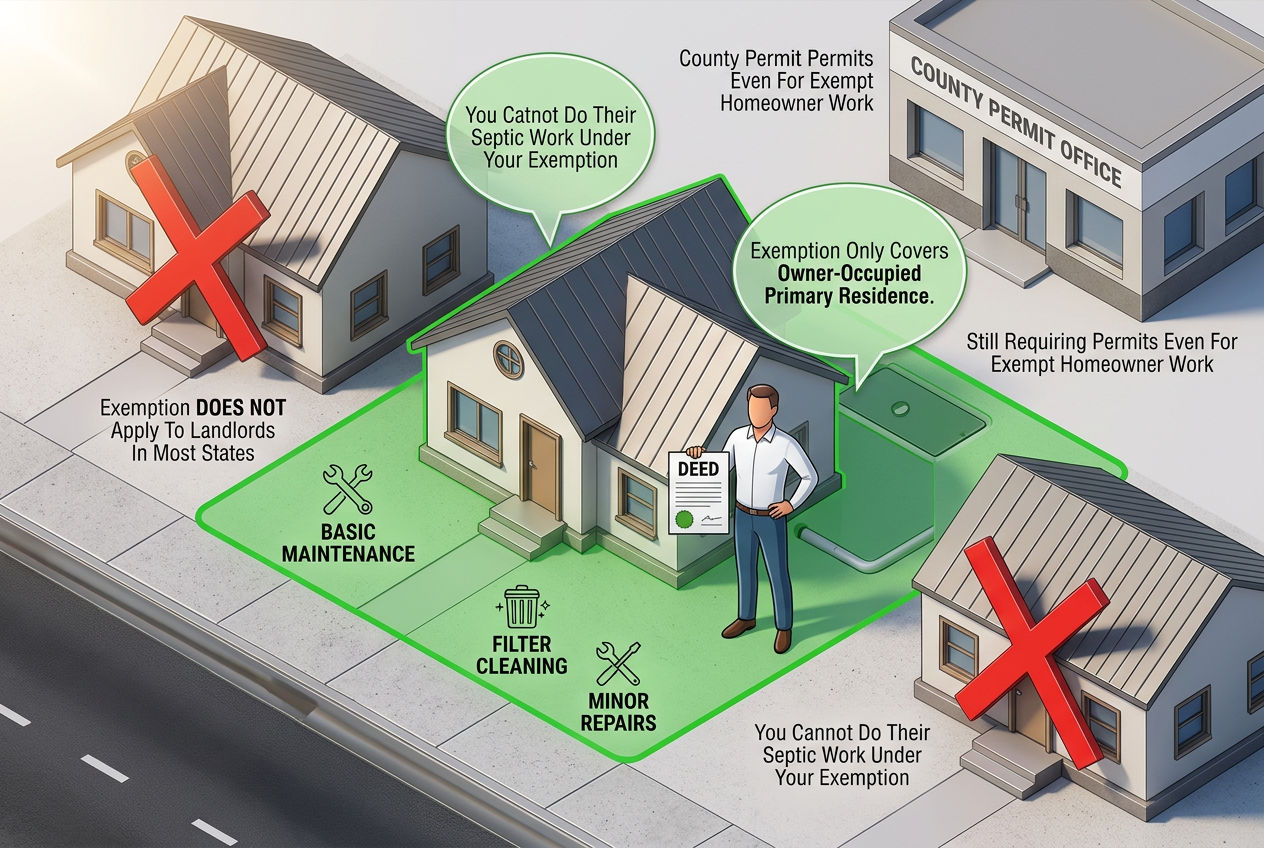
A homeowner exemption typically means you are exempt from needing a contractor's license to perform physical installation work on your own primary residence. It does not mean:
- You can skip the permit
- You can design the system yourself without a licensed engineer or certified designer
- You can skip the final inspection
- You can do the same work on a rental property or investment property
- You are exempt from environmental liability if the system fails
📊 Quick Fact: Think of it like the owner-builder exemption for residential construction. In many states, you can build your own house without a general contractor's license — but you still need building permits, electrical inspections, and a certificate of occupancy. The septic exemption works the same way.
The Three Things the Exemption Never Covers
Regardless of which state you're in, the homeowner exemption almost never covers:
- Septage disposal — You cannot haul or dispose of septage yourself. Period.
- System design in regulated soils — Mound systems, drip irrigation systems, and other alternative systems in challenging soil conditions almost always require a licensed engineer even where the standard exemption applies.
- Commercial, rental, or investment properties — The exemption is tied to owner-occupancy of a primary residence. The moment the property is a rental or you're not living there, you need a licensed contractor.
And if you're thinking about doing septic work for other people rather than your own home, the homeowner exemption stops mattering entirely — that's a business, and it requires a contractor license, insurance, and a hauling permit in every state. If that's the direction you're headed, start with how to start a septic tank business.
How to Find Out the Rules in Your Specific State and County
Regulations for septic system work without a license are not just state-level — county health departments frequently impose requirements that are stricter than the state baseline. Here's how to get accurate information:
Step 1: Start with your state environmental health agency
Search "[your state] onsite wastewater treatment regulations homeowner exemption" — most state DEP, DEQ, or Department of Health websites publish their OWTS regulations online. Look for the section titled "installer licensing" or "owner-builder."
Step 2: Call your county health department
Ask specifically: "I'm the homeowner at [address]. I want to [describe the work]. Do I need a permit? Do I need a licensed contractor, or is there a homeowner exemption? What inspections are required?"
✅ Pro Tip: Write down the name of the person you spoke with and the date. If they tell you no permit is required, that documentation protects you.
Step 3: Check whether your property has any deed restrictions or HOA covenants
Some HOA documents require licensed contractor work for all mechanical systems regardless of what state law allows.
Related: illegal septic system risks — worth reading if this applies to your situation.
Step 4: Pull your existing septic permit
Your county health department has the original permit and as-built drawings for your system on file (in most cases). Reviewing this before any repair work tells you the tank size, system type, and drain field layout — all of which affect what repairs are appropriate.
The Hidden Risk: Unpermitted Septic Work and Real Estate Transactions
Here's the scenario nobody thinks about until it's too late:
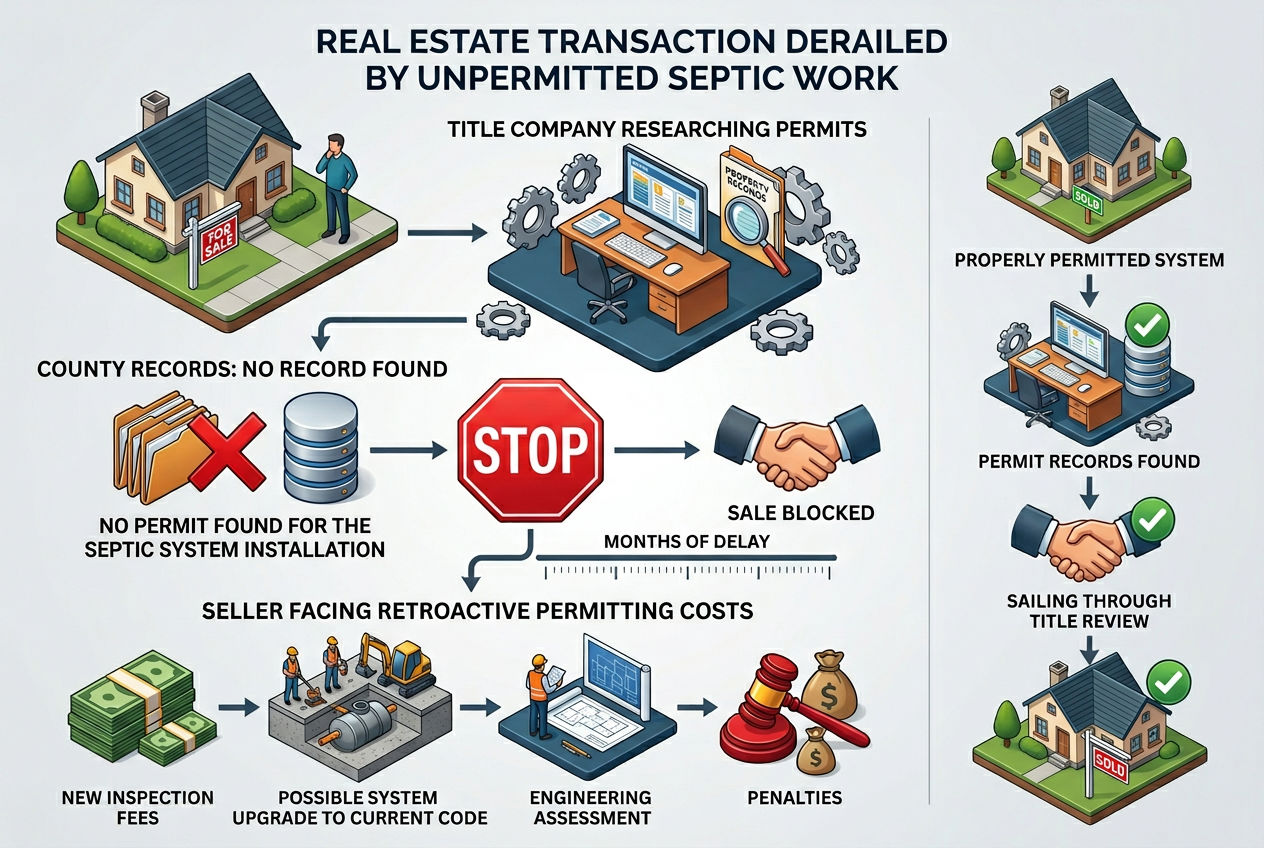
You replace a failed drain field lateral yourself. No permit, no inspection — it works fine. Five years later, you sell the house. The buyer's inspector flags the drain field area. During due diligence, the county pulls the permit history and discovers unpermitted work. Now you're facing:
- A mandatory inspection by the county
- Possible requirement to excavate and expose the repair for inspection
- Potential fine for unpermitted work (retroactive in many jurisdictions)
- A real estate deal in jeopardy or a price renegotiation
⚠️ Warning: This is not hypothetical. It's one of the most common septic-related issues that surfaces during property sales, and it's entirely avoidable by pulling a permit when required.
Some states go further. In Florida, for example, a septic system must be inspected and permitted before a property can be legally transferred in certain counties. Unpermitted work can literally block a sale.
The financial
Sources & Methodology
-
U.S. Environmental Protection Agency — Federal guidance on septic system permitting requirements and the role of state and county regulatory authority.
-
National Onsite Wastewater Recycling Association (NOWRA) — Industry standards for professional licensing, certification, and the scope of work requiring licensed contractors.
-
National Association of Wastewater Technicians (NAWT) — Professional certification programs and guidance on which septic tasks require licensed technicians versus homeowner-permissible work.
-
Florida Department of Health — Registered Septic Tank Contractor (RSTC) licensing requirements and homeowner exemption provisions, referenced as a representative state example.
-
National Environmental Services Center (NESC) — State-by-state database of septic system licensing and permitting requirements for contractors and homeowners.
Fine and penalty data reflects 2025–2026 ranges compiled from state health department enforcement records across SepticTankHub.com's coverage area.
Need help with your septic system? Find trusted septic professionals near you to get free quotes. Browse local septic companies in Georgia or North Carolina.
Was this article helpful?
Frequently Asked Questions
Recommended Resources
📖 Related Articles
💰 Cost Guides
🔧 Services
Find Septic Professionals Near You
Compare licensed, verified septic companies by area — top county markets and cities below, or browse all 50 states.
County markets
Popular cities
