
Quick Answer
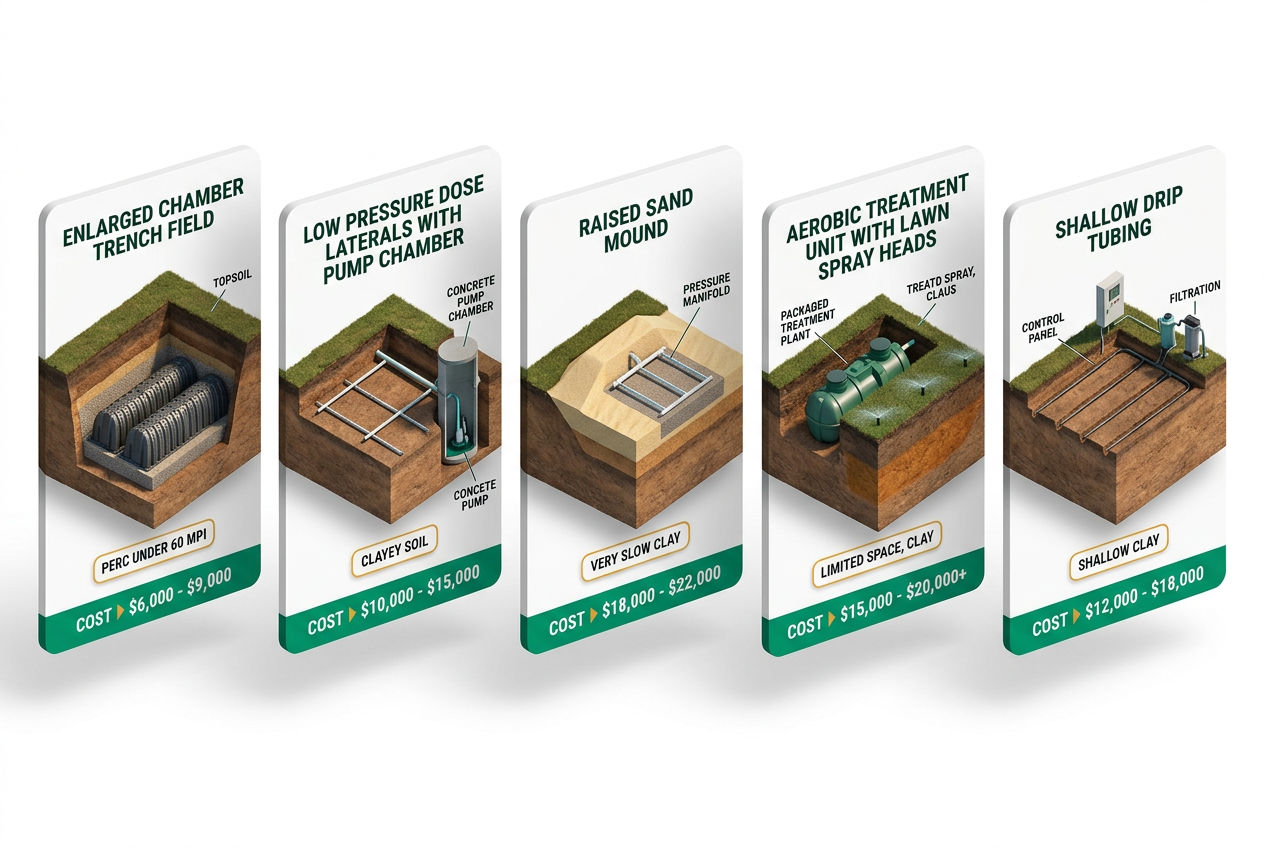
A septic system for clay soil is usually an enlarged or pressure-dosed drain field, a mound, or an aerobic unit with spray or drip dispersal. Which one passes depends on your perc rate and soil depth. Clay slower than about 60 minutes per inch usually rules out a standard gravity trench.
Key Takeaways
- Clay drains slowly, so a clay drain field often needs 2-3 times the area of one in sandy loam.
- Many states cap conventional trenches at about 60 minutes per inch; slower soil needs an alternative design.
- Mounds, low pressure dosing, aerobic units and drip dispersal are the systems that pass most often.
- Expect roughly $8,000-$25,000 for an alternative system, versus $3,000-$10,000 for a conventional one.
- Never dig trenches in wet clay. Smeared walls can seal a new field before it starts.
Picture this: you've closed on five acres outside Waco, Texas. The soil is black, sticky and cracks like a dry riverbed every August. Then the site evaluator tells you a standard drain field won't work. That's not the end of the build. It just means you need a design made for clay, and this guide shows you which ones regulators actually approve.
Why Is Clay Soil a Problem for a Septic System?
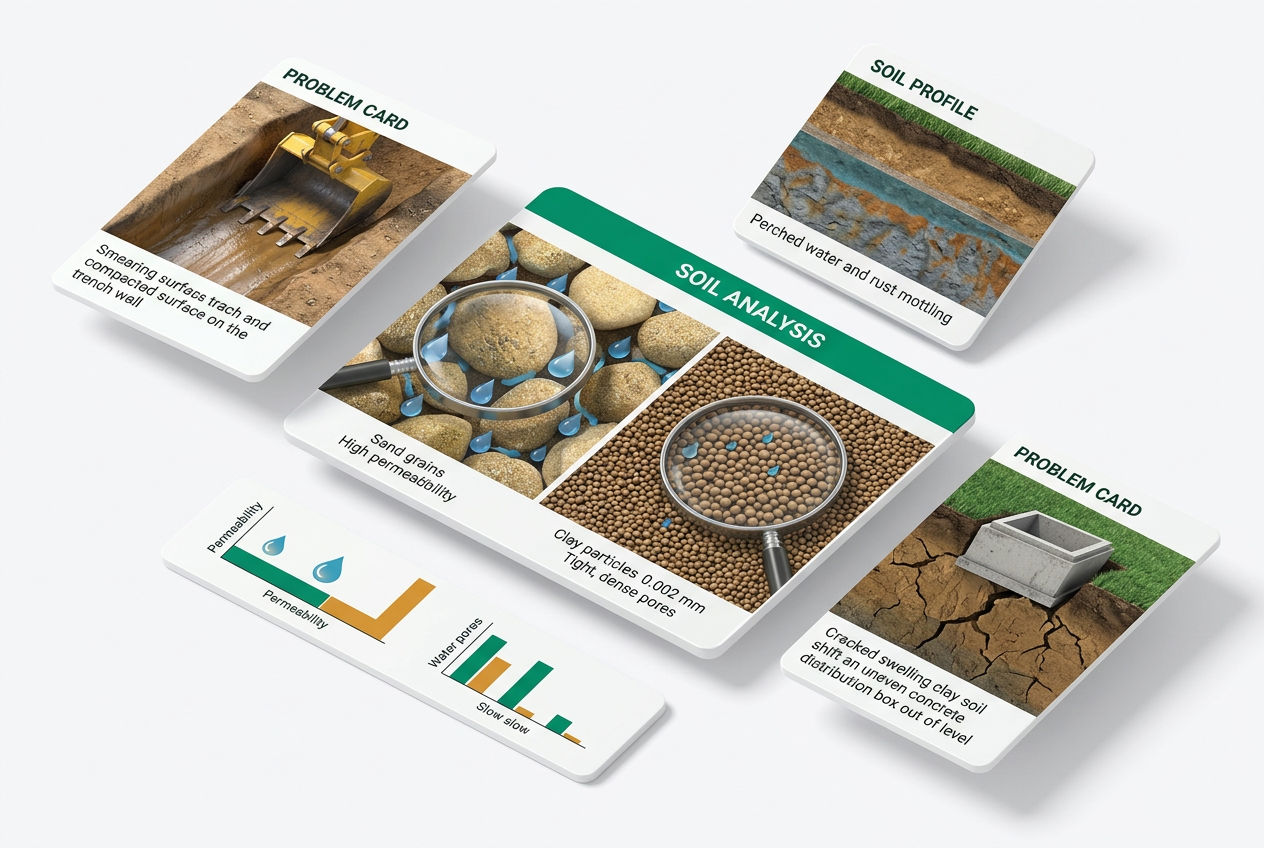
Clay is a problem because its particles are tiny, under 0.002 millimeters across by the USDA definition, so the pores between them are tiny too. Water moves through clay hundreds of times slower than through sand. A drain field in clay can't absorb a household's daily flow unless it's much larger, shallower or fed in small doses. Soil rate is the first number in any septic system design, so clay changes everything that follows.
Slow drainage is only the first issue. Clay causes three more headaches that a generic article won't mention:
- Smearing. A backhoe bucket dragged through wet clay polishes the trench walls into a slick, nearly waterproof surface. Your field can fail in its first year from that alone.
- Perched water. Clay layers trap rain above them. Your soil evaluator looks for gray and rust-colored mottling (redoximorphic features) that marks how high water sits in a wet spring.
- Shrink-swell. Smectite clays, like the Houston Black series in the Texas Blackland Prairie, swell when wet and crack when dry. That movement can shift pipes and distribution boxes out of level.
Not all clay is equal. The red kaolinite clays of the Georgia and Carolina Piedmont often have good structure and can perc acceptably. Dense glacial till in Ohio or Indiana usually can't.
How Do a Perc Test and Soil Evaluation Decide Your Options?
Your perc test and soil evaluation set your system type before anyone draws a plan. The perc rate, measured in minutes per inch (MPI), tells the county how fast effluent soaks in. The soil profile, read in a backhoe test pit, shows how deep usable soil goes before you hit dense clay, rock or seasonal water.
Here's how those numbers usually sort out. Rules vary by state, so treat these as typical thresholds, not your county's code:
- 1-60 MPI: A conventional trench or chamber field is often allowed, though clay loams near the slow end need a big footprint.
- 60-120 MPI: Most states require an alternative design, such as a mound or pressure-dosed field.
- Slower than 120 MPI: Many jurisdictions call the soil unsuitable for soil absorption. You're looking at an aerobic unit with spray, drip dispersal, or a treatment unit that discharges under a permit.
Several states don't use a classic perc test at all. North Carolina and Ohio lean on soil texture, structure and depth to limiting layers. Texas sorts soils into classes, and its Class IV clays can't take a standard absorptive drain field. Our perc test guide walks through how the hole test works and how to prepare your site for it.
A free head start: look up your parcel in the USDA NRCS Web Soil Survey. Its "Septic Tank Absorption Fields" rating labels soils as not limited, somewhat limited or very limited. Most heavy clays show up as very limited.
What Is the Best Septic System for Clay Soil?
The best septic system for clay soil is the simplest design your soil report allows. For clay loam that percs under 60 MPI, that's an enlarged, shallow trench or chamber field. For slower clay, a mound or low pressure dose system wins. For the heaviest clays, an aerobic unit with spray or drip dispersal is often the only approvable option.
| System | Fits clay when | Typical cost | Upkeep |
|---|---|---|---|
| Enlarged trench/chamber | Perc under ~60 MPI | $6,000-$15,000 | Pump every 3-5 yrs |
| Low pressure dose | Shallow, slow soil | $8,000-$18,000 | Pump, float checks |
| Mound | 1-2 ft usable soil | $10,000-$25,000+ | Pump, dosing pump |
| Aerobic + spray | Very slow clay | $10,000-$20,000 | Contract $200-$600/yr |
| Drip dispersal | Slow, shallow, sloped | $12,000-$25,000+ | Filter flush, service |
Source: National installed-cost ranges based on published installer pricing and state program guidance, plus EPA septic system guidance on alternative designs. Site work, permits and local labor rates move these numbers.
Enlarged Conventional or Chamber Field
If your clay loam percs in an allowed range, the county simply makes you build more trench. Gravelless chambers, such as Infiltrator's Quick4 line, keep the trench open and are easier to place shallow. Honest limitation: chambers don't make clay drain faster. Some states grant a size reduction for chambers, but many tighten or drop that credit in slow soils.
Low Pressure Dose (LPD) System
An LPD system uses a pump chamber and float switches to push effluent through small perforated pipes several times a day. Small, even doses let shallow clay absorb water between rests instead of ponding at one end of a trench. It's often the cheapest step up from a gravity system.
Mound System
A mound septic system builds a bed of specified sand above the native ground. Effluent gets treated in the sand, then spreads across a wide base into the clay below. The design came out of University of Wisconsin research in the 1970s for exactly this kind of slowly permeable soil. On clay, mounds run long and narrow along the contour, and most states still need 12-24 inches of native soil above a limiting layer.
Aerobic Treatment Unit With Spray or Drip
An aerobic treatment unit (ATU) injects air into the tank with a compressor, producing much cleaner effluent. That cleaner water can go to spray heads on the lawn or a drip field. Look for NSF/ANSI Standard 40 certification. Read the aerobic septic system cost breakdown before you commit, because the compressor and service contract are permanent costs.
Drip Dispersal
Drip systems bury small tubing 6-12 inches deep and meter tiny doses many times a day. That's the shallow, biologically active topsoil, which handles clay best. Drip works on slopes and odd-shaped lots too. Most states require pretreatment ahead of it, so it's rarely the cheap option.
Sand Filter
A sand filter septic system polishes effluent before it reaches the soil, which can shrink the field you need. Packed-bed units like Orenco's AdvanTex textile filter do the same job in a smaller footprint. It's a good fit when clay and a tight lot combine.
How Should a Leach Field Be Designed for Clay Soil?
Leach field design for clay soil follows four rules: go big, go shallow, dose instead of flood, and build only when the soil is dry. Designers size the field off a low loading rate, often 0.2-0.4 gallons per day per square foot for clay loams, compared with roughly 0.8 or more for sand.
Here's a worked example. A 3-bedroom house at a common design flow of 150 gallons per bedroom needs 450 gallons per day of capacity.
- Sandy loam at 0.8 gpd/sq ft: 450 ÷ 0.8 = about 560 sq ft of trench bottom. In 3-foot-wide trenches, that's roughly 190 linear feet.
- Clay loam at 0.3 gpd/sq ft: 450 ÷ 0.3 = 1,500 sq ft. That's about 500 linear feet of 3-foot trench.
Same house, more than 2.5 times the field. And that's before the reserve area many counties require. You can see how sizing a septic system for a 3-bedroom house changes once soil enters the math.
Other clay-specific design moves:
- Shallow trenches. Upper soil horizons usually have more structure and root channels. Many clay designs place trenches 12-18 inches deep.
- Narrow trenches, more of them. Sidewall area matters in clay, so designers favor more narrow runs over fewer wide ones.
- Scarified walls. Installers rake trench walls and bottoms to break up any smear.
- Dry-weather digging only. Roll a handful of soil between your palms. If it forms a wire about 1/8 inch thick without crumbling, it's too wet to dig.
For layouts, spacing and distribution, see our full leach field design article.
What Doesn't Work in Clay Soil?

DIY Septic Blueprint
Thinking about building it yourself?
The complete, plain-English plan to size, permit and install your own septic system — designed for homeowners, not contractors. Skip the $15,000–$25,000 quotes and do it right the first time.
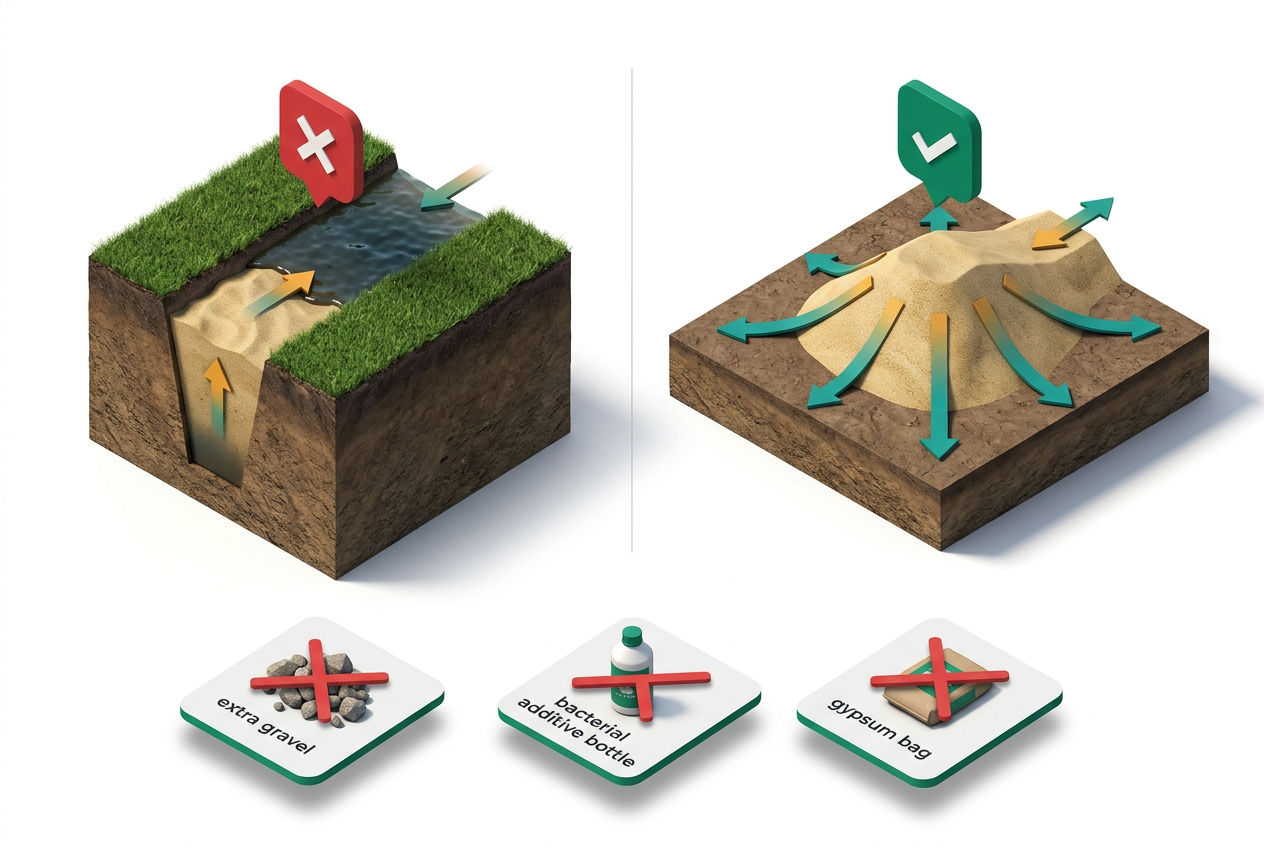
Get the DIY Blueprint — $67 →Instant download · 8 modules + 3 bonus guides · 60-day money-back guaranteeThree common shortcuts fail in clay: swapping native clay for sand inside the trench, adding more gravel, and pouring in additives. None of them change how fast water leaves the trench and enters the surrounding clay, which is the real bottleneck. Regulators reject them, and they tend to fail early.
The sand swap is the classic trap. A sand-filled trench cut into clay acts like a bathtub. It fills, stays full, and pushes effluent up to the surface. A mound works differently because the sand sits above grade and spreads water across a wide base.
Bacterial additives don't help either. They can't open clay pores, and the EPA doesn't list them as a substitute for proper design or pumping. Gypsum gets suggested online for clay too, but it's not an approved septic fix in any state code we're aware of.
How Much Does a Septic System for Clay Soil Cost?
A septic system for clay soil typically costs $6,000-$15,000 when an enlarged conventional field is allowed, and $10,000-$25,000 or more for a mound, aerobic or drip system. Add about $500-$3,000 for the soil evaluation and engineered design that most alternative systems require.
Regional pricing swings hard. A Central Texas aerobic system with spray heads often lands at $10,000-$15,000 because installers there build them constantly. A mound in New England or the upper Midwest can pass $25,000 once you add trucked-in sand, insulation for frost and engineering. For a full price picture by system type, see our septic installation cost guide.
Don't skip ongoing costs. Texas requires a maintenance contract on residential aerobic units, with inspections every four months. Dosed systems add pump replacements, often every 7-15 years, plus a little electricity.
What Should You Know About Clay Soil in Your Region?
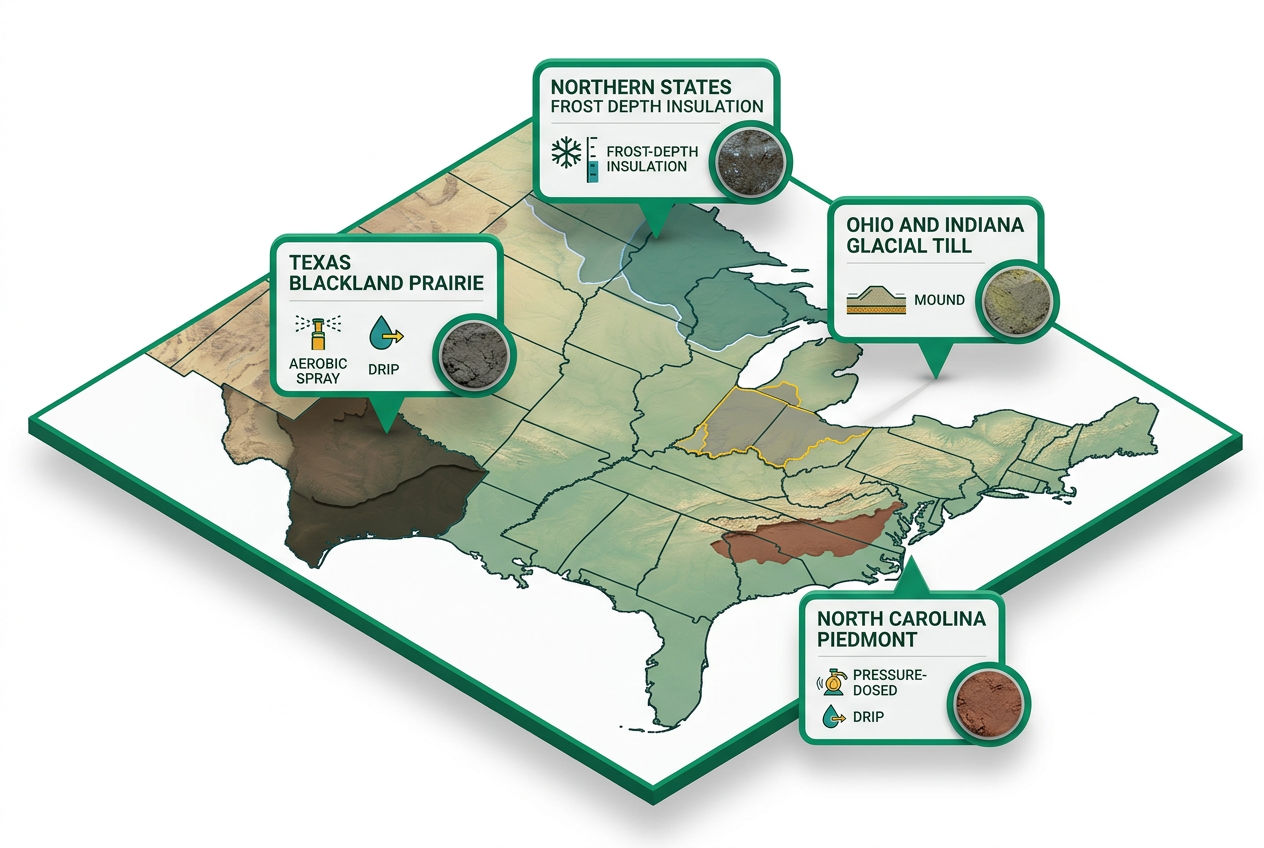
Clay behaves differently by region, and so do the rules. Texas, the Southeast Piedmont, the Midwest till belt and the Alabama-Mississippi Black Belt each have their own common soil types and preferred system designs. Your county health department decides which designs it will permit, so check local rules first.
- Texas: TCEQ sets the rules under Chapter 285, and local authorized agents, often counties, issue permits. Blackland Prairie clays push most rural builds to aerobic spray or drip.
- North Carolina: State rules assign clay soils some of the lowest long-term acceptance rates in the code, roughly 0.1-0.4 gallons per day per square foot. Pressure-dosed and drip systems are common in the Piedmont.
- Ohio and Indiana: Dense glacial till and seasonal saturation make mounds and engineered systems routine. The Ohio Department of Health's sewage treatment system rules govern design.
- Northern states: Frost depth shapes mound and drip design. Shallow lines may need insulation or deeper cover.
Season matters too. Some counties only accept soil testing in the wet months, so the evaluator sees the water table at its worst. Spring rain also makes clay too wet to dig, so many installers book clay jobs for late summer and fall.
How Do You Keep a Clay Soil Septic System Working?
A clay soil septic system lasts when you protect its limited absorption capacity. Pump the tank every 3-5 years, as the EPA recommends for most households. Spread out water use, keep roof runoff away from the field, and service any pump or aerator on schedule.
Clay forgives water surges less than sand does. Running six loads of laundry on Saturday can flood a clay field that would handle the same water spread over a week. Fix running toilets fast, since one leaking flapper can add 200 gallons a day. Keep vehicles off the field, because clay compacts easily and stays compacted.
Watch for soggy spots, lush green stripes or slow drains after rain. Those are early signs your drain field is failing, and clay fields give you less margin than most.
What Are Your Next Steps?
Start with the soil, not the system. Order a soil evaluation or perc test, get the results in writing, then let a designer or installer match a system to those numbers. If your site fails, you still have options, and a local pro knows which designs your county approves quickly.
If your test came back slow, read our guide to failed perc test options before you walk away from the lot. Thinking about building it yourself? Our DIY septic system guide explains where owner-builders can save money, and why most clay sites still need a licensed designer. When you're ready for quotes, our septic installation service page explains what to expect, or you can find a septic installer near you in our directory.
Sources & Methodology
- U.S. Environmental Protection Agency (EPA), Septic Systems program — guidance on system types, alternative designs and pumping intervals (epa.gov/septic).
- USDA Natural Resources Conservation Service, Web Soil Survey — soil series data and "Septic Tank Absorption Fields" limitation ratings; also the USDA clay particle-size definition. usda.gov
- Texas Commission on Environmental Quality (TCEQ), Chapter 285 OSSF rules — soil classes, Class IV limits and aerobic maintenance contract rules. tceq.texas.gov
- North Carolina Department of Health and Human Services, on-site wastewater rules — soil groups and long-term acceptance rates.
- University of Wisconsin mound research and NSF/ANSI Standard 40 — mound design origins and aerobic unit certification.
Cost ranges are national estimates from published installer pricing and state program documents. Loading rates and perc thresholds are typical values; your state and county codes govern your actual design.
Primary sources to read: USDA NRCS Web Soil Survey · EPA: types of septic systems · Texas TCEQ: OSSF permits · University of Minnesota Onsite Sewage Treatment Program
More Septic Design & Install Guides
- Septic system design: the complete guide
- Mound system design
- How to do a perc test
- Septic systems on a slope
- Leach field design and sizing
- What septic system design costs
- Can you install your own septic system? Rules by state
Frequently Asked Questions
What is the best septic system for clay soil?
The best septic system for clay soil is the simplest design your soil report allows. If your clay loam percs faster than about 60 minutes per inch, an enlarged shallow trench or chamber field is usually cheapest at roughly $6,000-$15,000. Slower clay typically calls for a low pressure dose system or a mound, at roughly $8,000-$25,000. The heaviest clays, like the Texas Blackland Prairie's Class IV soils, often need an aerobic treatment unit with spray or drip dispersal. No single system is best everywhere, because each state sets its own perc limits and approved technologies. Get a soil evaluation first, then ask your designer which options your county permits. Picking the system before the soil test is how homeowners end up paying for a redesign.
How does leach field design for clay soil differ from sandy soil?
Leach field design for clay soil uses a much lower loading rate, so the field gets bigger. Clay loams are often sized at 0.2-0.4 gallons per day per square foot, versus 0.8 or more for sand. For a 3-bedroom home with a 450-gallon daily design flow, that can mean 1,500 square feet of trench bottom in clay compared with about 560 in sandy loam. Clay designs also go shallower, often 12-18 inches deep, where the soil has more structure. Designers favor narrow trenches, pressure dosing to spread flow evenly, and scarified trench walls. Most important, installers dig only when the clay is dry. Wet clay smears under the bucket and can seal the trench before it ever carries effluent.
What are the alternative septic systems for clay soil if I fail a perc test?
Alternative septic systems for clay soil include mounds, low pressure dose fields, aerobic treatment units with spray or drip, drip dispersal behind a pretreatment unit, and sand or textile filters. A failed perc test usually means a conventional gravity trench is off the table, not that the lot is unbuildable. Which alternative fits depends on how slow the clay is, how deep usable soil goes, and how high water rises in a wet season. A mound generally needs 12-24 inches of native soil above a limiting layer. Aerobic spray and drip can work where almost nothing else does. Expect $10,000-$25,000 or more, plus $500-$3,000 for engineering. Ask your county health department for its list of approved alternative technologies before choosing.
Can you add sand to clay soil to make a septic drain field work?
No. Filling a trench with sand inside native clay doesn't fix the drain field, and regulators don't accept it. Water still has to leave the sand and enter the surrounding clay, which is the slow step. The sand-filled trench behaves like a bathtub: it fills during wet weather and pushes effluent toward the surface. A mound septic system is different because the sand sits above the original ground and spreads treated effluent across a wide base, which lowers the load on each square foot of clay. Gravel upgrades, gypsum and bacterial additives also don't change clay permeability. If your soil is too slow for a standard field, the fix is an approved design such as a mound, pressure dosing or aerobic treatment, not a soil amendment.
How much does a septic system for clay soil cost?
A septic system for clay soil usually costs $6,000-$15,000 when your county allows an enlarged conventional or chamber field. Alternative systems cost more: low pressure dosing runs about $8,000-$18,000, aerobic units with spray $10,000-$20,000, and mounds or drip systems $10,000-$25,000 or more. Add $500-$3,000 for soil evaluation and engineered design. Prices vary by region. Central Texas aerobic installs tend to land at the low end because they're common there, while upper Midwest and New England mounds climb with trucked-in sand and frost protection. Budget for ongoing costs too. Aerobic units usually carry service contracts of about $200-$600 a year, and dosing pumps typically need replacement every 7-15 years. Get at least three written quotes based on the same soil report.
Free download
Not ready for the Blueprint? Start free.
Grab the free DIY Septic Planning Kit — the permit-first checklist, perc-test cheat sheet, and sizing tables that keep your build from getting red-tagged.
Was this article helpful?
Frequently Asked Questions
Recommended Resources
📖 Related Articles
- Perc Test (Percolation Test): What It Is & How It Works
- Mound Septic System: $10K–$25K Cost & How It Works (2026)
- Aerobic Septic System (ATU) Cost: $10K–$20K Install (2026)
- Sand Filter Septic Systems: How They Work & What They Cost
- Septic System for a 3-Bedroom House: Tank Size, Drain Field & Cost
- Leach Field Design: How to Size and Lay Out a Drain Field (Step by Step)
- Signs Your Drain Field Is Failing (And What to Do)
- Land Failed the Perc Test? Here Are Your Options
- DIY Septic System: How to Build Your Own (Step-by-Step)
🔧 Services
Find Septic Professionals Near You
Compare licensed, verified septic companies by area — top county markets and cities below, or browse all 50 states.
County markets
Popular cities
