
Quick Answer
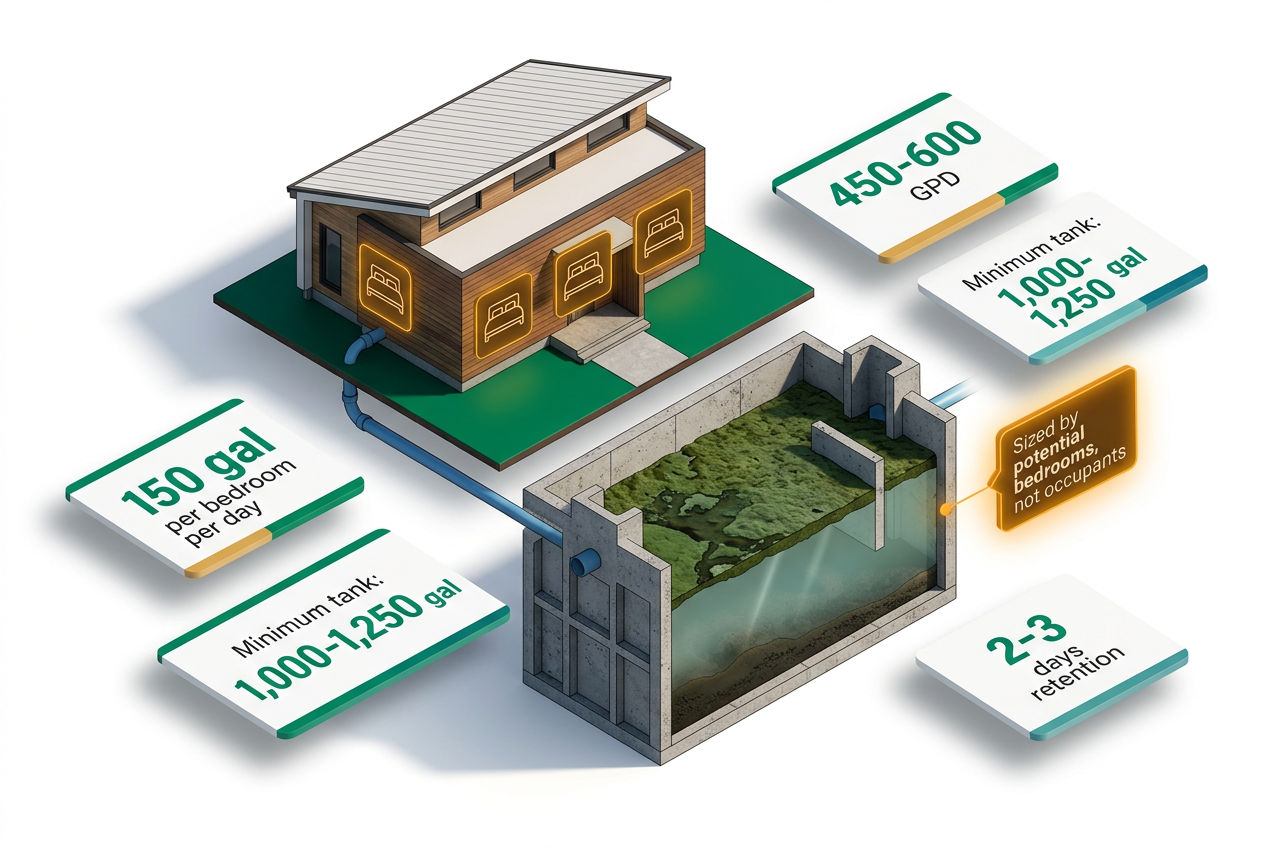
A septic system for a 3-bedroom house requires a minimum 1,000-gallon tank in most U.S. states, a drain field of 450–900 square feet based on your soil's percolation rate, and a total installed budget of $7,000–$15,000 for a conventional gravity system — rising to $25,000 or more if your lot needs an alternative design.
Key Takeaways
- Most states require a 1,000–1,250-gallon septic tank for a 3-bedroom home
- Your drain field (also called a leach field or absorption field) will typically cover 450–900 square feet — soil type determines where you land in that range
- A conventional gravity system costs $7,000–$15,000 installed; mound and aerobic systems run $15,000–$25,000+
- Codes size tanks by number of bedrooms, not bathrooms or current occupancy
- You'll need a soil percolation test before any permit is issued — budget $250–$1,000 for this step
What Size Septic Tank Do You Need for a 3-Bedroom House?
For a 3-bedroom house, the minimum septic tank capacity is 1,000 gallons under EPA guidelines and most state health department codes. Some jurisdictions — including Massachusetts, New Jersey, and Maryland — require a 1,250-gallon tank as their standard minimum. A handful of rural counties in older code cycles still permit 900-gallon tanks, but that's increasingly rare. If a fourth bedroom is likely now or later, compare the septic tank size for a 4-bedroom house.
Here's the logic behind that number: regulators assume roughly 150 gallons of daily wastewater flow per bedroom, putting a 3-bedroom home at 450–600 gallons per day. A 1,000-gallon tank provides two to three days of retention time — enough for solids to settle and anaerobic bacteria to break down waste before the liquid effluent moves to your drain field.
One critical point most homeowners miss: your county health department sizes your system based on the number of potential bedrooms on your property, not how many people actually live there. That finished bonus room you're calling a home office? It might count as a fourth bedroom in your permit. Always confirm with your local authority before finalizing any design.
For context across household sizes, here's how tank sizing typically scales:
| Bedrooms | Min. Tank Size (gal) | Est. Daily Flow (gpd) | Typical Cost Installed |
|---|---|---|---|
| 1–2 | 750–1,000 | 300–450 | $5,000–$12,000 |
| 3 | 1,000–1,250 | 450–600 | $7,000–$15,000 |
| 4 | 1,250–1,500 | 600–750 | $10,000–$18,000 |
| 5 | 1,500+ | 750+ | $12,000–$22,000+ |
Source: EPA Septic Systems Overview; state health department sizing tables (MN, MA, FL, TX)
For a deeper look at how tank size is calculated across the full size spectrum, the septic tank size chart breaks down capacity requirements by household size and state.
Does a 1,000-Gallon Tank Work, or Should You Upsize?
Technically, a 1,000-gallon concrete tank meets minimum code for a 3-bedroom home in most states. But if you have a garbage disposal, plan to add a bedroom later, or regularly host extended family, consider installing a 1,250-gallon tank from the start. The price difference between a 1,000-gallon and 1,250-gallon concrete tank is typically $200–$500. That's cheap insurance against needing to excavate and replace a undersized tank in 10 years.
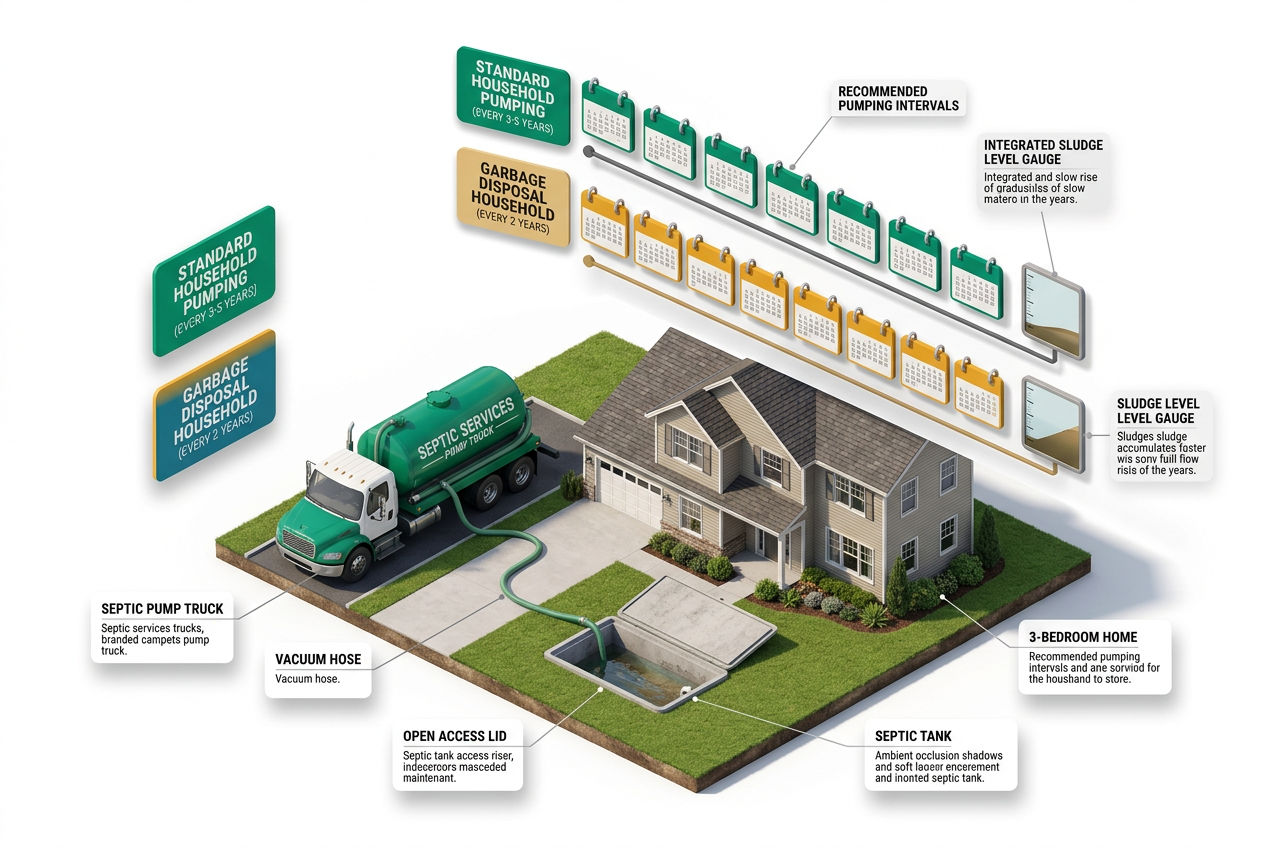
Adding a garbage disposal matters more than people realize. Penn State Extension research found that garbage disposals can increase the solids load on a septic tank by 50%, significantly accelerating sludge buildup and shortening pumping intervals. With a 1,000-gallon tank and a family of four, that could mean pumping every 2 years instead of every 3–5. If you use one, plan accordingly — and check whether your garbage disposal is truly septic-safe.
How Big Does a Drain Field Need to Be for a 3-Bedroom Home?
For a 3-bedroom home, a conventional drain field — also called a leach field or absorption field — typically needs to be 450–900 square feet. That range isn't vague; it's driven almost entirely by your soil's percolation rate, measured in a perc test.
Sandy, well-draining soil absorbs effluent faster. A site with a perc rate of 1 inch per minute might need only 450–500 square feet of absorption area. Clay-heavy soil that absorbs slowly — say, 60 minutes per inch — might require 900 square feet or more, and in some cases won't pass the perc test at all, forcing you into an alternative system design.
What Is a Perc Test and Why Does It Matter?
A soil percolation test (perc test) is a standardized assessment of how quickly your soil absorbs water. A licensed soil evaluator or engineer digs test holes, saturates them, and measures the drop in water level over time. This determines how many square feet of absorption trench your lot needs. Most county health departments require a perc test before issuing a septic system permit.
The perc test guide walks through the full process. Budget $250–$1,000 for the test itself depending on your state and site complexity.
Drain Field Dimensions
A typical 3-bedroom drain field uses multiple parallel trenches:
- Trench width: 1–3 feet
- Trench depth: 18–36 inches
- Trench length: 50–100 feet per run
- Number of runs: 3–6 laterals for a standard 3BR system
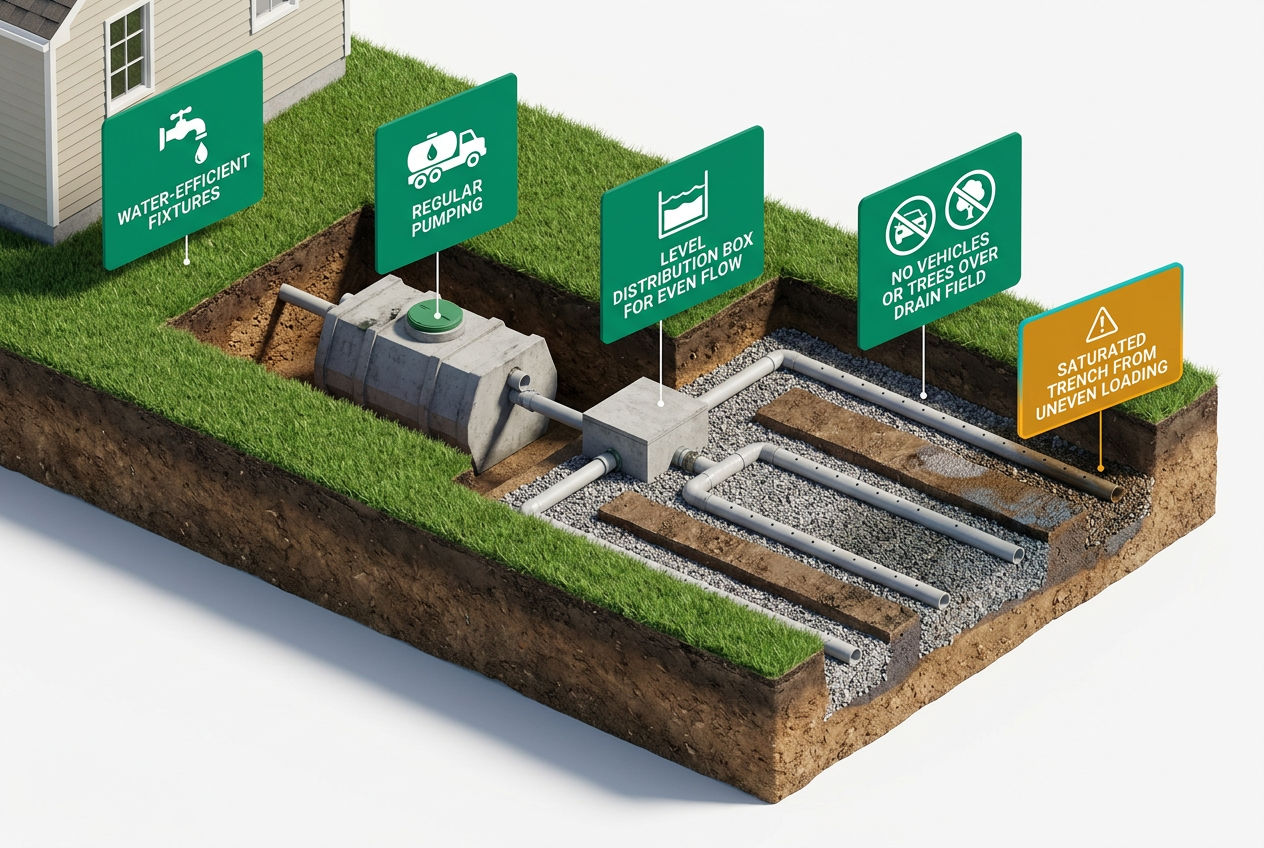
Your installer will route perforated pipe through gravel-filled trenches (or use chamber systems like Infiltrator Water Technologies chambers, which eliminate the gravel and can reduce excavation costs). Effluent flows from the tank through a distribution box, which splits the flow evenly across each lateral. If that distribution box fails or clogs, you can get uneven loading — where one trench gets saturated while others sit dry.
Setback requirements are non-negotiable. Most states mandate:
- 10 feet minimum from property lines
- 50–100 feet from any private water well
- 25 feet from buildings and foundations
- Varies by state near streams, ponds, and wetlands
Florida's Department of Health, for example, requires a 75-foot setback from surface water bodies in many coastal counties — which can make an already tight lot a real puzzle for system designers.
If your lot fails the perc test, you're not necessarily out of options. The failed perc test options guide covers mound systems, aerobic treatment units, and engineered alternatives that work in difficult soil conditions.
How Much Does a Septic System Cost for a 3-Bedroom House?
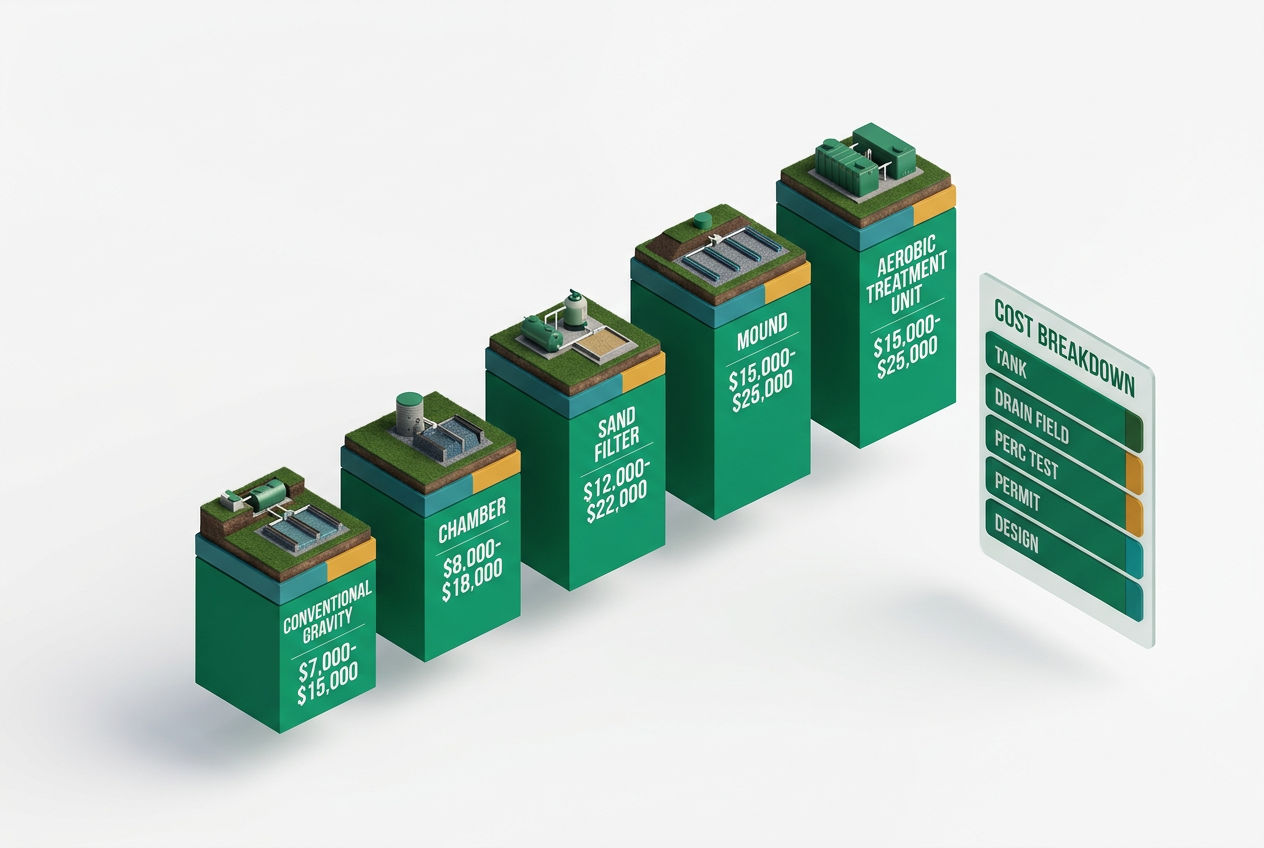
A 3-bedroom septic system cost runs $7,000–$15,000 for a conventional gravity system in most parts of the country. Alternative systems — necessary when soil or site conditions don't support conventional design — push costs to $15,000–$25,000 or higher. The full septic installation cost breakdown covers regional pricing in detail.
Here's how the total installed cost breaks down by system type:
Conventional (Gravity) System: $7,000–$15,000
- Tank (1,000-gal concrete): $800–$2,000 installed
- Tank (1,000-gal poly/plastic): $500–$1,500 installed
- Drain field installation: $3,000–$10,000
- Perc test / soil evaluation: $250–$1,000
- Septic permit fees: $200–$1,000
- Engineering and design: $500–$2,000
Alternative Systems:
| System Type | Typical Cost (3BR) | Best Fit |
|---|---|---|
| Conventional gravity | $7,000–$15,000 | Good soil, adequate space |
| Chamber system | $8,000–$18,000 | Areas with gravel shortages |
| Mound system | $15,000–$25,000 | High water table, shallow bedrock |
| Aerobic treatment unit | $15,000–$25,000 | Poor soil, smaller lots |
| Sand filter system | $12,000–$22,000 | Environmentally sensitive areas |
Source: National Onsite Wastewater Recycling Association (NOWRA); contractor survey data 2024–2025
Regional Cost Differences
Geography moves the needle substantially. Northeast and West Coast installations typically run 20–40% above national averages. Here's a real-world illustration: a conventional 3-bedroom septic system in rural Alabama might cost $8,000–$10,000. The same scope of work in coastal Massachusetts — where Title 5 regulations require more engineering oversight and licensed Title 5 inspectors — often runs $15,000–$20,000 or more.
In Texas, the Texas Commission on Environmental Quality (TCEQ) requires all On-Site Sewage Facility (OSSF) work to be performed by licensed installers and inspected by a Designated Representative. Texas is also notable for how commonly aerobic treatment units appear even on properties with adequate soil — partly driven by lot sizes and local ordinance preferences.
Florida is another outlier. High water tables in coastal and low-lying areas make conventional gravity systems impossible in many counties. Mound systems and aerobic treatment units dominate, pushing average installed costs for a 3BR system toward $18,000–$25,000 in those markets.
Can You Save Money by Installing It Yourself?
Some states do allow homeowner-installed septic systems. If you own the property and plan to live there, states like Tennessee, Idaho, and parts of rural Texas permit owner-installation with appropriate permits and inspections. But most states require a licensed installer, and even where DIY is legal, the excavation equipment, permit process, and soil engineering usually make a licensed contractor the smarter financial choice.
The DIY septic system guide covers which states allow it and what the realistic cost savings look like. Spoiler: the gap is narrower than most homeowners expect.
What Type of Septic System Is Right for a 3-Bedroom House?
The right system depends on your lot's soil, topography, water table depth, and local regulations — not personal preference.
Conventional gravity system: The most common and least expensive option. Wastewater flows by gravity from the house to the tank, and partially treated effluent flows by gravity to the drain field. Works well on lots with well-draining soil and adequate space. No mechanical components beyond the tank itself, so maintenance is minimal.
Chamber system: Similar to conventional, but instead of gravel-filled trenches, plastic arch chambers (like Infiltrator Quick4 chambers) sit in the trench and provide void space for effluent absorption. Lower installation cost in areas where gravel is expensive or scarce.
Mound system: When the water table is too high or bedrock is too shallow for a conventional drainfield, a mound system builds an engineered fill pad above grade. Effluent is pumped up into the mound. Expect a pump chamber, float switches, and a dosing pump — more mechanical complexity and an ongoing power draw. Mound systems are common across Minnesota, Wisconsin, and coastal regions of the mid-Atlantic.
Aerobic treatment unit (ATU): An ATU injects air into the treatment process, producing higher-quality effluent than a conventional tank. Often required when lot size is too small for a full absorption field, or when soil won't pass a perc test. ATUs require an aerator compressor, a chlorination or UV disinfection step, and typically an annual service contract — usually $200–$500 per year. They're extremely common in Texas and parts of the Southeast.
Sand filter system: A recirculating sand filter treats effluent before it reaches the drainfield, making it effective in environmentally sensitive areas near water bodies. Higher upfront cost but can protect a marginal drain field from premature failure.
For a comprehensive breakdown of all options, the types of septic systems guide covers every design with diagrams.
How Often Should You Pump a 3-Bedroom Septic System?

DIY Septic Blueprint
Thinking about building it yourself?
The complete, plain-English plan to size, permit and install your own septic system — designed for homeowners, not contractors. Skip the $15,000–$25,000 quotes and do it right the first time.
Get the DIY Blueprint — $67 →Instant download · 8 modules + 3 bonus guides · 60-day money-back guaranteeThe EPA recommends pumping most residential septic tanks every 3–5 years. For a 1,000-gallon tank serving a family of four in a 3-bedroom home, that pumping interval is realistic — roughly every 3–4 years under normal use.
Several factors tighten that schedule:
- Garbage disposal: Drops interval to 2–3 years
- More than 4 occupants: More daily flow, faster sludge accumulation
- Frequent guests or vacation property use: Variable loading stresses the system
- Bacterial additives: Products like Rid-X add beneficial microbes but don't eliminate pumping. Peer-reviewed research consistently shows additives can't reverse sludge buildup or restore a clogged drain field.
Pumping cost runs $300–$600 nationally for a standard service call. In rural areas with longer drive times — think northern Minnesota or rural Montana — expect $400–$600. Current septic pumping costs by region give you a tighter local estimate.
Having your installer add a septic effluent filter at the outlet baffle of your tank is one of the best low-cost moves you can make during installation. It prevents solids from migrating to your drain field — the most expensive component to repair or replace.
What to Know Before You Install: Permits, Planning, and Timing
Permits and Inspections
Every state requires a permit before septic installation. Most route this through the county health department. The process typically involves:
- Submit a site plan and perc test results
- Health department reviews and issues design approval
- Licensed installer pulls the installation permit
- Installation is inspected before backfill (don't skip this step)
- Final permit closes
Permit fees range from $200 in rural counties to over $1,000 in heavily regulated states. The septic system permit requirements guide breaks down the process state by state.
Timing Your Installation
Spring (March–May) is peak installation season in most of the country — soil conditions are good after thaw, and new home builds are accelerating. Wait times for licensed installers stretch to 4–8 weeks during this period, and prices can run 5–10% above fall rates.
Fall (September–November) is often the best window to get competitive pricing and faster scheduling. Avoid trying to install in December through February in northern states — frozen ground makes excavation difficult or impossible, and many contractors in Minnesota, Wisconsin, and Michigan simply stop scheduling installations until spring.
If you're in the South — Florida, Georgia, Texas, Louisiana — year-round installation is feasible. Just be aware of rainy-season soil saturation in coastal areas, which can complicate perc tests and drain field performance evaluations.
Real Estate Scenarios
Picture this: you're buying a rural property in New Jersey, and the seller's disclosure mentions the septic was "recently serviced." Your home inspector flags it as a 30-year-old conventional system with no documentation. New Jersey requires a septic inspection at point of sale in many counties — and if that system fails, you're looking at negotiating a repair or replacement credit before closing. A 3-bedroom system replacement in New Jersey can easily run $18,000–$25,000. That's not a footnote; it's a negotiating point.
If you're buying a home with a septic system, get a professional septic inspection done independently. The septic inspection guide for home buyers explains what inspectors look for and what results mean for your negotiation.
How Long Will a 3-Bedroom Septic System Last?
A well-maintained conventional septic system lasts 20–40 years. The tank itself — especially concrete — can outlast the house if maintained properly. The drain field is the vulnerable component. Saturate it with solids from an overfull tank, and you can destroy a drain field in 5–10 years that should have lasted 30.
Alternative systems have shorter typical lifespans: 15–25 years for aerobic treatment units, primarily because mechanical components (aerator compressors, pump chambers, float switches) wear out. Budget for component replacements throughout the system's life.
The single biggest factor in system longevity is pumping frequency. Skip pumping for 10 years on a 1,000-gallon tank serving four people, and the sludge and scum layers consume so much of the tank's working volume that raw solids start flowing to the drain field. Once a drain field biomat develops — a dense microbial layer that seals the soil surface — recovery is difficult and replacement is often the only option. Leach field rejuvenation can sometimes restore a marginal field, but it's not a guaranteed fix.
For long-term planning and maintenance schedules, the septic tank maintenance guide covers everything from pumping intervals to what to never flush.
Local Codes Change Everything Tank size minimums, drain field setbacks, and system type requirements vary significantly by county and state. Always verify requirements with your local health department before purchasing property or signing a contractor agreement. Find a licensed septic installer in your area who knows your jurisdiction's specific codes.
More Septic Design & Install Guides
- Septic system design: the complete guide
- Septic system for a 2-bedroom house
- Septic system for a 5-bedroom house
- Septic tank size for a 4-bedroom house
- Leach field design and sizing
- How to do a perc test
- What septic system design costs
- How to draw a septic site plan
- Can you install your own septic system? Rules by state
Frequently Asked Questions
What size septic tank do I need for a 3-bedroom house?
The standard minimum septic tank size for a 3-bedroom house is 1,000 gallons under EPA guidelines and most state codes. Some states — including Massachusetts, Maryland, and New Jersey — set their minimum at 1,250 gallons. The sizing logic is based on estimated daily wastewater flow of 150 gallons per bedroom, putting a 3BR home at 450–600 gallons per day. That 1,000-gallon capacity provides two to three days of retention time for solids to settle and anaerobic bacteria to treat the waste. If you have a garbage disposal, more than four occupants, or plan to add a bedroom later, consider installing a 1,250-gallon tank from the start — the cost difference is typically $200–$500, far less than future excavation and replacement.
How much does a 3-bedroom septic system cost to install?
A complete 3-bedroom septic system costs $7,000–$15,000 for a conventional gravity system in most U.S. markets. That includes the 1,000-gallon tank ($800–$2,000 installed), drain field ($3,000–$10,000), perc test ($250–$1,000), permits ($200–$1,000), and engineering design ($500–$2,000). Alternative systems cost significantly more: mound systems run $15,000–$25,000, aerobic treatment units run $15,000–$25,000, and sand filter systems typically land at $12,000–$22,000. Regional pricing varies sharply — Northeast and West Coast installations typically run 20–40% above Midwest and Southeast averages. A system that costs $9,000 in rural Tennessee might cost $18,000–$22,000 in coastal Massachusetts under Title 5 regulations.
How big does a leach field need to be for a 3-bedroom home?
A leach field for a 3-bedroom home typically needs 450–900 square feet of absorption area, with the actual size determined by your soil's percolation rate. Fast-draining sandy soil can absorb effluent quickly, requiring a smaller field — sometimes as little as 450 square feet. Slow-draining clay soil requires much more absorption area, pushing toward 900 square feet or beyond. The field is laid out in multiple parallel trenches, usually 1–3 feet wide, 18–36 inches deep, and 50–100 feet long, filled with gravel or chamber systems. Required setbacks — typically 10 feet from property lines, 50–100 feet from wells, and 25 feet from structures — further constrain your design. A licensed soil evaluator and perc test are required before the field can be sized and permitted.
How often should a 3-bedroom septic system be pumped?
The EPA recommends pumping most household septic tanks every 3–5 years. For a 1,000-gallon tank in a 3-bedroom home with four occupants under typical usage, that means pumping every 3–4 years. Several factors shorten that interval: a garbage disposal can accelerate sludge buildup enough to require pumping every 2–3 years. More than four regular occupants increases daily wastewater flow beyond the design assumption of 450–600 gallons per day, filling the tank faster. A technician with a sludge judge can measure your tank's actual sludge and scum layer depths at each pump-out — once the combined layers reach one-third of tank capacity, it's time to pump regardless of the calendar. Pumping costs $300–$600 nationally for a standard residential service.
Can I install my own septic system to save money on a 3-bedroom property?
Some states allow homeowners to install their own septic systems if they own the property and plan to occupy it. States like Tennessee and Idaho have provisions for owner-installation with permit oversight and inspections. However, most states require a licensed installer — and even where DIY is legal, you still need to hire a licensed engineer or soil evaluator for the site assessment and design, rent heavy excavation equipment, and pass the same inspections a licensed contractor would. The realistic cost savings are narrower than most people expect. Mistakes in drain field placement, pipe grades, or tank seating can cost more to fix than a licensed installation would have cost originally. Before pursuing the DIY route, check your specific county health department regulations — state law sometimes permits it while county ordinance does not.
Sources & Methodology
This article draws on the following primary sources:
-
U.S. Environmental Protection Agency — Septic Systems epa.gov/septic: Used for EPA recommendations on tank sizing, pumping frequency (3–5 year guideline), and the statistic that approximately 20% of U.S. homes rely on septic systems.
-
State Health Department Regulations: Minimum tank sizing requirements, setback distances, and installer licensing requirements referenced from Massachusetts (Title 5), Texas (TCEQ OSSF rules), Florida (Department of Health), New Jersey (DEP), and Minnesota (MPCA) regulatory frameworks. tceq.texas.gov
-
National Onsite Wastewater Recycling Association (NOWRA) nowra.org: Industry cost benchmarks and system type definitions referenced for the system cost comparison table.
-
Penn State Extension: Referenced for research on the impact of garbage disposals on septic system solids loading. extension.psu.edu
-
Contractor pricing data (2024–2025): Cost ranges compiled from septic installation contractor quotes and regional pricing surveys across the Southeast, Midwest, Northeast, and Southwest U.S. markets. All cost figures represent installed totals unless otherwise noted.
Regulations and costs change frequently. Verify all requirements with your local county health department before beginning any septic project.
Primary sources to read: EPA Onsite Wastewater Treatment Systems Manual (EPA/625/R-00/008) · MassDEP: Title 5 new construction · Texas TCEQ: OSSF permits · Florida DEP: onsite sewage permitting FAQ
Free download
Not ready for the Blueprint? Start free.
Grab the free DIY Septic Planning Kit — the permit-first checklist, perc-test cheat sheet, and sizing tables that keep your build from getting red-tagged.
Was this article helpful?
Frequently Asked Questions
Recommended Resources
📖 Related Articles
- Septic Tank Sizes & Dimensions Chart (by Bedrooms)
- Can You Use a Garbage Disposal with a Septic System?
- Septic System Permit Cost & State Requirements (2026 Guide)
- Perc Test (Percolation Test): What It Is & How It Works
- Land Failed the Perc Test? Here Are Your Options
- DIY Septic System: How to Build Your Own (Step-by-Step)
- Types of Septic Systems: Complete Comparison Guide
- Septic Effluent Filters: Do You Need One?
- Septic Inspection for Home Buyers: Complete Checklist
- Leach Field Rejuvenation: The Complete Guide
- The Complete Septic Tank Maintenance Guide
💰 Cost Guides
🔧 Services
Find Septic Professionals Near You
Compare licensed, verified septic companies by area — top county markets and cities below, or browse all 50 states.
County markets
Popular cities
