
Quick Answer
Yes, you can tie into an existing septic system when the system was permitted for enough bedrooms to cover everything it will serve after the project, and an inspection shows the tank and drain field are sound. Your county or state health department makes that call, not your plumber and not how well the system seems to work today.
Key Takeaways
- Septic systems are sized and permitted by bedrooms, not bathrooms or people. A cabin, tiny home or bedroom addition usually counts as at least one more bedroom.
- Codes typically use 100-150 gallons per day per bedroom (EPA). North Carolina uses 120.
- The tank is often fine. The drain field and the reserved repair area are what usually limit a tie-in.
- By our estimates, a gravity tie-in runs about $1,500-$6,000. A grinder pump adds about $2,000-$4,000 installed (Angi, 2025) if the new building sits below the tank.
- Get the health department's approval before you buy a tiny home, pour a slab or trench a line.
A homeowner in the North Carolina mountains sent us this question recently: "We're thinking of adding a small cabin on wheels or building a small cabin for my aging father-in-law. Can our current system handle that, or do we need a small system just for the cabin?" The answer depends on four things you can check yourself: what the system was permitted for, how many bedrooms you'll have afterward, the condition of the tank and drain field, and whether the site has room to grow. This guide walks through each one, using that family's situation as the worked example.
Can You Tie Into an Existing Septic System?
Yes. You can add to an existing septic system, tying in a second building or an addition, if three things line up: the system's permitted design flow covers the new total, the tank and drain field pass a real inspection, and the health department approves the change. When any one of those fails, the fix is an upgrade (bigger tank, more drain field) or a separate system.
"Permitted" is the word that matters. A septic system is approved for a specific design flow, which in most states comes straight from the bedroom count on the permit. A 3-bedroom house with a 1,000-gallon tank that has never backed up is still a 3-bedroom system on paper. Add a cabin with a bed in it and, in the county's eyes, you now have a 4-bedroom load on a 3-bedroom system.
Plumbing codes handle the pipe side differently. The Uniform Plumbing Code requires each building to have its own sewer connection, but allows a front building's drain to be extended to a building behind it on the same lot when the rear building has no other sewer available. IPC-based codes allow several buildings on the same lot to share a building sewer that connects to a public sewer. But plumbing code only covers the pipe. Whether the septic system can take the extra wastewater is a health department decision under your state's onsite rules.
If the second building is an ADU or a guest house with a kitchen, also read our septic system for an ADU guide, which covers the extra permitting that comes with a full second dwelling.
Will Your Septic System Handle Another Bedroom, Bathroom or Building?
Adding a bedroom to a septic system works only if its design flow was sized above your current bedroom count. Bathrooms usually don't change the math at all, because most states size systems by bedrooms. A new building, like a cabin or tiny home, almost always counts as at least one added bedroom, even if the person moving in already lives on the property.
Design flow is a permit number, not a usage number. North Carolina's rule sets the minimum design flow for a home at 120 gallons per day (gpd) per bedroom, or 60 gpd per person if more than two people share a bedroom (15A NCAC 18E .0401). According to the EPA's onsite design manual, codes typically specify 100 to 150 gpd per bedroom. The assumption behind it is two people per bedroom, each using about 60 gallons a day, at peak.
Real use is much lower. The Water Research Foundation's 2016 study of U.S. homes measured average indoor use at 58.6 gallons per person per day, and NC State Extension uses about 50. Newer fixtures push it lower still. The EPA's onsite design manual notes that real occupancy is typically 1.0 to 1.5 people per bedroom, and calls the two-per-bedroom code assumption conservative.
| Situation | Design flow the county counts | What one person really adds |
|---|---|---|
| Add a bedroom to the house | +120-150 gpd | 40-60 gpd if someone new moves in |
| Add a bathroom only | Usually +0 (bedrooms unchanged) | Little, unless more people move in |
| 1-bedroom cabin or tiny home | +120-150 gpd | 40-60 gpd |
| Parent moves from the house to a new cabin | +120-150 gpd | Close to 0 (same person) |
Sources: NC 15A NCAC 18E .0401; Water Research Foundation, Residential End Uses of Water (2016); NC State Extension AG-439.
That last row is the frustrating one. If your father-in-law already lives with you and simply moves into a cabin out back, your real wastewater barely changes. The county still counts the cabin as new capacity, because the permit has to cover whoever might live there in 20 years. Plan for the design number, not the real one. Our guide to what size septic system you need shows the full bedroom-to-tank math.
What about just adding a bathroom? In most states, a bathroom addition doesn't change your design flow, because the bedroom count stays the same. Some counties still want to review the plumbing, and a few size by fixtures or square footage, so ask. Watch any new room that comes with the bathroom. Each state defines a bedroom by its features, not its label: Minnesota counts any room of 70 square feet or more reached from the living area, while Florida requires at least 70 square feet, an exterior wall, a closet and a door.
How Do You Check If Your Septic System Has Room? A 5-Step Capacity Check
To check whether your septic system can take more, pull the original permit, count bedrooms before and after, get a full inspection, map the site, then ask the health department to review it. Doing these in order saves money, because the first step alone often answers the question for free.
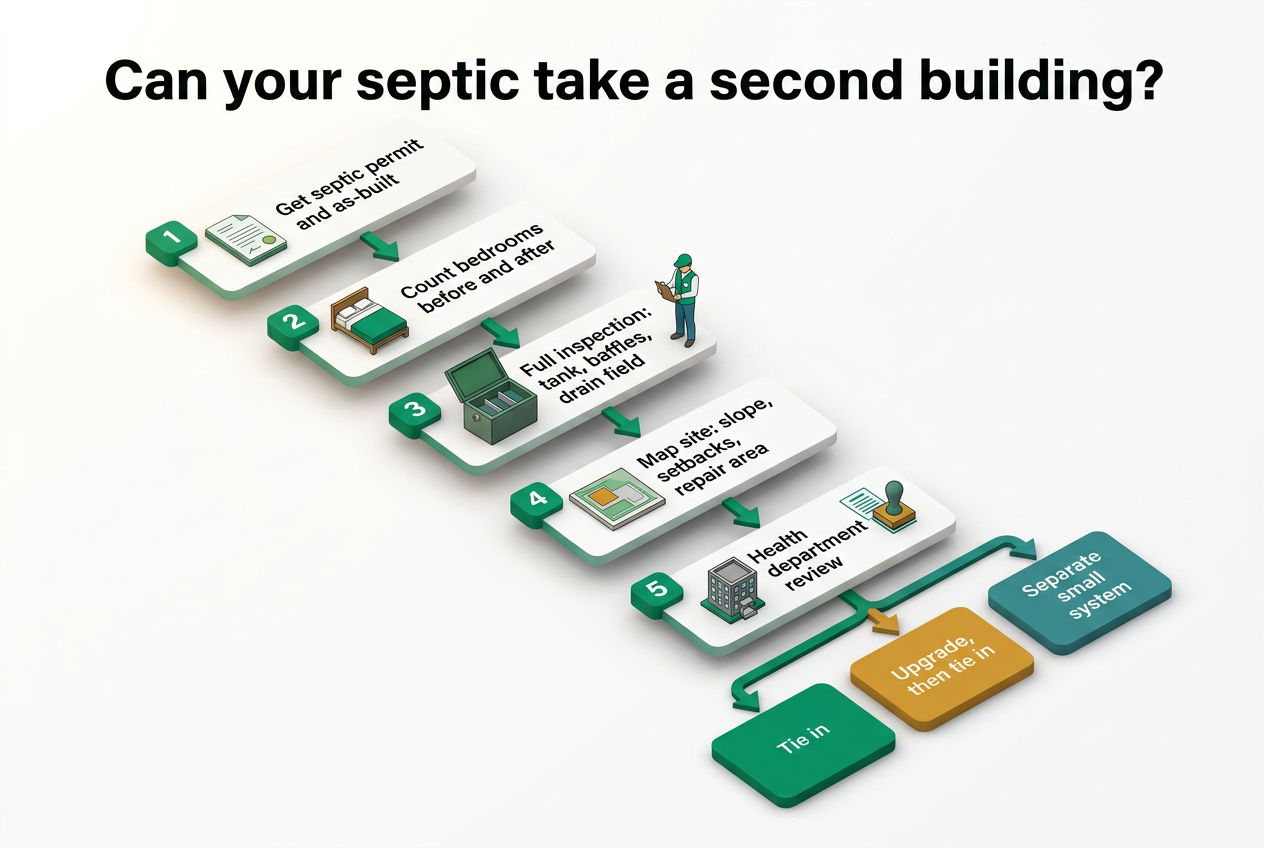
- Get your septic records. Ask your county (or district) environmental health office for the original construction permit, the as-built drawing and the soil evaluation. NC State Extension and the EPA both point homeowners to the local health department for these. The permit shows the approved bedroom count and design flow. The as-built shows where the tank, drain lines and repair area are.
- Count bedrooms before and after. Use the county's definition, not the listing's. Depending on your state, an office or den may count (Minnesota counts any room of 70 square feet or more off the living area). A cabin with a bedroom counts. Write down: permitted bedrooms, current bedrooms, bedrooms after the project.
- Book a full inspection, not a walk-over. The tank should be pumped so the inspector can see the baffles, the tank walls and any staining above the outlet that points to backups. They should check sludge and scum depths, the distribution box and the drain field for standing water or soggy spots. The EPA's inspection checklist covers exactly these items. Our septic inspection cost guide puts most inspections at about $150-$900, or book a septic inspection through a local pro.
- Map the site. Sketch the house, the new building, the tank, the drain field, the repair area, any well and the property lines. Mark which way the ground slopes between the new building and the tank. This tells you whether gravity will work and whether you're about to build on top of land the county has reserved for a future drain field. Our guide to drawing a septic site plan shows how.
- Ask the health department to review it. Bring the records, the inspection report and the sketch. Ask: "Is my system permitted for the bedrooms I'll have after this project? If not, what would you need to approve it?" Most counties call this an existing-system review, an authorization or an expansion permit. Get the answer in writing.
Want a quick check on the tank side? Enter your bedroom count after the project, and the calculator below shows the tank size most codes call for, so you can compare it with the tank on your permit.

DIY Septic Blueprint
Thinking about building it yourself?
The complete, plain-English plan to size, permit and install your own septic system — designed for homeowners, not contractors. Skip the $15,000–$25,000 quotes and do it right the first time.
Get the DIY Blueprint — $67 →Instant download · 8 modules + 3 bonus guides · 60-day money-back guaranteeIf step 1 shows your system was permitted for more bedrooms than you have now, you may have the spare capacity already. If not, the answer becomes "upgrade, or build separately," and the rest of this guide is about choosing between them.
Worked Example: A 1-Bedroom Cabin Next to a 3-Bedroom House
Here is the North Carolina family's situation, run through the state's actual rules. They have a 3-bedroom house with a standard system and want a 1-bedroom cabin for one person.
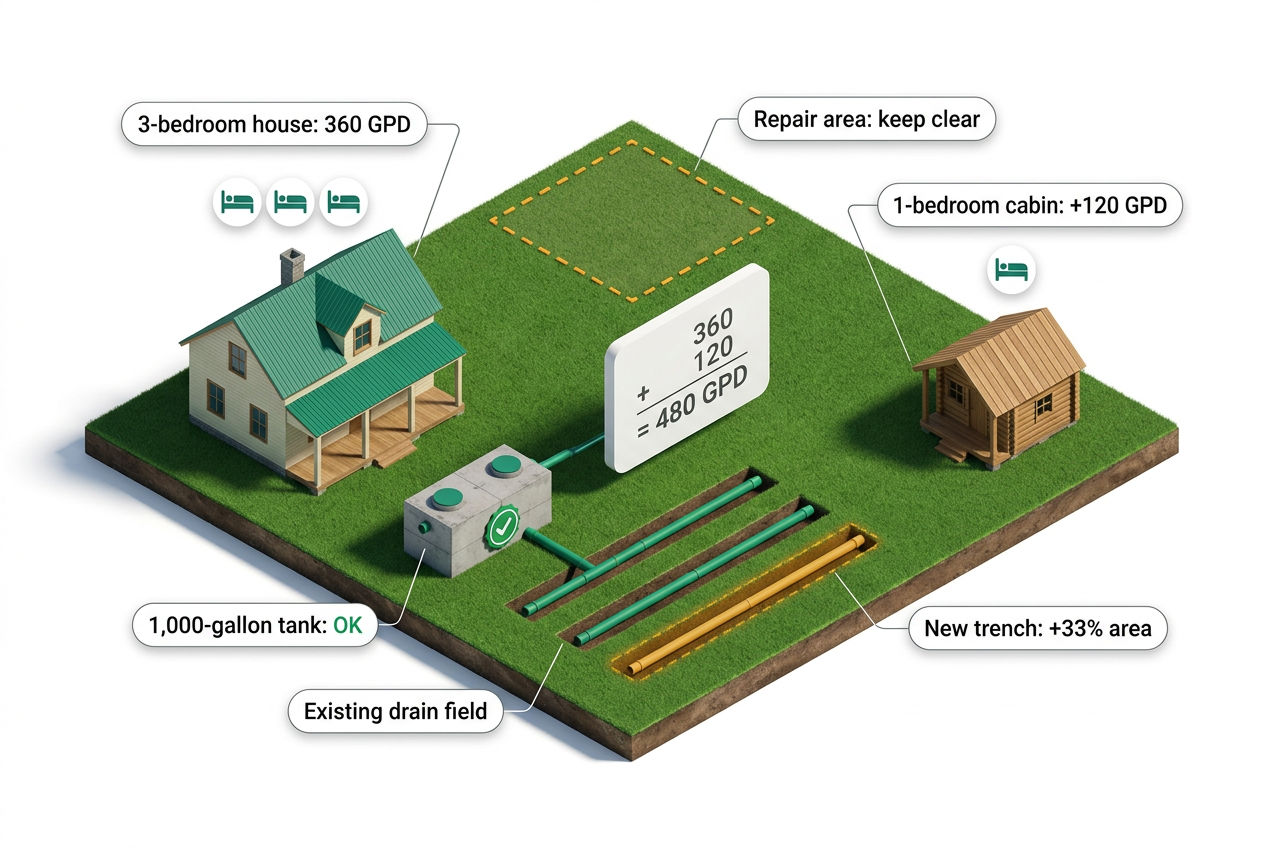
Design flow. Under NC rules the house is 3 × 120 = 360 gpd. The cabin adds 1 × 120 = 120 gpd, so the combined design flow becomes 480 gpd, a one-third increase.
The tank is probably fine. North Carolina requires a minimum 1,000-gallon tank for homes up to 4 bedrooms (15A NCAC 18E .0801), and its 2023 law says an accessory dwelling is not treated as a separate dwelling unit when sizing the tank. Instead, the cabin's bedroom is added to the house's, so the tank is sized for one combined 4-bedroom load rather than as two separate homes, and a standard 1,000-gallon tank covers it, provided it passes inspection.
The drain field is the real question. A field designed for 360 gpd now has to accept 480 gpd. On a conventional system that means roughly a third more absorption area, either new trenches next to the old ones or a replacement field. Whether there's room depends on soil, slope and the repair area: NC permits set aside a second area for a future replacement field, and the county will not let you build the cabin on it.
Watch the pump rule. If the cabin sits below the tank and needs a grinder or lift pump, North Carolina doubles the required tank capacity, which usually means two 1,000-gallon tanks in series. The exception: the pump can discharge into at least 10 feet of 4-inch gravity pipe before the tank (18E .0801(c)). A good designer will plan the line so that exception applies.
A cabin on wheels changes things. A tiny home on a trailer may be treated as an RV rather than a dwelling. NC's design-flow table lists an RV in an RV park at 100 gallons per day per space, and a 2024 state memo says RVs "designed or used as permanent dwelling units" must meet the same requirements as a dwelling. Whether you may live in one full time on your own land, and connect it to your house system, is a zoning and health department question. More on that below.
The permit. Because the cabin raises design flow, North Carolina requires a Construction Authorization from the county health department (or a notice of intent to construct from a private Authorized On-Site Wastewater Evaluator) before work starts, under rule 18E .0206(d). The approval lists the bedrooms, occupants and design flow, with a site plan showing the existing system and repair area.
The likely outcomes for this family: (1) the county confirms spare capacity and approves a gravity tie-in, (2) it approves a tie-in plus a drain field extension, or (3) the site can't take more field and the cabin needs its own small system. All three start with the same phone call to the county environmental health office, before they buy anything.
How Do You Physically Tie a Second Building Into a Septic System?
A common way to tie in a second building is to run a sewer line from it to the existing building sewer, joining with a wye fitting and a cleanout upstream of the septic tank, so the tank keeps a single inlet; your designer decides the exact connection point. When gravity can't do the job, a pump station at the new building pushes waste to the tank. Both need a permit and an open-trench inspection.
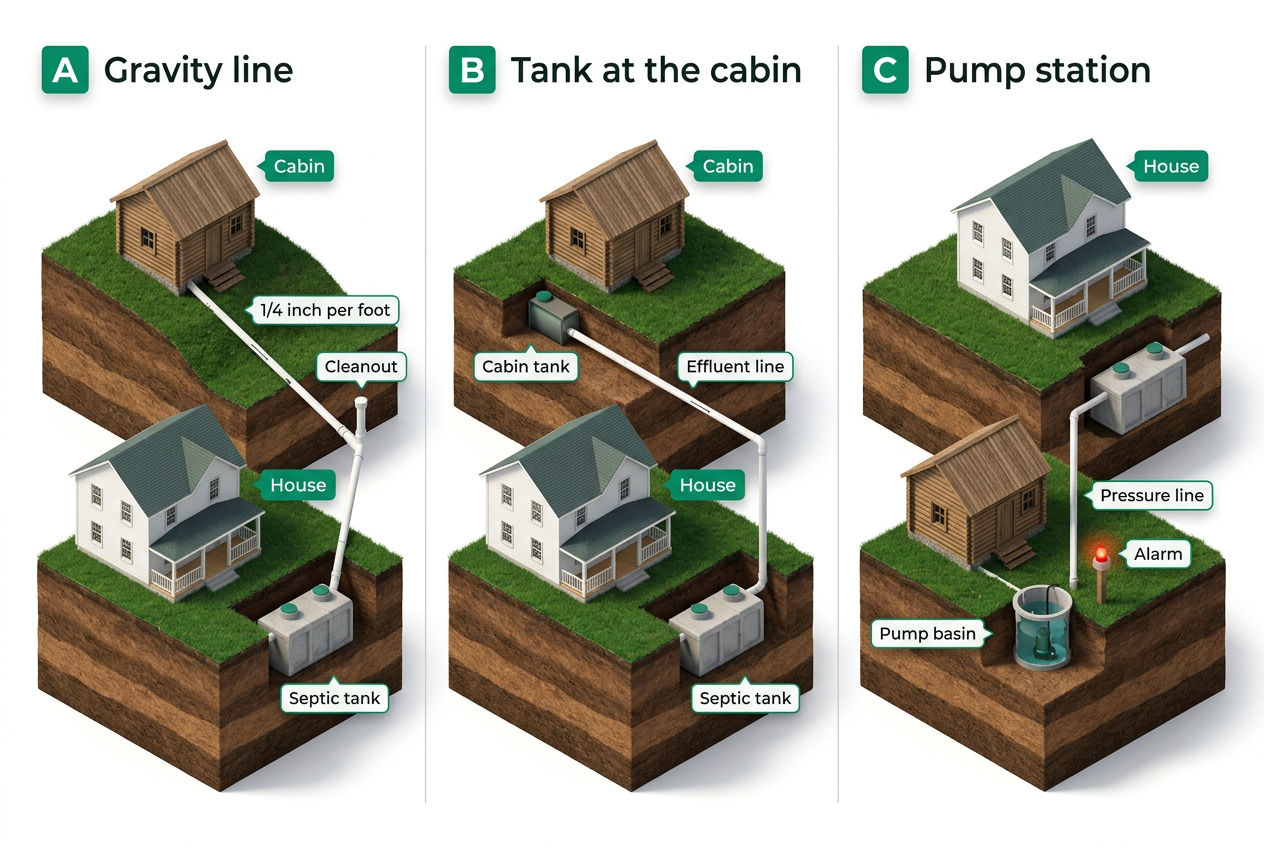
Option A: Gravity line into the existing sewer
A gravity line needs no pump, power or alarm. The new line slopes continuously downhill from the cabin to a wye on the house's existing sewer line, upstream of the tank.
- Slope. The Uniform Plumbing Code requires building sewers to fall at least 1/4 inch per foot, with 1/8 inch per foot allowed for 4-inch pipe and larger only where the inspector approves it. IPC-based codes allow 1/8 inch per foot for 3-inch pipe and up. Over a 100-foot run, 1/4 inch per foot is 25 inches of drop. Our septic pipe slope guide covers the math.
- Cleanouts. Expect a two-way cleanout just outside the new building and another at least every 100 feet, plus cleanouts where the line changes direction sharply. Mesa County, Colorado's rules for connecting an addition spell these out, and most counties are similar.
- Pipe and cover. Mesa County's rules call for solid sewer pipe (SDR-35, or Schedule 40 under driveways) at least 3 inches in diameter; bury it below your local frost depth. The UPC sets a 1-foot minimum cover for most pipe; colder counties require more.
- Fittings. The same rules limit bends to 45-degree or long-sweep quarter bends, so solids keep moving.
Option B: A second tank at the new building
On a long run, or when the new building has its own kitchen, some installers put a small septic tank near the new building first. The settled liquid then flows to the main tank or field with far less risk of clogging the long line. As one veteran installer put it in Onsite Installer, "It's never wrong to have a septic tank prior to another septic tank." North Carolina allows two tanks in series, each at least 1,000 gallons, with an effluent filter in the final compartment.
Option C: Pumping uphill
If the new building sits below the tank, you need a pump station: a basin with a sewage ejector, solids-handling pump or grinder pump, plus the controls, alarm and electrical circuit your designer and county specify. Angi's 2025 data puts a grinder pump at about $2,000-$4,000 installed, before trenching. Pump makers note that pumping into a septic tank is never ideal, because a grinder turns solids into a fine slurry that settles poorly. Zoeller's guidance recommends a solids-handling pump as the first option, or pumping to a short gravity line before the tank. Our effluent pump vs grinder pump comparison explains the difference, and in North Carolina remember the tank-doubling rule above.
What not to do
- Don't core a new hole in the septic tank wall. Tanks have engineered inlets with baffles or tees. A second inlet is a design decision that needs approval.
- Don't run the line over the drain field or repair area.
- Don't backfill before the inspection. Many counties, Mesa County among them, inspect the open trench. See our guide to the septic inspection before backfill.
Can You Add a Second Septic Tank to an Existing System?
Yes, you can add a second septic tank to an existing system, usually installed in series ahead of the drain field so wastewater flows through both tanks. It adds settling time and storage, which is why counties often require it when bedrooms are added or a pump feeds the tank. It does not add drain field capacity, so it solves a tank shortfall, not a field shortfall.
A second tank makes sense when:
- your existing tank is smaller than the minimum for the new bedroom count (for example, a 750-gallon tank on a house going to 4 bedrooms),
- a grinder or lift pump will feed the tank, or
- the new building is far enough away that a tank at that end protects the long line.
Expect roughly $900-$1,500 for a 1,000-gallon tank itself, plus excavation, piping, risers and the permit. A typical installed figure runs $2,000-$5,000 depending on access and soil. Add an effluent filter on the outlet of the last tank either way.
How Do You Expand a Septic System's Drain Field?
To expand a septic system, you usually extend its drain field, which works when the soil next to it is suitable and there's room outside setbacks and the repair area. The usual approach is new trenches or chamber rows fed from the existing distribution box. Partial expansions often cost $3,000-$8,000; if the old field is failing, the county may require a full replacement instead.
Three things decide whether an expansion is possible:
- Soil. The new area needs its own soil evaluation or perc test. Clay, shallow rock or a high water table can rule out a conventional extension and push you to a mound or treatment unit. See our perc test guide.
- Space. Setbacks from wells, property lines, streams and the new building all apply. Our setback requirements guide lists typical distances.
- Condition of the existing field. A field that already ponds after heavy rain is a poor base to add to, and the county may require the whole field to be rebuilt.
When a field is replaced or extended, the drain field replacement cost guide covers the full price range.
Can You Hook a Tiny Home on Wheels or an RV to Your Septic?
A tiny home on wheels or an RV can sometimes connect to a home septic system, but only where local zoning allows someone to live in it and the health department approves the connection. Many counties treat a tiny home on a trailer as an RV, which limits full-time occupancy, and some don't allow a permanent connection at all.
Check two offices before you buy: zoning or planning (can someone live in it on this lot, and for how long?) and environmental health (may it connect, and does it need its own permit?). Larimer County, Colorado, for example, treats a tiny home on wheels like an RV and requires a sewer connection, a full septic system or a sealed vault.
If a connection is approved, protect the system:
- Skip formaldehyde-based holding tank chemicals. The EPA warns that chemicals such as formaldehyde "can cause bacteria in the system to die," and University of Arizona Extension recommends enzyme- or bacteria-based products only. Our RV black tank treatment guide lists septic-safe options.
- Avoid slug loads. Dumping a full black tank sends a concentrated burst to the tank. A permanent gravity connection with no holding-tank cycle is gentler. If you do dump, keep the black valve closed until the tank is at least half full, then dump it all at once.
- Pump more often. EPA guidance notes that RV and mobile home waste can call for more frequent pump-outs.
Our RV septic vs house septic and tiny house septic guides go deeper on both.
When Is a Separate Small System the Better Choice?
A separate small system is the better choice when the existing drain field can't be expanded, the new building is far away or well below the tank, or local rules require separate systems for separate dwellings. It costs more up front, but neither building can take the other down if one system fails, and selling or splitting the property later is simpler.
Your realistic options for the second building:
- A small conventional system. Its own tank and field, sized for one bedroom, where the soil allows a conventional system. Remember that many states set a minimum tank size regardless of flow (North Carolina's is 1,000 gallons).
- An aerobic treatment unit (ATU). Used on sites with poor soil or little space. It needs constant power, and some states, such as Texas, require a maintenance contract.
- A holding tank. No discharge; it gets pumped. Some jurisdictions allow one only when nothing else works; one installer described the policy this way: "if you can use any other kind of system a holding tank is not allowed." For a lived-in cabin, pump-outs at roughly $290-$560 each, often monthly or more, add up fast. See our septic holding tank guide.
- A composting toilet plus a greywater system. Removes toilet waste, but sink and shower water is still wastewater in many states and needs a legal disposal route. University of Minnesota's onsite program notes kitchen water carries much higher organic and bacterial loading than people expect. See composting toilet vs septic.
How Much Does It Cost to Tie Into an Existing Septic System?
By our estimates, built from published contractor pricing, tying into an existing septic system costs about $1,500-$6,000 for a short gravity line with spare capacity, $4,000-$10,000 with a pump station, and $5,000-$20,000 if the tank or drain field must be upgraded too. A separate small system for the new building typically runs $4,000-$18,000, more on poor soil.
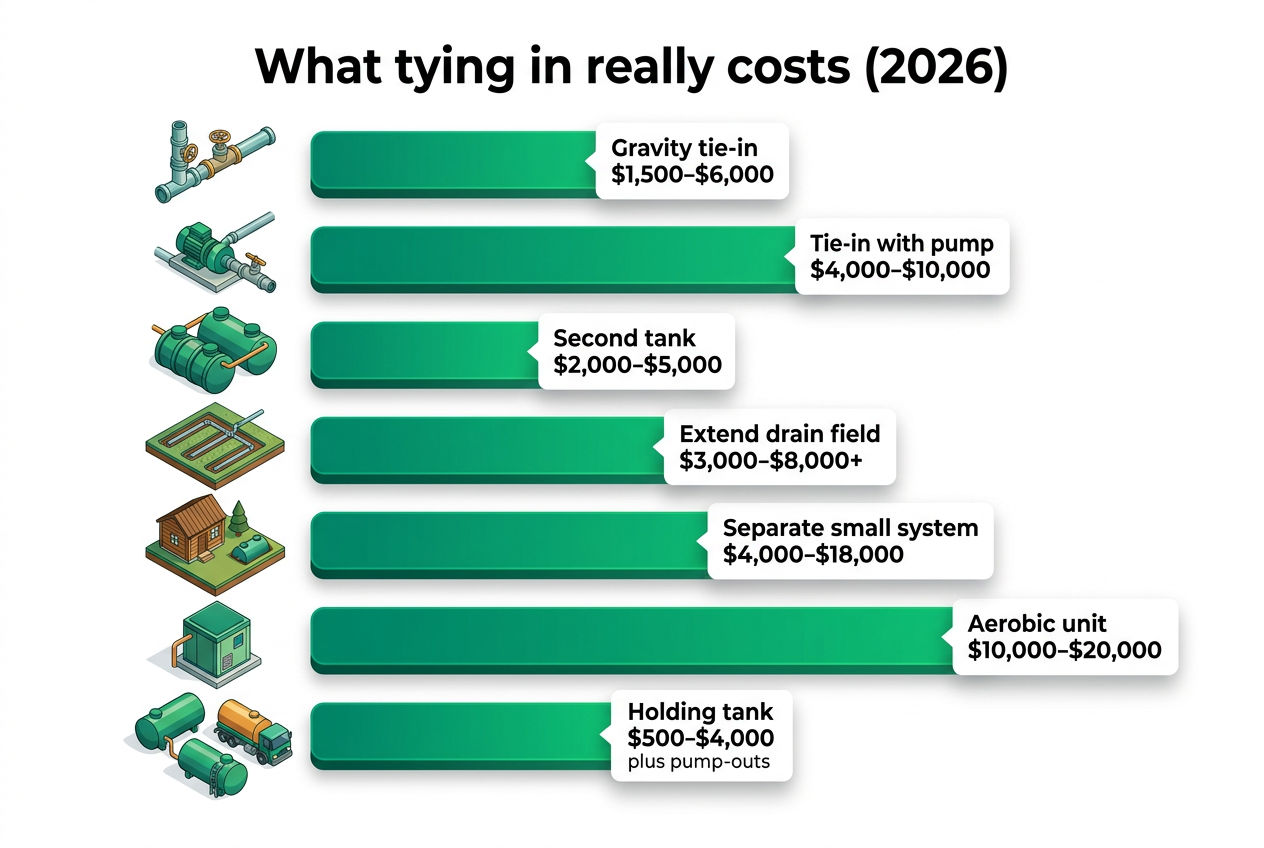
| Path | Typical cost | Best fit |
|---|---|---|
| Gravity tie-in | $1,500–$6,000 | Spare capacity, new building uphill of tank |
| Tie-in with pump station | $4,000–$10,000 | New building below the tank |
| Add a second tank in series | $2,000–$5,000 | Tank too small for new bedroom count |
| Extend the drain field | $3,000–$8,000+ | Room and good soil next to the field |
| Separate small conventional system | $4,000–$18,000 | Good soil, field can't be expanded |
| Aerobic treatment unit | $10,000–$20,000 | Poor soil or tight lot |
| Holding tank | $500–$4,000 + $290–$560 per pump-out | Last resort, seasonal use |
Sources: SepticTankHub estimates built from published contractor pricing (HomeAdvisor, Angi, 2024-2025) and county fee schedules. Sewer line runs about $50-$250 per foot installed depending on depth, soil and access.
Budget for the paperwork too: the inspection, a soil evaluation if the field grows (HomeGuide's figures run about $750-$1,900; in some states, such as North Carolina, the county health department does it for a fee), design work and permit fees. The septic installation cost guide has the full breakdown for new systems.
How Do the Rules Differ by State?
Nearly every state requires a permit or health department approval before you add design flow to an existing septic system. Where states differ is what counts as a bedroom, whether a second dwelling may share one system, and which permit you file. Here is how several states handle it.
- North Carolina. Rule 15A NCAC 18E .0206 separates projects that add no flow (a deck, a garage, a reconnection), which need only an existing-system approval, from projects that raise design flow, which need a Construction Authorization before construction starts. A 2023 law (S.L. 2023-77) lets an accessory dwelling share the main house's system, with its bedrooms added to the total. Fees vary by county. AppHealthCare, which serves Alleghany, Ashe and Watauga counties, lists $1,550 to expand a residential system for up to four added bedrooms and $375 for a compliance inspection on a no-flow change (fees effective July 1, 2026). See our North Carolina septic regulations guide.
- Washington. WAC 246-272A counts going from two to three bedrooms, or placing a building over the reserve area, as an "expansion" that needs a permit. It expressly allows "one additional dwelling served by the same OSS," at 120 gallons per bedroom.
- Oregon. OAR 340-071-0205 lets a modest increase (up to 300 gallons and 50% over design capacity) go through a simpler Authorization Notice if a full replacement area is available. It also has hardship and temporary family-dwelling approvals that let a second home use the existing system for a relative or caregiver.
- Massachusetts. MassDEP's 2025 ADU guidance says an ADU that adds bedrooms is "New Construction" under Title 5 (110 gpd per bedroom). The existing system must then meet new-construction standards for all the bedrooms on the property, with a two-compartment tank or two tanks in series.
- Minnesota. For septic sizing, any room of 70 square feet or more reached from the living area can count as a bedroom, so an office or den often does. A compliance inspection is required before a bedroom addition is permitted where the county permits bedroom additions.
- Florida. State law exempts remodels that don't add a bedroom from an existing-system upgrade, as long as the addition doesn't cover the system or its setbacks. Adding a bedroom means a modification permit sized on bedrooms and building area.
- Texas. TCEQ requires a permit to alter a system, including any increase in permitted flow. Texas's permit exemption for homes on 10 or more acres applies only when the house is the only dwelling on the tract, so adding a second dwelling ends it.
- California. Counties run septic programs under the state OWTS Policy. Sonoma County, for example, lets an ADU connect to the existing system if the system is code compliant, has capacity and keeps a code-compliant reserve area; otherwise the ADU needs its own system.
Moving an Aging Parent In: Septic Details Families Miss
Building a cabin or suite for a parent adds a few septic considerations beyond flow:
- Medications. Vermont's environmental agency advises having the tank pumped more often during chemotherapy and checked after a few months on long-term treatment, and avoiding harsh cleaners while someone is on long-term antibiotics. Never flush unused medications.
- Wipes and pads. Keep incontinence products and "flushable" wipes out of the toilet; put a lidded bin in the cabin bathroom. See are flushable wipes septic safe?
- Disinfectants. University of Arizona Extension notes that antibacterial and disinfectant products can destroy the good bacteria a septic system relies on, so use them sparingly.
- Access paths. Ramps, a paved path or a carport over the drain field or repair area compacts the soil and can make future repairs impossible. Route them around the field.
- Special permits for family caregiving. Some states have a shortcut for exactly this situation. North Carolina's temporary family health care structure law (G.S. 160D-915) allows a transportable unit of up to 300 square feet for one physically or mentally impaired relative (in-laws count, and a physician must certify the need for help with two or more daily activities), with a local permit capped at $100. The unit can be required to connect to the property's sewer or septic and must meet state rules as if it were permanent, so the septic review still applies. Oregon lets a temporary hardship dwelling use the existing system for up to five years, renewable, if the system isn't failing.
- The future. A cabin built for a parent may later become a guest house or rental. Permitting it properly now protects the sale of your home.
What Mistakes Make a Tie-In Go Wrong?
Mistakes that derail tie-ins include buying the tiny home or building the cabin before checking septic capacity, building on the repair area, and making an unpermitted connection. Each can stall a building permit, force an expensive redesign, or show up at resale.
- Buy first, ask second. Get the county's answer in writing before you order a tiny home or pour a slab.
- Building on the repair area. Once it's covered, the lot may never be permittable for a replacement field.
- A quiet connection. An unpermitted tie-in can be flagged by a buyer's inspector or lender, and you may have to permit it, or remove it, before closing.
- Too little slope. A line without enough fall lets solids settle and clog. The UPC's standard minimum is 1/4 inch per foot.
- Forgetting pumping. A tank serving more people fills faster. Have the pumper measure sludge at each visit and adjust; our pumping schedule guide shows the intervals.
Planning to do some of the work yourself? Many counties let homeowners install systems on their own primary residence but still require approved plans and inspections. Our DIY septic system guide explains what's realistic. When you want quotes, the SepticTankHub directory lists local septic designers and installers who know your county's review process.
Sources & Methodology
- North Carolina 15A NCAC 18E .0206, .0401 and .0801 (NC DHHS working copy, September 2024), S.L. 2023-77 and G.S. 160D-915: existing-system approvals and Construction Authorizations, 120 gpd per bedroom design flow, tank sizes, tanks in series, the grinder/lift pump tank-doubling rule, accessory dwellings and temporary family health care structures.
- AppHealthCare Environmental Health fee schedule (effective July 1, 2026): example county fees for system expansions and compliance inspections.
- Washington WAC 246-272A, Oregon OAR 340-071-0205, MassDEP ADU guidance (April 2025), Minnesota Rules 7080 and 7082, Florida Statutes 381.0065, Texas 30 TAC 285, Permit Sonoma OWTS Manual (2026): state and county rules for added bedrooms and second dwellings.
- NC State Extension, Septic System Owner's Guide (AG-439): records from the local health department, additions, typical use of 50 gallons per person per day.
- U.S. EPA, Onsite Wastewater Treatment Systems Manual (2002) and Homebuyer's Guide to Septic Systems (2017): occupancy per bedroom, per-person flows, inspection checklist and as-built records.
- Water Research Foundation, Residential End Uses of Water, Version 2 (2016): 58.6 gallons per person per day indoor use.
- Uniform Plumbing Code (as adopted in the 2025 California Plumbing Code), sections 311.1, 312.3, 718.1 and 719.1: independent connections and the rear-building exception, cover, slope and cleanouts.
- EPA Region 9, Alert for RV, Boat and Mobile Home Owners; University of Arizona Extension az1233: holding-tank chemicals and septic bacteria.
- Vermont DEC, Guidelines for Patients Taking Antibiotics or Chemotherapy Drugs (2025): medication guidance.
- Onsite Installer, "Tips for Connecting an Outbuilding to an Existing Onsite System" (2025): tanks ahead of long runs, holding-tank policy, outbuilding loading.
Cost ranges are SepticTankHub estimates drawn from published contractor pricing and county fee schedules. Your actual cost depends on soil, distance, access and local code.
Primary sources to read: NC DHHS: 15A NCAC 18E working copy · MassDEP: Title 5 guidance for ADUs · Washington WAC 246-272A-0230 · NC 15A NCAC 18E .0401 (design flow) · NC 15A NCAC 18E .0801 (septic tanks) · NC State Extension: Septic System Owner's Guide · EPA: A Homebuyer's Guide to Septic Systems · University of Arizona: RV holding-tank treatments
More Septic Design & Install Guides
- Septic system for an ADU or guest house
- Small septic system for a shop or garage
- Septic system for a 3-bedroom house
- Septic system for a 4-bedroom house
- Septic system design: the complete guide
- Leach field design and sizing
- Can you install your own septic system? Rules by state
Frequently Asked Questions
Can I connect a tiny house to my existing septic system?
You can connect a tiny house to an existing septic system only if zoning allows someone to live in it on your lot and the health department approves the connection. A tiny house on a foundation is usually treated as an added bedroom or dwelling, so your system needs spare permitted capacity for it, often 120-150 gallons per day. A tiny house on wheels is often classed as an RV, and some counties don't allow full-time occupancy or a permanent hookup at all. Ask your zoning office and your environmental health office before you buy the tiny home, and get both answers in writing.
How many bathrooms can a septic system handle?
A septic system can usually handle as many bathrooms as you like, because most states size systems by bedrooms, not bathrooms. Adding a bathroom without adding a bedroom normally leaves your design flow unchanged, so it rarely requires a bigger system. A few counties size by fixtures or floor area, and some review any added plumbing, so ask before you build. The catch is a new room that comes with the bathroom: depending on your state's definition, an office or bonus room can count as a bedroom (Minnesota counts any room of 70 square feet or more off the living area), and that does raise the required design flow and may trigger a system review.
How much does it cost to tie into an existing septic tank?
By our estimates, tying into an existing septic tank costs about $1,500-$6,000 for a gravity sewer line from a building that sits uphill of the tank, when the system already has spare capacity. If the new building sits below the tank, a pump station (pump, basin, alarm and circuit) adds roughly $2,500-$4,000 or more, putting the job at $4,000-$10,000. If the county requires a bigger tank or more drain field, the total can reach $5,000-$20,000. HomeAdvisor puts installed sewer line at about $50-$250 per foot, depending on depth, rock and access. Add the cost of the inspection most counties want first.
Can you add a second septic tank to an existing system?
Yes, you can add a second septic tank to an existing system with a permit. It is usually installed in series, so wastewater flows through both tanks before reaching the drain field. A second tank adds settling time and storage, which helps when bedrooms are added, when a pump feeds the tank, or when a new building sits far from the main tank. North Carolina, for example, allows two tanks in series of at least 1,000 gallons each. A second tank does not add drain field capacity, so if the field is the limit, it must be extended too. Expect roughly $2,000-$5,000 installed.
Do I need a permit to tie into my septic system?
Yes, in nearly every state you need a permit or health department approval to tie a new building or added bedrooms into an existing septic system. The review checks that the system is permitted for the new bedroom count, that it passes inspection, and that the new line and any added drain field meet setbacks. Many counties also inspect the open trench before it is backfilled. An unpermitted tie-in can be flagged when you sell, and you may have to permit it or remove it before closing. In North Carolina, for example, any project that raises design flow needs a Construction Authorization before work starts. Expect the county to ask for your existing permit, an inspection report and a site plan.
How many bedrooms can my septic system handle?
Your septic system can handle the number of bedrooms on its permit, which you can get from your county or district health department. If you don't have the permit, the tank size gives a rough clue: in North Carolina a 1,000-gallon tank covers up to 4 bedrooms, while the Uniform Plumbing Code table allows 1,000 gallons for 3 bedrooms. The drain field matters more than the tank, though, and its capacity depends on its size and your soil, so only the permit or a designer's review gives a reliable answer. If you're planning an addition, ask the county for the permit before you design the floor plan.
Can two houses share one septic system?
Two houses can share one septic system in some places, but it needs health department approval, a system sized for the combined bedroom count, and usually a recorded agreement covering access and maintenance. When both buildings sit on the same lot, the main question is capacity; the Uniform Plumbing Code, for example, lets a rear building drain through the front building's line when no other sewer is available. When they sit on separate lots, expect to need a recorded agreement (the UPC allows a sewer on an abutting lot only by recorded agreement), and Pennsylvania may treat a system serving two homes as a community system. Our guide to shared septic system rights covers the legal side. Separate systems are simpler to sell or split later.
Free download
Not ready for the Blueprint? Start free.
Grab the free DIY Septic Planning Kit — the permit-first checklist, perc-test cheat sheet, and sizing tables that keep your build from getting red-tagged.
Was this article helpful?
Frequently Asked Questions
Recommended Resources
📖 Related Articles
- Septic System for an ADU or Guest House: Tie In or Add a Second System?
- What Size Septic System Do I Need?
- Septic Pipe Slope: The Right Fall From House to Tank to Drain Field
- Effluent Pump: A Side-by-Side Comparison
- Tiny House Septic Systems: Cost, Tank Size & Options (2026)
- RV Septic vs House Septic: Key Differences Explained
- Septic Holding Tank: Cost, Sizes, Rules & Holding Tank vs. Septic System
- Septic System Regulations in North Carolina (2026 Guide)
- DIY Septic System: How to Build Your Own (Step-by-Step)
💰 Cost Guides
🔧 Services
Find Septic Professionals Near You
Compare licensed, verified septic companies by area — top county markets and cities below, or browse all 50 states.
County markets
Popular cities
