
Quick Answer
A small septic system for a garage is a permitted tank and drain field, usually 750 to 1,000 gallons, that treats waste from a shop toilet and sink. Many owners skip a separate system by tying into the house septic, using a holding tank, or installing a composting or incinerating toilet.
Key Takeaways
- Any toilet or sink in a garage, shop or barn needs an approved way to handle the wastewater. That usually means a permit.
- Tying into your house system is often cheapest: about $1,000–$5,000, more if you need an ejector pump.
- A separate small system typically runs $3,500–$10,000, and far more if your soil fails a perc test.
- Garage floor drains must never go to a septic tank. The EPA bans them as Class V wells.
- Adding a shower or sleeping space can turn your "shop" into a dwelling in the county's eyes.
Do You Need a Septic System for a Detached Garage?
You need an approved wastewater system for a detached garage the moment you add a toilet or sink. That doesn't always mean a brand-new septic system. Most owners choose between four paths: tie into the house septic, build a small dedicated system, install a holding tank, or use a waterless toilet.
Here's the thing people miss. Building permits and septic permits are separate. Plenty of rural counties let you put up a pole barn with no building permit at all. Ohio, like many farm states, exempts agricultural buildings from its building code. But the local health district still permits every sewage system under Ohio Department of Health rules. A "farm exemption" for the structure almost never covers the toilet inside it.
The rules also depend on where you live. Texas runs septic permitting through TCEQ's On-Site Sewage Facility (OSSF) rules, enforced by county Authorized Agents. Michigan has no statewide septic code, so each county health department writes its own. Call yours before you buy a single fitting. Our guide to septic system permit requirements explains what most offices ask for.
Can You Tie a Garage Bathroom Into Your House Septic?
Yes, you can usually tie a garage bathroom into your house septic if the existing system has spare capacity and is in good shape. House systems are sized by bedrooms, often 120–150 gallons per bedroom per day. A shop half-bath adding 20 gallons a day rarely tips the balance. Our guide to tying into an existing septic system walks through the capacity check and the connection options in detail.
The hard part is getting the waste there. You have two choices.
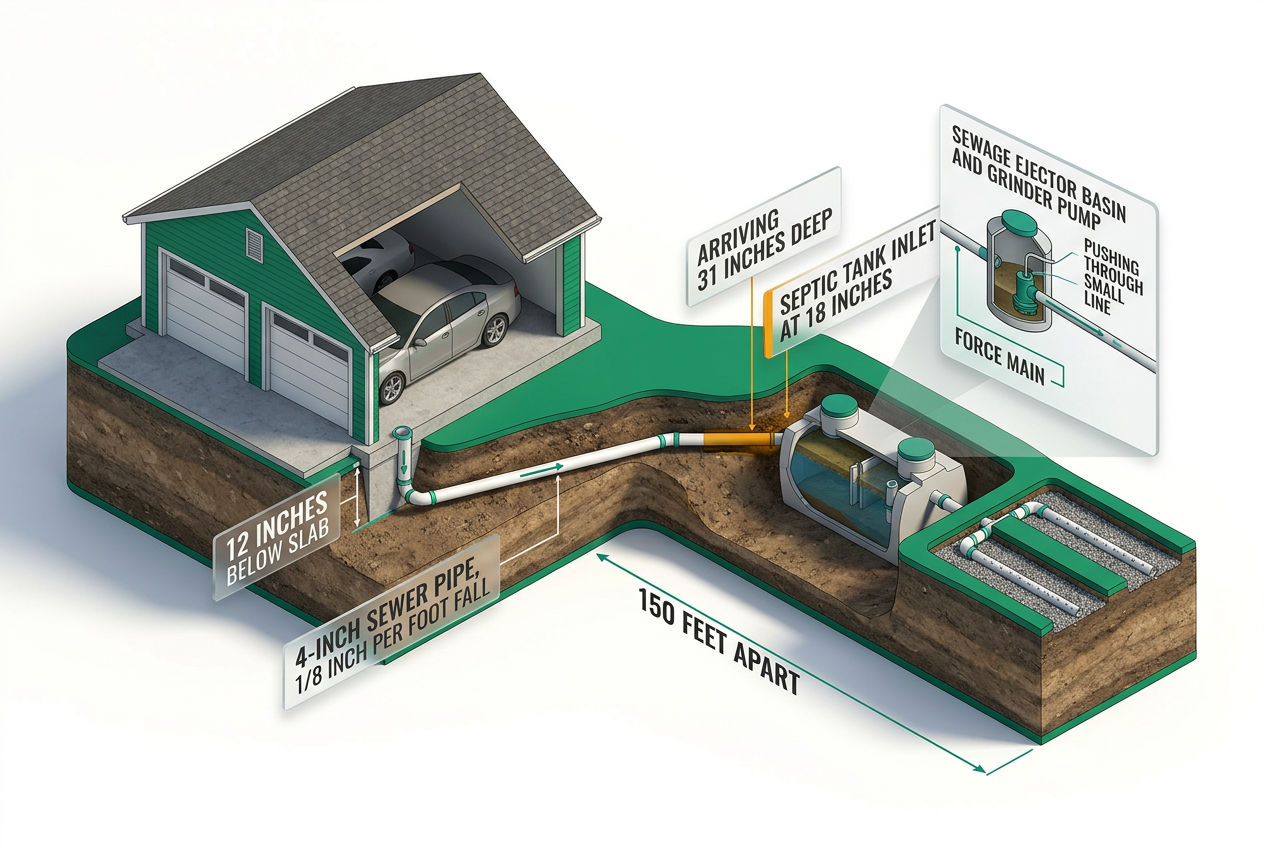
Gravity line. A 4-inch sewer pipe needs at least 1/8 inch of fall per foot under most plumbing codes, and many installers prefer 1/4 inch. Do the math before you trench. Say your garage sits 150 feet from the tank. At 1/8 inch per foot, the pipe drops about 19 inches over that run. If the pipe leaves the garage 12 inches below the slab, it arrives at the tank 31 inches deep. If your tank inlet sits 18 inches below grade, gravity fails. The garage would need to sit at least 13 inches uphill of the tank to make it work.
Ejector or grinder pump. When gravity won't work, a sewage ejector basin in the garage pushes waste through a 2-inch force main. A grinder pump chops solids and moves them through a smaller 1.25-inch line, so it handles longer or uphill runs better. Expect $1,500–$4,000 installed, plus a high-water alarm. Learn the trade-offs in our septic grinder pump systems guide.
An honest limitation: a tie-in won't fix a system that's already struggling. If your drain field is slow, adding a second building just speeds up the failure. Many counties want an inspection or pump-out record before they approve the connection.
What Size Is a Small Septic System for a Garage?
A small septic system for a garage usually uses a 750- to 1,000-gallon tank feeding a short drain field. Most states set a residential minimum tank size somewhere in that range, even if your shop only produces 20 gallons a day. A few allow smaller tanks for low-flow, non-residential buildings. Sizing follows the same steps as any septic system design, just with a much smaller daily flow.
Let's put real numbers on a typical shop. Two people work there five days a week. Each flushes about four times a day with a 1.28-gallon toilet. Add hand washing at a utility sink.
- Toilets: 2 people x 4 flushes x 1.28 gal = about 10 gallons
- Sink: about 5–10 gallons
- Total: 15–20 gallons per day
That's tiny. A 1,000-gallon tank holds about 50 days of that flow, which gives solids plenty of time to settle. The bigger question is the drain field. Even a small leach field needs soil that passes a perc test. Clay, shallow bedrock or a high water table can push you into a mound or other engineered design. Our small septic tank guide covers 300- to 750-gallon tank options and where they're legal.
Commercial shops are different. If you have employees or customers using the bathroom, many states size the system per employee, often 15–25 gallons per person per day. That moves you into commercial permitting, which usually requires a licensed designer.
When Does a Holding Tank Make Sense for a Shop?
A holding tank makes sense for a shop when the soil can't support a drain field, the building is used lightly, or the county allows it for seasonal use. It's a sealed tank, often 1,000–2,000 gallons, with no outlet. A truck pumps it out when an alarm says it's nearly full.
Installation is cheap, roughly $1,500–$5,000. The catch is the pump bill. Here's a worked example:
- Shop flow: 20 gallons x 5 days = 100 gallons per week
- Tank: 1,500 gallons, alarm set at about 80% full (1,200 gallons)
- Time to alarm: about 12 weeks
- Pump-outs: about 4 per year at $200–$400 each
- Yearly cost: $800–$1,600
Over ten years, that can cost more than a small conventional system. Check current rates in our septic pumping cost guide.
States treat holding tanks very differently. Wisconsin permits them under its private onsite wastewater (POWTS) rules, with a servicing agreement filed with the county. Other states allow them only when no other option works, or ban them for new construction. Ask before you assume.

Are Composting or Incinerating Toilets Legal in a Shop?
Composting and incinerating toilets are legal in many shops and garages, but the sink is the problem. Waterless toilets handle human waste. They don't handle wash water. Most counties still require gray water from a sink to go to an approved system, so a waterless toilet rarely eliminates the permit entirely.
Self-contained composting units like the Separett, Nature's Head and Sun-Mar models run about $1,000–$2,500. They need a vent fan and regular emptying. Our composting toilet guide walks through how they work and what states accept them.
Incinerating toilets, such as the Incinolet and Cinderella, burn waste to ash. They cost roughly $2,000–$4,500 and need a 120- or 240-volt circuit or propane, depending on the model. They suit heated shops in cold climates where a composting unit would stall. See our incinerating toilets breakdown for power and venting needs.
A few dry Western states are friendlier to gray water. Arizona and California both allow certain simple greywater systems without a full permit. A shop sink full of solvents and grease is a different story, though, and most inspectors won't treat it as clean gray water.
Can a Garage Floor Drain Go Into a Septic Tank?
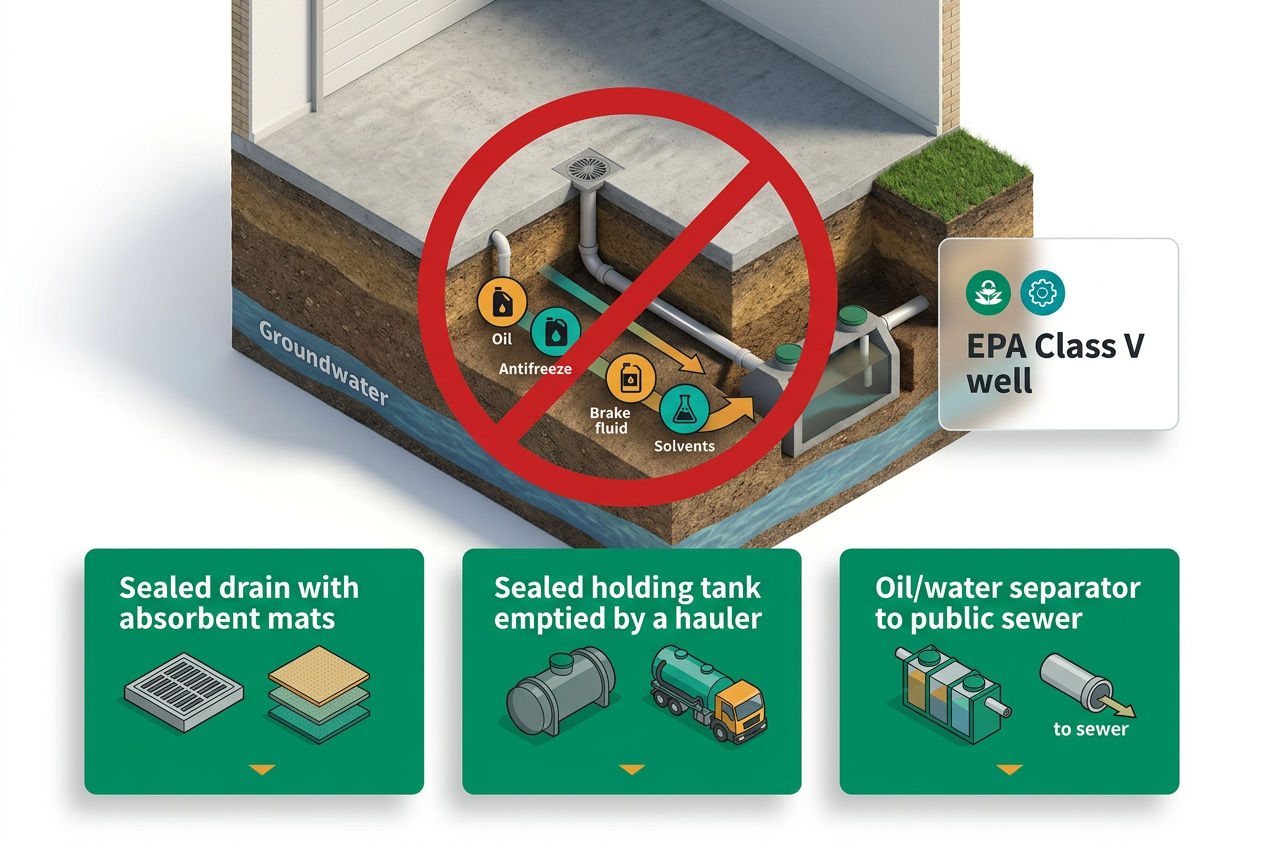
No. A garage floor drain should never go into a septic tank. Oil, antifreeze, brake fluid and solvents kill the bacteria that treat waste, and they pass straight into groundwater. The EPA's Underground Injection Control program has banned new motor vehicle waste disposal wells, which includes these drains, since 2000.
Your real choices are limited. You can seal the drain and use absorbent mats. You can run it to a sealed holding tank that a hauler empties. Or, if you're on public sewer, you can route it through an oil/water separator where the utility allows it.
Picture this: you buy a rural property with a big shop and a floor drain that "goes somewhere." An inspector traces it to the house septic tank. Now you're paying for a cleanup, a closure, and possibly a new drain field, because that soil has soaked up years of motor oil.
What Can't Go Into a Septic Tank for a Barn?
A septic tank for a barn can take toilet and hand-sink waste, but not livestock waste or farm wash water. Manure, stall wash-down and horse wash-rack runoff overload a tank with solids and nitrogen. Many states also regulate dairy milkhouse wastewater separately because its high fat and milk-solids load can wreck a standard drain field.
Keep these out of any barn or shop system:
- Manure and animal bedding
- Pesticide sprayer rinse water
- Parts-washer fluid, paint thinner and solvents
- Large volumes of hose wash-down water
Plan the barn bathroom as a small, separate fixture group. Route animal and equipment wash water somewhere else entirely, following your state's agricultural guidance.
How Much Does a Small Septic System for a Shop Cost?

DIY Septic Blueprint
Thinking about building it yourself?
The complete, plain-English plan to size, permit and install your own septic system — designed for homeowners, not contractors. Skip the $15,000–$25,000 quotes and do it right the first time.
Get the DIY Blueprint — $67 →Instant download · 8 modules + 3 bonus guides · 60-day money-back guaranteeA small septic system for a shop costs about $3,500–$10,000 for a conventional tank and drain field in 2026. Tying into a house system usually costs less. Engineered systems for poor soil can reach $10,000–$25,000 or more. Permits and perc testing add $300–$2,000.
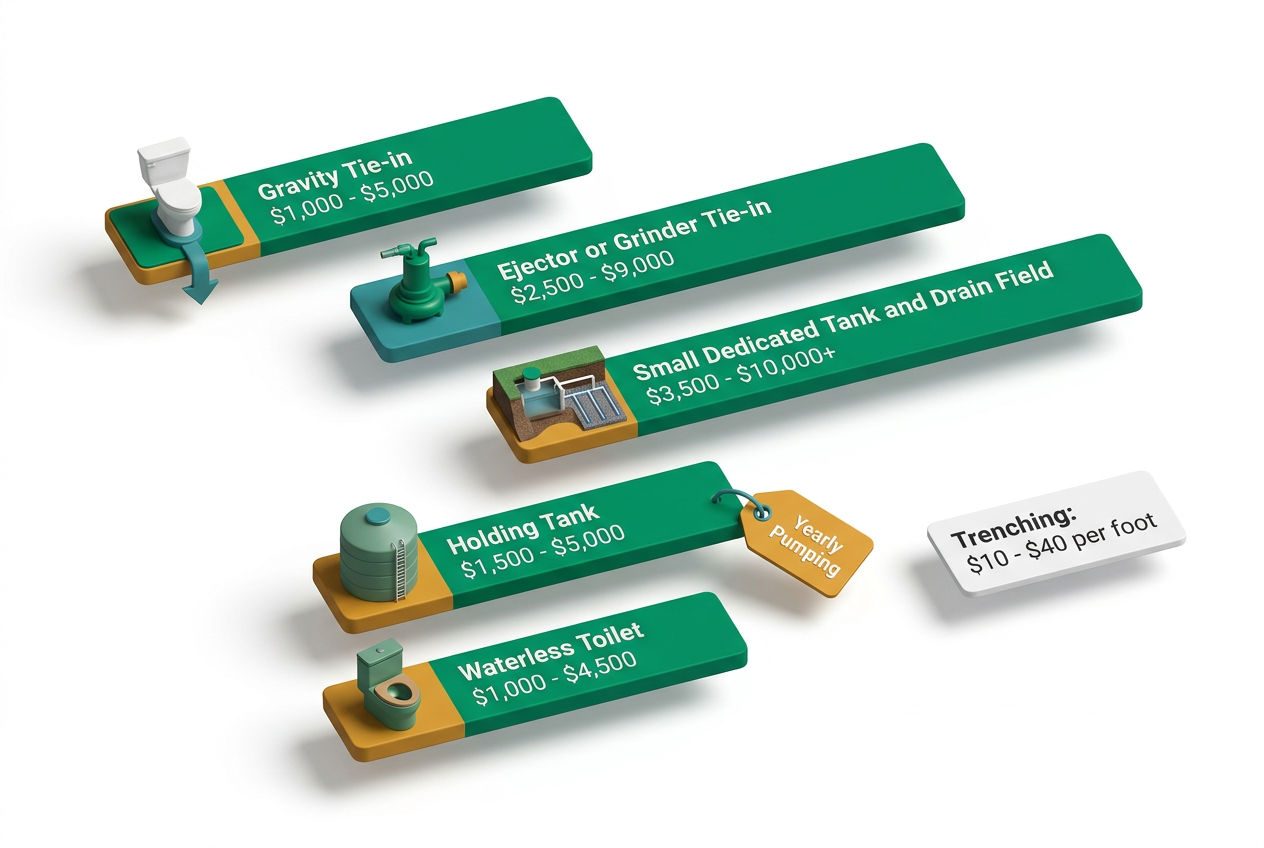
| Option | Installed Cost | Ongoing Cost | Best For |
|---|---|---|---|
| Gravity tie-in | $1,000–$5,000 | Shared pumping | Garage uphill of tank |
| Ejector/grinder tie-in | $2,500–$9,000 | Pump, power, alarm | Garage downhill or far |
| Small dedicated system | $3,500–$10,000+ | Pump every 3–5 yrs | Good soil, steady use |
| Holding tank | $1,500–$5,000 | $800–$1,600/yr pumping | Poor soil, light use |
| Waterless toilet | $1,000–$4,500 | Emptying, power | No sink, remote shop |
Source: SepticTankHub contractor pricing data, 2025–2026, and manufacturer list prices. Ranges vary by state, soil, distance and access.
Distance drives tie-in costs. Trenching often runs $10–$40 per foot depending on soil and rock. For a full breakdown of tank, field and labor pricing, see our septic installation cost guide.
What Permits and Tests Will You Need?
Most counties require a septic permit, a site plan and a soil evaluation or perc test for any new garage or shop system. A tie-in may need only a plumbing permit plus an inspection of the existing system. Budget $300–$2,000 for permits and testing, depending on your county.
The perc test tells the designer how fast your soil absorbs water. Spring testing can be tricky in wet regions because saturated soil gives poor results. Read our perc test guide before you schedule one.
Watch for the dwelling trap. Many counties restrict showers, kitchens or bedrooms in detached garages. Once you add those, the building may count as an accessory dwelling unit (ADU). Then the system gets sized by bedrooms, not by your shop's 20 gallons a day, and setbacks and fees change too. Some counties make you record a deed note saying the building isn't a residence.
Thinking of doing the work yourself? Our DIY septic system pillar explains which states let owners install their own system and which steps still need a licensed pro.
How Do You Keep Lines to a Detached Building From Freezing?
Keep the sewer line below your local frost depth, or insulate it. Frost depth ranges from about 12 inches in the South to 48–60 inches or more in Minnesota and northern New England. A long, shallow run to a detached garage is the classic winter freeze point.
Minnesota's MPCA rules for subsurface sewage treatment systems put a lot of weight on frost protection for this reason. Where you can't bury deep because of bedrock or a high tank inlet, lay 2-inch rigid foam board over the pipe before backfill. Avoid long flat runs where water can sit. In an unheated shop, a little-used toilet trap can also freeze. RV antifreeze in the bowl and trap over winter prevents a cracked fixture. Our septic pipe freeze prevention guide has more cold-climate fixes.
Which Option Should You Choose?
Pick the option that matches your use, your soil and your distance from the house. Most owners land on a tie-in when the house system is close and healthy, and a small dedicated system or holding tank when it isn't. Use this quick checklist:
- Is the house tank within about 150 feet, and is it healthy? Price a tie-in first.
- Is the garage downhill from the tank? Budget for an ejector or grinder pump.
- Does the shop need only a toilet, with no sink? A composting or incinerating toilet may be enough.
- Did the soil fail a perc test? Compare a holding tank against an engineered system over 10 years.
- Will anyone sleep or shower there? Expect ADU rules and bedroom-based sizing.
When you're ready for quotes, find a licensed septic installer near you and ask for a site visit, not a phone estimate. You can also review what a full septic installation service includes before you call.
Sources & Methodology
This article draws on these primary sources:
- U.S. Environmental Protection Agency — Septic Systems (epa.gov/septic): General septic design, sizing and maintenance guidance.
- EPA Underground Injection Control program (epa.gov): Rules on Class V motor vehicle waste disposal wells, including garage floor drains.
- State regulators: Texas TCEQ On-Site Sewage Facility rules, Minnesota Pollution Control Agency SSTS rules, Wisconsin POWTS rules and Ohio Department of Health sewage treatment system rules were reviewed for regional variations. tceq.texas.gov
- NOWRA (nowra.org): Industry standards for onsite system design and installation.
- Cost data: Ranges drawn from licensed septic contractors in the SepticTankHub directory and manufacturer list prices for composting and incinerating toilets, 2025–2026.
Rules change and vary by county. Confirm current requirements with your local health department before you build.
Primary sources to read: EPA: motor vehicle waste disposal wells · Texas TCEQ: OSSF permits · Minnesota Rules chapter 7080 (SSTS standards) · Ohio Admin. Code 3701-29-07 (soil evaluation)
More Septic Design & Install Guides
- Septic system design: the complete guide
- Septic for an ADU or guest house
- Septic pipe slope: the right fall per foot
- What septic system design costs
- How to draw a septic site plan
- Septic tank excavation
- Can you install your own septic system? Rules by state
Frequently Asked Questions
How much does a small septic system for a garage cost?
A small septic system for a garage usually costs $3,500–$10,000 for a conventional tank and drain field. That covers a 750- to 1,000-gallon tank, a short leach field, excavation and the permit. If your soil fails a perc test and you need a mound or other engineered system, the price can climb to $10,000–$25,000 or more. Tying into your existing house septic is often cheaper, about $1,000–$5,000 for a gravity line, or $2,500–$9,000 with an ejector or grinder pump. Distance matters, because trenching often runs $10–$40 per foot. Add $300–$2,000 for permits and soil testing. Get at least two site-visit quotes, since rock, slope and access can swing costs by thousands.
Can a septic system for a detached garage tie into my house septic?
Yes, a septic system for a detached garage can often tie into your house septic if the existing system has spare capacity and works well. House systems are sized by bedrooms, so a shop half-bath adding 15–20 gallons a day rarely overloads a healthy system. The challenge is getting waste there. A gravity line needs at least 1/8 inch of fall per foot, so a 150-foot run drops about 19 inches. If the garage sits downhill or too far away, you'll need an ejector or grinder pump, about $1,500–$4,000 installed. Many counties require a plumbing permit and an inspection of the house system first. Don't tie into a system that's already backing up or has a soggy drain field.
What size tank does a small septic system for a shop need?
A small septic system for a shop typically needs a 750- to 1,000-gallon tank, because most states set residential minimums in that range regardless of actual flow. A two-person shop with one toilet and a sink produces only about 15–20 gallons a day, so a 1,000-gallon tank holds roughly 50 days of flow. That long retention time lets solids settle well. Some states allow smaller tanks for low-flow, non-residential buildings, but you'll need approval. Commercial shops with employees are sized differently, often at 15–25 gallons per employee per day, and usually need a licensed designer. The drain field, not the tank, is usually the limiting factor, since it depends on your perc test results.
Can I install a septic tank for a barn with livestock?
You can install a septic tank for a barn, but it should only take human waste from a toilet and hand sink. Livestock waste, stall wash-down water and horse wash-rack runoff must stay out. Manure overloads a tank with solids and nitrogen and will clog the drain field quickly. Many states also regulate dairy milkhouse wastewater separately because its fats and milk solids damage standard systems. Farm buildings are often exempt from building codes, but that exemption rarely covers sewage. Your county health department will still require a permit for the barn bathroom. Plan the toilet as a separate small system or a tie-in, and route animal and equipment wash water elsewhere.
Can a garage floor drain go into a septic system for a detached garage?
No, a garage floor drain cannot go into a septic system for a detached garage. Oil, antifreeze, brake fluid and solvents kill the bacteria that treat sewage and seep into groundwater. The EPA's Underground Injection Control program has banned new motor vehicle waste disposal wells, which include these drains, since 2000. Existing ones in many areas must be closed. Your legal options are sealing the drain, routing it to a sealed holding tank that a licensed hauler empties, or connecting through an oil/water separator to public sewer where allowed. If you buy a property with an old shop drain, find out where it goes before closing. Cleanup of a contaminated drain field is expensive.
Free download
Not ready for the Blueprint? Start free.
Grab the free DIY Septic Planning Kit — the permit-first checklist, perc-test cheat sheet, and sizing tables that keep your build from getting red-tagged.
Was this article helpful?
Frequently Asked Questions
Recommended Resources
📖 Related Articles
- Septic System Permit Cost & State Requirements (2026 Guide)
- Septic Grinder Pump: The Complete Guide
- Small Septic Tanks: Options for Cabins, Tiny Homes & Guest Houses
- Composting Toilets: The Complete Guide (How They Work + Best Models)
- Incinerating Toilets: How They Work, Cost & Best Models
- Perc Test (Percolation Test): What It Is & How It Works
- DIY Septic System: How to Build Your Own (Step-by-Step)
- Freezing Pipes and Septic: How to Prevent Winter Damage
💰 Cost Guides
🔧 Services
Find Septic Professionals Near You
Compare licensed, verified septic companies by area — top county markets and cities below, or browse all 50 states.
County markets
Popular cities
