
Quick Answer
A septic grinder pump is a submersible sewage pump that grinds solid waste into a fine slurry and forces it uphill or over long distances through a pressurized pipe to a septic tank or sewer main. Homeowners in low-lying areas, hilly terrain, or homes with basement bathrooms rely on grinder pump systems when gravity alone can't move waste where it needs to go. Think about it this way: if your basement bathroom sits six feet below your septic tank, where exactly is that waste supposed to go without a pump doing the pushing?
Key Takeaways
- Grinder pumps are required when sewage can't flow downhill by gravity — common in coastal areas, hilly terrain, and homes with below-grade plumbing.
- Residential units run 1–2 HP and cost $800–$3,500 for the pump unit; total installed cost ranges from $2,500–$10,000+.
- Average lifespan is 8–15 years; premium models like E/One can last up to 25 years with maintenance.
- A grinder pump alarm means act now — you typically have 24–48 hours before the basin overflows.
- Never flush wipes, feminine products, or grease into a grinder pump system — they cause the most common preventable failures.
What Is a Septic Grinder Pump and How Does It Work?
A septic grinder pump sits inside a sealed underground basin — typically 30–50 gallons for residential systems — and does two jobs simultaneously: it grinds solid waste to particles as small as 1/8 inch, then pumps that liquefied slurry through a small-diameter pressure pipe (usually 1.25–2 inches) to its destination. That destination might be a municipal pressure sewer main, a septic tank further uphill, or a remote drain field on a large rural lot.
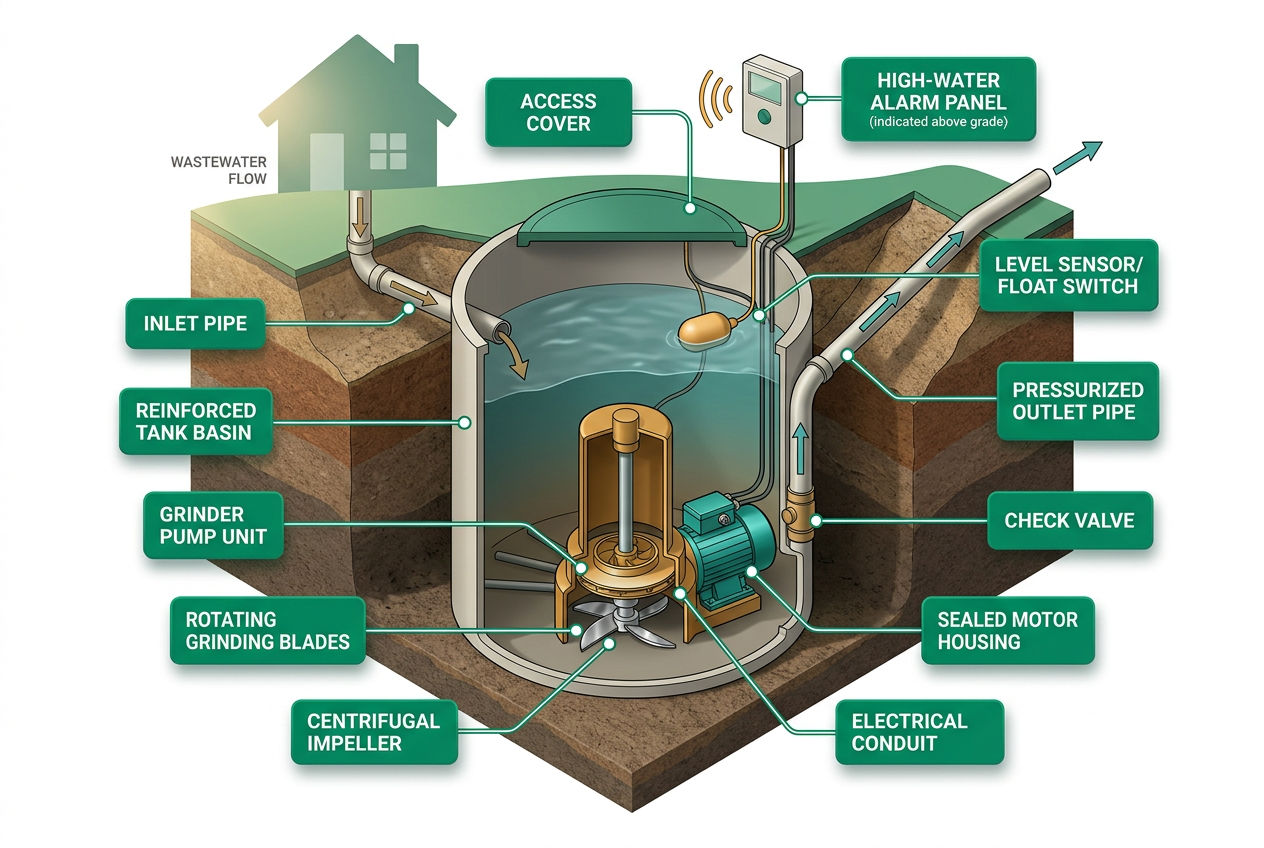
The cutting mechanism is the heart of the pump. Most residential models use counter-rotating steel cutter rings that work similarly to a garbage disposal — just far more powerful. Once the waste is ground fine enough, the centrifugal pump impeller kicks the slurry through the discharge line at pressures capable of pushing waste 60–130+ feet vertically or hundreds of feet horizontally.
Most residential grinder pumps are wired to 120V or 240V circuits depending on the model. Float switches inside the basin activate the pump automatically when sewage reaches a preset level. A second float — set higher — triggers the grinder pump alarm if the basin fills beyond normal operating range. The pump runs on demand. A 4-person household might cycle theirs 6–10 times per day depending on water usage habits.
When Do You Actually Need a Septic Grinder Pump?
Not every home needs one. Gravity does the job for most properties — waste flows downhill from the house to the tank. But several situations make a grinder pump non-negotiable.
Below-grade plumbing. A basement bathroom sits below the elevation of your septic tank or sewer main. Waste can't flow up on its own. A sewage grinder pump in the basin pushes it up and out. This is probably the most common residential use case.
High water table areas. In coastal Florida, the Louisiana Gulf Coast, and the Chesapeake Bay region of Maryland and Virginia, the water table can sit just a few feet below the surface. Gravity septic systems simply can't function. According to the National Association of Wastewater Technicians (NAWT), many municipalities in these areas have built entire pressure sewer systems where every home has its own grinder pump feeding a shared low-pressure sewer line.
Hilly and mountainous terrain. Homes in West Virginia, eastern Tennessee, and the Appalachian ridge of Virginia and North Carolina are frequently built below road grade. The septic connection runs uphill. Grinder pumps handle that elevation change without breaking a sweat.
Long horizontal distances. On large rural lots, your house might sit 400–600 feet from the septic tank location. A grinder pump's pressure capability makes those long runs feasible without oversizing the pipe.
If you're buying a property and the inspector mentions a grinder pump, don't panic — but do understand that you're taking on a mechanical component that requires electricity, periodic maintenance, and eventual replacement. Check out our guide to what to expect during a septic inspection before closing.
Grinder Pump vs. Ejector Pump: What's the Difference?
The short answer: a grinder pump grinds solids before pumping; an ejector pump does not. This comparison trips up a lot of homeowners, and the distinction matters because choosing the wrong unit leads to repeated clogs and costly service calls.
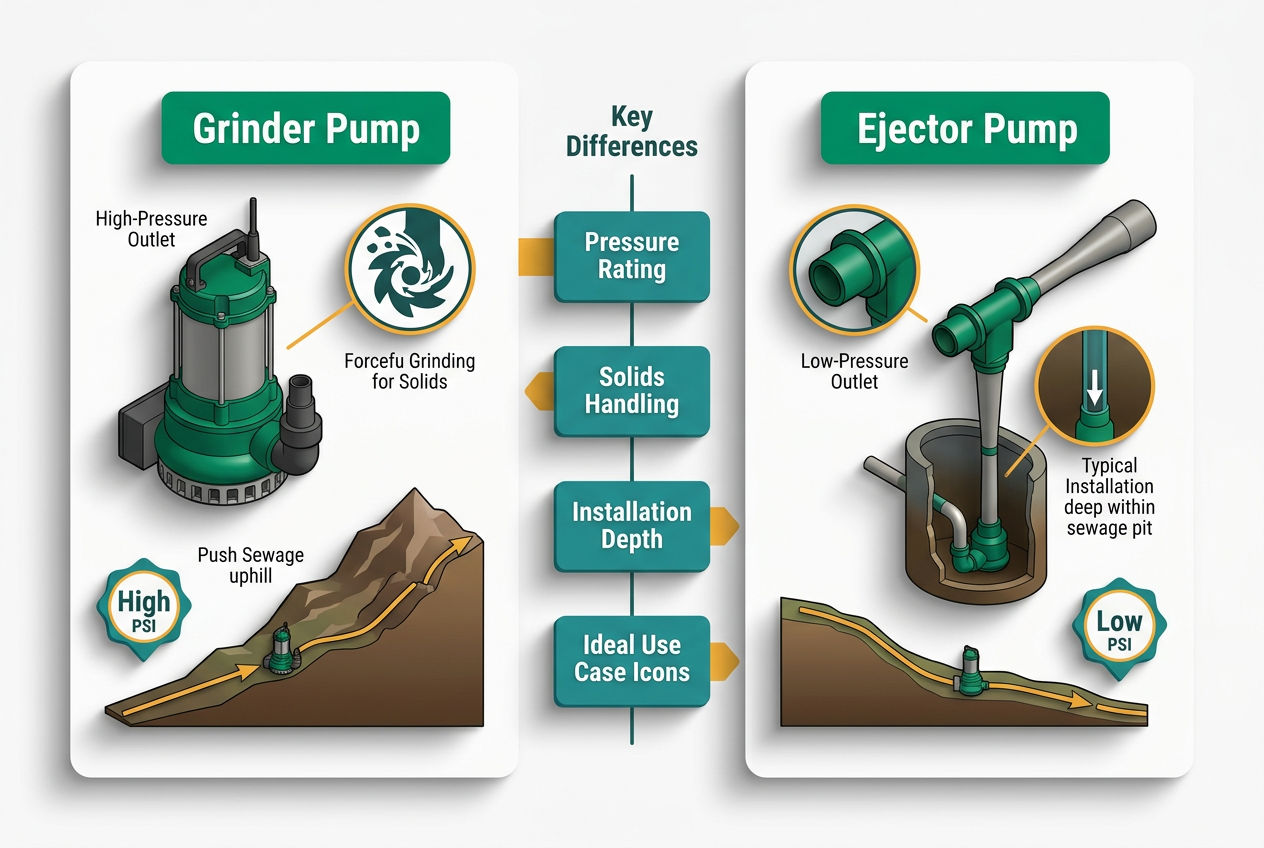
| Feature | Grinder Pump | Ejector Pump |
|---|---|---|
| Solids handling | Grinds to 1/8" particles | Passes small solids only |
| Typical HP | 1–2 HP | 0.5–1 HP |
| Discharge pressure | 60–130+ ft head | 15–25 ft head |
| Unit cost | $800–$3,500 | $300–$800 |
| Best application | Below-grade full baths, pressure sewer | Basement laundry, utility sinks |
| Lifespan | 8–15 years | 7–12 years |
Source: NAWT technical guidelines; manufacturer published specifications (E/One, Liberty, Myers)
An ejector pump — sometimes called a sewage ejector pump — is fine for a basement utility sink or laundry room. The moment you add a toilet to that basement bathroom, you need a true grinder pump. Toilets introduce solid waste that will jam an ejector pump in short order.
For a deeper comparison, see our article on effluent pump vs. grinder pump — they serve different roles in a septic system and get confused almost as often.
How Much Does a Septic Grinder Pump Cost?
Grinder pump costs break into two buckets: the unit itself and the total installed cost. Both vary widely based on horsepower, brand, and site conditions.

Unit cost: $800–$3,500
- Budget residential models (Liberty, Myers): $800–$1,500
- Mid-range 2 HP units: $1,200–$2,200
- Premium models (E/One, Environment One): $2,000–$3,500
Total installed cost (pump + basin + plumbing + labor): $2,500–$10,000+
Here's a real-world example. A homeowner in coastal South Carolina needs a grinder pump installed for a below-grade master bathroom addition. The E/One GP2000 unit runs about $2,400 from a supply house. The 45-gallon fiberglass basin, discharge plumbing, electrical connection to a 240V circuit, and one day of labor from a licensed contractor adds $3,000–$4,500. Total: $5,400–$6,900. That same project in rural Indiana with a lower-HP Liberty pump could come in closer to $3,000–$4,000.
Replacement cost (pump swap only): $1,500–$5,000 depending on parts and labor rates in your area. See our septic pump replacement cost guide for a full breakdown.
Annual maintenance: $100–$300 for a professional inspection and basic service.
Emergency repair call: $300–$800+ depending on time of day and your location. After-hours calls on holidays routinely run $600–$1,200.
For full system context, the septic installation cost guide covers how grinder pump systems compare to conventional gravity installations.
How Long Does a Septic Grinder Pump Last?
It depends heavily on what goes into the basin and whether you maintain it. Without maintenance, most residential grinder pumps fail between 6–10 years. With annual servicing and careful use, 8–15 years is realistic.
Premium units like the Environment One (E/One) series are engineered for 20–25 year service lives — and field data from municipal pressure sewer systems backs that up. According to Environment One Corporation's published performance data, properly maintained GP2000 series units deployed in low-pressure sewer districts routinely exceed 20 years of service.
The cutting mechanism is the first thing to wear. Cheap pumps use cast iron impellers and cutters that corrode and dull over time. Mid-grade and premium pumps use hardened steel alloys that hold an edge far longer. Motor burnout is the other common failure. It happens when the pump runs dry (no liquid to cool the motor), when electrical supply is inconsistent, or when the pump is straining against a clog it can't overcome. That's why protecting your pump from non-grindable materials isn't just about avoiding clogs — it directly affects motor lifespan.
What Should You Never Put in a Grinder Pump System?
Even with 1–2 HP of cutting force, there are materials a grinder pump simply cannot handle safely. Put any of these in regularly and you're looking at premature failure.
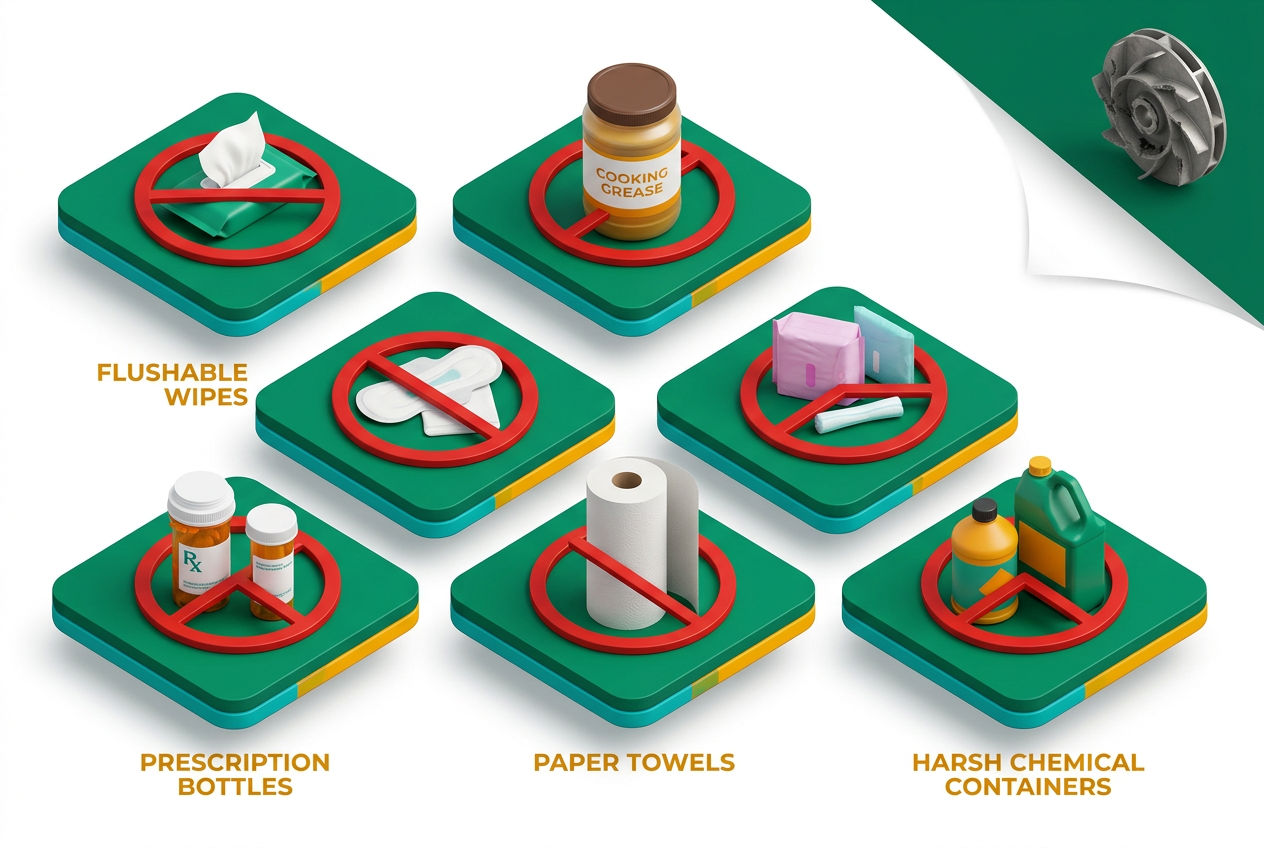
- "Flushable" wipes — These don't break down. They wrap around the cutter mechanism and create rope-like masses that jam even powerful motors. Our article on whether flushable wipes are truly septic-safe explains why they're the #1 cause of preventable pump failure.
- Feminine hygiene products — Tampons and pads absorb and expand; they're nearly impossible to grind through.
- Cooking grease and fats — These solidify in the basin and discharge line, creating blockages that require a service call.
- Paper towels and rags — Too dense to grind effectively.
- Medications — Won't damage the pump, but they pass through treatment systems unchanged and contaminate groundwater.
- Cat litter — Even "flushable" varieties create concrete-like paste in the basin.
The rule is simple: human waste and toilet paper only. Everything else goes in the trash.
How Do You Know If Your Grinder Pump Is Failing?
Your grinder pump alarm is your first and most important warning. When that alarm sounds — whether it's an audible buzzer, a red light on the control panel, or a notification from a smart control unit — it means the basin level has risen above normal operating range. Either the pump isn't running, isn't keeping up, or the incoming flow rate is temporarily overwhelming it.
Beyond the alarm, watch for these signs:
Slow drains throughout the house. If the basin is backing up, drain speed drops before sewage backs into the lowest fixture.
Pump running constantly. A healthy residential grinder pump cycles on and off. If yours runs nonstop, the motor is working against a blockage or the discharge line has a leak.
Gurgling sounds from drains or toilets. Air moving backward through the system as the basin fills.
Visible sewage odors around the basin lid. The basin is sealed. Odors escaping at grade level mean the seal has failed or the basin is near overflow.
Pump cycles but basin doesn't drain. Cutter is likely jammed. Don't keep manually cycling the pump — you'll burn the motor.
If the alarm sounds and the pump isn't running, try the reset button on the control panel first. If it trips again within an hour, call a licensed service technician. You typically have 24–48 hours before the basin reaches overflow capacity — less if the household is still using water heavily.
Grinder Pump Maintenance: What It Takes to Hit 15+ Years
Schedule a professional inspection annually. During that visit, a technician should check float switch calibration, test the alarm circuit, inspect the discharge check valve, measure amperage draw on the motor, and look for cutter wear. According to NAWT maintenance guidelines, annual inspections catch the majority of developing failures before they become emergency replacements.
Between professional visits, here's what you can do yourself:
Test the alarm annually. Manually lift the alarm float inside the basin (with power on and the pump off). The alarm should activate immediately. If it doesn't, the alarm circuit has failed — a service call is cheaper than the alternative.
Check for standing water around the basin lid. Surface water intrusion increases the load on the pump and introduces debris.
Know your circuit breaker location. If the pump alarm sounds during a power surge, you may need to reset a tripped breaker before calling a technician.
Keep a service log. Note each pump cycle anomaly, service call, and part replacement. When the pump eventually fails, this log tells a technician exactly how long the unit ran and what issues preceded failure.
One practical limitation worth acknowledging: even with perfect maintenance, you cannot fully predict when the motor will burn out. Grinder pump motors don't give much warning before final failure. Homeowners who are risk-averse should budget for replacement before the pump hits 10 years, not after the alarm sounds at 2 a.m.
Who Is Responsible for Maintaining a Grinder Pump — You or the Utility?
The answer depends entirely on your municipality, and getting it wrong costs money. In privately owned septic systems, the pump is your equipment — maintenance, repair, and replacement fall to you.
In municipal low-pressure sewer districts, the answer splits. Some utilities — including several West Virginia public utility districts — own the pump, basin, and associated equipment outright. They charge a monthly service fee ($25–$75 is typical) that covers maintenance and emergency response. Others install the equipment but transfer ownership to the homeowner at closing, making the utility responsible only for the main sewer line.
Before buying a property with a grinder pump system, ask three questions directly:
- Who owns the pump — the homeowner or the utility?
- Who is responsible for emergency repair calls?
- Is there a service agreement in place, and what does it cover?
Check with the local health department or public utility district for written documentation. Verbal assurances from sellers or real estate agents are not reliable for this question. Some states publish septic regulations by state pages through their environmental health departments — Florida's program is administered through the Florida Department of Health under Registered Septic Tank Contractor (RSTC) licensing requirements, which govern who may legally service grinder pump systems.
Top Grinder Pump Brands Worth Knowing
Not every grinder pump on the market deserves space in your yard. Here are the brands that show up consistently in contractor recommendations and municipal specifications:
Environment One (E/One) — The premium tier. The GP2000 series is the most commonly specified unit in municipal low-pressure sewer districts in the eastern United States. Engineered for 20–25 year lifespan. Expensive upfront; lower lifetime cost. Parts availability is excellent through utility distributor networks.
Liberty Pumps — The 404 series is a reliable mid-range option. Liberty has built strong contractor relationships and offers solid warranty support. A good choice for residential new construction where the E/One price point isn't justified.
Myers — The WG200 series competes in the same mid-range bracket as Liberty. Myers is a long-established brand with broad parts availability. Some contractors prefer Myers for retrofit applications because the footprint suits older basins well.
Zoeller — Respected brand in the sewage pump market. Their grinder line handles residential applications well. Zoeller's customer support infrastructure is one of the better ones in the industry.
What to avoid: House-brand pumps sold through big-box stores with no manufacturer support infrastructure. A contractor pushing a house-brand or unknown import to save cost deserves some scrutiny. Ask which brand they're specifying, why they chose it, and whether parts are stocked locally.
For help finding a qualified installer in your area, use our find licensed septic professionals directory.
Find a Grinder Pump Installer Near You
Grinder pump installation in most jurisdictions requires a licensed contractor — in Florida, that means an RSTC-licensed professional through the Florida Department of Health environmental health program. Other states have equivalent licensing through their environmental or health departments.
When interviewing contractors, ask:
- Are you licensed for septic system work in this state?
- Do you pull the required permit for grinder pump installation?
- Which brand are you specifying, and why?
- What's your warranty on labor?
- Do you offer emergency service if the pump fails after hours?
The guide to choosing a septic service company walks through the full vetting process in detail. For emergency situations, our emergency septic service listings connect you with licensed technicians by region.
Sources & Methodology
Pricing data reflects contractor quotes, supply house pricing, and regional cost surveys collected during Q1–Q2 2025. Lifespan figures are drawn from manufacturer published specifications and NAWT field guidance. Brand recommendations reflect installer feedback and municipal specification data, not paid placement.
- U.S. Environmental Protection Agency — Decentralized Wastewater Treatment Systems: A Program Strategy (EPA 832-R-05-002)
- National Association of Wastewater Technicians (NAWT) — Grinder Pump System Maintenance Guidelines
- Environment One Corporation — GP2000 Series Technical Specifications and Field Performance Data
- Florida Department of Health — Registered Septic Tank Contractor Licensing Requirements, floridahealth.gov
- Liberty Pumps — 404 Series Installation and Service Manual
Frequently Asked Questions
What is a sewage grinder pump and how is it different from a regular sump pump?
A sewage grinder pump is a heavy-duty submersible pump that grinds solid human waste into fine slurry — particles as small as 1/8 inch — and then forces that slurry through a small-diameter pressurized pipe to a septic tank or sewer main. A regular sump pump moves clean or lightly contaminated groundwater away from a foundation; it has no cutting mechanism and cannot handle solid waste at all. The sewage grinder pump operates inside a sealed underground basin that receives all household wastewater, including toilet waste. It activates automatically via float switches when the basin fills to a set level. According to NAWT maintenance guidelines, the cutting mechanism and motor are the two components most likely to fail, which is why annual inspections matter. A sump pump failing is a nuisance; a sewage grinder pump failing means sewage backs up into your home — a much more urgent and costly situation.
How much does grinder pump installation cost, and what drives the price variation?
Grinder pump installation costs range from $2,500 on the low end to $10,000 or more for complex projects. The pump unit itself runs $800–$3,500 depending on horsepower and brand — a Liberty 404 series might cost $900 from a supply house, while an E/One GP2000 runs approximately $2,400. Labor, basin, discharge plumbing, and electrical connection to a 240V circuit add $1,500–$5,000 on top of the unit cost. What drives the variation: site conditions (rocky soil increases excavation costs significantly), permit fees by jurisdiction, local labor rates, and whether the existing basin can be reused or must be replaced. A straightforward pump swap in an accessible basin in rural Indiana might cost $1,800 total. A new installation with full basin replacement and trenching in coastal South Carolina can reach $7,000. Always get three quotes and verify each contractor is licensed in your state.
How long does a grinder pump last before it needs replacement?
Most residential grinder pumps last 8–15 years under normal conditions with annual maintenance. Without regular servicing, expect failure closer to 6–10 years. Premium units like the Environment One GP2000 are engineered for 20–25 year service lives, and according to Environment One's published field performance data, properly maintained units in municipal pressure sewer systems routinely exceed 20 years. The biggest factors affecting lifespan are what goes into the system — flushable wipes, grease, and feminine hygiene products are the top causes of premature failure — and whether the motor runs dry, which destroys it quickly. Cast iron cutters on budget models dull and corrode faster than the hardened steel alloys used in premium units. One honest limitation: even with perfect maintenance, grinder pump motors give little warning before final failure. Homeowners approaching the 10-year mark should budget for replacement proactively rather than waiting for a 2 a.m. emergency.
What does it mean when a grinder pump alarm goes off?
When the grinder pump alarm activates — whether that's a buzzer, a red light on the control panel, or a smart system notification — it means the basin water level has risen above the normal operating range. The pump is either not running, not keeping up with incoming flow, or the discharge line is blocked. Your first step is to try the reset button on the control panel. If the alarm trips again within an hour, stop using water in the house immediately and call a licensed technician. According to system design standards cited by NAWT, most residential basins provide 24–48 hours of storage capacity above the alarm float level — but that window shrinks fast if the household keeps running water. Do not ignore the alarm and continue normal use. Sewage overflowing a grinder pump basin creates a health hazard and an expensive cleanup. Treat every alarm activation as urgent until proven otherwise.
Can I use a grinder pump for a basement bathroom addition?
Yes — a grinder pump is typically the correct solution for a basement bathroom that sits below the elevation of your septic tank or municipal sewer main. This is actually the most common residential grinder pump application. The pump grinds toilet waste to fine slurry and forces it upward through a 1.25–2 inch pressurized discharge line to wherever your drain system connects. An ejector pump is not sufficient for a basement bathroom with a toilet — ejector pumps pass small solids but cannot handle the volume and density of toilet waste. For a below-grade bathroom addition, a licensed contractor will install the pump inside a sealed 30–50 gallon basin, connect the bathroom fixtures, run a discharge line to the main drain, and wire the unit to a dedicated 120V or 240V circuit. Total installed cost typically runs $2,500–$6,000 depending on your location and the complexity of the plumbing run. Permit requirements apply in most jurisdictions.
What is the difference between a grinder pump and an effluent pump?
A grinder pump and an effluent pump serve completely different roles in a septic system and should not be confused. A grinder pump sits at the source — inside a basin that receives raw household sewage — and grinds solid waste before pumping the slurry to a tank or sewer main. It handles the full waste stream, including toilet solids. An effluent pump, by contrast, is installed inside a septic tank or pump chamber and moves liquid effluent — wastewater that has already been partially treated and clarified by the tank — to a drain field or secondary treatment system. Effluent pumps see no raw solids; they operate in clarified liquid. According to NAWT technical guidelines, effluent pumps typically run 0.5–1 HP and discharge at much lower pressures than grinder pumps. If your drain field is uphill or at a long distance from your septic tank, an effluent pump handles that transfer. See our full effluent pump vs. grinder pump comparison for complete details.
Who is responsible for grinder pump repair — the homeowner or the utility?
Responsibility depends entirely on your municipality and whether the system is privately owned or part of a municipal low-pressure sewer district. In private septic systems, the pump is your equipment — you pay for maintenance, repairs, and replacement. In municipal pressure sewer districts, some utilities own the pump and basin outright and charge a monthly service fee ($25–$75 per month is typical in West Virginia public utility districts, for example) that covers emergency response and routine maintenance. Other municipalities install the equipment but transfer ownership to the homeowner at closing. Before purchasing a property with a grinder pump system, get written documentation from the utility or local health department clarifying ownership and maintenance responsibility. Verbal assurances from sellers are not reliable. In Florida, any contractor legally performing grinder pump service must hold a Registered Septic Tank Contractor license through the Florida Department of Health — a useful standard to verify when hiring service technicians regardless of who owns the equipment.
Free download
Not ready for the Handbook? Start with the free Fridge Card.
The Do / Don’t card the whole family can see, plus the Survival Kit: emergency flowchart, warning-sign decoder and pump-schedule card. One printable PDF.
Was this article helpful?
Frequently Asked Questions
Recommended Resources
📖 Related Articles
🔧 Services
Find Septic Professionals Near You
Compare licensed, verified septic companies by area — top county markets and cities below, or browse all 50 states.
County markets
Popular cities
