
Quick Answer
A septic pump is a submersible or inline pump that moves wastewater when gravity alone can't get the job done. Most systems — roughly 60 to 70 percent of the 21 million septic systems in the U.S., according to the EPA — rely on gravity flow. But if your drainfield sits uphill from your tank, or your lot has poor soil drainage, or you're on a mound system, a pump isn't optional. It's the whole reason the system works.
Key Takeaways
- Not every septic system uses a pump. Gravity systems don't need one; mound, pressure-dosed, and low-pressure pipe systems do.
- The three main pump types are effluent pumps, grinder pumps, and dosing (timer-controlled) pumps — each built for a different job.
- Replacing a pump typically costs $500–$1,500 installed for effluent pumps and $1,000–$2,500 for grinder pumps.
- Average pump lifespan is 5–15 years. Float switch failure, motor burnout, and solids clogging are the top three causes of early failure.
- A high-water alarm going off usually means your pump has stopped working — don't ignore it.
Does Your Septic System Actually Need a Pump?
Most conventional gravity-fed septic systems have no pump at all. Wastewater flows from the house to the tank, separates into solids and liquid effluent, then drains passively to the drainfield through a distribution box. Gravity does all the work.
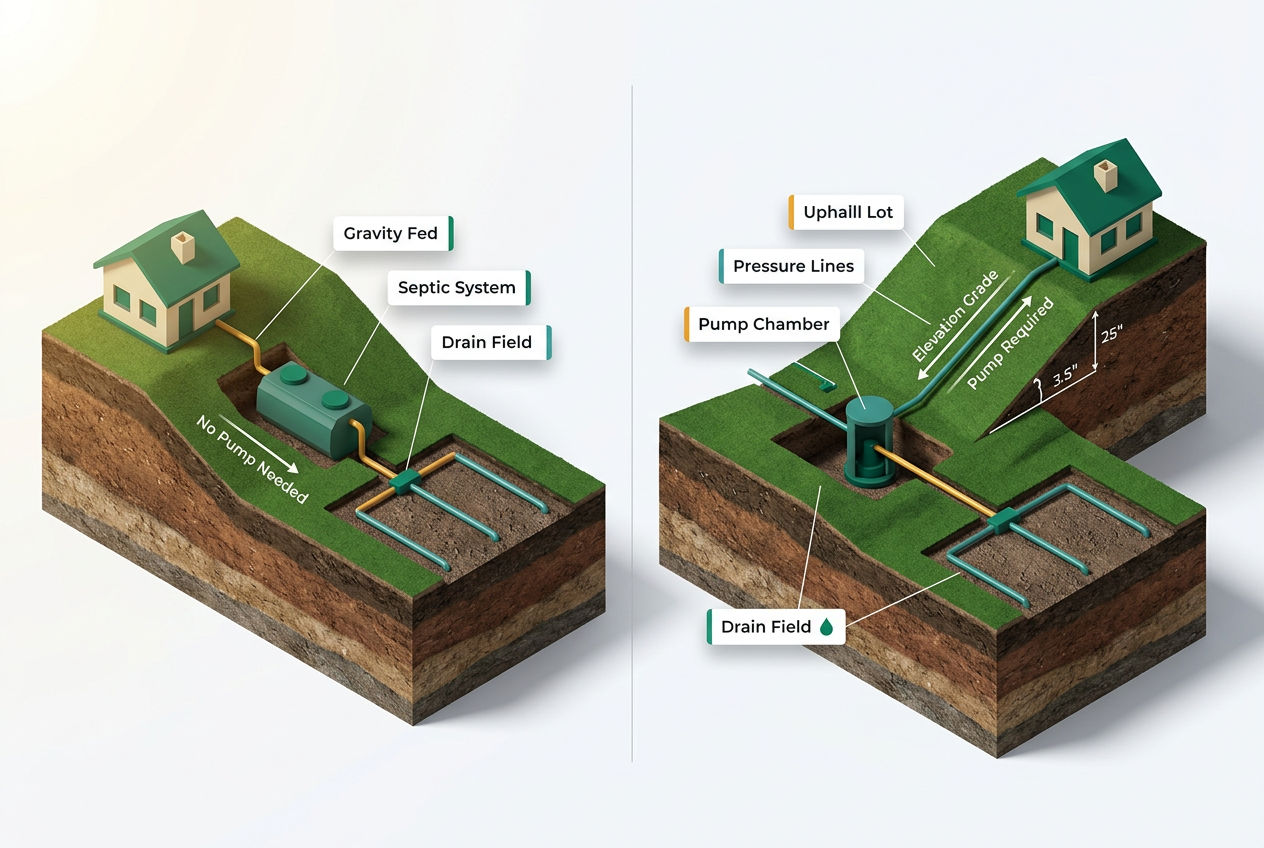
You need a pump when gravity can't. That happens in four main scenarios:
- Your drainfield is uphill from the tank. Even a 6-inch elevation difference over 100 feet can be enough to stall flow.
- You have a mound system. Mound septic systems are elevated above grade to compensate for shallow bedrock, high water tables, or poor-draining soil. The pump has to push effluent up into the mound media.
- You're on a low-pressure pipe (LPP) system. These distribute effluent through small-diameter perforated laterals under controlled pressure — a pump is required.
- You're connected to a community low-pressure sewer (LPS) system. Common in the Mid-Atlantic and suburban Southeast, these systems use individual grinder pumps at each home.
If you're not sure which system type you have, start with our guide to types of septic systems. Knowing your system type will tell you immediately whether a pump is part of the picture.
What Are the Different Types of Septic Pumps?
There are three primary pump types used in residential septic systems. They look similar but do very different jobs, and they are not interchangeable.
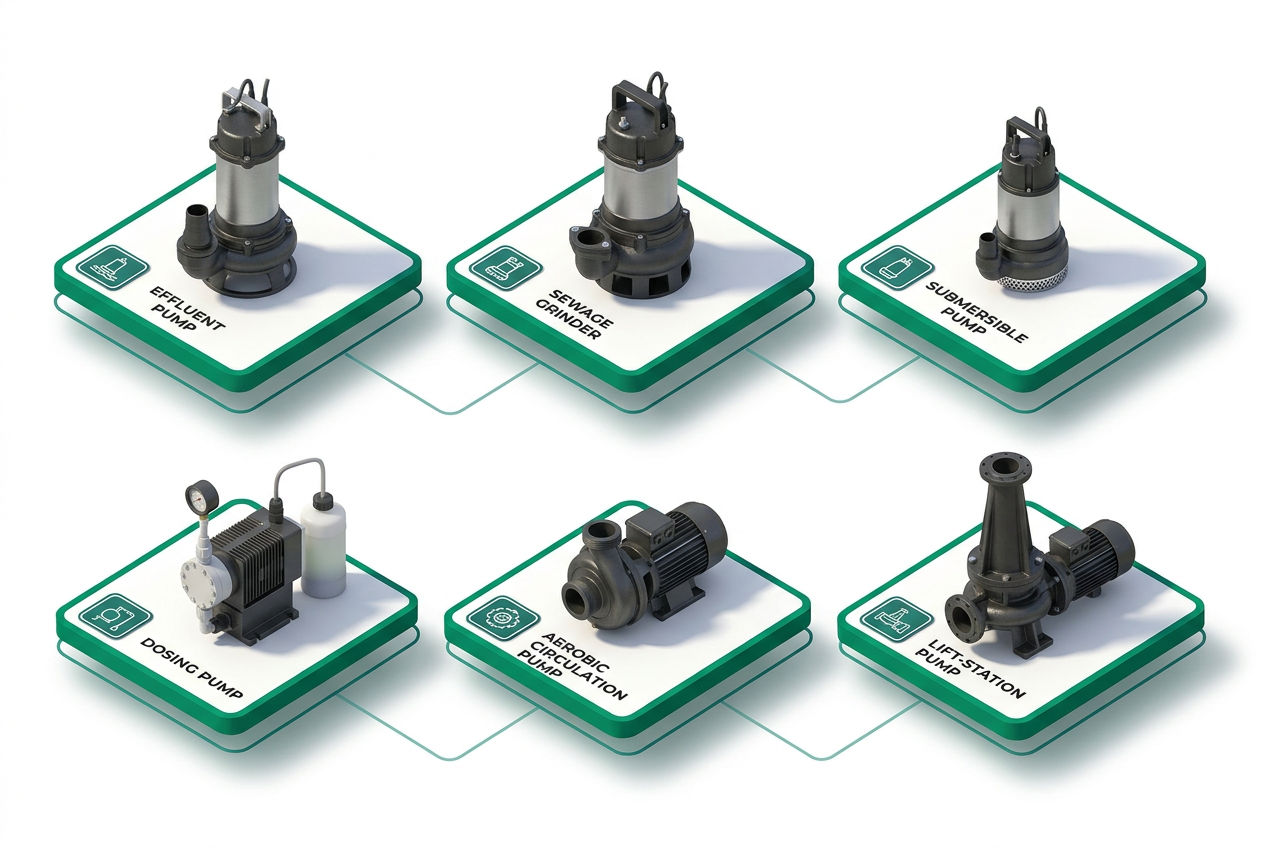
Effluent Pumps
An effluent pump moves clarified liquid — the effluent that's already been separated from solids in the tank — from a pump chamber or dose tank to the drainfield or mound. This is the most common residential septic pump. Most residential effluent pumps are rated at 0.5 HP to 1.0 HP and move 750 to 1,500 gallons per hour (GPH) depending on the head pressure required. They're submersible units, meaning they sit in the pump chamber submerged in effluent. A float switch controls when they cycle on and off.
Effluent pumps are designed for relatively clean liquid with small suspended solids. They can't handle raw sewage with intact solids, rags, or debris. If those things enter the pump chamber, you'll burn out the motor fast.
Common brands used by contractors include Zoeller, Liberty Pumps, and Myers. A Zoeller M267 or similar 0.5 HP unit typically costs $150–$350 for the pump alone. Installed with labor, expect $500–$1,200 total.
Grinder Pumps
A grinder pump handles raw sewage — not clarified effluent. It's installed directly in a wet well or holding chamber where toilet waste, solids, and household wastewater collect before being macerated and pumped under pressure to a sewer main or treatment system. The grinding mechanism chops solids into fine slurry. That's what makes them so useful in low-pressure sewer (LPS) community systems, where each home has its own unit pushing waste to a central collection point. They're also used in hillside builds where raw sewage has to travel uphill over long distances.
Grinder pumps are heavier-duty and more expensive. A residential unit costs $600–$1,200 for parts alone. Installed, expect $1,000–$2,500 depending on tank access and local labor rates. Their average lifespan is 8–12 years — shorter than an effluent pump because the grinding mechanism takes wear.
For a detailed side-by-side comparison, read our effluent pump vs. grinder pump breakdown.
Dosing Pumps (Timer-Controlled Distribution)
A dosing pump is essentially an effluent pump controlled by a timer rather than just a float switch. Instead of pumping whenever the chamber fills, it delivers measured "doses" of effluent to the drainfield at specific intervals throughout the day.
Why does that matter? Drainfields absorb effluent better in small, regular doses than in large single surges. Timed dosing prevents hydraulic overload, extends drainfield life, and is required by code in many states for certain system types.
Dosing systems typically use a pump chamber (or dose tank) with a capacity of 500–1,000 gallons. The timer and float switch work together: the float prevents the pump from running dry; the timer controls the schedule.
Orenco Systems makes widely-used residential dosing pump assemblies, including their AdvanTex series components.
Sewage Ejector Pumps
A sewage ejector pump serves a different function than the three types above. It handles wastewater from below-grade plumbing fixtures — basement bathrooms, laundry rooms, or utility sinks that sit below the main drain line — and lifts that waste up to the gravity drain level. Ejector pumps are installed in a sealed basin beneath the floor and pump raw sewage upward to connect with the home's main drain. They're a common addition when finishing a basement that includes a bathroom. Installed cost runs $800–$1,800, with pump-only prices of $300–$700. Average lifespan is 7–10 years. While not technically a septic field pump, ejector pumps are part of the broader residential wastewater system and interact directly with your septic tank.
Pump Type Comparison: Costs, Lifespan & Use Cases
| Pump Type | Installed Cost | Pump-Only Cost | Avg. Lifespan | Best For |
|---|---|---|---|---|
| Effluent Pump | $500 – $1,200 | $150 – $500 | 7 – 15 years | Mound & LPP systems |
| Grinder Pump | $1,000 – $2,500 | $600 – $1,200 | 8 – 12 years | LPS & uphill sewage runs |
| Dosing Pump | $600 – $1,400 | $200 – $600 | 7 – 15 years | Timed-dose drainfield systems |
| Sewage Ejector | $800 – $1,800 | $300 – $700 | 7 – 10 years | Below-grade plumbing fixtures |
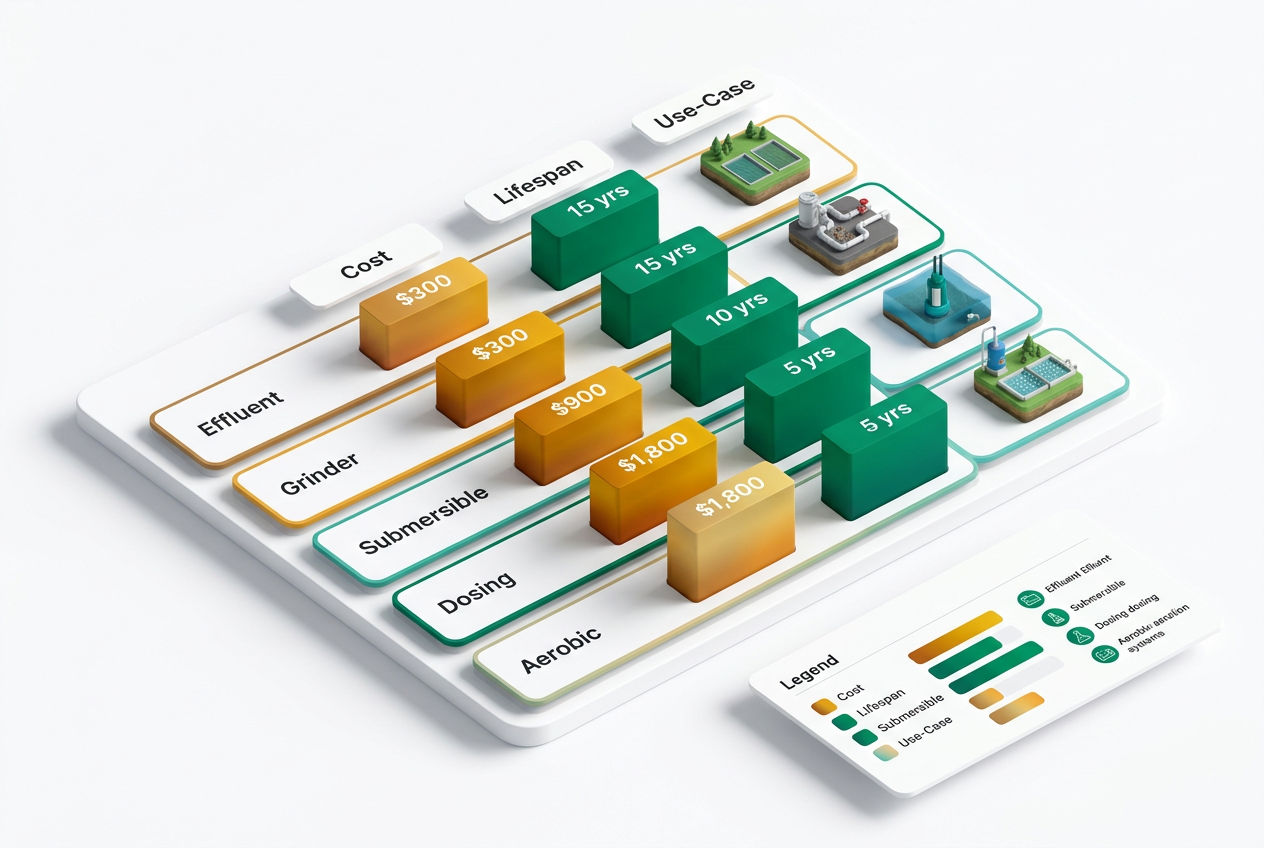
Sources: NAWT member contractor pricing surveys; manufacturer MSRP data (Zoeller, Liberty Pumps, Orenco Systems). Costs reflect national averages; regional labor variation of 30–50% is typical.
How Much Does It Cost to Replace a Septic Pump?
Replacing an effluent pump in a standard residential system costs $500–$1,500 installed for most homeowners. Grinder pump replacement runs $1,000–$2,500 installed. Those ranges cover the pump unit, labor to pull and replace it, and basic float switch inspection.
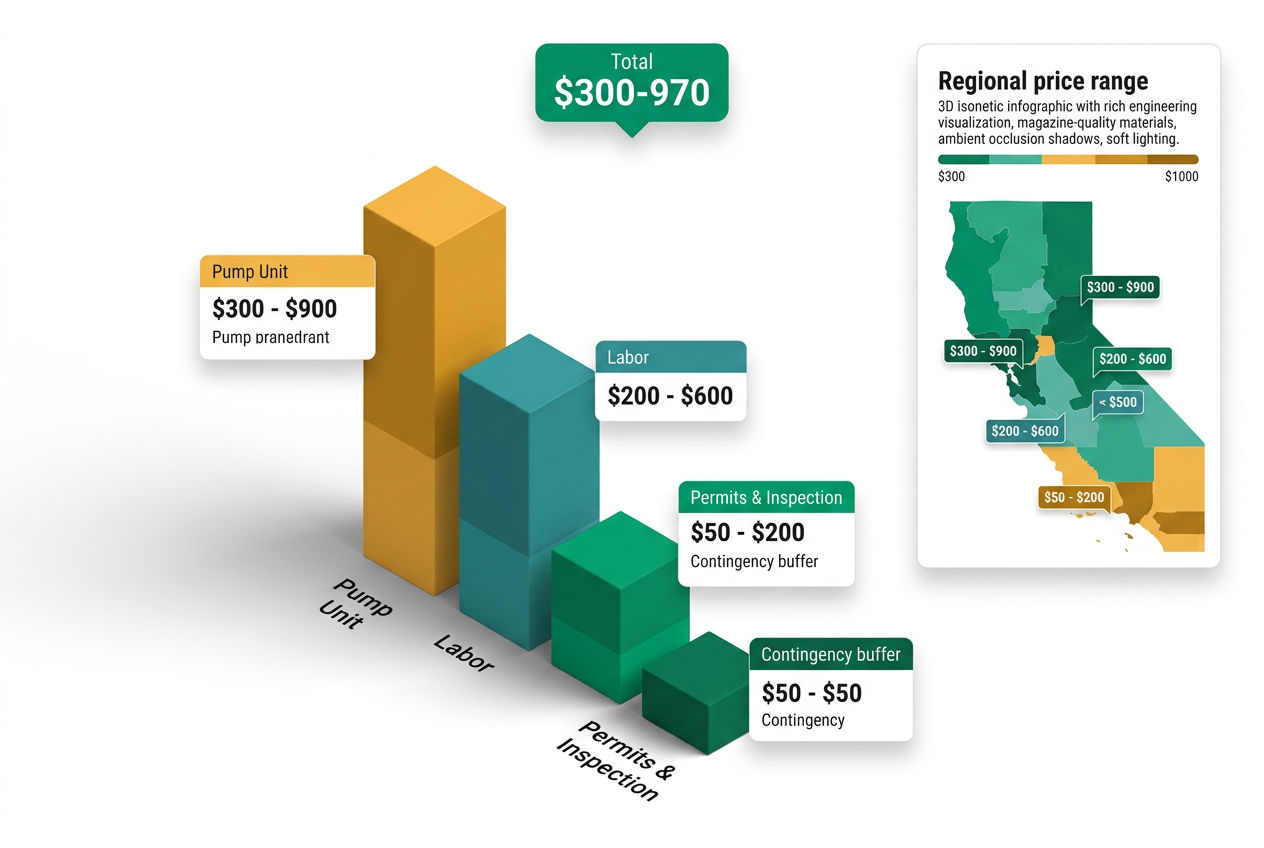
Here's a real-world example of how costs stack up. Say you have a 1,000-gallon dose tank on a mound system in central Wisconsin. Your 0.5 HP Zoeller effluent pump has failed. The pump itself costs around $275. Labor to pull the old unit, test the float switch, reinstall the new pump, and verify proper cycling runs 2–3 hours at local rates. Total bill: $650–$850. The same job in coastal Connecticut or the Seattle suburbs runs closer to $1,100–$1,400 because labor rates are 35–50% higher.
Emergency calls — the middle-of-the-night pump failure during a dinner party — add a 25–50% premium on top of standard service rates. That $850 job becomes $1,100–$1,275 if you call on a Sunday.
A few cost factors that move the needle significantly:
- Pump chamber depth and access. A shallow, lidded pump chamber with a riser is a 90-minute job. A buried tank with no riser that needs excavating can double labor costs.
- Float switch condition. If the float switch failed first (a very common scenario — more on that below), replacing just the switch costs $75–$150 and can save you an unnecessary pump replacement.
- Electrical work. If the pump's dedicated circuit needs repair or an outlet needs GFCI protection added, add $150–$400 for an electrician.
For a full cost breakdown with state-by-state pricing, see our septic pump replacement cost guide.
How Long Does a Septic Pump Last?
The average septic pump lasts 5–15 years, which is a frustratingly wide range. The real answer depends on three things: pump type, maintenance frequency, and what you're sending into the system.
Grinder pumps average 8–12 years because the grinding mechanism takes constant wear. A well-maintained effluent pump in a system that's properly loaded and regularly inspected can reach 15 years. The same pump in a system where flushable wipes and grease are sent down the drain might fail in 4 years.
The three most common causes of early pump failure are:
- Float switch malfunction. The float switch is a small buoyant device that tells the pump when to turn on and off. If it gets coated in grease, wrapped in debris, or stuck against the tank wall, the pump either runs continuously (burning out the motor) or never activates (causing high water and backup). Float switches cost $30–$75 to replace — they're the first thing a good tech checks.
- Motor burnout. Caused by running dry, running continuously due to a stuck float, or excessive heat from overloading. A burned motor means full pump replacement.
- Solids clogging the impeller. Flushable wipes, hair, and grease accumulation can jam the pump impeller, especially in effluent pumps not designed for solids handling. Regular tank pumping on schedule (every 3–5 years) keeps solids from migrating into the pump chamber in the first place.
What you put down the drain matters too. Grease, harsh chemical drain cleaners, and non-biodegradable wipes all shorten pump life directly. See our guide to septic-safe cleaning products for specifics on what to avoid.
Why Is My Septic Pump Alarm Going Off?
Your septic pump alarm — the high-water alarm — activates when liquid in the pump chamber rises above the normal operating level. The alarm is telling you the pump isn't keeping up with inflow, or has stopped working entirely. This is not a situation to silence and ignore. High water in the pump chamber means effluent isn't moving to the drainfield, and if the chamber overflows, you're dealing with a sewage backup or surface discharge — both serious health and code violations.
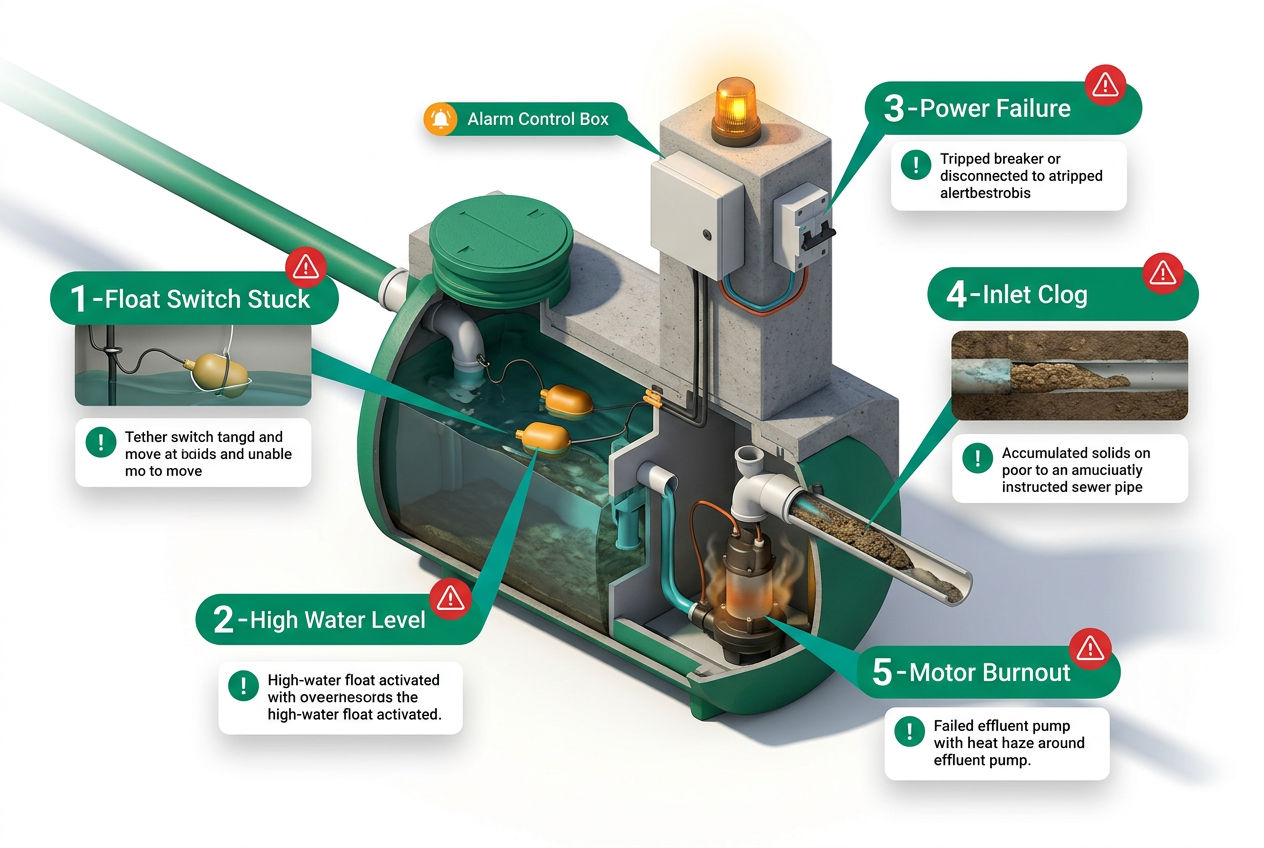
The most common causes, in order of frequency:
- The pump has failed. Motor burnout, impeller jam, or wiring failure. Call a contractor.
- The float switch is stuck. The pump may be fine but not receiving the "on" signal. Check the control panel first — some have a manual override or test button.
- Power interruption. Check the breaker. Pump circuits are typically dedicated 20-amp breakers. Reset it once. If it trips again, stop there — that's an electrical problem, not a pump problem.
- Unusually high water use. A large gathering, laundry marathon, or a running toilet can overwhelm the system temporarily. If the alarm clears within a few hours of reducing water use, it may have been a surge event.
- Infiltration from groundwater. During heavy rain or snowmelt, groundwater can infiltrate the pump chamber through cracks or poorly sealed risers. See our article on water table and septic systems for more detail.
For a full diagnostic walkthrough, see our septic pump troubleshooting guide.
How to Size the Right Pump for Your System
Getting pump sizing wrong is expensive — an undersized pump runs constantly and burns out early; an oversized pump short-cycles and never builds proper operating pressure. Sizing is based on total dynamic head (TDH) and required flow rate.
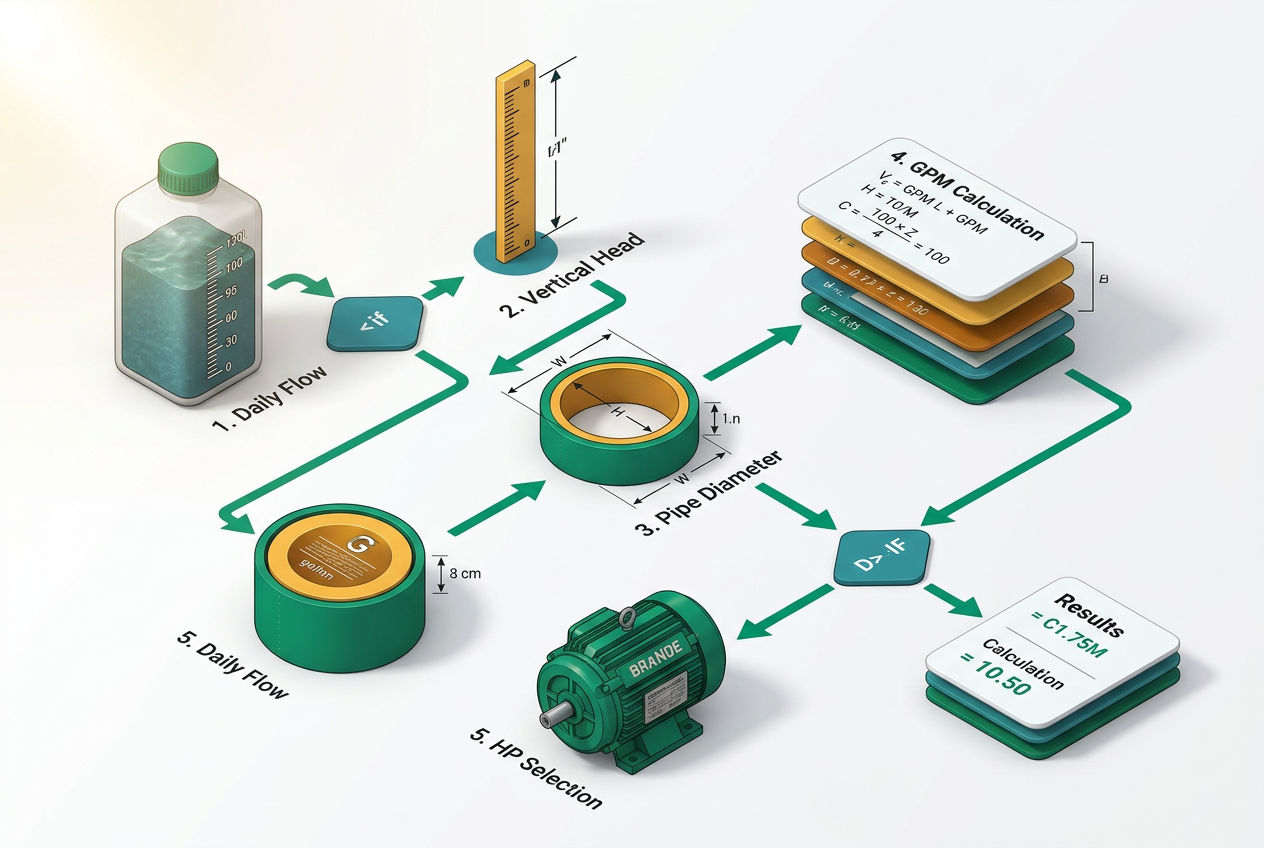
Total dynamic head (TDH) is the total resistance the pump must overcome — the sum of the elevation difference between the pump and the discharge point, plus friction losses in the pipe. A typical mound system installation with a drainfield 5 feet above grade and 150 feet of 2-inch force main will have a TDH of roughly 18–22 feet. Your pump needs to be rated to deliver the required GPH at that TDH, not just at zero head (which is how cheap pumps are often marketed).
Flow rate is determined by your system's dose volume and cycle timing. A dose tank designed to deliver 150 gallons every 2 hours needs a pump capable of moving that volume within a reasonable cycle — typically 10–20 minutes — at the required TDH.
The practical sizing decision looks like this:
- Calculate TDH from your system design drawings
- Determine required dose volume and acceptable cycle time
- Match those requirements to manufacturer pump curves
- Add a 10–15% safety margin on flow capacity
Your licensed septic designer or installer makes this call — it's not a DIY spec decision. But understanding TDH helps you evaluate whether a contractor is giving you a properly matched replacement or just grabbing the cheapest available unit. Always ask for the pump curve data when getting a replacement quote.
Can You Install a Septic Pump Yourself?
Technically, swapping a pump in an existing pump chamber is a mechanical task within reach of a competent DIYer. Remove the discharge piping union, disconnect the float switch wiring, pull the old pump, drop in the new one, reconnect. The physical task isn't complicated.
But there are significant reasons to hire a pro.
Permitting requirements vary by state. In Florida, a Registered Septic Tank Contractor (RSTC) must perform or oversee septic system work under Florida Department of Health licensing rules. Virginia requires a Department of Health Onsite Sewage System Installer license for any system component work. Many other states have similar requirements. Installing a pump yourself in a licensed-work state can void your system's compliance and create liability issues when you sell the property.
Electrical work is the bigger concern. Pump circuits require proper GFCI protection, correct wire gauge for submersible applications, and watertight connections. Wiring a pump incorrectly in a wet environment is a genuine safety hazard. If you're not an electrician, this part of the job warrants a professional regardless of what the mechanical swap looks like.
What homeowners can safely do themselves: test the float switch using the manual override on the control panel, clean accessible float switch components, check the breaker, and monitor cycle frequency with a cycle counter if your panel has one.
What requires a licensed contractor: any permit-required work in your state, electrical repairs or new circuit work, pump chamber excavation, and any work on pressurized force main connections.
What Are the Seasonal Considerations for Septic Pumps?
Seasonal conditions affect septic pump performance in ways many homeowners don't anticipate. Understanding the seasonal pattern helps you schedule maintenance before problems occur rather than after.
Winter: The Freeze Risk
In cold climates, the force main — the pressurized pipe running from the pump to the drainfield — is vulnerable to freezing if it's not buried below frost depth or if the system sits unused for extended periods. Minnesota, Wisconsin, and Michigan's Upper Peninsula have frost depths of 42–60 inches; in those regions, shallow force main installations are a real problem. Insulation board or heat tape on exposed sections is a common mitigation. If you're closing a vacation property for winter, a proper winterization procedure (draining the force main, verifying the pump chamber won't freeze) prevents a spring surprise.
Spring: The High-Demand Season
March through May is when most pump calls happen. Snowmelt raises water tables, which increases infiltration into pump chambers. Saturated drainfields work harder. Spring is also when deferred maintenance becomes an emergency — a pump that's been struggling all winter often fails outright as spring water tables peak. Scheduling a pump inspection in early spring, before the busy contractor season, is the single best timing decision a homeowner can make. Learn more about septic tank pumping in winter and spring transitions.
Vacation Home Startup
The Memorial Day weekend scenario: you arrive at the lake house after 6 months, flip the circuit breaker on the pump system, and nothing works. Pumps that sit idle for months can seize, float switches can stick from dried mineral deposits, and control panels can fail from moisture intrusion. A pre-season startup inspection — run the pump manually, verify float switch response, check the alarm circuit — takes 30 minutes and prevents a weekend-ruining backup.
Are Lift Stations the Same as Septic Pump Systems?
A lift station is a complete pumping system — wet well, pump assembly, control panel, and alarm — designed to move sewage or effluent from a collection point to a higher elevation or a treatment facility. The terminology distinction matters: a lift station is a system, while a pump is a component within it.
Residential lift stations are used when a single pump isn't sufficient — typically when multiple buildings share a collection point, when the elevation change is significant (more than 10–15 feet), or when the system must serve a community rather than a single household. They're more common in subdivisions served by community septic or low-pressure sewer systems than in individual residential applications.
The key practical difference for homeowners: if your property has a lift station rather than a simple pump chamber, maintenance responsibilities are often shared with a homeowners' association or municipality, and repair costs are correspondingly higher because the system is more complex. A lift station replacement can run $5,000–$20,000 depending on size and depth.
For a full technical breakdown, see our lift station guide.
How Should You Maintain Your Septic Pump?
You don't need to be a plumber to maintain a septic pump. You need a schedule.
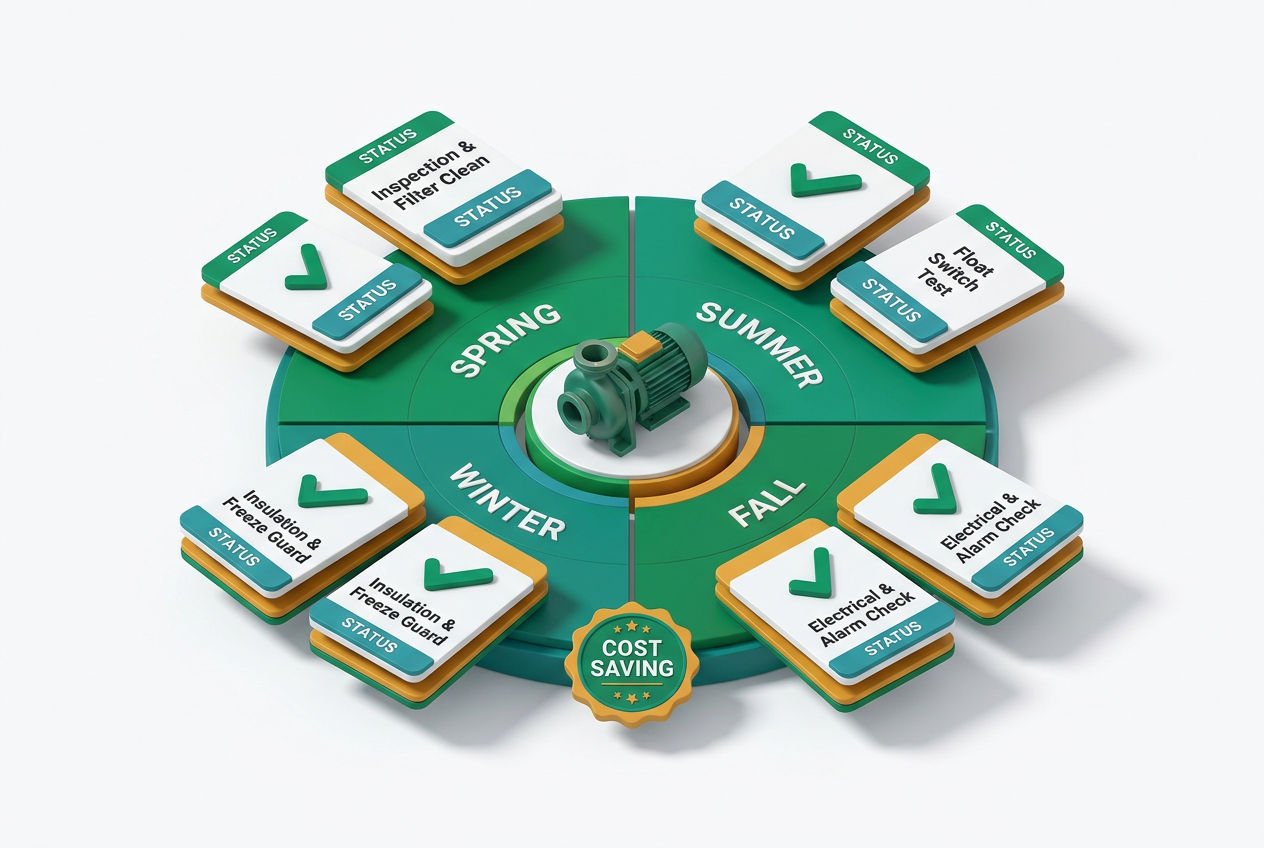
Every 1–3 years: Professional inspection. The National Association of Wastewater Technicians (NAWT) recommends inspections at least every 3 years for systems with mechanical components. An inspection includes pulling the float switch, checking the pump's amp draw (a rising amp draw signals a failing motor before it burns out), verifying alarm function, and inspecting the control panel for moisture or corrosion. Most contractors charge $150–$300 for a standalone pump inspection.
Every 3–5 years: Tank pumping. Regular septic tank pumping keeps solids from migrating into the pump chamber. When solids reach the pump, they shorten its life dramatically. The EPA recommends pumping every 3–5 years for most households; follow EPA guidance on pumping frequency and adjust for your household size and usage.
Ongoing: Monitor cycle frequency. If your control panel has a cycle counter, track it. A pump that's cycling significantly more often than it did last year — same household, same water use — is telling you something: it may be undersized, the dose volume may have changed, or you may have an infiltration problem. Unusual cycling patterns are the earliest warning sign most homeowners never notice.
What to avoid: Grease, flushable wipes, excessive garbage disposal use, and chemical drain cleaners all accelerate pump wear and reduce lifespan. If you use a garbage disposal, read our guide on garbage disposals and septic systems before your next tank pumping appointment. Also avoid septic additives that claim to eliminate the need for pumping — there's no credible evidence they work, and some may disrupt the bacterial balance that keeps solids from reaching your pump.
A good contractor doesn't just swap a pump — they inspect the float switch, check the control panel, and look at the pump chamber walls for signs of infiltration or corrosion. That 30-minute inspection at pumping time is often the difference between a $75 float switch replacement and a $1,200 emergency pump call six months later.
For the complete maintenance calendar, see our septic tank maintenance guide.
What Are the Signs Your Septic Pump Is Failing?
You don't always get an alarm warning. Sometimes pump failure is gradual — the pump weakens progressively before it quits entirely. Knowing the early warning signs lets you replace on your schedule, not during an emergency.
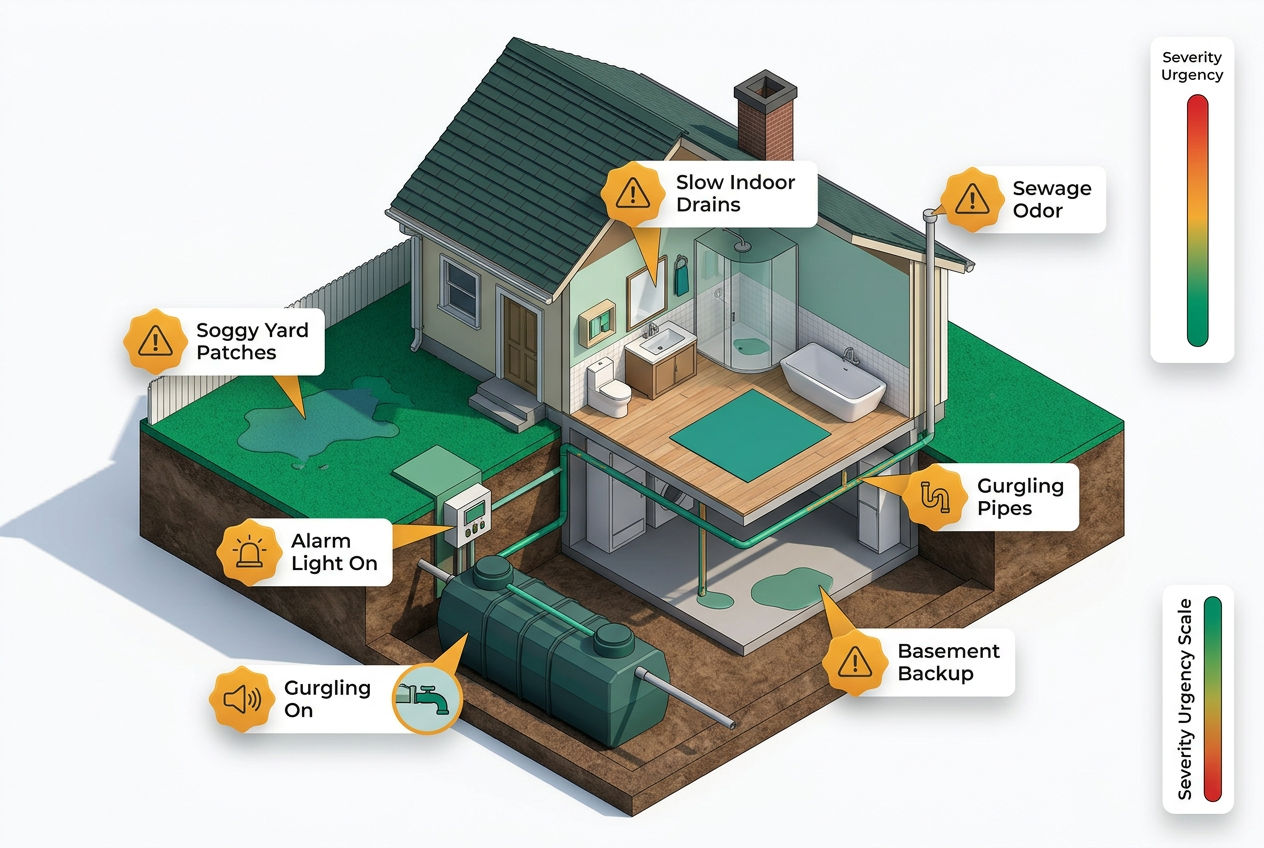
Early warning signs:
- Slow drains throughout the house — not just one fixture, but multiple. When the pump can't keep up, the system backs up from the tank forward.
- Sewage odor near the pump chamber or drainfield. Effluent that isn't moving creates pressure that forces odors to the surface.
- Wet or unusually green grass over the drainfield — this can indicate effluent surfacing because the drainfield isn't receiving properly dosed loads. See our article on signs a drain field is failing to distinguish between a pump problem and a drainfield problem.
- The pump running longer than usual per cycle. If you can hear the pump and it used to run for 10 minutes and now runs for 20, the motor is losing efficiency.
- Higher than normal electric bills — a struggling pump motor draws more current.
Late warning signs (act immediately):
- High-water alarm activation
- Complete sewage backup into the home
- Visible sewage surfacing near the tank or drainfield
The difference between an early-warning repair ($75–$300) and a late-stage emergency ($1,000–$2,500 plus after-hours premiums) is usually a matter of how attentive you've been to the early signs.
How Do You Find a Qualified Contractor for Septic Pump Work?
Finding a qualified contractor starts with verifying licensing, not price. In most states, septic system work requires a specific license — not a general plumber's license and not a general contractor's license. Call your state environmental or health department to confirm what license category covers pump work in your jurisdiction before you call any contractors.
Questions to ask when getting quotes:
- "Are you licensed for septic system work in this state, and can you provide your license number?" Any legitimate contractor will give this to you without hesitation.
- "Will this job require a permit, and will you pull it?" The contractor should know the permitting requirements for your county. If they say permits aren't needed when your county requires them, that's a red flag.
- "What does the quote include — pump only, or pump plus float switch inspection and electrical check?" A complete replacement quote should cover all three.
- "Do you carry liability insurance and workers' comp?" Pump chamber work involves confined spaces. Uninsured workers create liability for you.
Labor rates for legitimate licensed contractors run $75–$110 per hour in rural Midwest markets and $125–$175 per hour in coastal metro areas. A significantly lower quote often means unlicensed work, which creates compliance problems when you sell.
Find a septic contractor near you to get quotes from licensed professionals in your area.
Related Guides in This Series
- What Is a Lift Station? How Sewage Lift Stations Work
- 'Septic Pump Replacement Cost: 2026 Price Guide'
- Effluent Pump: A Side-by-Side Comparison
- Septic Grinder Pump: The Complete Guide
- How to Handle Lift Station Maintenance: Step by Step
- Septic Pump Replacement? Causes & How to Fix It
Frequently Asked Questions
What is a septic pump and how does it work?
A septic pump is a submersible or inline device that moves wastewater from one point in your septic system to another when gravity flow isn't possible. The pump sits inside a pump chamber or wet well, submerged in liquid effluent or raw sewage depending on the pump type. When the liquid level rises to the activation point, a float switch signals the pump motor to turn on. The motor spins an impeller that creates pressure, forcing wastewater through a force main pipe to the drainfield, mound system, or municipal collection point. Dosing pumps work on a timer instead of (or in addition to) a float switch, delivering measured doses of effluent at scheduled intervals. The pump turns off when the liquid drops to the cutoff level. Most residential septic pumps are rated at 0.5 to 1.0 HP and cycle on and off multiple times daily depending on household water use.
How much does septic pump replacement cost?
Septic pump replacement costs $500–$1,500 installed for a standard residential effluent pump and $1,000–$2,500 installed for a grinder pump. The pump unit itself runs $150–$500 for effluent models and $600–$1,200 for grinder pumps; the balance is labor, which typically takes 2–3 hours for a straightforward swap. Regional labor rates cause significant variation — the same job costs $650–$850 in the rural Midwest and $1,100–$1,400 in coastal metro areas. Emergency after-hours calls add a 25–50% premium. Additional costs can include float switch replacement ($75–$150), electrical work ($150–$400 if the circuit needs attention), and tank excavation if no access riser is present. Before approving a full pump replacement, ask the contractor to test the float switch first — a stuck float switch is a very common cause of pump failure symptoms and costs far less to fix than a full replacement.
What is the difference between an effluent pump and a grinder pump?
An effluent pump moves clarified liquid — wastewater that has already had solids separated out in the septic tank — from the pump chamber to the drainfield or mound system. It handles relatively clean liquid with small suspended solids only. A grinder pump, by contrast, handles raw sewage containing intact solids. It uses a cutting mechanism to macerate solids into a fine slurry before pumping, making it capable of moving unprocessed household wastewater under pressure. Grinder pumps are used in low-pressure sewer community systems, in hillside installations where raw sewage must travel uphill over long distances, and anywhere solids-laden wastewater needs to be lifted or pressurized. The two pumps are not interchangeable: installing an effluent pump where a grinder pump is required will result in rapid clogging and motor failure. Grinder pumps cost more ($1,000–$2,500 installed vs. $500–$1,200 for effluent pumps) and have a slightly shorter average lifespan of 8–12 years due to wear on the grinding mechanism.
How long does a septic pump last?
A septic pump typically lasts 5–15 years depending on pump type, system load, and maintenance history. Grinder pumps average 8–12 years because the grinding mechanism wears faster than an effluent pump's simpler impeller. A well-maintained effluent pump on a properly loaded system with regular tank pumping can reach 15 years; the same pump in a system receiving grease, flushable wipes, and irregular maintenance may fail in 4–5 years. The three most common causes of premature failure are float switch malfunction (the pump runs dry or runs continuously until the motor burns out), motor burnout from overloading or continuous operation, and solids clogging the impeller. Scheduling professional inspections every 1–3 years and tank pumping every 3–5 years are the most effective ways to extend pump life. Monitoring pump cycle frequency — how often and how long it runs — gives you the earliest warning that performance is declining before failure occurs.
Why does my septic pump alarm keep going off?
Your septic pump alarm activates when liquid in the pump chamber rises above the normal operating level, signaling that the pump isn't moving wastewater out as fast as it's coming in. The most common cause is pump failure — motor burnout, impeller jam, or wiring fault — requiring a contractor. Before calling, check the breaker for the pump circuit and reset it once; if it trips again, stop and call an electrician. Next, check the control panel for a manual override or test button that lets you activate the pump directly, which isolates whether the pump itself has failed or the float switch signal is the problem. If you've had unusually high water use (a large gathering, multiple laundry loads, a running toilet), the alarm may clear on its own within a few hours once inflow drops. Persistent alarms, recurring alarms, or any alarm accompanied by slow drains or sewage odor require same-day professional attention — don't use water unnecessarily until the system is restored.
Can I install a septic pump myself?
The physical act of swapping a pump in an existing pump chamber is mechanically straightforward — disconnect the union fitting, unplug the float switch, pull the old unit, lower the new one, reconnect. However, whether you're legally allowed to do this depends on your state. Florida, Virginia, and many other states require a licensed septic contractor to perform or supervise any septic system component work, including pump replacement. Installing a pump yourself in those states can create compliance violations that surface during property sale inspections. The electrical side of the job — pump wiring, GFCI protection, submersible-rated connections — represents a genuine safety hazard in a wet environment and should involve a licensed electrician if you have any doubt. What homeowners can safely do independently: test the float switch using the control panel's manual override, inspect accessible components for visible damage, check the circuit breaker, and monitor cycle frequency. For any work that breaks a pipe connection, involves wiring, or requires a permit in your county, hire a licensed contractor.
Sources & Methodology
-
U.S. Environmental Protection Agency — Septic Systems Overview (epa.gov/septic): Cited for the estimate that 21 million U.S. homes use septic systems and for general guidance on pumping frequency.
-
National Association of Wastewater Technicians (NAWT) (nawt.org): Cited for the recommendation that systems with mechanical components receive professional inspection every 1–3 years.
-
National Onsite Wastewater Recycling Association (NOWRA) (nowra.org): Referenced for definitions of system types and pressure dosing standards.
-
Zoeller Pump Company — Product Specifications (zoeller.com): Cited for effluent pump HP ratings, GPH flow ranges, and MSRP pricing data on the M267 and comparable models.
-
Orenco Systems — AdvanTex and Pressure Dosing Technical Documentation (orenco.com): Cited for dosing pump assembly specifications and dose tank sizing guidance.
Installed cost ranges reflect aggregated pricing data from NAWT member contractors across multiple U.S. regions. Individual quotes will vary based on local labor markets, pump chamber access, permit requirements, and the specific pump model selected.
Free download
Not ready for the Handbook? Start with the free Fridge Card.
The Do / Don’t card the whole family can see, plus the Survival Kit: emergency flowchart, warning-sign decoder and pump-schedule card. One printable PDF.
Was this article helpful?
Frequently Asked Questions
Recommended Resources
📖 Related Articles
- What Is a Drain Field? (And How Does It Work?)
- Mound Septic System: $10K–$25K Cost & How It Works (2026)
- Types of Septic Systems: Complete Comparison Guide
- Effluent Pump: A Side-by-Side Comparison
- Septic Pump Replacement Cost: 2026 Price Guide
- Septic-Safe Cleaning Products: The Complete List (Safe vs. Avoid)
- High Water Table and Septic Systems: What You Need to Know
- Septic Pump Replacement? Causes & How to Fix It
- Should You Pump Your Septic Tank Before Winter?
- What Is a Lift Station? How Sewage Lift Stations Work
- How Often Should You Pump Your Septic Tank?
- Can You Use a Garbage Disposal with a Septic System?
- Do Septic Tank Additives Actually Work? (The Science)
- The Complete Septic Tank Maintenance Guide
- Signs Your Drain Field Is Failing (And What to Do)
🔧 Services
Find Septic Professionals Near You
Compare licensed, verified septic companies by area — top county markets and cities below, or browse all 50 states.
County markets
Popular cities
