
Quick Answer
An effluent pump is a submersible septic system pump that moves clarified wastewater from a pump chamber to a drainfield or secondary treatment area. It handles solids up to ¾ inch, runs at 0.33–0.5 HP, costs $300–$1,000 installed, and lasts 7–15 years with proper maintenance.
Key Takeaways
- Effluent pumps move partially treated wastewater — not raw sewage — and can only handle solids up to ¾ inch in diameter.
- They typically run 0.33–0.5 HP and cost $300–$1,000 installed, far less than a grinder pump at $1,000–$3,000.
- Effluent pumps last 7–15 years; lifespan depends heavily on solids load, float switch maintenance, and whether an effluent filter (like a Polylok PL-122) protects the pump.
- High water table regions — Florida, the Pacific Northwest, the Gulf Coast — rely on effluent pumps because gravity drainage is physically impossible.
- DIY replacement is technically possible but risky; improper sizing or float switch wiring can cause a backup or a $5,000+ drainfield repair.
What Exactly Does an Effluent Pump Do?
An effluent pump sits submerged in a dedicated pump chamber — a separate concrete or polyethylene tank downstream from your main septic tank. By the time wastewater reaches the pump chamber, the septic tank has already separated solids. What remains is clarified liquid called septic tank effluent: partially treated, relatively clear wastewater with small suspended particles.
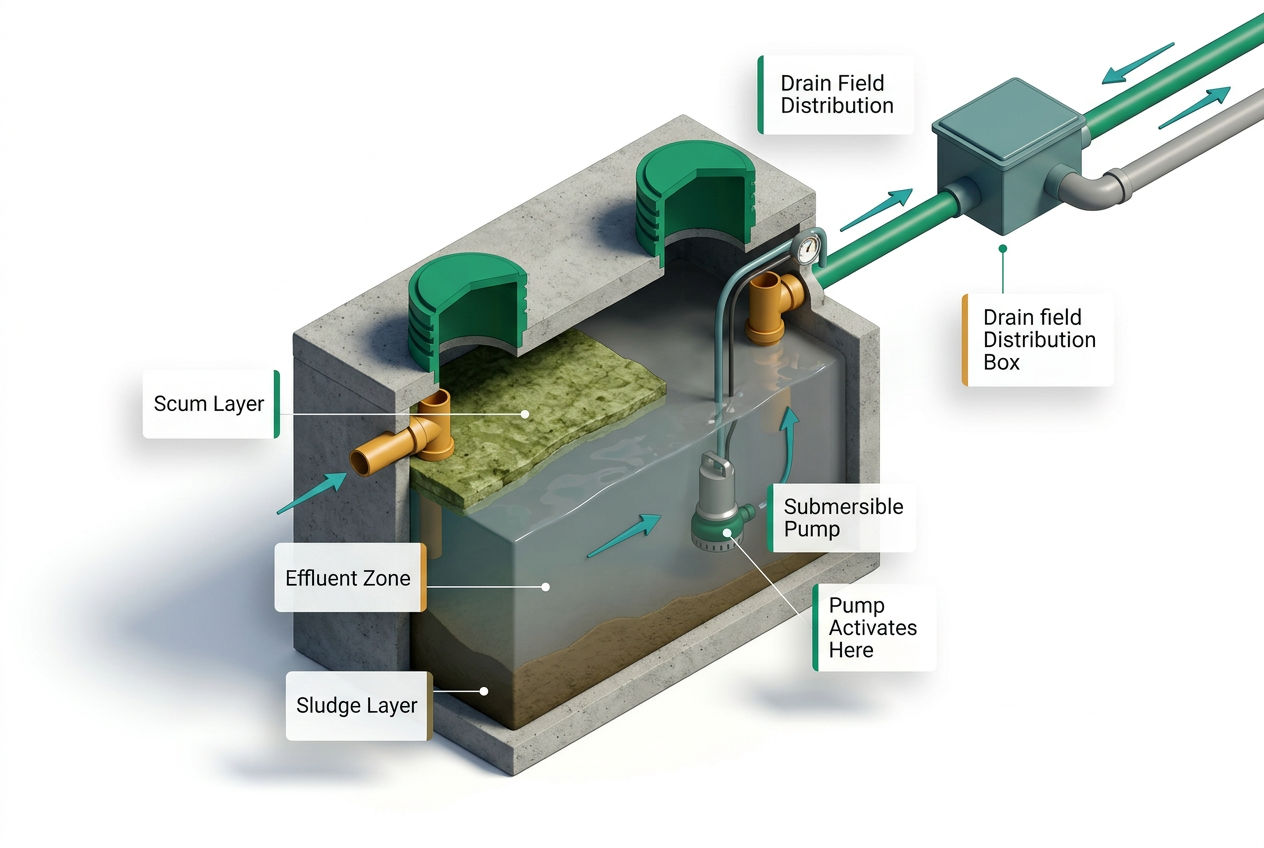
The pump's job is simple: when the liquid level in the pump chamber rises to a set point, the float switch triggers the pump to push effluent through a 1.25- to 2-inch discharge pipe toward your drainfield. On a mound system or drip-irrigation field, this happens in timed doses — which is why effluent pumps in advanced treatment systems are sometimes called dosing pumps.
Without a functioning effluent pump, effluent backs up into the pump chamber, overflows back toward the septic tank, and eventually causes sewage to surface in your yard or back up into your home. It's one of the most common outcomes for homeowners who ignore a pump alarm.
For a full walkthrough of how pumps fit into your overall system, see our septic pump guide.
Key Differences: Effluent Pump vs. Other Pump Types
This is where most homeowners get confused. Your plumber quotes you a "sewage pump." Your neighbor has a "grinder pump." The hardware store sells "sump pumps" by the dozen. None of these are interchangeable.
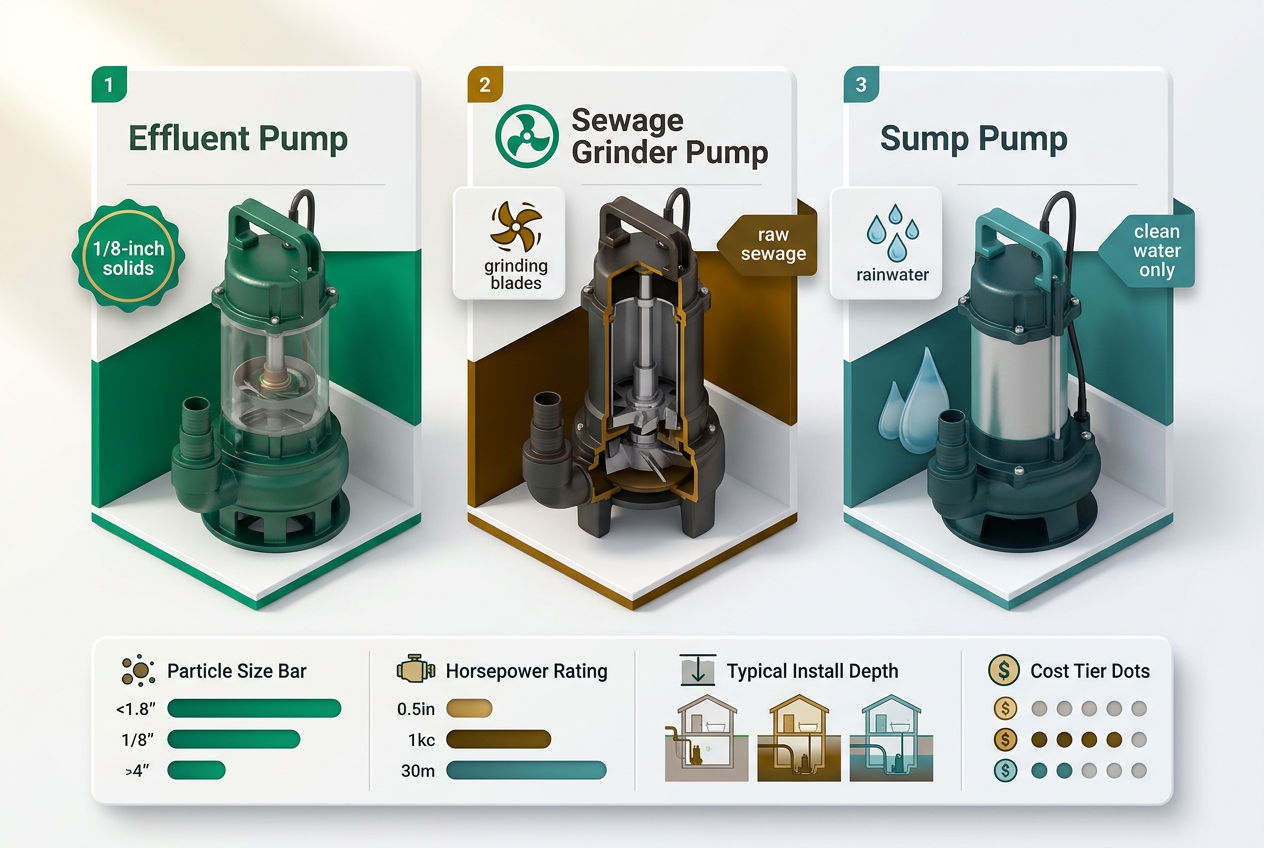
Here's the straight comparison:
| Metric | Effluent Pump | Sewage Ejector | Grinder Pump | Sump Pump |
|---|---|---|---|---|
| Solids handling | ¾" max | Up to 2" | Grinds all solids | Water only |
| Typical HP | 0.33–0.5 HP | 0.5–1.0 HP | 1.0–2.0 HP | 0.25–0.5 HP |
| Application | Septic to drainfield | Basement to sewer | Pressure sewer | Groundwater removal |
| Installed cost | $300–$1,000 | $500–$1,500 | $1,000–$3,000 | $300–$800 |
| Average lifespan | 7–15 years | 7–10 years | 7–12 years | 5–10 years |
| Voltage | 115V or 230V | 115V or 230V | 230V typical | 115V |
Sources: EPA Septic Systems guidance (epa.gov/septic), NOWRA technical specifications (nowra.org), manufacturer data from Orenco Systems and Zoeller Pump Company.
The biggest mistake homeowners make is buying a sewage ejector pump when they need an effluent pump, or vice versa. A sewage ejector moves raw sewage — unprocessed waste from a below-grade bathroom — up to a gravity sewer line. It handles 2-inch solids. Drop one into a pump chamber designed for an effluent pump and you've massively over-engineered the solution. The bigger problem goes the other direction: installing an effluent pump somewhere that handles raw sewage. The impeller clogs within weeks.
Effluent Pump Specs: What the Numbers Actually Mean
Horsepower and Flow Rate
Most residential effluent pumps run 0.33 HP to 0.5 HP. That's sufficient for the majority of conventional and mound septic systems serving 2- to 5-bedroom homes.
Flow rate matters more than HP for sizing purposes. Standard residential effluent pumps move 10–40 GPM. A 4-bedroom home generates roughly 600 gallons of wastewater per day (using the common 150 gallons per bedroom per day baseline). Your pump needs to dose your drainfield in multiple timed cycles without either starving the field or flooding it.
A 1-HP effluent pump — capable of 60+ GPM — is typically reserved for commercial applications or larger mound systems with long pump runs.
Total Dynamic Head (TDH)
TDH is the total resistance your pump fights: vertical lift plus friction losses in the pipe. Standard effluent pumps handle 15–30 feet of TDH. A mound system on a 3-foot-high mound with 20 feet of horizontal pipe run might demand 12–15 feet TDH. Easy. A pump pushing effluent up a steep hillside to a remote drainfield could exceed 30 feet — and that's where you need a pump specifically rated for higher head pressure, or where contractors sometimes spec a grinder pump despite the cost jump.
Float Switch and Pump Alarm
The float switch is a buoyant trigger hanging inside your pump chamber on a short cable. When liquid rises to the switch's activation point, it completes the circuit and the pump runs. When liquid drops below the shutoff point, the pump stops.
A second float set higher than the first triggers your pump alarm — an audible or visual alert that the pump has failed to keep up. If your alarm goes off, don't ignore it. The pump chamber has 24–48 hours of reserve capacity in most residential systems before you have a real problem on your hands. Read our septic tank alarm guide for exactly what to do next.
How Long Does an Effluent Pump Last?
A well-maintained effluent pump lasts 7–15 years. That wide range comes down to a few controllable factors.
The single biggest lifespan killer is solids reaching the pump. Effluent pumps are not designed to process raw sewage or large solids. If your septic tank's outlet baffle is damaged or your effluent filter is overdue for cleaning, partially settled sludge flows into the pump chamber and hammers the impeller. A Polylok PL-122 effluent filter — a $40–$80 part your technician cleans at every pump-out — can add years to your pump's life.
Geography plays a role too. In Florida and the Gulf Coast, effluent pumps run more annual cycles than the same system in Maine. More cycles mean more wear. A pump lasting 14 years in Minnesota might last 9–10 years in central Florida under comparable household loads.
For comparison: sewage ejector pumps average 7–10 years, grinder pumps 7–12 years, and sump pumps 5–10 years. On a cost-per-year-of-service basis, a well-maintained effluent pump at $500 installed over 12 years costs roughly $42 per year. A grinder pump at $2,000 over 10 years runs $200 per year — nearly five times more.
Check our breakdown of septic pump replacement costs to see what current labor rates look like in your region.
What Are the Signs of a Failing Effluent Pump?
Your effluent pump rarely dies without warning. The signs show up before the backup does — if you know what to look for.
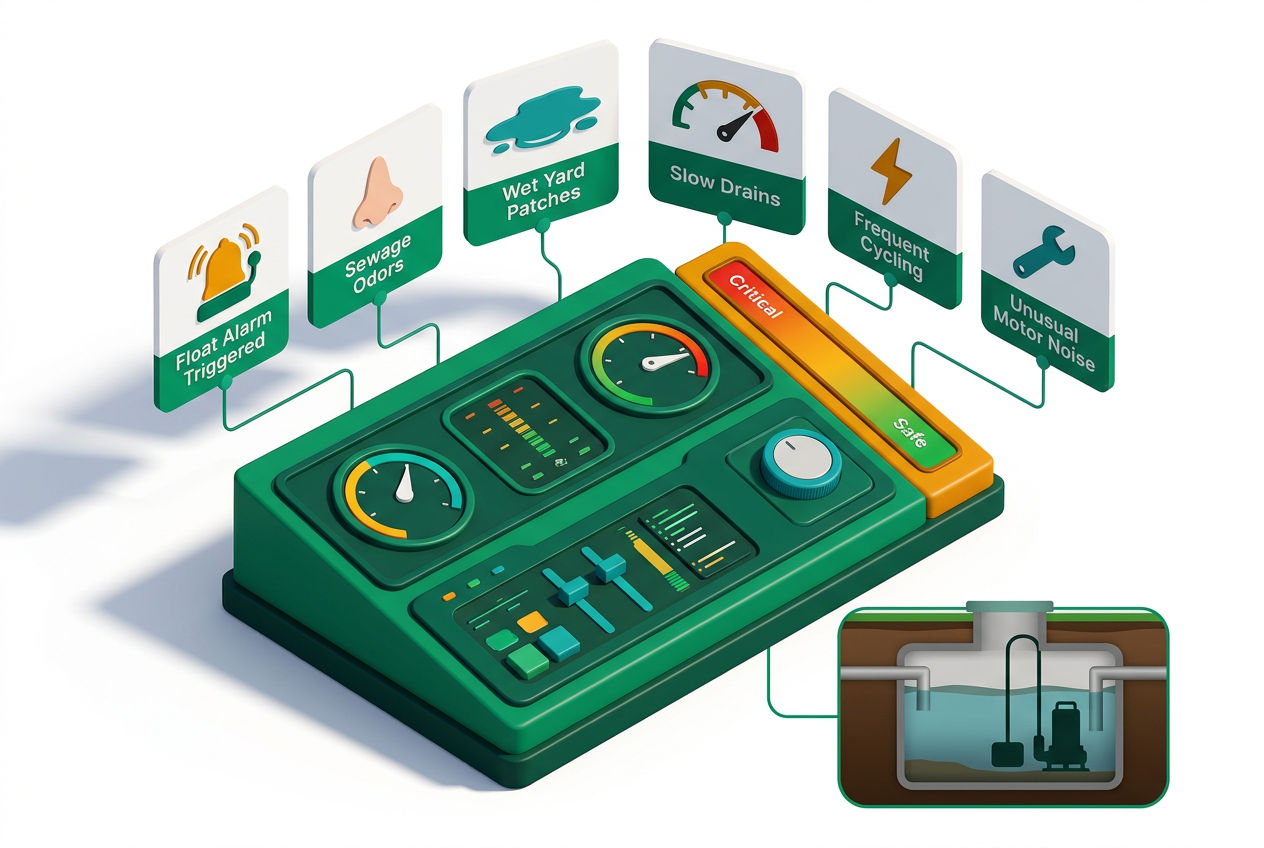
Alarm activation is the most obvious signal. Your pump alarm going off means the chamber is filling faster than the pump is emptying it. Could be a failed pump, a tripped breaker, a stuck float switch, or a clogged discharge line. Start at the breaker panel before calling anyone.
Slow drains and gurgling throughout the house — especially on the lowest floor — can indicate that the pump chamber is approaching capacity and creating back-pressure. Our septic pump troubleshooting guide walks through the diagnostic steps.
Wet spots or lush grass over the pump chamber or between the chamber and drainfield often mean effluent is surfacing. That's a health hazard and, in most states, a code violation requiring immediate repair.
Increased cycle frequency — if your pump seems to run constantly — can mean the pump is losing head pressure due to a worn impeller, or the float switch is set too close to the shutoff level.
One underappreciated failure mode: power outages. Most effluent pumps have no battery backup. During an extended outage, the pump chamber fills. When power returns, the pump runs continuously to catch up. If your household is in a region with frequent outages, ask your installer about a generator interlock or simplex pump alarm with battery backup notification. See also our guide to septic systems during power outages.
What Size Effluent Pump Do You Need?
Sizing an effluent pump isn't a guess — it's a calculation. Here's a simplified version:
Step 1: Estimate daily flow. A 3-bedroom home with 4 occupants generates roughly 450 gallons per day (4 people × ~113 gallons per person per day is a common actual-use figure, though the regulatory standard is often 150 gallons per bedroom). Add a garbage disposal and tack on 25–50 extra gallons.
Step 2: Determine your dosing schedule. Most mound and drip systems dose 4–6 times per day. Divide total daily flow by number of doses to get per-dose volume.
Step 3: Calculate TDH for your specific site — vertical lift from pump to drainfield plus friction losses. Your licensed installer should provide this. Most residential systems fall between 10 and 25 feet TDH.
Step 4: Match a pump curve. Pump manufacturers publish flow-vs-head curves. You want a pump that delivers your required GPM at your calculated TDH — ideally operating near the middle of its performance curve for efficiency and longevity.
For most 3–4 bedroom conventional or mound systems, a 0.5 HP effluent pump with a 1.5-inch discharge port hits the sweet spot. Orenco Systems' BF100 series and Zoeller's Model 57 are two frequently specified options in this category.
Can You Replace an Effluent Pump Yourself?
Technically, yes. Practically, it depends on your state and your skill level.
Several states — including Massachusetts (Title 5) and Washington State — require all septic system work, including pump replacement, to be performed by a licensed contractor. In Massachusetts, a Disposal System Contractor (DSC) license is mandatory for most septic repairs. Swapping a pump yourself in a regulated state risks a fine and potential permit issues when you sell your home.
Even in states with lighter oversight, DIY pump replacement has real risks:
- Incorrect sizing — buying the wrong HP or flow rate for your system
- Float switch misconfiguration — setting the activation level too high or low, causing short-cycling or chamber overflow
- Electrical safety — a submersible pump in a wet environment requires proper weatherproof wiring and GFCI protection
- Confined space hazard — pump chambers can accumulate hydrogen sulfide gas, which is odorless at lethal concentrations
If you're comfortable with basic electrical work and have a clear diagram of your existing setup, a straight swap of the same pump model in a non-regulated state is doable. For anything involving resizing, rewiring, or a different discharge configuration, hire a pro.
Find a licensed septic contractor near you before the pump fails completely — emergency service calls cost 1.5–2× standard rates.
How Much Does It Cost to Replace an Effluent Pump?
Pump unit costs range from $150–$600 depending on HP, brand, and whether you're buying a standard residential model or a higher-specification commercial unit.

Installed replacement costs — labor plus parts — typically run $300–$1,000 for a standard residential swap. Here's what drives the range:
- Access difficulty: A pump chamber with a buried concrete lid vs. a polyethylene riser lid with a twist-off cap can add 1–2 hours of labor.
- Region: Rural service areas with longer drive times cost more. A pump replacement in central Iowa might run $350–$500. The same job in the San Francisco Bay Area easily hits $800–$1,200.
- Pump chamber condition: If the technician opens the chamber and finds a corroded float switch bracket, a cracked discharge elbow, or a failing check valve, those parts add up fast.
Compare that to a grinder pump replacement at $1,000–$3,000 installed and you see why system designers prefer effluent pumps wherever the site conditions allow.
For a full regional cost breakdown, see our septic pump replacement cost guide.
Which Pump Is Right for Your System?
Use an effluent pump if:
- Your septic tank is functioning properly and effluent is already clarified before it reaches the pump chamber
- You're serving a conventional, mound, drip-irrigation, or sand filter system
- Your site requires 15–30 feet of TDH or less
- Budget is a consideration — this is the most cost-effective pump type for most residential septic applications
- You're in a high water table area (Florida, Pacific Northwest, Great Lakes) where gravity drainage is impossible
Choose a sewage ejector pump when:
- You're pumping raw sewage from a below-grade bathroom up to a gravity sewer line — this is a plumbing application, not a septic application
- Solids in the waste stream exceed what a septic system's first compartment has processed
Choose a grinder pump when:
- You're connecting to a low-pressure community sewer system
- The discharge line is very long with high friction losses or significant elevation change
- Raw sewage (not effluent) must be pumped through a small-diameter pressure main
- See our detailed grinder pump systems guide for pressure sewer scenarios
A sump pump is never a substitute for any of the above. Sump pumps handle clean groundwater only. Using one for wastewater will void the warranty, clog the impeller, and potentially violate environmental codes.
Regional Considerations Worth Knowing
In Florida, the Department of Health requires septic contractors to hold a Registered Septic Tank Contractor (RSTC) license. The state's shallow, sandy soils and high seasonal water tables mean a large percentage of residential systems require effluent pumps — it's not optional. Our Florida septic regulations guide covers what's required for pump installations specifically.
In the Pacific Northwest, high annual rainfall and clay-heavy soils in many areas create similar high-water-table conditions. Washington State's regulations require licensed onsite sewage system designers to specify pump sizing — homeowners can't self-certify the work.
In New England, particularly Massachusetts, Title 5 regulations are among the strictest in the country. Pump replacements must be filed with the local Board of Health in many towns. If you're selling a home with a septic system in Massachusetts, a properly documented pump installation history can be the difference between a clean inspection and a failed one.
Cold-climate homeowners should also know that pump discharge lines are vulnerable to freezing where they exit the pump chamber. In Minnesota, where frost penetration reaches 42–60 inches, discharge lines should be insulated for at least the first 10 feet outside the chamber — or buried below the frost line entirely.
Sources & Methodology
-
U.S. Environmental Protection Agency — Septic Systems (epa.gov/septic): Used for regulatory framework, system definitions, and general performance guidance on onsite wastewater systems.
-
National Onsite Wastewater Recycling Association (NOWRA) (nowra.org): Referenced for pump type classifications, technical specifications, and installer certification standards.
-
Orenco Systems, Inc. — Manufacturer technical data for BF-series effluent pump specifications including flow curves, TDH ratings, and float switch configurations.
-
Zoeller Pump Company — Product specification sheets for residential effluent pump models; used for HP, GPM, and TDH benchmarks.
-
Massachusetts Title 5 Regulations (310 CMR 15.000) — Referenced for licensed contractor requirements and documentation standards in regulated states.
FAQ
Q: What is the difference between an effluent pump and a sewage pump?
An effluent pump moves clarified, partially treated wastewater from a septic pump chamber to a drainfield or secondary treatment system. It handles solids up to ¾ inch. A sewage ejector pump (commonly called a sewage pump) moves raw, unprocessed sewage — typically from a below-grade bathroom — to a gravity sewer line or septic tank. Sewage ejectors handle solids up to 2 inches and run at higher HP (0.5–1.0 HP) because they're processing heavier material. Using an effluent pump where a sewage pump is required will clog the impeller quickly. Using a sewage pump in a septic pump chamber works mechanically but is overkill, costs more, and may create problems with float switch sizing. The systems are not interchangeable.
Q: How long does an effluent pump last?
A properly maintained effluent pump lasts 7–15 years. The wide range reflects several variables: solids load reaching the pump (the main lifespan killer), geographic duty cycles (Florida pumps cycle more frequently than northern climate pumps), and whether an effluent filter like a Polylok PL-122 is in place to screen particles before they reach the impeller. Pumps in high water table regions that run daily dosing cycles on mound or drip systems tend toward the lower end of that range — 7–10 years. Systems with lower hydraulic loads and good effluent filtration routinely hit 12–15 years. Annual inspection of the float switch, electrical connections, and discharge check valve adds measurable life to the unit.
Q: How do I know if my effluent pump is failing?
The clearest sign is your pump alarm activating — the audible or visual alert means the pump chamber is filling faster than the pump is emptying it. Other warning signs include slow drains throughout the house (especially ground-floor fixtures), gurgling sounds from toilets or floor drains, and wet or unusually green patches of grass between the pump chamber and drainfield. If the pump runs but never shuts off, that usually indicates a worn impeller losing head pressure or a float switch set too close to shutoff. Start by checking your breaker panel — a tripped circuit is the easiest fix. If the breaker is fine and the alarm is still active, call a licensed technician. Most pump chamber failures give you 24–48 hours before you have a backup.
Q: What size effluent pump do I need for my septic system?
Sizing depends on three factors: daily flow volume, dosing frequency, and total dynamic head (TDH). A standard 3-bedroom home generates roughly 450 gallons per day. Divided across 4–6 daily doses, that's 75–112 gallons per dose. Most residential mound or drip systems with 10–20 feet of TDH are well-served by a 0.33–0.5 HP pump flowing 15–30 GPM. The key is matching the pump curve to your actual TDH — vertical lift plus pipe friction losses. Your licensed installer should calculate this. Don't simply replace a failed pump with the same model without verifying it was correctly sized in the first place; undersized original installations are common in older systems and cause premature pump failure by forcing the motor to run at the edge of its performance curve.
Q: How much does it cost to replace an effluent pump?
Effluent pump replacement typically costs $300–$1,000 installed for a standard residential system. The pump unit itself runs $150–$600 depending on HP and brand. Labor adds $150–$400+ depending on access difficulty and regional rates. A buried concrete pump chamber lid requiring excavation can add $200–$500 in access costs alone. Rural areas with longer drive times — think central Iowa or rural Montana — may see base rates 20–30% higher than suburban markets. Compare that to grinder pump replacement at $1,000–$3,000 installed and sewage ejector replacement at $500–$1,500. On a per-year-of-service basis, a $600 effluent pump lasting 12 years costs about $50/year — one of the most cost-effective components in the entire septic system. See the full septic repair cost guide for current regional pricing.
For more on how pumps fit into your overall septic system, read our complete septic pump guide. Ready to get a quote from a licensed pro in your area? Find a septic contractor near you.
Free download
Not ready for the Handbook? Start with the free Fridge Card.
The Do / Don’t card the whole family can see, plus the Survival Kit: emergency flowchart, warning-sign decoder and pump-schedule card. One printable PDF.
Was this article helpful?
Frequently Asked Questions
Recommended Resources
📖 Related Articles
- What Is a Drain Field? (And How Does It Work?)
- Septic Pumps Explained: Types, Costs & When You Need One
- Septic Grinder Pump: The Complete Guide
- Septic Tank Alarm Going Off? What It Means and What to Do
- Septic Effluent Filters: Do You Need One?
- Septic Pump Replacement Cost: 2026 Price Guide
- Septic Pump Replacement? Causes & How to Fix It
- Septic System During a Power Outage: What Works and What Doesn't
- Selling a House With a Septic System: What Sellers Must Disclose
💰 Cost Guides
🔧 Services
Find Septic Professionals Near You
Compare licensed, verified septic companies by area — top county markets and cities below, or browse all 50 states.
County markets
Popular cities
