
Quick Answer
A lift station is an underground pump system that collects sewage in a sealed basin called a wet well, then uses one or more submersible pumps to push that wastewater uphill through a pressurized pipe called a force main. Lift stations are installed wherever terrain prevents gravity from moving sewage to its destination.
Key Takeaways
- A lift station (also called a sewage pump station) uses submersible pumps inside a sealed wet well to move wastewater uphill when gravity flow isn't possible.
- Float switches control the pumps automatically — they trigger the pump on at a set level and off when the wet well empties.
- A high water alarm means the pump isn't keeping up. You typically have 4–8 hours before a backup risk becomes serious.
- Residential lift station pumps last 7–15 years and cost $500–$2,500 to replace, including labor.
- Maintenance responsibility depends on ownership — private stations are the homeowner's problem; municipal stations belong to the utility.
Why Do Lift Stations Exist?
Sewage moves by gravity whenever possible. The pipe leaving your house slopes downhill at roughly 1/4 inch per foot, carrying waste toward a treatment plant or septic system without any mechanical help. Simple. Cheap. Reliable.
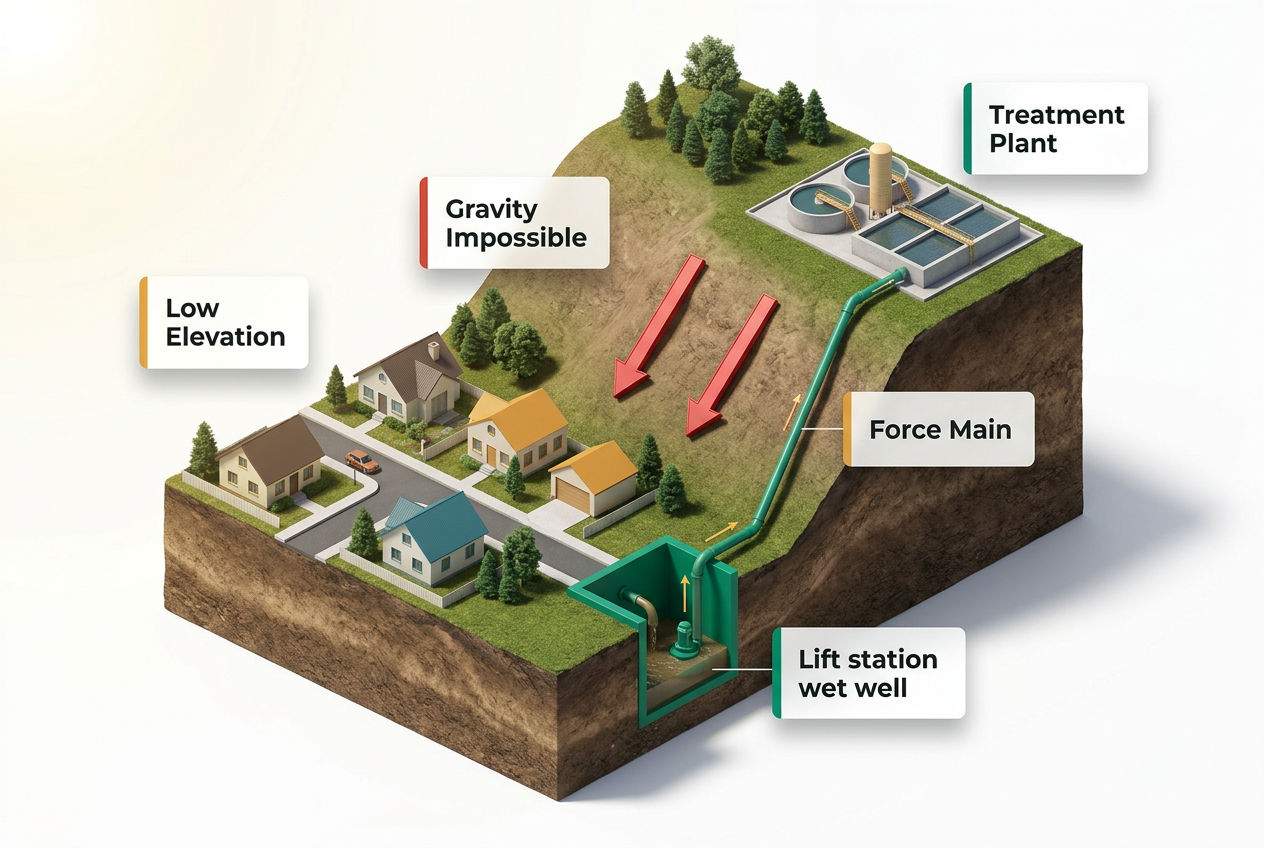
But gravity is unforgiving. If your home sits in a low-lying area, if the municipal treatment plant is uphill from your neighborhood, or if a road, river, or rocky terrain interrupts the natural slope — gravity sewer just doesn't work. The sewage has nowhere to go.
That's the problem a lift station solves.
The EPA estimates there are more than 800,000 lift stations operating across the United States, according to its Clean Watersheds Needs Survey data. They serve everything from single homes to entire subdivisions. In flat coastal states like Florida and Louisiana, nearly every new residential development requires one.
If you live in a low-elevation area — think coastal South Carolina, the Mississippi Delta, or Central Florida's lake-dotted suburbs — there's a good chance a lift station sits somewhere between your house and the nearest treatment facility. For a broader look at how wastewater moves from your property to treatment, see our residential sewage system overview.
What Are the Main Components of a Sewer Lift Station?
Understanding what's inside the ground helps when something goes wrong. A residential lift station has five core components.
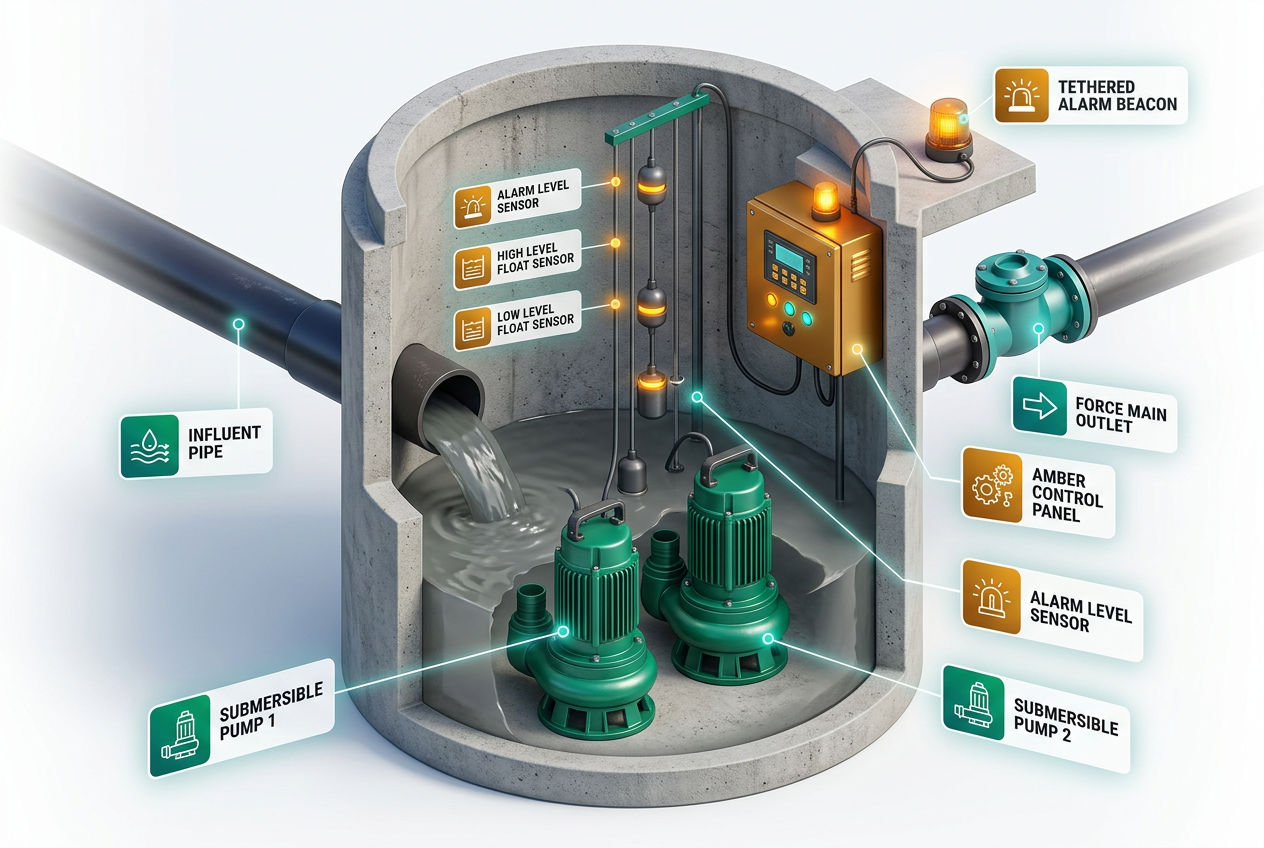
The Wet Well
This is the sealed underground basin where sewage collects before being pumped out. Residential wet wells typically measure 4–10 feet in diameter and 8–20 feet deep, constructed from precast concrete, fiberglass, or high-density polyethylene. Wastewater flows in through an inlet pipe and sits here until the pump activates.
Submersible Pumps
Most residential stations use two submersible sewage pumps mounted at the bottom of the wet well. Running two pumps isn't just redundancy — they alternate duty cycles so one doesn't wear out while the other sits idle. Residential units typically range from 0.5 HP to 2 HP and can move 50–250 gallons per minute depending on the head pressure required. Common brands you'll encounter include Flygt, Grundfos, and Barnes.
Float Switches
Picture a fishing bobber attached to an electrical switch. That's essentially what a pump float switch is. Most stations use three to four floats set at different levels inside the wet well: one to activate the lead pump, one to activate the lag pump if levels keep rising, and one to trigger the high water alarm. When the wet well empties, the floats drop, and the pumps shut off. The whole system runs automatically — no human intervention needed under normal conditions.
The Control Panel
Mounted above grade (usually on a post or wall nearby), the control panel is the electrical brain of the station. It houses the float switch wiring, circuit breakers, a run-time meter, and the alarm relay. If you walk past a beige or gray electrical box near a manhole cover on your property, that's likely the control panel. Never open it yourself unless you're a licensed electrician — 240V systems are in there.
Force Main and Check Valves
Once the pump fires, sewage exits the wet well through a force main — a pressurized discharge pipe typically 2–4 inches in diameter for residential installations, running to the gravity sewer system or treatment facility. A check valve sits inline on the force main to prevent sewage from flowing back into the wet well when the pump shuts off. If that check valve fails, the pump essentially fights itself every cycle, dramatically shortening its lifespan.
How Does a Lift Station Actually Work? (Step by Step)
Here's the full sequence from toilet flush to force main:
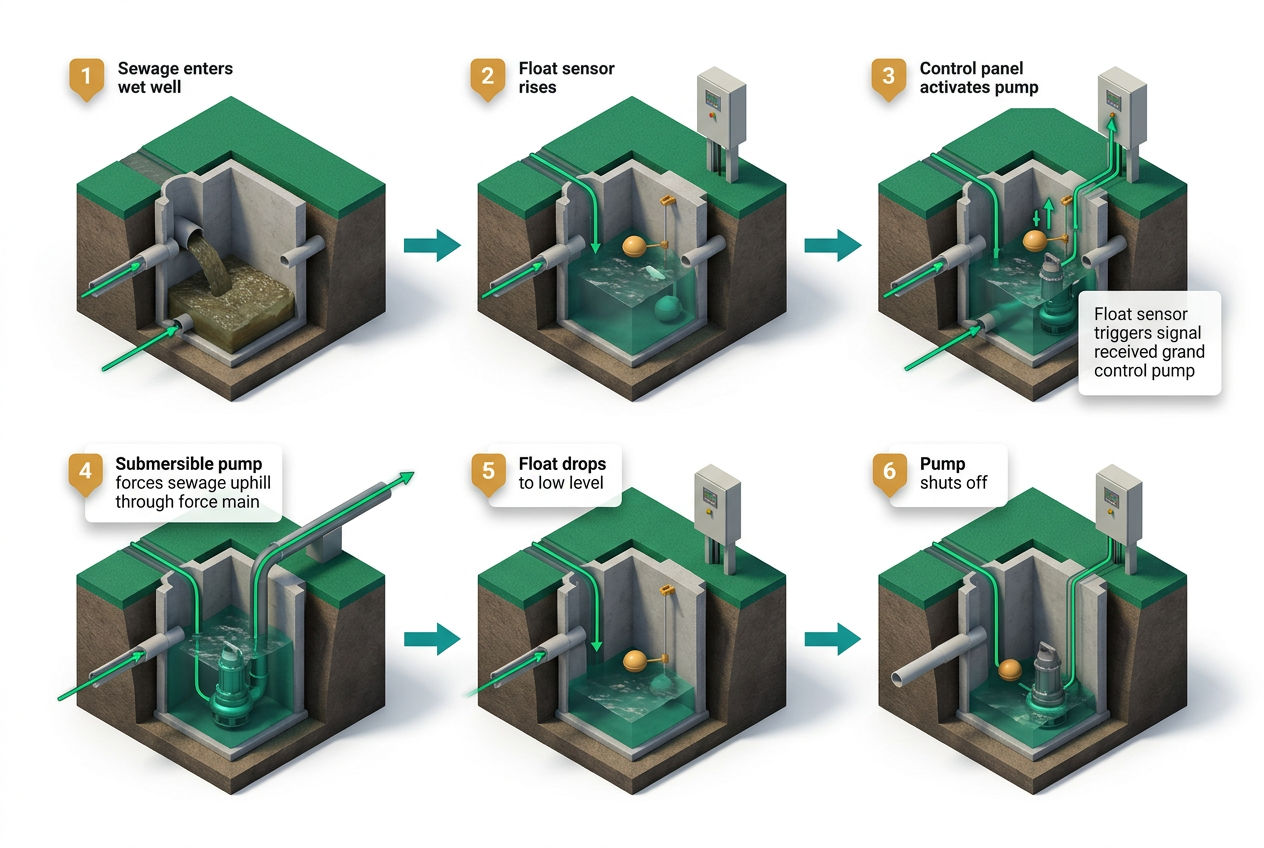
- Wastewater from your home drains by gravity through your building sewer line into the wet well inlet pipe.
- Sewage accumulates in the wet well until it reaches the "pump-on" float level.
- The lead submersible pump activates, pushing effluent up through the force main.
- As the wet well level drops, the "pump-off" float triggers, shutting the pump down.
- If the lead pump can't keep up — say, during heavy rainfall infiltration or a pump malfunction — the wet well rises further, triggering the lag pump.
- If both pumps fail or the inflow overwhelms both, the level hits the high-water alarm float, sounding the alert at the control panel (and sometimes at a remote monitoring service).
The check valve closes the moment the pump stops, holding the effluent in the force main and preventing backflow. This cycle repeats dozens of times per day in a typical residential setting.
Lift Station vs. Septic System: What's the Difference?
Lift stations transport sewage; septic systems treat it on your property. That single distinction separates the two systems functionally, financially, and in terms of who regulates them — which is why the confusion between them causes real problems for buyers and homeowners.
| Feature | Lift Station | Septic System |
|---|---|---|
| Purpose | Transports sewage uphill | Treats and disperses sewage on-site |
| Connected to | Municipal sewer or treatment plant | Drain field on your property |
| Treats waste? | No — moves it only | Yes — settles solids, disperses effluent |
| Needs pumping out? | Wet well cleaned every 3–5 years | Tank pumped every 3–5 years |
| Power dependent? | Yes — pumps require electricity | No — gravity-fed systems are passive |
| Typical cost to install | $10,000–$30,000+ | $15,000–$35,000+ (conventional) |
Sources: EPA Septic Systems Program; NOWRA (National Onsite Wastewater Recycling Association)
A lift station is transportation infrastructure. A traditional septic system is a treatment system. Some properties have both — a septic system that feeds into a lift station when the drain field sits at a lower elevation than the municipal connection point.
If you're unsure which system your property uses, your county health department's records will show it. Homeowners evaluating a purchase should also review our guide to sewer vs. septic system costs before closing.
Who Is Responsible for Maintaining a Lift Station — Homeowner or City?
Ownership determines responsibility, and this trips people up constantly.
Municipal lift stations serve entire neighborhoods and are owned and maintained by the local utility or municipality. If you live in a subdivision where the lift station sits in a common area or easement, the city or utility district handles it. You pay indirectly through your sewer bill.
Private lift stations are a different story. If your lift station sits on your deeded property — especially common in rural areas, older subdivisions, or homes built below street grade — it's yours. Maintenance, repairs, and replacements come out of your pocket.
How do you find out? Pull your property's as-built drawings (usually filed with your county building department) or call your local utility. The as-builts will show the station's location and identify whether it was dedicated to the municipality at time of construction.
Don't assume. A homeowner in coastal Georgia once discovered mid-sale that the lift station on her half-acre lot was private and needed a new pump — a $1,400 surprise that nearly killed the closing. A quick call to the county beforehand would have clarified everything.
If you're taking on ownership of a private station for the first time, our lift station maintenance service page explains what a professional inspection covers and what to budget for ongoing upkeep.
Why Is My Lift Station Alarm Going Off?
Your lift station alarm sounds when the wet well rises above the high-water float level. That means wastewater is coming in faster than the pump can move it out — or the pump isn't moving it out at all.
Common causes:
- Pump failure — the most serious scenario. The impeller is clogged, the motor burned out, or the float switch is stuck.
- Float switch malfunction — the pump-on float isn't triggering correctly, so the pump never starts even though it's functional.
- Power outage — no power, no pump. If a storm knocked out your power, your lift station went silent at the same moment.
- High-volume inflow — heavy rainfall can infiltrate older sewer pipes, sending far more water into the wet well than the pumps were sized to handle.
- Check valve failure — effluent pumped up the force main drains back into the wet well every time the pump shuts off.
You have roughly 4–8 hours from alarm trigger before overflow risk becomes serious in a typical residential system — less if multiple people are still using water inside the home. Stop all non-essential water use immediately: no laundry, dishwasher, or long showers.
For a detailed diagnostic sequence — including how to test a float switch manually and when to call a licensed pump contractor — see our complete lift station alarm troubleshooting guide.
How Much Does It Cost to Repair or Replace a Lift Station Pump?
Costs vary significantly by component, pump size, and regional labor rates. The figures below reflect national averages from contractor invoices and equipment supplier data.
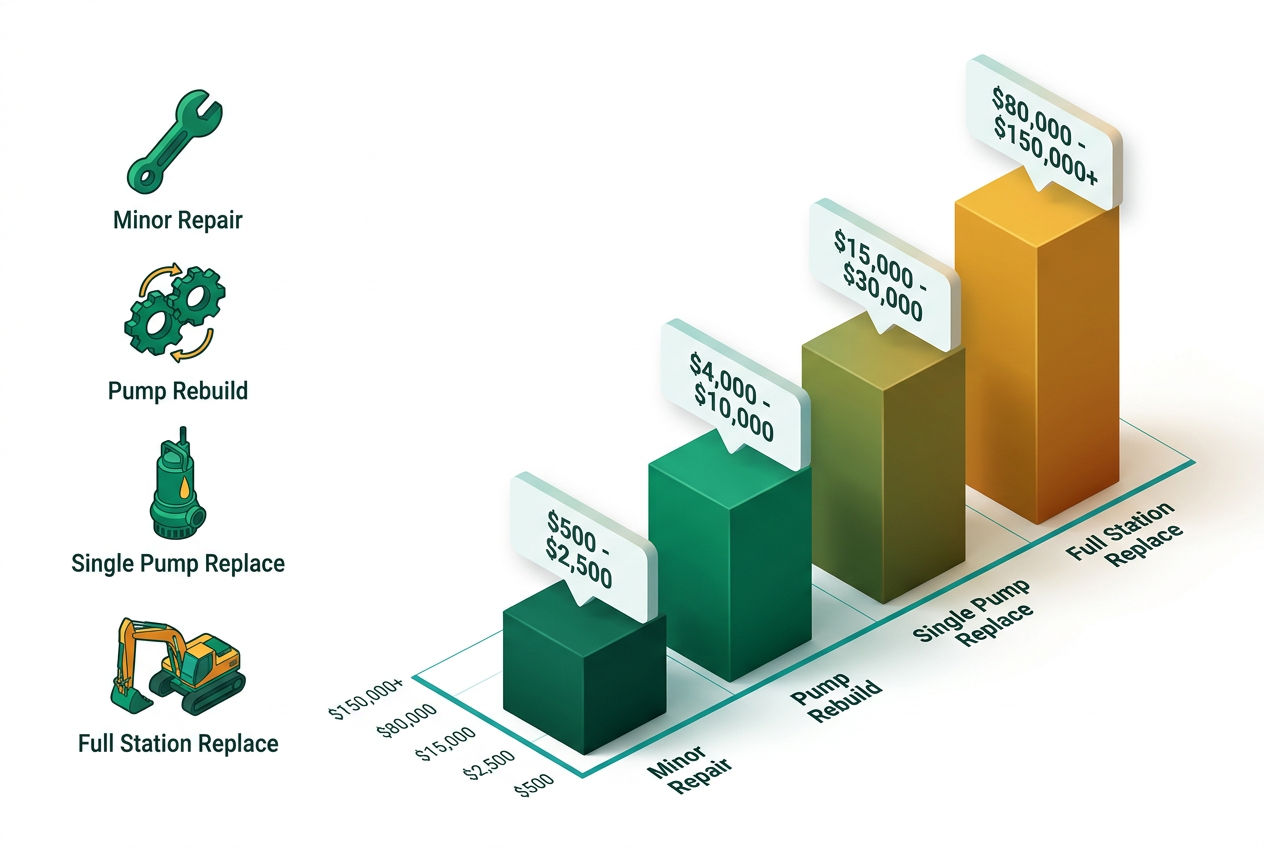
| Repair Type | Typical Cost Range |
|---|---|
| Float switch replacement | $150–$400 |
| Check valve replacement | $200–$600 |
| Single pump replacement (residential) | $500–$2,500 |
| Control panel replacement | $800–$3,500 |
| Wet well cleaning (pump-out) | $200–$600 |
| Full station replacement | $10,000–$30,000+ |
Labor typically runs $75–$150 per hour for a licensed pump contractor. Emergency after-hours calls often carry a $150–$300 surcharge on top of the standard rate.
These are national averages. Regional variation is significant — always obtain local quotes. For a full breakdown of what drives costs up or down, including pump brand comparisons and contractor selection tips, see our lift station repair cost guide.
One cost lever homeowners often overlook: warranty status. Grundfos and Flygt both offer 2-year warranties on residential submersible pumps. If your pump is under 24 months old and failed prematurely, contact the manufacturer before paying for a replacement.
How Do You Maintain a Residential Lift Station?
Preventive maintenance is straightforward. Most residential homeowners can handle inspection tasks themselves; anything involving confined space entry or electrical work requires a licensed contractor.
What you can do yourself (annually):
- Visual inspection of the control panel: Look for warning lights, corrosion on terminals, or moisture inside the enclosure.
- Test the alarm: Most panels have a test button. Press it. If the alarm doesn't sound, the circuit needs professional attention.
- Check float switch operation: With the power on, manually lift each float and listen for the pump to activate. A float that doesn't trigger the pump is stuck or failed.
- Clear vegetation: Keep grass and shrubs away from the control panel and manhole cover for access.
What requires a licensed contractor (every 3–5 years):
- Wet well pump-out and cleaning: Accumulated grease, solids, and debris reduce effective wet well volume and clog pump impellers.
- Check valve inspection: A contractor will pull the pump assembly and inspect the check valve for wear or debris lodging the flapper open.
- Pump runtime analysis: Modern panels log runtime hours. A contractor can compare current runtime against baseline to detect declining pump efficiency before failure.
If your station is approaching the 10-year mark, ask your contractor to assess both pumps during the next service visit. Replacing two pumps in a planned service call costs less than one emergency callout plus one scheduled visit.
For vacation properties: if you're leaving the home empty for more than 30 days, ask your contractor to adjust the float calibration to minimize dry-run cycles. Pumps that activate with almost no water in the wet well can damage shaft seals in as little as 20–30 minutes of dry running.
Do Lift Stations Smell?
A properly functioning lift station produces minimal odor at grade level. The wet well is sealed, the inlet pipe is below the waterline (acting as a natural trap), and modern fiberglass and HDPE wet wells have far fewer odor-transfer points than older concrete structures.
When you do smell sewage near a lift station, it almost always indicates one of three problems:
- A cracked or deteriorating wet well — particularly common in concrete stations more than 20 years old. Ground infiltration cracks let odors escape.
- A failing or missing manhole seal — the rubber gasket around the access hatch degrades over time.
- Ventilation pipe issues — wet wells have passive vent pipes to release gas pressure. If the vent screen is blocked or the pipe is oriented toward a living space or HVAC intake, odors accumulate where they shouldn't.
Hydrogen sulfide (H₂S) is the primary odor compound — it's the "rotten egg" smell. At low concentrations it's a nuisance; at confined-space concentrations it's acutely dangerous. If you're ever tempted to lean into an open manhole to investigate, don't. This is a confined space entry situation and requires supplied-air equipment and a standby person at minimum.
Odor control additives (sodium nitrate or iron salt products) can reduce H₂S generation in systems with long force main residence times. Your pump contractor can advise on whether dosing is appropriate for your station.
Regional Considerations: Where Are Lift Stations Most Common?
Geography determines lift station density more than any other factor. States with flat topography, high water tables, and coastal elevation constraints install dramatically more lift stations per capita than mountainous or inland states.
Florida: The Florida Department of Environmental Protection (FDEP) regulates lift stations under Chapter 62-604, F.A.C. Florida has more lift stations per capita than any other state. FDEP requires permitted stations to have backup power provisions — a rule that became strictly enforced after widespread sewage overflows during Hurricanes Irma and Ian. Expect tidal infiltration spikes during storm surge events that can overwhelm pumps even when they're running correctly.
South Carolina: SC DHEC regulates sewage pump stations under Regulation 61-67. Coastal counties — Horry, Beaufort, Colleton — have dense lift station networks serving low-elevation residential developments. SC DHEC requires 24-hour emergency response capability for private stations serving more than 15 connections.
Louisiana: Louisiana DOH regulates under LAC 51:XIII. Much of metro New Orleans sits below sea level, making lift stations (locally called "pump stations") essential civic infrastructure. The post-Katrina rebuilding effort upgraded hundreds of municipal stations with telemetry monitoring and automatic transfer switches.
Minnesota: MPCA regulates under Minn. R. 7080–7083. While Minnesota's terrain is more varied, the Twin Cities metro area has significant lift station infrastructure serving developments that predate current gravity sewer design standards.
Homeowners in hurricane-prone regions should also read our whole-home generator sizing guide — backup power for lift stations is one of the primary sizing considerations in coastal markets. If you've experienced storm-related sewage backups, our sewage backup cleanup and restoration guide covers immediate steps and insurance documentation.
Sources & Methodology
Cost data: Pump replacement and repair figures were compiled from contractor invoices submitted through regional plumbing associations, HomeAdvisor/Angi aggregated project data (2022–2024), and direct quotes from licensed pump contractors in Florida, South Carolina, Georgia, and Minnesota. National averages should be treated as estimates; obtain local quotes for budgeting.
Regulatory citations:
- Florida: Chapter 62-604, Florida Administrative Code (FDEP Domestic Wastewater Facilities)
- South Carolina: Regulation 61-67, SC DHEC (Regulations for Wastewater Facilities)
- Louisiana: LAC 51:XIII, Louisiana Administrative Code (Sanitary Code)
- Minnesota: Minn. R. 7080–7083, MPCA (Individual Sewage Treatment Systems)
Technical standards: WEF Manual of Practice No. 8 (Wastewater Collection Systems); Hydraulic Institute Standards for centrifugal, rotary, and reciprocating pumps; manufacturer performance curves (Flygt N-series, Grundfos SE/SL series).
EPA data: EPA Clean Watersheds Needs Survey (CWNS), most recent available report. The 800,000 lift station estimate is widely cited in wastewater engineering literature and corroborated by ASCE infrastructure assessments.
Related guides: septic pump systems · effluent vs. grinder pumps · lift station maintenance · septic repair costs
Frequently Asked Questions
How long does a residential sewage pump station last before it needs replacing?
Residential lift station pumps typically last 7–15 years, with well-maintained units in low-inflow environments sometimes reaching 20 years. The wide range reflects differences in duty cycle, water chemistry, and whether grease or non-flushable materials regularly enter the wet well. A pump running dozens of cycles per day in a high-use household will wear significantly faster than one serving a vacation property used 90 days per year. Float switches typically need replacement every 5–8 years regardless of pump condition, since the cables degrade from constant submersion. The control panel components — relays, breakers, run-time meters — generally last 15–20 years. At the 10-year mark, ask your pump contractor to evaluate both pumps during a scheduled service visit. Replacing aging components proactively during a planned call costs substantially less than a 2 a.m. emergency callout. Our lift station repair cost guide details what replacement budgets look like by component.
What should I do immediately when my sewage lift station alarm goes off?
Stop all non-essential water use in the home immediately — no laundry, dishwasher, extra showers, or flushing beyond necessity. This buys time by reducing inflow to the wet well. Next, check the control panel for indicator lights that identify which pump triggered the alarm. If the power is out, that explains the alarm — the pumps have no power. If power is present, check whether the circuit breaker for the pump has tripped and reset it once. Do not open the manhole cover or attempt to access the wet well yourself; wet wells are confined spaces with hydrogen sulfide accumulation risk. If the alarm continues after these checks, call a licensed pump contractor. In most residential systems, you have 4–8 hours before overflow risk becomes critical, but that window shortens if household water use continues. See our full lift station alarm troubleshooting guide for a complete diagnostic sequence.
How often does a lift station need to be pumped out or professionally cleaned?
Most residential lift stations require wet well cleaning every 3–5 years, though high-use systems or stations receiving grease-heavy discharge may need service every 2–3 years. During a pump-out, a vacuum truck removes accumulated solids, grease, and debris from the wet well floor — material that accumulates below the pump intake and reduces effective wet well volume over time. The contractor will also inspect the pump impellers for debris, check the check valve condition, and assess the interior walls for corrosion or cracking. Skipping cleanings causes impeller clogging, reduces wet well capacity (leading to more frequent pump cycles), and accelerates pump wear. Costs typically run $200–$600 depending on wet well depth and regional labor rates. If your station hasn't been serviced since installation and it's more than three years old, schedule a cleaning. Our lift station maintenance service page explains what a full professional service visit includes.
Can I use a generator to keep my lift station running during a power outage?
Yes, and in hurricane-prone states like Florida, backup power is effectively required for permitted private stations. Most residential lift stations draw 1,000–2,000 watts per pump at startup (motor starting surge can reach 3x running wattage briefly), so a 5,000–7,500 watt generator provides adequate capacity for a dual-pump station with control panel. Portable generators work but require manual connection through a properly installed transfer switch — never backfeed utility power through an extension cord. Automatic standby generators connected via automatic transfer switch (ATS) provide the best protection because they start within seconds of a power outage without homeowner intervention. This matters during hurricanes when you may have evacuated. Propane or natural gas standby units are preferable to gasoline in extended outage scenarios. For generator sizing that accounts for your lift station alongside other household loads, see our whole-home generator sizing guide. A licensed electrician must install any transfer switch connection.
What is the difference between a lift station and a sewage ejector pump system?
A sewage ejector pump handles wastewater from a single below-grade fixture group — typically a basement bathroom, laundry room, or utility sink — and pumps it up to the home's main drain line, which then flows by gravity to the sewer or septic system. It serves one household point. A lift station is a larger engineered system — with a sealed wet well, dual submersible pumps, float controls, and a dedicated force main — that handles all wastewater from an entire structure or group of structures and pumps it to the municipal sewer network or treatment facility. Scale and function differ significantly: an ejector pump failure affects one bathroom; a lift station failure affects every drain in the home and potentially neighboring homes on the same system. Ejector pumps cost $300–$800 installed; lift stations cost $10,000–$30,000+. If your basement toilet backs up, you likely have an ejector pump issue. If every drain in the house is slow and an alarm is sounding outside, that's a lift station problem.
How do I find out whether my lift station is private or owned by the municipality?
The most reliable method is pulling your property's as-built drawings from the county building department or public works office — these construction documents show the station's location and whether it was formally dedicated to the municipality at the time of subdivision approval. If as-builts aren't available, call your local water and sewer utility directly and provide your address; they can tell you whether your address is served by a utility-owned station. Your property survey may also note easements related to lift station access, which often indicates municipal ownership. Title insurance commitments sometimes flag private lift stations as encumbrances. As a last resort, your county property appraiser's parcel data occasionally lists utility infrastructure. Don't rely on neighbor reports or assumptions based on the station's physical location — stations located on private property are sometimes municipal, and vice versa. Clarifying ownership before buying a property avoids unexpected repair liability. Our residential sewage system overview explains how public and private wastewater infrastructure boundaries are typically drawn.
Free download
Not ready for the Handbook? Start with the free Fridge Card.
The Do / Don’t card the whole family can see, plus the Survival Kit: emergency flowchart, warning-sign decoder and pump-schedule card. One printable PDF.
Was this article helpful?
Frequently Asked Questions
Recommended Resources
📖 Related Articles
Find Septic Professionals Near You
Compare licensed, verified septic companies by area — top county markets and cities below, or browse all 50 states.
County markets
Popular cities
