
Quick Answer
Lift station maintenance is the scheduled process of inspecting, cleaning, and testing every component of a sewage lift station — including the pump, float switches, wet well, check valves, and control panel — to prevent failures, sewage overflows, and costly emergency repairs.
What Does a Lift Station Do in a Septic System?
A sewage lift station (also called a pump station) moves wastewater uphill when gravity can't do the job. Gravity-fed septic systems work great on flat or sloped lots. But if your home sits in a low-lying area, your bathroom is below the main sewer line, or you're in coastal Florida or Louisiana where the water table is practically at your feet, a lift station is what makes the whole thing work.
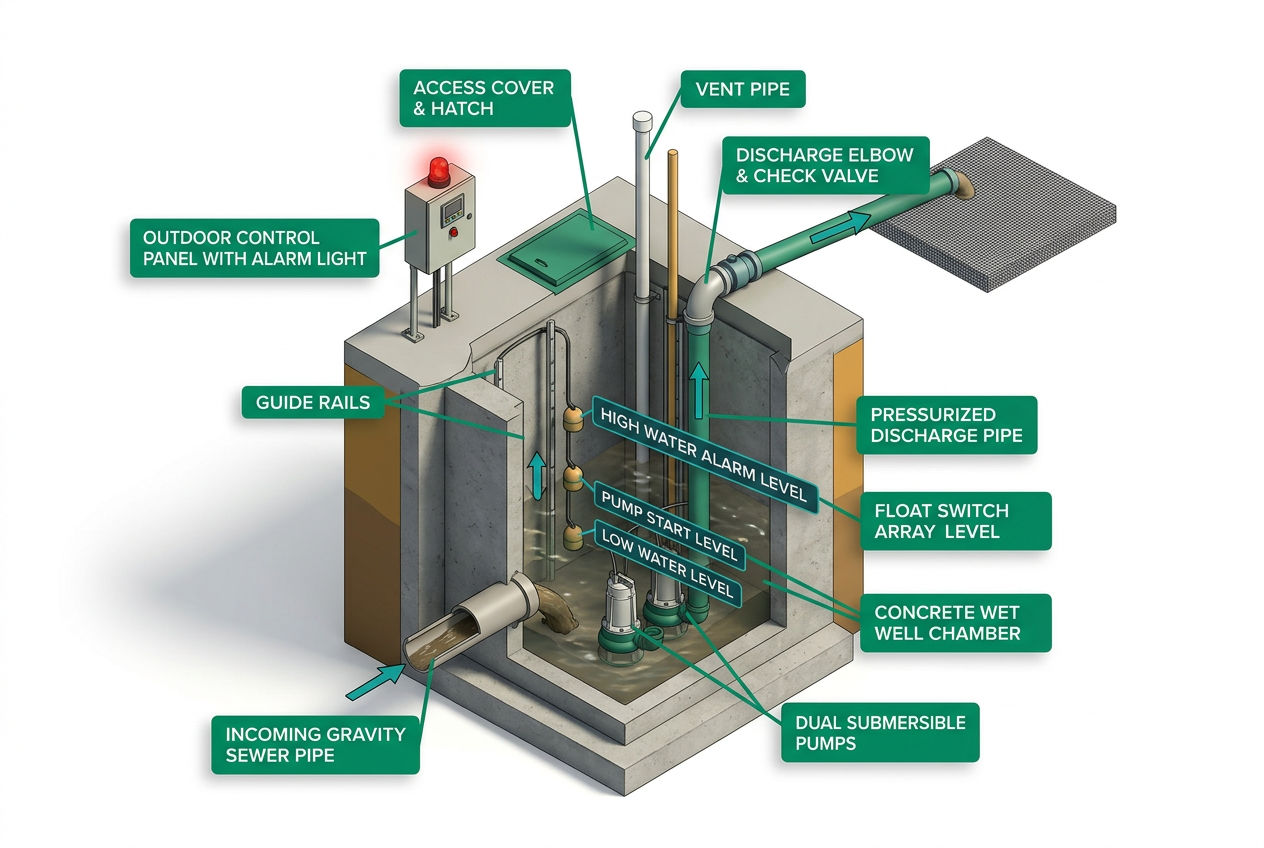
Inside the wet well — a buried tank, often 500–1,500 gallons — raw sewage collects until it reaches a set level. Float switches trigger the lift station pump, which pushes waste through the force main (the pressurized discharge pipe) to the next point in the system, whether that's a septic tank, drain field, or municipal sewer connection. No pump, no flow. That's the whole equation.
Which is exactly why understanding your pump system matters before skipping a maintenance cycle.
How Often Should a Lift Station Be Serviced?
Residential lift stations should receive a professional inspection every 3–6 months, with a full wet well cleaning every 6–12 months. Commercial and high-use systems need monthly checks. At minimum, every residential system needs comprehensive professional service at least once per year — twice is better.
That schedule isn't arbitrary. The EPA reports approximately 23,000–75,000 sanitary sewer overflows (SSOs) in the U.S. annually, and pump station failures are a significant contributing factor. The National Association of Wastewater Technicians (NAWT) consistently points to deferred maintenance as the leading cause of lift station failure.
Here's a practical maintenance frequency table:
| Task | Residential | Commercial | DIY or Pro? |
|---|---|---|---|
| Visual inspection / alarm test | Monthly | Weekly | DIY |
| Float switch test | Every 3–6 months | Monthly | Pro recommended |
| Wet well cleaning | Every 6–12 months | Every 3–6 months | Pro |
| Check valve inspection | Every 6–12 months | Every 3–6 months | Pro |
| Electrical panel inspection | Annually | Every 6 months | Licensed electrician/pro |
| Full pump-out & comprehensive service | 1–2× per year | Monthly–quarterly | Pro |
Source: NAWT maintenance guidelines; EPA septic systems guidance (epa.gov/septic)
What Does a Complete Lift Station Maintenance Checklist Include?
Here's every step a proper inspection covers. Some you can do yourself. Others need a licensed septic technician with the right tools and certifications.
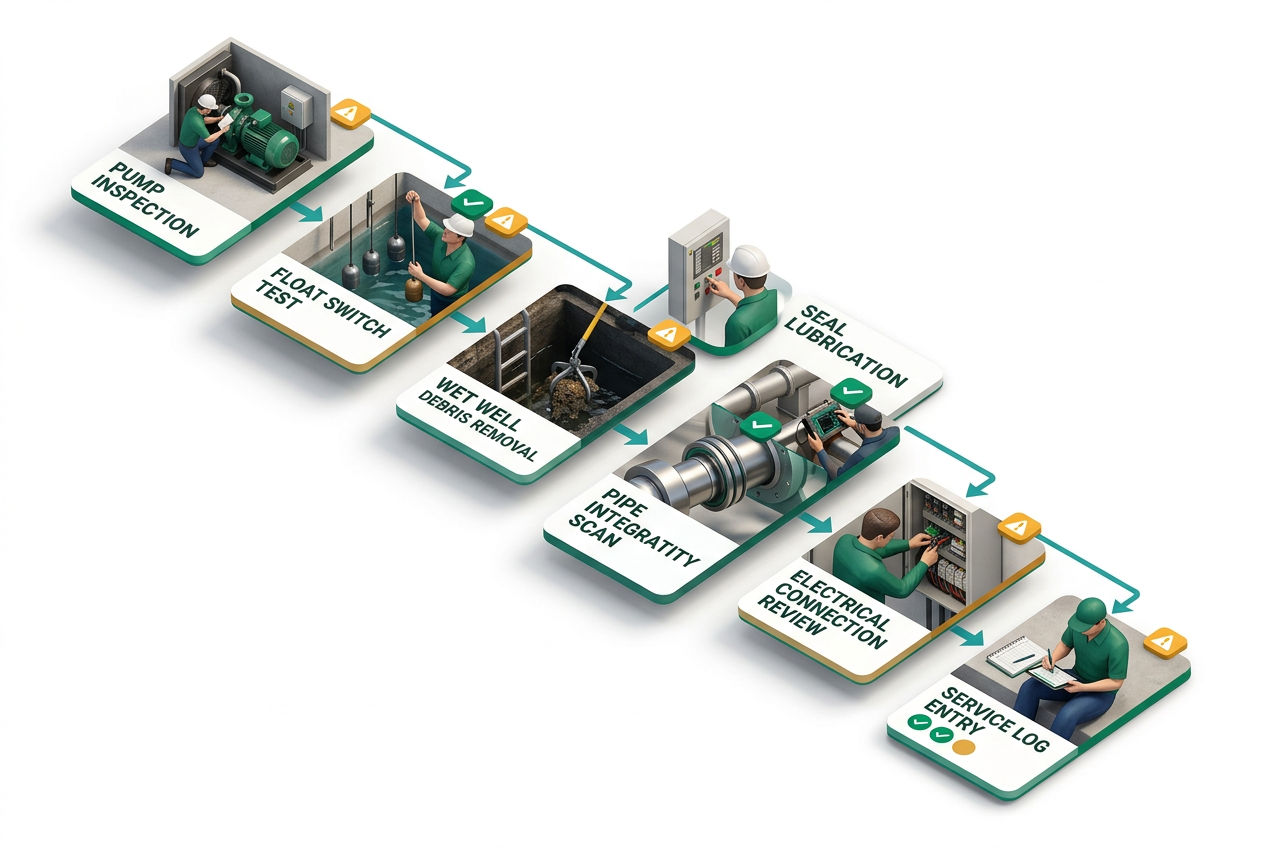
Step 1: Safety First — Ventilate and Lock Out Power
Wet wells contain hydrogen sulfide and methane. Both are lethal in enclosed spaces. Before anyone opens a wet well lid, the area needs to ventilate for several minutes. Licensed technicians carry gas detectors calibrated to OSHA standards (hydrogen sulfide becomes dangerous at 10 ppm and can be fatal above 100 ppm).
If you're doing any DIY visual inspection — say, checking a riser lid or reading an alarm panel — never lean over an open wet well in an enclosed space. Leave the confined-space entry to the pros.
Step 2: Inspect the Wet Well for Level and Debris
The wet well holds raw sewage until the pump activates. During a proper lift station inspection, the tech checks the current liquid level against where the float switches are set. If the wet well is fuller than normal at the time of the visit, that points to either a pump problem, float switch failure, or unusually high inflow — like what happens in the Pacific Northwest during heavy rain season when groundwater infiltration spikes.
They'll also look for floating debris, rags, wipes, or any material that shouldn't be there. (And yes, "flushable" wipes are a constant culprit — they're not actually septic-safe.)
Step 3: Test the Float Switches
Float switches are the trigger mechanism. They tell the pump when to turn on (at the "on" float) and when to shut off (at the "off" float). A third float — set higher — triggers the lift station alarm if the water level keeps rising despite the pump running.
Float switches typically last 5–7 years. Testing involves manually lifting each float to confirm the pump responds correctly and the alarm activates when the high-water float is triggered. A float that sticks in the "on" position runs the pump dry. A float stuck in the "off" position lets the wet well overflow. Replacement float switches run $25–$150 for the parts. Labor adds another $75–$200 depending on your region.
Step 4: Run the Lift Station Pump and Check Amp Draw
The technician will run the lift station pump and use a clamp meter to check amp draw against the manufacturer's nameplate rating. Residential sewage pumps typically draw 5–15 amps at full load. A pump pulling significantly above its rated amps is working too hard — usually because of a clog, worn impeller, or the beginning of motor failure.
There are two main pump types in residential systems: effluent pumps and grinder pumps. Grinder pumps macerate solids before pumping and draw higher amps by design (often 8–15 amps). Effluent pumps handle cleaner liquid and typically draw less. Knowing which you have matters when interpreting amp readings. Common residential brands include Zoeller (the M267 and E267 are workhorses in submersible applications), Liberty Pumps, and Goulds Water Technology — a tech familiar with these lines will recognize abnormal amp signatures immediately.
Step 5: Clean Grease Buildup from the Wet Well
Grease and debris account for approximately 70–75% of all pump clogs in wastewater lift stations, according to the EPA's "Primer for Municipal Wastewater Treatment Systems" (EPA 832-R-04-001). In areas with heavy cooking activity — think Gulf Coast communities in Louisiana and Texas — FOG (fats, oils, and grease) buildup inside the wet well is a relentless problem.
A full wet well cleaning involves vacuuming the contents with a pump truck, pressure-washing the interior walls to break up grease accumulation, and disposing of waste at an approved facility. This is not a DIY job. The cost runs $200–$600 for residential systems, depending on the wet well size and how long it's been since the last cleaning. For commercial properties dealing with serious FOG issues, a grease trap upstream of the lift station dramatically reduces buildup frequency.
Step 6: Inspect and Test the Check Valve
The check valve sits on the discharge side of the pump. Its job is simple but critical: let water flow out toward the force main, but never let it flow back when the pump shuts off. A failed check valve means the column of water in the force main drains back into the wet well every time the pump cycles off. The pump has to re-do that work every time it starts. That extra strain dramatically shortens pump life.
Testing involves listening for the characteristic "thump" when the pump shuts off (a healthy valve closes cleanly) and inspecting for corrosion, cracks, or debris preventing full closure. Swing-check valves and ball-check valves are both common in residential systems; ball-check valves tend to be more reliable in low-flow applications.
Step 7: Inspect the Force Main
The force main is the pressurized pipe running from the pump discharge to the next system component. Technicians check accessible portions for leaks, corrosion at pipe joints, and proper burial depth. In northern states like Minnesota and New Hampshire, freeze protection along exposed force main sections is critical — the frost line in Minnesota reaches 42–60 inches, and any section running above that depth without insulation is a winter liability.
Step 8: Check the Electrical Panel and Control Box
The control panel houses the pump circuit breakers, alarm circuitry, and (on newer systems) data logging equipment. An electrical panel inspection includes checking for moisture intrusion, corrosion on terminals, proper breaker ratings, and confirming the alarm light and audible alert both function. Control panels last 15–20 years with proper maintenance. This step must be performed by a licensed electrician or a septic technician with electrical certification — not a DIY task.
Step 9: Test the Lift Station Alarm System
The lift station alarm should activate before a sewage overflow occurs. It triggers when water in the wet well reaches the high-water float level — meaning the pump has run and failed to bring the level down, or hasn't run at all. Testing is straightforward: manually raise the high-water float and confirm the alarm panel lights up and the audible alert sounds.
Many modern control panels include a silence button that mutes the audible alarm while leaving the visual indicator active. If your alarm has been silenced and you haven't had a technician investigate why it triggered, the silence button is masking an active problem — not solving it.
Alarm systems connected to auto-dialers or cellular monitoring services need their contact lists verified annually. A panel that calls a disconnected number during a 2 a.m. overflow isn't protecting anyone.
Step 10: Document Everything in a Maintenance Log
A written lift station maintenance log records the date of service, technician name, amp readings, float switch test results, any parts replaced, and the next scheduled service date. This documentation matters for three reasons.
First, it creates a baseline. If amp draw was 8.2 amps in March and it's 11.4 amps in September, that trend tells you the pump is deteriorating — before it fails completely. Second, it satisfies regulatory requirements in states like Florida (under DEP Rule 64E-6, F.A.C.) and Virginia, which mandate maintenance records for permitted pump stations. Third, a properly documented lift station maintenance log is something buyers and home inspectors will request during a property sale — missing records can delay closing or trigger renegotiation.
What Does Lift Station Maintenance Cost?
Routine lift station service visits cost $150–$500 for residential systems. Wet well cleaning runs $200–$600. A full annual maintenance contract covering 2–4 visits typically costs $400–$900 per year. Emergency lift station repair calls start at $300–$600 for after-hours response, before parts.

Here's a cost breakdown by service type:
| Service | Typical Cost Range |
|---|---|
| Routine inspection visit | $150–$300 |
| Float switch replacement (parts + labor) | $100–$350 |
| Wet well cleaning (residential) | $200–$600 |
| Check valve replacement | $150–$400 |
| Control panel repair | $200–$800 |
| Lift station pump replacement | $800–$3,500+ |
| Emergency after-hours service call | $300–$600+ |
| Annual maintenance contract (residential) | $400–$900/year |
The math on preventive care is straightforward: two routine visits at $250 each costs $500 annually. A single pump replacement — which deferred maintenance makes dramatically more likely — runs $800–$3,500 for the pump alone, plus $500–$2,000 in excavation if the system is in frozen Minnesota ground in January. A maintenance contract pays for itself the first time it catches a failing check valve before it destroys the pump motor.
Lift station repair costs vary by region. Coastal Florida and Louisiana systems require more frequent wet well cleaning due to FOG accumulation, which pushes annual service costs toward the higher end of the range. Northern states add winterization costs. Urban areas with higher labor rates (Pacific Northwest metros, New England) add 20–30% to baseline service pricing.
What Are the Warning Signs of Lift Station Problems?
The six most critical warning signs that your lift station needs immediate attention are: the alarm light is on or was recently silenced, sewage odors near the wet well or in the home, gurgling sounds from drains, the pump runs continuously without shutting off, slow drains throughout the house, and visible sewage backup or wet soil near the force main.
Each of these signals a different failure mode:
Alarm light on: The wet well water level rose high enough to trigger the high-water float. The pump either failed to start, failed to pump down the level, or a float switch malfunctioned. This is an emergency — not a "check it in the morning" situation.
Sewage odors: Could indicate a failed wet well seal, cracked force main, or a pump that's no longer clearing the wet well completely. Persistent odors near the system that weren't there before indicate something has changed.
Gurgling drains: Negative pressure in the drain lines caused by a pump that's running but not clearing properly. Often a partial clog in the impeller or a check valve that's not seating correctly.
Continuous pump run: The pump is running but not achieving shutoff. Either the wet well is receiving more inflow than the pump can handle (possible during heavy rain with infiltration issues), the pump is losing capacity due to wear, or the "off" float is stuck in the triggered position.
Slow drains throughout the house: If every fixture is slow simultaneously, the problem is downstream of the house — which points to the lift station or force main, not a single clogged drain line.
Wet soil or sewage near the force main: A pressurized force main leak. Anything escaping a pressurized sewage line is both a health hazard and an environmental violation that requires immediate professional response.
Seasonal Lift Station Maintenance: What to Do Each Quarter
Lift station maintenance needs vary by season, especially in climates with temperature extremes. Here's a quarter-by-quarter breakdown:
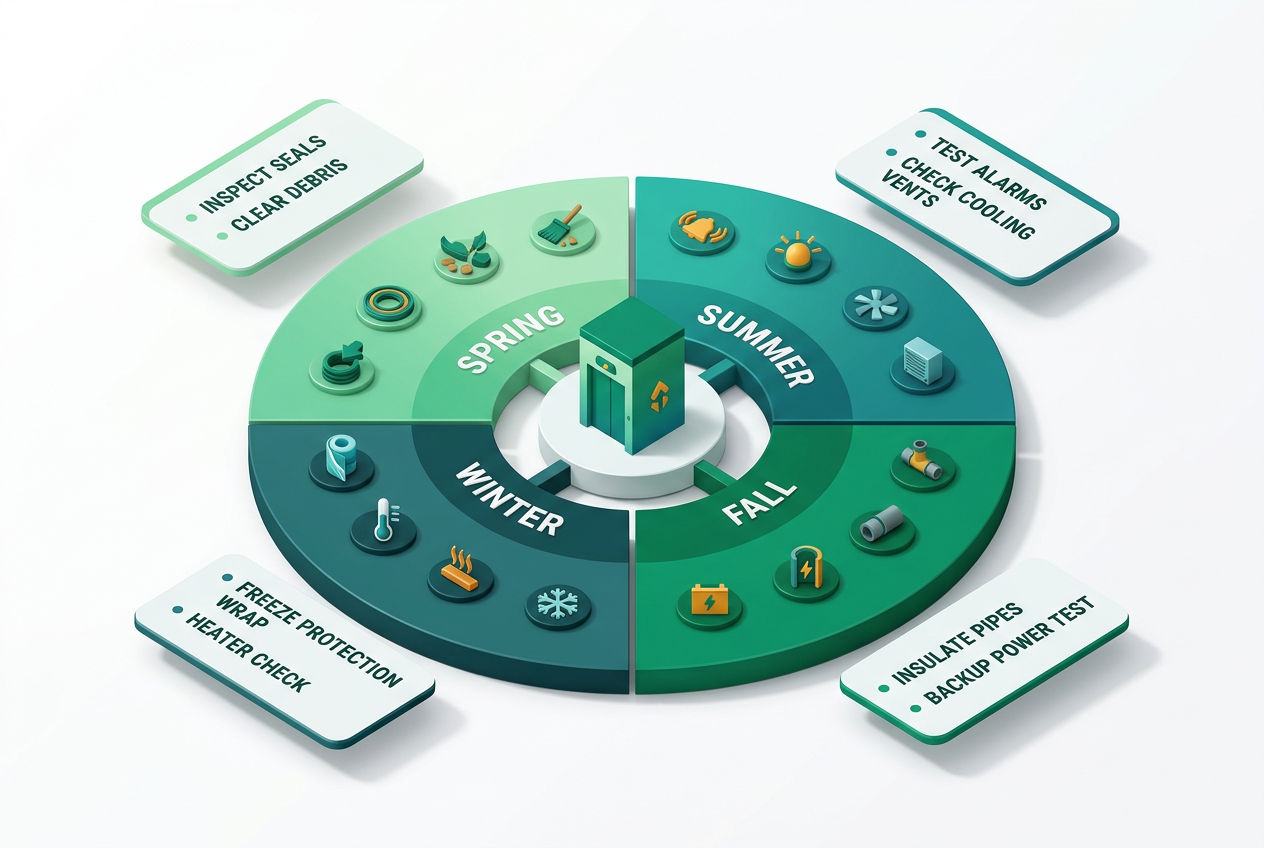
Spring: After winter, inspect the wet well for infiltration damage. Check pump run times against your baseline log — if the pump is running more frequently than before winter, groundwater infiltration through the wet well walls or pipe penetrations is a likely culprit. Verify float switch settings haven't shifted. Inspect the force main for frost heave damage at pipe joints. Test the alarm system after months of cold-weather stress on electrical components. This is also the right time to schedule your first professional wet well cleaning of the year if you're on a twice-annual schedule.
Summer: High temperatures accelerate grease buildup in the wet well, especially in Gulf Coast and Southwest climates. If your household hosts summer gatherings — more cooking, more guests, more FOG entering the system — consider a mid-summer visual check of the wet well. Verify the control panel is properly ventilated; overheating is a leading cause of panel failures in summer months. Check that the wet well vent screen is clear of debris and functioning. This is also the best season for non-emergency force main repairs since ground conditions are dry and excavation costs are lower.
Fall: Before the ground freezes, inspect all above-grade force main sections and add insulation where needed. Verify heat tape on any exposed pipe sections is functional — test it before temperatures drop, not after. Schedule your pre-winter professional inspection so any pump issues are resolved while the ground is still accessible. Clean debris from the wet well access cover area so winter ice doesn't seal it shut. Check the alarm system's auto-dialer contact list before the season when nighttime failures are most likely.
Winter: Minimize your own interference with the system during hard freezes — opening wet well lids in extreme cold introduces ice risk. Rely on your fall inspection findings and monitor the alarm panel daily. Know your emergency service number before you need it; response times for after-hours lift station repair calls in rural areas during winter can be 4–8 hours. If you lose power during a winter storm, your lift station has no backup power unless you've installed a generator connection — one pump cycle of water remains in the system before the wet well fills. Use water conservatively during extended outages.
What Lift Station Maintenance Can Homeowners Do Themselves?
Homeowners can safely handle monthly visual inspections, alarm panel checks, and exterior condition assessments. Everything involving the interior of the wet well, pump electrical systems, or float switch adjustment requires a licensed professional.
Here's the practical DIY monthly checklist:
- Walk the area around the lift station and check for wet soil, sewage odors, or any visible changes to the access cover
- Look at the alarm panel: no lights should be active other than the power indicator
- Press the alarm test button if your panel has one — confirm the audible alarm and visual indicator both function
- Listen while standing near the wet well during a flush cycle — you should hear the pump start, run briefly, and stop cleanly
- Check that the access cover is seated properly and not cracked or damaged
- Clear any grass, debris, or vegetation from around the access cover
What homeowners should not attempt:
- Opening the wet well for any interior inspection (confined space hazard)
- Manually adjusting float switch positions or cable lengths
- Resetting a tripped breaker in the control panel more than once without professional follow-up
- Any work on the pump wiring or control panel circuitry
- Attempting to clear a clogged pump by hand or with tools lowered into the wet well
The line between DIY and professional work in sewer lift station maintenance is clear: if it requires opening the wet well or touching electrical components, call a licensed septic technician.
Lift Station Maintenance Requirements by State
State regulations governing residential lift station maintenance vary significantly. Here's an overview of key states with notable requirements:
Florida: The Florida Department of Environmental Protection (DEP) regulates private pump stations under Rule 64E-6, F.A.C. Permitted systems require documented maintenance records and must meet performance standards to prevent sanitary sewer overflows. Florida's high water table and coastal conditions make quarterly professional inspections the practical standard, regardless of regulatory minimums.
Virginia: The Virginia Department of Health oversees private sewage systems including lift stations. Localities with elevated density — particularly Northern Virginia and Hampton Roads — have enacted local ordinances requiring annual pump station inspections with submitted documentation.
North Carolina: The NC Department of Environmental Quality (DEQ) requires engineered lift stations serving multiple homes to meet specific maintenance agreement conditions as part of system permitting. Single-family residential systems follow county health department rules that vary by jurisdiction.
Minnesota: The Minnesota Pollution Control Agency (MPCA) regulates pump stations under Minnesota Rules Chapter 7080. The freeze-depth requirements (42–60 inch frost line) directly affect installation and force main routing standards, and documentation of seasonal inspections is recommended practice under MPCA guidance.
Washington State: The Washington State Department of Ecology (Ecology) oversees wastewater system requirements. Ecology's guidance for onsite sewage systems recommends annual professional inspections and emphasizes infiltration monitoring — particularly relevant in the wet western portions of the state where groundwater infiltration is a documented pump station stressor.
When in doubt, contact your county health department — in most states, residential lift station oversight sits at the county level even when state agencies set the framework.
Frequently Asked Questions About Lift Station Maintenance
What Is a Sewer Lift Station and How Does It Work?
A sewer lift station is a pumping system that moves sewage uphill or across flat terrain when gravity drainage isn't possible. It consists of a wet well (a buried holding tank, typically 500–1,500 gallons), one or more submersible sewage pumps, float switches that trigger pump operation based on water level, a check valve on the discharge line, a force main (pressurized discharge pipe), and an alarm-equipped control panel. When sewage enters the wet well and reaches the "on" float level, the pump activates and pushes waste through the force main to the next system component — a septic tank, drain field, or municipal sewer connection. When the level drops to the "off" float position, the pump shuts down. A third float, set above normal pump range, triggers the high-water alarm if the level keeps rising despite pump operation. Without this system, homes in low-lying areas, below the main sewer elevation, or in coastal regions with minimal topographic relief would have no functional sewage removal. The entire system depends on every component — float switches, check valve, pump, and control panel — working correctly in sequence.
How Much Does Lift Station Maintenance Cost Per Year?
Annual lift station maintenance costs for a residential system typically run $400–$900 when covered under a service contract, or $300–$600 if you schedule individual visits. A standard service contract for a residential system usually covers two to four professional inspections per year, float switch testing, alarm verification, and minor adjustments — but not parts replacement or wet well cleaning, which are billed separately. Wet well cleaning adds $200–$600 per cleaning event, typically done once or twice annually. Float switch replacement runs $100–$350 including labor. If you defer routine service and face a pump replacement, costs jump to $800–$3,500 for the pump unit plus installation labor, with excavation costs in cold-climate states adding another $500–$2,000 in winter conditions. For comparison, two routine service visits at $250 each equals $500 per year — a fraction of a single emergency pump replacement. Annual maintenance contracts are cost-effective for most residential owners when factoring in the avoided-cost math of prevented pump and control panel failures.
How Do You Maintain a Residential Lift Station Yourself?
Homeowners can safely perform monthly visual checks without professional help. Each month: walk the perimeter of the lift station and check for wet soil, sewage odors, or surface pooling near the force main route; inspect the alarm control panel for any active warning lights; press the test button to confirm the audible alarm and visual alarm light both activate; listen near the access cover during a flush cycle to confirm the pump starts and stops cleanly; and verify the access cover is intact and properly seated. Beyond monthly checks, homeowners should track pump run frequency — if the pump seems to be running more often than usual, that's an early warning sign worth documenting and reporting to a technician. Homeowners should not open the wet well for interior inspection due to confined space gas hazards, should not manually adjust float switch positions, and should not reset tripped breakers more than once without professional follow-up. Everything involving the pump motor, electrical panel interior, float switch calibration, or wet well cleaning requires a licensed septic technician. The DIY role in residential lift station maintenance is monitoring and documentation — not repair or adjustment.
How Long Does a Lift Station Pump Last?
A residential lift station pump lasts 15–25 years with proper maintenance, though real-world lifespans vary significantly based on use intensity, sewage composition, and whether the system receives consistent service. Grinder pumps — which macerate solids before pumping and are common in systems serving homes with garbage disposals or high solid loads — typically last toward the lower end of that range, around 15–20 years, because the cutting mechanism experiences more wear than a standard effluent pump impeller. Effluent pumps in well-maintained systems with clean inflow regularly reach 20–25 years. The single biggest factor shortening pump life is running dry — caused by a float switch stuck in the "on" position that keeps the pump running after the wet well has emptied. The second biggest factor is clog-related strain: a pump repeatedly fighting through grease buildup or debris operates at higher amp draw, which accelerates motor winding failure. Brands like Zoeller, Liberty Pumps, and Goulds manufacture residential submersible pumps commonly rated for 15+ year service lives when operated within their design parameters. Tracking amp draw at each service visit provides the best early warning of impending pump failure.
What Causes Lift Station Pump Failure?
The most common cause of lift station pump failure is clogging from fats, oils, grease, and non-dispersible solids like wipes, feminine hygiene products, and paper towels — these account for approximately 70–75% of pump failures in residential and municipal systems according to EPA wastewater guidance. The second most frequent cause is dry-running damage, where a stuck float switch keeps the pump operating after the wet well is empty, overheating the motor windings and destroying the seal. Check valve failure is a third major contributor: when the check valve doesn't seat properly, water in the force main back-flows into the wet well every pump cycle, forcing the pump to restart under load repeatedly — a pattern that accelerates bearing and impeller wear. Electrical causes round out the picture: moisture intrusion into the control panel, corroded terminal connections, and improperly rated circuit breakers all contribute to pump circuit failures that damage the motor. Deferred maintenance allows all of these failure modes to develop undetected. A pump showing elevated amp draw, increased run frequency, or unusual noise is communicating early-stage failure — catching those signals at a routine inspection is the entire value proposition of a scheduled lift station service program.
What Is the Difference Between a Lift Station and a Septic Tank?
A lift station and a septic tank serve completely different functions in a wastewater system, though they often work together. A septic tank is a passive treatment vessel — sewage enters, solids settle to the bottom as sludge, grease floats to the top as scum, and partially clarified liquid (effluent) exits through an outlet baffle toward the drain field. No pump, no moving parts, no electricity required. A lift station is purely a transport mechanism — it moves sewage from one elevation to another using a pump, force main, and float-switch control system. It performs no treatment. In many residential configurations, a lift station pumps raw sewage from a low-lying collection point up to a septic tank, where treatment then begins. In municipal systems, lift stations pump sewage from neighborhood collection mains toward treatment plants. The key practical difference for homeowners: a septic tank needs pumping every 3–5 years when solids accumulate; a lift station needs mechanical inspection every 3–6 months because it has active components — pump, floats, valves, and electrical systems — that can fail at any time. Neglecting either system leads to sewage backup; the failure timelines are just very different.
What Is the Difference Between a Lift Station and a Sump Pump?
A lift station and a sump pump are both pumping systems, but they handle completely different types of water and operate at very different scales. A sump pump sits in a sump pit in a basement or crawlspace and removes groundwater or stormwater intrusion — clean or lightly contaminated water — to protect the structure from flooding. It's a single submersible pump with a simple float switch, typically handling 15–35 gallons per minute, and costs $150–$500 to replace. A lift station handles raw sewage — a fundamentally different material that requires corrosion-resistant pump materials, sealed wet wells with gas venting, and regulatory compliance for installation and operation. Lift station pumps are built to handle solids-laden fluid and are rated for continuous duty in aggressive environments. The control systems are more complex, including multi-float configurations, alarm panels, and in commercial applications, telemetry and SCADA monitoring. Maintenance requirements are also incomparable: a sump pump may need replacement every 7–10 years with minimal interim service, while a lift station requires quarterly to semi-annual professional inspections to remain code-compliant and functional. Confusing the two leads homeowners to underestimate what lift station service actually involves.
How Do I Know If My Lift Station Is Failing?
The clearest signs that your lift station is failing are an active alarm light on the control panel, sewage odors near the wet well or inside the home, gurgling sounds from toilets and drains when the pump runs, slow drainage throughout the entire house simultaneously, wet or sunken soil along the force main route, and a pump that runs continuously without cycling off. Each symptom maps to a specific failure mode. An alarm light means the wet well level exceeded the high-water float — the pump isn't keeping up, possibly due to mechanical failure or float switch malfunction. Gurgling drains indicate back-pressure from a pump struggling to move water through a blocked or check-valve-failed discharge line. Continuous pump run points to either a stuck "off" float, an undersized pump overwhelmed by inflow, or a pump losing impeller efficiency. Wet soil along the force main route means the pressurized discharge line has a leak — an environmental and health code violation requiring immediate repair. If you observe any of these signs, stop using water in the home as much as possible to reduce wet well inflow, and contact a licensed septic technician immediately. Do not attempt to diagnose or repair internal components yourself.
Sources & Methodology
This guide was developed using the following primary sources:
- EPA "Primer for Municipal Wastewater Treatment Systems" (EPA 832-R-04-001) — source for FOG clog percentage data and pump station failure context
- EPA Septic Systems Overview — epa.gov/septic — service frequency context and SSO statistics
- National Association of Wastewater Technicians (NAWT) — nawt.org — maintenance interval standards and technician certification requirements
- OSHA Confined Space Standards (29 CFR 1910.146) — hydrogen sulfide exposure limits (10 ppm action level; 100 ppm IDLH)
- Florida DEP Rule 64E-6, F.A.C. — Florida private sewage system maintenance requirements
- Minnesota Pollution Control Agency, Rules Chapter 7080 — frost line and pump station installation standards
- Washington State Department of Ecology — onsite sewage system guidance for infiltration monitoring
- North Carolina DEQ — engineered lift station permitting and maintenance agreement requirements
- Zoeller Pump Company, Liberty Pumps, Goulds Water Technology — residential pump specifications and amp draw ratings referenced for Step 4
Cost ranges reflect national averages compiled from contractor pricing data, regional service provider surveys, and published estimates from HomeAdvisor, Fixr, and direct contractor sources as of 2024–2025. Regional variation applies.
Free download
Not ready for the Handbook? Start with the free Fridge Card.
The Do / Don’t card the whole family can see, plus the Survival Kit: emergency flowchart, warning-sign decoder and pump-schedule card. One printable PDF.
Was this article helpful?
Frequently Asked Questions
Recommended Resources
Find Septic Professionals Near You
Compare licensed, verified septic companies by area — top county markets and cities below, or browse all 50 states.
County markets
Popular cities
