
Quick Answer
A grease trap is a plumbing interception device installed between kitchen drains and the municipal sewer line. It captures fats, oils, and grease — collectively called FOG — before that waste reaches the public wastewater system, where it solidifies, clogs pipes, and contributes to sewer overflows.
Key Takeaways
- Grease traps separate FOG from wastewater using basic physics — grease floats, solids sink, and cleaner water flows through.
- Most commercial kitchens are legally required to have one; requirements vary significantly by municipality.
- The EPA links FOG to approximately 47% of all sewer overflows in the U.S.
- Pump your grease trap when combined grease and solids reach 25% of total trap depth — a benchmark written into many municipal codes.
- A busy restaurant typically needs cleaning every 1–3 months; costs run $150–$1,000+ depending on unit size and location.
How Does a Grease Trap Work?
A grease trap works by exploiting a simple physical property: grease is roughly 10–15% less dense than water, so it floats. Wastewater flows from your kitchen sinks and floor drains into the trap. Inside the trap, the flow slows dramatically. That slower flow gives FOG time to separate — grease rises to the top, food solids sink to the bottom, and the relatively cleaner water in the middle layer flows out through the outlet baffle and into the sewer line.
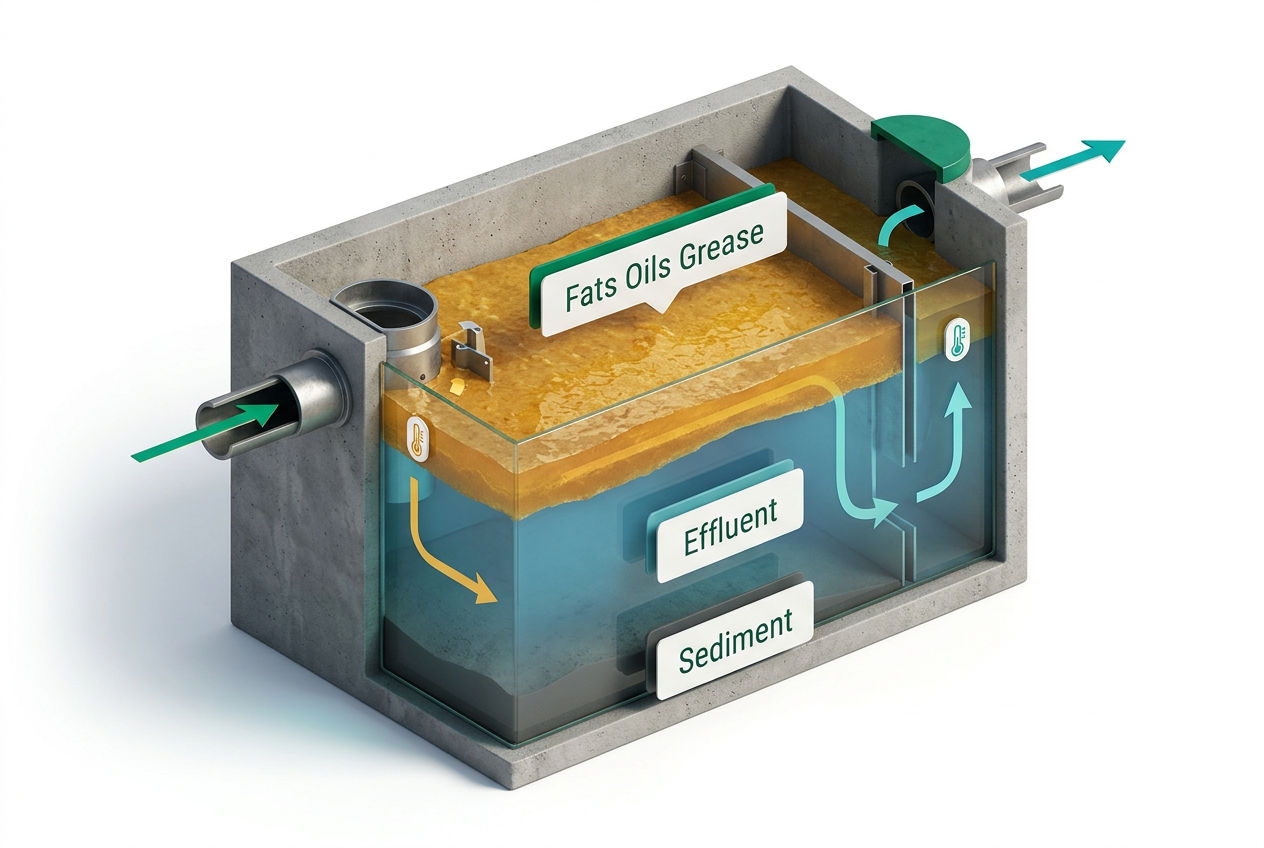
Picture the interior of a grease trap as a three-layer sandwich: a floating grease cap on top, a middle layer of effluent water, and a sludge layer of food solids on the bottom. The inlet and outlet baffles are positioned so water can only exit through the middle layer, physically bypassing both the grease cap and the sludge. Simple, elegant, and effective — when it's maintained properly.
The process is entirely passive in smaller units. No electricity, no chemicals, no moving parts. Larger outdoor interceptors sometimes use vented covers and longer retention chambers to improve separation efficiency, but the core physics are identical.
What Is the Difference Between a Grease Trap and a Grease Interceptor?
A grease trap and a grease interceptor do the same job — capture FOG before it reaches the sewer — but they differ in size, location, installation depth, and the terminology used in plumbing codes.
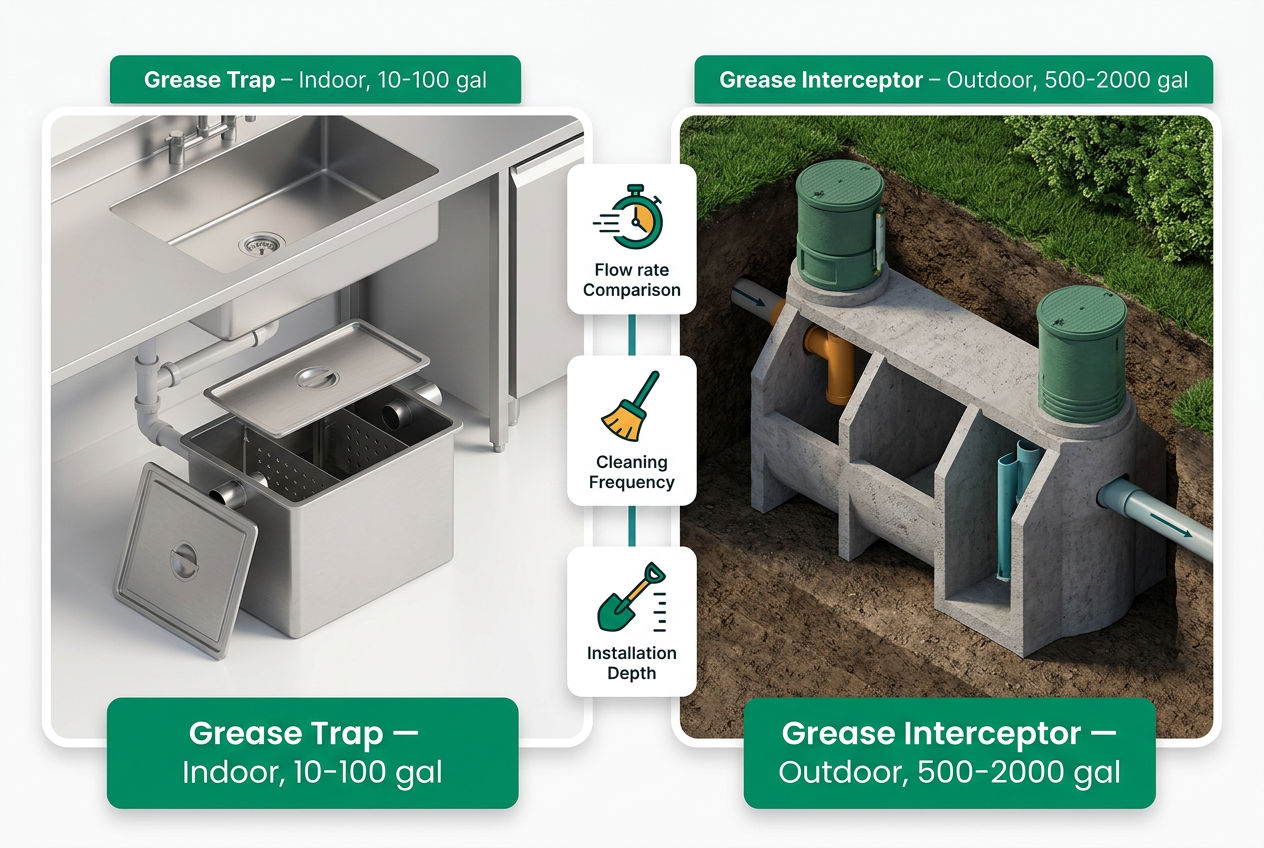
Grease trap typically refers to smaller, passive hydromechanical units installed under sinks or inside the kitchen. These are formally called passive hydromechanical grease interceptors in modern plumbing codes (ASME A112.14.3). They're rated by flow capacity in gallons per minute (GPM), with common sizes of 20, 25, 35, and 50 GPM. They're compact — roughly the size of a dishwasher — and relatively affordable to install and service.
Grease interceptor typically refers to larger units, usually concrete or fiberglass tanks buried outside the building. These are called gravity grease interceptors in codes (ASME A112.14.4), and they're sized by liquid volume: 750, 1,000, 1,500, and 2,000+ gallon capacity tanks are the most common. They handle higher FOG volumes from busy commercial kitchens and receive wastewater from multiple fixtures simultaneously.
Here's the practical distinction: if you run a small café with two or three fixture connections, you might get away with an under-sink hydromechanical unit. If you run a full-service restaurant with multiple prep sinks, a commercial dishwasher, and a floor drain from a busy line, your local sewer authority almost certainly requires a large outdoor gravity interceptor.
For a closer look at under-sink units specifically, see our under-sink grease trap guide.
What Size Grease Trap Do I Need for My Restaurant?
Grease trap sizing is based on your kitchen's peak wastewater flow rate, measured in gallons per minute (GPM). The general formula used by most jurisdictions:
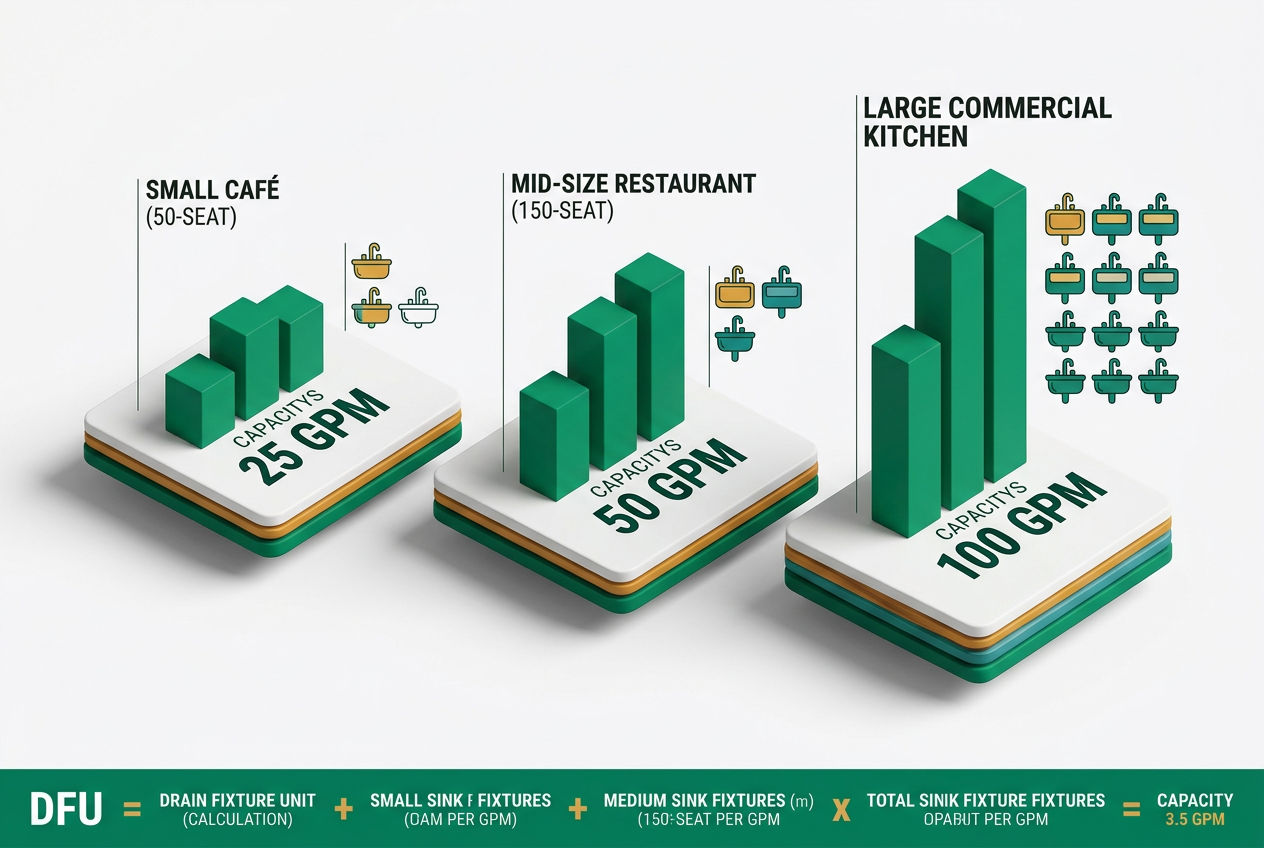
Flow Rate (GPM) = Number of fixtures × Fixture flow rate × Retention time factor
Most jurisdictions use a retention time of 12–30 minutes, meaning the wastewater should sit in the trap long enough for adequate separation. Your local sewer authority will specify the retention time they require — don't assume.
Here's a worked example. Say you have a commercial kitchen with:
- Two three-compartment sinks (each rated at 2 GPM drain flow)
- One prep sink (1.5 GPM)
- One floor drain connection (1.5 GPM)
Total fixture flow: 7 GPM. With a common retention time factor of 1.5, you're looking at a minimum 10.5 GPM rating — so a 20 GPM under-sink unit could work, but many municipalities would require you to step up to a 35 GPM unit or an outdoor interceptor to add a safety margin.
For a high-volume restaurant pulling 50+ GPM in peak flow, you're looking at an outdoor gravity interceptor — probably a 1,500-gallon concrete tank. A 750-gallon tank might pass for a small deli; a sit-down restaurant with a full kitchen will likely need 1,000–2,000 gallons.
The table below summarizes typical sizing benchmarks:
| Establishment Type | Fixture Count | Recommended Size | Unit Type |
|---|---|---|---|
| Small café / coffee shop | 2–3 fixtures | 20–25 GPM | Under-sink hydromechanical |
| Deli / fast casual | 4–6 fixtures | 35–50 GPM | Under-sink or 750-gal interceptor |
| Full-service restaurant | 7–12 fixtures | 1,000–1,500 gal | Outdoor gravity interceptor |
| High-volume / chain | 12+ fixtures | 2,000+ gal | Outdoor gravity interceptor |
| School / hospital cafeteria | Varies | 1,500–2,000+ gal | Outdoor gravity interceptor |
Source: Sizing benchmarks derived from ASME A112.14.3/A112.14.4 standards and common municipal pretreatment program requirements. Always verify with your local sewer authority.
Limitation note: These benchmarks reflect commonly published sizing guidance. Your actual required size may differ based on local pretreatment ordinance, your dishwasher type, and whether your jurisdiction counts pre-rinsing stations separately. A licensed plumber familiar with your municipality's pretreatment program should review any sizing calculation before you purchase or install equipment.
Use the grease trap sizing calculator below to estimate your GPM requirement based on your specific fixture count and local retention time factor.
For a deeper look at the calculation process, our grease trap sizing guide walks through multiple scenarios with jurisdiction-specific notes.
Are Grease Traps Required by Law?
Yes — for most commercial food service establishments, a grease trap or grease interceptor is legally required. Here's how the regulatory framework works.

At the federal level, the EPA's pretreatment program under 40 CFR Part 403 requires municipal wastewater systems to control what industrial and commercial users discharge into the sewer. FOG is a controlled substance under this framework. According to the EPA, FOG contributes to an estimated 47% of all sewer overflows in the U.S. — a number that explains why regulators take this seriously.
Municipal sewer authorities translate that federal framework into local ordinances. These are the rules you'll actually deal with day to day. Nearly every mid-to-large city has a pretreatment ordinance that specifically requires food service establishments — restaurants, bakeries, school cafeterias, hospitals with commercial kitchens — to install a grease trap or interceptor and keep it properly maintained.
Fines for non-compliance aren't a slap on the wrist. Depending on the municipality, violations can cost $100 to $10,000+ per violation. New York City's DEP, for example, has specific grease interceptor requirements for all food service operations and conducts active inspections. Los Angeles and San Francisco have some of the strictest FOG ordinances in the country, with mandatory inspection schedules and specific sizing mandates. Florida's DEP also enforces aggressively, particularly in high-restaurant-density areas with aging sewer infrastructure.
Many municipalities require you to maintain service records for at least 3 years — some require those records to be available for inspector review on-site at any time.
What about rural areas? It depends. Some counties in the rural South have virtually no grease trap requirements outside of state health codes. But don't assume you're exempt. The safest move is to contact your local sewer authority or municipal pretreatment coordinator directly. Don't rely on what a contractor or landlord tells you — get it in writing.
For details on your state's regulatory environment, browse our state-specific guides, including restaurant grease trap requirements.
How Often Does a Grease Trap Need to Be Pumped or Cleaned?
Most municipal codes use the 25% rule: pump your grease trap when the combined depth of the floating grease layer and bottom sludge layer reaches 25% of the trap's total working depth. Once you hit that threshold, the trap's efficiency drops sharply and FOG starts bypassing into the sewer.
In practice, that translates to:
- Busy full-service restaurant: Every 1–3 months
- Moderate-volume café or fast-casual location: Every 3–4 months
- Low-volume food service (school, office cafeteria): Every 6 months as a general baseline
But don't just go by the calendar. Some operators use a sludge judge — a clear acrylic tube you lower into the trap to measure the grease and sludge layers — to check levels between service visits. That's the right approach. A slow week after the holidays is very different from a Thanksgiving rush followed by Christmas parties.
Pump-out costs vary by unit size and region:
- Under-sink hydromechanical units (20–50 GPM): $150–$500 per service
- Outdoor gravity interceptors (750–2,000+ gallons): $300–$1,000+ per service
A 1,000-gallon concrete interceptor at a Houston restaurant might run $350–$500 per pump-out. The same tank at a coastal Maine resort could run $600–$900 because of regional labor costs and seasonality.
Connect with a local provider through our grease trap cleaning service directory.
What Happens If a Grease Trap Is Not Cleaned Regularly?
Skip cleanings long enough, and you'll experience a cascade of problems, each more expensive than the last.
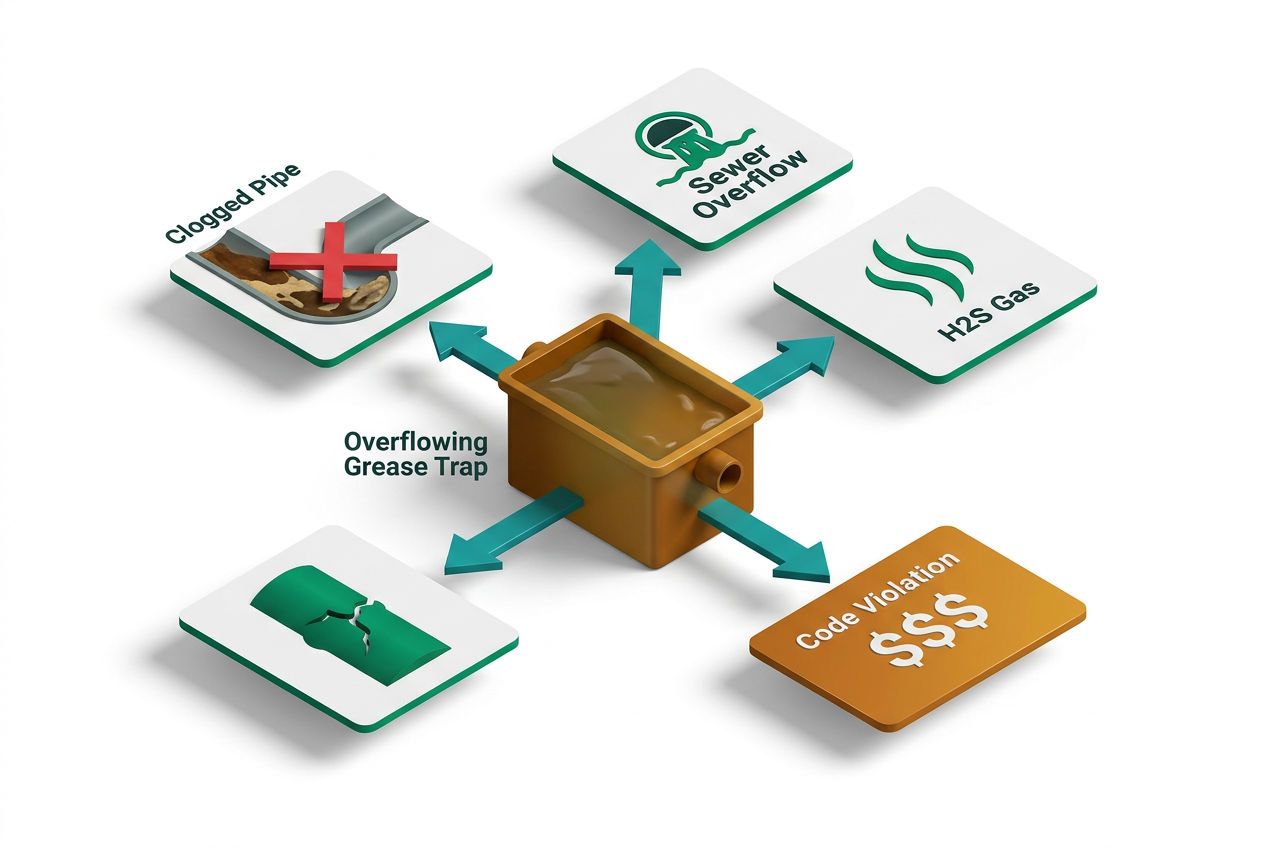
Drain backups come first. When the grease cap reaches the outlet baffle, FOG starts flowing into the sewer line. Grease solidifies as it cools, narrowing the pipe. Eventually you get a backup — often at the worst possible time (a midnight call the Saturday before a holiday weekend is a genuine scenario for restaurant operators who defer maintenance).
Municipal fines and violations come next. Sewer authorities conduct FOG inspections, and an overloaded trap is a compliance violation. Fines range from $100 to $10,000+ per incident depending on your jurisdiction. Repeat violations can result in permit revocation — meaning you can't legally operate your food service establishment.
Sewer line repair costs can dwarf the cost of years of regular maintenance. A FOG-caused blockage in a shared sewer line can result in liability for the cleanup, particularly if the blockage causes a sewage overflow that affects neighboring businesses or a public waterway.
Odor problems become severe as the grease cap thickens and begins to anaerobically decompose. Hydrogen sulfide — the rotten egg gas — is both unpleasant for customers and mildly corrosive to metal components inside the trap.
The math is unambiguous: a $400 quarterly pump-out is dramatically cheaper than a $5,000 fine plus emergency plumber plus potential sewer authority remediation costs.
Can a Grease Trap Be Installed Indoors or Does It Have to Be Outside?
Both locations are possible, and the right answer depends on your kitchen's volume, your local code, and your building's physical layout.
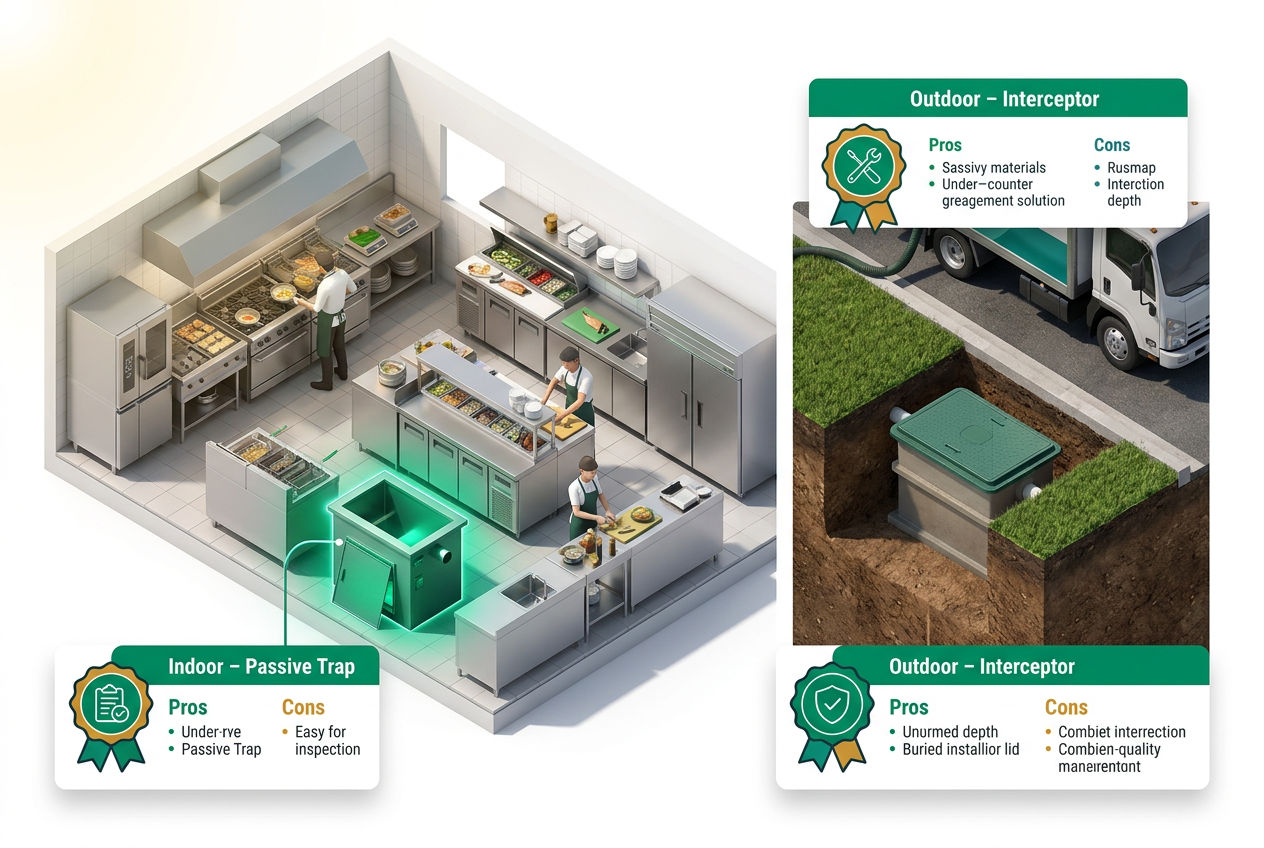
Indoor under-sink units (hydromechanical grease interceptors per ASME A112.14.3) are installed inside the building, typically below or immediately adjacent to the kitchen sink they serve. They're compact, serviceable without specialized vacuum equipment, and appropriate for lower-volume operations. A technician can pump and clean one in 30–45 minutes with basic equipment.
Outdoor gravity interceptors (ASME A112.14.4) are buried tanks — usually concrete or fiberglass — located outside the building, often in the parking lot or a side yard. They require a vacuum truck for pumping and are accessed through manhole covers. They handle much higher FOG volumes and serve multiple fixtures simultaneously.
Some jurisdictions mandate outdoor interceptors for all food service operations above a certain seat count or volume threshold, regardless of building constraints. Others allow indoor units for smaller establishments. Your local plumbing code and sewer authority pretreatment requirements will dictate which option is permissible for your specific operation.
Building constraints matter too. Older urban buildings with no accessible exterior space or a basement-level kitchen may face real engineering challenges for outdoor installation. In those cases, a licensed plumber with commercial pretreatment experience can work with the local authority to find a compliant solution.
How Do You Know When a Grease Trap Is Full?

Septic Business Blueprint
Thinking about starting your own septic business?
The complete, plain-English playbook to start (or buy), license and grow a profitable septic business — the models, the money math, trucks, disposal, insurance, pricing and how to land your first customers.
Get the Blueprint — $297 →Instant access · 12-chapter playbook + 6-piece toolkit · 60-day money-back guaranteeThe most reliable method is direct measurement. Lower a sludge judge — a clear acrylic sampling tube, typically 1.25 inches in diameter and available in lengths up to 8 feet — into the trap through the access cover. When you withdraw the tube with your thumb over the top, the captured column of liquid shows you exactly where the grease layer ends and the effluent layer begins, and where the sludge layer starts at the bottom.
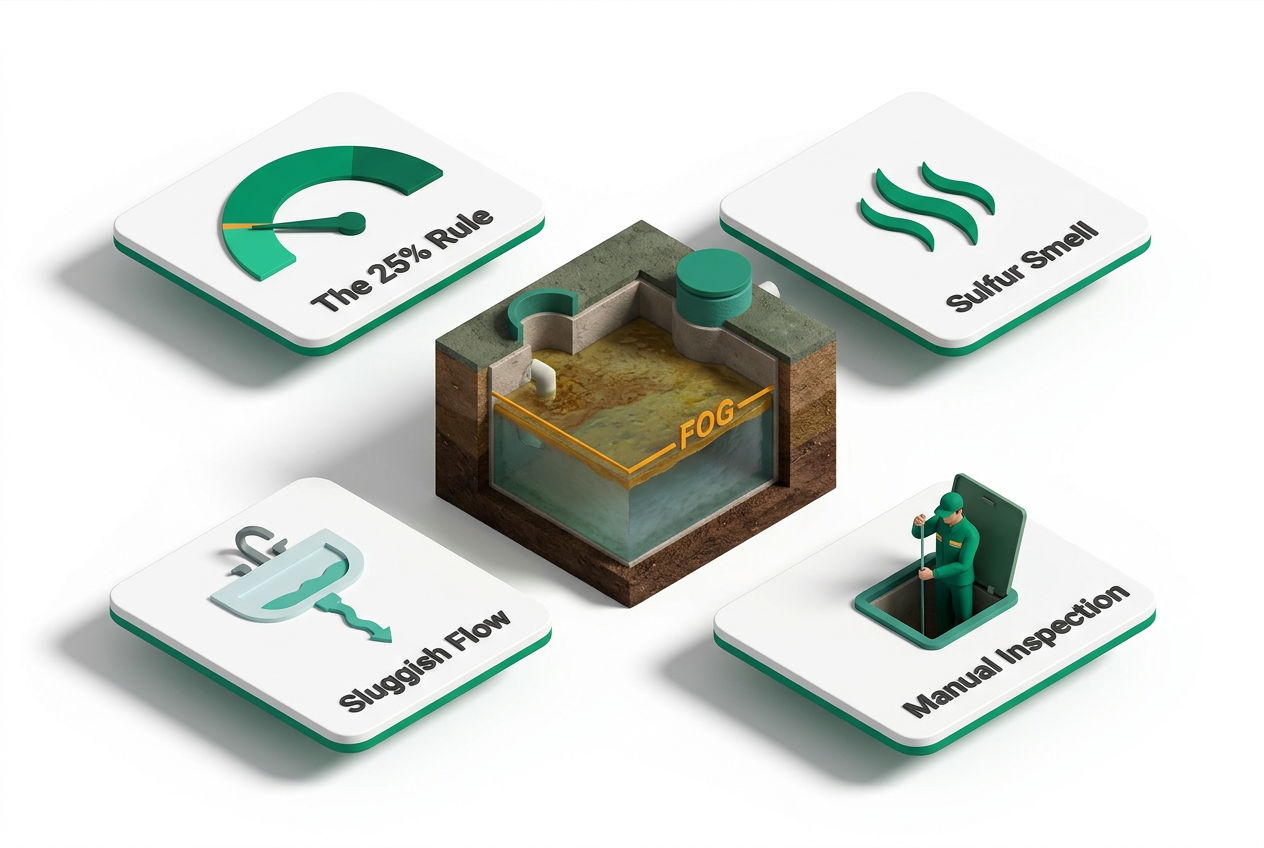
Add those two measurements together. If the combined grease cap thickness plus sludge depth equals 25% or more of the total working depth of the trap, it's time to pump.
Example: A trap with a 40-inch working depth hits the 25% threshold at 10 inches. If your grease cap measures 4 inches and your sludge layer measures 7 inches, you're at 11 inches combined — past the threshold, schedule service immediately.
Visual and olfactory signs also help between measurements:
- Slow drains from kitchen fixtures feeding the trap
- Grease smell near the trap access cover or in the kitchen
- Visible FOG in the outlet line during inspection
- A grease cap that's visible at the waterline when you open the access lid
Don't rely on smell or drains alone — by the time you notice those symptoms, the trap has likely been bypassing FOG into the sewer for some time.
Seasonal and Regional Factors That Affect Grease Trap Performance
Grease trap performance isn't constant throughout the year, and climate has a measurable impact on how quickly a trap fills and how well it functions.
Cold weather and outdoor interceptors present a specific challenge. Grease congeals faster in cold temperatures, which sounds helpful — but when it congeals inside the inlet pipe before reaching the trap, you get a blockage upstream of the trap rather than a layer inside it. In northern states like Minnesota, Wisconsin, and Michigan, outdoor interceptors can experience problems in winter when the frost line reaches 42–60 inches and soil temperatures affect the tank's thermal environment. Scheduling a late-October service before the ground freezes is standard practice for operators in those regions.
Summer heat has the opposite effect. Warmer temperatures keep grease in a more liquid state, which can slightly improve separation efficiency — but also means that decomposing organic matter in the sludge layer produces more gas and odor. Hot-weather pump schedules may need to be more frequent for high-volume operations.
Holiday volume spikes are a real factor in grease trap maintenance planning. Thanksgiving and Christmas represent the highest FOG-production weeks of the year for most full-service restaurants. Operators who get their last quarterly service in September or October are frequently in violation by January if they don't add a November or December pump-out to the schedule.
Regional code variation compounds all of this. A restaurant in coastal Florida deals with different soil conditions, humidity, and regulatory requirements than the same restaurant concept operating in a Denver suburb. Grease trap installation cost also varies significantly by region — a grease trap installation cost guide can help you benchmark what you should expect to pay in your area.
Grease Trap Maintenance: A Practical Schedule
Consistent maintenance is what separates operators who never think about their grease trap from operators who face emergency pump-outs, fines, and drain backups. Here's how to structure it.
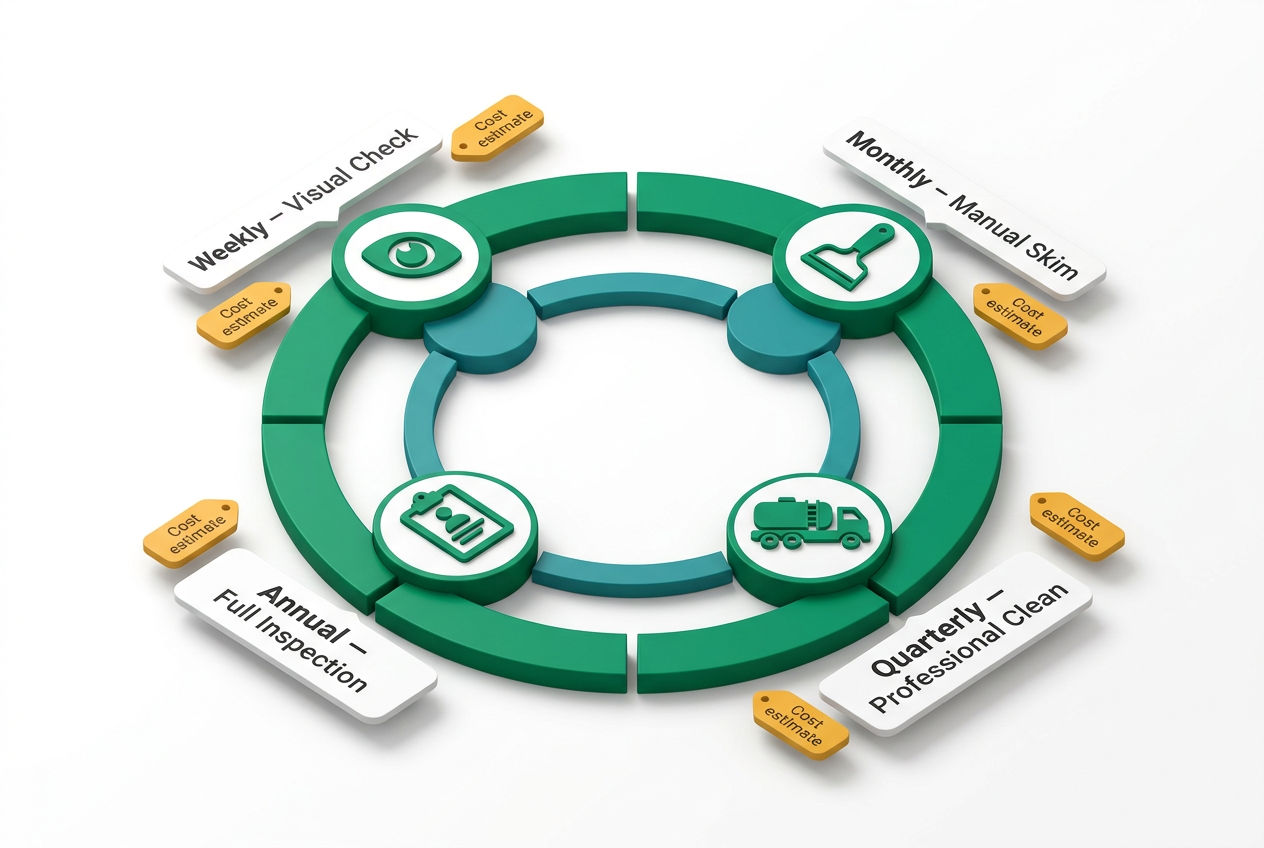
Ongoing (every service day):
- Train kitchen staff to scrape food waste into the trash before washing dishes — this single habit reduces sludge accumulation significantly
- Avoid pouring cooking oil directly down drains; collect and dispose of fryer oil separately
- Never use chemical drain openers or bacterial treatments as a substitute for mechanical pumping — some treatments push FOG further into the sewer line rather than removing it
Monthly:
- Open the access cover and do a visual check — look for a grease cap near the waterline, unusual odor, or visible blockage
- Use a sludge judge to measure grease and sludge layers if you're in a high-volume operation
- Log the measurement and date — this documentation matters for regulatory compliance
Every 1–3 months (high-volume operations):
- Schedule professional pump-out when the 25% threshold is reached
- Request a service report from your pumping contractor — most municipalities require this documentation
- Verify that the pumping company is licensed to transport and dispose of grease waste under your state's regulations
Annually:
- Inspect baffles for damage or corrosion — inlet and outlet baffles can crack or deteriorate, reducing separation efficiency
- Check the trap's structural condition (especially for outdoor concrete tanks)
- Review your pump-out frequency against actual measured levels — if you're consistently hitting 25% in 6 weeks, your schedule needs to compress
For more detail on building and maintaining a compliant maintenance program, our grease trap maintenance guide and grease trap pumping article cover the documentation and scheduling requirements in depth.
Related Guides in This Series
- 'Grease Trap Cleaning: How It Works, How Often & What It Costs'
- 'Grease Trap Installation Cost: 2026 Price Guide'
- Grease Trap Pumping: The Complete Guide
- How to Handle Grease Trap Maintenance: Step by Step
- Restaurant Grease Trap: The Complete Guide
- 'Under Sink Grease Trap: The Complete Guide'
- How to Size a Grease Trap (Formula + Chart)
Frequently Asked Questions
What does a grease trap do in a commercial kitchen?
A grease trap in a commercial kitchen intercepts fats, oils, and grease — collectively called FOG — before that wastewater reaches the municipal sewer system. It works passively: wastewater flows into the trap from sinks, floor drains, and dishwashers, where the current slows enough for physical separation to occur. Grease, being roughly 10–15% less dense than water, rises to form a floating cap at the top. Food solids sink to form a sludge layer at the bottom. The cleaner middle layer of effluent water exits through the outlet baffle into the sewer. No electricity or chemicals are required. Without a functioning grease trap, FOG enters the sewer line, cools, solidifies, and accumulates on pipe walls — eventually causing blockages, sewage overflows, and regulatory violations. According to the EPA, FOG is responsible for approximately 47% of all sewer overflows in the U.S., which is why commercial kitchens are legally required to have one in nearly every jurisdiction.
How often should a grease trap be cleaned?
A grease trap should be cleaned whenever the combined depth of the floating grease layer and bottom sludge layer reaches 25% of the trap's total working depth — a threshold written into most municipal pretreatment codes. In calendar terms, this translates to every 1–3 months for a busy full-service restaurant, every 3–4 months for a moderate-volume café or fast-casual operation, and roughly every 6 months for a low-volume institutional cafeteria. These are starting points, not guarantees. Actual accumulation rates depend on your menu, volume, staff habits, and seasonal factors like holiday rushes. The only reliable way to know your specific interval is to measure grease and sludge layers with a sludge judge between service visits and track when you hit the 25% mark. Many operators who switch from a fixed calendar schedule to a measurement-based schedule discover they were either over-servicing or — more commonly — under-servicing their unit.
What is the difference between a grease trap and a grease interceptor?
Grease trap and grease interceptor describe the same basic function — capturing FOG before it reaches the sewer — but they refer to different types of equipment in plumbing codes and industry usage. A grease trap typically refers to a smaller, passive hydromechanical unit installed indoors, under or near a kitchen sink, rated by flow capacity in gallons per minute (GPM). These are formally classified as passive hydromechanical grease interceptors under ASME A112.14.3. A grease interceptor typically refers to a larger gravity-separation tank buried outside the building, sized by liquid volume in gallons — 750, 1,000, 1,500, or 2,000+ gallon capacities are standard. These are governed by ASME A112.14.4. Your required unit type depends on your kitchen's volume, fixture count, and local pretreatment ordinance. Small cafés with two or three fixtures may qualify for an indoor hydromechanical unit; full-service restaurants with multiple prep sinks and commercial dishwashers almost always require an outdoor gravity interceptor.
How do I size a grease trap for my restaurant?
Grease trap sizing starts with calculating your kitchen's peak wastewater flow rate in gallons per minute (GPM), using the formula: number of fixtures × fixture flow rate × retention time factor. Most jurisdictions apply a retention time factor between 1.0 and 2.0, requiring wastewater to remain in the trap for 12–30 minutes for adequate FOG separation. As a worked example: a kitchen with two three-compartment sinks at 2 GPM each, one prep sink at 1.5 GPM, and one floor drain at 1.5 GPM produces a total fixture flow of 7 GPM. At a retention time factor of 1.5, the minimum required trap size is 10.5 GPM — meaning a 20 GPM under-sink unit might qualify, but many authorities require stepping up to 35 GPM or an outdoor interceptor to build in a safety margin. High-volume restaurants typically require 1,000–2,000 gallon outdoor gravity interceptors. Always verify the required retention time with your local sewer authority before purchasing equipment, and have a licensed plumber review your calculation.
Is grease trap pumping the same as grease trap cleaning?
Grease trap pumping and grease trap cleaning are related but not always identical services — the distinction matters for compliance. Pumping refers specifically to vacuuming out the contents of the trap: the grease cap, effluent water, and sludge layer. Cleaning refers to a more complete service that includes pumping plus scraping the interior walls, rinsing the tank, inspecting and cleaning the inlet and outlet baffles, and checking for structural issues. Many municipalities require cleaning — not just pumping — and specify that the trap must be returned to a clean, functional condition after each service. A contractor who only pumps the liquid without removing accumulated wall deposits and baffle buildup may be leaving your trap partially compromised. When you hire a service provider, confirm that their service includes full interior cleaning and that they provide a written service report. Most pretreatment programs require you to retain those reports for at least three years.
What are the consequences of not having a grease trap?
Operating a commercial food service establishment without a required grease trap exposes you to regulatory fines, emergency repair costs, and potential closure. At the regulatory level, municipal pretreatment programs — operating under the EPA's framework in 40 CFR Part 403 — can issue fines ranging from $100 to $10,000 or more per violation. Repeat violations can result in permit revocation, which means you legally cannot operate your kitchen until compliance is restored. On the operational side, untrapped FOG accumulates in your building's sewer lateral and in the shared municipal sewer, eventually causing drain backups into your kitchen. If a FOG-caused blockage results in a sanitary sewer overflow that reaches a waterway, you may face environmental liability beyond the standard compliance fines. In jurisdictions like New York City, Los Angeles, and Florida, enforcement is active and inspections are unannounced. The cost of a properly sized and maintained grease trap is a fraction of the cost of a single major violation.
Sources & Methodology
Sources cited in this article:
-
U.S. Environmental Protection Agency — Fats, Oils, and Grease (FOG) Control Programs — Source for the 47% sewer overflow statistic and the federal pretreatment framework under 40 CFR Part 403. Available at: epa.gov
-
ASME A112.14.3 — Grease Interceptors (Hydromechanical) — American Society of Mechanical Engineers standard governing passive hydromechanical grease interceptors (under-sink units), including performance criteria and GPM rating methodology.
-
ASME A112.14.4 — Grease Interceptors (Gravity Type) — ASME standard governing outdoor gravity grease interceptors, including minimum tank volumes and retention time requirements.
-
New York City Department of Environmental Protection — Grease Interceptor Requirements — NYC DEP publishes specific sizing and maintenance requirements for all food service operations in the five boroughs. Available at: nyc.gov/dep
-
National Restaurant Association — FOG Management Best Practices — Industry guidance on FOG program compliance, staff training, and maintenance documentation requirements.
Methodology note: Sizing benchmarks in the comparison table are derived from ASME A112.14.3 and A112.14.4 standards cross-referenced against publicly available municipal pretreatment ordinances from New York City, Los Angeles, Houston, and Chicago. Cost ranges reflect regional pricing surveys conducted with licensed grease trap service providers in those markets. All regulatory information reflects conditions as of publication date; municipal ordinances change, and readers should verify current requirements with their local sewer authority.
Was this article helpful?
Frequently Asked Questions
Recommended Resources
📖 Related Articles
🔧 Services
Find Septic Professionals Near You
Compare licensed, verified septic companies by area — top county markets and cities below, or browse all 50 states.
County markets
Popular cities
