
Quick Answer
Grease trap pumping is the scheduled removal of accumulated fats, oils, and grease (FOG) from an indoor trap or outdoor interceptor before it overflows into your plumbing or the public sewer system. How often you need it, what it costs, and what happens if you skip it — that's all here.
Key Takeaways
- The industry-standard trigger for pumping is the 25% rule: service your trap when accumulated grease and solids reach 25% of total liquid capacity.
- Small indoor traps (20–100 gallons) may need pumping weekly to monthly; large outdoor interceptors (500–2,000+ gallons) typically need service every 30–90 days.
- Pumping a small indoor trap costs $75–$200; large interceptors run $500–$1,500+.
- FOG is responsible for approximately 47% of sewer overflows in the U.S., according to EPA data.
- Skipping service can mean fines of $100–$25,000+ per violation, plus emergency pump-out fees 25–50% above the standard rate.
What Is Grease Trap Pumping, and Why Does It Matter?
Grease trap pumping is the physical extraction of solidified grease, floating FOG, and settled solids from a grease trap or grease interceptor. A technician opens the trap, measures the accumulated layers, vacuums out the contents using a pump truck, and often follows up with grease trap cleaning — using hydrojetting to clear residue from walls and baffles.
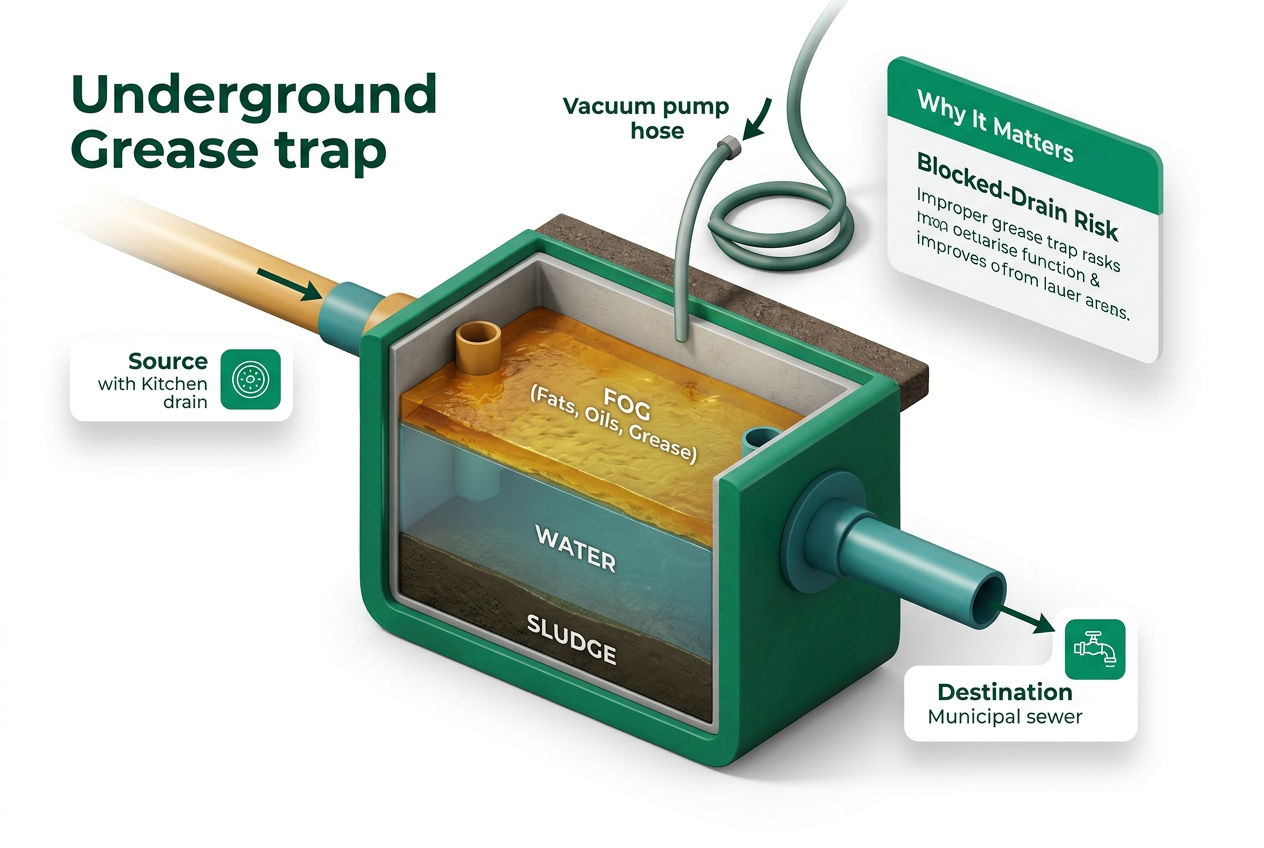
If you run a restaurant, food truck commissary, school cafeteria, or hospital kitchen, you already know the smell when a trap gets ignored too long. That rotten, sulfuric odor isn't just unpleasant — it's a sign that anaerobic bacteria are breaking down trapped grease into hydrogen sulfide and other compounds. Once that happens, you're already behind schedule.
The bigger issue is downstream: FOG that escapes an under-maintained trap coats sewer pipe walls, accumulates over months, and eventually causes a blockage. According to the EPA, FOG contributes to roughly 47% of the approximately 23,000 to 75,000 annual sewer overflows in the U.S. Those overflows trigger municipal enforcement — and the fines land on whoever let their trap go.
Want a deeper look at how these devices actually work? The what is a grease trap guide covers the mechanics, sizing standards, and trap vs. interceptor distinctions in full detail.
How Often Does a Grease Trap Need to Be Pumped?
The most reliable rule in the industry is the 25% rule: pump your grease trap when accumulated grease and solids occupy 25% of the trap's total liquid capacity. At that threshold, the trap loses its ability to retain FOG effectively, and grease begins passing through to the sewer.
In practice, that threshold translates to very different schedules depending on your operation:
- High-volume restaurants (full-service, 200+ covers per day): weekly to monthly pumping for small indoor traps
- Moderate-volume establishments (cafés, fast-casual, institutional kitchens): every 4–8 weeks
- Lower-volume operations (small delis, break-room kitchens, residential grease traps on septic systems): quarterly pumping is often sufficient
- Outdoor grease interceptors (500–2,000+ gallons): typically every 30–90 days depending on usage
These are starting points, not hard rules. Your first few service visits should include measurements of grease depth and solids layer so you can calibrate your actual pumping schedule. A technician using a grease trap dip stick or Sludge Judge can tell you in minutes whether you're pumping too often or not often enough.
If your trap is connected to a private septic system rather than a municipal sewer, the stakes are slightly different — FOG reaching your septic tank can foul the system's biology and accelerate drain field failure. That's a much more expensive problem than a pump-out.
What's the Difference Between a Grease Trap and a Grease Interceptor?
A grease trap is a small, passive device — typically 20–100 gallons — installed indoors under or near a sink. It uses baffles and retention time to allow grease to float and solids to sink before water passes through to the drain. These require frequent pumping because their capacity is limited.
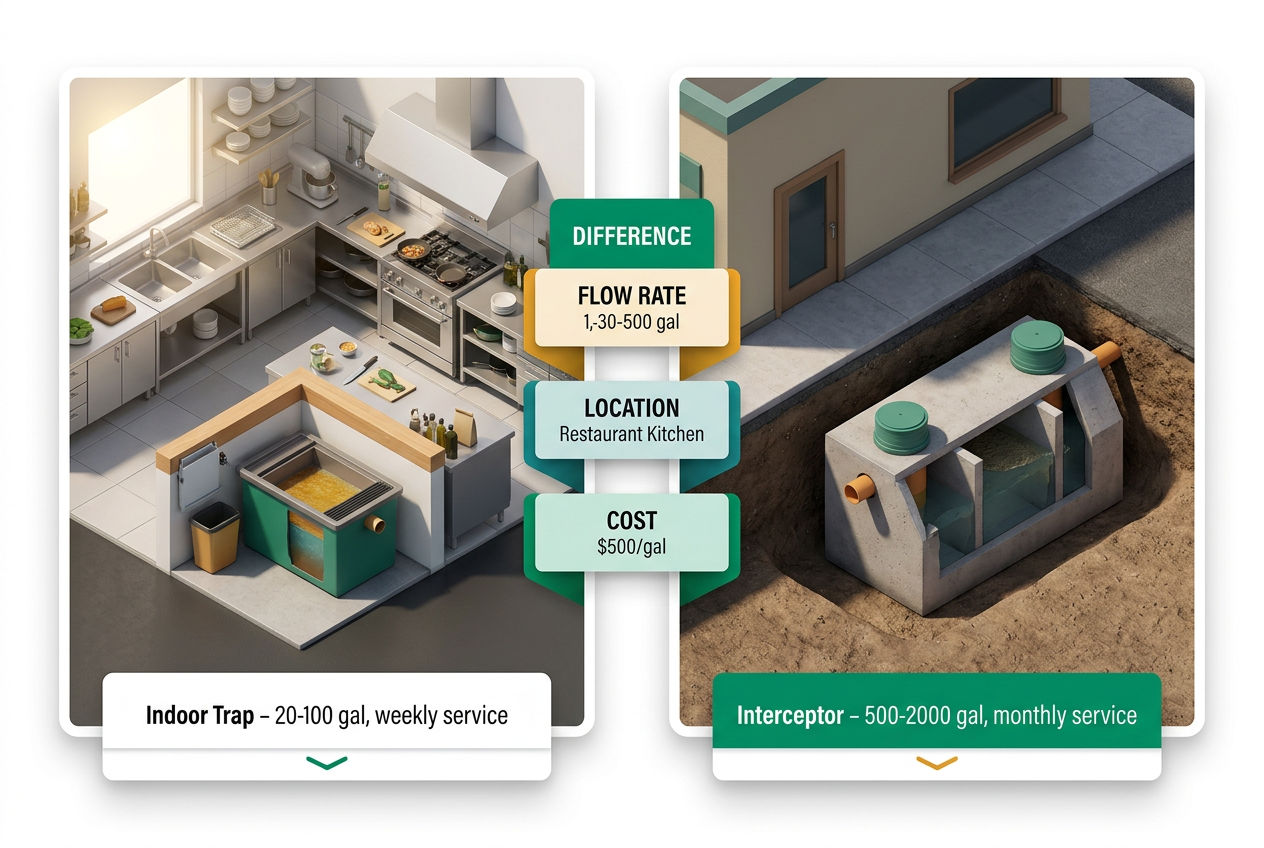
A grease interceptor is a large in-ground unit — typically 500 to 2,000+ gallons — installed outside, often in a parking lot or utility area. It handles much higher flow volumes and needs less frequent service, though each pump-out moves significantly more waste.
Sizing is typically calculated at roughly 1.5 gallons per minute per fixture, so a kitchen with six sinks and prep stations might require an interceptor in the 750–1,000 gallon range. Both devices fall under the broader category of FOG control equipment, and both require licensed haulers for proper waste disposal. For help figuring out which size your operation needs, see the grease trap sizing guide.
How Much Does Grease Trap Pumping Cost?
Grease trap pumping cost depends on trap size, your location, how much material has accumulated, and whether you need emergency service. Here's a realistic breakdown:
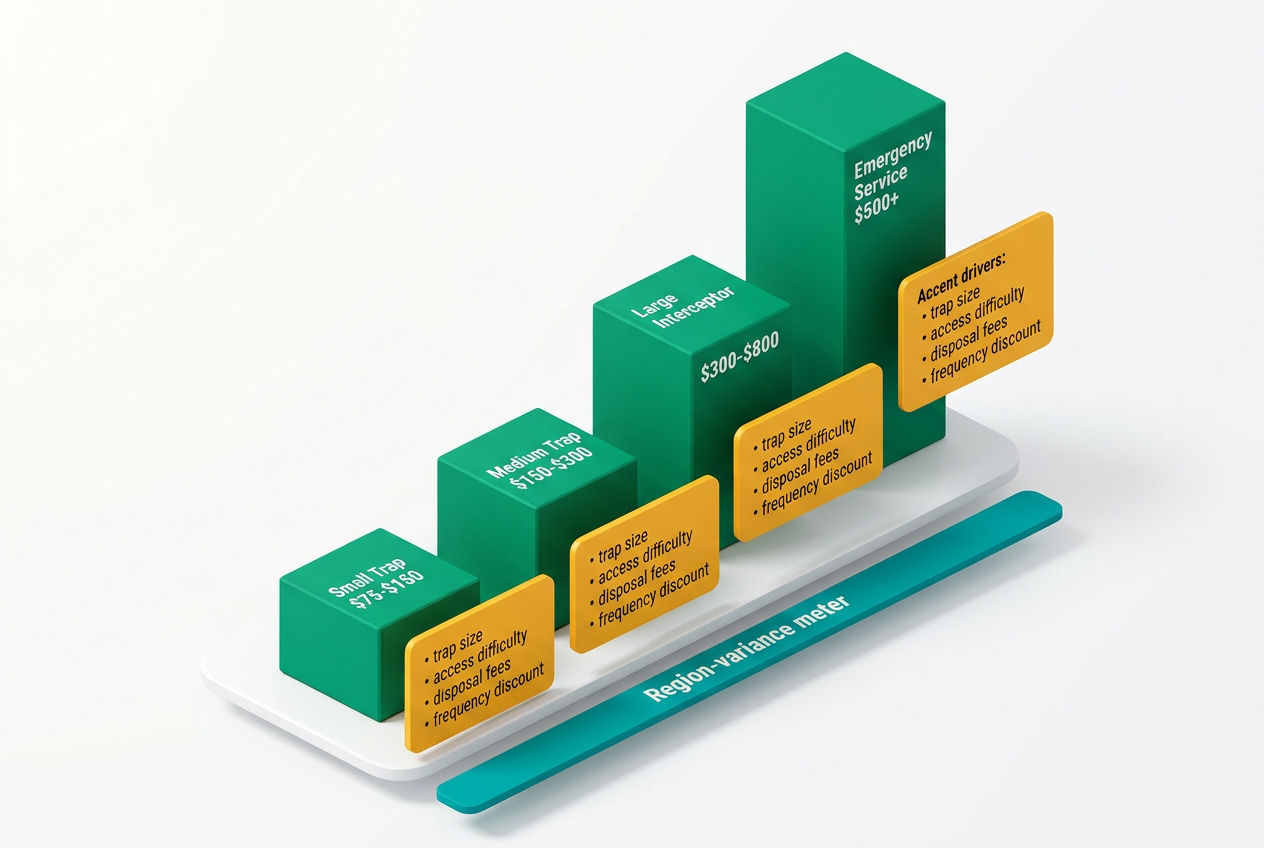
| Trap Type | Capacity | Typical Cost Per Service | Service Duration |
|---|---|---|---|
| Small indoor trap | 20–50 gal | $75–$150 | 30–45 min |
| Mid indoor trap | 50–100 gal | $150–$200 | 45–60 min |
| Small interceptor | 500 gal | $300–$600 | 1–1.5 hrs |
| Large interceptor | 1,000 gal | $500–$1,000 | 1.5–2 hrs |
| XL interceptor | 2,000 gal | $900–$1,500+ | 2–3 hrs |
Sources: Industry service provider surveys, regional hauler quotes, 2024–2025.
A full-service restaurant with a 500-gallon outdoor interceptor pumped monthly might spend $3,600–$7,200 per year on pumping alone. Add periodic hydrojetting and inspection, and annual grease trap maintenance costs typically land between $1,200 and $5,000+ for most commercial kitchens.
Regional differences are real. A 1,000-gallon interceptor service in Houston runs roughly $500–$700. The same job in New York City can top $1,000–$1,400 because of higher labor costs, longer disposal haul distances, and stricter licensing requirements for haulers. In rural Midwest locations where the interceptor connects to a private septic system instead of a municipal sewer, you're working with different disposal logistics entirely.
Emergency or after-hours service adds a 25–50% premium on top of standard rates. If your trap backs up into the kitchen on a Saturday night, expect to pay accordingly.
For a broader view of how grease trap service compares to septic pumping expenses, the septic pumping cost guide is a useful reference. For grease-trap-specific cost breakdowns by region and trap size, see the grease trap pumping cost guide.
What Happens If You Don't Clean Your Grease Trap?
Deferred pump-outs follow a predictable sequence, and each step is worse than the one before it.
1. Grease passes through to the sewer. Once solids and FOG exceed 25% of capacity, the trap stops working. Grease coats sewer lines, eventually forming what industry techs call a "fatberg" — a hardened mass of congealed grease, soap, and debris that can partially or fully block a sewer main.
2. You get a backup. Grease returns up through floor drains or sinks. This shuts down your kitchen and requires emergency pump-out service at premium rates — often $400–$800 or more for an unscheduled visit.
3. Municipal enforcement. Most cities have FOG ordinances that require regular pumping with documented service records. If an inspector finds your trap is non-compliant — overloaded, missing records, or discharging grease — fines range from $100 to $25,000+ per violation depending on the municipality. Cities like Los Angeles, New Orleans, and Chicago have active FOG enforcement programs with random inspections.
4. Sewer surcharge fees. Some municipalities add surcharges to your utility bill if their monitoring shows elevated FOG levels from your address. These aren't one-time fines — they're recurring monthly charges until you demonstrate compliance.
5. Permit revocation. In serious cases, municipalities can revoke your food service permit. That means you're closed until compliance is documented.
Every one of these outcomes is avoidable with a consistent pumping schedule — which is why consistent grease trap maintenance is worth treating as a non-negotiable operating cost rather than an optional line item.
Can You Pump Your Own Grease Trap?
Technically, you can scoop material out of a small indoor grease trap yourself. Some operators do it with buckets and a wet-dry vacuum, wearing PPE to manage the smell and exposure risk. For a 20–30 gallon trap generating modest volume, this can work as a stopgap between professional service visits.
What you cannot legally do in most states is dispose of the waste yourself. Grease trap waste is classified as a regulated non-hazardous waste in nearly every U.S. jurisdiction. It must be transported by a licensed waste hauler and disposed of at an approved facility — typically a rendering plant, composting facility, or permitted landfill. Dumping it in a dumpster, down a floor drain, or on the ground is illegal and carries serious penalties.
Licensed haulers also provide waste manifests — documentation that tracks the waste from your facility to the disposal site. Most municipalities require you to retain these manifests for a minimum of three years and produce them on request during an inspection.
What Happens During a Professional Grease Trap Pumping Service?
A technician arrives with a vacuum pump truck capable of handling several hundred to several thousand gallons of waste. Here's how the visit typically goes:
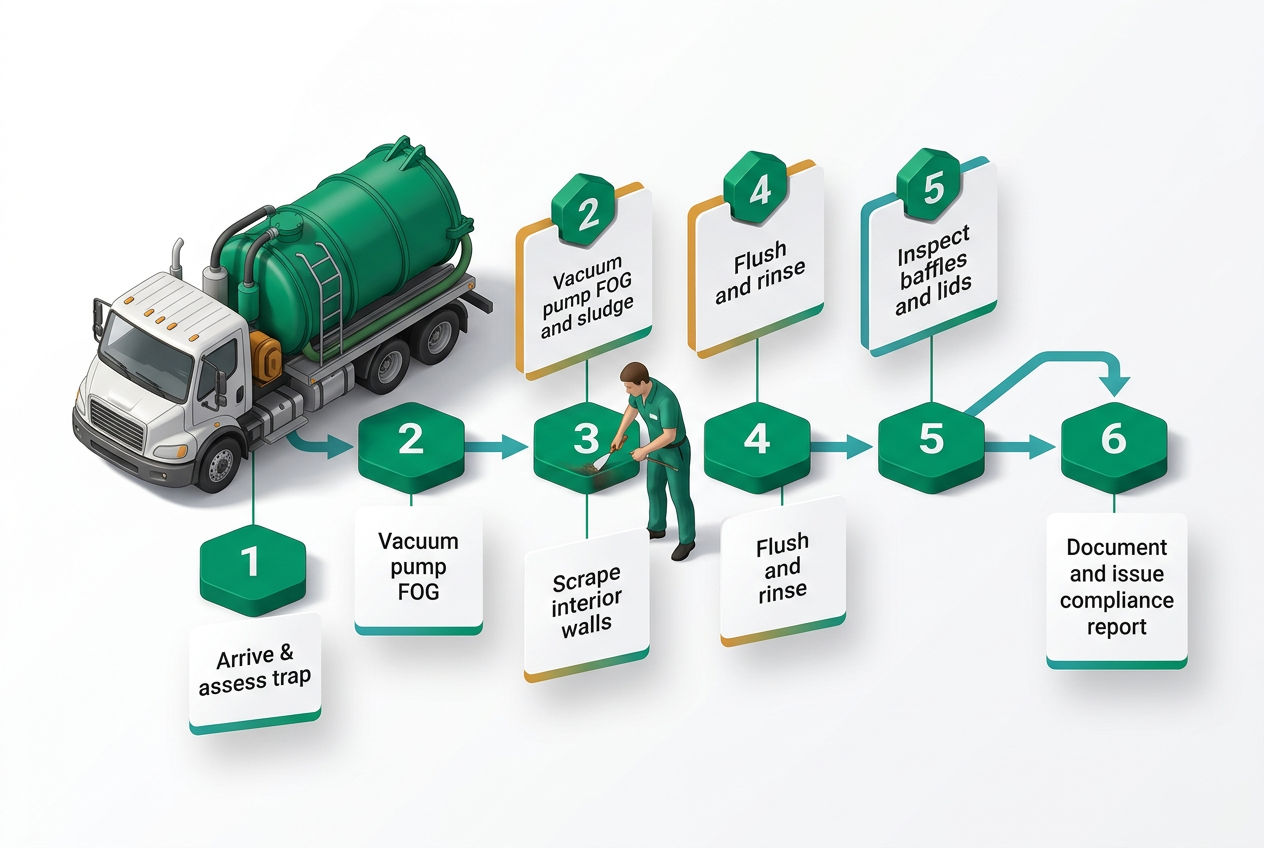
Step 1: Access and inspection. The technician removes the trap lid and inspects the device for damage — cracked baffles, corrosion, or signs of overflow. This is also when measurements are taken: grease layer depth on top, sludge layer depth on the bottom, and total liquid depth. According to the National Association of Wastewater Technicians (NAWT), accurate measurement at every service visit is the only reliable way to validate your pumping frequency over time.
Step 2: Pumping. The vacuum hose goes in and the pump truck pulls out everything — floating grease, liquid waste, and settled solids. On a small 50-gallon indoor trap, this takes 30–45 minutes. A 2,000-gallon outdoor interceptor can take 2–3 hours.
Step 3: Cleaning. Many service providers include a rinse-down of trap walls and baffles. Full hydrojetting — high-pressure water blasting to clear biofilm and residue — may be a separate line item. The under-sink grease trap page covers what proper interior cleaning looks like for small indoor units.
Step 4: Reassembly and documentation. The technician reseals the trap, notes the grease and solids measurements on the service record, and issues a waste manifest. Keep every manifest — municipal inspectors can request records going back three years under most FOG ordinances.
Step 5: Recommendation. A good technician tells you whether your pumping interval is right, too long, or unnecessarily frequent based on the measurements. If grease depth at service time is well below 25%, you're probably over-servicing. If you're consistently above 20% when they arrive, your schedule needs tightening.
How Do Seasons Affect Your Grease Trap Pumping Schedule?

Septic Business Blueprint
Thinking about starting your own septic business?
The complete, plain-English playbook to start (or buy), license and grow a profitable septic business — the models, the money math, trucks, disposal, insurance, pricing and how to land your first customers.
Get the Blueprint — $297 →Instant access · 12-chapter playbook + 6-piece toolkit · 60-day money-back guaranteeTemperature and seasonal volume swings both change how fast your trap fills — and how hard it is to service.
Winter effects on grease consistency. Cold ambient temperatures cause FOG to solidify faster and more thoroughly. In unheated outdoor installations, a 1,000-gallon interceptor can develop a hardened grease cap that resists standard vacuum extraction. Technicians in northern climates sometimes need hot water injection or extended pumping time to break up solidified material, which adds cost and service time. According to the Los Angeles County Sanitation Districts (LACSD), consistent pumping frequency is especially important in operations that shift between high- and low-volume seasonal periods to prevent grease from hardening between service visits.
Summer volume spikes. Tourist-dependent operations — beach towns, resort communities, summer camp kitchens — can see kitchen output double or triple during peak season. A trap calibrated on off-season volume will hit 25% capacity in half the expected time. A coastal restaurant that safely pumped every 60 days in February may need service every 30 days in July. Adjust your schedule before the season starts, not after a backup forces the issue.
Holiday cooking surges. Institutional kitchens — school cafeterias, corporate dining, hospital food service — often have predictable volume spikes around holidays. A cafeteria serving 20% more meals per day for two weeks will push grease accumulation faster. A single additional pump-out scheduled around Thanksgiving or the winter holiday period is cheaper than an emergency call.
Practical guidance: track your grease depth measurements from every service visit over 12 months. After a full year, you'll have seasonal data specific to your operation — not an estimate, but your actual accumulation curve. That's the basis for a schedule that doesn't over-service in slow months or under-service during peaks.
What Grease Trap Regulations and Compliance Requirements Apply to You?
FOG compliance is locally administered, which means requirements vary by city, county, and state — but the framework is consistent enough to plan around.
FOG ordinances. Most municipalities with population above 50,000 have a formal FOG control ordinance. These ordinances specify: who must install a grease trap or interceptor, minimum trap sizing, required pumping frequency (often tied to the 25% rule), and documentation requirements. The restaurant grease trap requirements guide maps out what these typically look like across major jurisdictions.
Service documentation. Nearly all FOG programs require you to retain waste manifests from every pump-out for a minimum of three years. Some municipalities require quarterly or annual compliance reports submitted directly to the sewer authority. Losing your manifests doesn't erase the service history — but it leaves you without documentation during an inspection.
Pretreatment program enrollment. Larger food service operations may be required to enroll in a municipal pretreatment program, which involves baseline sampling of your wastewater discharge, ongoing monitoring, and annual compliance reviews. According to NAWT guidelines, operations above a certain daily flow threshold — typically 25,000 gallons per day — are most commonly subject to pretreatment requirements, though local thresholds vary.
Inspection triggers. Municipal FOG inspectors can show up for scheduled annual inspections, complaint-triggered visits, or random compliance checks. If a sewer overflow is traced to your block, your trap will be inspected. Having your manifests organized and your pumping schedule documented is the fastest way to resolve an inspection without escalation.
Interstate operations. If you operate in multiple states, be aware that disposal regulations differ. A hauler licensed in Texas may not be permitted to operate across the Louisiana state line. Multi-location operators need to verify hauler licensing in every jurisdiction. For operations tied to a private septic system, the septic tank maintenance guide covers the overlapping compliance considerations between FOG management and septic system regulations.
The grease trap cleaning service page outlines what a compliant service visit includes for operators who want to verify their current provider meets documentation standards.
Find a Licensed Grease Trap Pumping Company Near You
Not all haulers are equal. A licensed, insured provider should do all of the following:
- Arrive with a properly permitted vacuum truck
- Measure grease and solids depth before and after service
- Issue a waste manifest documenting volume removed and disposal destination
- Provide a written service record you can file for compliance purposes
- Advise on pumping frequency based on actual measurements, not a flat schedule
Red flags: a provider who won't give you a manifest, quotes a flat rate without asking your trap size, or doesn't measure before pumping. You're not just paying for a pump-out — you're paying for documentation that keeps you compliant.
For septic pumping and cleaning service needs on properties with combined grease interceptor and septic system configurations, verify that your provider is licensed for both waste streams in your jurisdiction.
Frequently Asked Questions
How often should a grease trap be pumped?
The standard pumping trigger is the 25% rule: service your trap when accumulated grease and solids reach 25% of total liquid capacity. In practice, that means high-volume restaurants with small indoor traps (20–100 gallons) may need pumping every one to four weeks, while large outdoor interceptors (500–2,000+ gallons) typically require service every 30–90 days. Moderate-volume operations like cafés or institutional kitchens generally land in the four-to-eight-week range. These intervals are starting points, not fixed rules — your actual schedule should be calibrated from depth measurements taken at each service visit. If your technician consistently finds the trap below 15% capacity at service time, you may be over-pumping. If it's regularly above 22–23%, tighten the schedule before you hit 25% and start passing grease into the sewer line. Track at least six months of measurement data before locking in a final schedule.
How much does grease trap pumping cost?
Grease trap pumping costs range from $75–$200 for small indoor traps (20–100 gallons) to $500–$1,500 or more for large outdoor interceptors (1,000–2,000+ gallons). A 500-gallon interceptor typically runs $300–$600 per service. Annual costs for a full-service restaurant with monthly pumping can reach $3,600–$7,200 on the interceptor alone, not counting periodic hydrojetting. Location affects price significantly: the same 1,000-gallon interceptor job costs $500–$700 in Houston but $1,000–$1,400 in New York City due to labor rates, hauler licensing requirements, and disposal distance. Emergency or after-hours pump-outs add a 25–50% surcharge on top of standard rates — a Saturday-night backup can easily cost $400–$800 or more. Rural operations connected to private septic systems may face different pricing structures based on disposal logistics rather than municipal hauler rates.
What is the 25% rule for grease traps?
The 25% rule is the industry-standard threshold for scheduling grease trap pump-outs. It states that a grease trap should be serviced when the combined depth of the floating grease layer on top and the settled solids layer on the bottom equals 25% or more of the trap's total liquid capacity. At that point, the working liquid volume between the two layers is too shallow to provide adequate retention time, and FOG begins passing through to the sewer rather than being captured. A technician measures this using a Sludge Judge or grease trap dip stick at the beginning of each service visit. The 25% rule is referenced in municipal FOG ordinances across dozens of major U.S. cities and is used by the National Association of Wastewater Technicians as the primary service frequency benchmark. Consistently hitting 25% faster than expected is a signal that your trap is undersized for your current kitchen volume.
How long does grease trap pumping take?
Service time depends almost entirely on trap size. A small indoor grease trap in the 20–50 gallon range takes 30–45 minutes from lid removal to documentation. A mid-size indoor trap (50–100 gallons) typically runs 45–60 minutes. Outdoor interceptors require more time: a 500-gallon unit takes roughly one to one-and-a-half hours, a 1,000-gallon interceptor runs one-and-a-half to two hours, and a 2,000-gallon or larger unit can take two to three hours. These times assume normal conditions. In winter, solidified grease caps on outdoor interceptors can significantly extend service time — technicians may need hot water injection or repeated passes to fully extract hardened material. If hydrojetting is included in the service, add 30–60 minutes depending on trap size. Emergency calls after a backup event also tend to run longer because the technician must clear downstream blockage in addition to pumping the trap itself.
What happens if you don't pump your grease trap?
Skipping pump-outs triggers a predictable chain of problems. First, once accumulated grease and solids exceed 25% of trap capacity, the unit stops capturing FOG and passes grease directly into the sewer. That grease coats pipe walls and eventually forms a hardened blockage — what technicians call a fatberg. Second, you get a backup: grease returns through floor drains or sinks, shutting your kitchen down and requiring emergency pump-out service at $400–$800 or more. Third, municipal FOG enforcement kicks in — inspectors issue fines ranging from $100 to $25,000 or more per violation under local FOG ordinances, with cities like Los Angeles and Chicago running active inspection programs. Some municipalities add recurring sewer surcharge fees to your utility bill until compliance is restored. In serious cases, food service permits are revoked, closing the operation until documentation is provided. All of this is preventable with consistent pumping.
Do you need a license to pump a grease trap?
Physically removing material from a small indoor grease trap is something operators can do themselves using buckets or a wet-dry vacuum, and no license is required for that act alone. The licensing requirement applies to waste disposal. Grease trap waste is classified as a regulated non-hazardous waste in nearly every U.S. state, meaning it must be transported by a licensed waste hauler and deposited at a permitted facility — typically a rendering plant, composting operation, or approved landfill. You cannot legally dump grease trap waste in a dumpster, pour it down a floor drain, or discharge it onto the ground. Haulers must also issue a waste manifest for every load, documenting the volume removed, the originating facility, and the disposal destination. Most municipalities require food service operators to retain those manifests for at least three years and present them during inspections. Hiring an unlicensed hauler exposes you to the same penalties as improper disposal.
Sources & Methodology
Cost data in this article is drawn from regional hauler quotes collected between 2023 and 2025 across multiple U.S. markets, including Houston, New York City, Chicago, Los Angeles, and rural Midwest locations. Frequency guidelines reflect the 25% rule as codified in municipal FOG ordinances and NAWT service standards. Regulatory references draw from active FOG programs in major U.S. cities.
Primary sources:
- U.S. Environmental Protection Agency — Sanitary Sewer Overflows
- National Association of Wastewater Technicians (NAWT) — service standards and frequency benchmarks
- Los Angeles County Sanitation Districts (LACSD) — FOG control program documentation
- National Onsite Wastewater Recycling Association (NOWRA) — cross-reference for septic-adjacent FOG management
- Industry service provider surveys, 2024–2025 (regional hauler interviews and quote data)
Was this article helpful?
Frequently Asked Questions
Recommended Resources
📖 Related Articles
- Grease Trap Cleaning: How It Works, How Often & What It Costs
- What Is a Grease Trap? How It Works, Sizing & Rules
- What Is a Septic System? How It Works (Visual Guide)
- How to Size a Grease Trap (Formula + Chart)
- How to Handle Grease Trap Maintenance: Step by Step
- Under Sink Grease Trap: The Complete Guide
- Restaurant Grease Trap: The Complete Guide
- The Complete Septic Tank Maintenance Guide
💰 Cost Guides
Find Septic Professionals Near You
Compare licensed, verified septic companies by area — top county markets and cities below, or browse all 50 states.
County markets
Popular cities
