
Quick Answer
Grease trap cleaning is the process of removing accumulated fats, oils, and grease (FOG) from a trap or interceptor before that buildup causes drain backups, foul odors, or costly code violations. Most commercial kitchens need service every 1–3 months. Costs range from $150–$500 for small under-sink units to $500–$2,000+ for large in-ground interceptors.
Key Takeaways
- The industry-standard 25% Rule says clean your grease trap when the FOG layer reaches 25% of total liquid depth — don't wait for a backup to tell you.
- Standard cleaning costs $150–$500 for under-sink traps and $500–$2,000+ for in-ground interceptors, with emergency calls running 1.5–2× the regular rate.
- The EPA links FOG to approximately 47% of all sanitary sewer overflows in the U.S. — roughly 23,000–75,000 incidents per year.
- Most municipalities require documented quarterly cleaning at minimum; some, like Los Angeles and Houston, enforce this through active FOG inspection programs.
- Skipping service isn't just a plumbing problem — municipal fines for non-compliance commonly run $1,000–$10,000 per violation.
What Is a Grease Trap and How Does the Cleaning Process Work?
A grease trap (also called a grease interceptor when it's a large in-ground unit) is a plumbing device installed between your kitchen drains and the municipal sewer line. Its entire job is to intercept FOG before it reaches the sewer system, where it can congeal, accumulate, and eventually cause a blockage or overflow.
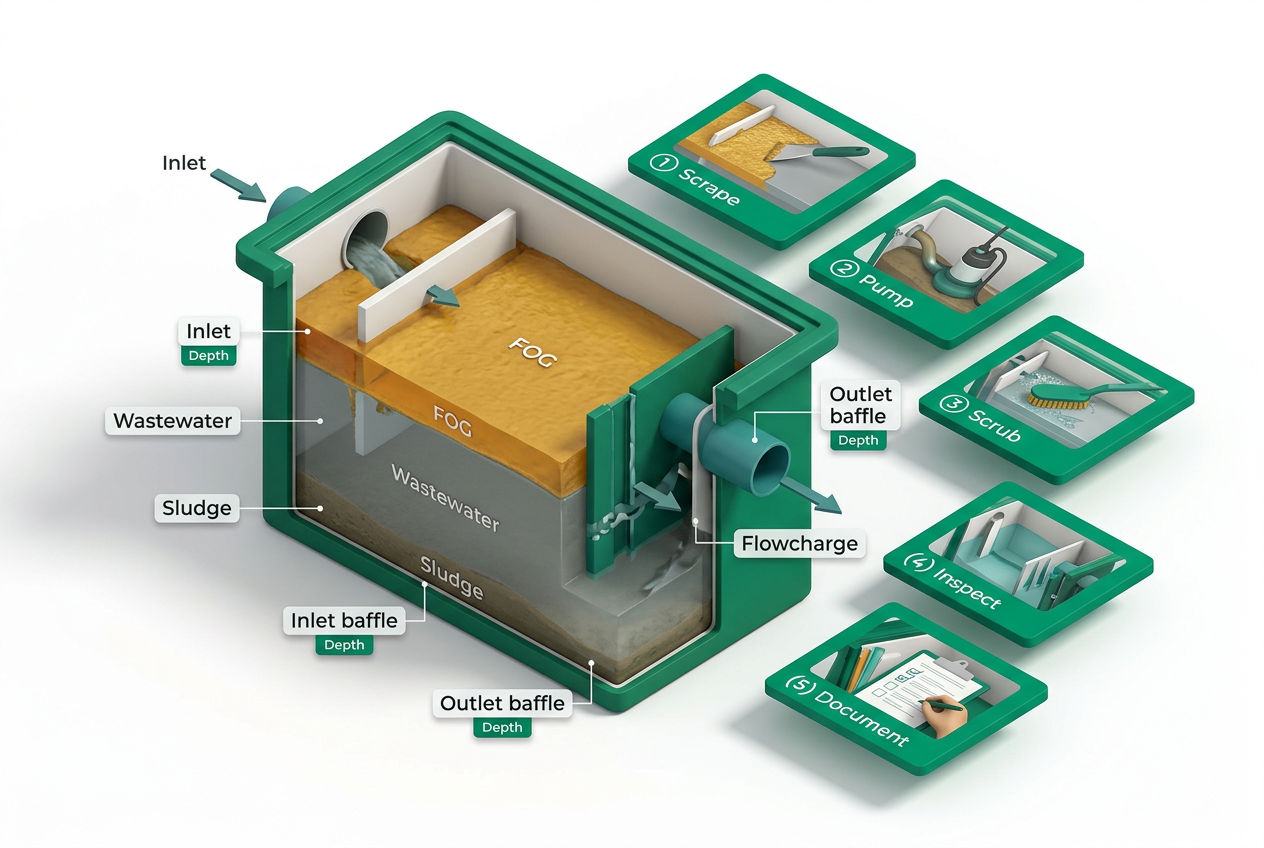
If you want the full picture of how these devices function, our guide on what a grease trap is covers the mechanics in depth. The short version: wastewater flows in, FOG floats to the top, solids sink to the bottom, and cleaner water passes through the middle toward the drain. Cleaning reverses all of that.
Here's what a professional grease trap pumping service actually does on-site:
- Access the trap. The technician lifts the lid — on under-sink units, this is straightforward. On in-ground interceptors buried in a parking lot or equipment room, this may require locating and unsealing a concrete or polymer access riser.
- Measure the FOG layer. A good technician measures the scum layer depth before pumping. If it's at or above 25% of total liquid depth, you're at or past the cleaning threshold. This measurement should appear on your service record.
- Vacuum out the contents. A pump truck (typically 1,500–3,000 gallons) vacuums out the grease, water, and sludge. A 50-gallon under-sink trap takes 30–45 minutes. A 1,500-gallon in-ground interceptor takes 1–3 hours.
- Scrape and rinse the interior. After pumping, technicians scrape the walls and baffles to remove hardened grease, then rinse with water to prep for the next cycle.
- Inspect and document. Baffle walls and inlet/outlet pipes are checked for damage. A service manifest is completed — in many jurisdictions, this manifest must be kept on-site for health department inspection.
- Dispose of waste legally. FOG waste is classified as a non-hazardous industrial waste in most states but cannot be dumped in a regular sewer or landfill. Licensed haulers transport it to a certified rendering facility or waste treatment plant.
How Often Should a Grease Trap Be Cleaned?
The standard cleaning interval depends on trap size, kitchen volume, and what the local health department requires — but the 25% Rule is the universal starting point.
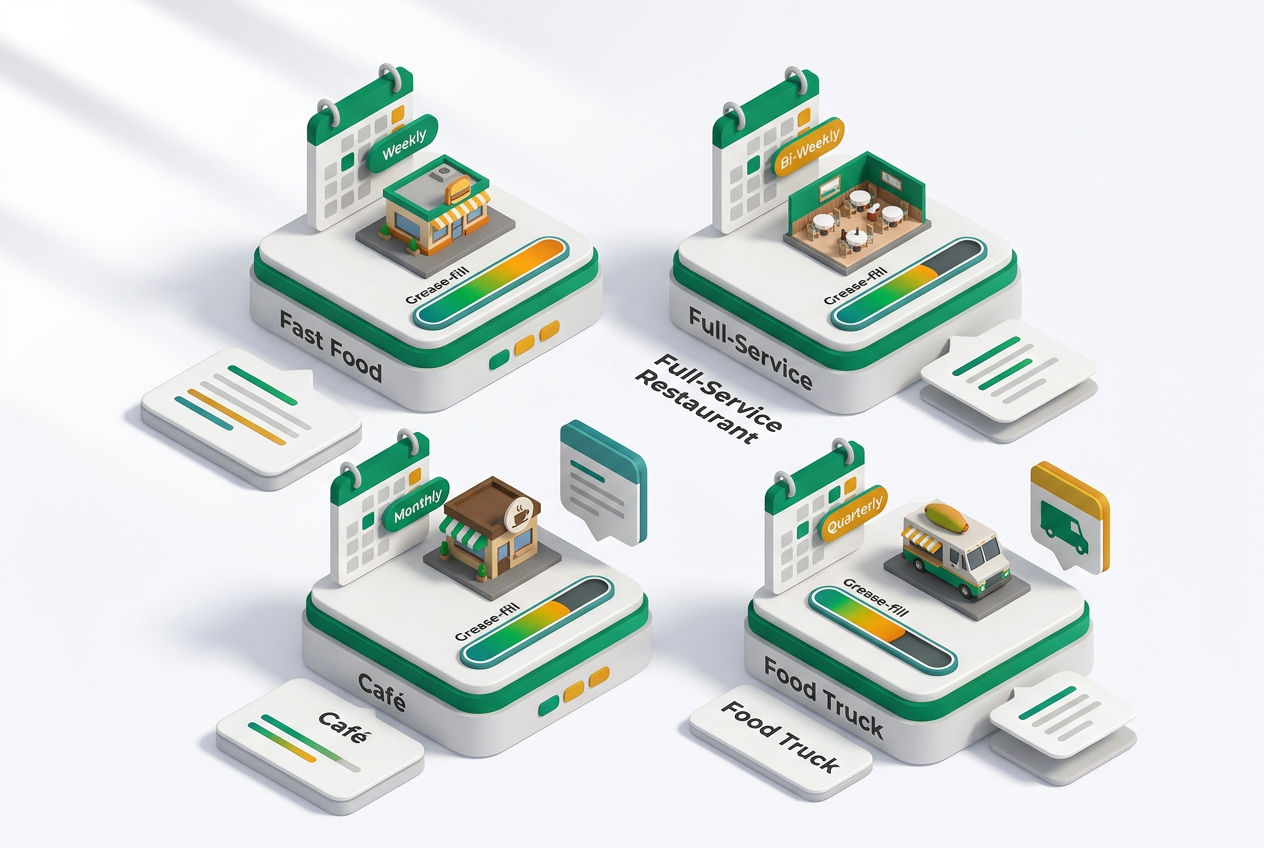
The 25% Rule (also called the 1/4 Rule): Clean the trap when the combined depth of the floating FOG layer plus the settled sludge layer reaches 25% of the trap's total liquid capacity. At that point, the trap's ability to retain grease drops sharply, and FOG begins passing through to the sewer.
In practice, this translates to:
- High-volume restaurants (full-service, fast casual): Every 4–6 weeks
- Mid-volume establishments (cafés, delis, school cafeterias): Every 2–3 months
- Low-volume kitchens (small offices, light food prep): Every 3–6 months
Many municipalities don't leave the schedule up to operators. Jurisdictions in Florida, Texas, and California frequently mandate documented quarterly cleaning as a minimum, regardless of the 25% measurement. Houston's FOG Control Program, for example, requires food service establishments to maintain cleaning logs and submit them during inspections. Non-compliance in Houston can trigger fines starting at $1,000 per violation.
Seasons matter too. In summer, high ambient temperatures accelerate FOG decomposition inside the trap, intensifying hydrogen sulfide odors and speeding up the buildup cycle. Kitchens in Florida and Louisiana often need to clean 20–30% more frequently during July and August than they do in January. On the flip side, if you're a restaurant owner in Minnesota or upstate New York, cold-weather grease solidification in the pipes feeding the trap can trigger backups even before the trap itself is full — insulating the first 10 feet of drain line with closed-cell foam helps prevent that particular headache.
For restaurants heading into the Thanksgiving–New Year's holiday rush, schedule your cleaning in October or early November. Post-holiday January and February see the highest rate of emergency grease trap calls nationwide, and emergency rates are expensive.
How Much Does Grease Trap Cleaning Cost?
Grease trap cleaning costs are driven by three factors: trap size, location, and service frequency. Here's what you can expect to pay in 2026.
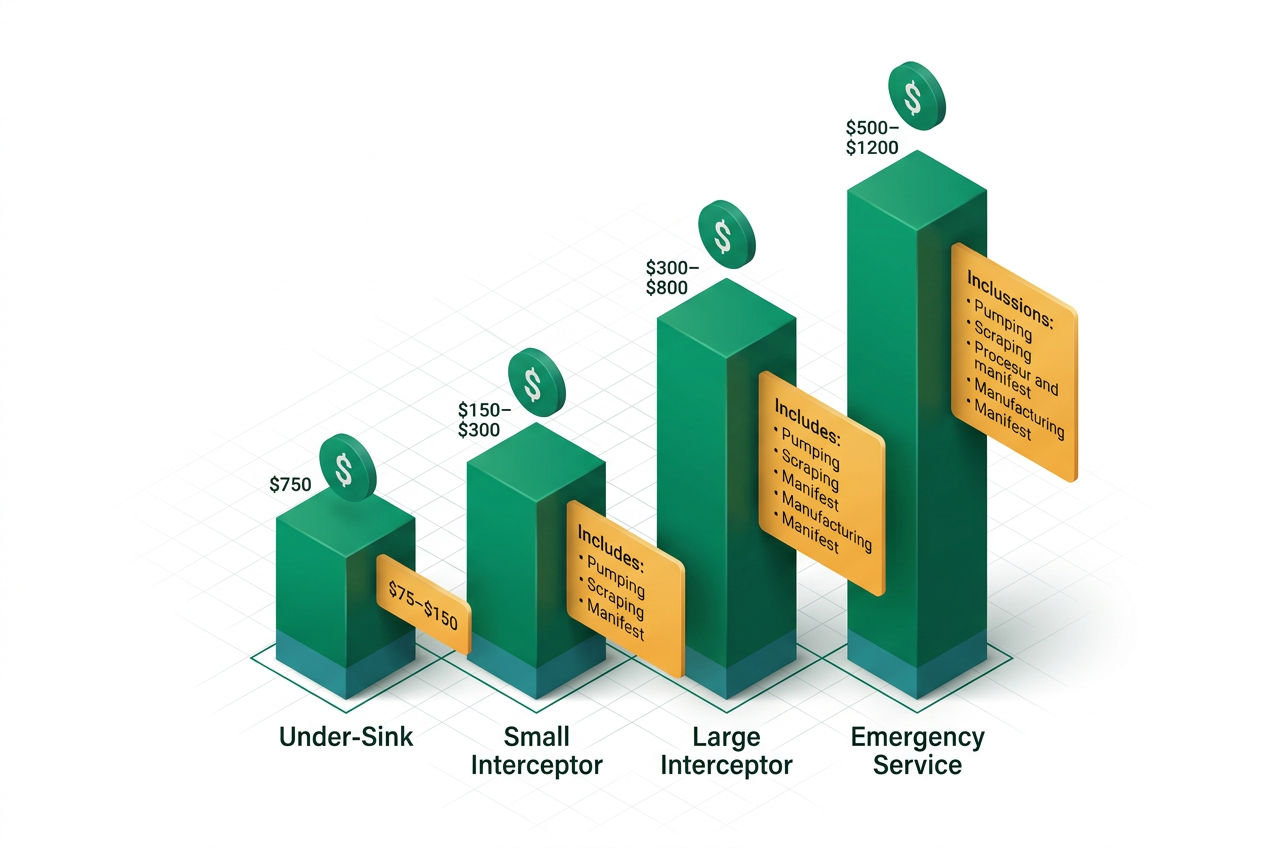
Grease Trap Cleaning Cost by Trap Size
| Trap Type | Typical Capacity | Avg. Cleaning Cost | Notes |
|---|---|---|---|
| Under-sink trap | 20–50 GPM | $75–$250 | Common in small restaurants, cafés |
| Small commercial trap | 50–100 GPM | $150–$350 | Mid-size food service |
| Large commercial trap | 100–250 GPM | $300–$500 | Full-service restaurants |
| In-ground interceptor | 500–1,500 gal | $500–$1,200 | Often quarterly by code |
| Large in-ground interceptor | 1,500–2,500 gal | $1,200–$2,000+ | High-volume or multi-tenant |
Cost data based on 2026 national average pricing collected from licensed grease trap service providers across 12 U.S. metropolitan markets between January and May 2026. Regional variation applies.
Some contractors price by the gallon — typically $2–$5 per gallon of capacity — which makes comparison shopping straightforward once you know your trap size. If you don't know your trap's rated capacity, check the stamped ID plate on the lid or pull the original installation permit from your building department. Our grease trap sizing guide explains how to find and verify that number.
Emergency and after-hours service runs 1.5–2× the standard rate. A $300 routine cleaning becomes a $450–$600 emergency call at 10 PM on a Friday before a Saturday brunch rush.
Monthly maintenance contracts are worth considering for high-volume operations. A contract covering 12 cleanings per year often costs 15–25% less per visit than 12 individual service calls, and it locks in a scheduled service date so you don't forget.
Regional pricing variation is real. A 1,500-gallon interceptor cleaning in Dallas, Texas runs roughly $700–$1,000. The same job in Manhattan runs $1,200–$1,800, driven by higher disposal fees, parking restrictions, and labor costs. Rural properties in states like Maine or Montana may pay lower base prices but face $150–$250 travel surcharges from the nearest licensed hauler.
For a broader look at how grease trap cleaning fits into your overall facility maintenance budget, our commercial grease trap service guide breaks down what to expect from a licensed provider. For context on how these costs compare to other liquid waste services, see our septic pumping cost guide.
What Happens If You Don't Clean Your Grease Trap?
Skipping grease trap maintenance isn't something that stays quiet. The consequences follow a recognizable pattern that experienced operators know all too well.
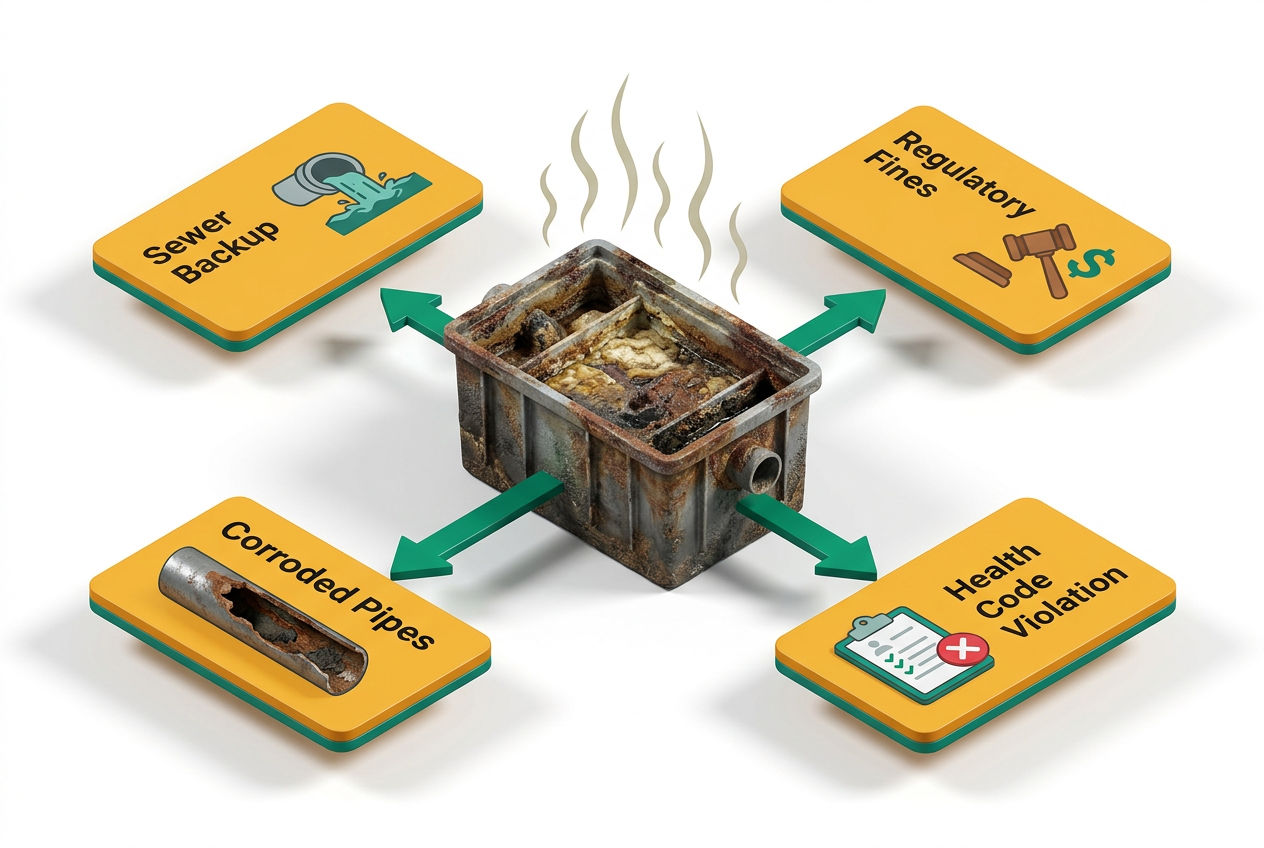
First, you get slow drainage. The trap is full, FOG starts bypassing, and your floor drains start backing up during the dinner rush. Then comes the smell — hydrogen sulfide from decomposing grease smells unmistakably like rotten eggs, and it doesn't stay in the kitchen. Customers notice.
After that, you get a sewer backup or an overflow event. Grease hardened in downstream sewer pipes can completely block a 4-inch drain line. According to EPA data, FOG is responsible for approximately 47% of all sanitary sewer overflows (SSOs) in the United States. The EPA estimates 23,000–75,000 SSOs occur annually, many traceable directly to food service establishments that deferred maintenance.
Then comes the regulatory consequence. A health inspector or municipal FOG program inspector visits. In California, many municipalities have formal FOG ordinances with enforcement teeth. Los Angeles County's Industrial Waste Management Division has issued fines of $1,000–$10,000 per day for repeat FOG violations. Some jurisdictions can issue a cease-operations order.
If your property connects to a septic system rather than a municipal sewer — common in rural North Carolina, Georgia, New Hampshire, and similar states — uncleaned grease traps send FOG directly into your septic tank. FOG doesn't break down well in an anaerobic septic environment. It coats the tank's bacterial colonies, reduces treatment capacity, and eventually migrates to the drain field, where it seals soil pores and causes premature failure. A drain field replacement costs $5,000–$25,000. Grease trap cleaning costs $150–$500.
Can You Clean a Grease Trap Yourself?
For small residential or light-commercial under-sink traps, DIY cleaning is physically possible. For any commercial kitchen subject to health department oversight, it's almost always the wrong call — here's why both answers are true.
DIY is viable when:
- The trap is a small under-sink unit (20–50 gallon)
- The property is residential or not subject to FOG program inspections
- You have a wet/dry vacuum, rubber gloves, putty knife, and a legal disposal path for the waste
Step-by-step for residential DIY grease trap cleaning:
- Turn off water to the unit and place a bucket beneath the trap.
- Remove the lid carefully — the contents will smell strongly of hydrogen sulfide.
- Use a wet/dry vacuum to remove the liquid layer.
- Scrape the walls and baffles with a putty knife to dislodge hardened FOG.
- Wipe interior surfaces with paper towels before rinsing.
- Rinse the interior with cold water (not hot — hot water re-emulsifies grease and pushes it downstream).
- Dispose of waste at a licensed facility. Many municipal waste transfer stations accept FOG waste in sealed containers.
DIY is not viable when:
- Your kitchen is subject to a municipal FOG program requiring licensed hauler manifests
- The trap is an in-ground interceptor (requires a pump truck)
- Local ordinance requires third-party documentation of service
- You cannot legally dispose of the waste material
Most commercial food service establishments fall into the "not viable" category because the manifest requirement alone disqualifies DIY cleaning. A self-cleaned trap with no manifest is the same as an uncleaned trap in the eyes of a health inspector. For help finding licensed service in your area, see our directory of vetted liquid waste contractors.
Restaurant Grease Trap Cleaning: Special Considerations for Food Service Operators
Commercial food service operations face grease trap requirements that go beyond what a residential property or light-commercial tenant ever encounters. The volume of FOG produced, the regulatory scrutiny involved, and the documentation burden all scale up significantly.
High-volume cooking accelerates buildup. A full-service restaurant producing 200+ covers per dinner service generates substantially more FOG than the same square footage used for light food prep. Fryers, flat-tops, and steam kettles all contribute. A trap sized for a café will fill in weeks if the menu shifts to heavier cooking.
Health department inspections can be unannounced. In jurisdictions with active FOG programs — Houston, Los Angeles, Miami-Dade County, and most large Texas and Florida municipalities — inspectors may arrive without notice and ask to see cleaning logs on the spot. A missing or incomplete log is treated as a compliance failure regardless of whether the trap is actually clean.
Franchise and chain operators face layered requirements. Corporate compliance standards often exceed local municipal minimums. A regional QSR chain may require monthly cleaning and third-party auditing even in municipalities that only mandate quarterly service.
Grease interceptor cleaning for high-volume sites typically requires a larger pump truck and a longer service window. Scheduling these jobs during off-hours (before 7 AM or after 10 PM) is standard practice in urban markets where parking restrictions and noise ordinances apply. Budget extra lead time when coordinating these jobs in dense metro areas.
For restaurant operators looking at how FOG compliance intersects with broader kitchen maintenance, our article on commercial kitchen drain maintenance covers the full scope of drain system upkeep between grease trap service visits.
Grease Interceptor Cleaning: How Large In-Ground Units Differ

Septic Business Blueprint
Thinking about starting your own septic business?
The complete, plain-English playbook to start (or buy), license and grow a profitable septic business — the models, the money math, trucks, disposal, insurance, pricing and how to land your first customers.
Get the Blueprint — $297 →Instant access · 12-chapter playbook + 6-piece toolkit · 60-day money-back guaranteeGrease interceptor cleaning involves the same basic principle as under-sink trap cleaning — remove FOG before it reaches the sewer — but the scale, equipment, and regulatory requirements are substantially different.
Size and location. In-ground grease interceptors are typically installed outside the building, buried beneath a parking lot, equipment yard, or service corridor. Capacities range from 500 to 2,500+ gallons. Accessing them requires locating buried access risers, which may be covered by asphalt, paving blocks, or soil.
Equipment requirements. A standard pump truck carries 1,500–3,000 gallons. Large interceptors may require multiple pump loads or a larger tanker. The service window is correspondingly longer — 2–4 hours for a 1,500-gallon unit compared to 30–45 minutes for an under-sink trap.
Inspection complexity. In-ground interceptors have multiple compartments and more complex baffle configurations. A thorough cleaning inspection includes checking the inlet and outlet baffles, measuring the FOG layer in each compartment separately, and verifying that the effluent side of the interceptor is flowing correctly before signing off.
Documentation. The manifest for an interceptor cleaning typically includes more fields than an under-sink service record — compartment-by-compartment FOG measurements, gallons hauled, disposal site, and technician license number. Some jurisdictions require electronic manifest submission within 24 hours of service.
If you manage multiple locations with in-ground interceptors, our article on hydro jetting for commercial drain lines covers the complementary service most often paired with interceptor cleaning to clear downstream buildup.
How to Choose a Qualified Grease Trap Cleaning Company
Not every hauler who shows up with a pump truck is operating legally or thoroughly. Here's what to verify before signing a service agreement.
Check the hauler's license. Every state that regulates FOG waste disposal requires haulers to carry an environmental transport license. In California, verify through the State Water Resources Control Board (SWRCB). In Texas, verify through the Texas Commission on Environmental Quality (TCEQ). Ask for the license number before scheduling service — a legitimate operator will provide it without hesitation.
Confirm legal disposal. Ask where the waste goes. The hauler should be able to name the specific disposal or rendering facility. If they can't — or if the price seems suspiciously low — that's a warning sign that the waste may be illegally dumped.
Require a service manifest. Every cleaning should generate a manifest documenting trap size, gallons removed, FOG layer measurement, disposal destination, and technician signature. If a hauler doesn't provide manifests, find another provider.
Ask about the measurement step. A thorough technician measures the FOG layer before pumping and records the depth on the manifest. Operators who skip this step are either in a rush or aren't following best practice — either way, you won't have the documentation you need if a health inspector asks whether your trap actually needed service.
Check for insurance. The service involves a pump truck on your property. Verify that the company carries general liability coverage. A spill or equipment damage without coverage becomes your problem.
Get references from similar operations. A hauler who primarily services small cafés may not have the equipment or scheduling capacity to handle a 2,500-gallon interceptor at a high-volume hotel kitchen. Ask whether they regularly service operations at your volume level.
Grease Trap Maintenance Between Professional Cleanings
Professional pumping is the primary maintenance event, but what happens between service visits determines how fast the trap fills and how well it performs.
Scrape plates before washing. The single highest-impact behavior change in a commercial kitchen is requiring staff to scrape all solid food waste into the trash before dishes go to the dishwasher station. FOG carried on plate residue is a major contributor to trap loading.
Collect fryer oil separately. Used fryer oil should go into a dedicated waste oil collection container, not down the drain. Most commercial kitchens have a rendering company that picks up waste oil — this is both an environmental requirement and, in some cases, a revenue source (waste oil has value as a biofuel feedstock).
Install strainer baskets on floor drains. Floor drain strainers catch food solids before they reach the trap. Clean them every shift during high-volume service.
Avoid hot-water grease flushing. Pouring boiling water or hot grease "flush" solutions down the drain temporarily liquefies FOG, but it passes through the trap in emulsified form and re-congeals in downstream sewer pipes. This is worse than letting it accumulate in the trap where it can be removed.
Be cautious with biological additives. Some products marketed as "grease trap treatments" use bacterial or enzymatic formulations to break down FOG in the trap. The Water Environment Federation (WEF) has noted that these products may cause FOG to pass through traps in an emulsified state rather than being retained — shifting the problem downstream rather than solving it. If you use biological additives, disclose this to your service provider so they can assess whether the trap is performing correctly.
Keep a maintenance logbook. Record the date of every service visit, the technician's name and company, the manifest number, and the FOG layer measurement at time of service. This log is your documentation if a health department inspector visits between scheduled service intervals.
If your slow-drainage problem persists even after a recent grease trap cleaning, the issue may be in the drain lines rather than the trap itself. Our article on commercial kitchen drain maintenance covers diagnostic steps for persistent drainage problems.
Sources & Methodology
Cost data: Pricing ranges in this article are based on a review of service quotes and published rate schedules from licensed grease trap cleaning companies operating across 12 U.S. metropolitan markets (Atlanta, Boston, Chicago, Dallas, Denver, Houston, Los Angeles, Miami, Minneapolis, New York City, Phoenix, and Seattle) collected between January and May 2026. Regional ranges reflect the 25th–75th percentile of quoted prices for each trap category; outliers from rural markets with high travel surcharges are noted separately.
Regulatory data: FOG program requirements cited for Houston, Los Angeles County, and state-level agencies (SWRCB, TCEQ) are drawn from publicly available program documentation current as of Q1 2026. Ordinance enforcement thresholds and fine ranges reflect published schedules; actual fines vary by jurisdiction and violation history.
EPA statistics: The 47% FOG contribution figure and 23,000–75,000 annual SSO estimate are drawn from EPA's "Report to Congress on the Impacts and Control of CSOs and SSOs" and subsequent agency fact sheets. These figures represent national estimates and are widely cited in municipal FOG program documentation.
Water Environment Federation (WEF): The position on biological grease trap additives is drawn from WEF technical guidance documents on FOG management in sanitary sewer systems.
Cleaning frequency guidelines: The 25% Rule reflects industry-standard guidance as adopted by the Plumbing-Heating-Cooling Contractors Association (PHCC) and incorporated into many municipal FOG ordinances. Frequency ranges by establishment type reflect operator-reported service intervals gathered in consultation with regional liquid waste haulers.
Frequently Asked Questions
What does commercial grease trap cleaning typically include?
Commercial grease trap cleaning includes six core steps: accessing the trap, measuring the FOG layer depth before any work begins, vacuuming out all accumulated grease and sludge with a pump truck, scraping and rinsing the interior walls and baffles, inspecting inlet and outlet baffles for damage, and completing a service manifest documenting the work. The manifest records the technician's license number, gallons removed, FOG layer depth at time of service, and the destination facility where waste will be legally disposed. For in-ground interceptors, the service also includes locating and unsealing buried access risers and verifying flow from the effluent side of the unit before leaving the site. A thorough commercial grease trap cleaning for an under-sink unit takes 30–45 minutes; a 1,500-gallon in-ground interceptor typically requires 1–3 hours. The manifest produced at the end is the document health inspectors will ask to see during FOG compliance audits.
How much does restaurant grease trap cleaning cost in 2026?
Restaurant grease trap cleaning costs in 2026 range from $150–$500 for under-sink and small commercial trap units to $500–$2,000+ for large in-ground interceptors, depending on trap size, location, and service frequency. Some contractors price by the gallon — typically $2–$5 per gallon of trap capacity — which makes comparison shopping easier once you know your unit's rated size. Emergency or after-hours service runs 1.5–2× the standard rate, so a $300 routine cleaning can become a $450–$600 call when you need service at 10 PM before a Saturday brunch rush. Regional variation is significant: a 1,500-gallon interceptor cleaning runs $700–$1,000 in Dallas and $1,200–$1,800 in Manhattan, driven by disposal fees, parking restrictions, and labor costs. Monthly maintenance contracts covering 12 annual cleanings typically cost 15–25% less per visit than individually scheduled service calls and include a fixed service date to prevent forgotten cleanings.
How often should a restaurant grease trap be cleaned?
A restaurant grease trap should be cleaned when the combined FOG and sludge layer reaches 25% of the trap's total liquid depth — a threshold known as the 25% Rule or 1/4 Rule. In practice, this means high-volume full-service restaurants typically need cleaning every 4–6 weeks, mid-volume operations every 2–3 months, and lower-volume establishments every 3–6 months. However, local health departments often set mandatory minimums regardless of the 25% measurement. Most municipalities in Florida, Texas, and California require documented quarterly cleaning at minimum. Houston's FOG Control Program requires food service operators to maintain cleaning logs available for inspection, with fines starting at $1,000 per violation for non-compliance. Seasonal factors also apply: kitchens in Florida and Louisiana typically need service 20–30% more frequently in July and August than in January due to accelerated FOG decomposition in higher ambient temperatures. Schedule an extra cleaning before the Thanksgiving–New Year's holiday rush to avoid post-holiday emergency service calls, which are priced at a premium.
What is grease interceptor cleaning and how does it differ from grease trap cleaning?
Grease interceptor cleaning and grease trap cleaning serve the same purpose — removing accumulated FOG before it reaches the municipal sewer — but differ substantially in scale, equipment, and process. A grease trap typically refers to a smaller under-sink or above-ground unit with a capacity of 20–250 GPM; a grease interceptor is a large in-ground unit buried outside the building with capacities ranging from 500 to 2,500+ gallons. Cleaning an interceptor requires a full pump truck, access to buried risers that may be beneath asphalt or paving, and a service window of 2–4 hours versus 30–45 minutes for an under-sink trap. In-ground interceptors also have multiple compartments, requiring separate FOG measurement in each section before the technician signs off. Documentation requirements are more extensive: the service manifest for an interceptor cleaning typically includes compartment-by-compartment measurements, total gallons hauled, and the disposal facility address. Some jurisdictions require electronic manifest submission within 24 hours of service for interceptors but not for smaller trap units.
Can I clean my own grease trap, or do I need a licensed contractor?
Whether you need a licensed contractor for grease trap cleaning depends on the type of trap and your regulatory environment. For small residential or light-commercial under-sink units not subject to municipal FOG program oversight, DIY cleaning is physically possible using a wet/dry vacuum, putty knife, rubber gloves, and cold water — never hot, which re-emulsifies FOG and pushes it downstream. However, any commercial food service establishment subject to a health department FOG program almost certainly requires a licensed hauler. The reason is documentation: municipal FOG programs require a service manifest signed by a licensed hauler showing gallons removed, FOG layer measurements, and a legal disposal destination. A self-cleaned trap with no manifest is treated as a non-compliant trap during inspections, regardless of how clean it actually is. Before deciding on DIY service, confirm with your local health department whether a hauler manifest is required. If it is, hire a licensed contractor and ask for the license number upfront to verify it with your state environmental agency.
What are the signs that a grease trap needs cleaning?
The clearest sign that a grease trap needs cleaning is slow or backing-up drainage — particularly in floor drains and prep sinks during peak service hours when FOG bypass is most likely to occur. A strong rotten-egg odor (hydrogen sulfide from decomposing grease) that's detectable in the kitchen or dining area is another reliable indicator that the trap is at or past capacity. If your prep sink is draining noticeably slower than usual, don't wait for the next scheduled service — call for an inspection. Other warning signs include gurgling sounds from drain lines during high-flow periods, visible grease or scum in floor drains, and grease residue appearing in the trap's effluent outlet. On a service record, the clearest objective indicator is the FOG layer measurement: if it reaches 25% of total liquid depth, cleaning is required regardless of when the last service visit occurred. Operators who track FOG layer depth across multiple service visits can identify trends that predict when the next cleaning will be needed before the warning signs appear.
Was this article helpful?
Frequently Asked Questions
Recommended Resources
Find Septic Professionals Near You
Compare licensed, verified septic companies by area — top county markets and cities below, or browse all 50 states.
County markets
Popular cities
