
Quick Answer
Commercial grease trap sizing is determined by calculating your peak drainage flow rate using the PDI-G101 standard formula, then cross-referencing that GPM figure against your local authority's minimum capacity requirements. The right size depends on fixture volume, retention time, and how many kitchen fixtures drain into the unit.
Key Takeaways
- The PDI-G101 formula is the national baseline: (fixture volume ÷ 2) × (1 ÷ retention time) × 0.75
- Most full-service restaurants (50–150 seats) need a 35–50 GPM trap with 750–1,000-gallon capacity
- Passive indoor traps handle 10–100 GPM; underground gravity interceptors handle 500–10,000+ gallons
- FOG (fats, oils, grease) causes an estimated 47% of U.S. sewer overflows, per EPA data — undersizing is a compliance risk, not just an operational one
- Always get your final sizing approved by your local sewer authority before installation
What Is a Commercial Grease Trap and Who Needs One?
A commercial grease trap — also called a grease interceptor — is a plumbing device that captures fats, oils, and grease (FOG) before they enter the municipal sewer or private septic system. When hot grease cools inside a drain line, it hardens and builds up. Left unchecked, that buildup causes blockages, sewer backups, and municipal FOG violations.
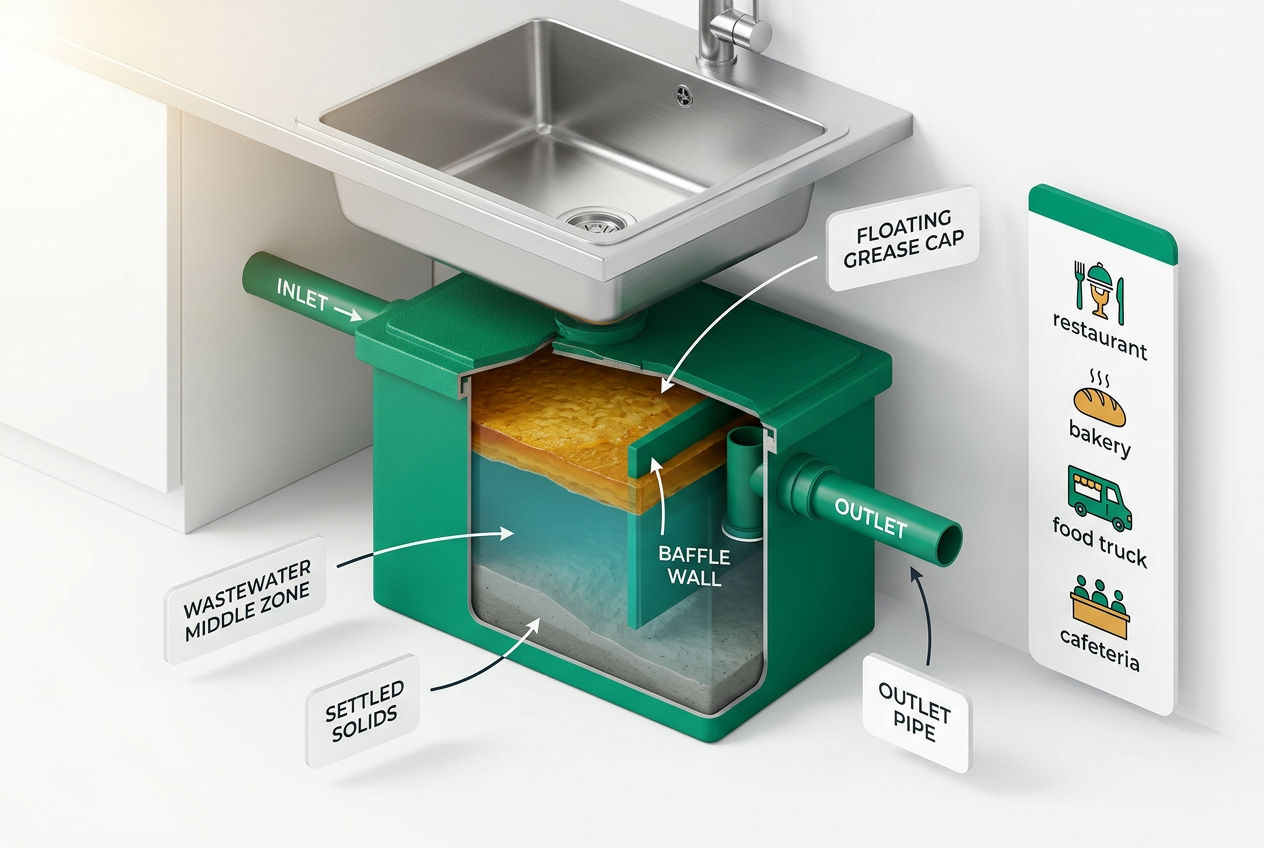
Any food service establishment that generates cooking waste typically needs one. That includes restaurants, cafeterias, hotel kitchens, hospital food prep areas, school cafeterias, and food trucks with permanent connections. In many jurisdictions, even a small café with a three-compartment sink must have a grease trap installed. Check your local FOG ordinance — most municipalities make this non-negotiable.
If your establishment connects to a private septic system rather than municipal sewer, grease management becomes even more critical. FOG entering a septic tank disrupts the bacterial environment, clogs the drain field's soil interface, and can cause catastrophic system failure. We cover this in more detail in the restaurant grease trap requirements guide and in our overview of commercial septic systems.
What Is the PDI Formula for Grease Trap Sizing?
The Plumbing & Drainage Institute's PDI-G101 standard is the most widely used sizing method in the United States. Most municipalities either adopt it directly or use it as their baseline.
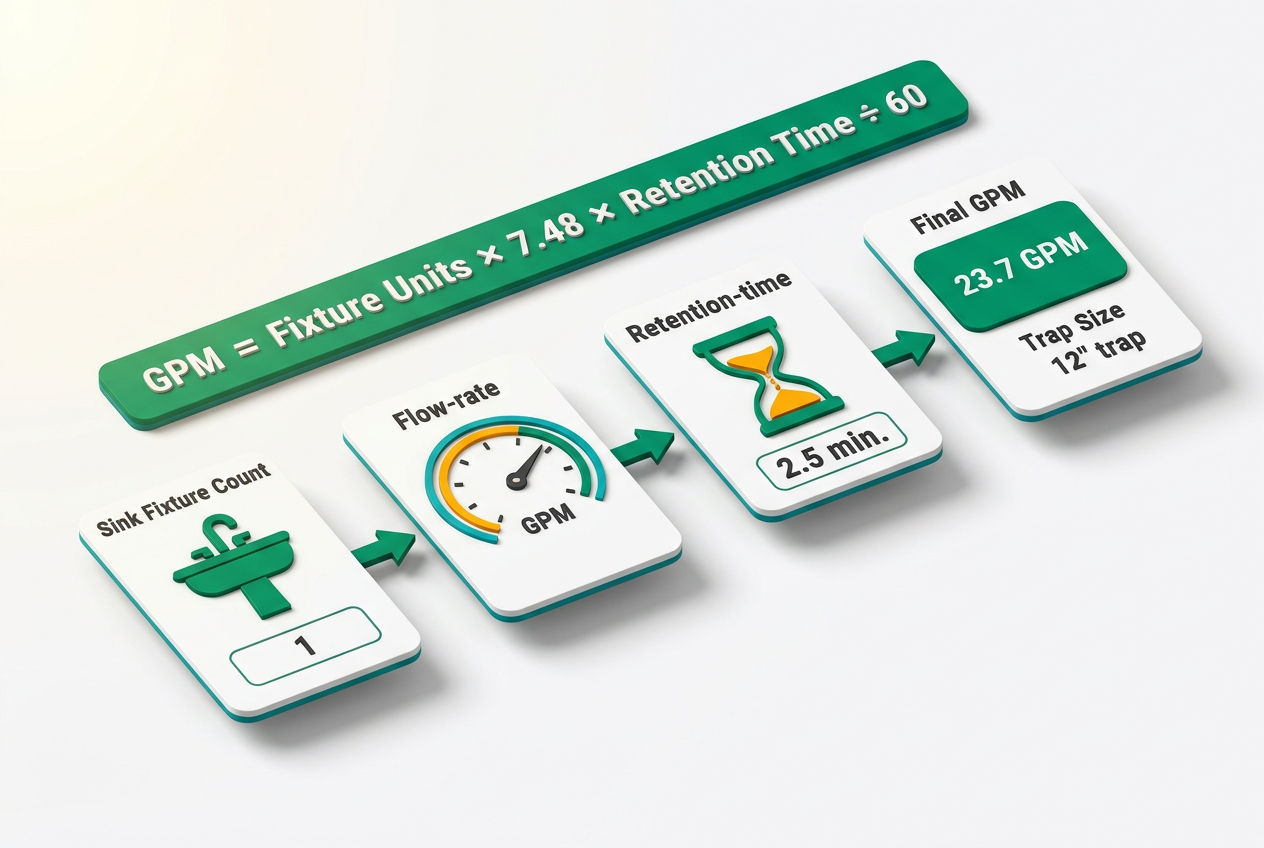
The formula:
Grease Trap Size (GPM) = (Volume of Fixture ÷ 2) × (1 ÷ Retention Time) × Demand Factor
Breaking that down:
- Volume of fixture — the total liquid capacity of the sink or fixture in gallons
- ÷ 2 — assumes the fixture is never filled more than halfway on average
- Retention time — how long water stays in the trap to allow grease separation; PDI uses 2.5 minutes as the standard
- Demand factor — PDI sets this at 0.75, which accounts for a 25% diversity allowance (not all fixtures run simultaneously at full capacity)
Worked Example: Three-Compartment Sink
Say you have a three-compartment sink where each compartment holds 20 gallons (60 gallons total).
- 60 ÷ 2 = 30
- 1 ÷ 2.5 = 0.4
- 30 × 0.4 × 0.75 = 9 GPM
That result puts you at a minimum 10 GPM trap (most jurisdictions set 10 GPM as the floor for any food service operation). If you also drain a pre-rinse spray valve and a hand sink into the same unit, recalculate with the combined fixture volume.
One thing the formula doesn't do automatically: account for peak-load multipliers. A restaurant that runs two full dinner services back-to-back generates significantly more FOG loading per hour than the PDI baseline assumes. During the holiday season — November through January — many operators see 30–50% higher volume. For high-turnover operations, build in a 1.25–1.5x buffer on top of your calculated GPM before selecting a unit.
Grease Trap Sizing Chart by Establishment Type
Use this chart as a starting reference. These are general benchmarks based on PDI-G101 guidance and industry practice. Your actual requirement may be higher depending on local code minimums, fixture count, and cooking volume.
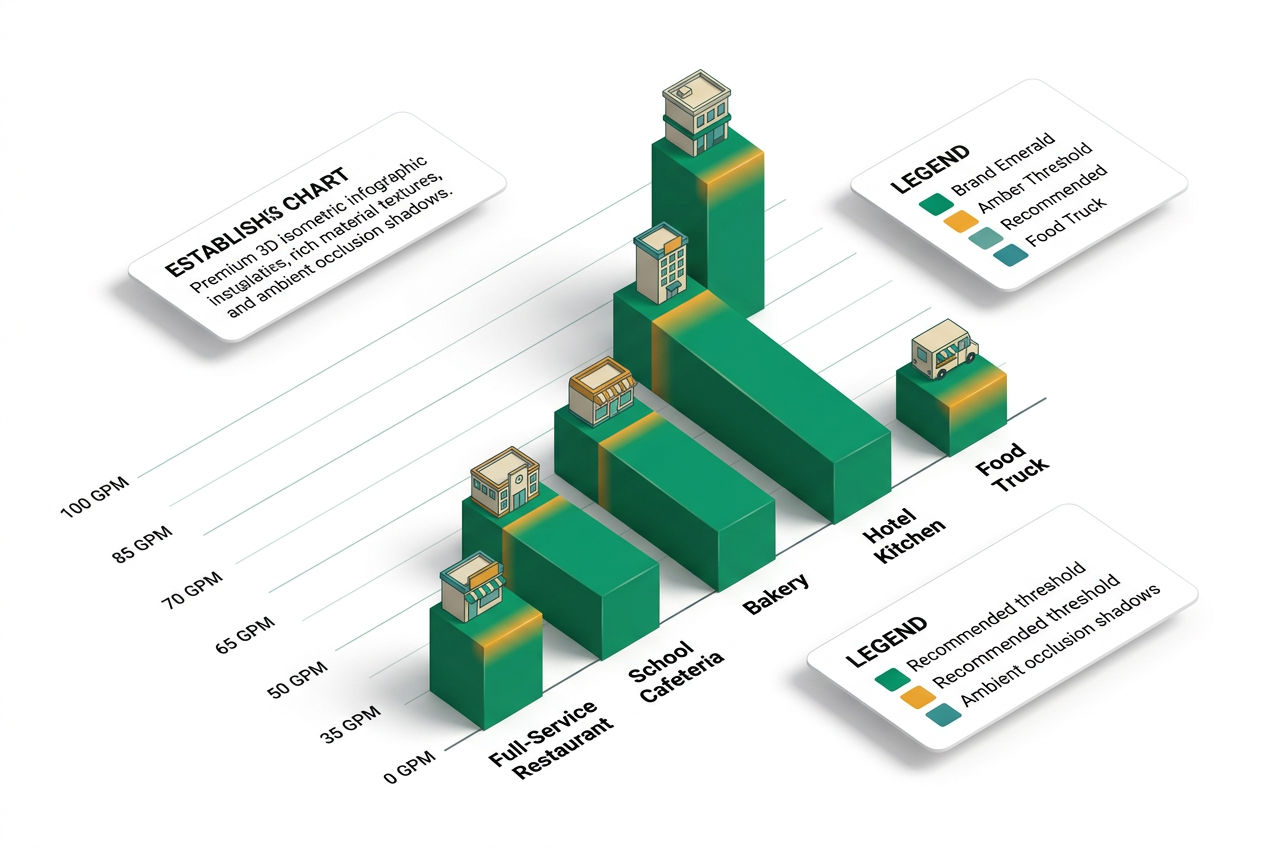
| Establishment Type | Seats / Scale | Recommended GPM | Tank Capacity |
|---|---|---|---|
| Coffee shop / café | Under 25 seats | 10–15 GPM | 40–75 gal |
| Small restaurant | 25–50 seats | 20–35 GPM | 500–750 gal |
| Full-service restaurant | 50–150 seats | 35–50 GPM | 750–1,000 gal |
| Large restaurant / cafeteria | 150+ seats | 50–100 GPM | 1,000–2,000 gal |
| Hotel kitchen / hospital | High volume | 100+ GPM | 2,000–10,000 gal |
Source: PDI-G101 standard guidelines and industry benchmark data. Verify against your local sewer authority's approved sizing tables before purchasing.
Note the jump between a small café and a small restaurant. A 40-gallon passive trap is fine under a sink at a coffee shop — but drop that same unit into a 40-seat diner and you'll be pumping it every two weeks and probably violating your FOG permit. Size for what you actually cook, not what the menu says.
Passive Grease Trap vs. Underground Grease Interceptor: Which Do You Need?
This is where a lot of buyers go wrong. These are two different product categories with completely different sizing rules.
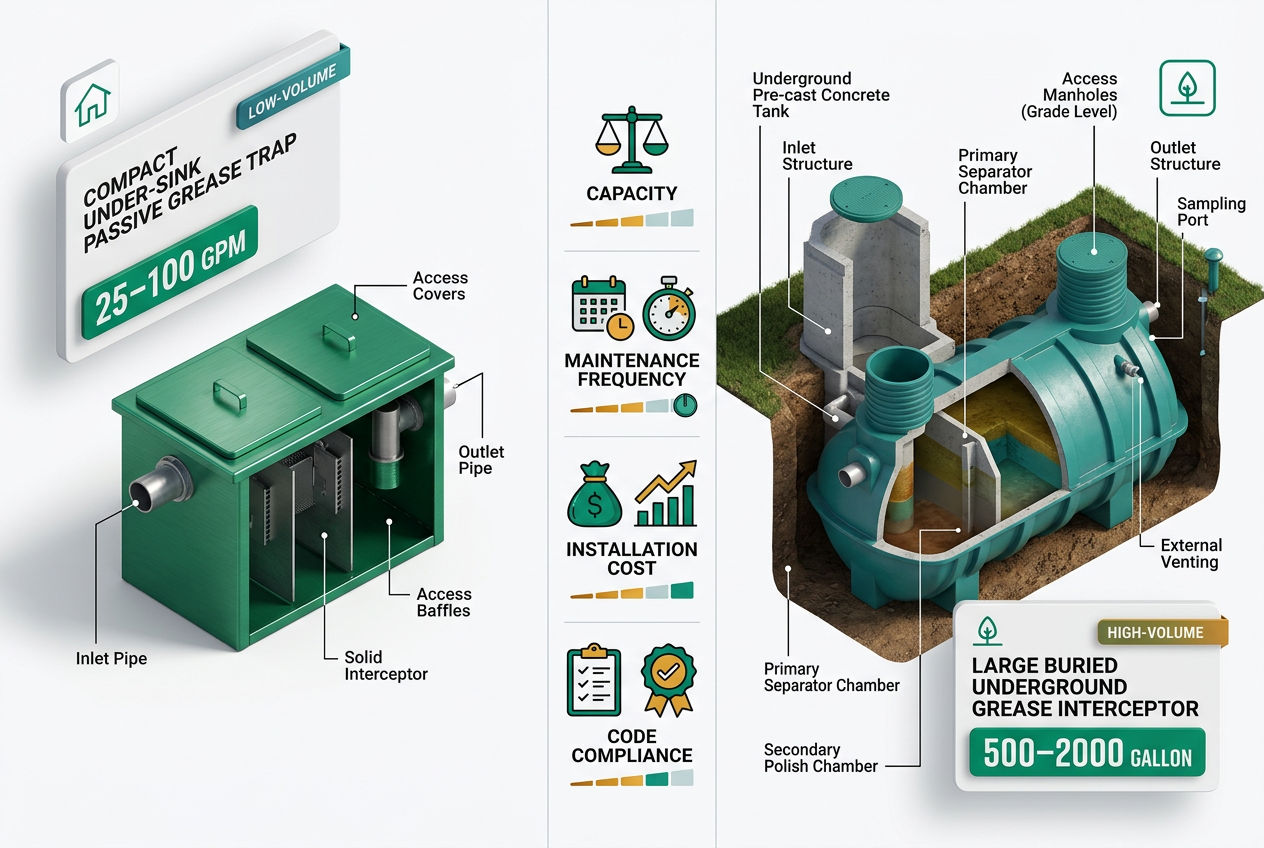
Passive (indoor) grease traps sit under the sink or in a floor recess inside the kitchen. They handle 10–100 GPM and typically hold 40–200 gallons. Units like the Josam 65000 Series or Jay R. Smith 8890 Series are common in restaurant kitchens. Equipment cost runs $250–$1,500. These work well for lower-volume operations with limited exterior space — common in dense urban settings like New York City or Boston where there's no room to excavate outside.
Gravity grease interceptors (also called underground grease interceptors) are large concrete or fiberglass tanks buried outside the building. They range from 500 to 10,000+ gallons and are required by most municipalities for any establishment generating significant FOG volume. Installed cost typically runs $4,000–$10,000 or more depending on tank size, excavation depth, and local labor rates. These are the standard solution for full-service restaurants in suburban and rural settings.
The key distinction: passive traps require more frequent cleaning — sometimes weekly for busy kitchens — while underground interceptors are typically pumped every one to three months. Both require attention. You can read more about scheduling in our grease trap pumping and grease trap cleaning guides.
How Many Gallons Should a Commercial Grease Trap Hold?

Septic Business Blueprint
Thinking about starting your own septic business?
The complete, plain-English playbook to start (or buy), license and grow a profitable septic business — the models, the money math, trucks, disposal, insurance, pricing and how to land your first customers.
Get the Blueprint — $297 →Instant access · 12-chapter playbook + 6-piece toolkit · 60-day money-back guaranteeA frequently asked question — and the answer depends on whether you're talking about a passive trap or an underground interceptor.
For passive traps, the GPM rating matters more than raw gallon capacity. A 50 GPM-rated trap handles the flow rate; the gallon capacity determines how long you go between cleanings. The EPA's FOG guidance and the "25% rule" used by most inspectors means you need to pump or clean the unit before grease and solids occupy 25% of the total tank volume. For a 100-gallon trap, that's 25 gallons of accumulated waste — which can fill faster than you'd expect in a high-volume kitchen.
For underground interceptors, capacity drives the sizing decision. A 750-gallon interceptor serving a 50-seat restaurant will typically need pumping every 4–6 weeks during busy seasons. A 1,500-gallon unit on the same operation buys you 8–12 weeks between pump-outs, which translates directly to lower annual service costs. Most operators see annual pumping and maintenance costs of $1,200–$4,800 per year depending on trap size and service frequency.
The rough rule of thumb: 1 GPM of rated flow = approximately 8.3 gallons of trap capacity. A 50 GPM system should have at least 415 gallons of capacity by that measure — which is why most codes push restaurants into the 750–1,000-gallon range as a safety buffer.
What Size Grease Trap Do I Need for My Restaurant?
A 50-seat full-service restaurant with a standard commercial kitchen — three-compartment sink, two pre-rinse spray stations, a floor drain, and a dishwasher — will typically land in the 35–50 GPM range using the PDI-G101 formula. That translates to a 750–1,000-gallon underground gravity interceptor in most jurisdictions.
Here's a quick sizing walkthrough for that scenario:
- Three-compartment sink: 60 gal total → 10 GPM (as calculated above)
- Commercial dishwasher: 20 gal sump → (20 ÷ 2) × (1 ÷ 2.5) × 0.75 = 3 GPM
- Pre-rinse spray valve (2 units): 15 gal each → (15 ÷ 2) × (1 ÷ 2.5) × 0.75 × 2 = 4.5 GPM
- Floor drain: typically excluded from grease trap flow in many codes, but confirm locally
Total calculated flow: ~17.5 GPM
Apply a 1.5x buffer for a busy dinner-service operation: ~26 GPM minimum.
Most plumbing engineers would round up to a 35 GPM unit to hit the next standard product size and maintain a compliance margin. Add seats, add fixtures, and you're pushing 50 GPM quickly.
If you're on a private septic system — a situation more common than most grease trap content acknowledges — you need to size even more conservatively. FOG entering a septic tank destroys the anaerobic bacterial layer and clogs leach field laterals in a way that's expensive and slow to reverse. A properly sized interceptor upstream of the septic inlet is the single most important thing a rural food service operator can do to protect their system. See our septic tank maintenance guide for broader context on protecting a private system from commercial-use damage.
Regional Code Variations That Affect Sizing
The PDI-G101 formula gives you a starting number. Local codes give you the final number. These are not always the same.
California operates under some of the strictest FOG regulations in the country. Los Angeles County's Industrial Waste Division and the San Francisco Public Utilities Commission both impose local sizing minimums that frequently exceed PDI recommendations. Many California jurisdictions require interceptors for any food service establishment — even small cafés — regardless of size. If you're opening in California, consult your local wastewater authority before selecting any equipment.
Texas municipalities like Houston and Dallas have adopted local FOG ordinances with GPM minimums that can exceed PDI standards. Houston's pretreatment program, administered through Houston Public Works, requires grease interceptors sized to a local calculation that considers peak hour flow rates rather than the PDI diversity factor. The large physical footprint of Texas properties generally favors underground interceptors over indoor passive units.
Florida's Department of Environmental Protection has specific interceptor sizing tables that in some cases supersede PDI guidelines. The Florida Building Code also references local utility approval as a mandatory step before installation.
Northeast states — New York, New Jersey, Massachusetts — tend to favor indoor passive traps for dense urban kitchens where exterior excavation isn't practical. NYC's Department of Environmental Protection runs active grease trap inspection programs; non-compliance fines start at $1,000 per violation.
Rural establishments on private septic systems face a unique situation that most grease trap guides skip entirely. Your local health department — not a municipal sewer authority — governs your installation. Sizing requirements vary significantly by county. In many rural jurisdictions, the licensed septic contractor who designs your system must specify the grease interceptor size as part of the overall wastewater plan. Our grease trap installation cost guide covers what to budget when professional design is required.
Do I Need a Permit to Install a Commercial Grease Trap?
Yes, in virtually every U.S. jurisdiction. Grease trap installation is a plumbing project subject to building permits, plumbing permits, and often sewer authority pre-approval. Many municipalities also require the interceptor to appear on approved equipment lists — meaning you can't just buy any unit off the shelf and install it.
The typical permitting path:
- Submit sizing calculations (PDI formula or local method) to your sewer authority or health department
- Get pre-approval on the interceptor model and size
- Pull a plumbing permit through your local building department
- Have a licensed plumber complete the installation
- Schedule a post-installation inspection
Skipping any of these steps risks fines, mandatory removal, and denial of your food service operating license. The grease trap installation process is worth understanding in full before you commit to a unit size or contractor.
After Sizing: What Comes Next?
Once you've calculated your GPM requirement and confirmed it against local code, the next decisions are:
- Passive trap or underground interceptor? (See the comparison above)
- Concrete vs. fiberglass interceptor? Fiberglass tanks are lighter and easier to install but may have local approval restrictions
- Pumping schedule: Budget for quarterly pump-outs minimum; monthly if you run high volume
- Maintenance contract: Many municipalities require documented cleaning records as part of FOG compliance
For ongoing maintenance planning, our grease trap maintenance guide covers the full service cycle. To find a licensed pumper in your area, the grease trap cleaning services directory connects you with vetted local providers.
Annual pumping costs for an average restaurant run $1,200–$4,800 per year. That sounds like a lot until you compare it to a sewer violation fine or a failed drain field replacement — the latter runs $5,000–$20,000 on a private septic system. Proper sizing and regular maintenance is always cheaper than the alternative.
Sources & Methodology
- Plumbing & Drainage Institute (PDI-G101): The primary industry standard for grease trap sizing calculations in the United States. Formula and demand factor values sourced from PDI published guidance.
- U.S. Environmental Protection Agency — FOG Program Data: EPA estimates that FOG contributes to approximately 47% of sanitary sewer overflows nationally. Source: epa.gov/septic and EPA's municipal wastewater management publications.
- Local FOG Ordinances Referenced: Los Angeles County Industrial Waste Division, Houston Public Works Pretreatment Program, Florida Department of Environmental Protection — referenced by name for regional sizing variations.
- Industry Cost Benchmarks: Passive trap and underground interceptor cost ranges reflect contractor pricing data and published equipment lists from Josam, Jay R. Smith, and Schier Products. Pumping cost ranges reflect regional service pricing compiled from operator interviews and public rate schedules.
- PDI Sizing Chart: Establishment-type capacity recommendations cross-referenced against PDI-G101 and municipal FOG program guidance from multiple jurisdictions.
This article is intended as an educational reference. Always verify sizing calculations and equipment selections with a licensed plumber and your local sewer authority or health department before installation.
Was this article helpful?
Frequently Asked Questions
Recommended Resources
📖 Related Articles
- Restaurant Grease Trap: The Complete Guide
- What Is a Septic System? How It Works (Visual Guide)
- Grease Trap Pumping: The Complete Guide
- Grease Trap Cleaning: How It Works, How Often & What It Costs
- The Complete Septic Tank Maintenance Guide
- Grease Trap Installation Cost: 2026 Price Guide
- How to Handle Grease Trap Maintenance: Step by Step
🔧 Services
Find Septic Professionals Near You
Compare licensed, verified septic companies by area — top county markets and cities below, or browse all 50 states.
County markets
Popular cities
