
Quick Answer
Grease trap maintenance is the process of regularly inspecting, measuring, pumping, and cleaning a grease trap to prevent fats, oils, and grease (FOG) from entering your drain lines or municipal sewer system. Most commercial units need service every 1–3 months. Residential units typically require annual attention, depending on cooking volume.
Key Takeaways
- Pump your grease trap when FOG and solids combined hit 25% of total liquid depth — the standard used by most municipal health codes
- High-volume restaurants typically need service every 1–3 months; residential traps every 6–12 months
- Professional pumping costs $150–$500 for small units and $500–$1,000+ for large in-ground interceptors
- Neglected grease traps cause sewer backups, health code violations, and fines up to $10,000+ per incident
- If your grease trap drains to a septic system rather than a municipal sewer, failures can devastate your drain field — a critical distinction for rural property owners
What Is a Grease Trap and How Does It Work?
A grease trap — also called a grease interceptor or hydromechanical grease interceptor for smaller under-sink models — is a plumbing device that captures FOG before wastewater enters the drain system. Grease is lighter than water, so it floats. The trap slows the flow, lets grease rise to the top, and allows cleaner water to pass through the outlet.
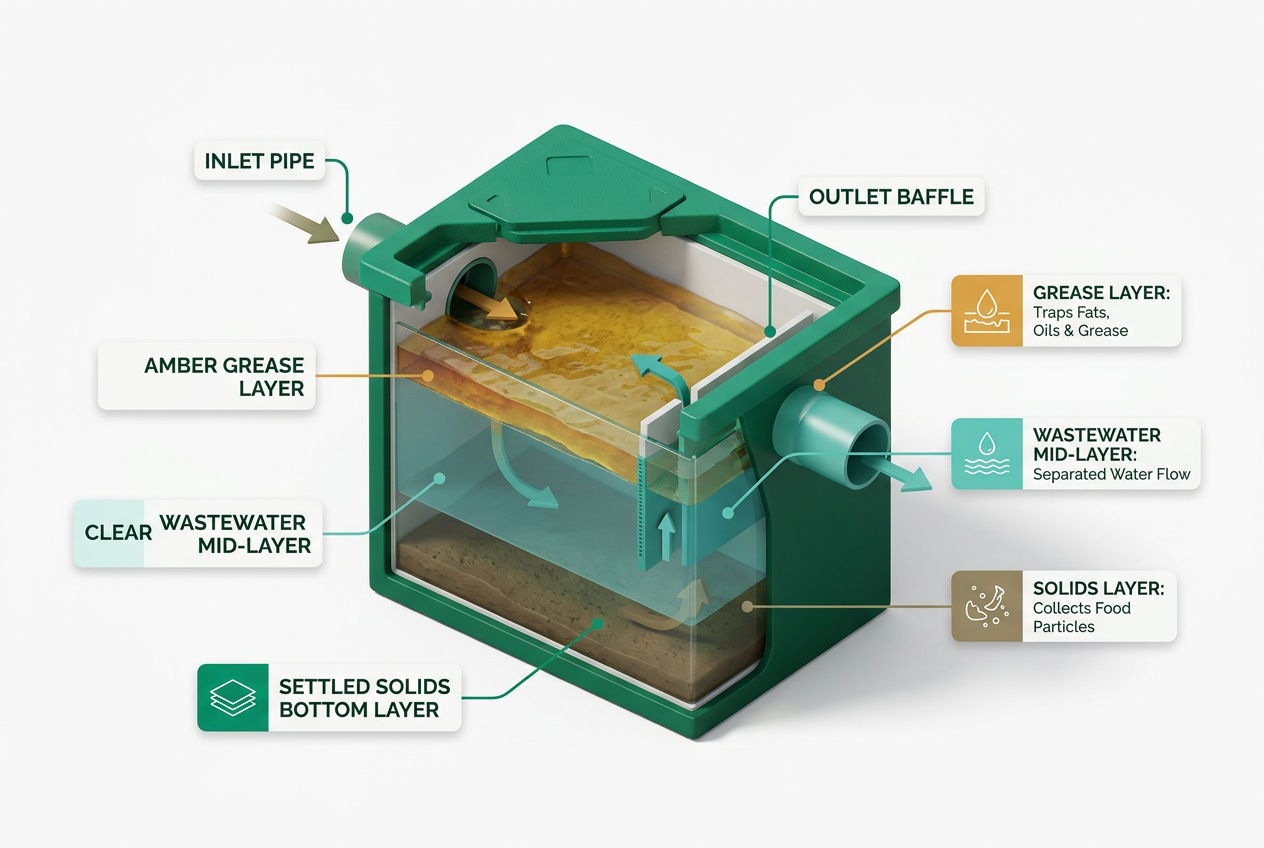
Residential units typically hold 25–50 gallons. Small commercial units run 100–1,000 gallons. Large in-ground grease interceptors serving busy restaurant kitchens can reach 1,000–5,000+ gallons.
For a full breakdown of types and sizing, see our guide on what is a grease trap and how to size a grease trap.
Understanding the difference between a passive trap and an automatic grease removal unit (AGRU) matters here. Passive traps require manual pumping. AGRUs use a heating element and skimming mechanism to remove grease automatically — but even these need weekly checks and manual servicing every 1–3 months.
How Often Should a Grease Trap Be Cleaned?
The industry standard is the "25% rule": pump the trap when the combined depth of grease (floating at the top) and settled solids (sinking to the bottom) equals 25% or more of the trap's total liquid depth. This threshold is written into most municipal FOG ordinances and is widely referenced by the EPA as the trigger point for required service.
In practical terms, that breaks down like this:
- High-volume restaurants (full-service, fast casual, BBQ joints): every 1–3 months
- Lower-volume foodservice (cafés, delis, school cafeterias): every 3–6 months
- Residential units: every 6–12 months, sometimes annually
- AGRUs: daily or weekly skimming cycles, plus a full cleaning every 1–3 months
Seasonality matters too. During the holiday stretch from Thanksgiving through New Year's, restaurant kitchens run harder, and grease volumes spike. Pumping demand from service companies typically surges November through January. If you're a restaurant operator, scheduling a pump-out in mid-November — before the rush — saves you from emergency calls when every truck in town is already booked.
Step-by-Step: How to Maintain a Grease Trap
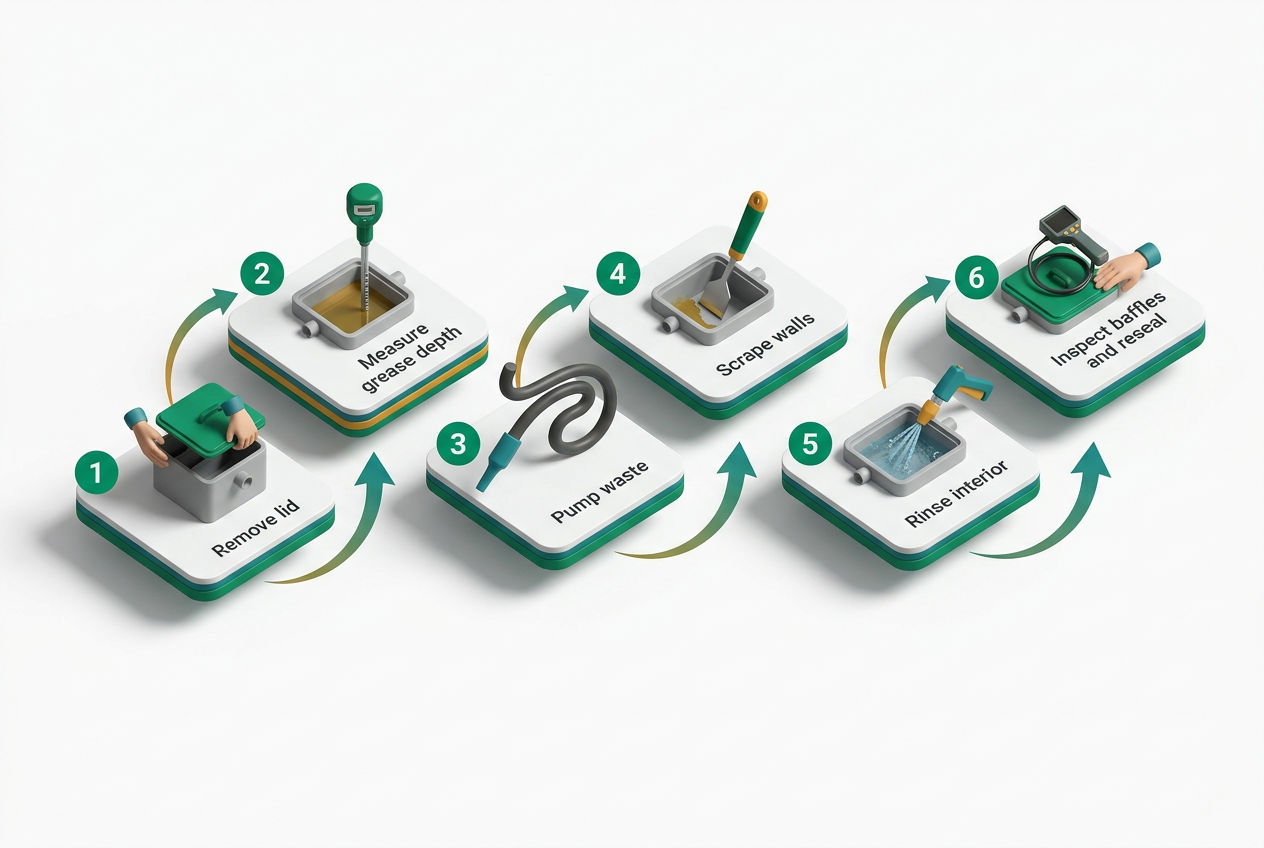
This process applies to a standard passive grease trap. If you have a large in-ground interceptor, steps 1–3 are the same, but the pumping requires a licensed vacuum truck operator. See grease trap pumping for specifics on that service.
Step 1: Gather Your Equipment
Before you lift the lid, have these on hand:
- Rubber gloves (nitrile, not latex — grease destroys latex)
- Safety glasses
- Flat pry bar or lid wrench
- Measuring stick or sludge judge (a clear acrylic tube used to measure layer depths)
- Shop vacuum or grease pump
- Stiff scrub brush
- Plastic scraper
- Heavy-duty waste bags or a sealed collection container rated for FOG waste
- Degreaser (non-enzyme-disrupting formula if the trap uses biological treatment)
Step 2: Remove the Lid
Use the pry bar carefully. In summer, heat expansion can cause lids to stick — especially cast iron frames. Work the bar around the perimeter instead of prying from one spot. You'll get a hit of hydrogen sulfide gas as soon as the lid breaks the seal. That rotten-egg odor is normal, but don't put your face directly over the opening.
Step 3: Measure the Grease and Solids Layers
Lower your measuring stick straight down through the grease cap, through the water column, and to the bottom. Mark the grease layer depth at the top and the solids layer at the bottom. Add those two numbers together. If the combined depth is 25% or more of total liquid depth, you're past due for a pump-out.
Worked example: A 150-gallon trap with 24 inches of total liquid depth needs pumping when grease and solids combined reach 6 inches (24 × 0.25 = 6). If your measuring stick shows 4 inches of floating grease cap and 5 inches of settled solids, your combined depth is 9 inches — 50% of liquid depth, meaning you're running significantly overloaded and immediate service is required. According to the EPA's 2004 Primer for Municipal Wastewater Treatment Systems, allowing accumulation beyond the 25% threshold substantially increases the risk of FOG discharge into the collection system.
Step 4: Pump Out the Contents
For smaller residential traps, a heavy-duty shop vacuum handles the job. For most commercial units, you need a licensed grease trap pumping service with a vacuum truck. They'll pull the entire liquid contents — grease cap, water, and settled solids.
This is not waste you can pour down a drain, dump in the trash, or spread on soil. Grease trap waste (classified as "brown grease") must be transported to approved rendering or waste processing facilities. Illegal dumping fines exceed $25,000 in most jurisdictions, and regulators don't treat it lightly. California and New York in particular require a waste manifest — a documented chain of custody proving the material was properly disposed of.
Step 5: Scrape and Scrub Interior Surfaces
Once pumped, use your plastic scraper to remove the grease film coating the trap walls, baffles, and outlet pipe. Then scrub everything with a stiff brush. You're not trying to sterilize it — a thin biofilm of beneficial bacteria actually helps break down incoming FOG. But thick buildup along the baffle walls restricts flow and speeds up the time before your next pump-out is required.
Step 6: Inspect Key Components
Check the inlet and outlet baffles for cracks or corrosion. These baffles are the functional heart of the trap — a cracked or missing baffle lets grease blow straight through into your drain lines. Also inspect the lid gasket, any flow-control fittings, and the outlet pipe for FOG buildup or blockage.
If you spot a cracked baffle, that's a repair job, not something to defer. A bypassed trap sends raw grease into the sewer, which triggers violations. For commercial operators, check your local requirements — many jurisdictions, including Los Angeles and New York City, mandate that inspections be logged and submitted to the municipal authority.
Step 7: Rinse and Reassemble
Rinse the trap interior with clean water. Do not use hot water — it liquefies grease and pushes it deeper into your drain lines. Cold or lukewarm water only. Reinstall the lid, reseat the gasket, and restore flow.
Step 8: Document the Service
Keep a written or digital log of every maintenance event: date, measured grease depth, solids depth, volume pumped, and the name of the hauling company. Many municipalities — especially California's Bay Area cities, Chicago under the MWRD's FOG program, and NYC's DEP — require this documentation during inspections. No log can mean an automatic violation.
What Happens If You Skip Grease Trap Maintenance?
The short answer: nothing good.
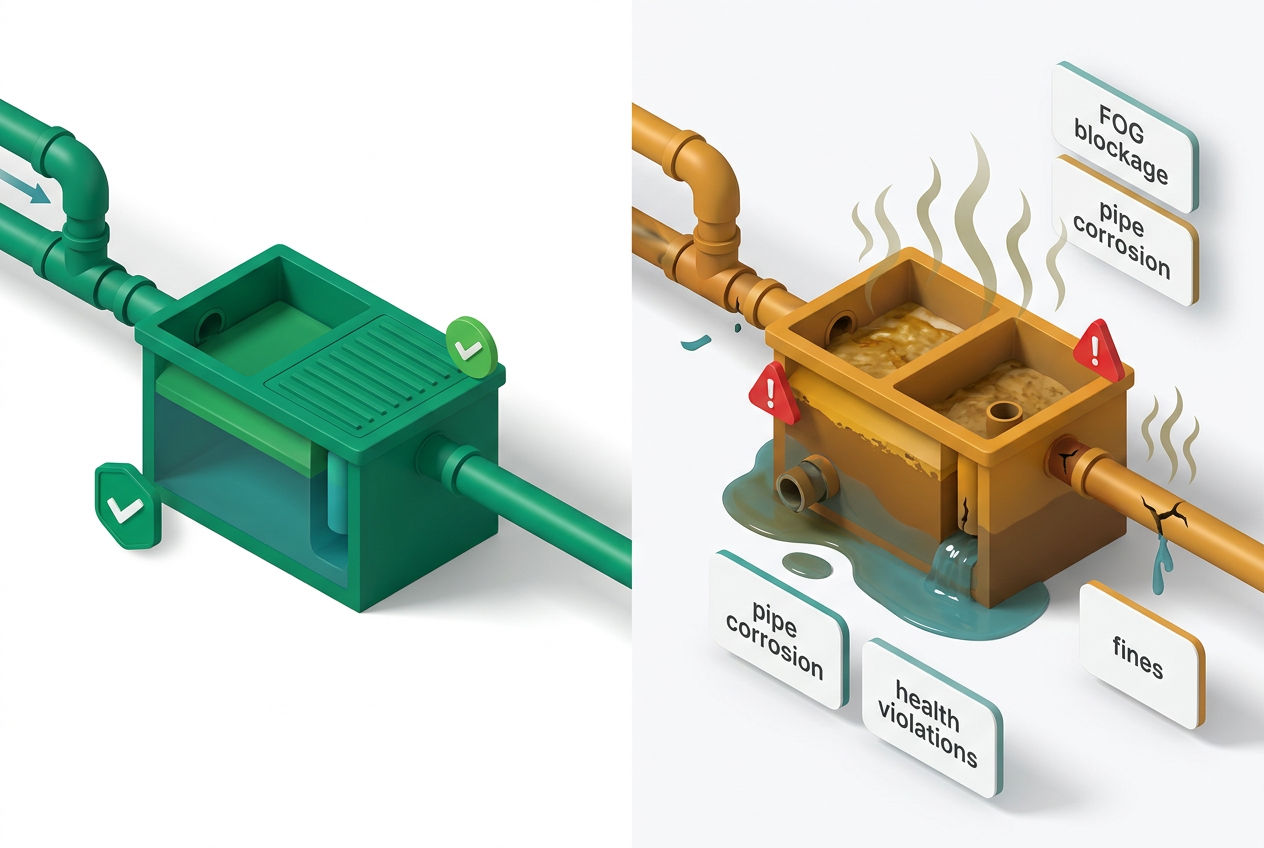
According to the U.S. Environmental Protection Agency, grease blockages account for approximately 47% of the 36,000 sewer overflows that occur annually in the U.S. — a figure the EPA has cited consistently in its collection systems guidance since the early 2000s.
For your business specifically, the consequences stack up fast:
- Sewer backups into your kitchen — a health code nightmare during service
- Grease trap odors penetrating the dining room (slow drains are often the first warning)
- Health department violations and fines ranging from $100 to $10,000+ per incident depending on jurisdiction
- Temporary closure orders — multiple cities have shuttered restaurants specifically for FOG non-compliance
- Sewer line damage that becomes your financial responsibility under most municipal agreements
If you're on a rural property and your grease trap drains to a septic system rather than a municipal sewer, the stakes are even higher. FOG that makes it past a failing trap will coat your drain field's soil pores, causing biomat formation that can render the drain field permanently non-functional. Replacing a drain field runs $3,000–$15,000 depending on size and soil conditions. Regular grease trap maintenance is dramatically cheaper.
Can You Clean Your Own Grease Trap?
For residential under-sink units (typically 25–50 gallons), DIY cleaning is feasible if you're comfortable with the process, have proper waste disposal access, and aren't subject to local regulations requiring licensed service providers.
For commercial kitchens, the honest answer is: probably not, at least not for the full pump-out. Most municipalities require that grease trap waste be hauled by a licensed waste hauler with proper manifesting. You can do the interim scraping, odor control, and minor maintenance between professional visits — but the pump-out itself typically requires a licensed contractor in commercial settings.
Limitation to acknowledge: DIY feasibility varies significantly by jurisdiction. Some counties permit owner-operators to self-haul grease trap waste to approved transfer stations; others prohibit it entirely. Always confirm your local ordinance before attempting a DIY pump-out on a commercial unit — the fine for non-compliant disposal will far exceed the cost of a professional service call.
A word on grease trap additives — enzyme treatments, bacterial cultures, and chemical degreasers marketed as maintenance shortcuts. According to the Water Environment Federation's guidance on FOG management programs, these products may slow grease accumulation at the margins, but they don't eliminate solids and they don't replace physical removal. Some additives actually emulsify grease and push it into the drain system, which violates most municipal FOG ordinances and accelerates downstream blockages. Use them only as a supplement between pump-outs, never as a replacement.
Grease Trap Maintenance Costs: What to Expect

Septic Business Blueprint
Thinking about starting your own septic business?
The complete, plain-English playbook to start (or buy), license and grow a profitable septic business — the models, the money math, trucks, disposal, insurance, pricing and how to land your first customers.
Get the Blueprint — $297 →Instant access · 12-chapter playbook + 6-piece toolkit · 60-day money-back guarantee| Unit Type | Typical Service Interval | Professional Cost Range |
|---|---|---|
| Residential under-sink (25–50 gal) | Annually | $75–$200 |
| Small commercial (100–500 gal) | Every 1–3 months | $150–$500 |
| Mid-size commercial (500–1,500 gal) | Every 1–3 months | $300–$700 |
| Large in-ground interceptor (1,500–5,000+ gal) | Every 1–3 months | $500–$1,500+ |
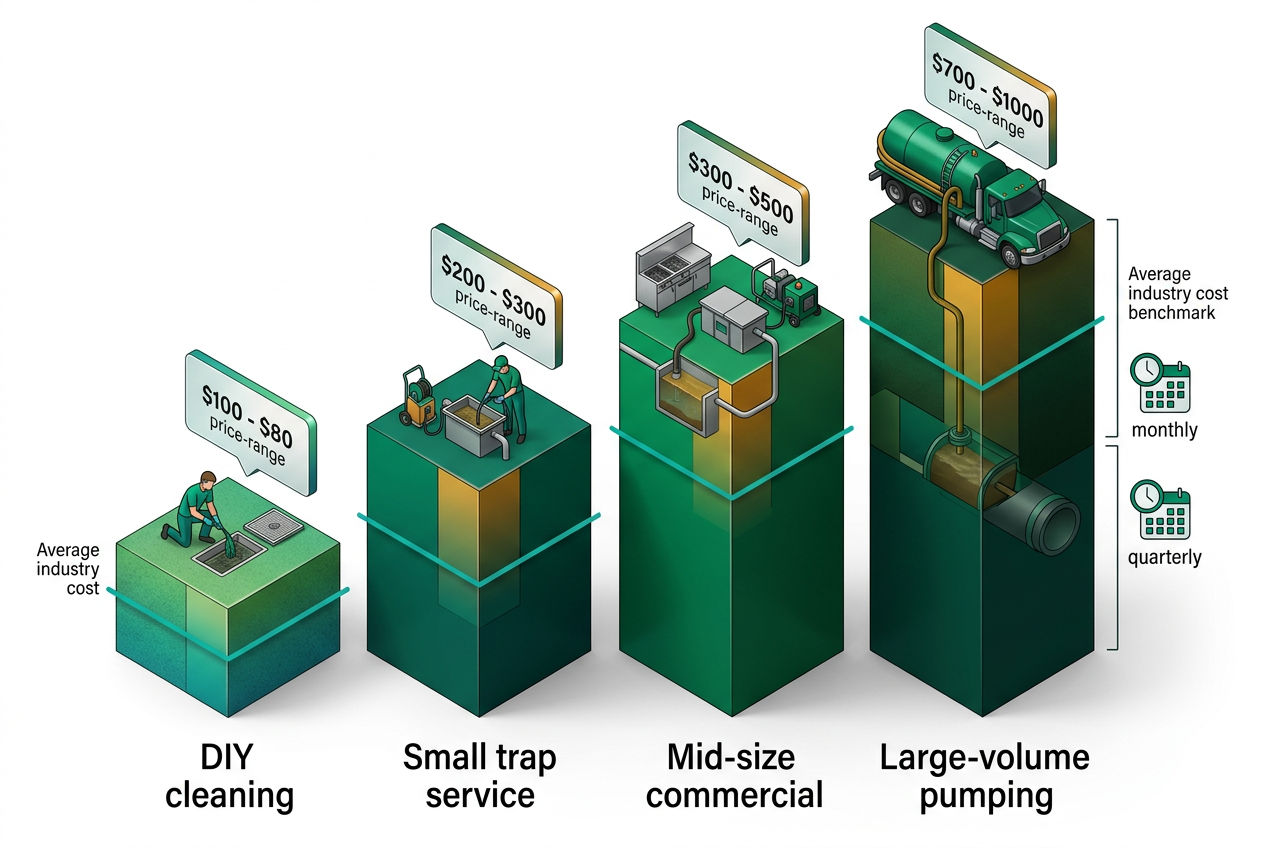
Source: Cost ranges compiled from service pricing data published by the National Association of Sewer Service Companies (NASSCO) member operators and regional FOG program rate disclosures from LA County Sanitation Districts and NYC DEP.
Geography affects pricing significantly. A 500-gallon trap cleaning in a dense urban market like Los Angeles or Chicago might run $400–$600 because of strict waste manifesting requirements and disposal costs. The same job in rural East Texas might cost $200–$350 — but you'd need to verify the hauler is licensed to handle FOG waste under Texas Commission on Environmental Quality rules, which vary considerably by county.
Emergency pump-outs — called during a backup or right before a health inspection — routinely carry a 25–50% premium over standard scheduled service rates. That mid-November scheduling advice isn't just about availability; it's about avoiding emergency pricing.
Is a Grease Trap Connected to a Septic System Treated Differently?
If you own a rural restaurant, food truck commissary, or residential property where the grease trap discharges to a septic system rather than a municipal sewer, your maintenance stakes are meaningfully higher. Municipal sewer systems have some capacity to absorb occasional FOG spikes — rural septic systems do not.
A septic system's anaerobic bacteria struggle with high FOG concentrations. Grease that bypasses a failing trap enters the septic tank, then migrates to the drain field, where it clogs soil pores and causes biomat formation. According to the National Small Flows Clearinghouse, FOG is among the leading causes of premature drain field failure in onsite wastewater systems — and unlike a sewer line blockage, a failed drain field often cannot be rehabilitated. Replacement costs of $3,000–$15,000 are common.
For rural operators, the practical implication is tighter service intervals — consider service every 4–6 weeks for a high-volume kitchen discharging to a septic system, rather than the standard 1–3 months. Watch for signs your drain field may be failing, including slow drains throughout the property, wet spots or lush grass over the drain field area, and sewage odors outdoors.
For more on managing an onsite system connected to kitchen operations, see our septic tank maintenance guide and how often to pump a septic tank.
Protecting your drain field starts at the grease trap. A $300 pump-out every six weeks is a straightforward insurance policy against a $10,000 drain field replacement.
Sources & Methodology
-
U.S. Environmental Protection Agency — Primer for Municipal Wastewater Treatment Systems (EPA 832-R-04-001, 2004). Referenced for the 25% rule standard and FOG sewer overflow statistics. https://www.epa.gov/sites/default/files/2015-09/documents/primer.pdf
-
Water Environment Federation (WEF) — FOG (Fats, Oils and Grease) Control Programs Manual of Practice (2009). Referenced for guidance on grease trap additives and enzyme treatments.
-
National Association of Sewer Service Companies (NASSCO) — Member operator service pricing surveys. Referenced for cost range benchmarks.
-
LA County Sanitation Districts FOG Control Program — Published manifesting requirements and service documentation standards. https://www.lacsd.org
-
National Small Flows Clearinghouse / WVU — Onsite wastewater system guidance on FOG impacts to drain fields. Referenced for septic system FOG failure rates.
Frequently Asked Questions
How do I know when my grease interceptor needs to be pumped?
Your grease interceptor needs pumping when the combined depth of the floating grease cap and the settled solids layer reaches 25% or more of the trap's total liquid depth — a threshold embedded in most municipal FOG ordinances and referenced by the EPA as the standard service trigger. To measure it, lower a sludge judge or measuring stick straight through the grease cap to the bottom of the trap and record both layer depths. Add them together. If the sum equals or exceeds 25% of total liquid depth, service is overdue. For example, a trap with 32 inches of total liquid depth hits the threshold at 8 combined inches. Don't rely on odor or slow drains as your primary indicator — by the time those symptoms appear, you're typically well past the 25% mark and already at risk of FOG discharge into the sewer line.
What is the difference between a grease trap and a grease interceptor?
Grease trap and grease interceptor are often used interchangeably, but they technically refer to different sizes and installation types. A grease trap typically refers to a smaller, passive hydromechanical unit installed under or near a sink — common in residential kitchens and small foodservice operations, usually holding 25–100 gallons. A grease interceptor generally refers to a larger in-ground unit, often 500–5,000+ gallons, installed outside the building to serve a full commercial kitchen. The term "hydromechanical grease interceptor" (HGI) is the formal plumbing code designation for the smaller passive units under ASME A112.14.3 standards. Both work on the same principle — slowing flow so FOG floats and separates — but interceptors handle higher flow rates and require vacuum truck pumping rather than shop-vacuum DIY removal. Local health codes may specify which type is required based on your facility's fixture count and flow rate.
How much does grease trap cleaning cost for a restaurant?
Grease trap cleaning costs for a restaurant typically range from $150 to $700 per service visit for units between 100 and 1,500 gallons, based on pricing data from NASSCO member operators and regional FOG program disclosures. Smaller units (100–500 gallons) generally run $150–$500; mid-size units (500–1,500 gallons) run $300–$700; large in-ground interceptors over 1,500 gallons can exceed $1,000–$1,500 per visit. Urban markets like Los Angeles and Chicago skew higher due to strict waste manifesting requirements and disposal facility costs. Emergency pump-outs — called in during a backup or on short notice before an inspection — typically carry a 25–50% premium over standard scheduled rates. The most cost-effective approach is scheduling service on a fixed calendar interval before the 25% threshold is reached, rather than waiting for a drain slowdown or odor complaint to trigger an emergency call.
Can grease trap additives replace regular pumping?
No — grease trap additives, including enzyme treatments and bacterial cultures, cannot replace regular pumping. According to the Water Environment Federation's FOG management guidance, these products may modestly slow grease accumulation between service visits, but they do not eliminate the settled solids layer and they do not remove the floating grease cap. Physical pump-out is the only way to extract both. More importantly, some chemical degreasers and surfactant-based additives actually emulsify FOG and push it into the drain line in a temporarily liquid state — which violates most municipal FOG ordinances and contributes to downstream sewer blockages. If your jurisdiction's FOG program prohibits chemical additives (Los Angeles County's program, for example, specifically restricts them), using them could itself trigger a compliance violation. Biological bacterial additives are generally considered lower-risk, but still function only as a supplement — not a maintenance replacement.
What happens if a restaurant fails a grease trap inspection?
If a restaurant fails a grease trap inspection, consequences escalate quickly depending on the severity of the violation and the jurisdiction. A first-offense citation for exceeding the 25% FOG threshold typically results in a written notice and a mandatory re-inspection within 30 days, plus a fine ranging from $100 to $500 in most cities. Repeat violations or evidence of active FOG discharge into the sewer system carry fines from $1,000 to $10,000 or more per incident — New York City's DEP and Chicago's MWRD FOG program both publish penalty schedules in this range. The most serious consequence is a temporary operating closure, which multiple cities have issued specifically for FOG non-compliance. Beyond regulatory penalties, a failed trap that causes a sewer backup into your kitchen triggers a health code violation on top of the FOG violation. Maintaining a documented service log is your primary defense — no log during an inspection can itself constitute a automatic violation in many jurisdictions.
How do I find a licensed grease trap pumping service near me?
Finding a licensed grease trap pumping service starts with confirming what your jurisdiction actually requires. Most municipalities require that grease trap waste be hauled by a company licensed as a non-hazardous liquid waste transporter — in California, this falls under CalRecycle and regional water board permits; in Texas, under Texas Commission on Environmental Quality (TCEQ) authorization that varies by county. Start by contacting your local municipal pretreatment or environmental services department, which typically maintains a list of approved haulers. National associations like NASSCO also maintain contractor directories. When evaluating a provider, ask specifically whether they issue a waste manifest documenting that brown grease was transported to an approved rendering or processing facility — this document is required for your service log in California, New York, and many other states, and protects you if disposal practices are ever questioned. Our grease trap cleaning professionals directory lists vetted providers by region. See also our septic pumping cost guide if your system discharges to an onsite septic unit.
Was this article helpful?
Frequently Asked Questions
Recommended Resources
📖 Related Articles
- What Is a Grease Trap? How It Works, Sizing & Rules
- How to Size a Grease Trap (Formula + Chart)
- Grease Trap Pumping: The Complete Guide
- What Is a Septic System? How It Works (Visual Guide)
- Signs Your Drain Field Is Failing (And What to Do)
- The Complete Septic Tank Maintenance Guide
- How Often Should You Pump Your Septic Tank?
💰 Cost Guides
🔧 Services
Find Septic Professionals Near You
Compare licensed, verified septic companies by area — top county markets and cities below, or browse all 50 states.
County markets
Popular cities
